After 15 years of working night shifts, I had finally bought my first home—a place just for me and my children. During the very first week, Mom called: “Your younger brother’s baby shower is going to be held at your house. There are 37 guests coming. You need to take the kids to a motel to stay.” Dad chimed in: “Once it’s over, they’re going to move right in.” I hung up. Come Saturday, a bus full of guests pulled up in front of the house. Upon seeing the scene, Mom screamed.

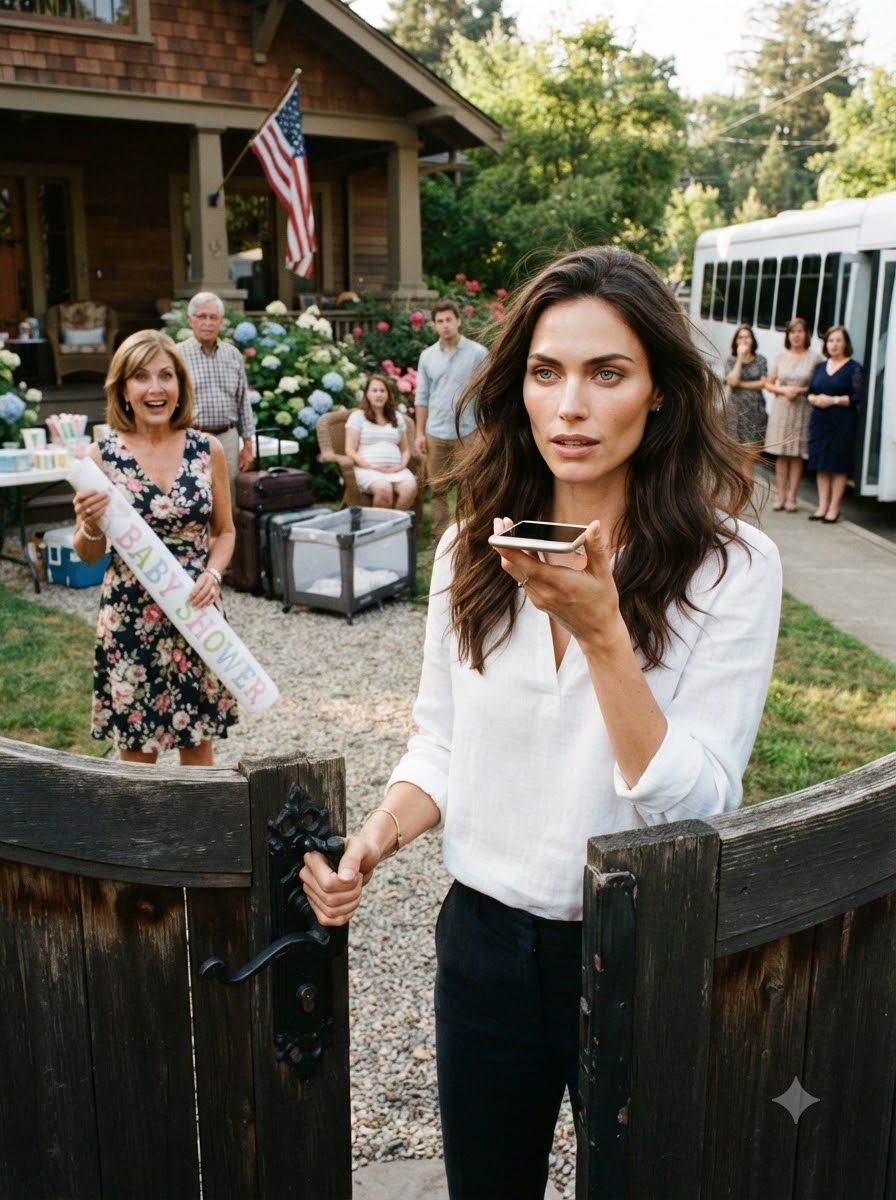
“Your brother’s baby shower is at your place. Thirty-seven guests. Take the kids to a motel.”
My mother said it like a woman who’d already decided I’d say yes.
On speaker, my father added the part they’d been saving.
“Then they’re moving in.”
I stood in the first kitchen I’d ever owned.
Six days in, listening to the two people who should have been proudest of me hand my children the word they’d handed me at 22.
A two-year-old on my hip.
My grandmother’s house sold out from under us.
Motel.
Same word.
Fifteen years of night shifts between them.
I hung up, turned the phone face down, and let the dryer finish its cycle.
I’m Lydia Brandt.
One down payment.
Two kids.
No one else.
Saturday, a party bus came crawling down my street.
My mother took one look at my porch.
Her hand froze on the rail.
And her scream stopped 37 conversations.
Wherever you’re listening from, tell me in the comments and stay, because that scream started 15 years earlier with a Christmas card, a motel ice machine, and a promise an old man kept.
Let me back up to that Tuesday morning before the phone rang.
On the old block south of Garrison Avenue in Fort Smith, the porches sit ten feet off the sidewalk, and every one of them has a chair in it.
So a house here isn’t something you own so much as something the street watches you keep.
Mine was a 1920s Craftsman on South 23rd Street with a porch that needed paint and a yard that needed mowing.
I’d come home from a night shift at the long-term care facility where I’ve worked for 15 years, started a load of scrubs, and put yesterday’s coffee in the microwave.
Six days earlier, the morning I signed the papers, I’d taken one picture.
The keys on their ring held up against the front door.
I posted it with two words:
15 years.
The night crew commented.
Two girls from the old duplex on Grand commented.
My mother, Sharon Brandt, did not comment.
Neither did my father or my brother.
And I told myself that was fine.
That was the first lie I told in that house.
My son Caleb, 16, was already at his summer job bagging groceries at Harps.
My daughter, June, 10, was at the library’s reading program where they give you a sticker for every book.
The house was doing the thing new houses do when they’re empty.
Ticking.
The dryer turned.
The microwave hummed.
Then the phone lit up on the counter.
Mom.
I’d like to tell you I felt nothing.
What I felt was the thing my chest has done since I was 16 years old.
Every time that name shows up.
A lift.
Small and stupid.
The body’s own old hope before the mind can catch it and set it down.
Six days.
A first house.
A picture she had seen.
Some part of me, the part that still clears their table every Christmas, thought:
She’s calling to say congratulations.
I picked up.
“Hi, Mom.”
“Lydia, honey,” my mother said. “We’ve been talking about the house.”
The microwave beeped.
I didn’t open it.
Then she said the thing you’ve already heard.
And she said it the way she says everything.
Fast.
Warm on the outside.
No question marks anywhere.
“Your brother’s baby shower is at your place. Thirty-seven guests. Take the kids to a motel.”
Then the details, like a woman reading a grocery list.
“Saturday. One o’clock. The ladies from church. I’ve already told them.”
Thirty-seven.
The number was already a fact.
I was the last person being informed.
There was a shuffle.
Then my father, Dennis Brandt, came in off the speaker like a man closing a deal he’d closed before.
“Then they’re moving in.”
A beat.
“They can’t bring a baby back to our place. It’s 55 and up. You know that.”
I knew that.
My brother, Kyle Brandt, and his fiancée, Brooke Hensley, had been on my parents’ couch since April.
My mother came back on, already furnishing.
“Kyle and Brooke take Caleb’s room. Caleb can bunk with June. He’s at that grocery store all summer anyway. You sleep days. You won’t even notice.”
I didn’t say no.
I didn’t say anything.
There’s a kind of quiet you learn on night shift when a family’s shouting at you in a hallway and the right move is to let them finish.
Except I didn’t let them finish.
I pressed the red circle.
The call ended.
The dryer kept turning like none of this was its business.
My hands were steady.
Night-shift hands.
My jaw was the thing that gave me away.
A click I could hear from the inside.
I turned the phone face down.
First thing in that house I’d put exactly where it belonged.
The word stayed in the kitchen after the call did.
Motel.
It has a sound inside it for me.
A mechanical one.
And I’ll explain that when we get there.
I walked the house.
Front room.
Hallway.
The two bedrooms the kids had fought over.
The small one at the back I’d taken for myself.
I wasn’t looking at anything.
I was reading my parents the way you read a chart.
Not what the patient says.
What the numbers say.
The numbers said this.
My brother and his fiancée had been living on my parents’ couch for two months in a community that does not allow residents under 55.
The homeowners association had already sent one letter about two adults who weren’t supposed to be there.
Kyle had made a joke of it in the family group text.
A newborn would be the second letter.
And my parents do not get second letters.
So they needed a house.
And here was one, six days old, owned by the daughter who works nights and sleeps days and, in their arithmetic, is never home.
A yard with a roof on it.
The shower wasn’t about a venue.
The shower was the cover.
Thirty-seven women from church delivered to my front door on a bus would walk away believing they’d been to a family party at the family’s house.
And after that, who moves out of the family’s house?
Even the bus made sense once I thought about parking.
There’s nowhere on South 23rd to put 37 cars.
And my mother likes an arrival.
Here’s the thing I understood.
Standing in my own house, I grew up in a family where my brother’s needs were weather.
You planned around them.
Mine were requests.
And requests can be denied.
I was hurt.
I wasn’t confused.
Those are different rooms.
And I’d stopped getting them mixed up years ago.
I had my reasons for this street.
I opened the hall closet and looked up.
On the top shelf was a box I hadn’t opened in 15 years.
I left the box where it was.
The year I was 15, my parents moved me across town and called it helping my grandmother.
Dorothy Brandt was my father’s mother.
A widow by then.
A woman who had taught the same Sunday school class at the same Baptist church for 40 years and could silence a room of grown men by setting down a spoon.
She did not need help.
What my parents needed was a bedroom and a calendar.
My brother was six years old and already playing travel baseball.
And travel baseball eats weekends.
And I was the easy child.
The one who could be carried somewhere and set down.
So they carried me there.
I’m not going to pretend it was a tragedy.
It was the best thing that ever happened to me.
And they did it by accident.
My grandmother’s house had a white porch, a wicker chair, and two rose bushes by the mailbox that she talked to in the mornings.
The two by the mailbox were her favorites.
She told me that every spring like it was news.
I was 20 when I found out I was pregnant.
The father was Eli Marsh, who drove long haul and loved me the way a man loves you when he’s home four days a month.
Completely.
And not enough.
My mother’s whole response fit in four words.
“Not in our house.”
My grandmother’s response was to set another plate.
“Then she’ll have it in mine.”
That Easter, with the ham on the table and my father carving, she said the thing out loud so there would be witnesses.
“This house is for Lydia and the baby.”
She looked down the table at her son.
“Dennis, you heard me.”
My father kept carving.
“Mama, let’s not do this at the table.”
“Dennis, you heard me.”
He said he had.
That turned out to be the problem.
He’d heard it.
Everyone at that table had heard it.
And the ham got eaten anyway.
That August, my son was born and came home to the white porch.
My grandmother had him for a year and a half.
Then her heart did what hearts do.
She died in her own bed in six days with the window open because she wanted to hear the street.
I was the one in the chair.
I was the one who called the funeral home before daylight and found out I already knew how to make a call like that without my voice doing anything.
The will left everything to her son.
She trusted him.
She’d said so.
Four months after the funeral, the house was sold.
A widower from across the river bought it.
My father told the church.
Told everyone.
Told my 13-year-old brother that it had to be sold to cover Mama’s care.
There had been no care.
There had been six days and an open window.
The money went where my parents’ money always went.
Kyle’s baseball.
The academy in Tulsa.
The travel teams.
The private coach who charged by the hour.
And some of it went into the hole under my father’s truck lot, which was always a hole.
I found out standing in my grandmother’s kitchen with boxes on the counter.
My father didn’t look up from the tape gun.
“Take the baby and find a place.”
My mother, practical, supplied the address.
“There’s a motel on Talson. Weekly rate.”
I asked one question.
I want you to notice that it was one.
“She told you. She wrote it down.”
“Your grandmother wrote a lot of things,” my father said.
The weekly-rate inn on Talson Avenue, room 114, had an ice machine outside the door that cycled all night.
A sound like something clearing its throat.
I filled out a night-shift application on the bedspread with Caleb asleep against my leg.
The pen went through the paper twice.
I used tape.
That fall, a legal aid lawyer read what she’d written kindly.
A Christmas card signed Grandma, he said, against a will signed Dorothy Brandt.
A fight I couldn’t afford.
I put the card in a box.
Caleb learned to sleep to an ice machine.
I learned not to ask.
The application got me the night shift as an aide.
Base pay.
The shift nobody wants.
I wanted it.
Nights meant I could be awake when Caleb was awake.
And nobody at a nursing home at three in the morning asks you where your family is.
Fifteen years told fast:
Aide.
Then licensed nurse.
Then the one who runs the floor at night.
The one families call when their mother is dying at two in the morning and they want a voice that doesn’t shake.
Two rented apartments.
Eli came off the road long enough to be a father for five years.
And my daughter was born in a duplex on Grand Avenue.
Then an 18-wheeler on Interstate 40 took him when June was two.
And it has been just me and my kids since.
Which is the only part of this I’ve ever said out loud without flinching.
Every Christmas, I sat at my parents’ table.
I cleared it too.
I never asked them for anything again.
Not a dollar.
Not a ride.
Not a kind word.
I’d like to tell you that was strength.
Some of it was just arithmetic.
Then, six days before the call, I bought a house.
And I posted the keys where they could see them.
I told myself it was for Caleb.
Fifteen years is 5,400 nights, give or take.
My mother needed six days to decide they were hers.
The notebook came out that same night before my shift.
It’s a habit.
Not a strategy.
Fifteen years of charting teaches your hand to write things down the minute they happen.
Time.
Words.
Who was present.
Because memory is a liar and a chart is not.
So I wrote the call.
A few minutes after nine:
Mother. Shower Saturday. 37. Motel. Caleb’s room. Father on speaker. Moving in.
I didn’t editorialize.
A chart doesn’t.
Then the voicemails started.
I let them.
Wednesday’s came while I was asleep.
I listened to it on the way to work with my thumb over the delete button and did not press it.
“It’s one night in a motel, Lydia. You’ve lived in one. The kids will be fine.”
Her voice was doing the thing where it sounds like patience.
Thursday’s came in the evening.
“It’s Mother’s neighborhood anyway. Kyle says some little place down the block from hers, I imagine. You should be glad a Brandt baby’s coming home there.”
Mother’s neighborhood.
She wasn’t wrong about the street.
In between, there were calls with no message.
Eight of them in three days.
Each one a little closer to the last.
The way a woman knocks when she’s used to doors opening.
And one text from my brother.
Lowercase.
No question in it anywhere.
thanks for doing this sis. means a lot to brooke.
I didn’t answer that either.
I wrote it in the notebook.
And under it, because the hand does what the hand does, I wrote the words:
A Brandt baby.
And next to those, I wrote my children’s full names.
Caleb Brandt.
June Brandt.
Eli and I never made it to a courthouse.
They have my name.
Here is what the chart told me, laid out plain.
They expected me to be asleep on Saturday the way I’m asleep every day.
They expected a yard.
They expected the thing they’d always gotten from me.
Which was nothing.
No fight.
No scene.
No word.
I didn’t delete a single one.
I’d need them in her voice.
Not mine.
The notebook was still open on the counter when Caleb came in from Harps that evening.
Apron still on.
Which is how I knew he’d rehearsed something in the car.
“I need to tell you a thing, and you’re gonna be mad.”
“Okay.”
“Uncle Kyle texted me yesterday. He wanted the address for a housewarming card.”
He pulled the apron strings loose and didn’t take it off.
“I sent it. Just the number on South 23rd. I didn’t think—”
“What else did he say?”
He looked at the floor.
“He said you weren’t answering anybody. And Grandma Sharon said to get it from me.”
There it was.
My brother had wanted the address and had not wanted to ask me for it.
Because asking me would have meant hearing an answer.
And he’s always preferred the version where there isn’t one.
So he went through my son.
“It’s fine,” I said.
Caleb’s head came up.
He’s 16.
He knows my voice better than I do.
“Why is it fine?”
“Because they’re coming anyway. Now I know how.”
I pulled the apron over his head for him the way I did when he was six.
“Sit. Eat something.”
He sat.
He didn’t eat.
“Are we going to a motel?”
“No.”
“Then where are we going?”
“Nowhere. We live here.”
He nodded slowly.
And I watched him decide to believe me.
Which is a thing you can watch a 16-year-old do.
“It’s fine,” I said.
And for the first time that week, I meant something by it.
Friday morning, after my last shift before the bus, with We live here still the last thing I’d promised my son, I made three calls.
Two I’ll tell you now.
The first was to the police department’s non-emergency line.
The number you call when nothing is on fire yet.
I told the officer who answered that 37 people I had not invited would be arriving at my home on Saturday afternoon on a bus.
And I asked him one thing.
“The word I need, and who do I say it to?”
He was patient about it.
He said it was my property and I could refuse anyone entry.
He said if they wouldn’t leave, I could call and an officer would come out and write what’s called a trespass warning.
A piece of paper that says:
Come back and you can be arrested.
I asked whether a car could drive by around one.
He said he’d note it.
The second call was to work.
To give away my Saturday night.
I’d be awake.
I wanted to be.
The third call was to a man in Tulsa who owed me nothing.
I want to be clear about something because you’ll wonder.
I didn’t invite the church.
My mother did.
I just didn’t stop her.
Her Friday voicemail came as I was getting into bed.
“We’ll be there at one. Don’t embarrass your brother in front of the church.”
I wrote it down.
Then I got up again and opened the hall closet.
The box held the things I’d taken from my grandmother’s house 15 years ago.
Which fit in a box.
On top was the Christmas card.
The kind with a cardinal on it.
And inside, in my grandmother’s handwriting, green ink, two lines.
I’ll read them to you when I read them to my brother.
I didn’t sleep before the bus.
My eyes had sand in them by the time the tea was made.
June and I made it together because I told her a guest was coming.
And a little before one, a silver Buick pulled up at the curb.
A woman my age helped an old man out of the passenger side.
“June, this is Mr. Fenwick.”
“Are you the party?”
“No, sweetheart,” said Walt Fenwick. “I’m the one who came before it.”
“Mom,” Caleb said from the window. “There’s a bus.”
It’s going slow.
It was going slow because my father was reading house numbers through the windshield.
I could see him from the porch.
Front seat.
Leaning forward.
Lips moving.
Behind the driver, my mother sat with a roll of banner across her lap.
The bus was white.
The long kind with tinted windows.
And it crept down South 23rd past three porches, three chairs, three neighbors who had stopped pretending not to look.
It stopped at mine.
Through the glass:
A white porch.
A wicker chair.
And by the mailbox in full June bloom, two rose bushes an old woman used to talk to in the mornings.
My mother took one look.
Her hand went to the rail by the door.
And froze there.
Then she screamed.
It wasn’t a word.
It had a word inside it, though.
And the word was Mother’s.
Thirty-seven heads turned to the windows.
The driver’s hand came off the wheel.
I’ll say it plainly since she couldn’t.
It was my grandmother’s house.
The one they sold.
She was screaming at a porch she’d emptied with her own hands 15 years ago.
Her hands stayed on the rail.
Nobody moved to help her down because 37 women were busy looking at my porch.
Then at each other.
I didn’t hear what they said through the glass.
I heard it later from one of them.
And I could see it happen anyway.
A murmur that started at the front and went down the aisle like a draft.
“That’s Dorothy’s place.”
“That’s the Brandt house.”
Those women were my grandmother’s Sunday school class.
Some of them had sat in her living room.
One of them had brought the ham that Easter.
My father had gone the color of the dashboard.
He’d seen the number.
Now, you’ll want to know how three grown adults rode a bus to a house none of them had looked at.
So here’s how.
Kyle booked the bus.
He’d been 13 the last time he set foot on this porch.
And 13-year-olds don’t learn their grandmother’s house number.
They learn the way there.
My mother had the street and a picture in her head of what I could afford.
And she has never once looked at anything of mine long enough to check.
On Friday, my father had offered to drive over and see the yard.
She told him she wasn’t driving across town to look at a yard.
The street was enough to make them feel entitled.
It was not enough to make them afraid.
Halfway back, my brother stood up into the aisle.
“What’s going on? Why’d we stop?”
Next to him, Brooke, eight months along, put her hand on her belly the way you do when a room changes temperature.
Behind me, through the screen door:
“Mom?”
“Stay behind me, bud. You’re fine.”
I want to be accurate about this because it matters to me.
I didn’t plan the scream.
I planned the porch.
The scream was hers.
Kyle asked the whole bus:
“What’s wrong with it?”
Nobody told him.
In my kitchen, an old man was finishing his iced tea with my daughter like none of this was happening.
He’d ridden two hours to be here.
And he hadn’t come for the party.
Out at the curb, the bus door folded open with a hiss.
My mother came down the steps the way she comes down church steps.
One hand on the rail.
Chin first.
Heels.
She’d worn heels for a yard party.
They hit the sidewalk.
She’d walked a thousand times to my grandmother’s door.
And she stood on it.
And she looked at the house number.
The porch.
Then at me.
The first words between us since I’d hung up on her.
“Lydia, what did you do?”
Not a question.
My mother doesn’t ask them.
“I bought a house, Mom. You called me about it Tuesday.”
My father came down behind her and stopped one step up.
Which is where he stood his whole life.
The driver cut the engine.
For a second, there was nothing on South 23rd but cicadas and the tick of a bus cooling down.
And my mother’s hand, still on that rail, not letting go of it.
Behind her, 37 women began very quietly to get off the bus.
They came down in twos.
Holding each other’s elbows.
And gathered on the sidewalk.
The way a congregation gathers after a service when something has happened in the sermon.
My mother let go of the rail.
I watched her do the math.
It took her about four seconds.
Then she turned to face them with the banner roll in her hands and the voice she uses for announcements.
“Well, isn’t this something?”
A laugh.
Bright.
Nothing under it.
“Lydia’s gone and brought Mother’s house back into the family. That’s all this is, ladies. We’re home.”
She lifted the banner a little.
Like evidence.
“A Brandt baby coming home to Dorothy’s house. You couldn’t ask for better.”
My father took his cue.
He went to the driver and had him pop the luggage bay.
Out came the folding tables.
Two of them.
A cooler with a sheet cake in it.
And a box of paper plates.
As if the question of whether the party was happening had been settled by the existence of plates.
At the back of the bay, behind the plates, sat three suitcases and a Pack ‘n Play still in its box.
Nobody packs a crib for a shower.
Then, lower to the two women nearest her, with a hand on one of their arms:
“Lydia’s had a hard road since Eli, you know. Nights. She’s not herself. We’ll just set up in the yard. She’ll come around.”
Every word of it placed like silverware.
She was good.
I’d forgotten how good.
The women didn’t move toward the gate.
They looked at the roses.
One of them, a small woman with a cane, whom I’d known as Miss Alma since I was 15, had sat in my grandmother’s living room every week for 30 years.
She looked at my mother and said carefully:
“Did she invite us, Sharon?”
“You don’t invite family,” my mother said.
And reached for my gate latch.
My hand got to the latch before hers did.
From the inside.
I didn’t hold it shut.
I just rested my hand on it the way you rest a hand on a patient’s shoulder to let them know where you are.
Then I said the first thing I’d ever said back to my family in public.
“Nobody’s coming home here but the people who live here.”
“Lydia, don’t be dramatic. There’s a baby coming.”
“I know. I’m a nurse.”
I looked past her at my brother, still on the bus steps.
Then at Brooke.
“The baby will have a home. It isn’t this one.”
Then I turned to the women on the sidewalk.
Because they were the ones my mother had brought to see this.
And I said it to them plainly.
The way I’d tell a family at the nurses’ station what the doctor had actually said.
“Nobody on this bus was invited. Not by me.”
Nobody answered.
I didn’t look back at the screen door where I knew my son was standing.
You don’t look back at your own child in a moment like that.
It tells the other side where to aim.
I hadn’t raised my voice.
I didn’t need to.
The street was already listening.
Not by me.
The words hung over the sidewalk for exactly as long as it took my father to get through the women with the cooler in his hands.
He set it down on the sidewalk so he’d have his hands free.
“After everything we did for you—”
His voice found its size.
“We put you with Mother so you’d have a roof. We kept you at our table every Christmas. We sold Mother’s house to pay her care. And we still—”
He said it in front of them.
The sentence he’d been telling that church for 15 years.
Delivered to the women who’d known my grandmother best.
Standing on her sidewalk.
I watched it land.
I watched my brother on the bus steps nod along with it because he’d never heard any other version.
My mother stepped in beside my father.
And they did the thing they do where they stand close enough that you can’t answer one without answering both.
“Your brother’s fiancée is eight months along, Lydia. On our couch. You would do this to a baby.”
I didn’t answer that.
There’s no answer to a question built like that.
It isn’t a question.
It’s a trap with a child in it.
My brother came down the steps then, with Brooke behind him holding the rail with both hands.
He came to the fence.
Up close, he looked like what he is.
Twenty-eight.
Tired.
A man who spent two months on a couch.
He kept his voice down.
“Did you say yes? Mom said you offered.”
“Ask her.”
He turned his head.
“Mom, did she offer?”
My mother gave him the face she uses on waiters.
“We discussed it,” my mother said.
Kyle looked at me.
I took out my phone.
Before I could do anything with it, Brooke put her hand on the top of my fence.
She’s 26.
She had the look a woman gets at eight months where the body is running the whole operation and the face is just along for it.
And she looked at me.
Not at my mother.
Not at Kyle.
“I didn’t know,” she said. “He said you said yes. I wouldn’t have—”
“I know.”
I said:
“Nobody asked you either.”
Something went across her face then.
Quick.
The recognition of one person who hasn’t been asked by another one.
I opened the gate.
Not wide.
Enough for one.
“Porch. It’s 90 degrees out here. Sit.”
“You’ll let her in?”
My mother’s voice went up a register.
“Her. But not—”
“A guest I asked can sit.”
Brooke came through.
She didn’t look at my mother on the way past.
Which I noticed.
And so did the women.
She climbed the two steps and lowered herself into the wicker chair the way you lower a full cup.
Then she took out her own phone.
I saw her thumb move.
I found out later it was to her mother in Greenwood.
Three words.
Come get me.
Brooke sat down on my porch.
That was her answer.
And my mother heard it.
My thumb was already on the first voicemail.
I held the phone up at shoulder height, the way you hold something up at a nurses’ station so the whole room can hear the order.
Then I turned the speaker on.
And I let my mother talk to her own church.
“It’s one night in a motel, Lydia. You’ve lived in one. The kids will be fine.”
Her voice came out of the speaker doing the patient thing.
Warm.
Tired.
Reasonable.
And it hung there over the sidewalk.
Nobody breathed.
Every woman on that sidewalk knew the weekly-rate inn.
Half the churches in Fort Smith run a food drive through that parking lot at Christmas.
They’d stood out there with casseroles.
Some of them had probably handed one to me.
Miss Alma spoke first.
One word.
“Sharon.”
Not a question.
Not loud.
The way you say the name of someone who’s just dropped something in church.
My mother’s mouth opened.
Shut.
“That’s—that was out of context. That’s private.”
“It’s your voice,” I said. “There’s more.”
My mother’s hand went to her throat.
Her hand stayed at her throat while I found Thursday’s.
“It’s Mother’s neighborhood anyway. Kyle says some little place down the block from hers, I imagine. You should be glad a Brandt baby’s coming home there.”
I let it finish.
Then I lowered the phone to my side and looked at the women.
Because the voicemail had done its work.
And the rest was mine.
“She wasn’t wrong about the street.”
Some of them laughed one short breath.
The kind that gets out before you can stop it.
Then were ashamed of it.
Then weren’t.
“I’ll tell you what this house is since you’ve been told what it is by somebody else.”
I kept my voice where I keep it at three in the morning.
“I bought it in May with 15 years of night shifts. There’s a savings account at the credit union with the name of this street on it, and it’s empty now because this is where it went.
“My son learned to sleep in room 114 of the weekly-rate inn with an ice machine outside the door.
“My daughter was born in a rented duplex on Grand Avenue.
“My children’s last name is Brandt.”
I let that one sit.
“A Brandt baby is coming home here. Two already did.”
Miss Alma had both hands on her cane.
She was looking at the roses.
And she said it to the roses.
Which is how I knew it was true.
“Dorothy told us the house was for you.”
Her voice was small.
Old.
Very clear.
“We all knew it. We thought—”
“Mother was confused at the end,” my mother said.
My father looked at the ground.
My father had been telling that story for 15 years.
He was about to tell it one more time to the one person who had never thought to ask him a question about it.
Stay with me for that.
And if this is your first time here, subscribe so the next one finds you.
My father stopped looking at the ground when he found something to do with his voice.
Which was raise it.
“We sold that house to pay for Mother’s care.”
Loud now.
To the sidewalk.
To the porches across the street.
“You think that was free? Hospice. Medications. All of it. We had nothing. Nothing. And we still kept this family together.”
“There was no care to pay for,” I said.
I said it the way I’d read a lab result.
Flat.
Correct.
“She died at home in her own bed in six days with the window open. I was the one in the chair. I was the one who called the funeral home before daylight.”
I looked at the women.
“Half of you were at the funeral. You know how long it was.”
They knew.
I watched three of them nod without meaning to.
“There were bills,” my father started.
“Dennis.”
My mother’s voice.
Low.
Not a defense.
A warning.
Then my brother, who had come up to the fence beside my father and had not said a word since Mom said we discussed it, asked the first question I have ever heard him ask our father.
“Dad.”
He didn’t raise his voice.
He didn’t have to.
His was the only new one.
“Where did the house money go?”
“To this family.”
“Where?”
Nothing.
My father looked at my mother.
My mother looked at the banner in her hands.
Across the street, a screen door banged.
Somebody’s radio was playing.
The cicadas kept doing what cicadas do.
Kyle said:
“Where?”
A second time.
Quieter.
Nobody on the sidewalk answered him.
The silence after he asked it the second time was the kind I’d been waiting for since Tuesday.
And I had something for it in my back pocket.
The card had been there all morning.
The cardinal on the front had gone soft at the corners from 15 years in a box.
I took it out.
I did not open it.
I did not hold it up for the women.
And I did not hand it to my father, who had, after all, already been told what was in it by the woman who wrote it at her own table.
I reached over the gate and gave it to my brother.
“She wrote this to me the Christmas before she died,” I said.
Only to him.
“Read it out loud or don’t. It’s yours to decide.”
“Kyle, don’t.”
My mother’s hand came out.
“Son.”
My father’s voice.
The one from the truck lot.
Kyle looked at the card in his hand.
He turned it over once.
The way you’d turn over something that might be alive.
Then he looked at our mother.
And I saw him understand that she was not telling him not to read it because of what it would do to me.
Kyle opened the card.
I watched him read two lines twice.
He read it the second time out loud.
His voice wasn’t steady.
The paper was green ink.
My grandmother’s slant.
The hand that had written 40 years of Sunday school lessons on a chalkboard.
Two lines on a card with a cardinal on it.
And he read them slowly into a street that had gone quiet enough to hear the paper.
“The house is for you and the baby. I told your father.”
And under it, one word.
Grandma.
Nobody moved.
Kyle looked up.
Not at me.
At our father.
“You told me it was for her care.”
“It was for this family.”
My father didn’t say it so much as throw it.
Loud enough for the porches.
“Dennis,” my mother said.
“The academy.”
My brother’s voice cracked on it.
“Tulsa. That was—”
“You think that was free?”
Miss Alma sat down on the bus.
“It was for this family,” my father said.
To a street that had just learned what the word cost.
The word was still in the air when my mother turned on my father.
And I understood that I could have gone inside and made a sandwich and the rest of it would have happened without me.
“I told you to sell it quiet.”
Low.
Fast.
Furious.
Not at what he’d done.
At where he’d said it.
“I told you. You had to stand up in front of the whole church and say it was for her care.”
“You wanted the academy more than I did, Sharon.”
“Don’t you dare.”
“You drove him to Tulsa every—”
“Don’t you dare put that on me in front of—”
They’d forgotten the sidewalk.
That’s what 15 years of a story does when it finally breaks.
The people who built it stop performing it and start fighting over who holds the pieces.
The banner had come half unrolled in my mother’s fist.
I could read it from the gate.
WELCOME, BABY BRANDT.
“You let her go to a motel.”
My brother.
Quiet.
“With Caleb. He was two. And you let me think—”
My mother turned on him then because it was the only direction she had left.
And she did what she does when cornered.
Which is reach past the person in front of her for me.
“She never asked for help, Kyle. Not once. She’s always been like this. Proud. She’d rather—”
“I asked once,” I said from the gate.
Not loud.
“In that kitchen with the boxes on the counter. Dad said Grandma wrote a lot of things.”
My father flinched.
A small thing.
A man remembering a tape gun.
The banner slid out of my mother’s hand and dragged on the sidewalk.
One of the women bent and picked it up.
Didn’t hand it back to her.
Laid it on the bus steps.
Nobody picked it up again.
The banner lay where it was when the screen door opened on its spring behind me.
And the old man from my kitchen came out onto the porch with my daughter behind him, holding the tea pitcher like a thing she’d been put in charge of.
He didn’t hurry.
He put one hand on the porch rail.
Looked down at the sidewalk the way a man looks at a field he used to own.
“Name’s Walt Fenwick.”
To all of them.
Flat.
“I bought this house from Dennis 15 years ago.”
A nod at my father.
Who did not nod back.
“That Christmas, this girl walked up from Talson Avenue with a baby in a stroller and asked me for two rose cuttings and one favor.”
He pointed.
Not at me.
At the mailbox.
“She asked me to call her first if I ever sold.”
Fifteen years.
He let that sit.
“I called.”
Then he looked at my mother.
And I don’t think he’d planned the next part because his voice changed.
“She never asked me to keep the roses. I kept them anyway. Nobody from your family ever came by to ask about anything.”
I had to look at the roses.
Because I couldn’t look at him.
June, who is 10 and does not yet know what a pause is for, said into it:
“He kept Grandma Dorothy’s roses for Mom.”
Miss Alma, from the bus step:
“Dorothy’s roses.”
Just that.
Two words.
But the sidewalk changed when she said them.
I watched it happen.
Thirty-seven women who had come to a shower turning, one at a time, into people standing in front of Dorothy Brandt’s house.
Where Dorothy’s granddaughter lived.
With Dorothy’s roses by the mailbox.
And a stranger on the porch who had kept them alive for a girl with a stroller.
You could see them rearrange it.
Whose side of the fence they were on.
Brooke, in the wicker chair, had her hand over her mouth.
“Fifteen years,” Walt said. “I called.”
He sat down on the top step like that was all there was to it.
It wasn’t all of it.
That first Christmas, he’d gone inside and come back with his dead wife’s pruning shears.
“Take the two by the mailbox,” he’d said. “They were her favorites, I’m told.”
When I asked him to call me first, he looked at me for a long time.
“You’ll have to be first, then.”
The cuttings died in the motel.
I never asked for more.
For 15 Christmases, I drove past that porch and didn’t knock.
Then one morning this past January, at the end of a shift, my phone buzzed on the med cart.
A voice I hadn’t heard in 15 years.
“Lydia, it’s Walt. I’m going to my daughter’s in Tulsa. You said first.”
I had to set the phone down on the cart and put both hands flat beside it before I could answer.
He didn’t give me the house.
He gave me first.
I paid what it was worth.
Every dollar in that account with this street’s name on it.
And we closed at the end of May.
I told you I had my reasons for this street.
That was the only one.
My brother was still holding the card when he turned to face our parents.
And I saw him put it in his shirt pocket first.
Over his heart.
The way you put away a thing you don’t intend to give back.
“We’re not moving in here.”
“Kyle.”
My mother came toward him.
“Kyle, this is your grandmother’s house. This is where you—”
“It’s Lydia’s house,” he said to her face. “It was always supposed to be.”
My mother stopped walking.
“And we’re not staying at yours either.”
A breath.
“We’ll figure it out.”
On the porch, Brooke’s phone buzzed against the arm of the chair.
She looked at it.
Then at Kyle.
Nodded once.
Her mother was coming.
Kyle turned to me then.
And whatever he’d been about to say had been building for two months on a couch.
I didn’t let him say it.
“Lyd—”
“Not today, Kyle.”
I tipped my head toward the porch.
Toward Brooke.
“Take care of her.”
He closed his mouth.
He nodded.
It’s the most honest thing he’s ever done in front of me.
And I’ll give it to him.
My mother turned around then and found the bus half empty and the sidewalk full.
Half of her church had gone back onto the bus to get out of the sun.
And the half that hadn’t were standing in a loose line along my fence like people at a viewing.
My mother looked at both halves.
And did the only thing left in her hands.
She reached for the baby.
“You’d put your brother’s child on the street over a house.”
Her voice went up and out.
To the bus.
To the porches.
“Your kids are half grown, Lydia. This is a baby.”
There it was.
The whole thing.
Finally said plain.
My children.
Half grown.
And his.
A baby.
And only one of those words with any weight in it.
I’d promised myself I wouldn’t look back at my son.
She’d already aimed.
So I turned.
Not toward her.
Toward the house.
So that every woman on that sidewalk could see what I was looking at.
Which was a screen door with a 16-year-old standing behind it.
Whose room had been promised to his uncle on Tuesday.
“My son slept in a motel at two so your son could have Tulsa.”
My voice stayed level.
And I felt what that cost in my teeth.
“My daughter was born in a rented duplex on Grand. They are sleeping in their own rooms tonight. Not a motel. Not tonight. Not ever again.”
I turned back to the sidewalk.
“I’m not putting a baby on the street. She’s sitting on my porch. I’m putting one family out of a yard that isn’t theirs.”
Miss Alma was crying.
Not loudly.
The way old women cry in church with a tissue already in her hand.
As if she’d known since the bus turned the corner that she’d need it.
Behind me, through the screen:
“Mom?”
“I’m fine, bud.”
I said it for the street to hear.
But I said it facing the screen door.
While my mother talked, my father had gone back to the luggage bay.
He stood there with a folding table in his hands.
The way a man holds a thing he’s decided about.
Now he used it.
He put the end of the table against my gate and pushed.
And the gate, which I hadn’t latched, I’d only been resting my hand on it, swung in.
He walked through it onto my grass.
Set the table down.
Kicked its legs open.
“We’re setting up.”
To no one.
To the table.
“It’s a yard. We’ll be gone by six.”
That’s my father.
When the story fails, he builds something on top of it and calls it settled.
“Dennis.”
My mother.
And for the first time in my life, she sounded like she was on my side of something.
“Dennis, stop.”
“Dad.”
I didn’t move from the gate.
“Pick it up.”
He didn’t.
He went back toward the bus for the second table.
Past the women.
Past the cooler on the sidewalk.
Like a man who’d found the one job in the world he still knew how to do.
If the car I’d asked for hadn’t come, I’d have called.
It came.
A Fort Smith cruiser turned onto my street slowly.
The way I’d asked it to on Friday.
The cruiser stopped behind the bus.
And the officer who got out of it took his time coming up the sidewalk.
Which is the right way to come up a sidewalk with 40 people on it.
His name tag said Catchem.
He was my age.
Maybe older.
With the face of a man who’d seen every version of this and wasn’t going to pick a side until somebody told him whose grass he was standing next to.
My mother got to him first.
Of course she did.
“Officer, this is a family event.”
Bright again.
Church voice.
“My daughter’s a bit overwhelmed. We’re just setting up for a—”
He let her finish.
Then he looked past her at me.
“Ma’am, who’s the owner here?”
“I am.”
“Do you want these folks to leave your property?”
“Yes.”
He glanced at the table on my grass.
At my father coming back through the gate with the second one.
Then he said the next part the way they’re trained to say it.
Evenly.
So there’s nothing in it to argue with.
“Do you want me to write a trespass warning for anyone?”
I had waited 15 years and one week to answer a question like that.
I did not use the words I’d used for them my whole life.
“Dennis Brandt. Sharon Brandt.”
The officer nodded once.
“What that means, folks, is simple. If you come back on this property without her say-so, you can be arrested.”
That’s it.
“I’m her mother,” my mother said to him like it was a credential.
“Yes, ma’am,” the officer said. “And this is her house.”
“This is ridiculous,” my father said to the table.
The officer took out his pen.
He wrote it on the hood of his cruiser with the bus idling beside him.
Then he read it to them the way you’d read a prescription.
Names.
Address.
What it meant.
My father signed.
His jaw was doing what mine had done on Tuesday.
Then he walked back through my gate without looking at me.
Folded the table.
Carried it to the luggage bay.
And that was the last thing my father did on South 23rd Street.
My mother wouldn’t take the pen.
“I’m not signing anything.”
The officer wrote one word on her line.
Then told her what it was.
“Refused.”
It changed nothing.
Her name was on it anyway.
In his handwriting instead of hers.
The first thing in years that didn’t need her yes.
A gray Honda came down the street and stopped behind the cruiser.
A woman got out who had Brooke’s face with 25 more years on it.
I opened my gate.
Brooke came down off my porch with one hand on the rail.
Her mother met her at the sidewalk and didn’t say a word to anyone.
Kyle pulled their suitcases and the Pack ‘n Play from under the bus and loaded them into the Honda.
The women got on the bus in silence.
Some had already called their husbands.
Miss Alma was the last.
She stopped at my gate with her cane.
She looked at the roses.
Then at me.
“She’d be glad it’s you.”
The banner lay on the bus steps until the driver kicked it inside with his heel.
The Honda pulled away first with my brother in the passenger seat.
The card in his pocket.
And Brooke in the back with her hand on the baby my mother had just tried to use as a key.
What was left on South 23rd was a bus with half its seats empty.
And the half that were full had women in them looking straight ahead.
My father had taken the front seat.
He was looking at the dashboard.
He had been looking at it since he signed.
Walt’s daughter had brought the Buick around and was waiting with the engine running.
And the old man was inside my house washing a tea pitcher he didn’t need to wash.
My mother stood on the sidewalk alone.
No banner.
No class.
The heels she’d worn for a yard party sinking a little into the strip of grass between the curb and the walk.
The driver leaned out.
“Ma’am, we’re leaving in five.”
She didn’t answer him.
She was looking at the gate.
I knew the look.
I’d seen it on families at two in the morning when the doctor has left the room and they’ve realized the only person left to argue with is the nurse.
Then she walked to my gate.
She stopped where my father had pushed through, with the gate open between us.
And she put her hand on the latch.
This time, she didn’t lift it.
Her voice had gone low.
The church voice was gone.
What was under it was something I’d heard from her maybe twice in my life.
And both times she’d wanted something.
“We’re your parents, Lydia.”
Quiet.
“You don’t do this to your parents. Whatever you think happened back then, whatever your grandmother wrote, she was old. We’re family. Let me come in. Let me just come in, and we’ll sit down and we’ll talk like—”
“You were my parents at the motel.”
I said it at the same volume she had.
Nobody on the bus could hear us.
This part wasn’t for them.
“You were my parents when you told Kyle the money was for her care. You don’t get to be my parents at my door today because the church saw you.”
“I’m your mother.”
“You’re the woman who told me to take my kids to a motel while I was standing in Grandma’s kitchen. That’s the last call you make to this house.”
Her face did something I’m not going to describe.
Because she’s still my mother.
And I’m still the one telling this.
Then it found the one thing it always finds.
“You’ll never see that baby.”
“That’ll be Kyle’s call. And Brooke’s.”
I held the gate.
“It was never yours.”
Behind her, the bus driver gunned the engine once.
“Go get on the bus, Mom.”
She looked at my hand on the gate.
And at her own hand on the latch.
I watched her decide which one to move.
She let go of the latch.
It was the first thing in that yard she’d ever given back.
The bus couldn’t turn around on South 23rd.
It had to back out all the way to the corner.
Beeping.
With my mother in the window behind the driver.
And my father in front of her.
Neither of them looking at the roses on the way past.
Walt’s daughter pulled out behind it.
The old man had shaken my hand at the door and said nothing at all.
Which from him is a speech.
I went up the porch steps.
Caleb opened the screen door before I got to it.
Held it.
Let it close behind me on its spring.
June was at the kitchen table with the empty pitcher and a library sticker on her shirt.
I shut the front door.
I didn’t lock it.
There wasn’t anything on the street anymore that needed locking out.
Then I put the box back on the top shelf of the hall closet.
It was lighter.
The card had gone where it needed to go.
And the box was just a box.
It was quiet.
The house ticked the way it had on Tuesday before the phone rang.
And this time, the ticking was the whole sound.
“So,” Caleb said from the kitchen doorway, “are we still having dinner?”
“We live here.”
I took my shoes off.
“Of course we are.”
I put the phone face down on the hall table.
This time, nobody was going to call.
Eight weeks later, on a Sunday morning in August, my son was mowing the strip of grass between the sidewalk and the curb.
My daughter was watering the roses because Walt had told her mornings only and she’d taken it as law.
I was in the wicker chair with a cup of coffee, in scrubs, off a shift.
The porches up and down the block had their chairs filled.
The street was watching me keep it.
I’d heard by then the one piece of news that comes to you in a town like this whether you want it or not.
The women’s group at my mother’s church had a new woman running it.
My mother had stepped down.
“For her health,” they said.
Nobody had asked which part.
A pickup I knew turned onto 23rd.
My hands tightened on the cup for one second before I made them stop.
My brother parked at the curb.
Brooke was in the passenger seat with her arm curled around something small in a yellow blanket.
Three weeks old by my arithmetic.
Kyle got out with a cardboard box and came up the walk.
Stopped at my gate.
Through the open window of the truck, I could hear the baby making the sound new ones make.
Like a question nobody’s taught them to finish.
“Lyd.”
He shifted the box onto his hip.
“These are hers. Grandma’s albums. They were in Dad’s garage.”
A pause.
“They should be here.”
June had stopped watering.
She looked at the truck.
“Is that the baby?”
Brooke leaned toward the window with the bundle.
“This is Dorie.”
Nobody said anything about the name.
It didn’t need saying.
Kyle stood at the gate with the box.
He didn’t open the latch.
I set the coffee down.
Went and opened the gate myself.
He didn’t reach for it.
I noticed that.
And I’ll go on noticing it.
He carried the box up the walk and set it on the bottom step of the porch.
Square.
Like something being returned to a counter.
“You can come to the step, Kyle.”
I said it before he could ask.
“Not inside. Not yet. Maybe not ever. I don’t know.”
He nodded.
He didn’t argue.
He sat down on the step next to the box.
And June came over with the hose still dripping and showed him the two bushes by the mailbox.
He looked at them for a long time.
Long enough that I think he remembered something.
I walked down to the truck.
Brooke rolled the window the rest of the way down.
And I looked at my niece.
Who had my grandmother’s name and my brother’s chin.
And no idea yet what either one would cost her or save her.
“Call me when you need a nurse,” I told Brooke. “Not when you need a house.”
She nodded.
She’s a quick study.
Kyle left after ten minutes.
My parents have not set foot on this street since the day the bus backed off it.
They know the word now.
Here is what I know.
What a family takes from you to hand the chosen one, you can take back once with your own hands.
And then you keep it the way you earned it.
One night at a time.
If your family ever had a word for you—motel, or whatever yours was, the one they handed you twice—tell me in the comments what it was and what you did with it.
I read them after my shifts with the coffee.
And if this story kept you to the end, a like and a subscribe is how the next one finds you.
The albums are on the hall.
June’s watering the roses.
Shift at seven.








