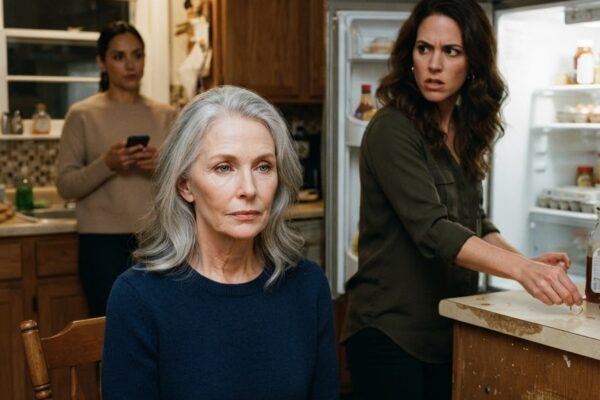
My daughter walked into our family’s luxury hotel looking as though she had nowhere else to go, and the manager stopped her before she could even reach the front desk. “This lobby is for registered guests,” he told her, motioning for an employee to escort her back toward the entrance as people nearby quietly watched. She didn’t protest. She didn’t reveal her last name. Instead, she calmly asked for his name, glanced up at the security cameras, and made a single phone call. The manager smiled as though the matter had already been settled. Ten minutes later, the private elevator doors opened. And the person who stepped out made that smile vanish.
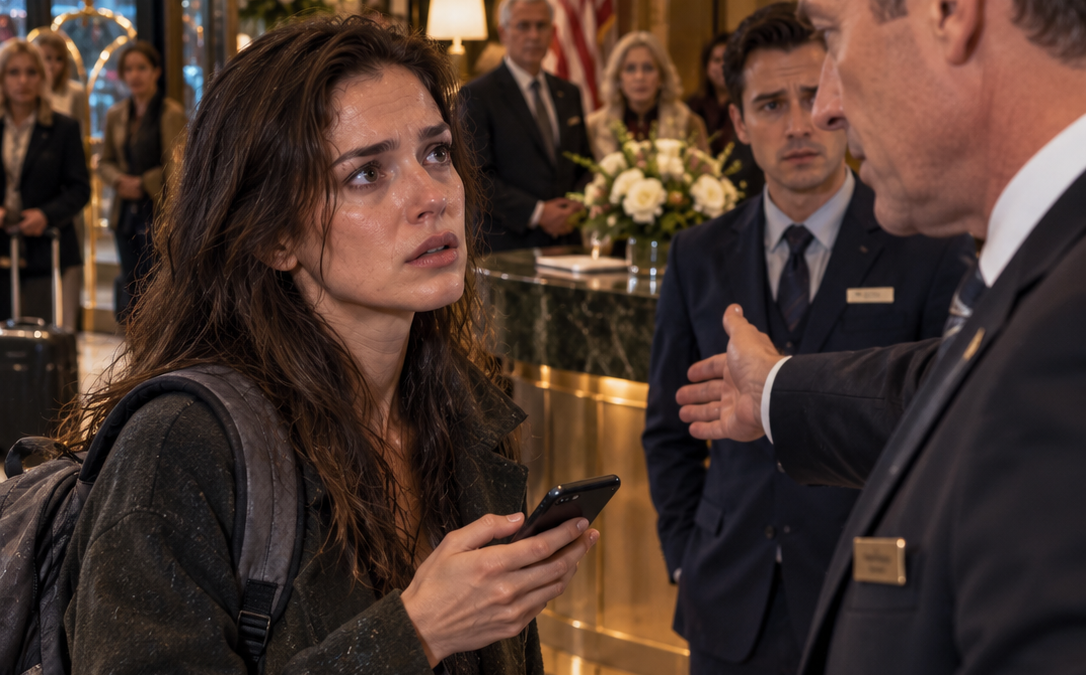
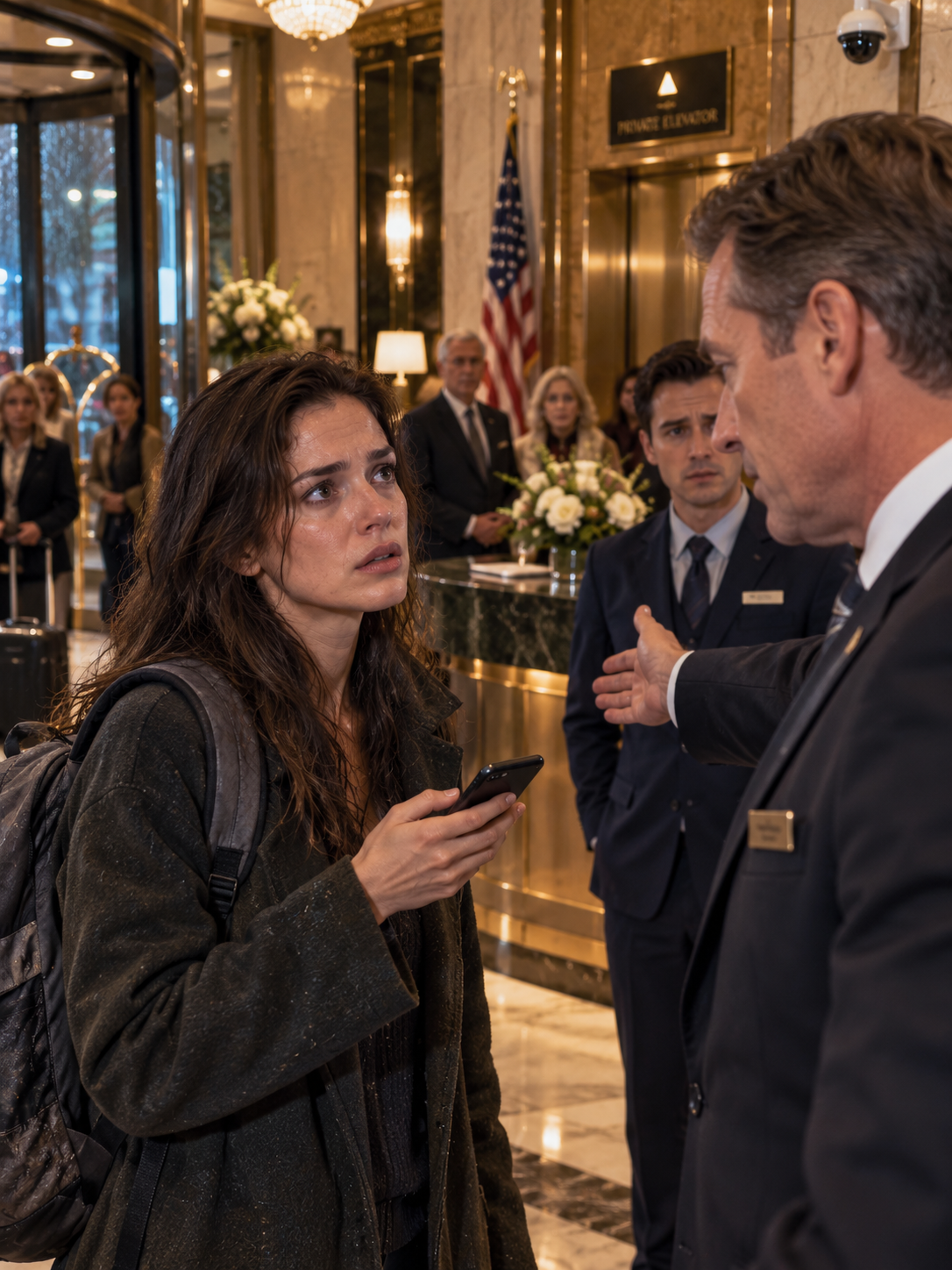
The rain had been coming down for nearly an hour when the woman stepped beneath the brass awning of the Hail Crown Grand.
Water ran from the hood of her faded coat, and the canvas backpack on her shoulder looked as though it had been through several winters. She stood just inside the revolving door without asking for a room, without approaching the marble reception desk, and without doing anything except trying to get warm.
Richard Cole noticed her almost immediately. He was the hotel’s general manager, a man who liked polished shoes, perfect flower arrangements, and a lobby that looked exactly the way the company brochures promised. He crossed the floor with the kind of smile that did not reach his eyes. “You can’t stay here,” he said. “This is a five-star hotel.” The woman looked toward the glass doors. Rain struck the sidewalk so hard that the taxis outside had become blurred yellow shapes. “I only need a few minutes,” she said.
“Long enough to dry off.” “Outside,” Richard replied. Noah Bennett heard the exchange from the front desk. At thirty-four, Noah had worked at the Hail Crown Grand long enough to recognize the difference between enforcing a policy and humiliating somebody. He stepped away from his terminal before Richard could summon hotel security. “She’s freezing,” Noah said quietly. “Give her ten minutes.” Richard turned toward him. “That was not a request.”
Noah glanced at the woman. She had not raised her voice. She had not argued. She looked tired, but there was something unusually observant in the way her eyes moved through the lobby. She noticed the staff door behind reception, the camera above the elevator bank, the service hallway beside the lounge.
Noah assumed she was simply trying to understand where she was allowed to stand. “She’s not bothering anyone,” he said. Richard’s jaw tightened. “Ten minutes. And she stays away from the guests. You are responsible for her.” Noah nodded. “Fine.” The woman gave him a small look of thanks, then followed him toward a chair near a side corridor. It was not the most comfortable seat in the lobby, but it was warm and partially hidden from the main entrance.
Noah found a clean hand towel from the concierge cabinet and handed it to her. “You didn’t have to do that,” she said. “No,” he replied. “I did.” Her name, she told him, was Vicki. She offered no last name. Noah did not ask for one. For the next several minutes, she sat quietly while hotel life moved around her. Business travelers rolled suitcases across the marble floor. A wedding coordinator hurried past with fabric samples. Two bell attendants debated which luggage cart had a bad wheel. Richard walked from department to department correcting details so minor that most guests would never have noticed them. Vicki noticed something else.
Whenever Richard approached, employees stopped talking. A housekeeper pushing a linen cart lowered her eyes. A young bellman straightened as if someone had pulled a string through his shoulders. At the reception desk, a trainee quickly closed a notebook when Richard passed. Noah noticed Vicki noticing. “You’re studying the place,” he said. “Habit.” “What kind of habit?” “The kind you get when you spend a lot of time waiting.” That answer should have ended the conversation. Instead, Noah found himself curious. There was something measured in the way she spoke, as though every sentence had been considered before it left her mouth. A guest crossing the lobby dropped a leather wallet near the elevators. Vicki saw it before anyone else.
She picked it up, hurried after the woman, and tapped her lightly on the arm. “Ma’am, you dropped this.” The guest took the wallet and immediately opened it. Richard, who had been speaking to a supervisor nearby, turned toward them. “Is there a problem?” The guest looked embarrassed. “No. Everything is here.” Vicki said nothing. Richard smiled. “Good. Always best to make sure.” Noah understood the insult hidden inside the remark. So did Vicki. The difference was that she did not react. She simply returned to her chair. When Richard walked away, Noah said, “I’m sorry.” “For what?” “For pretending he didn’t mean what he meant.”
Vicki looked at him for a moment. “That might be the first honest thing I’ve heard in this lobby.” The ten minutes ended, but the rain did not. Noah checked the weather on his phone. The nearest public shelter showed no available beds for the evening. Richard appeared again. “Time’s up.” Noah looked through the front doors. “It’s still pouring.” “Then she can wait under the awning.” Vicki stood before Noah could argue. “It’s okay.” “No, it isn’t.” Richard gave Noah a warning look. “Careful.” There was history in that single word. Vicki heard it.
Noah reached for an umbrella from the hotel’s courtesy stand, but Richard stopped him. “Those are for registered guests.” For the first time, Vicki’s expression changed. Not because she had been denied the umbrella, but because she had seen how automatically Noah’s hand had moved toward it. “Keep it,” she said. “I’ll wait a little longer near the service entrance.” Richard laughed once under his breath. “You won’t.” Noah stepped between them, not dramatically, just enough to slow the moment down.
“She can sit in the staff corridor until the rain eases. Guests won’t even see her.” Richard stared at him for several seconds. “Warning number two. Put it in writing yourself.” Noah did not answer. Richard walked away. Vicki looked toward Noah. “You’ve done this before.” “Done what?” “Chosen a person over a rule.” Noah gave a tired smile. “It hasn’t been great for my career.”
That was the first moment Victoria Hail realized the night might tell her more about the company she had inherited than months of board reports ever could. But Noah still believed she was simply Vicki, a woman with wet shoes, a worn coat, and nowhere obvious to go.
The staff corridor smelled like coffee, detergent, and warm bread from the kitchen downstairs. Noah found another chair near the employee entrance and left Vicki there while he returned to the front desk. Ten minutes became twenty, then thirty, because Richard had been pulled into a call about the monthly operating report. Vicki listened. She was not trying to overhear private conversations, but people spoke differently around someone they considered invisible. A banquet supervisor complained that two workers had been scheduled for twelve-hour shifts with no proper break. A housekeeper whispered that a missing towel might be deducted from her next paycheck. A kitchen employee muttered that perfectly good leftover food would be discarded because Richard did not allow staff to distribute it after events. Each detail was small. Together, they formed a pattern. Victoria had spent the previous six weeks reading financial summaries after her father, Alexander Hail, had passed away. His controlling interest in Hail Crown Hospitality had transferred to her under a succession plan almost nobody outside the board knew existed. Marcus Reed, the company’s chief executive officer and an old family friend she had always called Uncle Marcus, had told her the hotels were healthy, profitable, and professionally managed. Her father’s last private note to her had said something different. Do not inherit my confidence. Earn your own.
It was the kind of sentence Alexander Hail would leave behind: blunt, irritating, impossible to ignore. Victoria had decided that before she took the chair formally in public, she would visit several properties without introducing herself. She wanted to see what happened when employees believed no powerful person was watching. At the Hail Crown Grand, she had found her answer in less than an hour. Noah returned carrying a paper cup of hot tea. “Kitchen said staff only,” he said, “so officially this fell out of the sky.” She accepted it. “And the sandwich?” He held up a wrapped turkey sandwich. “Also weather-related.” “You’re going to get written up again.” “That ship left the harbor a long time ago.” They split the sandwich. Vicki took half and wrapped a small portion in a napkin. Noah noticed. “Saving breakfast?” “Maybe.” “For yourself?” “Maybe.” He did not press her. A few minutes later, Richard entered the corridor. His eyes went straight to the tea and sandwich. “What did I say?” Noah remained calm. “You said she shouldn’t disturb guests. She isn’t.” “I also said staff resources are for staff.” “I paid for the food.” “That is not the point.” Vicki looked up from the chair. “What is the point?” Richard seemed surprised that she had spoken. “The point,” he said, “is that people stay in places they have paid to use.” Noah’s expression hardened. “She’s sitting on a chair.” “And you used to be an assistant manager.”
There it was again—the history behind the warning. Richard stepped closer. “You had a future here until you started confusing kindness with authority.” He left before Noah could answer. Vicki waited until the door closed. “You were assistant manager?” Noah exhaled. “Last winter.” “What happened?” For a moment he seemed reluctant to explain. Then he leaned against the wall. “A woman came in during a snowstorm. Her car had stopped on the highway. She had two kids, no available roadside service for several hours, and every public shelter nearby was full. We had an empty room that hadn’t been sold.” “So you let them use it.” “For six hours.” “And Richard demoted you.” “Officially, I failed to follow revenue-protection procedures. Unofficially, I made a decision without making him feel important first.” Vicki studied him. “Why did you stay?” “Because good people still work here.” The answer came too quickly to be rehearsed. Noah continued. “Elisa in housekeeping has three kids. Jules in the kitchen is putting his younger brother through school. Dana at reception is caring for her mother. If every decent person walks away when management gets ugly, the only people left are the ones who enjoy it.” Vicki looked into the paper cup in her hands. “Somebody has to stay,” Noah said. A kitchen worker appeared at the end of the corridor and slowed when he saw Noah. “Did you hear about Elisa?” Noah straightened. “What happened?”
“They ended her shifts.” “Why?” “She asked payroll about overtime from last month.” Noah pushed away from the wall. “She has three kids.” The worker shrugged helplessly. “Richard said she was creating conflict.” After he left, Vicki said, “Has anyone reported this?” “To corporate?” “Yes.” Noah gave her a look that was almost a laugh. “You think nobody has tried?” “How many complaints?” “I don’t know. Enough.” “And nothing changed?” “Complaints disappear. People get moved. People get warned. People decide they need a paycheck more than they need to be right.” Vicki felt a familiar pressure in her chest. It was not anger exactly. Anger was too simple. It was the growing awareness that reports labeled “isolated staffing friction” might represent real people who had learned the company would not protect them. A housekeeper named Marisol came through the corridor carrying a clipboard. She looked upset. “Noah, Room 1108 says one towel is missing,” she said. “I counted the room myself.” Before Noah could respond, Richard appeared again, almost as if he had been waiting. “It will be deducted,” he said. Marisol looked stunned. “I didn’t take anything.” “Then perhaps you should have counted more carefully.” “You can’t deduct money without knowing what happened,” Noah said. Richard turned. “Nobody asked you.” “She’s telling you she didn’t do it.”
Richard’s eyes moved from Noah to Vicki and back again. “First a chair. Then food. Now payroll advice. You’re having a productive evening.” “It’s a towel,” Vicki said. Richard looked at her. “Stay out of staff matters.” She held his gaze. “Then handle them fairly.” Silence filled the corridor. Noah almost smiled. Richard did not. “Loading dock,” he told Noah. “My shift is front desk.” “Not anymore.” “You’re moving him because I spoke,” Vicki said. “I’m reminding him who controls his schedule.” Noah picked up his jacket from the chair. “It’s fine.” “No,” Vicki said quietly. “It’s informative.” Richard paused. Something about that word bothered him. But by then, Victoria had already learned more than he realized.
The loading dock sat two floors below the lobby, beside storage rooms filled with banquet chairs, cleaning supplies, bottled water, and unopened cartons of guest amenities. It was not where Noah belonged, but he had been sent there often enough that the night crew knew not to ask questions. To his surprise, Vicki followed him. “You can leave,” he said. “So can you.” “I work here.” “Not down here.” That earned a laugh. Noah handed her a lightweight pair of work gloves from a shelf. “If Richard sees you helping, he’ll probably write me up for unauthorized volunteer labor.” “Then I’ll try to be inefficient.” They began moving unopened supply boxes away from a leaking pipe near the wall. The work was ordinary, almost boring, but the storage area gave Vicki something she had not expected: access to discarded paperwork waiting to be shredded. A stack of old receiving forms had been left beside the loading office. She glanced at them while Noah scanned inventory. One page listed emergency community assistance expenses. Another listed temporary lodging support. A third listed meal-relief purchases. The amounts were significant—far more than anything she had heard staff describe. “Does this hotel support local shelters?” she asked. Noah looked over. “Not that I know of.” “Food programs?” “Richard won’t even let the kitchen donate extra rolls.” She held up a form. “Then what is this?” Noah came closer.
The sheet showed an $8,000 charge described as emergency relief after a winter service disruption. Noah read the date twice. “I worked that night.” “What happened?” “Nothing.” “You’re sure?” “I was here fourteen hours. I would remember an eight-thousand-dollar emergency.” Vicki flipped to another form. Then another. The same vendor name appeared repeatedly: Northstar Community Logistics. “Have you heard of Northstar?” “No.” A storage clerk passing the doorway stopped. “What are you doing?” “Inventory question,” Noah said. The clerk glanced at the forms. “Richard wants you upstairs.” “Of course he does,” Noah muttered. Vicki had already found a monthly summary. Twenty-nine line items totaled just under a quarter of a million dollars. She pointed to the number. Noah’s face changed. “That can’t be right.” “Maybe it can.” He lowered his voice. “How much does this hotel actually spend helping people who aren’t guests?” “Based on what you’ve told me?” “Nothing.” “Then the money is going somewhere.” The storage clerk shifted uneasily. “You should put those back.” Vicki did. But not before memorizing the vendor name and several dates. As they walked toward the service elevator, Noah whispered, “Richard has a brother named Daniel.” Vicki stopped. “How do you know?” “Christmas party two years ago. Daniel came in late. Richard introduced him to a few department heads. I think he runs some kind of supply company.”
The elevator doors opened. “Do you remember the name?” Noah shook his head. “No.” Inside the elevator, Vicki took out an old prepaid phone she had carried specifically for the visit. She typed Northstar Community Logistics into a note. Noah noticed. “You planning to investigate?” “I’m curious.” “You’re very curious for someone who just needed ten minutes out of the rain.” She slipped the phone away. “You’re very observant for someone working the loading dock.” The doors opened to the employee floor. Richard was waiting. “Vicki,” he said, using her name for the first time. “A word.” Noah stepped slightly forward. “About what?” “Not you.” Vicki walked into the corridor. Richard folded his arms. “What exactly are you looking for?” “A dry place.” “You’ve had one.” “Then why are you worried?” “I’m not worried.” “That’s good.” His expression cooled. “People who come into this hotel usually want something.” “Everybody wants something.” “Especially people in your situation.” Vicki looked at him. “And what situation is that?” He gestured toward her coat without answering. “Interesting,” she said. Richard leaned closer. “Noah is impressionable. He used to have a future here. I can still restore it.” “I don’t want anything from you,” Vicki said. “I wasn’t talking about you.” “I know.” That answer unsettled him more than an argument would have. He stepped aside. “The weather has improved. You should go.”
Vicki looked through a nearby service window. The rain had weakened, but the streets remained soaked and cold. Before she could respond, Noah appeared. “The shelter on Eighth is full,” he said. “She can stay at my place.” Richard stared at him. “You barely know her.” “So?” “She’s using you.” Noah looked at Vicki, then back at Richard. “You don’t know her either.” Richard smiled thinly. “That’s the problem.” Later, while Noah finished his shift, Vicki sat near the employee entrance and thought about the ledger. She could have ended the experiment that moment. One call to the board’s outside counsel would have opened an audit. One message to Marcus Reed would have brought executives into the building before midnight. But she did not want paperwork alone. Her father had taught her that a bad system rarely survives because one person breaks rules. It survives because other people benefit from not asking questions. She needed to know who else was involved. And she needed to know whether Noah’s integrity would remain intact when helping her became genuinely expensive.
Noah’s shift was supposed to end at eleven. At ten-thirty, Richard called him back to the lobby. The atmosphere had changed. A guest stood near the concierge desk speaking sharply to a supervisor. She was elegantly dressed and clearly upset. Richard listened with exaggerated concern while hotel security waited nearby. “What happened?” Noah asked Dana at reception. “A bracelet is missing from a suite.” “Was anyone inside?” “Housekeeping, turn-down staff, and the guest’s family.” Richard looked across the lobby and saw Vicki beside Noah. His expression became almost satisfied. “Perfect timing,” he said. Noah felt the warning before he understood it. The guest described the missing item as a diamond bracelet kept in a small jewelry case. Richard asked several questions, then slowly turned his attention toward Vicki. “She was in employee areas,” he said. Noah’s voice sharpened. “Because you sent me to the loading dock.” “She was also near service corridors.” “So were fifty employees.” Richard ignored him. “Security needs to inspect her backpack.” Vicki remained calm. “On what basis?” “Unauthorized access to restricted areas.” “You authorized me to remain in the staff corridor.” “Not the loading dock.” “Noah was instructed to take his ‘project’ with him,” Vicki reminded him. “Your words.” Several employees heard that. Richard’s face tightened. “Open the bag.”
Noah stepped forward. “You can’t just decide she’s responsible because it’s convenient.” Richard looked at him. “Careful, Noah.” The hotel’s security supervisor, a middle-aged man named Sam, spoke before the situation could become louder. “We can ask. We cannot force an inspection without consent.” Vicki looked at Sam, then handed him the backpack. “Go ahead.” Sam opened it on a side table where everyone could see. Inside were a folded sweater, an old paperback, socks, toiletries, two sealed granola bars, a small notebook, and nothing resembling the missing bracelet. “There’s nothing here,” Sam said. Richard did not look relieved. He looked disappointed. Then Dana received a call at reception. She listened, frowned, and looked toward the lobby. “The bracelet was found.” Noah exhaled. “Where?” Richard asked. Dana hesitated. “In a linen bag on the eleventh floor.” Richard’s eyes moved to Vicki. “Then this is finished.” “No,” Noah said. “It isn’t.” Richard turned. “You were ready to blame her before anyone checked the floor.” “I responded to a guest concern.” “You chose the easiest person to accuse.” Richard’s tone became soft, which Noah knew was more dangerous than shouting. “My office. Now.” Noah followed him. Vicki waited outside with the others. Inside the office, Richard closed the door. “You keep making bad decisions,” he said. Noah stood in front of the desk. “You keep giving me bad choices.”
Richard opened a drawer and pulled out a personnel form. “Assistant front office manager,” he said. “Full salary restoration. Benefits restored. Effective tomorrow.” Noah stared at him. “You’re offering me my old job?” “I’m offering you a way back.” “In exchange for what?” Richard leaned back. “A simple statement. You tell security Vicki entered restricted areas on her own and that you repeatedly told her not to. Nothing dramatic.” “That isn’t true.” “It is close enough.” “No.” Richard looked almost amused. “Think before you answer.” “I did.” “You know what that salary would do for you? You told payroll last year you were helping your mother with rent.” Noah’s face changed. Richard had crossed a line by using a private employee record to pressure him. “All you need to do,” Richard continued, “is confirm that she acted independently.” “No.” “Choose carefully.” “I already did.” Richard pushed the personnel form across the desk. “You are throwing away your career.” Noah looked down at the paper, then back at him. “You already took my title. You don’t get my character too.” Richard’s expression went still. “Then you’re done here.” Noah nodded. “I figured.” When he walked back into the lobby carrying his employee badge in one hand, Vicki stood immediately. “What happened?” “I’m apparently free tomorrow.” Her eyes narrowed. “He ended your job?” “He gave me an option. I didn’t like it.” “What option?” Noah told her.
For the first time that night, Victoria felt guilt stronger than curiosity. She had entered the hotel knowing she had power Noah did not. She had watched him take risks without knowing she could stop the consequences with a sentence. “I can fix this,” she said. Noah studied her. The words had come out too confidently. “How?” She hesitated. There were moments when a lie ended naturally because the truth became necessary. This should have been one of them. But then Richard emerged from his office and immediately made a phone call. His posture changed when the other person answered. “Marcus,” he said. “We have a problem.” Victoria’s stomach tightened. Noah saw her reaction. “You know that name?” She looked at Richard across the lobby. “I know enough,” she said. “Who is he?” Victoria kept her eyes on Richard. “Give me until I know why he called him.” “Why?” “Because Richard isn’t the top of this.” Noah stared at her. For the first time, he understood that the woman he had invited to sleep on his sofa had been hiding something much larger than a last name.
Marcus Reed arrived twenty-seven minutes later. He did not come with an entourage. He entered through the main doors in a dark overcoat, carrying only a leather portfolio and the expression of a man who expected other people to explain themselves quickly. Staff recognized him immediately. Conversations stopped. Even Richard’s posture changed. Noah did not need an introduction. Marcus Reed was the chief executive officer of Hail Crown Hospitality. Richard crossed the lobby to meet him. “Mr. Reed, thank you for coming.” Marcus looked past him and saw Vicki. For half a second, nothing moved. Then Marcus said, “Victoria.” Noah turned toward her. Richard blinked. “Victoria?” Vicki closed her eyes briefly. The name had escaped earlier than she wanted, but Marcus had no reason to know the rules of her visit. “Not here,” she said. Marcus’s expression hardened. “What is going on?” Richard seized the moment. “That woman has been creating problems all evening. She entered restricted areas, interfered with staff operations, and made accusations about management.” Victoria looked at him. “I asked questions.” “You have no authority here.”
“That depends on what kind of authority you mean.” Richard laughed softly. “You couldn’t even get yourself a room tonight.” Marcus studied Victoria. “Why are you dressed like this?” She ignored the question. “Richard Cole,” she said, “your disciplinary authority is suspended pending board review.”
The lobby went silent. Richard stared at her, then laughed loudly enough for several guests to look over. “Did everyone hear that?” he said. “She thinks she can suspend me.” Victoria did not raise her voice. “Check your phone.” Richard’s phone vibrated. He looked down. His smile disappeared. A corporate notice had been issued minutes earlier through the board’s emergency compliance channel. It did not reveal Victoria’s identity, but it stated that disciplinary actions at the Hail Crown Grand were temporarily frozen pending an active review. Richard looked at Marcus. “You authorized this?” Marcus did not answer immediately. Victoria did. “Someone you do not outrank did.” Richard looked at her coat, her old shoes, the damp hair around her face. “Who exactly do you think you are?” Victoria met his eyes. “Someone who has been watching you all night.” Noah stood several feet away, trying to fit the scene together. Marcus had called her Victoria. A board notice had appeared seconds after she spoke. Richard, who had spent the evening treating her as though she had no importance, suddenly looked uncertain. Marcus stepped closer to Victoria. “Whatever board member sent you, this freezes disciplinary action. It does not give you operational control of this property.” “I never said it did.” “Good.” He turned to Sam from security. “Escort her outside.” Noah moved forward. “Mr. Reed—” Victoria lifted a hand. “It’s okay.”
Noah looked at her in disbelief. Marcus’s eyes narrowed. “You have authority to demand a review. You do not have authority to disrupt this hotel.” Victoria nodded slowly. “That is useful to hear.” Richard seemed relieved. Sam looked uncomfortable, but Victoria picked up her backpack and walked toward the doors. At the entrance, Noah caught up with her. “All that authority,” he said, “and you’re still going out the same door.” “For now.” “You need to tell me what is happening.” “I will.” “You said that before.” She stopped under the awning. The rain had become a mist. “I’m sorry,” she said. “That is not an explanation.” “No.” He looked toward the lobby, where Richard and Marcus were speaking in low voices. Then his phone vibrated.
A message had arrived from Dana. Richard is locking the audit archive. Victoria saw Noah’s expression. “What?” He showed her. She looked through the glass doors at Marcus. “That’s what I needed.” Noah frowned. “What do you mean?” “If Richard were acting alone, he would protect himself. If someone above him is involved, he will protect the system.” Another message appeared. Dana: They’re asking IT to restrict access to Northstar records. Victoria’s face went still. Noah finally understood why she had allowed herself to be escorted out. “You wanted them to react.” “I wanted them to decide what mattered most when they thought I had lost access.” “You used yourself as bait.” “Yes.” “And me?”
The question landed harder. Victoria did not answer. Noah looked away. Before he could speak again, a black sedan pulled to the curb. A woman in her fifties stepped out carrying a laptop case. Victoria recognized her immediately: Claire Mason, the board’s outside compliance counsel. Claire walked up to them. “Deletion alert just triggered,” she said. Noah looked at Victoria. Victoria looked back through the hotel doors. “Now we know where to look.”
Claire’s temporary office was not inside the hotel. It was a twenty-four-hour business center across the street, the kind of place with rentable conference rooms and bad coffee. Ten minutes after leaving the Hail Crown Grand, Victoria, Noah, and Claire were seated around a narrow table with two laptops open between them. Claire had been monitoring corporate systems since Victoria entered the property. “You asked me not to interfere unless something crossed a threshold,” Claire said. “This crossed it.” “What exactly happened?” Noah asked. Claire rotated one laptop toward him. “After the board notice was issued, someone at the hotel attempted to change permissions on the audit archive. Three minutes later, a batch deletion request targeted records associated with Northstar Community Logistics.” Noah leaned closer. “Can you stop it?” “Corporate copies are protected. Local property backups are more complicated.” Victoria said, “Can we recover them?” “Possibly. But the fastest path is a valid local credential.” Noah sat back. “My account might still work.” Victoria looked at him. “Richard ended your job.” “HR hasn’t processed anything yet.” Claire considered it. “If your credentials remain active, you can lawfully access the same systems you were authorized to use during your employment, but do not exceed your normal permissions. We need preservation, not improvisation.” Noah nodded. They opened the employee portal.
His password worked. He exhaled. “Still active.” The property backup contained thousands of files, but Noah knew the folder structure better than Claire did. He navigated through operations, vendor reconciliation, community assistance, and archived expense support. Northstar appeared in all four. Victoria began comparing dates. A supposed “winter emergency response” matched a night Noah remembered as completely routine. A “temporary lodging assistance” entry for twenty rooms had been submitted during a week when occupancy reports showed no such use. Food-relief invoices appeared on days when kitchen records showed no external distribution at all. Claire’s expression hardened. “This is not one bad invoice.” “How many?” Victoria asked. Claire ran a search. “Forty-seven transactions at this property.” Noah stared at the screen. Victoria said, “How many were flagged?” Claire checked the compliance history. “Fourteen.” Noah looked at her. “Those are the complaints.” “Not exactly,” Claire said. “Fourteen internal inquiries reference either vendor irregularities or employee concerns. Eleven were closed locally. Three were escalated, then returned to management with no action.” “Who returned them?” Victoria asked. Claire opened the approval chain. The room went quiet. Marcus Reed’s office appeared on two of the escalations. Noah looked at Victoria. She did not react visibly, but the silence around her changed.
“Search the vendor registration,” she said. Claire did. Northstar Community Logistics had been incorporated four years earlier. Its mailing address matched a private office suite forty miles away. The listed director was Daniel Cole. Richard’s brother. Noah whispered, “There it is.” Claire kept searching. “It gets worse.” Northstar was not limited to the Hail Crown Grand. It had billed eleven Hail Crown properties. Victoria leaned forward. “Eleven?” “Same categories. Community assistance, temporary lodging support, crisis transportation, emergency meal distribution.” Noah shook his head. “Richard could not do that alone.” “No,” Claire said. “A property manager could initiate some payments. He could not maintain the same vendor relationship across eleven properties without higher-level approval.” Victoria looked at Marcus’s name on the screen. For years, Marcus had attended family holidays. He had taught her how to read a balance sheet. After her father became ill, Marcus had repeatedly told her not to worry about operations. He had said the company was in good hands. She remembered her father’s note again. Do not inherit my confidence. Earn your own. Noah watched her carefully. “You trusted him.” Victoria nodded once. “I did.” Claire interrupted. “Someone is actively trying to close the local session.” A warning appeared on Noah’s screen. ACCESS UPDATE PENDING. “How much time?” Victoria asked. “Minutes. Maybe less.”
Noah moved quickly through the folders and selected the audit-preservation function built into the property system. It did not allow him to download everything, but it could create a protected snapshot for compliance review. “Can I preserve this?” Claire checked the screen. “Yes. That function is within your access level.” Noah clicked. The progress bar moved slowly. Twenty percent. Thirty-eight. Then the connection flickered. “They see us,” Noah said. Claire opened her own system. “The local administrator is terminating sessions.” Fifty-six percent. Victoria stood behind Noah, one hand gripping the back of his chair. “Come on.” Seventy-two. A second warning appeared. SESSION EXPIRING. Noah did not move. Eighty-nine. Ninety-six. The screen went black. For one second nobody spoke. Then Claire’s laptop chimed. “Snapshot secured.” Noah leaned back. Victoria closed her eyes. Claire looked at both of them. “We have enough to preserve the evidence trail.” “Enough for what?” Noah asked. Claire answered carefully. “Enough for the board to act if executive obstruction can be established.” Victoria opened her phone. “What do we need?” Claire looked toward the hotel across the street. “We need to know whether Marcus was simply negligent, or whether he is participating now.” Victoria stood. “Then we go back.”
They returned through the employee entrance because the main lobby was crowded with guests checking in after a delayed flight. Dana let them through after Claire showed her board authorization. Noah walked beside Victoria but did not speak. She knew why. They had reached the moment she could no longer postpone. In the service hallway, she stopped. “My name is Victoria Hail.” Noah looked at her. “Hail?” “Yes.” “As in Hail Crown?” “Yes.” He stared at her for several seconds. “Alexander Hail’s daughter.” “Yes.” Noah looked down at the coat, the backpack, the shoes. “You were never without a place to stay.” “No.” “The clothes?” “A disguise.” “The full shelter?” “Real. I checked it before I came.” “The sandwich?” She swallowed. “Real to me.” His expression changed. “That isn’t what I asked.” “I know.” “You watched me lose my job.” “I believed I could restore it.” “That is not the same thing as stopping it.” “No.” “You could have told me at any time.” “Yes.” He looked away, jaw tight. Victoria did not defend herself. She had spent the evening judging Richard for using power without understanding what it felt like from the other side. Now Noah was showing her that she had done a different version of the same thing. “I needed to know how people behaved when they thought I had no influence,” she said. “And you needed to know how I behaved.” “Yes.” “So Richard was right about one thing.” She waited. “You were using me.”
The sentence hurt because it was true. Victoria nodded. “Yes.” Noah laughed once, but there was no humor in it. “Good to know.” He started walking. She followed. “Noah.” “Not now.” “I’m sorry.” “I believe you.” That surprised her. He turned back. “I believe you are sorry. That doesn’t mean I’m finished being angry.” Victoria nodded. “Fair.” They continued toward the administrative offices. Outside Marcus’s temporary meeting room, Richard was speaking rapidly. “This is one property,” he said. “She came in here pretending to be someone she isn’t and created chaos.” Marcus replied, “She is not the problem.” Richard lowered his voice. “Then handle her.” Victoria opened the door. Marcus looked up. Richard froze. Claire entered behind her and placed the leather portfolio on the table. “What is this?” Marcus asked. “A board preservation notice,” Claire said. Marcus’s eyes moved to Noah. “He was terminated.” “His local credentials remained active,” Claire said. “He used authorized preservation tools before the change was processed.” Richard’s face drained of color. Marcus turned toward Victoria. “Whatever you found, this company still has procedures.” Victoria rem
oved the old coat.
Underneath, she wore a plain black sweater and trousers. Nothing about the outfit was dramatic. The transformation came from her posture. “I agree,” she said. “Let’s use them.”
Marcus leaned back. “Your father left you shares. Significant shares. That does not make you operational management.” “No.” “Then stop pretending it does.” “I’m not operational management.” Richard looked between them. Marcus’s voice sharpened. “This company answers to me.” Victoria looked at him. “Does it?” Marcus paused. She opened her bag and placed a sealed document on the table. Richard frowned. Marcus did not. He recognized the board seal. Victoria said, “The succession resolution became effective at 8:00 this morning.” Noah stood near the door. Richard whispered, “What resolution?” Marcus remained silent. Victoria answered. “My father did not only leave me shares. The board elected me chairwoman, effective upon final transfer of the voting trust.” Richard stared at her. Marcus’s face became unreadable. Victoria continued. “I did not announce it because I wanted one week to review the company without changing how people behaved around me.” Noah looked at her. Now the entire night made sense. Richard sank slightly into a chair. Marcus finally said, “A chairwoman does not run individual hotels.” “No. But the board appoints and removes executive officers.” The room became very still. Claire opened the portfolio. “And tonight,” she said, “the board’s emergency review provision has been activated.”
The evidence did not arrive as one dramatic document. It arrived as a pattern. Claire projected a timeline onto the meeting-room screen. Northstar Community Logistics had billed the company for four years. The earliest payments were small enough to attract little attention. Then the amounts increased. New properties were added. The descriptions became broader and harder to verify. Richard sat at one end of the table with his arms folded. Marcus remained standing. Victoria reviewed the records one by one. “Property three,” she said. “Emergency meal distribution, sixty-two thousand dollars over eighteen months.” Claire nodded. “Property five. Temporary lodging assistance.” “Yes.” “Property eight. Transportation support after a weather event.” “Yes.” Noah spoke from the side of the room. “Were any of those services real?” Claire was careful. “We do not know yet. Some may have been legitimate. The issue is that records are incomplete, several staff complaints were closed without adequate review, and tonight someone attempted to remove related files after a board notice.” Marcus looked at Richard. “Explain the deletion request.” Richard’s mouth tightened. “Routine archive cleanup.” Claire slid a printed log toward him. “It targeted Northstar folders only.” Richard said nothing. Victoria looked at Marcus. “Did you know Northstar was connected to Daniel Cole?” “I knew vendors existed. I do not memorize ownership records.”
“Did you know employees had raised concerns?” “I receive hundreds of escalations.” “Two came through your office.” “My office is not me.” “That is true.” Marcus seemed to relax slightly. Victoria continued. “Which is why we checked the executive approval logs.” Claire changed the screen. A series of payment exceptions appeared. Several had been approved under Marcus’s executive authorization token. Marcus’s eyes narrowed. “My office processes approvals under delegated authority.” Claire nodded. “Also true.” Richard exhaled. Victoria did not move. “The question,” she said, “is what you did tonight.” Marcus looked at her. Claire displayed another log. At 11:21 p.m., after Victoria suspended Richard’s disciplinary authority, a call was placed from Richard’s office to Marcus. At 11:42, Marcus arrived. At 11:58, Marcus instructed hotel IT to lock the audit archive. At 12:04, an administrator using executive authorization attempted to remove Northstar materials from the active review queue. Marcus’s face changed. “That was to protect data integrity.” Claire replied, “The system recorded a deletion instruction, not a preservation instruction.” Richard looked at Marcus. For the first time that evening, fear moved in the opposite direction. Marcus said, “You are interpreting technical logs without context.” “Then give us the context,” Victoria said. He looked directly at her. “You are letting grief turn into suspicion.”
The room went cold. Noah watched Victoria carefully. Her father had passed away only weeks earlier. Marcus knew that. He also knew exactly how to use it. Victoria’s voice remained controlled. “This is not about my grief.” “Your father trusted me for twenty-three years.” “And that is why I wanted you to explain this before the board did.” Marcus stepped closer to the table. “Alexander built this company with me.” “He built it with thousands of employees.” “He understood that difficult decisions are made at scale.” “Does scale require hiding complaints?” “You do not know they were hidden.” “Does scale require deleting audit records after a review begins?” “You do not know why they were deleted.” “Then explain it.” Marcus said nothing. Victoria looked toward Richard. “What did Marcus tell you when you called him?” Richard’s eyes shifted. Marcus spoke immediately. “Do not answer that.” Victoria did not look away from Richard. “That instruction just became part of the record.” Richard swallowed. Noah remembered something from earlier. “People around you seem to make very bad career decisions,” Richard had told him. Now Noah understood the irony. Richard had spent years believing Marcus was protection. But protection can become pressure the moment the person above you needs distance. Marcus turned toward Richard. “You managed the vendor relationship. You signed the local confirmations.”
Richard stared at him. “You told me the program was approved.” “I approved community assistance spending. I did not approve false documentation.” “You knew Daniel ran Northstar.” Marcus’s voice sharpened. “Be careful.” Richard’s face changed. Victoria saw it. The alliance was breaking. Richard looked at Claire, then at Victoria. “Do I have whistleblower protection if I cooperate?” Claire answered, “I cannot promise outcomes. I can document cooperation.” Marcus placed his palm flat on the table, firm enough to make the water glasses tremble. “This meeting is over.” Victoria remained seated. “No,” she said. “Your authority is.”
Claire had already scheduled an emergency board call. At 12:26 a.m., six directors appeared on the conference-room screen. Two joined from homes on the East Coast, one from California, one from London, and two from nearby offices. Nobody looked pleased to be awake, but the preservation notice and deletion logs had made the meeting impossible to postpone. Victoria sat at the head of the table. Marcus stood near the window with his arms crossed. Richard had asked to remain. Claire allowed it because his statements were now relevant to the review. The first director, Evelyn Park, spoke without ceremony. “Madam Chair, summarize.” The title changed the room. Until that moment, Victoria’s authority had been a document. Hearing it spoken aloud made it real. Victoria did not give a speech. She described the evening in sequence: the treatment of staff, the missing payroll questions, the suspicious community-assistance charges, the Northstar vendor connection, the repeated complaints, the eleven-property pattern, and the archive activity after the review notice. She did not mention the humiliation she had experienced in the lobby except where it showed how policies were applied. She did not make the story about herself. Then Claire presented the logs. One director asked Marcus directly, “Did you instruct anyone to delete or remove Northstar records?”
Marcus replied, “I instructed IT to secure operational data during an unauthorized intrusion.” Noah spoke before he could stop himself. “I used my active employee account.” Marcus looked at him. Claire said, “Mr. Bennett’s access was valid when the preservation snapshot was created.” Another director asked, “Why was Northstar singled out?” Marcus replied, “Because it was the subject of the concern.” Evelyn Park frowned. “That is precisely why records should have been preserved.” Marcus’s tone hardened. “I was trying to prevent contamination.” Claire changed the screen. “The command entered was purge, not lock.” Silence. Richard rubbed both hands over his face. Victoria watched him. “What did Marcus tell you on the phone?” she asked. Richard looked toward Marcus. Marcus said, “Richard, speak carefully.” Evelyn Park interrupted. “Mr. Cole, answer the chair.” Richard took a breath. “He asked what she had seen.” Victoria said nothing. Richard continued. “I told him she found Northstar references in storage records. He asked whether she had copied anything. I said I didn’t know.” “And then?” Evelyn asked. “He told me to keep her away from records until he arrived.” Marcus shook his head. “That is not accurate.” Richard looked at him. “You said Northstar could not become a board issue.” The video call went completely silent. Marcus stepped away from the window. “Richard is protecting himself.”
“Maybe,” Victoria said. “That is why we use records.” Claire displayed the call timeline again, followed by messages from the hotel IT administrator. One message read: Executive office wants Northstar archive removed from active access. Preserve only what legal requires. Evelyn Park leaned toward her camera. “Who sent that instruction?” Claire answered. “The hotel administrator says it came from Marcus Reed’s office after a direct call.” Marcus’s face remained controlled. “Then the administrator misunderstood.” Victoria looked at him. “Every explanation tonight requires someone below you to have misunderstood you.” Marcus turned to her. “Be careful, Victoria.” She almost smiled. Richard had used the same word hours earlier. “People keep telling me that tonight.” Evelyn Park cleared her throat. “The emergency removal resolution requires a majority finding that an executive officer may be obstructing a board-authorized review. We are not deciding final liability tonight. We are deciding whether Marcus Reed can remain in operational control while the investigation proceeds.” Marcus stared at the screen. “You are considering removing a CEO based on one chaotic evening?” Victoria answered before any director could. “Not one property. Eleven.” Claire distributed the supporting index electronically. One by one, the directors confirmed receipt. The vote was not dramatic.
There was no speech, no applause, no music swelling behind the moment. There were simply six directors reading logs, asking questions, and making a governance decision. Five voted to activate the emergency removal provision. One abstained pending further review. Evelyn Park looked into the camera. “Marcus Reed is suspended from executive authority effective immediately, subject to formal investigation.” Marcus’s face went pale. “I am still the chief executive officer.” “For title purposes pending formal action,” Evelyn said. “Not for operational authority.” Victoria looked at Claire. Claire checked a second document. “The employment committee resolution is also active based on the preservation event and executive noncompliance. Under the succession framework, termination for cause may be executed by the chair with committee concurrence.” Marcus looked at Victoria. For years, he had been the most powerful person in any room connected to Hail Crown. That changed without anyone raising their voice. Victoria signed the document. “Marcus,” she said, “your employment is terminated for cause, subject to the contractual review process. Effective immediately.” He stared at her. “Your father would never have done this.” Victoria’s expression softened, but only slightly. “My father is the reason I checked.”
Richard had spent the evening calling upward whenever he felt challenged. When Noah disagreed with him, Richard threatened his schedule. When Vicki asked questions, Richard relied on security. When records became uncomfortable, he called Marcus. Each time, he reached for someone or something he believed had more power than the person in front of him. Now there was nowhere left to reach. Marcus gathered his portfolio. Richard stood. “Marcus.” He did not respond. “Marcus, you told me this was protected.” Marcus turned toward him with a look that answered more than words could. Richard’s mouth opened, then closed. Victoria understood the relationship immediately. Richard had believed he was part of a protected arrangement. Marcus had seen him as a replaceable layer between executive decisions and local paperwork. Richard looked at Victoria. “What happens to me?” “That depends on the investigation.” “You already suspended me.” “Your disciplinary authority, yes.” “You’re going to end my job.” Victoria did not answer immediately. She thought about Marisol and the missing towel. Elisa and the overtime question. Noah losing his title for giving a family an empty room during a snowstorm. She thought about how small every incident looked when separated from the others. Then she thought about how systems are built. Not through one enormous act, but through repeated choices that teach people what they are allowed to do to one another.
“Richard Cole,” she said, “your employment is ended effective immediately under the property-management misconduct clause, subject to final HR processing and review.” Richard stared at her. “You came into my hotel pretending to be someone else.” Victoria stood. “That sentence is the problem.” “What?” “You called it your hotel.” He shook his head. “You know what I meant.” “I do.” She picked up the old coat from the back of the chair. “This hotel belongs to a company, and the company exists because guests trust it and employees keep it running. Management is stewardship. It is not ownership.” Richard looked toward Noah. “You did this.” Noah almost laughed. “No. You did.” Richard left the room escorted by a senior HR representative who had joined the property after the board call. There was no public scene. Most guests never knew anything had happened. That was intentional. Victoria did not want employees turned into entertainment. She wanted the building to keep functioning. At 2:00 a.m., the first operational changes began. Payroll deductions for unverified missing items were suspended pending review. The prior overtime complaints were reopened. Elisa’s case was placed on immediate reinstatement review. Staff who had raised concerns were given a direct independent reporting channel outside property management. Claire also ordered a full review of Northstar invoices across all eleven properties.
Noah watched from the doorway as Victoria worked. “You really are the chairwoman,” he said. She looked up. “Apparently.” He did not smile. She closed the laptop. “Still angry?” “Yes.” “Fair.” “You keep saying that.” “Because it is.” He leaned against the doorframe. “You could have stopped Richard from ending my job.” “Yes.” “You could have told me who you were before I offered you my sofa.” “Yes.” “You let me think you needed me.” Victoria looked down at her hands. “I did need you.” “For what?” “To show me something the reports couldn’t.” “That is not better.” “No.” Noah walked to the window. Victoria continued. “I came here expecting to test management. I did not expect to test you.” “But you did.” “Yes.” “And you kept going after you knew I was paying for it.” “Yes.” She did not hide behind strategy. She did not say the ends justified the means. “I made that choice,” she said. “It gave me information I needed, and it also treated your life like part of my experiment. Both things are true.” Noah looked at her. That answer did not erase what happened. But it was the first thing she had said that did not ask him to forgive her. After a long silence, he said, “Good.” “What is good?” “That you understand why I’m angry.” Victoria nodded. Noah glanced at the old backpack. “So the granola bars?” “Real.” “The book?” “Real.” “The wet socks?” “Unfortunately very real.” He almost smiled. Then his expression became serious again.
“What about the woman you were pretending to be?” Victoria looked toward the empty lobby beyond the office. “I don’t think she was completely pretend.”
By morning, the Hail Crown Grand looked exactly as it had the day before. The brass fixtures were polished. Coffee arrived in the lobby at six. The first breakfast guests opened newspapers beneath soft lights. A bell attendant rolled suitcases toward a waiting car. But behind the scenes, the company had changed. The board appointed an interim chief executive officer from outside Marcus’s reporting line. An independent accounting firm received access to the Northstar files. Each of the eleven properties was instructed to preserve vendor records, employee complaints, payroll disputes, and local approval histories. Victoria stayed at the hotel. Not in the presidential suite. She took a standard room on the sixth floor and paid the same internal rate used during board travel. At seven-thirty, she returned to the employee cafeteria wearing ordinary business clothes. The difference in how people reacted was immediate. Employees who had barely looked at her the night before now stood straighter. Some smiled too quickly. Some became nervous. A few tried to move out of her path. Victoria hated it. This was exactly what her disguise had been designed to avoid. Marisol, the housekeeper from Room 1108, stopped near the doorway. “You’re really the chairwoman?” “Yes.” Marisol looked embarrassed. “I complained in front of you.” “You were supposed to.” “No, I mean—” “I know what you mean.” Victoria pulled out a chair. “Sit for a minute.”
Marisol hesitated, then sat. “The towel deduction is being reviewed,” Victoria said. “More importantly, the policy that allowed unverified deductions has been suspended.” Marisol’s shoulders lowered. “Am I in trouble for talking?” “No.” “You can say that now.” Victoria understood the question beneath the words. Trust did not arrive because someone powerful promised it. It arrived after promises survived contact with consequences. “You’re right,” she said. “So don’t trust the promise. Watch what happens next.” Marisol nodded slowly. Later that morning, Elisa arrived after receiving a call from HR. She looked confused, exhausted, and suspicious. “I was told my case is being reopened.” “It is,” Victoria said. “Am I getting my job back?” “I cannot promise an outcome before the review. But no one will close the complaint locally, and no one will punish you for asking about pay records.” Elisa studied her. “People have promised things before.” “I know.” Victoria heard herself repeating the lesson. “Watch what happens next.” The phrase became her operating principle for the next several weeks.
The Northstar review uncovered a web of inflated invoices, unsupported service descriptions, and approval shortcuts. Some community-assistance spending was legitimate; much of it lacked adequate documentation. The company did not rush to claim every questionable payment was improper. Instead, it separated verified services from unsupported charges and referred the findings to outside professionals for formal review. That distinction mattered to Victoria. She had seen what happened when Richard decided the answer before checking the facts. She refused to repeat the method simply because she disliked the people being investigated. The board also discovered that the culture problem extended beyond Northstar. Managers had learned to protect monthly numbers even when doing so damaged employee trust. Complaints were treated as threats to stability rather than information. Promotions often rewarded silence and compliance more than judgment. Noah’s demotion became one of the clearest examples. The room he had given the stranded family during the snowstorm had been empty. No paying guest had been displaced. The family had remained for six hours and left a handwritten thank-you note that was still stored in an archived guest-relations file. Victoria read it twice. Then she asked Noah to meet her in the same side corridor where they had shared the sandwich. She handed him a folder. “What is this?” “Your personnel record. Corrected.”
He opened it. The disciplinary finding tied to the snowstorm had been rescinded. His assistant manager title had been restored retroactively for payroll and benefits purposes. Noah closed the folder. “You’re giving me my old job back?” “No.” His eyebrows rose. Victoria continued. “I’m correcting what should never have happened. What you do next is your choice.” He looked at her carefully. “There is an opening for director of guest and employee experience.” “That sounds invented.” “It is new.” “You created a job for me.” “I created a function the company clearly needs. You are qualified. You are not obligated to take it.” “Would I report to you?” “No. That would be a terrible idea right now.” He laughed despite himself. “That might be the smartest thing you’ve said.” “I’ve had a difficult week.” Noah looked at the folder again. “What if I say no?” “Then your record remains corrected, your back pay remains yours, and I give you a good reference.” “No punishment?” “No.” “No guilt?” “I’ll try.” He studied her for a long time. “I need time.” “Take it.” As he walked away, Victoria realized that the moment mattered more than whether he accepted. Power had damaged the company when it became a way to force outcomes. She wanted to learn how to use it to create choices instead.
Three weeks later, Noah asked Victoria to meet him at a small coffee shop two blocks from the hotel. Not the executive lounge. Not a boardroom. Not the Hail Crown Grand. A place with scratched wooden tables, mismatched mugs, and a handwritten pastry menu taped beside the register. Victoria arrived first. She chose a table near the window. When Noah entered, he carried the same expression he had worn the night of the rain: observant, cautious, unwilling to be impressed by appearances. He sat across from her. “I accepted the job.” Victoria smiled. “I heard.” “You were not supposed to know before I told you.” “HR copied me.” “Of course they did.” “I can pretend to be surprised.” “Please don’t.” She raised both hands in surrender. Noah ordered coffee. For a few minutes they talked about ordinary things. Elisa had returned to work under a new supervisor. Marisol’s towel deduction had been reversed. The kitchen was testing a formal food-donation partnership that complied with local handling rules instead of automatically discarding every extra item. The independent review was still ongoing. Not everything had been fixed. That mattered.
Victoria did not want a neat ending where one dramatic night solved years of bad habits. People needed new procedures, training, leadership, and time. Some employees still did not trust the new reporting channels. Some managers resented the scrutiny. The board still had difficult questions to answer about how obvious warning signs had been missed. Noah stirred his coffee. “Do you regret it?” “The disguise?” “Yes.” Victoria looked through the window at pedestrians moving along the sidewalk. “I regret what it cost you.” “That is not the same question.” “No.” She thought for a moment. “I learned things I would never have learned walking in as chairwoman. The moment people see power, they perform for it. Richard would have smiled. Marcus would have prepared. Employees would have been too careful to tell me anything real.” “So you would do it again.” “Not the same way.” Noah waited. “I would create protections before putting someone else at risk,” she said. “And I would decide in advance where observation ends and manipulation begins.” He nodded. “That sounds like a very chairwoman answer.” “I was hoping for human.” “It’s getting there.” Victoria smiled. Noah took a sip. “I owe you half a sandwich.” “You owe me more than that.” “I know.” He looked at her over the rim of the mug. “Why didn’t you tell me?” Victoria had answered the question before, but this time she answered differently.
“Because you saw me before you saw my last name.” Noah said nothing. “I was afraid the second you knew who I was, I would lose the only honest thing that happened to me that night.” “So you decided for me.” “Yes.” “That was arrogant.” “Yes.” “And unfair.” “Yes.” “And extremely annoying.” “Yes.” He looked almost disappointed by her lack of resistance. “I’m still angry.” “Okay.” “Is that all?” “What do you want me to say?” “I don’t know.” Victoria looked at his coffee. “I could give you a speech about trust.” “No.” “Good. I didn’t prepare one.” A server passed and topped off their cups. Outside, the sky was clear. Noah looked at Victoria for a long moment, then pulled out the chair beside him with his foot. “Sit over here.” She frowned. “Why?” “The sun is in my eyes.” “That is less meaningful than I expected.” “Not everything is a board resolution.” She moved to the other side of the table. For several minutes they said nothing. Then Victoria asked, “Is this forgiveness?” Noah picked up his mug. “It’s coffee.” She laughed. He did too. And for the first time since her father had passed away, Victoria felt no need to know exactly what happened next. The company still had work to do. So did she. But now she understood what Alexander Hail had meant. Do not inherit my confidence. Earn your own. She had entered the Hail Crown Grand believing she needed to discover whether other people deserved the power they held.
She left understanding that the harder question was whether she deserved hers. That answer would not be decided in one night. It would be decided in every choice that followed.