“She’s still playing dress-up—only now it’s in the Navy,” my uncle said with a wry smile as he introduced his Green Beret son. Everyone laughed. The special forces soldier stepped forward, seemingly about to shake my hand, but then he stopped short and snapped into a formal salute: “Commander Miller! It is an honor, sir—Commander of Special Operations.” A heavy silence fell over the room.
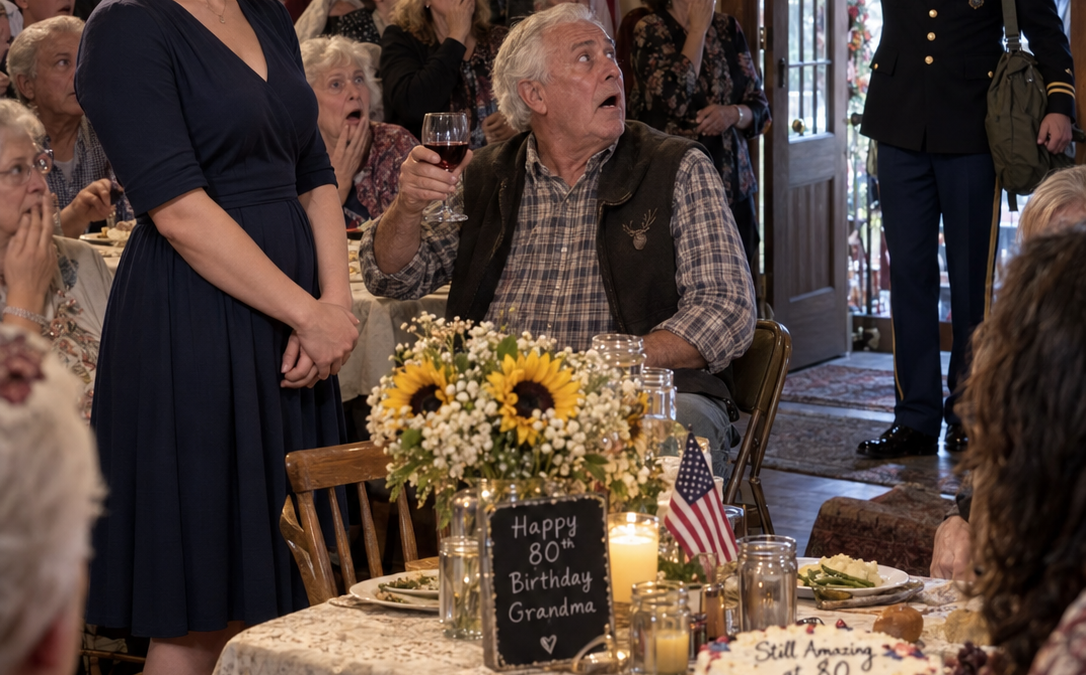
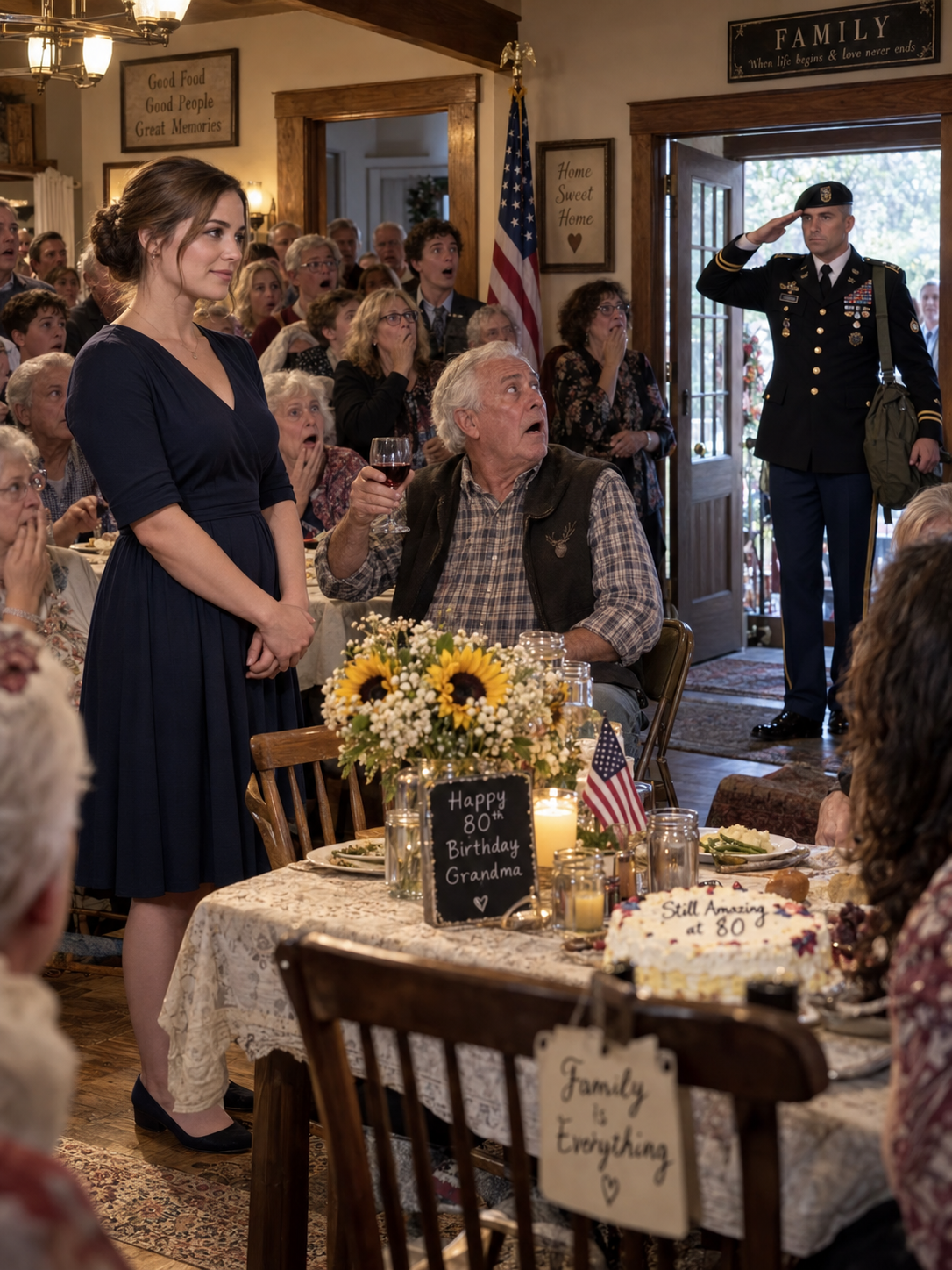
My uncle raised his glass in front of 40 relatives and called me a little girl playing dress up.
30 seconds later, the front door opened and his own son.
A decorated green beret.
A man my uncle had woripped his whole life looked straight at me, snapped to attention, and saluted.
The room went so quiet I could hear the ice settling in my glass.
My uncle’s smile slid off his face like wet paint.
And then his son said one sentence that would change everything my family believed about me.
But to explain why, I have to take you back to the beginning of that evening.
I landed in Columbus on a Friday afternoon after 11 months away, and I could still feel the hum of the ship’s engines in my bones.
The drive out to my grandmother’s farmhouse felt strange.
The Ohio cornfields looked too wide, too quiet, too green.
I had traded my uniform for a plain navy dress and flat shoes.
And I’d left every ribbon and every rank folded in a garment bag in the trunk.
That was deliberate.
Grandma Helen was turning 72.
And I had promised myself one evening of being nothing more than her granddaughter.
No briefings.
No decisions that cost anything.
Just put roast, laughter, and the creek of the old porch swing.
The house smelled exactly the way it always had, like cinnamon, wood polish, and coffee that had been sitting too long on the burner.
Grandma Helen met me at the screen door and held my face in both her hands, studying me the way she used to check peaches at the market.
“You’re thinner,” she said. “And you’re not sleeping.”
I told her I was fine.
She gave me a look that said she’d file that answer under lies and deal with it later.
Then pulled me into a hug that smelled of lavender and flower.
I held on a second longer than I meant to.
By 7:00, the living room was packed.
Ants, kuza, neighbors from down the road.
A man from church whose name I could never remember.
Plates clinkedked.
Somebody had the Buckeyes game playing on mute in the corner.
My cousin Thomas waved at me from the sofa with a beer in his hand and the same half smile he’d worn since high school.
The one that always waited to see which way the room was leaning before it committed.
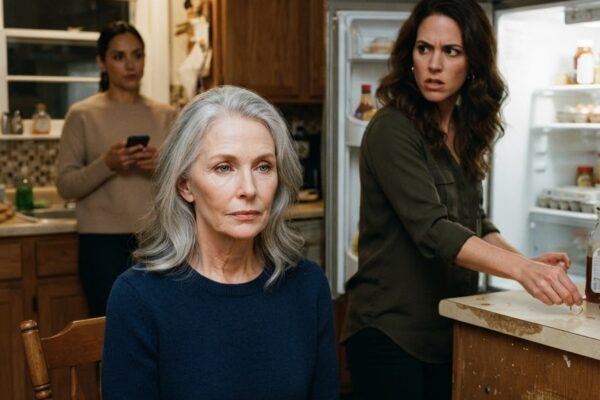
His mother, my aunt Evelyn, squeezed my arm in the kitchen doorway and whispered that she was glad I’d come.
She said it softly, almost guilty, then glanced over her shoulder as if someone might have heard.
Then I heard him before I saw him.
Uncle Richard has a voice built for filling rooms.
A baritone he spent 40 years sharpening as a regional sales manager, and it came rolling in from the dining room ahead of him like weather.
He was 67, broad in the chest, silver hair combed back with the confidence of a man who had never once doubted his own reflection.
He kissed Grandma’s cheek, shook a few hands, and then his eyes landed on me.
“Well, look who finally came ashore,” he said. “Claire. Still in the Navy?”
“Still in the Navy. Uncle Richard, it’s good to see you.”
“Good to see you too, sweetheart.”
He said sweetheart the way some men say honey to a waitress.
I smiled anyway.
I have stood in front of admirals and foreign ministers with less effort than it took to smile at that man.
But there is a particular discipline in swallowing a small insult because I have learned the small ones are never really small.
They are rehearsals.
Richard had been rehearsing me for 20 years, and I had been letting him, partly out of respect for my grandmother’s table, and partly because I understood something he didn’t.
A person who needs to be bigger than you has already told you how small he feels.
Dinner was a long table of mismatched chairs and borrowed folding ones.
Richard took the head of it, though it wasn’t his house.
And within 10 minutes, he had steered every topic toward his son.
“Daniel’s been in the army for what, nearly 20 years now,” he told the table, cutting into his roast. “Multiple deployments. They pinned another metal on him last spring, and the boy barely mentioned it. That’s humility. That’s what real service looks like.”
He chewed, swallowed, and let his gaze drift across the table to me.
“Not everybody gets to be a soldier. Of course, some folks just wear the uniform.”
A few people chuckled.
The uncertain kind of chuckle that asks permission first.
He buttered a roll under the table.
My left thumb pressed hard against my knuckle.
An old habit from the bridge of a ship during long nights.
A way of keeping my hands from showing anything my face wouldn’t.
“Of course, Claire’s doing her part,” Richard went on, lifting his glass toward me with a grin that stopped well short of his eyes. “She’s still playing dress up in the navy. Bless her heart.”
The laugh that followed was louder this time.
I felt the heat climb my neck, but I kept my voice level.
“I’m happy Daniel is doing so well, Uncle Richard.”
“Oh, he’s doing better than well. And I’ll tell you what I told you at Christmas. Claire, there’s no shame in leaving all that behind. Find yourself a decent job. A husband, maybe. Something that lets a woman come home at night.”
Aunt Evelyn stared at her plate.
She had stared at that plate through 40 years of dinners like this one.
I could have ended it right there.
One sentence.
One rank.
One name I could have dropped on that table and the whole room would have tilted.
I also thought about what it would cost my grandmother, who sat at the far end with her fork suspended in midair, watching me with eyes that missed nothing.
Helen knew I was holding something back, even if she didn’t know what.
She slowly shook her head at Richard, then looked at me and gave me the smallest nod.
Hold the line.
It said, “Not yet.”
So, I laughed softly.
“Pass the potatoes.”
And let the moment go by.
Richard wasn’t finished.
He rose with his glass for a toast no one had asked for.
The whole room turning toward him like sunflowers.
“If my Daniel walked into this room right now,” he declared, “every man here would know what real military service looks like.”
The front door opened.
Boots on the hardwood.
Unhurried, Daniel stepped in out of the cold, scanning the room the way trained men do, and his eyes found mine.
He stopped mid-stride, and every drop of color left his face.
Daniel Miller had always been a quiet man.
Even as a boy.
And 20 years in the army had cut that quiet down to something harder and cleaner.
He stood in the doorway still in uniform, a duffel bag hanging from one shoulder, the green beret folded in his left hand, the cold of the October night clinging to his coat.
He was 42, lean, weathered around the eyes, with the kind of stillness that makes a room adjust itself around a man without knowing why.
The last time I’d seen him in this house, we were teenagers fighting over the final slice of pecan pie.
“There he is!”
Richard’s chair scraped back so hard it nearly tipped.
“There’s my boy.”
He crossed the room in four strides.
Glass still raised.
Clapped both hands on Daniel’s shoulders and turned him toward the crowd like a man unveiling a new truck.
“Ladies and gentlemen, Captain Daniel Miller, Green Barrett, decorated, multiple deployments. I told you he’d make it for Helen’s birthday.”
Daniel took it the way he probably always had, with a tight nod and eyes that slid sideways.
Embarrassed.
I knew that look.
I had seen it on young sailors whose parents showed up to a ceremony and talked too loudly about them.
He crossed to his grandmother, hugged her carefully, murmured, “Happy birthday,” and kissed the top of her head.
Helen patted his cheek and said nothing.
But her eyes flicked to me and back again, and I had the strange feeling she was watching a fuse burn down.
“Now you two haven’t met properly in years, have you?”
Richard steered Daniel across the carpet with one hand planted between his shoulder blades.
“Your cousin Clare, home from her little cruise. Clare, you remember Daniel?”
I stood, smoothed the front of my dress, and held out my hand.
“Claire Miller. It’s been a long time.”
Daniel, here is what you need to understand.
In this family, I was Claire, the cousin who mailed Christmas cards from ports nobody could pronounce.
In the field, I was Commander Miller.
And Miller is a name as common as dirt.
For years, Richard had given his son the same version of me.
That Clare shuffled paperwork on a Navy ship somewhere, a desk job with an ocean view.
And three months earlier, in a windowless operations center half a world away, Daniel had stood across a steel table from a woman in digital camouflage who never once mentioned Ohio or pie or a grandmother who checked her face for sleep.
Neither of us had connected the dots.
Why would we?
Different branches.
Different circles.
A surname on a name plate.
He reached for my hand.
Halfway there, his fingers stopped.
I watched it arrive on his face in pieces.
First confusion.
Then my voice.
Then the particular tilt of my head when I’m listening.
And finally something close to alarm.
The look of a man who has just realized whose desk he’s been leaning on.
His hand fell to his side.
His heels came together with a soft click on the hardwood.
His spine lengthened until he seemed to gain an inch, and his right hand rose to his brow in a salute so crisp it could have cut paper.
“Come on there, Miller. Mom.”
Nobody breathed.
Somewhere in the kitchen, a faucet dripped.
Richard let out a short laugh.
The kind a man gives when he’s waiting for the punchline.
“What’s this now, Daniel? What are you doing?”
Daniel didn’t look at him.
His eyes stayed fixed on a point just past my shoulder.
Exactly where he’d been trained to look.
“It’s an honor to see our task force leader. Mom, I had no idea.”
I have imagined a lot of moments in my career.
Promotions.
Hard calls.
The quiet after a mission ends.
Well, I’d never once imagined this.
And I certainly never wanted it.
Not in Grandma’s living room with a tray of deileled eggs sweating on the sideboard and Aunt Evelyn’s hand drifting slowly up to her mouth.
I felt the weight of 40 pairs of eyes.
My pulse was steady, but something in my chest pulled tight.
An ache that had nothing to do with triumph.
“At ease. Danielle,” I said quietly.
His hand came down.
His shoulders did not.
“Task Force leader?”
Richard repeated the words as if they belong to a foreign language.
He looked at me.
Then at his son.
Then at me again.
“Somebody explained that to me.”
Daniel swallowed.
It was the first time I had ever seen him search for words.
“Dad, on the last operation, my team was assigned to a joint task force. Na’vi, Army, Air Force, Allied Units, all of it under one commander.”
He paused.
“Every element reported through her, including mine.”
“That’s ridiculous.”
Richard waved a hand toward my navy dress, my flat shoes, the plain gold chain at my throat as though the evidence were hanging on a rack.
“She’s Claire is—”
He couldn’t finish.
I watched the sentence collapse in his mouth.
Across the room, Thomas’s lopsided smile had gone slack.
Aunt Evelyn lowered her hand and for the first time in my memory looked directly at her husband without flinching.
And at the far end of the room, Grandma Helen sat down her fork with a small, deliberate click, folded her hands in her lap, and allowed herself the quietest, proudest smile I have ever seen on a human face.
I looked at Richard.
And what struck me wasn’t satisfaction.
It was something closer to pity.
This was a man who had built his whole house on one beam.
His son.
His son’s medals.
His certainty about who deserved respect and who didn’t.
I had just watched the floor tilt under it.
I knew that feeling.
I’d felt it once myself.
On a night I never talk about.
When everything I believed about my own judgment was put to the test.
It does not feel like losing an argument.
It feels like losing the ground.
Daniel turned slowly toward his father.
His voice came out low, steady, and unmistakably the voice of a man who had just learned something about the person who raised him.
“Dad, you told everyone she was playing dress up.”
Let me tell you how I got here because Richard never asked.
And I suspect that’s the part that hurt him most once it finally sank in.
I grew up two miles from this farmhouse in a white clapboard house with a flag on the porch and a father who drove a school bus.
Richard was my father’s older brother.
And for most of my childhood, he was the biggest man I knew.
When Daniel enlisted at 18, Richard threw a party that lasted until midnight.
When I told that same table that I’d accepted an appointment to the naval academy, he set down his fork and said:
“Well, a woman can serve su, but command is different.”
Then he asked on Evelyn to pass the gravy.
Nobody argued.
I didn’t either.
I remember staring at that gravy boat and deciding with the stubbornness only a 17-year-old can manufacture that I would never again ask that man’s permission to become anything.
The first years were brutal, though not in ways that make good Thanksgiving stories.
Pleb summer in Annapolis took the skin off my heels and the certainty out of my head.
I was one of very few women in my company, and I learned fast that I would be graded twice.
Once on the work and once on whether I deserve to be in the room.
Then, in my fourth year as an officer, I failed.
It was a qualification course I’d trained a full year to pass, the kind that decides whether you ever carry real responsibility on a watch.
I froze on one problem.
One decision.
And the instructor wrote it down in a cold, flat hand.
Afterward, I sat in my car in the parking lot with my forehead against the steering wheel, the engine off, the heat slowly leaving the glass.
I called no one.
Not my mother.
Not Helen.
I thought about Richard’s voice and how perfectly it would fit around the word failed.
Then I went back.
I retook the course 8 weeks later.
And I didn’t pass because I’d gotten smarter.
I passed because I’d finally understood what the failure was made of.
It wasn’t a lack of knowledge.
It was a fear of being wrong in front of people who were waiting for me to be angry.
That lesson did more for me than any ribbon ever has.
After that, the assignments got harder and the rooms got smaller.
I stood watches in the dark.
I took charge of a department, then a ship’s operations, then a joint staff where I learned to speak the dialects of every other service.
The Army’s love of acronyms.
The Marines bluntness.
The Air Force’s calm precision.
The quiet, lethal patience of the special operations community.
I learned that authority isn’t volume.
It’s the willingness to be the last one holding a decision when it’s heavy.
Every promotion arrived with a little more weight and a little less applause.
And by the time I was leading a multinational task force, I had gone nearly a decade without telling my family a single operational detail.
People assume that kind of silence comes from shame or weakness.
It didn’t.
I simply knew what would happen.
The first time I mentioned a rank, Richard would answer with Daniels.
The first time I described a deployment, he’d describe a bigger one.
Every holiday would become a scoreboard with Grandma at the end of the table, hands folded in her lap, pretending she couldn’t see it.
I wanted to come home to be fed.
Not measured.
So, I mailed cards, and I said fine on the phone, and I let a man believe what he needed to believe.
Now, in the living room, Daniel was still standing as if he’d been nailed to the floor.
And I realized I owed him something, too.
3 months earlier in that operations center, he’d been one of 11 element leaders around a steel table.
A communications failure and a bad stretch of weather had cut us off from two teams, and the room had gone loud.
Everybody certain.
Everybody offering a plan.
I didn’t raise my voice.
I asked three questions.
Listened to the answers and made a call.
It wasn’t glamorous.
It was simply mine.
And I would have carried it if it had gone wrong.
It didn’t.
Afterward, Daniel told his sergeant major something I only learned later.
“When she gives an order, you listen.”
He had no idea then that the woman he was talking about was the cousin who used to steal his pecan pie.
Richard cleared his throat.
His baritone had thinned into something stubborn and brittle.
“So you’re telling me you’re actually his commander?”
“I’m the task force commander for the current operation,” I said evenly. “Daniel’s unit is one of the elements assigned to it. That’s all.”
“That’s all. Hey, Eut.”
As if testing whether the words would hold his weight, Thomas gave a nervous laugh and leaned forward on the sofa.
Reaching for the old half smile.
“Come on now. Dad probably just didn’t know. Clare. Nobody told him.”
I turned and looked at my cousin.
Not unkindly.
Thomas had spent his whole life agreeing with whoever was loudest.
And I couldn’t entirely blame him.
He had learned it at the same table I had.
“He didn’t ask.”
I said the words weren’t sharp.
I set them down the way you set a cup on a saucer.
But they landed anyway.
And I watched them travel around the room.
Aunt Evelyn closed her eyes for a moment.
Grandma Helen glanced at the ceiling like a woman thanking someone up there.
Daniel stared at the floor, his jaw working.
And Richard, who had spent 20 years telling me who I was without once wondering, opened his mouth and found nothing in it.
Richard recovered the way he always did.
By moving the ground under the argument.
I watched him do it, and I almost admired the reflex.
He straightened his jacket, set his glass down, and found a new tone.
Patient and faintly amused.
The voice he used on customers who hadn’t read the fine print.
“Well, now, let’s not get carried away,” he said. “A task force, a title, that’s paper cla navy paper.”
At that, he turned to the room as if addressing a jury.
“Daniel’s the one who walks into the dark with a rifle. The army does the dirty work. The Navy sails around and sends memos. Everybody knows that.”
They had laughed at the dressup line.
But this was different.
This was a man arguing with his own son’s salute.
And even people who love a good story can feel when one starts to curdle.
“That’s not how this works, Dad.”
Daniel hadn’t raised his voice.
He rarely did.
But he turned fully toward his father.
Boots planted.
And I recognized the posture from the operations center.
The one he took when a plan was wrong.
And he intended to say so respectfully and completely.
“Don’t you start defending her, son,” Richard said. “You don’t owe her anything here. This is family.”
“I’m not defending her.”
Daniel’s jaw tightened.
“I’m correcting you.”
Nobody moved.
I felt Grandma Helen’s gaze on me from across the room.
And I kept mine on Daniel because I understood what was happening.
He wasn’t doing this for me.
He was doing it for something he’d been carrying for years.
A sentence he’d never found the moment to say to the man who raised him.
“Rank isn’t a contest between branches,” he said. “Nobody who’s actually done the work thinks like that. A joint task force pulls people from everywhere. Army, Navy, Air Force, Marines, allies. Somebody has to hold the whole picture, and that somebody gets the authority because the mission needs it and because the people above them trust their judgment. It has nothing to do with who carries a rifle.”
He drew a breath.
“I carry one. I also answer to people who don’t. And I’m glad too because the good ones make me better at my job.”
“That’s a nice speech.”
“But she’s not good because she outranks me.”
He said it flatly.
“I’d follow her if she were a lieutenant.”
That stopped Richard.
I saw it land somewhere under his ribs.
Daniel looked around the room at the cousins, the neighbors, the aunt gripping a dish towel, and I realized he was about to tell a story.
The way soldiers do when an argument won’t carry the weight.
“3 months ago, we lost contact with two teams. Bad weather, a comms failure, a clock running. Everybody in that room had a plan. Loud ones. I had one, too. And I’ll tell you now, mine would have gotten people hurt.”
He glanced at me.
Quick.
Almost apologetic.
“She let every one of us finish. Then she asked three questions. She didn’t pretend to know what she didn’t. She turned to an Air Force major and said, ‘Walk me through what you’d do.’ And when she made the call, it wasn’t the safest one for her. If it went wrong, it was hers. She said so out loud in front of all of us.”
“Daniel,” I said quietly.
“Everybody came home, Dad.”
His voice cracked on the last word.
Barely.
And he cleared his throat to cover it.
“That’s leadership. That’s what I’ve spent 20 years trying to figure out how to be.”
The silence that followed had wait.
The old refrigerator hummed in the kitchen.
Aunt Evelyn’s towel had stopped moving.
Richard’s face had gone a deep blotchy red climbing from his collar toward his silver hair.
I knew that color.
I had seen it on senior officers when a junior spoke the truth in public.
It isn’t really anger.
It’s the body’s alarm when a man’s picture of the world begins to slide.
And the proud ones fight it hardest.
I felt something I hadn’t expected.
A pain close to tenderness.
This was my father’s brother.
He had taught me to throw a baseball in the yard behind this house when I was nine.
Before he decided what I was permitted to become.
“Daniel, you don’t have to explain anything,” I said. “Not for me.”
“I know, Mom.”
He met my eyes.
Steady now.
“But somebody should.”
Richard heard the ma’am again.
His gaze flicked to his son’s mouth as if the word were a stranger who’d walked in uninvited.
He tried once more.
I’ll give him that.
The man never lacked stamina.
He pulled his shoulders back, gripped the chair in front of him, and spoke in a low, rough voice stripped of its salesman polish.
“Fine, then tell us, Claire, since everyone seemed so sure, what exactly have you accomplished?”
It wasn’t a joke anymore.
It was a real question.
Perhaps the first he had ever asked me.
And it came out sounding almost like a plea.
40 people waited.
Grandma Helen leaned forward an inch.
I looked at my uncle for a long moment.
Then I set my glass of iced tea down on Grandma’s lace doily and pressed my palms flat against the edge of the table.
I had a hundred answers ready.
Over the years, I’d rehearsed them in hotel rooms and on night watches.
A tidy inventory of dates, places, and decisions that other people’s lives hung from.
I could have flattened a man twice his size.
Instead, I looked at the strain around my uncle’s mouth and understood that every word would be a brick and that I’d be building a wall between us and calling it justice.
So, I told him the smallest true thing I had.
“I’ve done my job, Uncle Richard.”
He blinked.
“That’s it?”
“That’s always been enough for me.”
It wasn’t the answer he wanted.
He’d braced for a list.
Something to argue with.
Measure against Daniel’s medals and find short.
A list gives a proud man something to grab.
I’d handed him a closed door with no slam.
And he stood there with his hand on the chair, searching for a handle that wasn’t there.
“Well.”
Grandma Helen’s voice came from the far end of the room, thin and clear as a bell.
She pushed herself up on the arms of her chair, waved off Thomas when he moved to help, and said:
“I’d like to say something. If the birthday girl is allowed.”
Nobody argued with the birthday girl for 11 years.
She said:
“My phone has rung at odd hours. 3:00 in the morning once. Noon on Christmas Day. With a terrible connection and a lot of wind. Always the same few words. ‘I’m okay, Grandma.’ I’d ask where she was and she’d say working. And I’d ask if she was eating and she’d say yes and I knew she wasn’t.”
Her eyes found mine.
“I never needed to know where. I could hear she was carrying something heavy and had decided not to hand it to anybody. Do you know how rare that is, Richard? To carry a thing and not need a metal for it?”
My throat closed.
I stared at the lace doily because I couldn’t look at her.
11 years of those calls and I’d never known she was keeping count.
“I’ve been proud of this girl every day,” Helen said, settling back into her chair. “And I haven’t said so loudly because she asked me not to. Now somebody cut that cake before the candles melt.”
A few people laughed shakily, and a soundlike relief moved through the room.
Aunt Evelyn wiped under her eye with the dish towel and pretended she hadn’t.
Daniel spoke next.
More quietly.
“In my line of work, you learn who the real ones are pretty quick. They’re almost never the loud ones.”
He looked at his father.
Not hard.
Almost sad.
“The people who actually lead us don’t need a room full of civilians to know their rank.”
It was gentle.
It was also the sharpest thing anyone said all night.
And I watched it go in.
Richard’s chin lifted a fraction.
The old instinct to fight.
And then it dropped.
“So what?”
Then his voice scraped.
“You’re some kind of big commander now. You come in here in a Sunday dress.”
And I didn’t answer.
I wasn’t being cold.
I simply had nothing that would help him.
And I’d learned long ago that when you don’t, silence is kinder than something clever.
I held his gaze and let the question hang between us for a very long time.
Then Daniel’s phone buzzed against his hip.
He glanced at the screen, and I saw his whole body take a breath.
The way it does when something real arrives.
“Excuse me, Mom.”
He said and went out through the kitchen door into the cold.
Through the window over the sink, I could see him in the yard under the porch light.
One hand pressed to his ear.
Head bowed.
Shoulders squared.
40 people watched him through the glass, and nobody pretended otherwise.
He was gone maybe 90 seconds.
When he came back, he walked straight to me, wearing a look I knew from other rooms.
Flat and focused and free of ceremony.
“Mom, we’re needed.”
Something in me shifted.
A gear engaging.
The dress.
The flat shoes.
The smell of cinnamon.
All of it stepped back to a respectful distance.
And what stood in the middle of that room was the person who’d been waiting underneath all evening.
Patient as a held breath.
“Who’s holding?”
“Watch officer at the ops center. They want an answer within the hour.”
“Then we don’t waste it.”
My voice had dropped half a register.
Even and unhurried.
“Secure line in 20 minutes. My bags in the trunk. Have Sergeant Hail pull the weather overlay and the last two comm’s logs. Nobody moves until I’ve seen both.”
“Yes, Mom.”
He was already going.
“Luke.”
I caught my reflection in the dark window above the sideboard.
A woman in a navy dress with her shoulders back and her chin level.
And I almost didn’t recognize how at home she looked.
When I turned back, every face in that living room had changed.
Thomas had stopped slouching.
The man from church whose name I never could remember had taken a half step backward.
And Richard stood very still beside his chair, his glass forgotten.
Looking at his niece the way you look at a stranger who has just spoken your name.
I took the call in Grandma’s study.
A narrow room with a roll top desk and a wall of church cookbook binders.
And it lasted a little under 40 minutes.
I won’t tell you what was said.
I’ll tell you only that when I put the phone down, the decision was made.
Nobody was in danger who hadn’t already been.
And my hands were perfectly steady.
They usually are.
It’s afterward that they shake.
In a hotel bathroom.
Or a parked car.
When nobody can see.
I stood for a moment with my palm flat against the desk, breathing in the smell of old paper and pencil shavings.
Then I smoothed my dress, picked up my coat, and walked back out to say goodbye.
The party had gone quiet in a different way.
The noise had thinned into murmurss.
People clustering near the kitchen with plates they’d stopped eating from.
Someone had cut the cake, after all.
And Grandma’s slice sat untouched on a saucer beside her chair.
Daniel was waiting by the front door with my garment bag over his arm and a black sedan idled at the end of the gravel drive.
Its headlights cutting two pale tunnels through the dark.
I had nearly reached the door when Richard stepped into my path.
He didn’t block it the way he would have an hour earlier.
With his chest out and a grin ready.
He just stood there, hands hanging at his sides.
A big man who suddenly seemed to have been built to a slightly different scale.
Up close, I could see things the dinner table had hidden.
The gray stubble along his jaw.
The tremor in his left thumb.
The tiredness underneath the bluster.
He looked 67 for the first time.
“Clare.”
Even my name sounded unfamiliar in his mouth, as if he were handling it carefully.
“How long have you been doing this?”
“Long enough.”
“That’s not an answer.”
“No,” I said. “It isn’t.”
He took that.
I watched him take it.
The way you watch a man lift something heavier than he expected.
“Why didn’t you ever say? 20 years. You could have shut me up any Thanksgiving you wanted.”
I thought about lying.
A graceful lie would have been easy.
Something about security.
About discretion.
And part of it would even have been true.
But it was late, and my grandmother was watching.
And I was tired of being the one who protected everyone else from the truth.
“Because every time I came home,” I said, “you measured me against Daniel.”
He opened his mouth.
Nothing came.
“I never wanted to beat him, Uncle Richard. I was proud of him. I still am. But you turned the two of us into a race, and I didn’t want to run it in front of Grandma every holiday. So I stopped coming to the starting line.”
I said it without heat.
And I think that’s what undid him.
If I’d shouted, he could have shouted back.
Instead, he stood there absorbing a plain fact about his own table.
And I saw his eyes go to the floor.
Then to Evelyn, who hadn’t moved from the kitchen doorway.
Then to the far wall where decades of family photographs hung in their frames.
Daniel at his graduation.
Thomas holding a fish.
And in the corner, half hidden behind a lamp.
A small snapshot of me at the academy in white dress uniform that Grandma had hung herself years ago.
Without telling anyone why.
Daniel stepped up beside me.
He set the garment bag down, and I saw his hands curl once and uncurl.
“Dad,” he said, “I need to say something. And I need you to listen to all of it.”
Richard nodded.
Barely.
“You raised me to believe I had to be the best man in every room. The toughest. The proudest. The one everybody pointed at.”
Daniel’s voice was low and even, but I could hear what it cost him.
“I spent my 20s trying to be that, and it nearly broke me because it made me think respect was something you took off other people.”
He glanced at me.
“Then I got sent somewhere and I met people who were simply better than me at things I couldn’t do. Medics, pilots, analysts, and her. That’s when I learned the thing you never taught me. Being good doesn’t mean being the only one who’s good. S I’m not angry, Dad. I’m telling you because I love you and because I think you’ve been scared your whole life of being second to somebody. You don’t have to be. Nobody’s keeping score except you.”
No one in that house breathed.
Richard’s mouth worked once.
I thought of a bridge at night.
A long slow turn of the wheel.
How a big ship gives you no warning until it’s already moving.
Then he looked at me.
And what he asked was so small and so bewildered that for a second I nearly laughed.
“Are you really my niece?”
I felt the smile come before I could stop it.
Warm and tired and entirely sincere.
“Last I checked, Uncle Richard.”
A sound rippled through the room.
Half laugh.
Half exhale.
The sound of 40 people being allowed to let go.
Even Aunt Evelyn laughed.
One short wet note, pressing the dish towel to her mouth.
Thomas dropped his head and shook it, grinning at nobody.
And Grandma Helen, from her chair, said clearly:
“Well, that took long enough.”
Richard didn’t join in.
He stood with his hand covering his eyes for a moment.
And what struck me was that nobody had humiliated him.
Nobody had thrown him out.
I hadn’t raised my voice once.
He was simply standing in the plain light of what he’d said and done.
With nothing to dress it in.
And that, I think, was heavier than any punishment I could have invented.
I touched his arm lightly as I passed.
He didn’t pull away.
Outside, the night air bit my cheeks and smelled of wood smoke and cut corn.
Behind me, the porch light threw a long yellow rectangle across the gravel.
And in it, small and upright, stood my grandmother.
One hand lifted in a wave I’d carry for the rest of the deployment.
The operation ended 11 days after I left Ohio.
And everyone came home.
I’d like to tell you that felt like a victory.
It felt like a long exhale in a quiet room.
I wrote my reports, signed the last of the paperwork, and slept for 14 hours in a rack that smelled of diesel and clean linen.
When I woke, my phone was lit with a message from a number I’d saved years ago and never once seen appear.
It was Richard.
He typed it.
I could tell.
The way men of his generation type slowly with too much punctuation and no abbreviations.
Clare, I owe you an apology and I’d rather not do it by pieces. I treated you as less than my son for 20 years. I used Daniel like a trophy and you like a joke. And I never once asked what your work was because I was afraid the answer might be bigger than mine. Worst of all, I taught my boy that respect was something you had to take from other people. He told me that night what it cost him. I’ve thought about little else since. I’m sorry. You don’t have to answer.
I read it three times.
Sitting on the edge of the rack with my boots still unlaced.
I thought about the version of me at 17 staring at a gravy boat.
Who would have given anything for those words?
Then I thought about the man who’d typed them alone somewhere in Ohio.
Probably at the kitchen table with Evelyn pretending not to watch.
And I realized that apologizing might have been the bravest thing he had ever done.
Braver than any sales floor.
I didn’t answer for 2 days.
I’m not proud of the delay, but I didn’t want to reply out of reflex or out of triumph.
When I finally wrote back, I kept it short.
I don’t need you to be impressed, Uncle Richard. I just wanted you to respect me.
His answer came within a minute.
As if he’d been holding the phone the whole time.
Eo now.
We left it there.
Some things don’t need a third message.
Thanksgiving found me back at Grandma’s farmhouse.
The same mismatched chairs.
The same smell of cinnamon and burnt coffee.
A turkey the size of a small child resting under foil on the counter.
I’d worn jeans and an old Naval Academy sweatshirt because I wanted to be comfortable and because I had finally stopped hiding anything in the trunk when I walked in.
Richard was already there, hovering near the door in a clean flannel shirt, holding a pie dish with both hands like a man delivering a verdict.
“But Chan,” he said, “Daniel says you used to steal his.”
“Daniel’s a liar.”
“He’s not.”
Actually, I laughed.
And so did he.
A smaller laugh than the old booming one.
With less performance and more air in it.
Then a cousin of Thomas’s wife walked in, someone I’d never met, and Richard turned and put a hand lightly on my shoulder.
“This is my niece,” he said. “Come on declare miller.”
That was all.
Noi no ornament.
No glance around to see who was impressed.
He said it the way you say the name of someone you have come to know.
And the woman shook my hand and said she’d heard so much.
I felt something loosen behind my ribs that I’d been carrying since I was 17.
A knot so old I’d mistaken it for part of my skeleton.
Over dinner, Richard asked me about the ship.
Really asked.
And listened to the answers.
He wanted to know what a watch felt like at 3:00 in the morning and why I’d chosen the Navy over the army.
And he laughed out loud when I told him the academyy’s food had been worse than anything Grandma ever burned.
Daniel sat across from me in civilian clothes, quieter than his father, passing me the cranberries without being asked.
When Richard had stepped into the kitchen, Daniel caught my eye and mouthed:
“Thank you.”
I shook my head.
I hadn’t done a thing.
He and his father had done the hard part.
When the plates were cleared, Richard tapped his glass and I braced out of habit.
But he only stood, looked from Daniel to me, and let his shoulders drop.
“I spent years thinking I had to choose which one of you to be proud of,” he said.
His voice wavered, and he let it.
“Like pride was a pie, and one slice meant less for the other. I was wrong. I’m proud of both of you. I should have said so a long time ago.”
Grandma Helen dabbed her eyes with a napkin and muttered:
“Amen.”
Daniel pushed back his chair and held out his hand across the table.
For an instant, I saw the old reflex in his shoulders.
The straightening spine.
I shook my head gently, took his hand in both of mine, and shook it the way you shake the hand of a teammate after a long day.
“Good to see you, Daniel.”
He grinned, and the weariness slid off his face.
“Good to see you, too, Mom.”
Later, when the dishes were done and the house had gone drowsy and warm, I slipped out onto the porch with my coat around my shoulders.
The swing creaked under me.
Beyond the yard, the fields lay silver and still beneath the sky, so thick with stars it felt like standing at the bottom of a lake.
No crowd.
No applause.
No one pinning anything to my chest.
Only the cold on my cheeks, the faint sound of a dishwasher humming through the wall, and a deep, unfamiliar quiet that I realized.
Slowly was peace.
I used to think revenge meant making someone regret underestimating me.
I imagined a room gone silent.
A rank revealed.
A proud man brought low.
And I’ll be honest, for about 90 seconds in that living room, it looked exactly like that.
But it didn’t feel like anything I wanted.
What I wanted, I discovered, was never to see him fall.
It was to stop needing him to look up.
Sometimes the greatest revenge is simply becoming the person they never imagined you could be and never needing their approval again.
Respect isn’t something you demand with a uniform, a title or aidal.
You earn it in how you lead, how you serve, and how you treat people when nobody is watching.
And sometimes, if you’re very lucky, the people who doubted you learn to see it too.
Thank you for staying with me through this one.
If this story touched you, I’d love to hear from you.
Have you ever been underestimated by someone in your own family?
Did they ever come around?
Or are you still waiting for that apology?
Leave a comment below and tell me where you’re watching from.
I read everyone.
If you’d like more stories like this about family, pride, and the quiet power of grace, subscribe and hit the bell so you never miss one.
Share this with someone who needs to hear that respect doesn’t have to be loud.
Let’s keep walking this road together, one story at a