My daughter found me sitting in the dark and exclaimed, “Mom, why is there no food? You get $9,500 a month.” Then my daughter-in-law smiled: “I control every penny she gets.” My daughter slowly took off her earrings… and that was when everything changed.

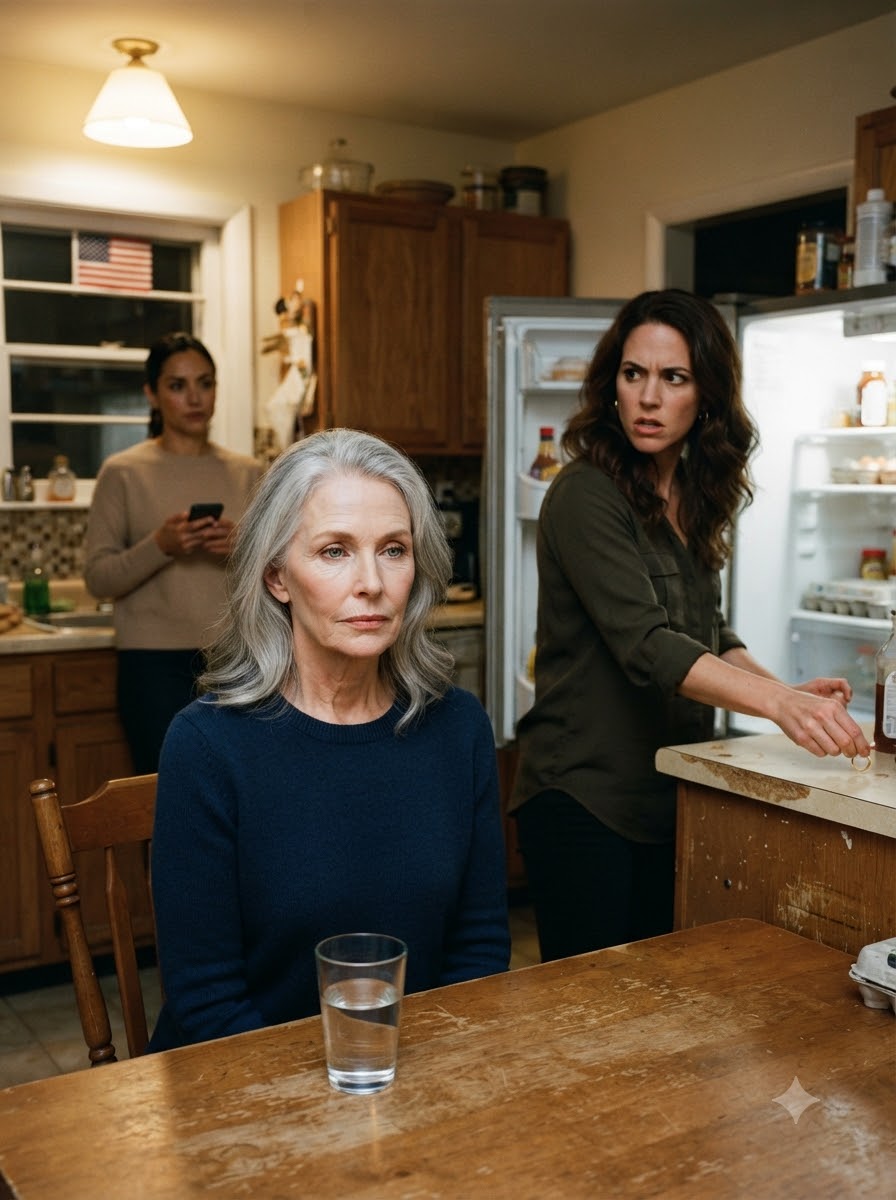
The kitchen light was off when Lanni’s headlight swept through the living room window.
I had been sitting at my kitchen table for more than an hour, watching the room darken around me the way it had been doing lately, slowly, without my noticing till it was already gone.
There was a glass of water in front of me.
Not because I was thirsty.
Because there was nothing else to put on the table.
I heard her key in the lock and her voice calling:
“Mom!”
From the hallway, the way it always rises at the end when she is not sure what she is walking into.
Then she turned on the light.
She stood in the kitchen doorway and looked at me.
Looked at the empty table.
Looked at the stove that had not been turned on since Tuesday.
Then she walked to the refrigerator and opened it slowly.
The way you open something when you already suspect what is inside.
Half a container of orange juice.
A stick of butter going soft on the middle shelf.
Nothing else.
“Mom,” she said very quietly, “you receive nearly $10,000 every month. Why is there nothing to eat in this house?”
And before I could gather the right words, Sandre appeared behind her in the hallway.
She had followed Lanni inside without knocking, which had become a habit of hers over the past 18 months.
“Because I oversee what comes in,” Sandre said pleasantly. “It is simpler that way. Your mother tends to lose track of things.”
Lanni turned around slowly.
She looked at her sister-in-law for a long moment.
Then she reached up, unclipped the small gold earrings she was wearing, and set them on the counter one at a time.
“Los track,” she said. “My mother taught high school mathematics for 32 years.”
My name is Selene Hadley.
I am 67 years old.
I have short silver hair and reading glasses I keep misplacing, and I have never once in my adult life been confused about money.
I spent three decades teaching algebra and calculus to teenagers who did not want to learn it.
And I did it well enough that two of my former students went on to become accountants.
When I retired four years ago, I had a pension that sends just over $9,000 into my account every single month.
I also had savings, a paid-off house in Asheville, North Carolina, and the quiet satisfaction of someone who had planned carefully.
I am telling you this because it matters.
Because one of the most painful things about getting older is that the moment you reach a certain number, others begin to treat your mind like a room they can rearrange without asking.
What happened to me did not happen because I was confused.
It happened because I was trusting.
Eighteen months before Lanni found me in the dark, I mentioned a brief dizzy spell to my son Kirk during a phone call.
I had been dehydrated and I said so.
But Kirk, who was living 40 minutes away with Sandre and their two children, turned that one sentence into a conversation.
And that conversation into a plan.
He drove over the following weekend.
He brought a pan of lasagna and a warm smile and sat at this same kitchen table and said:
“Mom, I just want to make sure things are looked after. Sandre understands finance. She could help you manage the accounts, just to simplify things.”
I told him I did not need help managing accounts.
I had never needed help.
He nodded patiently.
The way you nod at someone when you have already decided the answer.
“It is not about need,” he said. “It is about having a system. One less thing on your mind.”
Sandre set up the online banking that afternoon.
She changed the email address on file so statements went to her account.
She said it was to reduce my junk mail.
She asked me to sign a document that she described as a convenience force, something to allow her to make quick transfers in case I was ever traveling or unwell and needed something handled.
I signed it on a Sunday afternoon without reading it carefully.
That is the part I cannot fully forgive myself for.
I was a mathematics teacher.
I knew better than anyone that the small print is where the meaning lives.
But I was also a mother who wanted to believe her son was acting out of love, and I did not want to make him feel doubted.
The first month, nothing seemed different.
The second month, the cash Sandre brought when I asked was less than what I expected, but she explained there had been a quarterly insurance adjustment.
The third month, I asked to see a myself, and she said she would print it and bring it over.
She never did.
By month six, I had stopped attending my Tuesday lunches with the friends I had made through the music ministry at my church.
By month 10, I was asking Sandre for 60 or $80 at a time like a child, asking for an allowance.
I told myself I was being careful.
I told myself it was temporary.
By month 16, the refrigerator looked the way it did when Lanni found me.
I am not someone who sits quietly by nature, but something about the arrangement had made me smaller.
The way a door left ajar causes a whole room to go cold without anyone being able to name exactly when the chill started.
So when Lanni set down her earrings and Sandre said those words about losing track, something shifted.
Not just in the room.
In me.
Like a window finally opening.
Sandre did not seem particularly concerned.
She had the calm of someone who has rarely been questioned.
“Lanni,” she said reasonably, “your mother agreed to this arrangement. It protects her. There are investment allocations, financial structures. It is not as simple as it looks from the outside.”
“What investment allocations?” Lanni asked.
Sandre paused.
“Kirk manages several financial vehicles,” she said after a moment. “Your mother has a stake in his company’s growth.”
“Mom, did you agree to invest your pension income into Kirk’s business?” Laney asked, looking at me directly.
I thought about that Sunday afternoon and the paper I had signed.
I thought about the word convenience.
“Kirk said it would grow,” I said quietly. “He said it was protected.”
“What company?” Lanni asked.
“Sandre.”
That second pause was longer than the first.
“Commercial property renovation,” Sandre said.
Lanni looked at her for a moment.
Then back at me.
“How much of your 9,000 are you spending on yourself each month, Mom?”
“Maybe 200,” I said. “Some months less.”
Silence settled over the kitchen like a change in weather.
“$200,” Lanni said slowly. “Out of 9,000.”
Sandre crossed her arms.
“The rest is working for her future.”
Laney’s voice became calm in the specific way it becomes when she is not calm at all.
“Working where exactly?”
Sandre did not answer.
And that was the moment I understood something that had been living just beneath the surface of my awareness for months.
She had never actually answered a direct question.
She had always redirected.
Always explained alongside the thing I asked about.
Never the thing itself.
I had let it happen because I told myself she was handling complexity I no longer wanted to deal with.
But the truth was simpler.
She had been counting on the fact that I would not push.
I was 67 years old.
I had spent 32 years teaching students who thought they could get away with not showing their work.
“I want to see my account balance,” I said. “Tonight.”
Sandre looked at me carefully.
“The online system requires verification codes, and they go to my phone. I can bring printed statements by the weekend.”
“No,” I said. “Tonight.”
Sandre’s phone lit up on the counter where she had set it down.
Kirk’s name was on the screen.
She grabbed it quickly.
But Lanni had already seen it.
“Let him wait,” Lanni said.
Sandre answered anyway.
She moved toward the hallway, voice low.
I caught fragments.
Numbers.
The word protected.
The phrase not yet.
When she came back, the pleasantness had sharpened into something else entirely.
“Kirk would like to speak with you both tomorrow,” she said. “He will explain the full picture.”
“And tonight?” Laney asked.
“The accounts are in a protected status.”
“Standard hold because of a pending contract.”
“Protected by whom?” Lanni asked.
Sandre picked up her keys.
“By Kirk, who is handling this responsibly.”
She left without another word.
The door closed, and the house felt both quieter and lighter at the same time.
Lanni ordered groceries on her phone and stayed at the night.
She made eggs at nine, and we sat at the kitchen table with all the lights on and talked about things we had not talked about in a long time, including the fact that I had not told how much things had changed.
I had been too busy managing my own embarrassment to ask for help.
The next morning, we drove to my bank before nine.
The branch manager, a composed man named Mr. Okafer, asked for my identification and pulled up the records.
I watched his face as he scrolled.
It told me what I needed to know before he said a word.
In the 18 months since Sandre had set up the arrangement, $214,000 had been transferred from my account to an external business account registered to a company called Hadley Crane Property Solutions.
The current balance in my account was $143.
I did not cry.
I looked at the number.
And I understood exactly what it meant.
Lanni asked about the authorization.
Mr. Okaffor showed us the document on file.
It was not a convenience form.
It was a limited durable power of attorney granting Sandre authority to manage, transfer, and allocate funds on my behalf.
I had signed it on a Sunday afternoon without reading the title.
“Can it be revoked?” Lanni asked immediately.
“Yes,” Mr. Okafor said. “In North Carolina, a principal can revoke a power of attorney in writing at any time, provided they are legally competent, which you clearly are, Mrs. Hadley.”
I had the revocation signed before we left the building.
Mr. Okaffor also walked us through the process of flagging the account for a formal financial review given the pattern of outgoing transfers.
He spoke directly to me throughout.
Not around me.
Not at Lanni as a proxy.
I appreciated that more than I could say in the moment.
We were walking back to the car when my phone received a text from a number I did not recognize.
You are making a mistake. Stop now while there is still something to come back to.
I showed Lanni.
We went back inside and showed Mr. Okafor.
He added it to the file.
We drove home mostly in silence.
When we turned onto my street, Lanni saw it before I did.
The front door was not fully closed.
I had locked it when we left.
I always locked it.
Lanni told me to stay in the car.
I did not stay in the car.
We went inside together.
The living room was undisturbed.
The kitchen was undisturbed.
Phân cảnh 4: Lanie arrives, turns on the light, and removes her earrings
But the small cabinet in my home office, where I kept copies of the property deed, my retirement documentation, and my late husband’s life insurance papers, was standing open.
Documents were spread across the floor.
On top of them lay a business card.
Clean white card stock.
The name read:
Gerald Harker, financial restructuring consultant.
And below it, a phone number.
I did not recognize the name.
Lanni photographed everything and called the police.
Two officers came and wrote a report.
The lock had not been forced.
Someone had used a key.
Kirk had one.
He had asked for it a year ago, saying he wanted to be able to check on me if I was ever unreachable.
That evening, Kirk arrived with Sandre.
I opened the door and let them in.
But did not offer coffee.
Lanni stood beside me.
And I noticed she had put her earrings back in.
Which meant she was done with one kind of seriousness and had moved into another.
Kirk looked tired in a way I had not seen before.
Not the tiredness of a man who has been dishonest.
The tiredness of a man who has been carrying something too heavy for too long and has finally run out of road.
He sat at my kitchen table and put his hands flat on the surface.
“Mom,” he said, “I need to explain.”
“Yes,” I said. “You do.”
His company had taken on a large commercial property contract two years ago.
A warehouse conversion.
Investors pulled out eight months in.
Suppliers stopped receiving payment.
The debt compounded faster than he expected.
Gerald Harker had appeared through a business networking cont and presented himself as a specialist in financial restructuring.
He told Kirk that routing income through a family member’s established account could demonstrate liquidity to remaining creditors and create space for refinancing deal.
Harker had helped draft the convenience form.
He had advised on the specific wording to obscure its legal function.
“He called it a bridge,” Kirk said.
His voice broke on that word.
“He said by the time the refinancing closed, everything would be back in your account with interest.”
“When was that promise made?” Lanni asked.
Kirk was quiet.
“Fourteen months ago,” Sandre said softly.
The silence in the room was not empty.
It was full of every small envelope of cash.
Every canceled trip.
Every Tuesday lunch I skipped.
Every plant I did not buy for the porch.
“Kirk,” I said, “did you use this house as collateral for any of this debt?”
He did not answer immediately.
That silence was its own answer.
“There was a bridge loan,” he said. “Harker arranged it. The property deed was listed as secondary collateral. He said it would never be triggered.”
“How much is the loan?” Laney asked.
“180,000.”
My house.
The one I had lived in for 19 years.
Where my husband died in the back bedroom holding my hand on a Tuesday morning in April.
“Kirk,” I said. “Look at me.”
He did.
“I am not confused,” I said clearly. “I have never been confused. You took advantage of the fact that I loved you enough to trust you without asking for documentation. That is a very different thing, and I need you to understand the difference.”
He nodded.
His eyes filled.
But I did not reach for him the way I once would have.
Not yet.
Lanni had already contacted an attorney.
She arrived within the hour.
A focused woman named Miss Tate, who asked very precise questions and reviewed every document on the table with an expression that gave nothing away until she was ready to speak.
“The document you signed was drafted to appear routine,” she told me. “The scope of authority granted here is far beyond what a reasonable person would understand from a casual verbal explanation.”
She continued.
“Combined with the removal of statements from your access and the pattern of minimal personals distributions, this raises serious financial exploitation concerns under North Carolina Elder Law.”
Sandre shifted in her chair.
“We intended to return everything.”
Miss Tate looked at her steadily.
“Intent to return funds does not retroactively transform unauthorized use into authorized use.”
Harker arrived 40 minutes later.
Kirk had contacted him, and he had chosen to come.
Which told me something about how confident he was in his own position.
He was smooth in the way of someone accustomed to being the most assured person in the room.
He was not the most assured person in this room.
Miss Tate asked him directly whether he had advised Kirk to use a mislabeled power of attorney to redirect pension income without the account holder’s informed understanding of the document scope.
He said the documentation was standard.
She asked whether he had facilitated the use of retirees primary residence as undisclosed secondary collateral.
He said the arrangement fell within normal restructuring parameters.
She informed him she would be filing a complaint with the North Carolina Secretary of State’s office and the state financial regulatory board.
And that a threatening text messages sent to my phone would be included in the report.
His polished expression came apart at the seams.
After he left, Kirk sat in the same chair.
Smaller than when he had arrived.
“What happens to the company?” he asked.
“That is not my first concern,” I told him.
He flinched.
“My concern is my account, my house, and the fact that for 18 months I sat at this table asking your wife for $60 in an envelope while over $200,000 of my money was somewhere else.”
He put his face in his hands.
I watched him and felt something that did not have a clean name.
Not coldness.
Not forgiveness either.
Something in between.
Honest and complicated and not yet resolved.
“I want you to sit across from Miss Tate,” I said, “and tell the truth about every dollar and every document. Not to protect yourself. To protect me. That is what you owe me now.”
He nodded.
“And Kirk, the next time you are drowning in something, you call me first. Not a consultant you met at a networking event who has never sat at this table and does not know your name. Me.”
The investigation that followed took 11 weeks.
The bank’s review confirmed the full transfer pattern.
Ms. Tate negotiated directly with the bridge lender, presenting documented evidence that the property collateral had been registered through a fraudulent advisory structure without the homeowner’s informed consent.
The lender, unwilling to invite regulatory scrutiny, agreed to restructure the loan terms and remove the lean from my property.
My house was formally and unambiguously mine again.
Gerald Harker’s professional conduct became the subject of a state regulatory inquiry.
I later learned he had run variations of the same arrangement with two other families in the Carolinas.
The threatening text messages were traced to a debt collection firm operating on behalf of one of Kirk’s creditors.
Not Kirk himself.
But silence had made room for that pressure to reach me.
And that was something Kirk would have to carry forward.
Kirk’s company closed.
He declared personal restructuring and began working for a contracting firm at a level far below where he had been.
He came to see me on a Tuesday evening six weeks after the investigation concluded.
He sat at my kitchen table and said:
“I do not know how to apologize for something this large.”
I poured him coffee and sat across from him.
“You can start,” I said, “by being honest about what it actually was. Not a mistake. Not a bridge loan gone wrong. A choice. You chose not to tell me what was happening. Every month for 18 months, you chose it again.”
He was quiet for a long time.
“Yes,” he said finally.
That single word was the beginning of something.
Not restored trust.
Not yet.
But an honest foundation that might, over time, become something worth building on again.
Lanni called that night after he left.
“How do you feel?” she asked.
I looked around my kitchen.
The refrigerator was full.
The lights were on.
The heater was running.
Those were small things.
And they were also not small at all.
“Clear,” I said.
“I feel clear.”
The thing about silence is that it has a texture.
When you live inside it long enough, it begins to feel like peace.
Like you are keeping things together.
Not making trouble.
Not being difficult.
But there is a particular kind of silence that is not peace at all.
It is the silence of a room where someone has been making decisions about your life and counting on you not to ask questions.
I was a mathematics teacher for 32 years.
I spent my career teaching people that the only way to find the right answers is to show your work and then check it.
Age did not change that.
Sixty-seven did not change that.
If you are someone who has handed over access to your finances because a family member said it would be simpler, I want you to hear this.
You are allowed to ask for your own statements.
You’re allowed to revoke what you signed.
You’re allowed to walk into a bank and say your own name and ask exactly what is happening with your money.
Competence does not expire.
The right to understand your own financial life does not expire.
I worked for 32 years.
I planned carefully.
I loved my son honestly.
My home is mine.
And the next time the kitchen went dark, I was the one who reached up and turned the light back on.
If this story reached you, if it made you feel something or reminded you of someone you love, please like and leave a comment below.
Your support helps these stories find the people who need to hear them most.
And if no one has told you lately, you are allowed to ask questions.
You are allowed to know.








