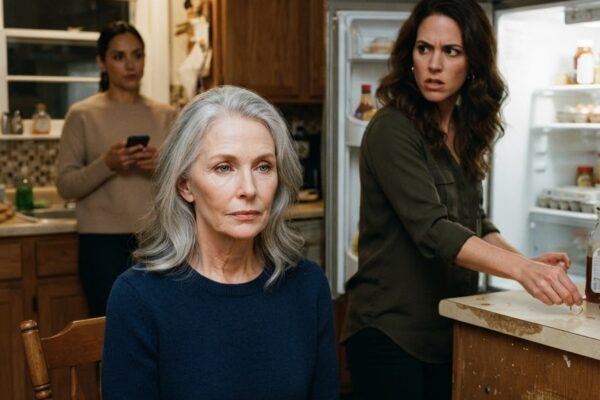
Every Thanksgiving, my sister—the family’s “golden child”—hosts the dinner, while I bring the pie. This year, she insisted that my little one and I stay the night in the living room. At 1 a.m., I smelled gasoline wafting in through the door cracks, but the door wouldn’t open. My brother-in-law shouted from outside, “Climb out the window! Right now! She just took out a $400,000 insurance policy.” My legs gave way when I saw…

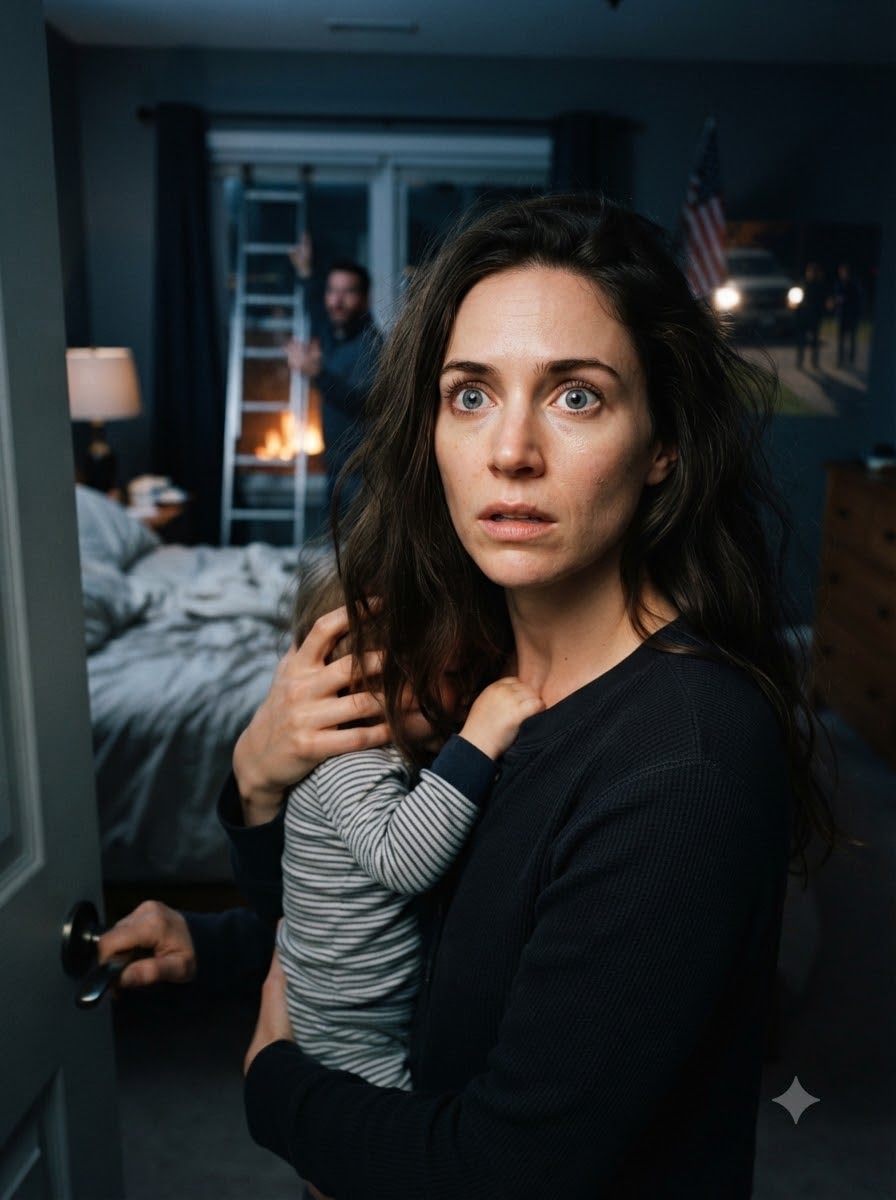
At 1:04 in the morning, the guest room door at my sister’s house turned at the knob and did not open.
And the carpet under my bare feet smelled like a gas station.
My daughter June was asleep against my chest with her whole fist wrapped around my left index finger, the way she has slept since the day she was born.
And every breath she took had a small catch in it, a little click at the back of her throat.
The bottom of the door was wet.
I could feel it through my sock where I’d stepped.
I said my sister’s name through the wood.
“Tessa.”
Quietly, the way you say it in somebody else’s house at one in the morning.
Then louder.
“Tessa. The door’s stuck.”
Nobody answered.
Below the window, the little panes of glass in the garage door were glowing orange.
And the orange was moving.
I stopped pulling on the knob.
I zipped June into her green sleep sack up to her chin, put my phone in the pocket of my cardigan, and looked at the clock on the nightstand.
The way I look at the clock at the start of every deposition I’ve ever taken, so I could write down the time later.
I didn’t know yet why that would matter.
I unlatched the window.
Down on the lawn, my brother-in-law, Dale, was dragging his extension ladder off the side of his truck and slamming its feet into the frozen grass under the porch roof.
“Tell Tessa the door’s stuck!” I shouted.
He looked straight up at me.
“Go out the window now. She took out a $400,000 policy.”
The bonus room at Tessa’s house sits over the garage, and its front window opens onto the shallow roof of the porch.
I’d seen my nieces sit out there in summer with popsicles, which is the only reason I knew it would hold me.
The shingles were white with frost.
I went out on my backside with June held against me in my right arm.
And I came down that roof one heel at a time.
I did not look at the orange in the garage windows.
Dale had the ladder against the gutter.
He held it with both hands and didn’t look at my face.
“Hand her down,” he said.
Then, before I could:
“No. Keep her. Just come.”
I turned and found the first rung with my foot.
That’s when I could see the whole driveway.
Tessa’s SUV was idling at the curb with its headlights on.
Through the back window, I could see my nieces, Addie and Bri, nine and six, buckled into their car seats in their winter coats with the hoods up, zipped to their chins.
And in the front passenger seat was my mother.
She was sitting very straight.
Her seat belt was across her chest.
She had my sister’s purse on her lap, held with both hands, the way she holds her own purse in church.
And at the end of the driveway, next to the mailbox, stood Tessa in jeans and her lace-up boots.
The laces tied.
Her phone in her hand.
Not at her ear.
In her hand.
I want to tell you what I thought.
And the truth is, I didn’t think anything.
It was like the times my steno paper has run off the end of the roll and my hands keep going.
Writing down words that aren’t landing anywhere.
Two rungs down, my legs gave out.
They just folded.
Dale caught my elbow and held me against the ladder.
I wanted to walk straight across that lawn, knock on my mother’s window, and ask her what time she’d buckled her seat belt.
I didn’t.
June was coughing a little against my neck.
The air coming off the garage tasted like a burned pan.
And the only thing in the world that mattered was getting her away from it.
So I stood up on that ladder and went down the rest of it.
When my feet hit the grass, Tessa looked at me.
And then, only then, she started screaming my name loud enough for the neighbors whose lights were coming on.
She reached me before I’d taken five steps and threw her arms around me and June both.
“Oh my God. Oh my God, Leah.”
Into my hair.
Her hands were cold.
Her hair smelled like her shampoo.
It didn’t smell like smoke at all.
The Liberty Township trucks came up the street with their lights going and no sirens, which I found out later is what they do at night in a neighborhood.
Tessa let go of me and went straight to the captain.
I heard her say:
“There was a gas can in the garage by the heater. My sister brought it. Oh my God, I didn’t even think.”
I stood on the lawn with June and looked for Dale.
He was standing by his truck.
I went to him and said, very low:
“What policy?”
He looked past me at the SUV where his daughters were watching us through the glass.
He turned his wedding ring around his finger with his thumb.
Around and around.
“Not now,” he said. “Leah, not now.”
A paramedic touched my arm and said she wanted to check the baby’s breathing.
I let her lead me to the back of the ambulance.
I sat on the bumper with a blanket around both of us.
From there, I could see the SUV.
My sister walked over and leaned into the driver’s window to say something to my mother.
My mother didn’t get out.
When the ambulance doors closed, she was still sitting in the front seat of Tessa’s car.
Eleven hours earlier, I had come in through the side door with three pies, the way I have every Thanksgiving for 11 years.
Tessa hosts.
I bring the pies.
Pumpkin.
Pecan.
And an apple in my father’s old aluminum pie tin, the one with the dent in the rim.
Carol Hensley from Tessa’s church was at the kitchen island.
Tessa kissed my cheek, took the apple out of my hands, and said to Carol:
“Leah just brings the pies. I do the actual holiday.”
Carol laughed.
My mother laughed.
I laughed too, I think.
“Set that gas can by the heater in the garage, hon.”
Tessa had called the day before and asked if I’d pick up a can of gas on my way through Newark for the generator because Dale never remembers.
“Get it at the Speedway by the exit because it’s cheaper.”
I’d done it with June asleep in her car seat.
I set the can where she said.
Later, looking for the pie server, I opened the drawer under the mail basket.
And in the basket, I saw an envelope with a little blue lighthouse printed in the corner and my own name showing in the window.
Tessa reached past me and turned it face down.
“Junk,” she said. “They sell your name to everybody once you have a baby.”
Then she said:
“Stay over tonight. I made up the bonus room.”
In 11 years, I had never stayed past the dishes.
I’d always been the one who brought something and left before anybody had to figure out where to put me.
I called my agency from her hallway and canceled my Friday morning job.
And I was so happy that I was embarrassed by it.
At 34 years old, I still took an invitation to sleep in my sister’s spare room as proof that I was wanted.
Around ten, Tessa offered to put June down in the girls’ room so I could get some real sleep for once.
I said June was cutting a tooth and wouldn’t settle without me.
Tessa said:
“Suit yourself.”
And kissed the top of my daughter’s head.
Eleven hours later, a paramedic was counting my daughter’s breaths.
The hospital in Dublin put us in a curtained bay with a monitor that clipped onto June’s toe and glowed red.
Her oxygen was 99.
A nurse named Patrice listened to her chest twice and told me she sounded clear and that babies are better at this than we are.
June fell asleep again with her hand around my finger.
On the other side of the curtain, I could hear my sister.
She’d followed the ambulance in with my mother.
She was speaking to the nurse at the desk in the quiet, helpful voice she uses for teachers and pastors.
“She’s not well. She hasn’t been since the baby.”
I couldn’t see my mother.
I could see her shoes under the curtain next to Tessa’s boots.
And I watched one of them shift as she nodded.
A Delaware County deputy came in around three.
He was young and polite.
And he wrote with a pen that clicked.
I told him what I’d heard.
I didn’t paraphrase.
I gave it to him the way I’d give it in a transcript.
Word for word.
With the time.
“Go out the window now. She took out a $400,000 policy.”
He wrote it down.
Then he went to find Dale, who had come in last.
I watched them through the gap in the curtain.
Dale was turning his ring.
When the deputy came back, he said:
“Mr. Brandt says he told you to get out the window. He says that’s all he remembers saying.”
“That isn’t all he said.”
“Okay. A policy with whom, ma’am?”
I didn’t know.
I didn’t know the company or the amount except for what Dale had shouted.
Or who had signed anything.
Or why.
I heard myself telling a sheriff’s deputy at three in the morning, in a hospital gown they’d given me because my sweater smelled like gasoline, that my sister had insured my life.
And I could hear exactly how I sounded.
I sounded like the woman my sister had just described to the nurse.
At five, a man in a canvas jacket that smelled like wet smoke pulled back the curtain and introduced himself as Investigator Marcus Bell from the state fire marshal’s office.
He was gray at the temples.
And he didn’t sit down.
He said the fire had been held to the garage and the back stairs and that nobody had been hurt.
And that he’d need to talk to me formally on Tuesday at 10:30 at his field office.
“My report goes to the county prosecutor a week from Monday,” he said. “Whatever’s in it by then is what they’ll work from.”
That gave me ten days.
When he left, the hospital social worker came in with a clipboard and told me gently that Children’s Services would be calling me sometime today.
I was 16 the first time I made a pie by myself.
My father taught me.
Frank Kowalsski was a lineman for the electric company.
He had big cracked hands.
And he could roll out a crust better than anyone I’ve ever known, using a wine bottle because we didn’t own a rolling pin.
He gave me the aluminum tin with the dent in it, the one his mother had used.
And he showed me how to crimp the edge with a fork so it came out as even as the teeth on a comb.
I made an apple pie that Thanksgiving.
I remember carrying it out of the oven like it was made of glass.
Tessa was 20 that year.
Home from Ohio State.
She came in the door with a pie from the bakery on Main Street in a white box with a string around it.
My mother set Tessa’s pie in the middle of the table on the good cloth.
She took mine out of my hands and smiled at me.
Then set it on the counter by the microwave.
“For later,” she said.
Nobody cut it at dinner.
After everybody had gone into the living room for the game, my father stood at the sink and ate two pieces of my pie off a paper towel.
He told me it was the best crust in the house.
I believed him.
And I also knew where my pie had been put.
Seven years later, Tessa married Dale Brandt and they bought the house in Powell.
And from then on, the holiday was hers.
I don’t think anyone ever said it out loud.
It just became the way things were.
Tessa hosted.
I brought the pies.
I came in through the side door because it opened into the kitchen and I didn’t want to make anyone get up.
I set my pies down.
I helped where I was asked.
And I left before the dishes were finished so nobody had to work out whether there was room for me on the couch.
I got good at it.
I got so good at being there without taking up any space that I stopped noticing I was doing it.
Eighteen years after that first apple pie, I was still walking into my sister’s house through the side door.
At 6:40 that Friday morning, I was home in my half of a duplex in New York with June asleep in her crib and my laptop open on the kitchen table.
My phone was at 9%.
I typed out everything before I could lose it.
That’s the habit of the job.
I’ve been a freelance court reporter for ten years, which mostly means I sit in conference rooms with lawyers and take down every word of a deposition.
And the first thing you learn is that memory goes soft in about a day.
So I wrote it the way I’d write a transcript.
10:04 a.m. Door does not open. 1:06 window. 1:08 ladder.
What Dale said in quotation marks.
Where Tessa was standing.
What my mother was holding.
When I’d finished, I changed June and fed her.
And while she ate, I looked at the baby book on the shelf over the changing table.
The first page is her ultrasound picture.
The one where she had the hiccups, with the date and the time printed in tiny white numbers in the corner.
I’d taped it in myself.
At eight, a woman named Ranata Sims from Licking County Children’s Services called to set up a home visit for one.
She was reading from something.
“The referral notes that you purchased gasoline on Wednesday at 4:12 p.m. at the Speedway on Route 16.”
I had not told anyone which gas station.
Not the deputy.
Not the nurse.
Not Investigator Bell.
The only person who knew which Speedway was the person who had told me to go there.
“Yes,” I said. “I bought it.”
Ms. Sims said:
“Okay.”
Confirmed one and hung up.
I sat down on the floor next to June’s crib with the phone in my lap.
My sister had called me on Wednesday and asked me for a favor.
And I’d done it the way I’ve done everything she’s asked my whole life.
She hadn’t asked me for a favor.
She’d asked me for a receipt.
I have signed a lot of things for that family.
The one I think about most, I signed three days after we buried my father.
I was 28.
We were at my mother’s kitchen table in Heath with the casserole dishes from the funeral still stacked by the sink.
People’s names on masking tape.
Tessa put a sheet of paper in front of me and a pen next to it, already clicked open.
It said that I agreed to let my share of Dad’s life insurance go to my mother and Tessa to cover the house and the arrangements, since Tessa had a family and I didn’t yet.
That was how she said it.
“Since you don’t have a family yet.”
I asked what was on the second page.
My mother put her hand flat on the table.
“Tessa has it handled,” she said. “Please don’t make this harder.”
Something in me wanted to turn that page over and read it the way I’d read anything else put in front of me at work.
I didn’t.
Because my mother was watching me.
And because it was three days after the funeral.
And I didn’t want to be the daughter who made her cry over a form.
I signed it.
When I did, my mother reached over and laid her hand on my shoulder for the first time that week.
And I felt such relief that I was ashamed of it.
Later, I found out Tessa had filled in the date for me.
And that there had been a box on the second page I’d missed.
And she’d initialed it with my initials to save time.
She [snorts] told me about it herself, laughing like it was a thing sisters do.
My signature on that page didn’t look like mine.
It looked like a name I’d typed into a transcript for a stranger.
The only thing I asked for afterward was Dad’s pie tin.
Tessa said it should stay with the house since Mom would be hosting less and she’d be hosting more.
And she took it home to Powell in a grocery bag.
After that, Tessa did Mom’s paperwork.
Mom’s checks.
Mom’s bills.
Mom’s prescriptions.
Mom’s mail.
Everybody said it was a blessing that she was so organized.
I have signed a lot of things to keep that family quiet.
I was about to be asked to sign one more.
Ranata Sims was in her 50s, with reading glasses on a beaded chain and a clipboard she held against her chest when she wasn’t writing on it.
She was neither friendly nor unfriendly.
She asked if she could take pictures.
I said yes.
She photographed June’s crib.
The inside of my refrigerator.
My medicine cabinet.
And the smoke detector in the hallway, which she pressed with the end of her pen until it shrieked.
In the corner of my living room, she looked for a long moment at my steno machine on its tripod and at the boxes of transcripts on the shelf above it.
Each one labeled with a date in black marker.
“This is your work?”
“Depositions mostly.”
“Some hearings?”
“You keep all of these?”
“Seven years. It’s required.”
She wrote something down.
Then she sat on the edge of my couch and asked about feeding, sleeping, doctor visits.
And then she asked about June.
Not my June.
The month.
“Your sister provided some text messages from early June,” she said. “Can you tell me about that time?”
I told her the truth.
That June had screamed every night for three weeks with what turned out to be reflux.
That I hadn’t slept more than two hours at a stretch.
That I’d been frightened and alone.
And that I’d called my doctor twice.
And that the doctor had changed her formula and it had gotten better.
Ms. Sims wrote all of it down.
“Your sister also said that you’d asked her to be a guardian for the baby,” she said. “And that you bought life insurance so June would be provided for.”
“I put her down as guardian in October. She asked me to. I never bought any insurance.”
Ms. Sims looked at me over her glasses.
She didn’t argue.
She wrote it down in the same handwriting as everything else.
“The assessment stays open,” she said. “Until we hear from the fire investigator.”
She thanked me for my time at the door.
When I closed it behind her, I stood with my hand still on the knob for a long time.
Tessa had told a stranger the policy was mine.
If I was going to say it wasn’t, I was going to have to find it.
And I remembered the envelope in my sister’s mail basket.
The one she’d turned face down.
With the little blue lighthouse in the corner.
I spent that Friday night at my kitchen table with June asleep in the bouncer by my feet, searching for life insurance companies with a lighthouse in their logo.
It’s the kind of thing I’m good at.
Lawyers hand me exhibit lists with company names misspelled, and I find the right ones before the first break.
There were three.
One was in Maine.
One only sold boat insurance.
The third was Lakeshore Mutual Life, with a home office in Columbus, 40 minutes from my front door, and a little blue lighthouse that matched the one I remembered exactly.
Their customer line opened at nine on Saturday.
I called at 9:01.
I gave the woman my name and my Social Security number.
And I asked whether there was a policy on my life.
There was a pause.
The sound of typing.
“I do show a policy under that social,” she said. “You’re listed as the owner and the insured.”
I put my hand flat on the table.
“I’m the owner?”
“Yes, ma’am. I’ll just need to verify a couple of things before we go further. Can you confirm the phone number on file?”
I gave her my number.
“That’s not the number I have.”
“The email address?”
I gave her my email.
“I’m sorry. That doesn’t match either.”
“Because I didn’t open this policy. That’s the whole point. Somebody opened it using my name.”
I want to explain what that word meant because I didn’t understand it right away.
On a life insurance policy, the owner is the person who buys it and controls it.
The insured is the person whose death pays it out.
The beneficiary is the person who gets the money.
Somebody had made me the first two.
Which meant that, on paper, I had bought a policy on my own life.
And there was only one name I could imagine in the third box.
“Can you tell me who the beneficiary is?”
“Not until I can verify you.”
“Ma’am, I’m sitting here with my driver’s license in my hand.”
“I understand. I can’t see it over the phone.”
I could hear how patient she was being.
And how many calls like mine she must get from people who aren’t who they say they are.
I’d spent my whole working life on the side of the table where people prove things.
I’d never once thought about how it would feel to be on the other side with nothing to prove it with but my own voice.
She told me very kindly that she couldn’t discuss the policy with someone who couldn’t pass verification.
And that I could contact their fraud department or write to them.
I asked her for one thing.
Only one.
“When was it issued?”
There was a little silence.
The kind where someone decides whether a fact is harmless.
“It was issued in March,” she said.
In March, I’d been seven months pregnant.
In March, I’d been going to the doctor every two weeks with my ankles swollen and the baby kicking under my ribs.
I wrote the word March on the back of an envelope and drew a box around it.
Then she said:
“For your security, ma’am, a notice of this attempt has been sent to the contact on file.”
Forty minutes later, my phone rang.
It was Tessa.
She didn’t sound the way she’d sounded on the lawn.
She sounded the way she sounds when she’s calling the cable company.
“You need to stop calling people,” she said.
“What people?”
“Leah, you’ll only confuse them. You’ll confuse Mom. You’re not thinking straight. And honestly, nobody would blame you after the year you’ve had.”
I held the phone with both hands.
“Who did you insure, Tessa?”
She laughed.
It was a small, tired laugh.
Like I was a child asking where the dog went.
“You type what people say, Leah. Nobody asks what you think.”
Then she read me something.
She read it slowly, like a passage from a book she knew by heart.
“I’m not good at this. You’d be better at this than me.”
It was a text I’d sent her at three in the morning in June, with June screaming in the next room.
I’d forgotten I’d written it.
She hadn’t.
Dale’s name was right there in my mouth.
I wanted to say:
Dale saw it.
Dale told me.
Dale was there.
I didn’t say it.
I didn’t know what it would cost him inside that house if I did.
“I’m going to hang up now,” I said.
“Mom’s worried about June,” she said, as if I hadn’t spoken. “She’s talking to someone.”
Then she was gone.
I sat at my table and realized that I’d just had one of the most important conversations of my life.
And I hadn’t recorded a word of it.
I opened the voice memo app on my phone and dragged it to the middle of my home screen where my thumb would find it without looking.
From then on, every conversation I was part of, I was going to have a record of.
It’s a strange thing to decide about your own family.
It felt like changing the locks.
And it came one call too late.
Because the line I kept hearing for the rest of that day wasn’t the insult.
It was the last thing she’d said in that same easy voice.
Mom’s worried about June. She’s talking to someone.
I took June to the New York police station that afternoon because it was the only door I could think of.
There was a line at the front window.
A man with a towed car.
A woman with a dog bite.
When it was my turn, I explained it to the officer behind the glass as clearly as I could.
A life insurance policy existed in my name that I had not purchased.
Someone had used my identity to buy it.
My sister was the likely beneficiary.
And two nights earlier, there had been a fire in the room where I was sleeping.
He listened.
He wasn’t unkind.
Then he said:
“So you’re listed as the owner of the policy?”
“Yes, but I didn’t buy it.”
“And you’re alive, and nobody’s taken any money from you.”
“Not yet.”
“Ma’am, I hear you. But right now, that’s a civil matter between you and the insurance company. Nobody’s taken anything from you yet. And the fire’s in Delaware County. That’s the state fire marshal and their sheriff. Not us.”
June had started to fuss.
The man behind me sighed.
The officer slid a pamphlet about identity theft under the glass with a report number written on the front in blue pen.
He told me to keep it for my records.
In the car, I folded it in half.
And in half again.
And again.
Until it was a hard little square I could close my fist around.
I understood what was missing.
It wasn’t enough for me to say I hadn’t bought the policy.
I needed to prove that somebody else had, using my name.
My phone rang in the parking lot.
It was Gail Navaro, a family lawyer I’d taken depositions for since my first year, who once told me I was the only reporter in central Ohio who never asked her to spell anything.
I’d left her a message that morning.
“Do not walk into that interview on Tuesday without me,” she said. “And Leah, pull the docket on your sister’s house.”
On Sunday morning, with June asleep for what I knew would be about 40 minutes, I did what I do for lawyers every week.
I pulled the records.
The Delaware County Clerk of Courts has an online docket.
So does the county recorder.
If you know how to read them, they’ll tell you more about a family than the family will ever tell you about itself.
The first thing I found was a foreclosure.
In September, Tessa and Dale’s bank had filed to foreclose on the house in Powell.
The house I’d been sleeping in.
The house with the bonus room.
Then the recorder’s site.
In February, a second mortgage had been recorded on that same house for $85,000.
With two signatures.
Dale’s and Tessa’s.
And a notary stamp.
Then I searched the business name.
Brandt Roofing had been sued twice that year by suppliers for unpaid invoices.
I sat back.
The picture that made on my laptop screen was a roofing company going under.
Dale’s company.
I thought about Dale on the lawn at one in the morning.
Fully dressed.
His work boots on.
I thought about how fast that ladder had come off his truck.
I thought about the gas can in the bed of that truck.
I’d seen it in his headlights.
The red plastic lid.
I’m going to tell you something I’m not proud of.
Sitting at my kitchen table, I wanted it to be Dale.
I wanted it so badly that my hands were steady for the first time in two days.
Because if it was Dale, then it was a brother-in-law drowning in debt who had done a terrible thing.
And my sister was just a woman who’d married the wrong man.
And the person who wanted me dead wasn’t my own blood.
I printed the mortgage page with the notary stamp on it.
The foreclosure filing.
And the two lawsuits.
I put them in a manila folder.
I wrote DALE on the tab.
Then I sat looking at it.
I got up and pulled the kitchen curtains closed in the middle of the day.
June woke up at minute 38.
I was lifting her out of the crib when I heard a diesel engine slow down in front of my duplex and stop.
I knew the sound of that truck.
I’d ridden in it to my father’s funeral.
I put June in her bouncer by the window where I could see her.
And I started the voice memo before I opened the door.
Dale didn’t come in.
He stood on my porch in his canvas work coat with his hands in the pockets.
He looked like he hadn’t slept since Thursday.
“Don’t repeat what I said,” he told me. “Out there on the lawn. Don’t repeat it to anybody.”
“I already did. I told the deputy.”
“I know. They called me.”
He looked out at the street.
“Tess says you set it all up yourself. The insurance for June. She says you asked her to be the one who’d get it if anything happened to you.”
“Do you believe that?”
He didn’t answer.
He took one hand out of his pocket and put it on my porch railing.
On the exact spot he’d fixed for me back in April when the bracket came loose.
He’d done it for free and wouldn’t even take a beer for it.
“How’s the business, Dale?”
“Business is fine,” he said. “Tess does the books.”
He turned his ring with his thumb.
“There’s a foreclosure filing on your house.”
He looked at me for a long second.
“That’s a mistake. Tess is handling it.”
Then he said it almost to himself.
“I came downstairs because she wasn’t in bed. That’s all. Around midnight. And there was a paper on the kitchen island with a lighthouse at the top and 400 and your name. And she came in from the garage and picked it up and said it was nothing. An old thing. Go back to bed.”
He stopped.
His phone was ringing in his coat.
He took it out.
I saw the name on the screen.
Tess.
He answered it standing on my porch.
“Hey,” he said. “Yeah, no, I’m at Home Depot. I’ll grab the filters.”
He said it so smoothly.
So easily.
He hung up.
And I didn’t know whether I was looking at a man who was scared of his wife or a man who’d had a lot of practice saying where he was.
I’d taken half a step back behind my screen door without meaning to.
“I have to go,” he said. “Leah, I’ve got the girls to think about.”
He went down my steps and got into his truck.
I stopped the recording.
Played back the last minute standing in my doorway.
[snorts]
He’d told me about a paper and a lighthouse.
He had not said, not once, what he’d shouted at me from the lawn.
A paper with a lighthouse on it isn’t a crime.
A husband shouting what his wife has done is.
I have to go back to June, the month, for a minute because I’ve had a lot of time to think about it since.
For three weeks that summer, my daughter screamed every night from about ten until about four.
I walked her up and down the hall of the duplex until I could have drawn the floorboards from memory.
One night at three in the morning, sitting on the bathroom floor with her because the fan noise sometimes helped, I texted my sister.
I’m not good at this. You’d be better at this than me.
Tessa came the next week.
Once.
She brought a chicken casserole and held June and took a picture of herself doing it.
And she was gone in 40 minutes.
The reflux medicine started working in July.
And I forgot about that text.
Then in October, Tessa called me on a Sunday evening in a voice I hadn’t heard from her in years.
Soft.
Almost shy.
“I want to be in her life. Put me down as her guardian, just in case. You know, God forbid.”
I filled out the form at Gail’s office that week.
I was happy for days.
Three weeks after that, she invited me to stay over for Thanksgiving.
I remember practicing in the car on the way to Powell what I’d say to her at the table.
How I’d thank her for having us.
The way you’d practice before a job interview.
At the time, I thought every one of those things was my sister coming back to me.
Every one of them was a step.
And the messages I’d sent that June, the worst ones, the ones I’d forgotten, weren’t in my phone anymore.
I’d cleared my phone in August.
They were in hers.
On Monday morning at 8:05, with Gail on speakerphone in my kitchen, I called Lakeshore Mutual’s fraud line.
Gail had told me what to say.
And she’d told me to file a report on the Ohio Department of Insurance website while I was on hold.
So I did both at once.
Typing with one hand while June chewed on a plastic giraffe in my lap.
The man who took the report was quiet and slow and asked me to spell everything.
At the end, he gave me a reference number.
He said someone from their special investigations unit would call back within two business days to verify with the policy owner.
I read him my phone number twice.
Digit by digit.
To make sure.
Then I wrote the reference number on the little whiteboard on my refrigerator under the time of June’s next feeding.
And underlined it twice.
Gail explained what the unit was.
“Every insurance company has one,” she said. “A small office of people whose whole job is deciding who is lying to them. Most days it would be the person on the phone.”
This time, I needed it to be somebody else.
When I hung up, I let out a breath I’d been holding since Saturday.
It was the first thing in four days that existed on paper.
“Good,” said Gail. “And then seven days, Leah. And tomorrow, Bell gets to ask the questions.”
The state fire marshal’s field office was a low brick building off Route 23 with a flag that clanged against its pole in the wind.
Gail met me in the parking lot in her good coat.
My neighbor, Mrs. Ortiz, had June for three hours.
The first time I’d left her with anyone.
Investigator Bell’s interview room had a table.
Four chairs.
A box of tissues.
And a small black camera up in the corner of the ceiling.
He sat down across from me, looked up at the camera, and said:
“Interview with Leah Kowalsski. Tuesday, December 1st, 10:31 a.m.”
I’d heard lawyers say that sentence a thousand times.
I’d never heard it with my own name in it.
He laid out what he had.
And he did it without any drama at all.
There were signs that an accelerant had been used on the back stairs.
There was a receipt from the Speedway on Route 16.
Wednesday, 4:12 p.m.
For a two-gallon can and the gas to fill it.
Paid with my debit card.
There was a statement from Tessa Brandt saying that I’d brought the can into the house and wanted it by the heater.
There was a statement from Dale Brandt saying he’d woken up to the smoke alarm, seen the fire, and called up to me to use the window.
“Your brother-in-law doesn’t remember mentioning insurance,” he said.
I asked if I could read him what I’d written down on Friday morning.
Gail nodded.
I read it to him from my laptop.
The times.
The words.
Where everyone was standing.
He listened all the way through.
When I finished, he flipped back a page in his own notebook and looked at it for a while.
“That’s the same thing you told the deputy at the hospital,” he said. “Word for word.”
“That’s my job.”
“I know what your job is. I looked it up.”
He tapped his pen on the table.
Then he asked me something that surprised me.
He asked how quickly Mr. Brandt had gotten his ladder off the truck.
And whether I’d seen a second gas can.
I told him about the red lid in the truck bed.
He wrote it down without looking up.
And I understood that he hadn’t made up his mind about Dale either.
I slid my notes from Monday across the table with the Lakeshore reference number at the top.
Bell read it and slid it back.
“That tells me you made a phone call,” he said. “Anybody can make a phone call. Bring me paper with a date on it, Miss Kowalsski. Something somebody else made.”
“I’m trying. They won’t talk to me. They say I’m not me.”
“Then you’d better figure out how to be you,” he said.
And for the first time, he almost smiled.
Before we finished, Gail asked him about the door.
Bell said they’d pulled the hardware from the guest room door out of the debris on Saturday, along with the frame.
It was at the lab.
That was all he’d say.
He looked up at the camera.
“Ending interview, 11:20 a.m.”
And turned it off.
All through that interview, I’d sat up straight the way I sit at my machine.
Fifty minutes.
And I had never once been on my usual side of the table.
Out in the parking lot in the wind, my phone showed a voicemail from a number in Columbus.
I put it on speaker so Gail could hear.
“Ms. Kowalsski, this is Denise Okafor in Special Investigations at Lakeshore Mutual. I’m following up on our call at 10:42 this morning. Per your request, we’ve closed the fraud inquiry. If you have any other questions, please call us at the number on file.”
Gail looked at me.
I looked at my phone.
At 10:42 that morning, I had been sitting in front of Investigator Bell’s camera.
I called her back from Gail’s car with the heater running.
Denise Okafor had a low, careful voice.
And she didn’t rush.
She told me that at 10:42 that morning, the owner of the policy had called in from the phone number on file, passed every verification question, and asked to withdraw the fraud report.
Explaining that it had all been a family misunderstanding.
“That wasn’t me.”
“Ma’am, I understand that you’re saying that.”
“I was in an interview with the state fire marshal at 10:42. On camera.”
“I can’t reopen an inquiry based on a call from a number I can’t verify. I’m sure you can understand that from my side.”
I could.
That was the worst part.
I understood it perfectly.
I asked the only question I could think of that mattered.
“Was the call recorded?”
There was a silence on the line.
Not long.
Long enough.
“All verification calls are recorded,” she said.
Then more slowly:
“If you are who you say you are, Miss Kowalsski, you come in person. Government ID. Our home office is open eight to 4:30, Monday through Friday.”
Gail was already looking at the clock on the dashboard.
She had a hearing at one and a deposition at three.
She couldn’t drive me to Columbus today.
And she didn’t want me going in alone without a plan.
I wrote 8 to 4:30 on the back of my hand in ballpoint pen.
“Wednesday,” said Gail. “First thing.”
At 6:30 that evening, a man knocked on my door with an envelope.
He asked if I was Leah Kowalsski.
When I said yes, he said:
“You’ve been served.”
Then walked back to his car.
Inside was a petition from the Licking County Juvenile Court.
My mother, Maryanne Kowalsski, was asking for legal custody of my daughter with an emergency motion attached.
The hearing was set for Monday, December 7th, at 9:00 a.m.
The same morning Bell’s report would go to the prosecutor.
Paper-clipped to the back was a short affidavit, signed and notarized that afternoon, from Dale Brandt.
I never said anything to Leah Kowalsski about an insurance policy on the night of the fire. I told her to get out the window.
I started the voice memo before I called my mother.
She answered on the fourth ring.
I could hear her television behind her.
The Tuesday night program she’d watched with my father every week for 30 years.
“Mom, did you file this?”
“Leah, you told Tessa yourself you wanted her to have June. You bought that insurance for June. Tessa told me all about it in the spring.”
“In the spring? In April?”
“She was worried about you even then.”
My mother had known about a policy on my life since April.
Not from me.
From my sister, who’d explained it to her before anyone else could.
I asked her one question.
“Mom, what time did you put your seat belt on that night?”
The television went on talking.
My mother didn’t.
Then she said:
“Don’t come to the house, Leah.”
And hung up.
I sat on the third step of my stairs with the petition on my knees.
June was asleep in her crib above me.
Everything in me wanted to get in the car, drive to Heath, knock on my mother’s door until she opened it, and stand on her porch until she looked at me.
I didn’t go.
My daughter was asleep upstairs.
And everything I did that week was going into somebody’s file.
And a woman who pounds on her mother’s door at night is a woman who belongs in one.
It felt like reading back a transcript and finding my own name in the column where the defendant goes.
After a while, I got up and found the folder with DALE on the tab.
I took out the second mortgage and looked at the signature over the notary stamp.
Dale Brandt.
The D was round and full and fat.
Almost a circle.
I knew that D.
I’d watched it go onto checks at my mother’s kitchen table for six years.
Dale’s crew was tearing off a roof in Westerville on Wednesday morning.
I knew because he always writes the job address on a whiteboard in his truck’s back window.
I got there at 7:40 with June buckled in her car seat and the engine running.
I left my car door open so I could hear her.
Dale came down the ladder when he saw me.
His face closed up.
“You can’t be here.”
“Five minutes.”
I held out the page with the notary stamp.
“Did you sign this?”
He took it.
I watched him read it the way people read something they’ve never seen before.
His lips moving a little at the numbers.
$85,000.
A second mortgage on his house.
“I didn’t take out any second mortgage.”
“Look at the date. February 9th.”
He took out his phone.
Scrolled.
Turned the screen to me.
Photos of a torn-up roof in Lexington, Kentucky.
February 8th.
9th.
10th.
“Storm job,” he said. “I was down there a week. I couldn’t have signed anything in Delaware, Ohio, on the 9th.”
“Look at your D.”
He looked.
He didn’t say anything for a long moment.
“That’s how she makes a D,” he said. “That’s how Tess writes.”
“That’s how she wrote my mother’s name on her checks for six years,” I said. “And mine once.”
He sat down on the tailgate of his truck.
He opened his company’s banking app on his phone.
And he told me, without looking at me, that he hadn’t logged in since spring because Tess did the books and he did roofs.
And that’s how they’d always worked.
He scrolled.
He kept scrolling.
There were transfers.
Dozens of them.
To a sports betting app I’d seen advertised during football games.
$500.
$2,000.
$800.
$3,000.
And in the middle of them, every month, a little charge for $23 to Lakeshore Mutual Life.
He read the total out loud because his app added it up for him.
$131,000.
He said it the way you’d read a stranger’s address.
Then he put his head down.
A man up on the roof called his name.
He didn’t answer.
“Why did you sign that statement?” I asked. “Saying you never mentioned the policy.”
He didn’t lift his head.
“She said if she goes down, they’ll say I helped. She said it’s my company, my house, my truck. And the girls go to strangers. Foster care. She said I’d never see them again.”
For four days, I’d been building a case against the wrong person.
Dale hadn’t done this.
Dale had found out at midnight on Thanksgiving.
And he’d done the only thing he could think of.
Which was get his ladder.
The money and the family.
The second mortgage and the policy.
It had all been coming out of the same kitchen.
From the same woman.
The whole time.
I went to my car and got him the bottle of water I keep in the door.
He drank half of it.
“Will you tell them?” I asked. “Bell. The court. What you saw on the counter? What you said to me?”
He looked at me for the first time that morning.
“She’s their mother, Leah.”
I didn’t have anything to say to that.
I didn’t think there was anything to say to it.
My phone buzzed in my coat.
It was a text from Ranata Sims.
I need to see you and June at our office at 2:00 today. Please bring her.
The Licking County Children’s Services Office is in a building that used to be a bank.
They took me to a small room with a round table.
A box of tissues.
And a basket of toys that had been sanitized so many times their colors had faded.
Ranata Sims sat across from me with a folder.
Gail was on speakerphone from a courthouse hallway between two of her own hearings.
Her voice thin and far away.
Ms. Sims laid out what she had in the same calm way Bell had.
Screenshots of my texts from June, provided by Tessa Brandt.
The gas station receipt.
A note from the fire investigator listing me as a person of interest in an active arson investigation.
And the custody petition from my mother.
“I’m going to give you two options,” she said. “The first is a voluntary safety plan. June stays with her grandmother until the court hearing. You’d have supervised visits. It isn’t a finding against you. It’s a pause.”
“And the second?”
“The second is that the agency files today for emergency temporary custody. Then it’s the court’s decision, not yours.”
I asked Gail what she thought.
There was a pause on the line full of hallway noise.
“Leah, I hate this, but signing is the less bad door. If the agency files, that goes on a record that follows you.”
Then she said:
“And there’s something else. Your mother’s lawyer moved the hearing up. It’s Friday now. Friday at nine.”
Friday.
Not Monday.
Two days and 17 hours.
Ms. Sims slid the safety plan across the table with a pen on top of it.
It was the kind of pen that clicks.
And it had already been clicked.
I want you to understand that I knew exactly what I was doing.
I read every line.
I’m not ashamed of reading it.
I’m only ashamed of how quickly my hand knew what to do next.
Because I’d been signing papers at kitchen tables for that family my whole life.
And my hand had learned the motion long before I ever met a woman with a clipboard.
I signed it.
My mother was waiting in the parking lot in her own car.
Ms. Sims walked me out.
I’d brought June’s green sleep sack.
Her diaper bag.
And the purple pacifier she likes.
I handed my mother each thing and told her about the finger.
“She won’t sleep unless she’s holding your index finger. The left one, usually. She’ll cry until she finds it.”
My mother said:
“I raised two babies, Leah.”
I buckled June into the car seat in the back of my mother’s car myself.
I pulled the straps snug.
Checked them twice.
When I straightened up to step back, June had my left index finger in her fist.
She held on through the open door.
My mother reached back to close it.
And June still held on.
I could feel her four little fingers around mine.
Her thumb pressed against my knuckle.
Then my mother said:
“Okay. Now.”
And I took my hand back slowly.
June let go of me one finger at a time.
The last one was the smallest.
The door shut.
I didn’t run after the car.
I didn’t call out.
I didn’t put my hand on the window.
I just stood there in the parking lot of a building that used to be a bank.
My finger still bent in the shape of her hand, like a key on my steno machine that stuck down.
Ms. Sims was standing by the door watching me.
And I knew that whatever I did next would go into her careful handwriting.
So I didn’t do anything.
I stood there until the place where my mother’s car had been parked was dry.
Then I got into my own car and looked at the clock on the dashboard.
3:50.
Lakeshore Mutual closed at 4:30.
And it was 45 minutes away.
That night, I came home to a quiet house.
I didn’t turn on the television because I didn’t want to hear anything that wasn’t June.
Her crib was made up with the green sheet.
And I didn’t sit down for a long time because every place I could sit was a place I’d sat holding her.
Eventually, I sat at my kitchen table and opened my laptop out of pure habit.
Then I did something I’ve never told anyone until now.
I typed out a statement.
It was easy.
I know how statements sound.
I wrote that I’d brought the gas can into my sister’s house as she’d asked.
That I’d set it near the heater myself.
That I hadn’t realized the danger.
And that the fire was a terrible accident.
And I wanted nothing more than to put this behind our family.
I read it back.
It was clean.
It was believable.
And if I sent it to my sister, I was sure she’d have June back in my arms within a day.
Here’s the part I’m most ashamed of.
Reading that statement, I felt relieved.
Because then everybody would stop being angry with me.
I picked up my phone and dialed Tessa’s number all the way to the last digit.
And I stopped.
Because the policy was still in force.
$400,000 on my life.
And the beneficiary hadn’t changed.
Whatever I signed to get my daughter back, my sister would still be standing there to collect if anything happened to me.
I put the phone face down.
I deleted the file.
And emptied the trash.
Then I got up, took June’s baby book down from the shelf over the changing table, and sat with it in the dark.
I opened it to the first page.
To the ultrasound picture with the hiccups.
And the little white numbers in the corner.
Without knowing why I needed to see it.
My phone lit up on the table.
It was a text from Tessa.
Visit tomorrow 10 to 11 at Mom’s. Come alone. Let’s fix this.
I put my phone in the breast pocket of my coat with the voice memo already running before I got out of the car in Heath.
It was Thursday.
Ten in the morning.
I’d driven to my mother’s house a thousand times in my life.
I’d never once parked across the street from it.
I went to the side door.
The one that opens into the kitchen.
Because that’s what my body did.
Tessa opened it with my daughter on her hip.
“Here’s Mama,” she said to June.
Then to me, brightly:
“She’s been so good for Mama Tess.”
I took June out of her arms.
June smelled like my mother’s laundry soap instead of mine.
She pressed her face into my neck and found my finger.
And I could have stood there in the doorway for the whole hour.
But I followed Tessa into the kitchen.
Through the doorway to the back bedroom, I could see June’s portable crib set up beside the bed Tessa used when she stayed over.
On the counter by the coffee maker was my father’s pie tin with the dent in the rim.
It was full of car keys and loose change and a pair of sunglasses.
Next to it, plugged into the outlet under the cabinet, a cheap gray flip phone was charging.
I had never in my life seen my sister use a phone like that.
My mother was in the living room with the television on low.
She didn’t come into the kitchen.
Tessa sat across from me at the table.
She had put on lipstick.
She put a single typed page in front of me with a pen on top of it.
I read it.
It was almost exactly the statement I’d typed and deleted the night before.
As if she’d been sitting at my laptop.
That I’d brought the gas can.
That I’d put it by the heater.
That I hadn’t been thinking.
That it was an accident.
“Here’s what happens,” Tessa said. “You sign this and it’s an accident. Nobody goes to jail. The homeowner’s insurance covers the house. Mom drops the petition. June comes home with you tonight.”
“Tonight?”
She leaned forward.
“Sign it and you can hold your own daughter.”
I looked at the pie tin.
I looked at the car keys my sister had dropped into it.
There was a dime caught in the dent.
I wanted to pick it up, tip everything in it onto the floor, and walk out with it under my arm.
I didn’t do that either.
My phone was in my pocket recording.
And I had 55 minutes left with my child.
I watched Tessa’s hands while she talked.
Her voice was soft.
But her right hand never let go of the back of June’s high chair the whole time.
As if somebody might try to take it from her.
I believe she thought she was saving this family.
I really do.
I believe she thought she was the only one who had ever held any of us together.
“Let me read it tonight,” I said.
“Okay,” said Tessa. “Of course. Take your time.”
I folded the page in half and put it in my coat pocket.
Then I sat in my mother’s armchair by the window with June on my chest and her hand around my finger.
And I didn’t look at the pie tin again.
At 11:00 exactly, my mother came and stood in front of me.
And I gave my daughter back to her.
I went out the front door this time.
I didn’t turn toward Newark.
I turned onto Route 16 West toward Columbus.
And looked at the clock.
11:04.
Lakeshore Mutual closed at 4:30.
The home office of Lakeshore Mutual Life is a glass building on the east side of Columbus with a lighthouse etched into the lobby window.
At 12:20, I set three things on the reception desk.
My driver’s license.
My passport, which I’d last used on a trip to Toronto before I was pregnant.
And my Social Security card, which had been in a fireproof box in my closet since I was 18.
The receptionist entered my number into her computer and frowned.
“The social matches,” she said, “but the phone and email on file don’t. I’m not authorized to release anything, ma’am. I’m sorry.”
“Denise Okafor in Special Investigations told me to come in person.”
I sat in a leather chair in the lobby for 40 minutes.
Twice, the receptionist looked over at me.
At one, a woman in a navy cardigan came out of the elevator holding a thin folder.
She was older than she’d sounded.
With gray locks pinned up and reading glasses pushed onto her head.
“Miss Kowalsski,” she said.
Not a question.
I had practiced the next part in the car for an hour.
“My sister made me the owner of this policy,” I said. “When she put my name on it, so it’s my policy. I’m the owner. And I’m standing here with my identification, asking to see my own file.”
Denise Okafor looked at my three cards for a long time.
Then she looked at me.
“Then let’s see what you bought,” she said.
She took me to a small conference room on the fourth floor.
She opened the folder and turned it toward me.
The application had been submitted online on March 4th.
The internet address it came from was registered to a residence in Powell, Ohio.
The premium, $23 a month, was paid with a business credit card in the name of Brandt Roofing.
The phone number on file was a prepaid cell.
“The beneficiary,” Miss Okafor said.
She turned one more page.
I didn’t need to read it.
Tessa Brandt.
Sister.
“For a policy like this, there’s no medical exam,” she said. “We do a recorded phone interview instead and ask the health questions. This one was March 9th.”
She turned her laptop toward me and pressed play.
A woman’s voice.
Pleasant.
Unhurried.
It spelled my name for the interviewer.
“Leah. L-E-A-H. Jean. J-E-A-N. Kowalsski.”
My middle name is John with two N’s and an E on the end.
It’s on my birth certificate and my license and every transcript I’ve ever certified.
The interviewer asked about smoking.
Diabetes.
Heart conditions.
Then she asked:
“Are you currently pregnant?”
And the voice said:
“No, ma’am.”
It was the way she drew out the ma’am.
My father said it like that.
A little long.
As if there were an extra syllable hiding in it.
My ears went hot first.
Then my hands went cold on the table.
I’ve spent ten years taking down the voices of strangers.
I had never in my life recognized a voice before it finished saying a name.
I wanted to play it again ten times.
The clock on the conference room wall said 2:20.
I didn’t play it again.
I asked:
“What time was this call?”
Miss Okafor looked at her screen.
“March 9th, 2:10 in the afternoon.”
I took June’s baby book out of my bag.
I’d brought it without being sure why.
The same way I’d taken it off the shelf the night before.
I opened it to the first page and laid it on the table beside the laptop.
Under the picture of my daughter with the hiccups, in small white numbers, it said:
March. 2:14 p.m.
I said it out loud so it would be clear.
“At 2:10 that afternoon, the woman using my name told your company she wasn’t pregnant. Four minutes later, I was lying on an ultrasound table in Newark, 40 miles away, 31 weeks pregnant with my daughter.”
Miss Okafor looked at the picture for a long time.
Then she pulled up a second recording.
December 1st.
10:42 a.m.
The same voice.
Pleasant.
Unhurried.
Calling to withdraw a fraud report.
“A family misunderstanding. So sorry for the trouble.”
I’d been sitting in front of a camera in a fire investigator’s office at that exact minute.
I said so.
And Miss Okafor wrote it down.
Then she told me what she could do.
And what she couldn’t.
She couldn’t give me copies of the recordings.
Those would go to law enforcement or to a court under a subpoena.
She needed me to sign a sworn affidavit of forgery and a release for my prenatal records from my doctor’s office so they could confirm the ultrasound.
And she needed a sample of my voice.
Which she recorded right there while I read a paragraph about water damage claims.
I signed three pages.
I read every line of all three before I signed them.
When I was done, she picked up the conference room phone and dialed.
“Investigator Marcus Bell,” she said. “This is Denise Okafor at Lakeshore Mutual.”
I listened to it ring and ring.
And roll over to voicemail.
By four, I was in Gail’s office on Third Street with a cup of coffee.
I didn’t drink it.
She was on the phone with the courthouse.
Then with Lakeshore’s legal department.
Then with Ms. Okafor again.
By five, she’d issued a subpoena for Lakeshore’s records custodian to appear Friday morning at nine with the file and the recordings.
And Ms. Okafor had confirmed she’d bring them herself.
At six, Investigator Bell called me back.
He had spoken with Okafor.
He sounded the same as always.
Only slower.
“The lab came back on the guest room door this afternoon,” he said. “It was blocked from the hallway side.”
He let that sit.
“Nobody inside that room did that.”
If the recordings were what Okafor said they were, he told me he’d go to the prosecutor for a warrant.
But he still wanted Dale.
“A tape is a voice,” he said. “A man who was in the house is a witness.”
That night at my kitchen table, I typed out the recording from my mother’s kitchen.
Every word.
With line numbers down the left margin like a real transcript.
I didn’t sign Tessa’s page.
I slid it into a plastic sleeve in my folder.
Unsigned.
Then I took a picture of the signature on the second mortgage.
Dale’s name.
With the round fat D.
And sent it to his phone with one line.
Friday. 9:00 a.m. Licking County Juvenile Court. Courtroom 2.
I stood in the doorway of June’s room for a long time without turning on the light.
At seven minutes after 11, my phone rang.
It was Dale.
“What time tomorrow?” he said.
I told him.
He hung up without saying whether he’d be there.
The second floor of the Licking County Juvenile Court smells like floor wax and old radiators.
At 8:30 on Friday morning, I stood in the hallway with my hands folded behind my back.
Gail stood beside me with two folders.
At the far end of the hall by the windows, Investigator Bell was leaning against the wall with two sheriff’s deputies.
Drinking coffee from a paper cup.
Not looking at anyone.
Denise Okafor came up the stairs carrying a cardboard file box against her chest.
And sat down on the bench outside Courtroom 2.
My mother was on a bench across from us with June on her lap.
Next to her sat a gray-haired lawyer named Mr. Toiver.
And Tessa in a camel coat.
And beside Tessa, Carol Hensley from church.
Ranata Sims stood a little apart with her clipboard.
Mr. Toiver crossed the hall to us and handed Gail a page.
It was the statement again.
The accident.
“If your client signs this,” he said, “my client withdraws the petition right here in the hallway. Nobody needs to go in there.”
Gail handed the page to me.
I gave it back to him unsigned.
With the words turned face down.
Then I took out my phone and checked it the way I had every ten minutes since six that morning.
Nothing from Dale.
Through the window at the end of the hall, I could see most of the parking lot.
I looked for a white pickup with a ladder rack on top and a whiteboard in the back window.
There wasn’t one.
Tessa came over while Mr. Toiver was walking away.
She stood beside me at the vending machine as if she were choosing a drink.
She spoke quietly in a voice only I could hear.
“Who’s going to believe you over me? Mom didn’t.”
Across the hall, June saw me.
She lifted both arms toward me and opened and closed her hands.
My mother turned her shoulder so June was facing the wall.
Through the open courtroom door, I could see our table.
There was one empty chair beside Gail’s.
Then the bailiff stepped out and read our case name into the hallway.
Dale wasn’t there.
Magistrate Linfist was a small woman with short white hair who wrote with a fountain pen.
On her right, below the bench, the court reporter sat at her machine.
A young woman with a long braid.
Her fingers already resting on the keys.
I knew exactly what the paper inside that machine looked like.
Mr. Toiver called Tessa first.
She walked to the witness chair.
Raised her right hand.
And swore to tell the truth.
He led her through it gently.
That I’d been struggling since the baby was born.
That I’d sent her messages saying I couldn’t do this.
That I’d asked her to be June’s guardian.
That I’d bought a life insurance policy so June would be provided for and told her about it in the spring.
That I’d brought gasoline into her home on Thanksgiving and insisted on putting it next to the heater.
She cried at the right place when she talked about pulling me into her arms on the lawn.
She looked straight at the magistrate and said:
“I love my sister. I’m just trying to protect her baby.”
From where I sat, I could see my mother in the second row behind Mr. Oliver with June on her lap.
June had my mother’s reading glasses by one arm and was trying to fit them into her mouth.
And my mother kept gently taking them back.
Every time my sister’s voice broke, my mother’s chin lifted a little.
The way it used to lift at Tessa’s choir concerts.
Gail didn’t take a single note during Tessa’s testimony.
She just listened with her pen capped.
Once, she leaned toward me and said, almost without moving her lips:
“Let her talk.”
Then Gail stood.
She didn’t approach the witness.
She stayed at our table with one hand flat on a closed folder.
“Mrs. Brandt, just three questions. You’ve never called Lakeshore Mutual Life pretending to be your sister?”
“Never.”
“You didn’t fill out that insurance application yourself?”
“No.”
“And you didn’t ask your sister to buy that gasoline?”
“No. She brought it on her own.”
Tessa answered each one quickly and firmly.
Looking straight at the bench.
And I watched the court reporter’s fingers come down on the keys for every word.
Never.
No.
No.
I know how a reporter’s hands move when a witness says a single word.
A quick little stroke.
Almost nothing.
And then it’s there forever with the time beside it.
Gail said:
“Thank you. Nothing further.”
Mr. Toiver looked faintly puzzled.
The way lawyers look when the other side sits down too soon.
Tessa stepped down.
As she walked back to her seat, she gave my mother a small nod.
And my mother gave her a small nod back.
Then Gail stood up again.
“Your Honor, we call Denise Okafor.”
Denise Okafor set her box on the floor beside the witness chair and was sworn in.
Gail walked her through who she was and what she did.
Then through the file.
The application submitted online on March 4th from an internet address registered to the Brandt home in Powell.
The premium paid every month on a business credit card for Brandt Roofing.
The phone number on file.
A prepaid cell.
Mr. Toiver objected once and was overruled.
Tessa leaned over to whisper to him.
He stood.
“Your Honor, Mrs. Brandt will explain that her sister was struggling financially and asked her to help with the premiums.”
It sounded reasonable.
My mother nodded.
Then Gail asked about the March interview.
Miss Okafor took a small speaker out of her box and set it on the rail.
And the courtroom heard the voice.
“Leah. L-E-A-H. Jean. J-E-A-N.”
Then:
“Are you currently pregnant?”
“No, ma’am.”
Gail handed up my prenatal records, which my doctor’s office had faxed over that morning.
And the page from the baby book in a plastic sleeve.
Ms. Okafor read the timestamp aloud.
“2:14 p.m. March 9th. Four minutes after the call.”
My mother’s hand went up over her mouth.
She said it to no one.
Very quietly.
But the room was so still that everyone heard it.
“That’s Tessa. That’s how Frank used to say it.”
Tessa didn’t look at our mother.
She leaned forward and said loud enough for the bench:
“Leah told me what to say. She asked me to make the call for her because she was too tired. I was helping her.”
Magistrate Linkfist didn’t respond to that.
She wrote something with her fountain pen.
Gail turned toward the court reporter.
“Your Honor, I’d ask that the reporter read back the witness’s answer to my first question this morning. At approximately 9:14.”
The magistrate nodded.
The young woman with the braid scrolled on her screen.
Found it.
And read it out in the flat, careful voice all of us use.
The voice that has no opinion about anything.
“Question: You’ve never called Lakeshore Mutual Life pretending to be your sister?
“Answer: Never.”
The room was quiet.
Tessa opened her mouth.
Closed it.
Smoothed her skirt over her knees twice.
The way she does before she calls everyone to the table.
Mr. Toiver set his pen down on his legal pad.
I hadn’t said a word.
I didn’t need to.
You type what people say, Leah.
My sister had told me on the phone.
Nobody asks what you think.
Nobody was asking what I thought.
A young woman at a steno machine had just read my sister’s own words back to her under oath.
And for the first time that morning, I let myself look over at my mother.
She was staring at Tessa as if she’d never seen her before.
Gail let the silence sit for a moment.
Then she said:
“There’s a second call, Your Honor, from this past Tuesday.”
Ms. Okafor played the second recording.
December 1st.
10:42 a.m.
The same unhurried voice.
Withdrawing the fraud report.
Calling it a family misunderstanding.
Apologizing for any trouble.
Then Gail called Investigator Bell.
He took the stand in his canvas jacket.
And didn’t take it off.
He confirmed that on December 1st, from 10:31 to 11:20 in the morning, I had been sitting in his interview room in front of a running camera.
And that he had the recording with the times on it.
Gail said it plainly for anyone whose mind had drifted.
“So at 10:42, while this woman was on the phone to Lakeshore saying she was Leah Kowalsski, the real Leah Kowalsski was sitting across a table from you in a fire marshal’s office?”
“Yes, ma’am.”
Mr. Toiver asked for a short recess.
He spent it in the hallway on his phone.
When he came back, he stood and spoke to the bench without looking at the woman beside him.
“Your Honor, I represent Mrs. Kowalsski, the petitioner. I don’t represent Mrs. Brandt. In light of this testimony, I’ve advised Mrs. Brandt to consult her own counsel, and I’d advise her not to answer any further questions.”
Tessa turned and looked at him as if he’d slapped her.
Then the door at the back of the courtroom opened.
And Dale walked in.
He was in his work clothes and his canvas coat with a smear of roofing tar on the knee of his jeans.
He’d come straight from a job.
He walked up the aisle past his wife without looking at her.
And stood by the rail until Gail asked whether he’d take the stand.
He said yes.
He raised his hand.
And swore.
He told them about coming downstairs at midnight because Tess wasn’t in bed.
The paper on the kitchen island with the lighthouse and 400 and my name.
Tess coming in from the garage and picking it up.
Lying awake.
The smell.
Going to the girls’ room and finding it empty.
Their coats gone from the hooks.
Going outside and finding his daughters already buckled into the car.
And Tess walking down the driveway past him with her boots on.
Getting his ladder.
Then he said it.
Turning his ring under oath.
Word for word.
“I said, ‘Go out the window now. She took out a $400,000 policy.’”
He told them about the second mortgage.
The week in Lexington.
And the round D.
And he told them why he’d signed that statement.
“She told me if she went down, I’d go down with her, and my girls would go to strangers. I believed her.”
Tessa stood up.
“You couldn’t keep a business alive for one month without me!” she said to him across the courtroom.
The magistrate said her name sharply.
Tessa didn’t hear it.
She turned to my mother.
“And you’re the one who said she’d never manage on her own. You said it. You said it at Easter.”
My mother didn’t answer her.
Gail asked the magistrate’s permission.
Then pressed play on my phone.
And the courtroom heard one sentence from my mother’s kitchen the day before.
“Sign it, and you can hold your own daughter.”
Ranata Sims stopped writing.
My mother stood up from the bench with June in her arms.
“I want to take it back,” she said. “The petition, Your Honor. I want to take it back.”
Gail leaned toward me and asked under her breath whether I wanted her to play the rest of the visit.
I shook my head.
I’d heard enough of my sister’s voice for one lifetime.
Magistrate Linfist capped her fountain pen.
“I’ve heard enough to rule,” she said.
She dismissed the petition.
When the magistrate looked her way, Ranata Sims stood and said the agency was ending the safety plan effective immediately and had no concerns about returning June to her mother.
The magistrate ordered the child returned to me there in the courthouse.
It took about four minutes.
In the hallway, my mother walked over to me with June.
She didn’t say anything.
She put my daughter into my arms.
June’s hand went looking the way it always does.
Found my left index finger.
And closed.
Investigator Bell pushed off the wall at the end of the hall.
The two deputies came with him.
He stopped in front of my sister and spoke in an ordinary voice.
The way you’d tell someone their table was ready.
“Tessa Brandt, I have a warrant for your arrest for aggravated arson, attempted murder, insurance fraud, identity fraud, and forgery. Turn around for me, please. Hands behind your back.”
“This is insane,” Tessa said.
“Ma’am. Hands behind your back.”
The handcuffs made a small ordinary sound.
Like a zipper.
Carol Hensley from church, who had started an online fundraiser for the Brandts the Monday after the fire, took a step back with her purse clutched against her chest.
Ranata Sims watched all of it without blinking.
When the elevator doors had closed, Ms. Sims walked over to the bench where I was standing with June.
She didn’t smile exactly.
But something in her face had changed.
“I’ll close the assessment on Monday,” she said. “You’ll get a letter saying so. Keep it with your records.”
Then she looked at the baby.
And at me.
“You kept very good notes, Miss Kowalsski.”
Tessa turned her head toward the nearest person, who happened to be Ms. Sims.
“She’s not well,” Tessa said. “Ask anyone. She’s not well.”
Nobody answered her.
The deputies walked her toward the elevator.
I’d been holding a sentence for my sister since Wednesday night.
I’d rewritten it in my head a hundred times.
Driving.
Rocking a crib that was empty.
I left it where it was.
Instead, I fixed June’s hat, which had slipped down over one eye.
She felt heavier than she had two days before.
I know that isn’t possible.
My knees went soft.
The way they had on the ladder.
This time, I didn’t fall.
I sat down on the hallway bench on purpose with my daughter in my arms.
And for a minute, I felt the way a court reporter feels when the judge says we’re off the record and she lifts her hands from the keys and rests them in her lap.
Then I felt relieved that they’d taken my sister away.
And right after that, I felt like a traitor for being relieved.
Behind me, my mother said:
“Leah, wait. Please.”
I didn’t go to my mother’s house for two weeks.
When I did, it was a Friday afternoon, the 18th of December.
I went because she asked me to.
And because the pie tin was there.
June slept in her car seat on the kitchen floor beside my chair.
My mother made coffee.
Didn’t drink it.
She told me that on Thanksgiving night around 12:30, Tessa had woken her up and told her to get dressed and get in the car.
That there was a smell in the garage.
It might be the furnace.
And that Dale was getting Leah and the baby.
“I believed her,” my mother said. “I didn’t go and look. I just did what she said. I’ve always just done what she said.”
She didn’t say it to make me feel sorry for her.
She said it the way you say something you finally stopped arguing with.
“Thank you,” I said.
I meant it.
Then she slid a two-page letter across the table.
It was on the letterhead of Tessa’s defense lawyer.
And it was addressed to the county prosecutor.
It said that I, Leah Kowalsski, the victim, did not wish my sister to go to prison.
That my sister had been under terrible financial strain.
That what she had wanted was to save her house, not to hurt me.
And that I asked the prosecutor to consider a lesser plea.
“Think about Addie and Bri,” my mother said. “They’re nine and six. They need their mother. Sign this and we can all sit at one table again.”
There was a pen lying on top of the letter.
It had already been clicked.
My mother was drying a plate that was already dry.
Around and around with the dish towel.
And I understood that she was frightened of losing her other daughter too.
And that she didn’t know yet which one.
I read the whole first page.
Then I turned it over.
And read the whole second page.
It was the first time in my life I’d read the second page of anything at that table.
I laid the pen down across the letter and pressed the clip so the point went back in.
“I’m going to sign something today, Mom,” I said. “Just not this.”
At ten after four, I was in the victim services office at the county prosecutor’s building in Delaware with June on my knee and a victim advocate named Ruth across the desk.
I signed a statement of everything that had happened from the phone call on Wednesday to the morning in the courtroom.
I signed that I would testify if there was a trial.
I said no to taking calls from the jail.
I said no to putting up money for bail.
Before I’d left my mother’s kitchen, I’d told her what I could do.
She could see June every other Sunday at my house.
She could not bring me messages from Tessa.
Then I’d picked up my father’s pie tin from the counter.
Tipped the car keys and the change and the sunglasses out onto the countertop.
And carried it out to my car.
In the prosecutor’s office, I signed my full name slowly.
Leah Jean Kowalsski.
Two N’s and an E.
“I’ve signed things to keep this family quiet my whole life,” I told Ruth, who hadn’t asked. “This is the first one that’s true.”
That night, I set the pie tin on the counter in my own kitchen.
June was asleep upstairs.
I stood there looking at it.
And my legs went out from under me for the second time that winter.
I didn’t fight it.
I sat down on my kitchen floor with my back against the cabinet.
And I cried until there was nothing left.
I didn’t get up.
I didn’t tell myself to stop.
It was like the paper finally running off the end of the roll.
And this time, my hand stopped too.
Above me on the counter, the tin sat empty with the dent in its rim turned toward the room.
Tessa pleaded guilty the following spring to aggravated arson, attempted murder, insurance fraud, and identity fraud.
The judge sentenced her to 14 years.
Lakeshore Mutual voided the policy.
The homeowner’s insurance company denied her claim on the garage.
The bank took the house in Powell.
Investigator Bell’s report went to the prosecutor on Monday, December 7th.
After all.
The same day my mother’s hearing had first been set for.
My name is in it under the word victim.
I have a protection order.
Dale filed for divorce in January and has the girls.
He sold his truck and works for a bigger roofing company in Westerville now.
And he says he likes having someone else do the books.
Once a month, he drives the girls to see their mother.
I don’t ask about those visits.
And he doesn’t tell me unless I do.
Carol Hensley closed the fundraiser and returned the money with a short note to everyone who had given.
And she has not spoken to me since.
I went back to work full-time in February.
I testified once at the sentencing.
And when I did, I read from my own notes from that Friday morning with the times in them.
My mother comes every other Sunday for two hours.
Some Sundays, I see her car pull up and she sits in it for ten minutes before she comes to the door.
I don’t go out to get her.
I let her decide.
Some days, I still miss my sister.
Or more truthfully, I miss the sister I built in my head so there’d be someone who wanted me to stay.
At the beginning of November, almost a year later, my phone rang.
It was Dale’s number.
But it wasn’t Dale.
It was Addie.
“Aunt Leah,” she said, “can we come to your house for Thanksgiving?”
So this year, I hosted.
I made one pie.
An apple in my father’s tin, with the edge crimped as even as the teeth on a comb, the way he showed me.
It sat in the middle of my little table on a tablecloth I’d bought at Target.
Dale came at noon with a smoked turkey from his new boss and the girls in their coats.
He came to the front door and knocked.
I saw him rub his thumb over the place on his finger where his ring used to be.
Then stop himself.
Gail came with green beans and a bottle of wine.
June was 18 months old.
Had just learned to say pie.
And said it about every 30 seconds.
My mother came at two.
She brought a pie from the bakery in a white box with a string around it.
I took it from her.
And set it on the table right next to mine.
Neither one went on the counter.
We ate when the turkey was carved.
Not before.
And not after.
I sat down while my pie was still warm.
And I cut it myself.
And I didn’t wait for anyone to tell me I could.
After dinner, Addie asked if she and Bri could sleep over.
I said yes.
I took them upstairs to the little room I’d made up for them with two sleeping bags.
And before I did anything else, I showed them the door.
“This turns from the inside,” I said. “See? Like this. You can always open it. And I’m going to leave it open a little so you can see the hall light.”
Bri tried it twice to make sure.
Addie watched me for a long moment.
The way her father looks at a roof before he climbs it.
Then she nodded.
I left the dishes in the sink until morning.
That night, June fell asleep holding my left index finger.
I took it back slowly.
A little at a time.
In the hall, I checked the girls’ door.
Then June’s.
And I left each one open the width of my hand so the light from the hallway lay across both floors.
Downstairs, the clock on the oven said 1:04.
I saw it.
And I went to bed.
If you were Leah, would you have signed that letter for your niece’s sake?
Tell me what you would have done in the comments.
And if you’d like to hear more stories like this one, please subscribe.