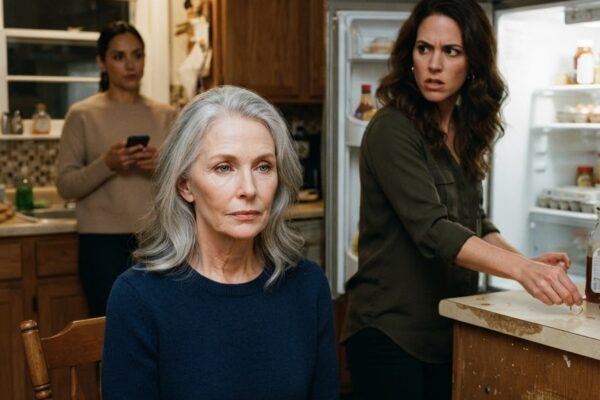
My parents left me in my grandmother’s care when I was one, then vanished. Nineteen years later—right after her funeral—they returned with a moving truck and a notary. My father handed me a document: “Sign here.” My mother held a list of planned home renovations: “She raised you. That was enough. Pack your things.” I dialed the number my grandmother had given me: “Come over. They’re here.” She had foreseen this.
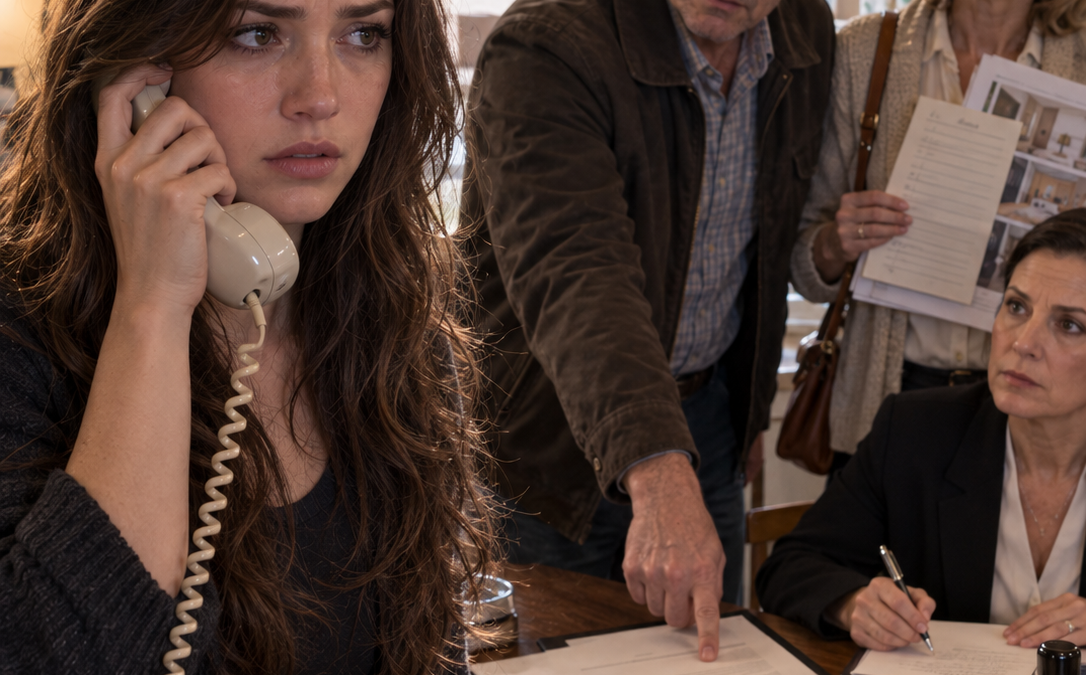
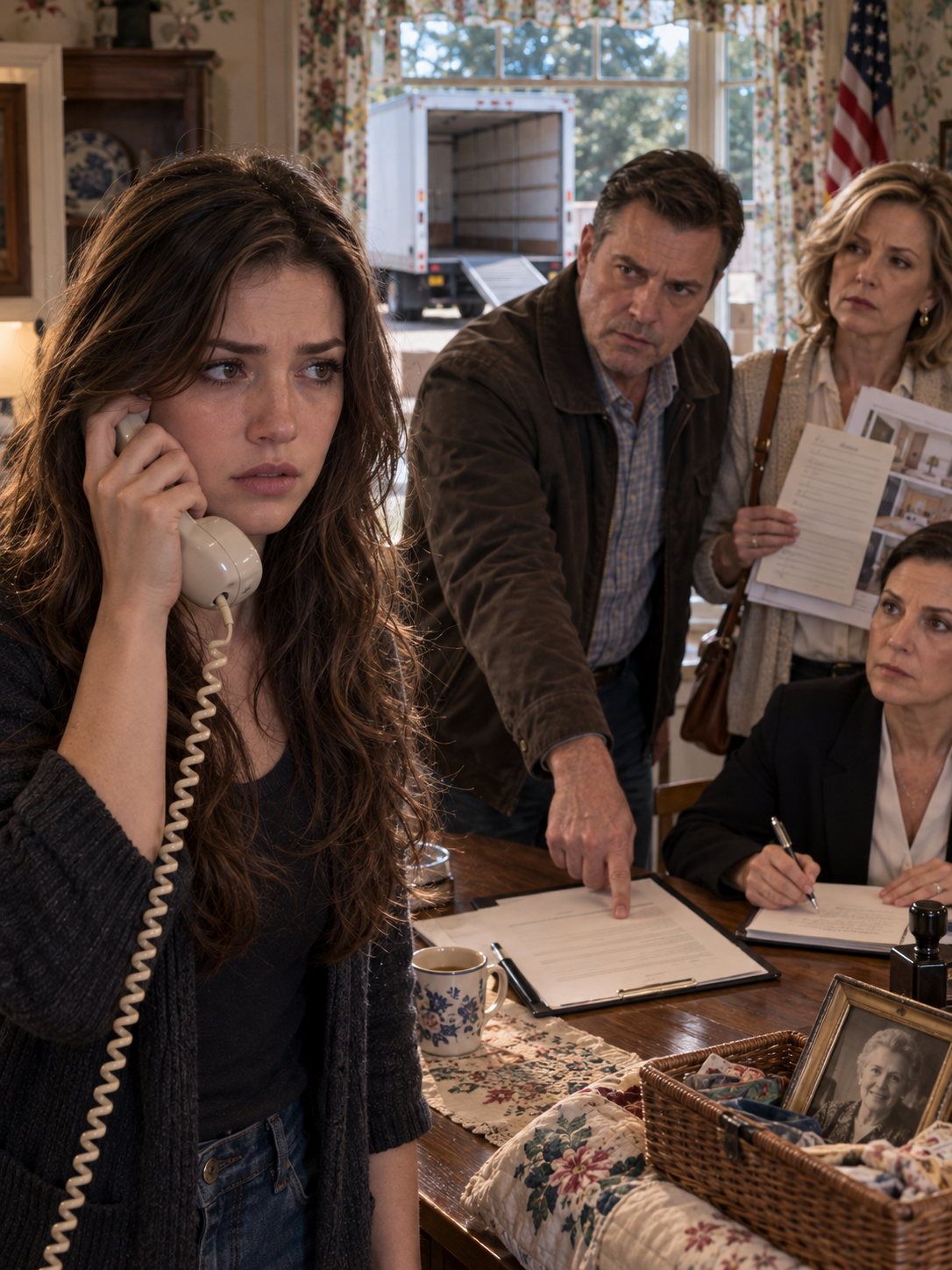
She raised you. That’s enough. Pack. My mother said it in grandma’s kitchen nine days after the funeral. A renovation list in her hand. 19 years of my grandmother’s life. Raising the child they left behind. Priced in one breath. Dad slid a document across the table and tapped the signature line. Sign here. A notary waited beside him. through the window.
Their moving truck sat in the driveway, ramp down, door rolled up,
empty. I hadn’t seen my parents since I was one. Grandma used to say people weren’t lost, only late. So when that truck pulled up, part of me thought they had finally come back for me. The list told me otherwise. My name is Satie Boyd. I was 20, standing in the only home I had ever known. I didn’t argue or sign. I called the number grandma had made me memorize.
Come in, I said. They’re here. That summer, a judge asked my mother to prove one thing. She couldn’t. And it wasn’t about the house. Stay with me and tell me where you’re listening from. To understand who walked through that door, I have to start an hour earlier in my grandmother’s sewing room with a smell of hot starch.
From my grandmother’s sewing room window in Oxford, you can count the lock boxes on the door knobs all the way to the square. Everybody here knows what a lock box means. That family has stopped living in their house and started renting it out by the football weekend. Ours never had one.
We were four blocks off the square in Oxford, Mississippi, and my grandmother, Peggy Tatum, had hemmed half the dresses in town. It was the first warm Monday in April, and I was pressing a hem. The room smelled the way it had my whole life. Hot starch.
My left hand rested on the magnet pin dish, cool and heavy, pins clicking to it like they were glad to be home. On the shelf above the cutting table sat a child’s sewing box nobody was allowed to touch.
It had not moved in 19 years. Then a moving truck started beeping, backing into our driveway. Behind it, a sedan pulled to the curb and a woman in a navy blazer got out. This was Carla Sims, a notary my parents had hired out of
Tupello, an hour’s drive away. I knew the woman climbing down from the truck from one old photograph. My mother, Amber Boyd. The man behind the wheel was my father, Shane Boyd. On the porch, Amber used a voice like sweet tea. Honey, we’re just so glad to be home. We’re going to look after our girl, and we want it all done properly. She said it to Carla loud enough for the neighbor across the street who had stopped watering her ferns. Carla kept it short. Which one of y’all is signing today? Morning, my father said, and walked straight past me to the kitchen. inside. While Carla laid out her journal and her stamp on the table beside him, Amber walked the hallway with a roll of blue painters tape.
She pressed strips to the door frames, one room at a time, and wrote on each with a marker. I stood in the sewing room doorway and watched. I said nothing. They had hired a notary from an hour away, and it took me until noon to understand why. The journal lay open on my grandmother’s table. a bound book with numbered lines and Carla’s pen was already uncapped above it. You heard what happened next. Here is what I left out. My mother did not raise her voice. She said it low like household business with the notary sitting 3 ft from her elbow. To Amber, Carla was not a person in the room. She was a rented stamp. I read the list in her hand upside down. Two lines were enough. Sewing room to bunk room sleeps four.
And under it, clear out all personal items. It was typed clean margins, no crossouts. Nobody’s first draft looks like that.
Hold on to that list. It comes back. It’s just cleanup, my father said. He tapped the line again. He laid a second paper on top of the first. A truck rental contract. That truck’s costing us every day you stall. Carla’s pen stopped over the page. Something in my chest pulled tight like a thread drawn through too fast. I did not pick up his pen. I picked up the phone on the wall and pressed the number I had said out loud a hundred times. Come in, I said when the ringing stopped. They’re here. She picked up on the first ring like a woman who had been sitting beside that phone for 9 days. 8 minutes, the voice said, and hung up.
From the kitchen window, I watched a woman in her 60s come up our street from the square at a walk that was almost not a walk, reading glasses still in one hand. This was Gail Picket, my grandmother’s lawyer. At the truck, she stopped. She looked up the ramp into the empty box, lifted her phone, and took one picture. Then she came up the steps without knocking. She didn’t sit. She spoke to my parents slowly in a voice that never once went up. This house is in Miss Peggy’s trust. It belongs to Sadi. Nothing anybody signs at this table today changes that. My father started in “Ma’am, we are doing this properly legally as her parents.” Gail turned to the notary instead. Every notary in this town has had a hem let down in this house.
That’s why they drove to Tupelo. So that was why Carla did her job then, the whole of it. She asked for my driver’s license. She held it up beside my face. She wrote in her book. Then she put the question to me the way the law tells her to. Are you signing of your own free will? No.
Carla capped her pen. It made a small final click. Then I’m refusing this notoriization and I’m writing down why. She looked at Shane. My commission is not something I lose over one morning. Then to me in a different voice altogether. Honey, you don’t have to sign anything today. My mother’s mouth went flat and thin. When it opened again, the porch voice was back. We did everything the right way. We’ll be at the motel. This isn’t finished. They left the rental paper on the table. They left the tape on the doors. When the truck had pulled out, Gail told me to go to the school district office and the children’s clinic that week and ask for my own records. They’ll only hand them to you, she said. Then she told me the rest.
“Your grandmother left me three envelopes,” Gail said. “And I’m only allowed to open the first, a diaper bag on a kitchen table.” That is where my life with my grandmother starts. And I only know it because she told me exactly once while she pinned a sleeve. It was April of 2007. I was 13 months old. My mother was 21. A job had come up down on the Gulf Coast, the kind that wanted you there by the weekend. It came with a room for staff. The room did not come with space for a crib. So Amber set the diaper bag on this same table and said the sentence my grandmother could still repeat word for word. Two weeks, mama, just till we’re set up. My father waited in the car. He did not come in. Grandma didn’t tell it like a grievance.
She told it like a recipe. What was in the bag? Six diapers, one can of formula, a stuffed rabbit, and a slip of paper with a phone number on it. What happened next? She called that number every Sunday. For three Sundays, it rang. On the 4th, a recording said it was no longer in service. She tried two more weeks anyway in case the recording was wrong. Then she stopped calling, but she did not throw the slip away. She put it in the
drawer or under the wall phone and there it stayed. I have no memory of any of it. I have the rabbit. I have the slip of paper. I have the shape of a thing that was done before I could hold a spoon. She never said one hard word about my mother while she told it. Not one. When she finished, she went back to her pins. I’ll be honest with you about something because it matters later. I always wanted to know why. Not how why I wanted it the way you want water. I never asked her and I’m going to leave that right there for now. She said 2 weeks and I have done the arithmetic since 991 weeks. Nobody ever answered that number. So every line meant for a parent had to be filled in by somebody else. I did what Gail asked.
I went to the school district office and then to the children’s clinic out on the bypass, showed my license and signed my own name for copies of my own file. It was the first thing I had signed since they came. Here is what the paper told me. When I was two, my grandmother went to the courthouse one time and came home my legal guardian. Nobody showed up to object. After that, 13 years of enrollment forms, shot records, field trip slips for the pumpkin patch and the state capital. On everyone, the line marked parent or guardian carried the same slanted blue handwriting. The emergency cards were the worst. Every school year, there was a fresh one with a box for mother and a box for father. 13 cards, 26 boxes, all blank. Nobody filled them in.
Nobody even crossed them out. The records clerk had run the front desk at my elementary school when I was little. She knew me. She squared the stack of copies and slid it across the counter. Miss Peggy signed every one of these herself, she said. I put them in a folder by year, kindergarten on top. 13 years of forms and one name on every guardian line. Hers. I carried that folder home under my arm and set it on the cutting table in the room where most of those years had actually happened. I learned to pin a hem before I learned to write in cursive. My grandmother would stand a bride on the little carpeted box in front of the three-way mirror and I would kneel with the magnet dish and hand up pins. That was my after school program. On the shelf above us sat the sewing box. It was a child’s pink plastic gone the color of old gum and it had belonged to my mother when she was a girl. The thread inside was still wound the way a 12-year-old whines thread. I reached for it once when I was about six. That’s your mama’s.
Grandma said, “Leave it be.” I left it be for the next 14 years. One afternoon, a customer was up on the box having a mother of the bride dress taken in. She had known our family a long time. She glanced down at me, then said over my head that it was a shame about Amber, that some people were just a lost cause. My grandmother took the pins out of her mouth. She set them in the dish one at a time. Not in my house, she said. She’s not lost. She’s only late. The woman went red to her collar. Peggy, I’m sorry. I didn’t mean a thing by it. Grandma nodded, picked her pins back up, and finished the dart. She charged that woman exactly what the ticket said. Not a dollar more to punish her. Not a dollar less to smooth it over.
After the lady left, I asked. Late for what? She didn’t answer. She handed me the tailaylor’s chalk and pointed at the next hem. There was one other thing. My birthday is March 2nd. Every year she made me pancakes and every year after the dishes she picked up her purse. Every March 2nd she had an errand downtown. And in 19 years I never once asked where. That purse waited by the door every March 2nd. And only one year did I wonder whether she’d pick it up. The fall I was seven. My grandfather Ray Tatum died. My mother did not come to bury her own father. A week later, the kitchen phone rang. I stood in the doorway in my socks. I heard my grandmother say, “Amber,” and then almost nothing. She pressed the receiver hard to her ear.
Two words leaked out anyway. “Daddy’s truck.” My mother wanted to know whose name his pickup was in now. Grandma listened to the end. I hear you, Amber,” she said and hung up. She stood a moment with her hand on the receiver. Then she turned the burner back on under the beans. She told me nothing. That March, she picked up her purse. “If you’ve known a woman who could hang up a phone like that and go right back to the stove, leave a like for her.” The week I turned 18, she sat me down at that table and gave me a phone number and a rule in the voice she used for reminding me to unplug the iron. They won’t come to the funeral. They’ll come after. When they do, you call this. I said the number back again. She said. I said it twice.
Again. She made me say the number back until it sounded like something you’d say before supper. The night they came, the rental contract was still lying on my grandmother’s table, right where my father had laid it down to hurry me. I hadn’t touched it all day. After supper, I finally read it. Most of it was boxes and initials. One line mattered. Date of reservation. I read it and then I counted on my fingers like a child because I didn’t trust my head. My grandmother died on a Tuesday. This truck was reserved the very next day. We buried her 3 days after that. I sat with it. Then I started laying pieces beside it. The way you lay out a pattern before you cut the box of the truck empty.
The line on my mother’s list that said sleeps for spring, which in this town is when people sign the leases for football season. They were not moving in. You don’t come home in an empty truck. You come to haul a house clean. I was never the reason. I was the address. I took a freezer bag from the drawer, slid the contract inside, press the seal shut, and wrote the day’s date across it in marker. Grandma labeled everything that went in the freezer. It seemed like the right way to keep this. The truck was reserved the day after she died, and I wondered what else they decided before we buried her. I put the freezer bag in the drawer under the wall phone on top of a slip of paper with a dead number on it.
And then I walked my grandmother’s house like a stranger had been through it because one had 20 minutes with a roll of tape. That was all it had taken my mother. There was blue tape on nearly every door frame and on each strip a word in black marker in handwriting I had never seen before that day and recognized anyway because my own G’s hook the same way. The front bedroom said bunk. The hall closet said storage. My room, the one with my quilt on the bed and my shoes under it, said bunk, too. On paper, this house was mine. Gail had said so that morning in one sentence, but a house is not paper. I stood in my own hallway and felt like I ought to ask somebody’s permission to be there.
I was hungry and didn’t want to sit, so I ate standing at the counter.
The refrigerator was full of funeral food. Six casserole dishes from the church ladies, each with a name on masking tape across the bottom so it could find its way home. I ate chicken spaghetti cold out of one marked Louise, and couldn’t have told you what it tasted like. My phone buzzed. A voicemail from Tammy Row, my mother’s cousin, the only family in town who still kept up with her. Your mama just wants to do right. Baby, call me. I did not call her. I went back down the hall. The sewing room door had its own strip of tape stuck at eye level. One word, out. I didn’t peel it off. I didn’t peel any of them. I left every strip exactly where she’d pressed it. the way you don’t wipe down a counter before the insurance man comes.
Then I found the old door key in the button jar, threaded it on a length of bias tape, and hung it around my neck. I locked a door in my grandmother’s house for the first time in my life. The key was warm against my breastbone. The next morning, when I climbed the stairs to Gail’s office, one floor above the square, her window looked down on the courthouse lawn. On her desk sat a plain white envelope. across the front in slanted blue ink I would know anywhere one when she calls. Gail opened it in front of me. Inside was a single sheet. She read it to herself then folded it again. The house was never in play. Sugar, she said. Miss Peggy saw to that when you were 8 years old. It’s done and it’s been done.
I let out a breath I had been holding since the truck. Then what do they want from me? She didn’t answer that. She let the quiet sit between us while a delivery van idled down on the square. Then she told me how it would go. There were two more envelopes. She was not permitted to open the second until I brought her something. Her instructions on that point were seven words long in my grandmother’s hand. She turned the page around so I could read them. What she told you to leave be? I don’t know what that is, Gail said. She said you would. I did. She walked me to the door and she stopped me there with a hand on my sleeve. The question she left open isn’t about you, Gail said. It’s about them. Leave it be.
She had only ever said that to me about one thing. I unlocked the sewing room with the key from around my neck and stood under the shelf. Then I lifted my mother’s sewing box down for the first time in my life. It weighed almost nothing. The clasp was stiff. Inside was a tray, and in the tray, a little girl’s whole ambition. Spools was wound lumpy and loose. The way you wind before anybody has shown you how. A thimble too small for my finger. A square of muslin in an embroidery hoop with a single letter started on it in pink floss. A capital A, half done. The needle was still parked in the cloth. I lifted the tray out. Under it lay a savings pass, the old-fashioned kind the bank on the square still gives to customers who ask.
On the cover in my grandmother’s pencil, were three words, amber, coming home. I opened it. The banks printer had stamped 19 lines down the pages, one deposit to a line. Every date was the same day, March 2nd, my birthday, her errand. And beside each printed line, out in the margin, she had penciled those same three words again, 19 times. The pencil on the last line from just this March wavered like a road on a map. I did not understand what I was holding. My my mind went to the ugly places first. Hush money, a debt, a price somebody had named for something. I couldn’t make the amounts and the name and the woman I knew fit in the same sentence.
So, I did a cowardly thing and I’ll own it. I set the box on the hall shelf outside the locked room because I couldn’t stand to put it back like nothing had happened.
And I put the passbook in my bag and carried it for a week without showing it to a soul. I wasn’t ready to know. 19 deposits, one for every birthday I’d had without them, and the name on the cover wasn’t mine. The third pew on the left on the aisle. My grandmother sat there for 40 years. And that Sunday, my mother was sitting in it. I saw the back of her head from the church door and kept walking because turning around would have been a scene. and I had decided the first day I was not going to hand them one. I took a seat across the aisle, two rows behind. My father sat beside Amber with his arm along the pew like a man who had never left. After the benediction, the ladies came for her. They hugged my mother one after another.
The same women whose casserles were in my refrigerator. The prodigal daughter was home. I understood it. It’s the story we’re raised on. Amber’s voice shook in just the right places. We came back to take care of my baby. She’s grieving so hard she won’t even let us in the house yet. Mama would have wanted us together. I know she would. Then they turned all those soft, kind faces, and looked at me. The pastor’s wife took my hand in both of hers. She wasn’t unkind. That was the hard part. Sweetheart, forgive and ye shall be forgiven. Give your mama a chance for Peggy. Arguing in that aisle would have been playing the part they had written for me. The cold, ungrateful girl. So, I chose my quiet, the way you choose a thread. Yes, ma’am, I said.
Thank you for the casserole. Tammy was there too, pink with the pleasure of a family mended. She squeezed my arm on her way out. In the parking lot, I was unlocking my car when I heard her behind me walking with a friend. Tammy talks fast and she talks before she thinks. Her voice dropped to the hush people save for good gossip. By the time I glanced back, she had her fingertips pressed to her lips like she could push it back in. Behind me, cousin Tammy whispered that they already had it least for the season. Least. I carried that word home from the parking lot and slept on it badly. By Monday morning, it had a truck attached. A white pickup sat at my curb with a ladder rack and a magnet sign on the door. Gentry remodeling. The man who got out had a clipboard in hand already looking the house up and down the way you’d look at a horse. He came up the walk. I met him at the porch steps. Morning, ma’am. Russ Gentry. He checked his clipboard. She told me come Monday. Said the house would be empty by then. Says here owners a Miss Amber Boyd. That right? No sir. He looked at the house number. He looked at the porch swing and at the handlettered sign in the window that had said alterations since before I was born. Then he looked at me and I watched it arrive on his face. He took off his cap. This is Miss Peggy’s house. It wasn’t a question. She let down the hem on my girl’s prom dress. Night before the dance, charged me $2.
“He never set foot on the porch.” He folded the work order in thirds, slid it into his shirt pocket, and buttoned the flap over it. “I’ll be calling the lady back,” he said, and walked down to the street bareheaded. He put his cap back on at the gate, and not one step before. Whatever Russ said when he called the lady back, it brought her to my porch by 4:00. Alone this time, no notary, no church ladies, no neighbor with a hose with nobody to hear. My mother didn’t bother with the sweet tea voice. You’re a kid. You’re 20 years old. You don’t have the first idea what it costs to keep a house like this. Taxes, insurance, a roof. We’re your parents. This is the kind of thing where you trust your elders.
Sign the paper and I’ll see to it you can stay through the end of May. It’s not yours to give. That lawyer’s filling your head. No, ma’am. She looked at me a long moment. And I looked back and the thing I had carried for 19 years climbed right up my throat. I felt my mouth open on it. Why? She waited. There was something almost eager in it. I swallowed it. It went down like a button. Why don’t you go on back to the motel? That cost me something. I felt what it cost standing there. I’m telling you so you’ll know. I felt it. I need a glass of water, Amber said and walked past me into the house like it was already hers. I let her. I wanted to see what she would do. She ran the tap.
She drank half of it and left the glass on my grandmother’s counter. Then she drifted down the hall and tried the sewing room door. The knob rattled. Why is my room locked? That’s grandma’s sewing room. It’s going to be my room. I’ll want that key. She went up the hall and back down it, looking at ceilings, at floors, at the width of the doorways. The little pink sewing box sat on the hall shelf at the height of her elbow, right where I’d left it. Her initial was still inside it, half stitched in pink floss, the needle parked where she’d left it at 12. Her name in her own mother’s pencil 19 times, was in my bag on a kitchen chair. She walked past her own sewing box twice that afternoon and never once looked down.
The passbook had been riding in the bottom of my bag for a week. I climbed Gail’s stairs, took it out, and set it on her desk. She didn’t pick it up. She read the cover where it lay. She looked at those three pencled words for so long, I thought she had forgotten I was there. When she took off her glasses, her eyes were wet, and she didn’t hide it.
“That’s the thing she told you to leave be,” she said. “It was in my mother’s sewing box.”
Gail nodded slowly. I knew there was money. I drove her to the bank this March and waited in the car. I never saw the book. I never knew what she wrote in it. Then she told me the second envelope came with one more condition written in my grandmother’s hand. It was not to be opened until they had shown what they came for.
I wasn’t there when they pulled up. You were? She uncapped a pen and squared a legal pad. Tell me about the truck.
So I told her. It took three sentences. It backed into the driveway. The ramp came down. There was nothing inside it. She wrote down every word. Then she’s answered it herself, Gail said quietly. And I didn’t know yet whether she meant my mother or my grandmother.
She slid the pad across. I signed my name under my own words.
Gail read my three sentences back to me and then she reached for the second envelope. The second envelope held no paper at all, only a small memory card taped to an index card and on the Windex card one line two. After they show you, Gail fitted it into her computer and turned the screen toward me.
And then my grandmother was in the room. She was sitting at the cutting table in the sewing room with her gray shawl around her shoulders, though the house was warm. She was thinner than I had let myself notice while it was happening. The date in the corner was my 20th birthday. She looked into the lens the way she’d look at me across the kitchen table. And she stopped for breath where she needed to.
Sadie baby, if you’re seeing this, you found the bank. And I expect you’ve thought some hard things about it. So, let me say it plain. Every year on your birthday, I put a little buy for your mama for the day she comes home. Rent on a place close to you for as long as it takes her to get her feet under her. That’s all it is.
Her hands smoothed the shawl. It isn’t a test, baby. It’s bus fair, and bus fair is no good mailed to somebody who’s staying put. It has to be waiting at the house for when she comes for it. Then she told me about that same morning. Gail had driven her to the bank and she had signed the deposit slip herself. Though it took three tries to hold the pen. Afterward, she had asked Gail to mail one letter to an address Tammy had given them. She unfolded a copy and read it to the camera.
Four lines.
It asked my mother to come see me before it was too late. Not one word about money. Not one word about the house. The recording ended on her face.
Gail waited before she spoke. “As keeper of that fund, I’m bound to tell your mother it exists,” she said. “What it’s for, your grandmother left to you.”
I barely heard her. I was still hearing my grandmother. “It isn’t a test,” she said. “It’s bus fair, and bus fair is no good mailed to somebody who’s staying put.”
Her face stayed with me. Stop between one breath and the next. all the way home and into the night. I didn’t turn on a lamp. I went into the sewing room in the dark and did a thing I hadn’t done since I was small. I sat down on the floor under the cutting table, knees up, back against the leg of it.
I had pressed a hem before supper out of habit. The iron was cooling on its rest, and it ticked.
Tick.
A long wait.
Tick.
19 years.
She had wanted the same thing I wanted for the same 19 years in the same house and never once set it on my shoulders. She carried hers to the bank every March and she carried mine too without ever telling me she knew I had one.
There was a thing I needed to ask her. Just one.
Grandma, did you really believe she’d come?
I opened my mouth in the dark to ask it.
The iron ticked.
Something went out of me then, a sound with no word in it, and my shoulders slid down the table leg until they met the floorboards.
I lay there with my cheek on wood her feet had worn smooth.
Then it was over, and I got up and unplugged the iron.
There was no one left to ask, and there was never going to be again.
Gray light came across the cutting table around 6, and by the time it reached the pin dish, I knew what I was going to do. I was on Gail’s stairs before her office opened.
She found me sitting on the top step.
I felt clear. That’s the plain word for it. Clear. The way the mirror is after you wipe the steam off.
I had never said so many words in a row to her. And I said them slowly so I wouldn’t have to say them twice.
That money was never mine, Miss Gail. Not to keep and not to hand out either. It was hers to offer.
It’s an invitation. and she wrote it 19 times. The only job I’ve got is to see it gets delivered honest the way she meant it. So send my mother the letter, tell her it exists and tell her what it’s for.
Gail studied me over her glasses. You understand what that’s likely to do. The minute she learns there’s money with coming home written on it, she’s going to change her tune.
Yes, ma’am. I want to watch her do it.
One corner of her mouth moved.
Most folks your age would have asked me how to keep it.
It wasn’t saved for me.
She drafted the notice while I sat there. It was short. While she typed, I asked for a folder and a marker.
I wrote three words on the tab in my own hand. The same three that were on the passbook cover. into it went the freezer bag with the rental contract, my school forms, kindergarten on top, my three sentences about the truck signed.
On Gail’s wall hung the fall football schedule that every office in this town hangs. I found the first home game and drew a circle around it.
That was their deadline, not mine.
I wanted it where I could see it.
I wasn’t the one getting anything anymore. I was the one carrying out what she wanted.
It felt like picking up her shears.
“Send it,” I told her.
And then we waited to see who would come up my front walk.
She came up my front walk 2 days after the notice reached the motel at noon on a Sunday, carrying a cake.
It was a grocery store sheetcake under a plastic dome, and the orange price sticker was still on the lid.
She had timed it well.
Church had just let out and half the congregation was strolling past our gate toward lunch on the square.
My mother stood on the top step where everyone could see her and pitched her voice to Carrie.
I came back for you, baby. Mama’s here now.
Out on the sidewalk, heads turned. A woman pressed her hand to her heart.
My father stayed at the bottom of the steps with both hands in his pockets, studying the porch boards.
He didn’t say a word.
I understood the arithmetic of it.
If I refused the cake, I was the scene.
If I invited her in, I was the proof.
So, I took the cake out of her hands because it was heavy and she was holding it out.
And I stayed exactly where I was in the doorway.
“Thank you for the cake,” I said.
I did not step back.
After a moment, she smiled for the sidewalk, touched my cheek with two fingers, and went down the steps.
Less than two weeks earlier, the word had been pack.
And now, with the sidewalk listening, it was baby.
The cake was still sitting uncut on my counter when Tammy turned up with the pastor’s wife and one more casserole.
I put them in the front room and poured sweet tea.
They had come, they said, on Peggy’s behalf.
The pastor’s wife went at it gently around the edges.
Peggy had a forgiving heart.
Peggy would surely want mother and daughter reconciled.
Hadn’t I seen how Amber stood up on that porch?
I had been raised to answer my elders, so I did.
And I used the only words that felt like mine to use.
Nobody in this house gets called a lost cause, ma’am.
Grandma’s rule.
That goes for my mother, too.
I won’t speak against her.
I set the picture down.
I just won’t speak for her.
Tammy opened her mouth and somebody knocked on the door.
On the porch stood a man I had never seen in a red golf shirt with the university’s logo on the chest.
He was holding a printed page and smiling like a man on a pleasant errand.
Afternoon, Miss Jim Whitaker from down in Jackson.
I was in town for the day and couldn’t resist coming by to see the place. We’re the family that’s got it for football season, all the home weekends.
He held up the page.
It was a deposit confirmation.
Your folks said the renovation had be wrapped by August. Is the owner around? Mrs. Boyd.
Behind me, the front room had gone silent.
The door stood wide open.
Every word was carrying.
Mrs. Boyd isn’t the owner, sir.”
His smile held a second too long, and then it went.
He looked down at his paper.
She signed as the owner, “Miss, is that not right?”
“No, sir, it’s not.”
I heard a small knock of glass on wood.
Tammy had been lifting her tea. It had stopped halfway to her mouth, and she’d set it down harder than she meant to.
Mr. Whitaker was a gentleman about it.
He asked who my attorney was and I pointed him across the square.
Mr. Whitaker walked his paperwork across the square himself and by the time I got up Gail’s stairs behind him, it was spread over her desk.
He had brought everything, a lease for the football season, a receipt for his deposit.
Gail turned the last page toward me and laid one finger beside the signature block.
There was a line marked owner.
On it in round confident cursive was my mother’s name.
She had signed it three days after we buried my grandmother.
And this, Mr. Whitaker said, and handed over his phone.
It was the post he had answered in an alumni group for game day housing, four blocks from the square, fully renovated by August.
Sleeps 10.
The photograph on it was as our front porch taken from the street.
Gail read the date on it twice.
Then she made a copy of every page, ran them through a three-hole punch, and fitted them into my folder without a word about my mother.
Not one.
I asked the only question I had.
When did she post it?
That’s not mine to punish, and it’s not yours, Gail said, which wasn’t an answer.
It’s the counties to read.
Then she answered me.
Posted two days before the funeral, Gail said.
And then somebody knocked on her office door.
It was Russ at the door and he had his cap in his hands again.
He stayed standing.
He turned that cap a quarter turn at a time while he talked like a man tightening his own nerve.
He had been in church on Sunday.
He told us he had heard how the boys came home to look after their girl and he had gone home and sat in his truck in his own driveway because his phone said different.
He held it out to Gail.
I didn’t know it was Miss Peggy’s place. I’d have never.
It was a string of text messages between him and my mother.
Gail scrolled to the top.
The first one had been sent while my grandmother was still alive.
She was in the back bedroom then with the hospice nurse coming mornings and I was feeding her ice chips off a spoon.
My mom’s place in Oxford is going to need work this spring.
Amber had written sending you my notes.
Below it was a photograph.
Her notes were handwritten on the back of an envelope.
Sewing room to bunk sleeps 10 with a question mark.
Knockout pantry wall.
Gail put two fingers on the screen and spread them.
The corner of this picture grew.
On the flap of that envelope, a little crooked, was a return address sticker with a cardinal on it.
I had bought those stickers myself at the drugstore.
Gail turned the screen toward me and said nothing at all.
I read the name on the sticker out loud one time.
Peggy Tatum.
I knew that envelope.
I had watched my grandmother read its four lines to a camera.
Come see Sadie before it’s too late.
My mother had gotten the letter.
She had opened it and read it and turned it over and used the clean side to plan the bunk room.
So that was the first draft of the list.
I won’t be doing that job, Russ said.
And I’ll carry this phone anywhere you need it carried.
She had answered my grandmother’s last letter, just not to my grandmother.
The motel was charging them by the night.
Mr. Whitaker wanted his deposit back and my mother changed tactics.
She came by at dusk and for the first time she used my name.
Sadi, let’s be grown women about this.
She stayed on the porch steps.
I stayed in the door.
There’s a fund.
You know there’s a fund.
All you have to do is tell that lawyer I came home for you.
We split it down the middle and your daddy and I are gone by the weekend.
Half is more than fair.
You want me to say you came back for me?
It’s one sentence.
It’s not a true one.
Shi took that without blinking.
Then she set the real bait down between us carefully like a woman who has been watching where my eyes go.
And I’ll tell you everything why we left.
All of it.
Don’t you want to know?
I’ve wanted to know my whole life.
I said I still won’t say it.
She only heard the first half.
I watched her hear it.
She went down the steps looking satisfied, but the rest of it followed me inside.
Not the lie.
I was never going to tell the lie.
The other part.
That money had my mother’s name on it in my grandmother’s pencil 19 times.
Grandma saved it for her.
Who was I to stand between them?
So, tell me what you’d have done with that bank.
Hand her the bus fair and be done or hold on to it.
Here is what I did.
I sat down at the kitchen table with a sheet of notebook paper and wrote to Gail.
I asked her to release the whole fund to my mother.
No statement from me about why she came.
No claim of my own, just the money because it had been put by for her.
I read it over once.
It said what I meant.
I wrote the note to Gail that night and I even signed it.
The note rode in my back pocket up Gail’s stairs the next morning, folded in quarters.
I laid it on her desk and stood there like a girl turning in homework.
Gail read it through.
She didn’t tear it up.
She set it down and put her hand on top of it.
And for the only time in all the months I have known her, her voice had an edge on it.
No, ma’am.
You listen to me.
She saved it to help her stay, not to pay her to go.
Those aren’t the same check.
I didn’t say anything.
You hand this over and you’ve answered Miss Peggy’s question for her with your own mouth.
She left it open on purpose, Sadie.
She didn’t leave it to you and she didn’t leave it to me.
Let somebody with no stake in it answer.
That’s all I’m asking.
I thought about pencil in a margin 19 times.
Not pay her to go, help her stay.
I reached over, slid my note out from under her hand, and folded it back along its creases.
Then let a judge read it.
Gail let out a breath.
She said she would ask the chancery court to decide whether my mother had come home for me.
And that was every word of law I heard that morning.
There’s a third envelope, Gail said.
And it only exists if you walk into that courtroom.
The third envelope stayed sealed in Gail’s safe, and while it waited, the bills started arriving at the motel.
My father took the truck back after a few days.
I know because I saw it go down our street toward the highway, ramp up, door rolled shut on an empty box.
They paid full price for a truck that never carried a thing.
Then Mr. Whitaker’s letter came on a lawyer’s letter head asking for his deposit back.
And then Carla called Gail and Gail put her on speaker so I could hear.
Shane had phoned her.
He wanted her to write up a little statement.
Nothing fancy.
Just a note saying the girl had been emotional that morning, grieving, not herself.
I told him no.
Carla said her voice was dry as a ruler.
I don’t write opinions for clients.
My record is my journal, Miss Picket.
I write it in ink.
When a court asks for it, I’ll bring it myself.
Later, Tammy came to the house alone.
She wouldn’t come in past the mat.
She was holding one of my grandmother’s casserole dishes, washed and dried, and she turned it over to show me.
The strip of masking tape was still on the bottom.
Peggy T in faded marker.
She had washed around it for years.
Then it all came out of her in pieces.
She was the one who called Amber when grandma passed.
She was the one who had told Amber years back that everybody at church knew Peggy was leaving the house to me.
She was the one who gave Gail the address.
I thought she’d want to come say goodbye.
I swear that’s all I thought.
She didn’t ask me to forgive her.
I’ll give her that.
She just stood there holding out the dish.
I took it.
I I know, Miss Tammy.
I never did wash that tape off.
My phone lit up on the cutting table.
It was my mother.
I’ll give you the message word for word.
Hearings Thursday.
After I will sit down with you and tell you why I left.
All of it.
Start to finish.
I only need you to say one good word for me.
Thursday.
19 years.
I had wanted that exact thing.
Here it was on a screen the size of my palm and the price was one word.
I stood in the sewing room holding it for a long time.
The light went from gold to gray on the three-way mirror.
I decided three things in order.
I would not shame her.
I would not punish her.
That was never mine to do.
And I would not buy an explanation with a lie.
Not even that one.
Not even now.
I called Gail and told her I would be at the hearing and that I would not say a thing unless somebody asked me.
I didn’t answer my mother.
I didn’t block her either.
I held the button until the screen went black.
I opened the long drawer of my grandmother’s sewing machine, the one with the bobbins in it, and laid the phone in there face down.
Then I pushed it shut slow so it wouldn’t make a sound.
I closed the drawer on 19 years of wanting to know.
Thursday came in the middle of July and at a quarter to 9 I was standing in the hallway of the chancery court a block off the square in a dress I had hemmed myself.
Four people were sitting on the long oak bench outside the courtroom door.
Carla sat at the near end in her navy blazer, a hardbound journal closed on her knees, both hands resting on it.
beside her, Russ, cap in his lap.
Then Mr. Whitaker, who had driven up from Jackson before daylight, holding a folder, and at the far end by herself, looking at her shoes.
Tammy, it was the first time in my life I had seen her anywhere in public, and not sitting next to family.
“Miss Sadie,” Russ said, and dipped his head.
Mr. Whitaker stood, introduced himself, and shook Gail’s hand.
The elevator opened.
My parents stepped out with their lawyer and saw that bench.
The people they had hired.
The people they had leaned on.
My father lost half a step like a man who has misjudged a stare.
Their lawyer saw it too.
He bent to my mother’s ear and spoke low for maybe 10 seconds.
I couldn’t hear him.
I didn’t need to.
I saw her answer.
She shook her head.
Once inside the back row was already full of my grandmother’s church.
Four people were waiting outside that room and not one of them was there for my mother.
A baiff held the door and we filed into a room not much bigger than a classroom with a flag, a seal and a chancellor who had been on that bench since before I was born.
He kept it simple.
The court had one question in front of it. he said.
Had this woman come home for Sadie Boyd?
Or hadn’t she?
Carla went first.
She opened her journal to a numbered line and read it in a level voice, giving no word more weight than the next.
The date, the type of document, that she had checked the signer’s identification, that she had asked the signer if she was acting of her own free will, and the signer had answered no.
Then the part she had written in her own hand at my grandmother’s table.
Statement made to Siner by her mother.
In my presence, she raised you.
That’s enough.
Pack.
Notoriization refused.
In the back row, somebody drew in a breath.
The clerk read my mother’s list into the record exactly as typed.
Sewing room to bunk room.
Sleeps four.
Clear out all personal items.
Then the rest went up one sheet at a time.
The rental contract reserved the day after the death. the lease with her signature on the owner’s line, the photograph of notes on the back of an envelope, and the cardinal on the flap.
Their lawyer asked Carla if she might have misheard.
“No, sir. I wrote it while she was still talking.”
He asked Russ if the text might be out of order.
Russ held up the phone.
After that, the lawyer mostly sat down.
Then, my mother took the stand.
She had the porch voice on.
The one that trembles on Q.
I came home for my daughter, your honor.
I know how it looks, but a mother knows her own heart.
The chancellor made a note.
Nobody spoke.
She wasn’t finished.
She turned in the chair until she found me.
I came back for you.
She said it to the judge first and then looking straight at me, she said it again.
There was a photograph on the table in front of me.
Gail had taken it with her phone.
That that first morning on her way up my walk, a driveway, a ramp down, a truck with its door rolled all the way up.
Nothing inside.
Bare plywood walls, one strap hanging.
The chancellor looked over his glasses.
Miss Boyd, is there anything you’d like to say?
I had promised to speak only if asked.
He had asked.
I didn’t stand.
I didn’t look at her.
I looked at the picture.
I used my fitting room voice.
The one for telling a bride to hold still.
Then what did you bring?
Five words.
The room waited.
Amber Boyd opened her mouth.
Nothing came.
She looked at her lawyer.
He was looking at his legal pad.
She looked at my father.
Shane Boyd was looking at the table.
The clock over the door kept on.
I counted 11 ticks.
In the back row, a church lady lowered her eyes.
The chancellor let it run.
All of it.
Then he picked up his pen.
Let the record reflect the question, he said, and the answer.
Gail stood up with an envelope in her hand, and I could read my grandmother’s handwriting on it from where I sat.
Three. only if she lets a judge decide.
She asked the court’s permission to open it.
The chancellor gave it.
Inside was another small card, and the clerk fitted it into a little gray speaker on the corner of her desk, the kind you’d keep in a kitchen for music, and pressed a button.
There was a rustle first, a shawl brushing a microphone, and somewhere behind it the faint tick of an iron cooling.
Then my grandmother breathed in, and a room full of people who had sat beside her in church for 40 years went still because the voice was thin and tired, and it was unmistakably hers.
“Your honor, my name is Peggy Tatum, and I want to say this while I still have the wind for it. I know my daughter. She will not come while I’m living. If she came now, Sadi would still have somebody to ask. She’ll come after when that child is by herself. That’s why there’s a gale. That’s why there’s a trust. She stopped for air. Folks will say I should have known better than to save for her. I’m not a fool. I’m a mother. I got ready for the daughter I have and I saved for the one I kept hoping for. If you’re hearing this, then you already know which one showed up. Another breath longer. I only ask one thing of this court.
Whatever you decide, don’t let anybody in that room call my Amber a lost cause. Not in my hearing.”
The speaker clicked off.
In the back row, tissues came out of purses, one after another, like a congregation finding the same page.
The pastor’s wife had her hand flat against her collarbone.
Tammy was crying without making a sound.
I sat up straight because that is how she taught me to sit when somebody is speaking to you.
At the other table, my mother had not moved.
She was staring at that gray speaker as if it might say one more thing.
Then Gail slid a small bank book across to the clerk, open to the first page.
The clerk pulled her lamp closer and read the passbook into the record, line by line, in the flat voice of a woman reading a grocery receipt.
March 2nd, $2,000.
March 2nd, $2,000.
She read it 19 times.
She read the total, $38,000.
Then she tipped the book toward the light and read what was penciled in the margin beside the first deposit. and the second and everyone after.
Amber coming home.
My mother had priced 19 years of her own mother’s life in two words.
That’s enough.
Now she sat and listened to those same years, read back to her one line at a time, and every line had her name on it.
The clerk held the last page up so the chancellor could see how the pencil shook.
Amber looked at it.
She knew that handwriting.
It had signed her report cards.
Her lips parted.
She didn’t say anything.
My father put his hand over his eyes.
The chancellor ruled from the bench in short sentences without a sermon.
The condition had had not been met.
The fund would pass to Sadie Boyd.
The house would remain in trust for Sadie Boyd.
The lease signed as owner and the deposit taken on it would go to the county prosecutor.
cost to the losing side.
19 lines, the same three words on everyone, and she never changed them.
Out in the hallway, the oak bench was emptying.
The four of them got to their feet one at a time, like people leaving a pew.
Carla clipped her pen to the cover of her journal and gave me one nod, the kind you’d give a colleague, and went to find her car.
Mr. Whitaker shook my hand.
Well find another house for the season.
You keep your porch, miss?
Yes, sir.
Russ didn’t say anything.
He waited until he reached the outside door and then he put on his cap and touched the brim.
My parents left by the side exit.
I heard the bar on that door clank.
I didn’t turn my head to watch them go.
I walked out the front by myself and stopped on the top step.
It was July in Mississippi, and the brass handrail was hot as a skillet under my palm.
I held on to it anyway, and standing there, I finally understood what she had known all along.
A laugh came out of me.
One short one with no joke in it, like air let out of something held shut too long.
A man on the sidewalk glanced up.
It was relief.
Plain relief.
It felt like cutting the last basting thread and watching the seam hold by itself.
She was never wrong about my mother.
She cut the pattern for the daughter she had and left a little extra in the seam for the one she hoped for.
In a sewing room, that’s all hope ever is.
Seam allowance.
On a Friday at the tail end of August, with football about to start, the cars with outofstate plates were already circling the square and every porch on my street had a lock box hanging on the door knob.
Every porch but one.
Gail came up my walk with two pieces of paper.
The first was a letter from the bank.
The fund was in my name now.
It was enough, she said, to keep this house a home through a good many football seasons without my ever renting a bed to anybody.
The second was an envelope.
It had come to her office.
My mother’s handwriting was on the front, and under my name, she had written two words and underlined them to explain.
She’d like to explain herself, Gail said.
I looked at it for a while.
I won’t pretend I didn’t.
I had wanted the why my whole life, but I’d already heard the only part of it that mattered in a courtroom in 11 ticks of a clock.
Whatever was in that envelope would be a reason.
I had spent 19 years waiting for a person, and the person had already answered.
Then I took the bank letter out of Gail’s hand and I left the other one where it was.
I know she would.
Thank you, Miss Gail.
She didn’t push.
She slid the envelope into her bag in with a file that had already been closed, and that is where it lives.
Then she told me, without my asking, that the county had given my mother a choice.
Pay Mr. Whitaker back every dollar or stand trial.
She paid.
It took everything they had left.
They had been gone from the motel since the 1st of August.
Nobody at church had saved them a pew.
She had one more thing for me.
The court was finished with my mother’s list, the typed one, and it had come back with an exhibit sticker on the corner.
Gail laid it on the hall table and went on home.
She was barely out the gate ate when a sophomore blew in with a garment bag, talking the whole way down the hall. the game, the boy, the dress, whether navy was too dark for a day game.
She needed two inches off by next Saturday.
I needed something to write on.
The list was right there.
I turned it over to the clean side, the way somebody once turned over an envelope and wrote down her hem.
Waist to floor, heel height, 2 in, less a quarter.
It made a good scratch pad.
That’s all it’s good for.
Now, there was one thing left in that sewing box I had never used.
She’s standing at the three-way mirror now, up on the carpeted box, holding very still in three directions at once.
It’s past 5.
The house is quiet.
The room smells the way it has my whole life.
Hot starch.
My left hand rests on the magnet pin dish.
Cool and heavy.
Pins clicking to it like they’re glad to be home.
I reach up to the shelf and lift down my mother’s sewing box.
I open the clasp.
I take out a spool of navy thread that a 12-year-old wound, lumpy and loose, close to 30 years ago.
I pull off an arm’s length and thread my needle with it.
It holds.
Nobody ever used it.
Somebody should.
The money she put by to bring one of us home is going to keep the other one here.
I think she’d call that thread well spent.
If somebody once saved a place for you like that, a porch light, a bank, a box on a shelf, tell me about them in the comments and subscribe if you’d like to sit with me for the next one.
My grandmother used to say, “People aren’t lost, only late.”
If you’re the one who stayed, you were never either.
The iron’s hot.
I kneel down, take a pin from the dish, and start on the hem.