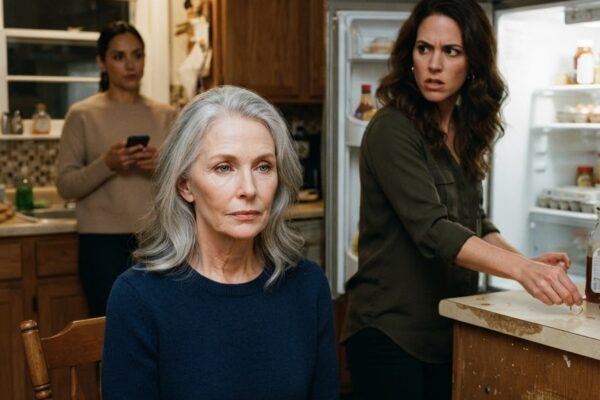
During dinner, my wealthy grandfather asked, “Did you get the email about your trust fund?” I replied: “No one has ever told me that I have that fund.” He turned the laptop with the banking page open towards me. My mother whispered, “This can’t be right.” Grandpa looked at her and said: “Fine. Let’s see who… changed the contact email address.”
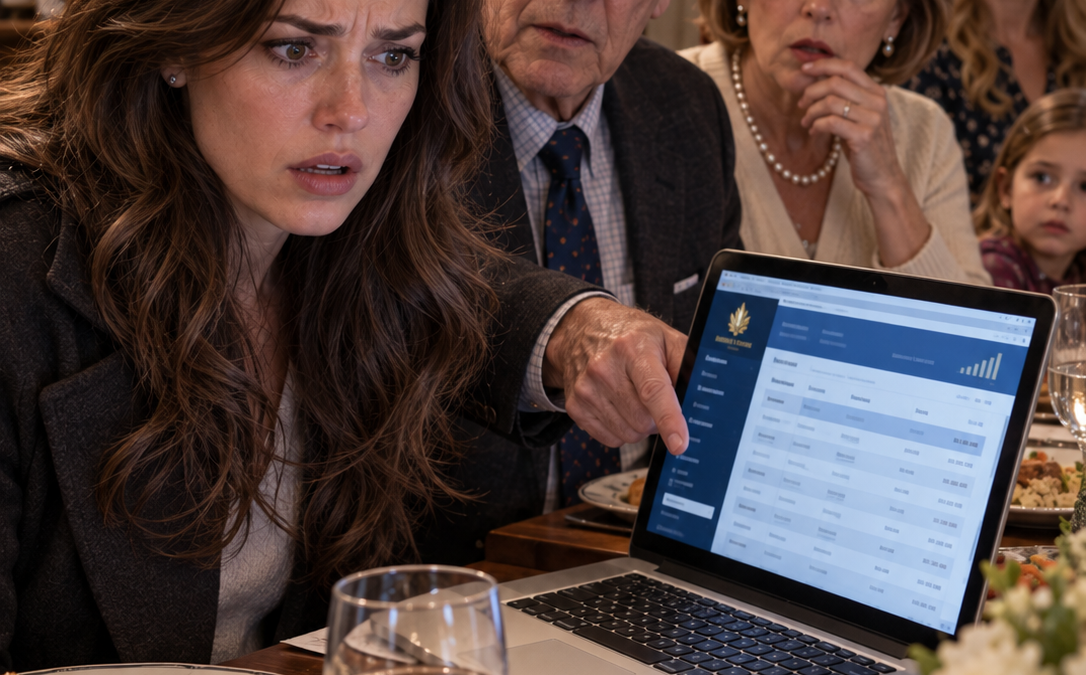
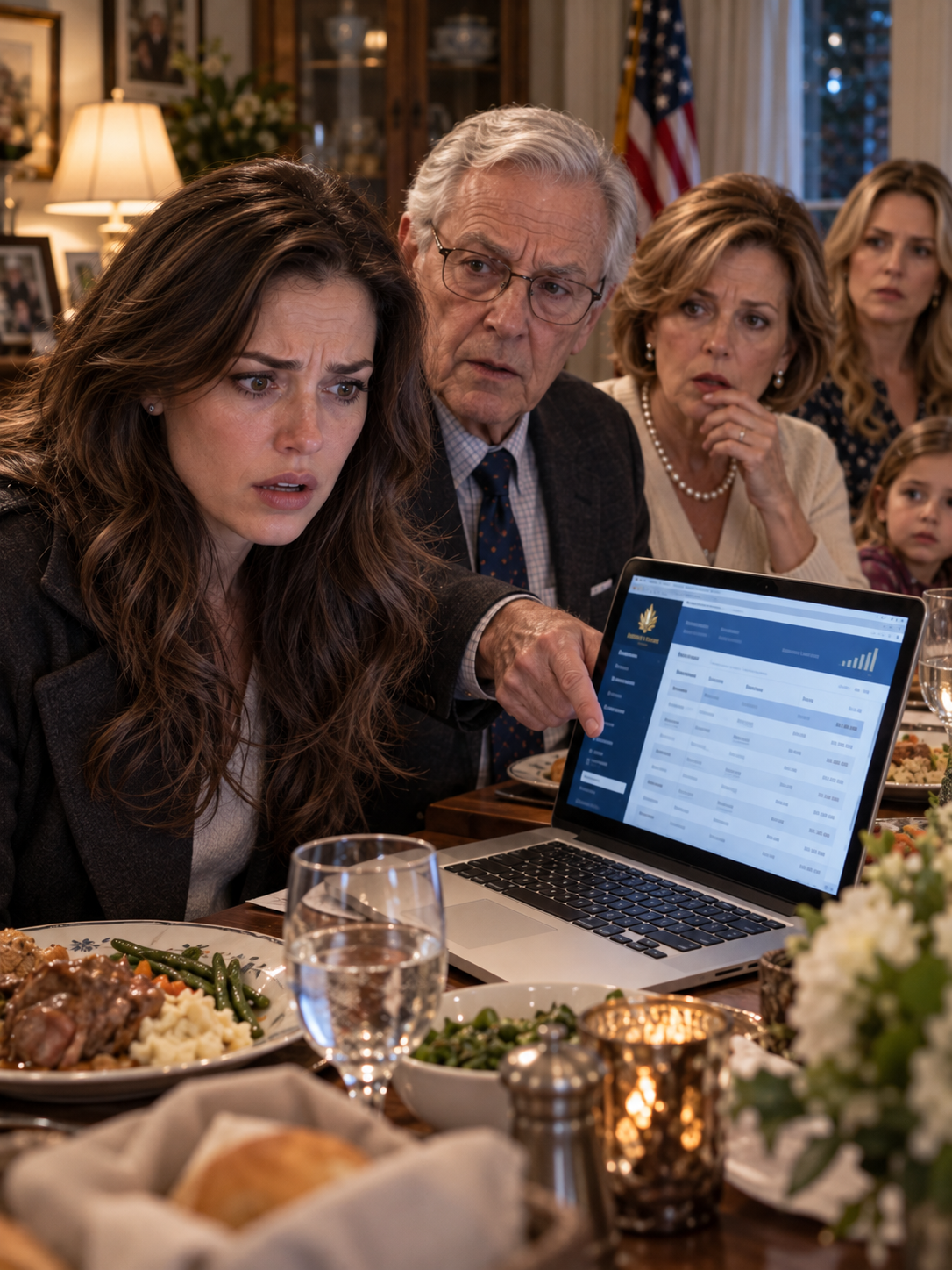
My mom had just set the pot roast down in front of Grandpa when he looked across the table and asked if I’d gotten the email about my trust fund.
No one ever told me I had one, I said. I was still in my coat. I had just made my second to last payment on my school loan.
And for 10 years, I had believed my grandfather helped my sister and decided I wasn’t worth the risk.
Grandpa turned his laptop around to face me. A gold oak leaf on a navy banner. 10 years of statements. Everyone addressed to Lan Mercer.
I didn’t scream. I did what I do for a living. I read at the bottom in small gray letters.
Notices went to an address that started with the letter E, then a row of little dots and ended in [email protected].
That’s not my email, I said.
My mom whispered. That can’t be right.
Grandpa didn’t look at her.
Good, he said. Let’s see who changed the contact email.
Welcome back to Calm Drama Stories. Here we share long- form family stories about hidden secrets, quiet betrayals, and the moment someone finally decides they deserve better.
Pour yourself a cup of tea, settle in, and stay with us until the very end because every choice in this story matters.
Drop a comment and be sure to subscribe.
3 hours earlier, I had pulled into my mom’s driveway in Ketering with a grocery store apple pie on the passenger seat and one question I’d been rehearsing for 70 m of I7.
Why Marissa and not me?
That was all.
Four words I had been carrying since I was 22.
Grandpa had moved back to Ohio in August into a senior apartment at a place called Brook Haven, 10 minutes from mom’s house after almost 10 years in Sarasota.
This was the first Sunday dinner with all of us at one table since my grandmother’s funeral.
I told myself I would wait for dessert, find him alone on the back porch, and ask him calmly like an adult.
I’m a court reporter. I spend my days in rooms where people say hard things out loud. I figured I could manage one question.
I set the pie down on the hall table next to the cut glass dish that had belonged to my grandmother, June. That dish was where the male lived in my mother’s house.
Mom swept the pie off the table before I had my coat unbuttoned.
Not on the mail, Ellen.
Then she leaned close and told me very quietly that Dad had been getting confused lately, that he repeated himself, that I shouldn’t let him get worked up.
She had already put his phone on the kitchen charger. She had set his place at the far end of the table, the end farthest from mine.
When I finally reached him, he squeezed my hand with both of his and said, “You look like your grandmother.”
Then mom called us in to eat.
I noticed the laptop in his canvas bag. He said he had something to ask the girls.
So when he turned the screen toward me, I had no time to be polite.
Mom said, “Dad, not at dinner.”
She reached for the lid.
Grandpa put his palm flat on the keyboard and kept scrolling.
Below the statements were other lines and those were worse.
Distribution to beneficiary, October 2017, $22,000.
Distribution to beneficiary, April 2019, $45,000.
More after that.
Grandpa tapped the screen.
I thought you used it for school, he said to me. I thought maybe a house. I was proud of you for keeping quiet about it. Your grandmother would have been the same.
My sister Marissa was cutting my niece’s meat into small squares without looking up.
She said, “Mom said, you spent yours.”
The knife stopped.
“Spent what?” I asked.
Marissa looked at our mother, and our mother looked at the gravy.
Then I saw the oak leaf again, the gold one in the corner of every page, and something old turned over in my stomach.
I had seen that logo before on a Navy folder 10 years ago.
I’ll get to that right then.
I took out my phone and photographed the screen.
Five pictures the way I’d photograph an exhibit before it got handed back.
Grandpa, can you forward me all of these?
He nodded.
All of it?
Mom stood.
Ellen, help me with the coffee.
In the kitchen, she filled the carff at the sink and water ran over her wrist and she didn’t notice.
Don’t upset him, she said. He gets confused. It’s some bank mixup. I’ll call them Monday and straighten it out.
For 32 years, my answer to that tone had been okay, Mom.
This time, I said, I’ll call them myself.
She looked at me the way you look at a stranger who has wandered into your kitchen.
I carried the coffee out.
Nobody ate the pie.
At 8:00, I drove Grandpa back to Brook Haven because mom had already said I would.
He didn’t speak until we were in his parking lot under a yellow light with the engine running.
Then he said, “I gave your mother a folder for you at your graduation. Did you ever get it?”
I didn’t answer because I was remembering it.
A backyard, a sheetcake, a navy folder with a gold oak leaf sliding into my mother’s purse while I stood behind a folding table cutting squares of frosting for my college roommates.
That was May of 2016.
I had just graduated from Ohio State with a degree in English and no plan, and my party was in mom’s backyard with a store-bought cake and lemonade in a plastic dispenser.
Marissa’s party 3 years earlier had been in a rented hall with a DJ and a slideshow.
Mom said we had to be careful that year.
Grandma Jun had died the winter before and Grandpa looked like a coat with no one inside it.
I remember wanting so badly to make him smile.
He found me by the cake and handed me a card.
Inside was a check for $500, and under his signature he’d written, “The rest is with your mom. Make it count.”
I hugged him.
Over his shoulder, I watched him hand my mother a navy folder and I watched her slip it into her purse.
That night, after everyone left, I asked her what grandpa meant by the rest.
She was rinsing plastic cups.
She said grandpa had told her he might help me with more school someday if I proved I was serious about something.
Don’t bring it up with him, she said. He’s grieving. Let me handle dad.
I remember feeling grateful.
I remember thinking she always knows how to handle things.
I thanked her for looking out for me.
A few weeks later, I moved into her basement because I had a degree, a part-time job at a bookstore, and nowhere else to go.
And she said very kindly that I could stay as long as I paid my way.
Paying my way was $600 a month.
Mom said that was how grown-ups lived and that it would help with the mortgage.
I wrote her a check on the first of every month and she asked me to deposit it into the old Brightwater Credit Union account she had opened for me when I was 16 for my paychecks from the ice cream shop.
It’s easier, she said. Mom will move it where it needs to go.
I didn’t think twice.
That fall, I decided I wanted to become a court reporter.
I’d sat in on a friend’s deposition and watched a woman take down every word four people said at once.
And I thought, I want to be the person whose job is to get it exactly right.
The program cost $9,000.
I didn’t have 900.
So I asked mom if she thought grandpa might help.
That was the deal, wasn’t it?
Prove you’re serious.
2 days later, she came down to the basement and sat on the arm of the old couch.
She said she’d called Dad.
She said he’d told her he had already helped Marissa and he wasn’t going to throw money at you girls twice.
Then she paused the way she does when she’s choosing a word and said, “He doesn’t think you’re steady, honey. I’m sorry.”
I told him he was wrong.
I took out a loan at 11%.
I worked nights at the deli counter at Kroger and practiced Steno on a folding table in that basement until I could write 225 words a minute.
My fingers smelled like sliced ham for a year.
In October of 2017, Marissa married Trent in a ballroom downtown with four courses and a string quartet.
Mom gave a toast and said she had saved for years to give her daughter this day.
I stood near the bar doing math about my shift schedule.
That Christmas, Grandpa invited both of us down to Sarasota.
Marissa went.
I said I had to work, which was true, but it wasn’t the reason.
The reason was that I couldn’t sit across from a man who thought I wasn’t steady and pretend I didn’t know.
I stopped calling him.
He sent birthday cards and I sent thank you notes and that was it.
In March of 2018, I passed my certification, got hired by a reporting firm in Columbus and moved out of the basement.
I had paid my mother rent for 22 months.
After that, I became what my mother had always called me her easy one.
My dad left when I was 12.
And the week he left, mom sat on the edge of my bed and said, “You’re my easy one, Ellen. Don’t make this harder.”
I took that as a job description.
I drove home almost every Sunday.
I fixed her printer.
I changed the bulb in the garage.
I sat at the far end of the table and asked for nothing because if you need nothing, nobody can call you a burden.
And I never touched the mail.
Mom handled the mail.
Once years ago, I saw an envelope with my name on it sticking out of Grandma Jun’s glass dish.
And mom plucked it out and said, “Junk, sweetheart.”
And dropped it in the recycling.
I didn’t think about it again.
You don’t when you trust the person.
Mom still had the same cell number she’d had since 1999.
I could have dialed it in my sleep.
It ended in 41.
And when I was little, I used to think of it as her lucky number because she said it was.
That’s the kind of thing you know about your mother.
Her number, her coffee order, the way she taps a pen against her teeth when she’s lying about how much something cost.
That Sunday night, after I dropped Grandpa off, I drove back past her house.
The porch light was already off an hour earlier than usual.
I sat in my car at the curb with the engine running and my phone in my lap looking at five photographs of a laptop screen.
I didn’t go in to say goodbye.
I drove home to Columbus and somewhere around the London exit, I promised myself one thing.
Before I believed anybody, I was going to read the whole record.
At 9 the next morning, I was in a windowless conference room on the 11th floor of a law firm downtown taking a deposition in a forklift accident case.
Two attorneys, one witness, one court reporter, and a picture of water nobody touched.
If you’ve never seen a steno machine, it looks like a tiny piano with no numbers or letters on the keys.
You press several keys at once, the way you’d play a chord, and each chord is a sound or a whole word.
On a good day, I write about 260 words a minute.
That Monday, I wrote every word the warehouse manager said, and I did not hear a single one of them.
My hands knew the job.
My head was in my mother’s kitchen, watching water run over her wrist.
Around 11, the plaintiff’s attorney asked me to read back an answer from earlier in the morning.
That’s part of my job.
I scrolled to it and read it aloud in the flat voice we use so that we don’t sound like we’re taking sides.
40 minutes earlier, the witness had said he never saw the safety report.
2 minutes earlier, he had described what was in it.
The room went quiet.
Nobody looked at me, which is how it should be.
I don’t get to judge anything.
I only get to read it back exactly the way it was said.
And sitting there, I realized I had spent my entire life taking down what my family told me, word for word.
And I had never once read any of it back.
At lunch, I ate a turkey sandwich in my Corolla in the parking garage and zoomed in on the photographs from the night before.
The letter E, the little black dots.
Who names an email inbox files?
Someone who thinks of a person as paperwork, I thought.
Someone who keeps things.
I had a transcript due that night.
3 hours of an insurance arbitration and a break job I’d been putting off since August, and $1,900 left on my school loan.
That was my life.
It wasn’t a bad life.
It was just a careful one.
And every careful decision in it had been made by a woman who believed there was no money anywhere for her.
That evening, while I was typing up the arbitration, my phone lit up with a number I hadn’t seen call me in years.
Grandpa.
He sounded nothing like a confused man.
He said he’d forwarded me 41 emails and wanted to make sure they had arrived.
They had.
I’d been afraid to open them.
Then I said the thing I had driven 70 m to say, except it came out different.
Grandpa, did you tell mom I wasn’t steady?
There was a long silence on the line.
I could hear a television somewhere in his apartment, a game show, people clapping.
Ellen, he said, I have never said that about you in my life.
He told me that he’d set up two trusts, one for each granddaughter exactly the same.
Same amount, $250,000.
Same rules.
Each one started the year the girl turned 22.
Marissa’s in 2013.
Mine in 2016.
I did not do one thing for your sister that I didn’t do for you, he said.
Then he told me his side.
That summer after the graduation party, my mother had told him I didn’t want to talk to him about money, that I was embarrassed, that I’d asked her to say thank you for me and to please not bring it up.
She said, “Let her be, Dad. She’s private, so I let you be.”
He thought I had pulled away because he’d moved to Florida and left everybody behind after grandma died.
He thought the thank you notes were me being polite to an old man who had disappointed me.
I should have called you myself, he said.
I should have picked up the phone a hundred times.
I’m sorry, sweetheart.
I put my hand over my mouth so he wouldn’t hear me.
10 years.
I had lost my grandfather for 10 years over a sentence he never said.
When I could talk again, he said he wanted to hire a lawyer in the morning, the best one in Dayton, and sent him straight to Harlland and Pike.
I surprised both of us.
Not yet, I said.
Let me get the record first.
I want to see it with my own eyes, Grandpa.
I don’t want anybody to tell me what happened.
I’ve had enough of people telling me what happened.
He was quiet and then he laughed a little.
An old tired laugh.
All right, I won’t do a thing unless you ask me to.
Before he hung up, he said, “Your grandmother would have liked hearing you call it the record.”
After he hung up, I texted the only person I knew who would understand what I meant by that.
Joe, are you free for breakfast tomorrow? It’s not about work, but it kind of is.
Joe Whitam trained me when I was a nervous 24year-old with a secondhand machine.
She’s 64.
She has been a court reporter for 40 years, and she has heard people confess to things in conference rooms that would curl your hair.
We met at the diner next to our office at 7.
I told her everything.
She didn’t gasp or say, “Oh my god.”
She ate her hash browns and listened.
And when I was finished, she wiped her fingers on a napkin and said, “Okay, here’s what you do. Banks keep who called. Every time somebody changes a phone number or an address, there’s a log.”
“You go in person, you show your ID, and you ask for the contact change log. Then you ask for certified copies of every request with your name on it. Not prints, certified copies.”
Then she asked a question I hadn’t thought of.
Where did the money land?
I pulled up the photographs and zoomed in on one of the distribution lines deposited to account ending 0447.
I stared at it.
I knew those numbers.
It took me a few seconds to place them and then my stomach dropped.
Bright water.
The credit union account mom opened for me when I was 16. the account she had me deposit my rent checks into.
I had never closed it because I’d never thought of it as mine.
My name was still on it.
Joe watched my face change and nodded slowly.
“One more thing,” she said. “Don’t you dare confront her until you can read it back line by line. Read it back before you react.”
I moved my Wednesday deposition and took the day off.
That night, I sat at my kitchen table with my laptop and a legal pad, the way I’d sit before a long trial day.
I didn’t have a password.
I wasn’t going to guess one, and I wasn’t going to break into anything.
But I did know one harmless thing you can do with any email address.
I typed [email protected] into the sign-in page, and I clicked the link that says forgot password.
I didn’t want a code.
I only wanted to see the hint.
The screen thought for a second.
Then it said it would send a verification code to a phone number ending in 41.
I sat back in my chair.
My mother’s lucky number, the number she’d had since 1999.
I closed the tab without sending anything.
I took a screenshot first and then I wrote the time on my legal pad, 10:47 p.m., the way I’d note the time a witness entered the room.
My hands were steady, which surprised me.
I wanted very badly for there to be some other explanation, a coincidence.
A clerk who typed the wrong digits 10 years ago.
But two digits weren’t a record.
Two digits were a feeling, and I had promised myself I wasn’t going to run on feelings anymore.
I needed the trust company to tell me on paper who had called them and when.
I set my alarm for 6, laid out my gray blazer, and went to bed.
I didn’t sleep much.
At 7 the next morning, I was back on ESA 70, driving west toward Dayton.
Harlland and Pike’s office was on the ninth floor of a stone building downtown, all carpet and quiet.
A trust officer named Priya Natarajan met me in a glass conference room.
She was about my age, very precise and kind in a way that never once tipped into taking sides.
She checked my driver’s license, then my passport, then asked me to set up new security questions while she watched.
Then she turned her monitor toward me and said as gently as she could, “Miss Mercer, our records show you’ve received every statement and every annual notice for the last 10 years.”
I said, “Then your records are wrong about who I am.”
She pulled up the contact history.
September 14th, 2016.
An inbound phone call to the client service line requesting a change to the beneficiary’s email address.
The caller was verified with my social security number, my date of birth, and my mother’s maiden name.
The call back number on the log ended in 41.
Then Priya pulled up five scanned distribution request forms, one for each withdrawal.
Everyone was signed Ellen R. Mercer.
I looked at the signatures for a long time.
The capital E was big and round and looped back on itself like a ribbon.
It was the E on every grocery list my mother had ever stuck to the refrigerator.
It was not my E.
Mine is small and straight because I learned to write fast.
Every distribution had been deposited into the Brightwater account ending 0447.
I asked Priya to freeze all distributions and to change every email, phone number, and mailing address on the trust to mine.
She did it while I sat there.
She explained carefully what came next if I chose it.
As the beneficiary, I could sign an affidavit stating that I had not requested or authorized those distributions.
The trust company would open an unauthorized transaction claim and could pursue recovery.
She said that in her experience, they would usually also want a police report before trying to recover the money, though she’d confirm what our case required.
Then she asked, “Would you like us to notify the other party?”
I said, “Not yet.”
She printed certified copies of everything and slid them into an envelope with a gold oak leaf on the flap.
At the door, I asked her one last thing.
Whose names were on the account ending 0447?
She checked.
Ellen R. Mercer and Diane L. Mercer, she said.
My mother and me.
The next morning, I walked into the Brightwater branch in Ketering, the same one where I had opened that account at 16 with a check for $84 from the ice cream shop.
I half expected to see one of mom’s friends from church at the teller window.
A young man at the desk confirmed that I’d been a joint owner since 2010.
When I asked for every statement from 2016 to the present, he raised his eyebrows and said it would be a lot of pages, $2 a page, ready tomorrow afternoon.
I said that was fine.
Then I asked him to put my own address and phone number on the account and to stop sending anything about it to the house on Woodbine Avenue.
He typed for a minute and said, “Done.”
Walking back to my car, I realized something had changed in me in the space of a week.
On Sunday night, I had wanted to find out whether this was some kind of mistake.
Now, I didn’t care whether anyone called it a mistake.
I wanted every line of it on paper, in my name, in my own hands.
I had my keys out when my phone buzzed.
A text from mom.
Haven’t heard from you since Sunday, sweetheart. Coming up to Columbus on Saturday with lasagna. Love you.
I read it twice.
Then I put my phone face down on the passenger seat on top of the envelope with the gold oak leaf and drove home.
On Friday evening, I spread 212 pages of credit union statements across my kitchen table.
I used a yellow highlighter for money that came in from Haron and Pike and a pink one for money that went out.
It went fast because the pattern was simple once you saw it.
October 2017, $22,000 in from the trust.
Two days later, $22,000 out, a transfer to M. Doyle with a memo that said, “Wedding.”
April 2019, 45,000 in.
4 days later, 45,000 out to Trent and Marissa Doyle.
Memo closing.
August 2021, 18,000 in, and then checks to Dayton Roofing and Harmon Appliance.
That was the summer mom got a new roof and a new kitchen and told me grandpa’s estate lawyer had finally sent her a little something from Grandma June.
March 2023, 15,000 in and then a payoff to Ali Auto for Mom’s car.
June 2025, 12,000 in and then a payment to her credit card.
I added it up three times on the calculator on my phone because I didn’t trust my own arithmetic.
$12,000.
Then I turned back to the very first statement, October 2017, and looked at the line right above the 22,000.
Deposit check number 104, $600.
My handwriting on the memo line in the little scanned image.
Rent October.
I had been paying my mother rent into the same account she was using to empty mine.
The same month, the same page.
I sat there for a while.
Then I cried once, hard and fast, like a summer storm, and then it was over.
I added the rent to the bottom of the page in pencil.
$13,200 over 22 months.
Then I squared the pages into a neat stack, the way I’d stack exhibits at the end of a long day, and put them in my bedroom closet on the shelf above my winter boots.
Joe’s rule was still in my head.
Don’t confront her until you can read it back line by line.
I could almost read it back now.
Almost.
I went to bed early.
At 8:15 on Saturday morning, 2 hours before she’d said she would come, my doorbell rang.
I knew it was her before I opened the door because nobody else I know rings twice.
Mom stood in the hallway holding a lasagna in a glass dish wrapped in foil, the blue oven mitts still on her hands.
She kissed my cheek and walked past me and looked around my one-bedroom apartment, and said it was cozy, which is the word she uses for small.
She set the lasagna on my stove.
She asked if I’d been eating.
She asked about my breaks.
And then, when she’d finished being my mother for a few minutes, she sat down at my kitchen table, right where the statements had been the night before, and folded her hands.
“I think dad got confused about which granddaughter,” she said. He’s 79. The bank made a mess and now he’s upset and I don’t want you making it worse. That’s all this is.
I sat across from her and didn’t say anything.
She watched me not say anything.
And her voice changed.
It got lower and warmer, the voice she used when I was sick as a kid.
All right, there was some money.
And I handled it for you, sweetheart.
The way I’ve handled everything for you since your father walked out.
You were 22.
You couldn’t balance a checkbook.
She reached into her purse and took out a single typed page.
It was a letter addressed to Haron and Pike.
It was dated June of 2016.
It said that I, Ellen R. Mercer, at my own request, authorized my mother to manage all matters relating to my trust.
There was a blank line at the bottom for my signature.
Just sign this, she said, so the bank stops bothering dad. then it’s over. He doesn’t need this stress at his age.
I said I wanted to read it carefully first.
I said it the way I’d say it to an attorney who handed me something at the last minute.
Her eyes narrowed just slightly and she tried something else.
You know, if this turns ugly, Dad’s going to redo his will.
He’s done it before.
Do you want Lily and Owen to lose their college money because their aunt couldn’t let a paperwork thing go?
Lily is seven.
Owen is four.
I love them more than almost anything in the world.
And she knew that.
And she put them on the table like chips.
I folded the letter in half.
I’ll read it tonight, I said.
Then I asked her one question casually while I put the lasagna in my refrigerator.
Mom, what’s your cell number again?
I think I have an old one saved.
She frowned at me like I’d asked her what year it was, and then she recited it.
The same 10 digits I’d known my whole life ending in 41.
“Why?” she asked.
“No reason,” I said.
She stood up and put her coat on and pulled on the blue oven mitts again, even though she wasn’t carrying anything.
At my door, she turned around.
“Don’t make me the bad guy, Ellen,” she said. “I’ve given you everything.”
Then she left.
I locked the door behind her, sat down on the floor of my little hallway with my back against it, and stayed there until my legs fell asleep.
I didn’t sign the letter.
I put it in the closet with the statements.
It was dated 3 months before the phone call that changed my email.
She had brought me a lie with a date on it.
On Sunday night, my sister called.
She was sitting in her car outside Lily’s gymnastics class, and I could hear the rain on her windshield.
Marissa and I had never been close.
She was the pretty one, the one who knew what to say, and I was the one who brought the extra chairs.
She didn’t say hello.
She said, “Mom told me you’re doing something with the bank.”
I asked her what she knew.
There was a long pause.
Then she told me that in 2017, Mom had said I wanted to help pay for the wedding.
She said you’d saved up and you wanted to do it, but you’d be embarrassed if I made a big deal.
She said, “Don’t thank her. Ellen hates attention.”
I said, “Marissa, I was working nights at a deli counter.”
She started to cry.
Then she said, “Wait.”
And I heard her scrolling.
She read me a text message from April of 2019, the week she and Trent closed on their house.
Ellen insists on helping with the down payment. Don’t thank her. She gets embarrassed. Just let her do this for you.
I asked her to send me a screenshot.
She did right then while we were still on the phone.
I never asked, she said.
I didn’t want to know.
I thought maybe grandpa gave you more or you had savings.
I didn’t want to know, Ellen.
Then the begging started.
If you take this to the bank, they could charge mom.
Like actually charge her.
Owen asks for grandma every day.
Please, can we just keep it in the family?
I looked at the closet door.
Keeping it in the family is how it happened, I said.
She didn’t have an answer for that.
After a while, she said she had to go get Lily, and she hung up without saying goodbye.
I sat in my kitchen and understood for the first time exactly what this was going to cost, not money.
Money was the part I was getting back.
It was going to cost Sunday dinners and Christmas mornings and the sound of Owen yelling Aunt Ellen when I came through the door.
It might cost my sister.
Before I crossed that line, I needed to hear one person tell me I wasn’t crazy.
I texted my grandfather, “Can I come see you tomorrow after work?”
He wrote back in less than a minute.
“Yes, bring your appetite. They have pie here.”
Grandpa’s apartment at Brook Haven had one big window, a recliner, and a shelf full of photographs of my grandmother.
On Monday afternoon, I put the statements, the certified copies, and my sister’s screenshot on his little dining table and watched him read every page.
He didn’t skim.
He read the way I read, with one finger moving down the margin.
And every so often he tapped that finger on the edge of the table the way he used to when I was little and he was doing a crossword.
When he got to the rent check, he stopped and looked at me over his glasses for a long time.
Then he got up, went to his desk, and came back with a checkbook.
I’ll put the 112 back myself, he said.
No police, he said.
No lawyers.
Nobody has to lose a Sunday over this.
It’s my money anyway, Ellen.
It was always my money.
He already had the pen uncapped.
I put my hand over the checkbook.
It was the first time in my life I had ever said no to a gift from him.
If you pay for it, Grandpa, she never did it, I said.
It just disappears the way everything disappears into that glass dish on her hall table.
And next time it won’t be my account.
It’ll be yours.
He looked at me.
I watched him think about it.
I watched him understand that he was 79 and that he had just moved 10 minutes from his daughter and that she knew his social security number, too.
He put the pen down.
What do you want then?
He asked.
Nobody had asked me that in a very long time.
I want it on the record, I said.
Done the right way by the trustee with my name on it.
Not yours, Grandpa.
Mine.
He nodded slowly.
Then he said the thing I didn’t know I needed.
You’re steadier than any of us, kid.
I asked him for one favor, and it wasn’t money.
I asked him to come to the meeting and to sit there as the man who set up the trust and not to speak for me unless I asked.
He promised.
Before I left, he made me eat a slice of Brook Haven pie, which was terrible, and we both laughed about how terrible it was.
Then I called Priya from the parking lot and asked her to set up a meeting.
Priya scheduled it for Friday at 10 in the same glass conference room.
She told me the trust company would send my mother a letter inviting her to attend to correct the beneficiary contact records.
Every word of that was true.
I didn’t want a trap.
I wanted a room where everybody could hear the same thing at the same time.
Then I did what I know how to do.
I took 212 pages and turned them into one.
I formatted it like a transcript page with the line numbers down the left side, 1 through 25.
One event per line, a date, an amount, a source.
Line one said, May 2016, Navy folder from Howard Kesler handed to Diane Mercer at graduation party.
Line two said, “June 2016 through March 2018, rent checks deposited to Brightwater account ending 0447.”
Line three was the phone call.
Lines 4 through 9 were the five distributions with the dates, the amounts, and where the money went after it landed.
Line 10 was the text my mother sent my sister in 2019.
Line 11 was the letter she brought to my apartment, dated June of 2016.
I kept going until line 24.
I left line 25 blank.
I didn’t know why exactly.
It just felt like the record wasn’t finished.
Then I stood in my living room and read the page out loud, start to finish, in my flat courtroom voice.
The first time my voice broke on line two.
The second time it broke on line two again.
The fifth time it didn’t.
Read it back before you react.
I could do this.
I could just read.
At 8:00 on Wednesday morning, I was sitting in my car outside the Franklin County Courthouse 10 minutes before a hearing when Priya called.
She didn’t waste time.
Ms. Mercer, something came in last night that you need to know about.
At 11:52 p.m. on Tuesday, an email had arrived at their client service address from Ellenmer. files atgmail.com.
It requested an urgent distribution of $20,000 for the purchase of a vehicle to be deposited into the Brightwater account ending 0447.
Attached was a signed request form.
Because the trust is frozen and that address is no longer on file, she said, “Our system flagged it and routed it to our fraud team. They’ve preserved the email and the attachment.”
Then she said very carefully, “You were in our office in person last week with two forms of identification. We know this request didn’t come from you.”
I asked her to send me a copy.
It arrived while we were still on the phone, a scanned form.
My name, that big round looping E, like a ribbon.
I thought about the letter my mother had brought me on Saturday, dated 2016, and how she’d watched me not sign it.
She must have driven home and understood that time was running out and decided to take one more piece before the door closed.
She didn’t know the door had already closed.
She didn’t know that a week earlier I had walked in and locked it myself.
I felt something I didn’t expect.
It wasn’t anger.
It was a deep, heavy sadness, like grief.
She had looked me in the eye on Saturday and then gone home and done it again.
I took a pen out of my bag, unfolded the timeline from my folder, and filled in the blank.
Line 25.
Tuesday, 11:52 p.m. request for $20,000 sent from the files address after the trust was frozen, flagged and preserved by Harlon and Pike.
Then I went into the courthouse and took down a 2-hour hearing about a property line dispute between two brothers who hadn’t spoken in 11 years.
I wrote every word they said.
Neither of them would look at the other.
At one point, the younger brother said, “I just wanted him to admit it. That’s all I ever wanted.”
And the judge said, “That’s not something this court can order.”
I wrote that down, too.
On Thursday night, mom texted me, “See you tomorrow, sweetheart. Wear something nice. Dad likes that.”
I printed four copies of my timeline at the library around the corner and clipped each one to copies of the statements. my sister’s screenshot, the Gmail screen, and the email from 11:52.
One for Priya, one for Grandpa, one for Mom, one for me.
Grandpa called at 9:00.
Do you want me to talk first? He asked.
No, I said, “I’ll talk. You just stay.”
He said, “I’m not going anywhere, kid. I’ve done enough going.”
I hung my gray blazer on the closet door, the same one I wear to every deposition.
Not something nice, something I work in.
Then I set two alarms and lay in the dark, reading the page back to myself in my head until I fell asleep somewhere around line 19.
My mother arrived at Harlland and Pike at 5 minutes to 10 in the Navy Blazer she wears to church, carrying a box of donuts from the Good Bakery on Far Hills Avenue.
for everyone,” she said, and set it in the middle of the glass table.
She kissed Grandpa on the cheek and pulled out the chair right next to his so that the two of them faced me and Priya like a panel.
Before Priya could finish introducing herself, Mom was already talking.
“This was all a banking error,” she said.
An old one, and she was sure we could clear it up in 10 minutes.
Then she opened her big purse and took out something that made my breath catch.
A navy folder with a gold oak leaf on the cover, a little faded at the corners.
The folder from my graduation.
I kept everything, she said, laying a hand on it.
Every page, I kept it safe for her.
Ellen asked me to handle it.
She was 22.
She was living in my basement.
She couldn’t balance a checkbook.
I did what any mother would do.
She turned to Priya.
I’m sure you understand.
Priya said evenly that the trust company needed to hear from the beneficiary.
Then everybody looked at me and my mother did the thing she has done my whole life.
She looked at me and waited for the nod.
Just a small one.
The little nod that meant, “Okay, mom, you’re right. I’m sorry. I’ll be easy.”
I could feel my chin wanting to do it.
32 years of muscle memory.
I didn’t nod.
I took four copies of a single page out of my bag and set one in front of each person at the table.
Line one, I said, and I read it back.
I read it the way I read testimony, flat and clear, no adjectives.
May 2016, the folder.
Line two, the rent.
Line three, September 14th, 2016.
A phone call to this company changing my email. verified with my social security number and my mother’s maiden name, call back number ending in 41.
Mom cut in.
Anyone could have used my phone.
I leave it lying around the kitchen all the time.
I slid the screenshot across the table.
This is the recovery number on that email account, Mom.
Ending in 41.
It’s your cell.
The one you recited to me in my kitchen on Saturday.
She looked at the screenshot and then at me as if she were trying to remember when I’d become someone she had to watch.
Lines 4 through 9, five distribution requests, five signatures with her big looping E.
Each amount and each date.
This time she didn’t deny it.
She switched tactics and it was a good one.
I’ll give her that.
The money went into your account, Ellen.
Look at the name on it.
Ellen R. Mercer.
I didn’t take a dime from you.
Every penny of it went to you.
I had expected that.
I’d read it back in my head a hundred times.
And then it left.
I said, “Two days later to Marissa’s wedding. 4 days later to Marissa’s closing. Then to your roof, your kitchen, your car, and your visa.”
I read each pink line aloud with its date.
Nobody touched the donuts.
Grandpa’s finger had stopped tapping the edge of the table.
Then I read line two again, out of order because it belonged next to line four.
October 2017, $600 rent deposited into the same account the same month you moved $22,000 of my money out of it.
Mom’s face went red.
I raised you by myself, she said.
You think $600 was too much to ask?
I didn’t answer that.
That wasn’t a question for the record.
I just read the total.
$112,000 from the trust, 13,200 in rent.
Then line 10, the text to Marissa.
Don’t thank her.
She gets embarrassed.
Then line 11, the authorization letter dated 2016 that she had brought to my apartment 6 days ago.
She said she was only trying to protect dad from stress.
Then I read line 25.
Tuesday night, 11:52, $20,000 for a vehicle requested from the files address after the trust had already been frozen.
I looked at Priya and she said very quietly that the request had been received, flagged, and preserved by the company’s fraud team.
For the first time all morning, my mother didn’t have an answer ready.
She stared at the page in front of her and whispered, “That can’t be right.”
It was the same thing she’d said at dinner, but now I understood what it had meant then, too.
She wasn’t afraid it was a mistake.
She was afraid it was true.
Grandpa slid the navy folder away from her across the glass until it was sitting in front of me.
My mother turned to her father.
Her voice went soft and high, a little girl’s voice.
Daddy, she said, if she signs whatever this is, I could be charged.
Your daughter, is that really what you want?
Grandpa looked at her for a long moment.
Then he said, “What I want is to know why you told me Ellen didn’t want to speak to me for 10 years, Diane.”
She opened her mouth and nothing came out.
And then finally, something true did.
You made trust for them, she said.
“Not for me. I’m the one who stayed in Ohio. I’m the one who drove you and mom to every single appointment when she was dying. And you sold the company and gave it to my daughters like I wasn’t even in the room.”
It was the first honest thing she had said since we sat down.
And I’m not going to pretend it didn’t land.
I could see it land on Grandpa, too.
For a second, I understood her completely.
And that was the most frightening part of the whole morning.
Then she turned back to me and she was my mother again.
I’ll pay it back, she said.
All of it.
$1,000 a month.
I’ll put the house in your name someday, Ellen.
I swear to God.
Just don’t put it on paper.
Please, sweetheart.
sweetheart.
The way she said it when I had the flu in second grade.
Priya explained without any expression at all that if the beneficiary signed an affidavit, the trust company would open a claim and pursue recovery and that if the beneficiary didn’t, that was the beneficiary’s decision.
Grandpa didn’t say a word.
He’d promised and he kept his promise.
The whole decision was sitting on the glass table in front of me and it was mine.
I thought about $1,000 a month quietly with no paper.
I thought about how that was exactly how the last 10 years had worked.
Quiet arrangements, nobody writing anything down.
Things going into the glass dish on the hall table and never coming back out.
Priya slid a form across the table to me, two pages, and set a pen on top of it.
I picked it up.
I read the affidavit the way I read a transcript before I certify it.
every line slowly.
On the second page, one of the dates was wrong, the year of the roofing checks.
I corrected it and initialed the correction.
Then I signed my name.
I signed it the way I sign everything.
Ellen R. Mercer, a small straight E because I learned to write fast.
Then I looked across the table at my mother.
You’ve signed my name five times, I said.
This is the first time it’s been me.
Priya took the form and said that the claim was now open.
Every contact on the trust belonged to me.
The company would send my mother a formal demand for repayment.
And the right I’d had since my birthday to withdraw up to half of the principal at 32 was untouched and waiting for me whenever I wanted it.
My mother stood up.
She didn’t look at grandpa.
She didn’t look at me.
She left the donuts and the navy folder on the table, picked up her purse, and walked out of the glass room without closing the door.
That same afternoon, I drove to the Brightwater branch in Ketering.
As a joint owner, I had the right to withdraw what was in that account, and I did.
$31140.
I opened a new account in my name alone, moved the money into it, and asked the young man at the desk to close the account ending 0447.
He asked me if I was sure.
I said I had never been sureer of anything.
He printed a closing statement and handed it to me.
And I put it in the Navy folder with Grandpa’s welcome letter from 2016, which I finally read in my car in the credit union parking lot.
It said, “Ellen, this is yours. Not a prize. A floor to stand on. Love, Grandpa.”
That night, my phone buzzed.
Mom, Sunday pot roast. Let’s talk like a family.
On Sunday at 4:00, I was standing in my kitchen with my car keys in my hand.
I had the key to my mother’s house on that ring, the brass one I’d carried since I was 15.
Marissa texted, “She’s making your pie, too. Please come for the kids.”
I went down to my car and sat in it in the parking lot of my building for 20 minutes with the engine off.
I could smell her kitchen.
I could hear her calling me her easy one.
Part of me wanted to drive to Ketaring more than I have ever wanted anything.
I wanted to sit at the far end of the table and pass the gravy and let everything go quiet again because quiet was the only kind of peace I’d ever had in that house.
Then I called her instead.
She picked up on the first ring.
I could hear the oven door.
“I’m not coming, Mom.” I said, “Not this Sunday and not any Sunday until you’ve paid back every dollar through the trust company and written grandpa and Marissa the truth in your own words. Anything about money goes through Priya now, not through me.”
She said, “You would do this to your own mother?”
I said, “I’m not doing it to you. I’m doing it with my own name.”
Then I said the thing I’d been carrying all weekend.
I’m not punishing you, Mom.
I’m just done being the place you put things.
You can have your key back.
I’m keeping my mail.
There was a long silence and then a click.
I sat in my car and shook for a while.
Then I went upstairs and ate her lasagna because it was still good and I was hungry.
Priya had told me the claim would move faster with a police report.
And on Monday morning at 8, I walked into the Ketaring Police Department and filed one for identity theft.
A tired officer with reading glasses took my statement, and I gave him copies of everything, and I noticed that he didn’t need anything explained twice.
It took 40 minutes.
On my way back to Columbus, I stopped at the post office, took the brass key off my ring, put it in a small envelope with a piece of paper that said returned, and sent it to the house on Woodbine Avenue by certified mail.
Signature required.
I wanted a record of it, too.
Marissa had asked me to keep it in the family.
I finally understood that I was I was just keeping the truth in it on paper instead of in a glass dish.
3 months later in January, Harlon and Pike recovered the full $112,000.
My mother took out a loan against her house to pay it.
The prosecutor’s office offered her a deal tied to full repayment.
And when they asked me what I thought, I said that was fair.
I didn’t need her in a courtroom.
I needed the record to be right.
She wrote a letter to Grandpa and another one to Marissa.
Grandpa let me read his.
It was two pages long and it said she was sorry and it explained a lot about her mother’s illness and very little about me.
She never wrote one to me.
I’ve made my peace with that mostly.
Some apologies aren’t coming and you have to build your house anyway.
Marissa started sending me $500 every month on her own.
She called it the wedding money.
Her note with the first one said, “Not because the bank asked, because I should have.”
We met at a park in Beaver Creek in February in our winter coats.
And she cried and I let her.
And Lily ran across the frozen grass and grabbed me around the waist and wouldn’t let go.
Priya called once to tell me that Haron and Pike had changed how they handle contact changes over the phone.
Now they send a confirmation to the old address and the new one and they wait.
It was a small thing, but it meant some other girl’s mother would have a harder time.
On a Tuesday afternoon in late January, I came home from a deposition and opened mailbox number 3B in the lobby of my building with my own small silver key.
Inside, on top of the pizza coupons, was an envelope with a gold oak leaf on the corner addressed to Ellen R. Mercer at my address, my quarterly statement, the first one I had ever held in my own hands.
I stood in the lobby and opened it right there.
I had used my right to withdraw at 32 for exactly three things.
I paid off the last $1,900 on my school loan.
I bought a new Steno machine, the good one, and I put a down payment on a little duplex in Clintonville with a porch and a yellow door.
The rest I left alone where it was meant to be.
I quit taking night transcripts.
For the first time in 10 years, I had evenings.
I learned how to make my grandmother’s pot roast from an old recipe card grandpa found in a box.
And it turns out it’s better with more onions than my mother ever used.
Grandpa’s card from my graduation, the one with the $500 check, is on my refrigerator now, held up by a magnet shaped like a lemon.
The rest is with your mom.
Make it count.
I read it every morning while the coffee brews.
The rest isn’t with my mom anymore.
It’s with me, and I’m trying to make it count.
My Sundays are different now.
I don’t drive to Ketaring.
I drive to Brook Haven.
And grandpa and I eat lunch at a little table by the window in the dining room.
Soup and bread and whatever the terrible pie of the week is.
Last Sunday, I taught him how to filter his junk mail.
He was very proud of himself.
Then he typed something with two fingers, frowning, and pressed send.
My phone buzzed on the table between us.
He looked at me over his glasses with a perfectly straight face.
“Did you get the email?” he asked.
I opened it.
It was an old photograph of my grandmother, June, young and laughing, holding up a letter.
I got it, Grandpa, I said.
And nobody at that table had to handle anything for anybody.
If you were sitting at that glass table, would you have signed the affidavit or taken the quiet $1,000 a month?
Tell me in the comments and subscribe so you don’t miss the next