After being pushed down the stairs, I sold the house and flew to Vancouver. My ex-boyfriend kept laughing all the way to the airport—until he saw the deserted departure gate and heard what the lawyer had to say. He collapsed…
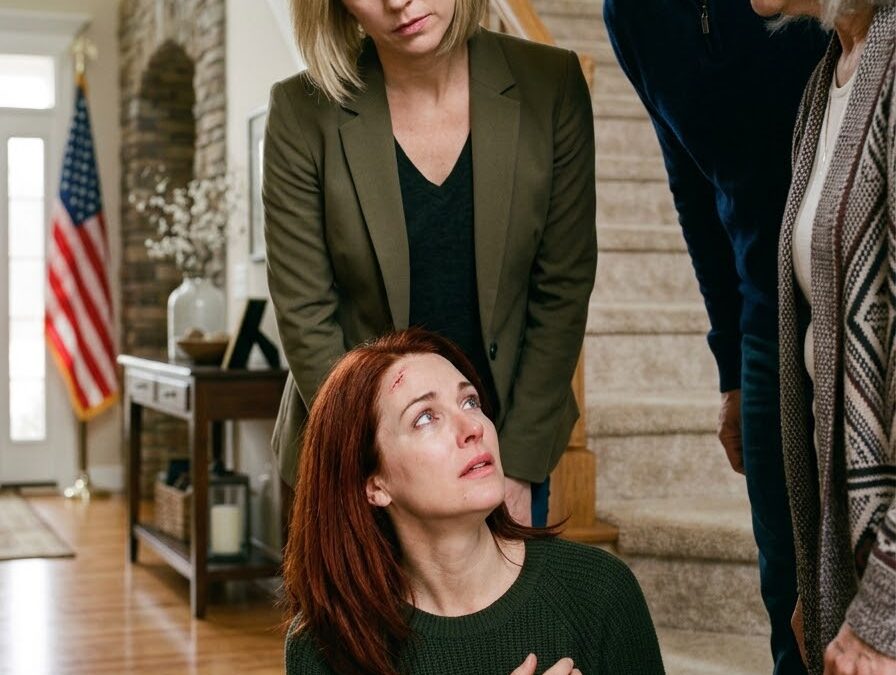
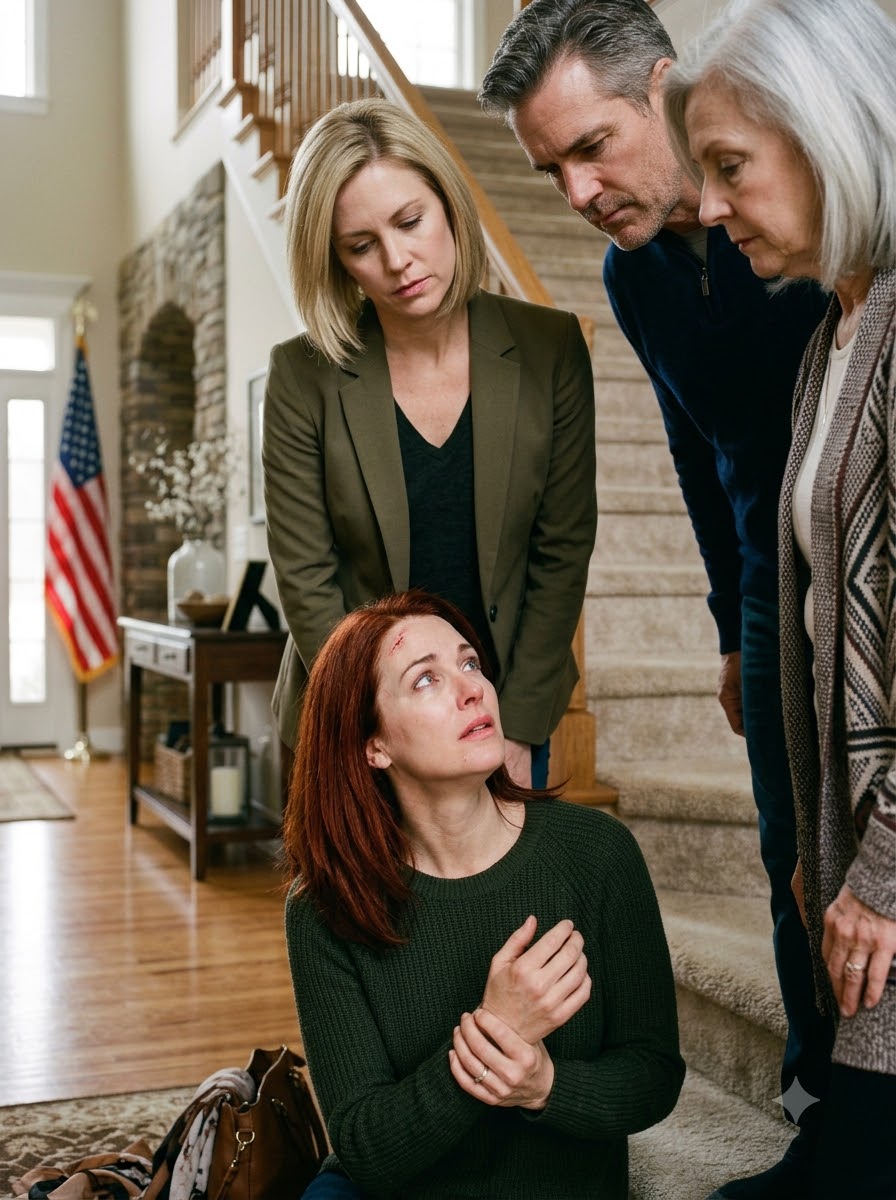
The moment my sister-in-law’s hands hit my back, I knew with a clarity I hadn’t felt in 23 years of marriage that I was finally, completely done.
I didn’t scream. I didn’t cry out. I tumbled down the last six steps of the staircase and landed hard on the entryway floor, the side of my head catching the baseboard, my left wrist folding under my weight in a way that sent a white-hot current all the way up to my shoulder.
I lay there for a moment, blinking at the ceiling.
Then I heard them.
“Oh, stop being so dramatic.”
That was April, my sister-in-law, looking down at me from the landing like I was something she’d accidentally knocked off a shelf.
“You always make everything into a production.”
My husband, Brandon, stood beside her. He didn’t come down the steps. He didn’t ask if I was hurt. He just sighed, that long, performative sigh I had come to know better than any other sound in this house, and said, “You shouldn’t have provoked her.”
His mother, Doris, stood at the top of the stairs in her robe. She looked at me the way you look at a spill you’re annoyed to have to clean up. Then she turned and shuffled back to her room, cane tapping the hardwood without a word.
I sat up.
I pressed my palm against my temple and felt the warm stickiness of blood against my fingers. My wrist throbbed.
My husband. His sister. The space where his mother had just been.
And something that had been stretched almost to breaking inside me quietly, finally gave way.
“I’m sorry,” I said.
My voice was so level it surprised even me.
April rolled her eyes.
Brandon went back to the living room.
A door closed somewhere upstairs.
I was a registered nurse. I knew exactly what I was feeling, and I knew it wasn’t the fall that had done the real damage.
My name is Janelle.
This November would have been my 23rd wedding anniversary.
I grew up in foster care, shuttled between six different homes before I aged out at 18. That kind of childhood teaches you early that family is something you build, something you earn, not something that simply happens to you.
When Brandon proposed, I was 31 and working at Northwestern Memorial, holding a nursing license I had spent four years earning and another two years certifying in critical care.
I had savings.
I had a career I was proud of.
I had tucked into the back of my desk drawer an offer letter from a hospital network in Vancouver that had recruited me through a professional conference. A better salary, a better title, a city I had already fallen in love with during a weekend visit.
I turned it down three weeks after the engagement.
Brandon’s family needed help.
His mother, Doris, had just been diagnosed with hypertension and early-stage heart failure.
His sister, April, had moved back home after a divorce and hadn’t found steady work yet.
Brandon’s contracting business had accumulated debts he hadn’t disclosed until after a ring was already on my finger.
I told myself, “That’s what you do for the people you love. You show up. You stay.”
I showed up, and I stayed for 23 years.
I made Doris’s meals, calculated her sodium intake down to the milligram, drove her to every appointment, sat in every waiting room, filled every prescription.
I covered the mortgage, which I eventually refinanced entirely in my own name after Brandon’s second bankruptcy, with night shifts that sometimes stretched to 16 hours.
I paid off $80,000 of Brandon’s gambling debts over 11 years.
April’s car loan.
April’s credit card balance.
April’s portion of the HOA fees she never once offered to cover.
They believed none of this would ever run out.
They believed I had no choice but to keep going.
Because where else, they told themselves, would a woman like me, a foster kid with no family, no inheritance, no safety net, possibly go?
The night of the fall, I waited until Brandon’s snoring filled the bedroom.
Then I drove myself to the emergency room.
I told them I had been pushed.
I told them exactly what happened, who had done it, and when.
A nurse, young, maybe 25, with the careful eyes of someone who had heard this kind of story before, documented everything methodically.
The attending physician photographed the laceration at my hairline and the swelling at my wrist and confirmed what I already suspected: a hairline fracture of the distal radius.
He handed me a copy of the report and said quietly that a social worker was available if I needed one.
I told him I was a nurse, too.
I thanked him.
I drove home in the dark and lay down on the den couch so I wouldn’t wake Brandon.
I didn’t sleep at all.
What I did instead in those hours before dawn was make a list.
The next morning, I made breakfast as usual.
I brought Doris her tray.
I did two loads of laundry.
April came downstairs at 10:00 and complained that her favorite sweater was still damp.
I told her I’d put it back in the dryer.
“Good,” she said, pouring coffee without looking at me. “And don’t forget Mom’s appointment Thursday. I can’t take her. I have plans.”
“Of course,” I said.
Then I took off my apron, folded it neatly over the back of the kitchen chair, picked up my purse, and walked out the front door.
My first stop was not the grocery store.
It was the office of a real estate attorney on Michigan Avenue, whose name I had researched three weeks earlier during the quiet hours between Doris’s midnight medications and my 6:00 a.m. shift.
I had his card in my wallet.
I had been carrying it for exactly 21 days.
I sat across from him and slid the property deed across the desk.
The house was in my name.
It had been in my name since the refinancing.
Brandon knew this, but he had the comfortable habit of forgetting inconvenient facts.
“I’d like to list it immediately,” I said.
He asked if I was sure.
“More sure than I’ve been about anything in a long time,” I said.
From his office, I went to the bank, where I had, four days prior, opened a new individual checking account at a different institution.
I redirected my direct deposit.
I moved my savings, every dollar I had accumulated in my own name across 23 years of night differentials and holiday pay, and every shift I worked while running a fever, to the new account.
What remained in the joint account was the $240 Brandon had last contributed toward a utility bill six weeks ago.
Then I went to the county clerk’s office.
Then I stopped at a FedEx location on the north side and shipped a sealed envelope to my attorney’s business address because I didn’t trust the mailbox at the house anymore.
Inside that envelope were 10 years of receipts.
Every out-of-pocket medical expense I had covered for Doris.
Every co-pay.
Every specialist visit.
Every pharmacy charge her Medicare plan didn’t cover.
I had kept them all organized by year and category in a fireproof box in the back of my closet.
I had taken them with me that morning in my tote bag, along with my passport, my nursing credentials, and the Vancouver offer letter I had never once thrown away.
I did not take my winter coat.
I did not take my jewelry.
I left almost everything behind because almost everything could be replaced.
What could not be replaced, I had already taken.
By the time Brandon sat down at the kitchen table the next morning and noticed the absence of coffee and breakfast, and any sign of me, I had been checked into a downtown hotel for 15 hours.
He found the divorce papers I had left in the center of the kitchen table.
He laughed.
April laughed.
Doris reportedly said I’d be back within a week.
That I had nowhere to go.
That I had never had anywhere to go.
That this was the one thing they had always known about me, and the one thing that had always kept me in line.
The calls started that afternoon.
I didn’t answer.
By the second day, Brandon’s texts had shifted from threats to something almost like pleading, then back to threats.
By the third day, I had already arranged through my attorney for all contact to be redirected, so the messages stopped reaching me entirely.
I knew what was happening inside that house.
I had lived there long enough to know exactly how it would unravel without me.
The premade meals in the refrigerator would last four days.
Doris’s medication management.
The pill organizer I filled every Sunday.
The blood thinner that had to be taken at 8:00 a.m. and 8:00 p.m. with food.
The calcium supplement that couldn’t be taken within two hours of her thyroid medication.
None of that had ever been explained to Brandon or April.
They had never asked.
Not once in 23 years.
I knew the laundry would pile up.
I knew April wouldn’t wash a single dish.
I knew Brandon would order takeout until he ran out of accessible money.
And I knew precisely the moment he opened the banking app and saw what had happened to the balances because it was the same moment I imagined him understanding, for the first time, that this was not a tantrum.
This was not a sulk.
This was a closing door.
What I didn’t anticipate was how fast the panic would turn vicious.
My attorney called me on the fourth morning.
Brandon had gone to the bank and made a declaration claiming I had embezzled funds from Doris’s care account.
He had presented fabricated claims that Doris suffered from dementia and that I had been exploiting her for years.
He had filed a police report listing me as a high-risk missing person, mentally unstable, possibly a danger to myself.
He had also shown up at my hospital, screaming in the lobby that I was a criminal until security physically removed him from the building.
My attorney was not alarmed.
He had been waiting for exactly this move.
“Filing a false report is a crime,” he said.
And I could hear the particular quiet satisfaction in his voice of someone watching a trap close.
“He’s handed us everything we need. The bank freeze will be lifted within 24 hours once we present your receipts to the fraud department. The police are going to want to speak with him, not with you.”
I sat on the edge of the hotel bed with my passport in my hands.
I thought about the night I turned down Vancouver.
I thought about the woman I had been at 31, standing in a hospital conference room, reading that offer letter and believing that love meant giving up everything you had built for yourself.
“How soon can you move?” my attorney asked.
“My flight is in two days,” I said.
What Brandon did not know, what none of them had ever thought to ask, was that my Canadian nursing license had never lapsed.
I had renewed it every three years, quietly, because something in me had never entirely let go of the idea that I might someday use it.
The Vancouver Hospital Network had changed names twice since my original offer, but the credential transferred cleanly.
I had emailed their HR department eight weeks before I signed a single piece of paperwork with the real estate attorney.
They had responded within 48 hours.
I had a signed job offer before I ever walked into the attorney’s office.
Brandon found out about the Canada connection somewhere along the way through the same shady college friend he always called when his own plans collapsed.
He showed up at O’Hare two days later, unshaven and hollow-eyed, stalking the departure gates for a flight to Vancouver that was booked in my name.
A flight I was not on.
My attorney had anticipated this.
We booked that ticket deliberately, then canceled it the night before.
I had already cleared Canadian customs by the time Brandon was demanding passenger information from a gate agent and being surrounded by airport security.
My attorney met him in the terminal.
What was said there was recorded.
Brandon had not thought to lower his voice.
And my attorney relayed it to me afterward with the kind of measured calm that told me he was choosing his words carefully.
He told Brandon who I was.
He told him that the woman Brandon had spent 23 years dismissing as a lucky charity case had, at the time of our marriage, been on track for a career that most nurses spend a decade trying to reach.
That I had been recruited internationally.
That I had been fluent in French and medical Spanish.
That I had turned down a position most people in my field would never be offered.
He told Brandon that every dollar, every night shift, every silent, exhausted morning when I had swallowed my anger and refilled Doris’s pill organizer for another week, all of it had been documented, receipted, and submitted to the relevant authorities.
He told him the false police report had already been investigated and that Brandon himself was now the subject of a fraud inquiry.
He told him the house had sold.
He told him the divorce was finalized.
He told him that any attempt at contact from either side of the border would be met with immediate legal action in both countries.
And then he left Brandon standing at O’Hare.
I heard later, through my attorney, through the slow, grinding unraveling of events over the following months, what became of them.
The electricity was shut off the first week.
The house sale closed without complication after Brandon’s fraudulent court injunction was nullified in 11 days.
The car Brandon had driven to poker nights and weekend golf had been financed under my credit.
It was repossessed from the driveway on a Tuesday morning while Doris and April stood at the front window and the neighbors watched from their porches.
Which was apparently the part that broke something particular in Brandon.
Not the debt.
Not the termination letter that arrived from his employer shortly after.
Not even the police inquiry.
It was the neighbors watching.
He lost his job because two officers had walked into his workplace asking questions about a fraudulent missing-person report, and his company could not absorb that kind of exposure.
He was terminated without severance.
The following week, April, who had not held a job for longer than eight months in her adult life, found that her social circle evaporated the moment she stopped being entertaining and became a problem to solve.
She moved back into the apartment with Brandon and Doris because she had nowhere else to go.
Doris was hospitalized after a hypertensive crisis caused by four days without her blood thinner.
Neither Brandon nor April had known the name of the medication, the dosage, or the schedule.
They had not known she had a standing refill order at the pharmacy because they had never once asked.
The attending physician told the insurance company that the situation was entirely preventable.
They ended up in a two-bedroom apartment in a suburb none of them had chosen, surviving on Brandon’s day-labor income and April’s part-time retail hours.
Fighting every night about who was responsible for Doris’s medications.
Who had last made a doctor’s appointment.
Who was supposed to have called the insurance company.
They had never learned any of it.
They had simply sat inside the architecture I built and treated it like weather.
Inevitable.
Effortless.
Requiring nothing from them.
The pharmacy called me once about four months after I left, looking for me by name.
The pharmacist’s voice was apologetic.
The refill authorization had lapsed, she said, and the family had been unable to locate the paperwork.
I gave her the attending physician’s name and the clinic number and told her gently that I was no longer the responsible party.
Then I hung up, sat quietly in my office for a moment, and let the silence settle.
Vancouver in the fall is gray and extraordinary.
The mountains appear and disappear behind the cloud cover.
And between patients, I sometimes catch myself standing at the window just watching for them.
My colleagues at the regional health center are genuinely kind in a way that still catches me off guard sometimes.
They ask my opinion during rounds.
They remember what I told them the week before.
One of them, a physician I work with closely, told me in my first month that she was glad the recruiting team had been persistent, that nurses with my level of clinical judgment were difficult to find.
She said it in passing, the way people say true things without ceremony, and I had to look away for a moment before I could respond.
My patient on a recent Tuesday morning, an 81-year-old retired schoolteacher named George who comes in every week for wound-care follow-up, looked up at me while I was changing his dressing and said, “You know, you’re the best nurse I’ve ever had.”
Matter-of-fact.
No performance in it.
Just a man saying a true thing.
I thanked him and finished the dressing and went to chart his vitals.
It was only later, walking to my car in the parking structure, that I let myself feel the full weight of those words.
Not because I needed his approval to know my own worth, but because for 23 years I had brought the same quality of care, the same precision and attention and genuine presence, to every patient and every task and every person in that house.
And the people who were supposed to know me best had never once said anything close to it.
They had never thought to wonder what it cost me.
They had never thought to wonder at all.
The sale of the house cleared six weeks after I arrived.
After attorney fees and the last of Brandon’s debt that had been tied to my credit, I had enough for a reasonable down payment on a small condo three blocks from the hospital.
I closed on a Friday afternoon.
The realtor handed me the keys in the parking lot, apologizing for the lack of ceremony.
I told her the lack of ceremony was perfectly fine.
I drove to my new building, rode the elevator to the fourth floor, unlocked the door, and stood in a room that was entirely, unambiguously mine.
The floors were hardwood, and the windows faced west.
There was no one’s medication schedule on the refrigerator.
There was no one’s resentment in the air.
There were no footsteps overhead, no voices carrying through the walls like accusations.
There was only the sound of the street below and, faintly, rain beginning against the glass.
I set my bag down.
I stood in the middle of that room for a long time.
I didn’t cry.
I wasn’t triumphant in the way I might have expected.
What I felt was something quieter and more fundamental than triumph.
Something that settled into the bones rather than rushing to the surface.
It was the particular feeling of a person who has finally, after a very long time, arrived somewhere she was always supposed to be.
I thought about the woman I had been at 31, standing in a hospital conference room, reading a job offer and deciding it was something she’d have to give up in order to deserve love.
I thought about what she had given up.
I thought about what she had carried in exchange.
And I thought about what she had ultimately brought with her across that border.
An unbroken nursing license.
10 years of meticulous receipts.
A passport that had always been ready.
And the knowledge, finally certain, finally actionable, that she had never needed anyone’s permission to be worth something.
I walked to the window and watched the rain move across the mountains.
Somewhere far away, in a cramped apartment in a suburb no one had chosen, three people were learning at great cost what it meant to be responsible for their own lives.
I hoped, genuinely, that they would find their way through it.
Not for my sake.
Just because pointless suffering is still suffering, and I had spent too many years watching it not to recognize it.
But that was their story now.
And it was theirs to carry.
Mine was just beginning.








