All four of his children refused to pick him up from the hospital. The hospital had called each of them, but none would come to get him. Dad texted me: “We can’t put our own lives on hold just for him. You handle this.” At the time, I was more than 200 miles away. When he got into my car, he didn’t ask about them at all. He pulled a business card from his coat pocket and said, “Drive to this address first.”
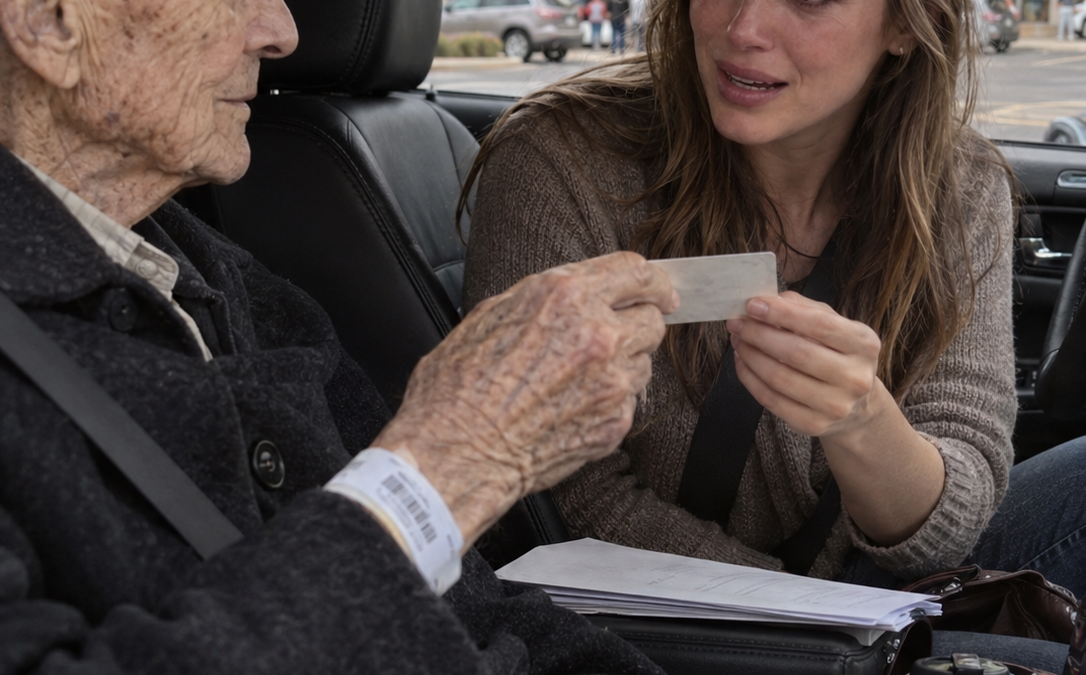
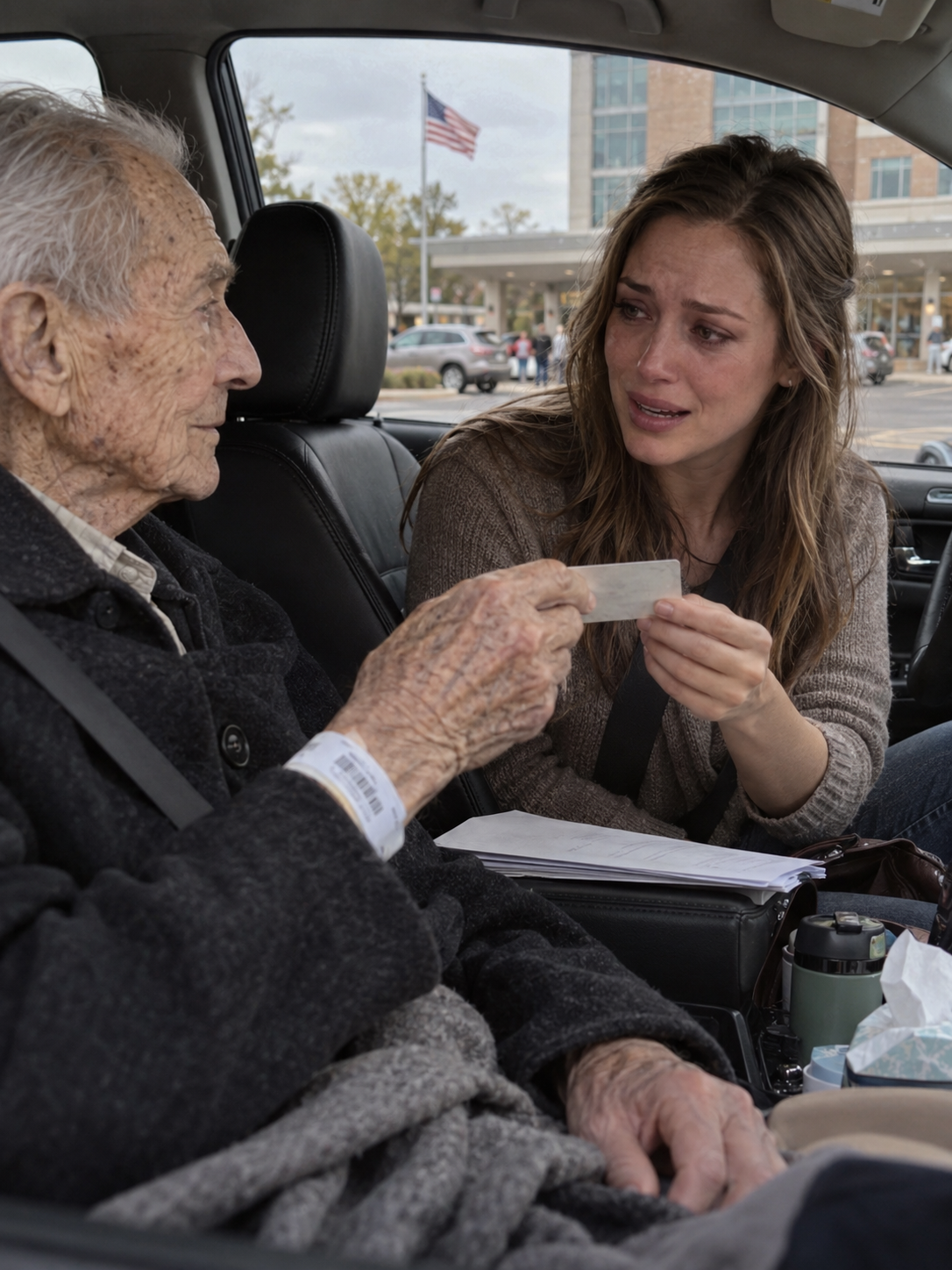
The hospital called each of Grandpa’s four children.
For six hours, he sat on the edge of the hospital bed with his coat buttoned to the collar, hands folded on his knees, watching the door, waiting to learn which one would come.
None did.
Then my phone buzzed.
A text from my father.
We can’t put our lives on hold for him.
You handle it.
I was 212 mi away.
I drove 4 hours west, signed where grandpa’s own children would not, and helped him into my car.
He never asked why they hadn’t come.
He never said their names.
He simply reached into his coat, took out a business card worn so soft at the corners it bent like cloth and said, “Drive here first.” He’d been carrying that card for weeks, and every refusal made that afternoon was about to matter.
If you’re settling in for this one, tell me where you’re listening from.
I read every note because to understand that card, you have to start with a phone call and with what a hospital writes down.
My name is Kristen Lindall.
I’m 28 and I record other people’s words for a living.
Depositions, hearings, every syllable exactly as spoken.
The text came through while I was still in the courthouse in Omaha.
My stenotype machine folded on its cart beside me.
I had just finished a morning session when my phone lit up with my father’s name and those two sentences.
We can’t put our lives on hold for him.
You handle it.
I read it twice.
My thumb was already tapping the phone case.
The way it taps when I’m holding a sentence in my head for the record.
The second call came from a number I didn’t know.
Beth Carlson, discharge coordinator at the county hospital in Hrega, the town where my grandfather has farmed since before my father was born.
Her voice was flat.
Nebraska courtesy.
All facts, no editorial.
Mr. Lindel had a fall and what the doctors calling a small stroke.
He’s cleared to go home, but not alone.
We’re required to contact family.
A pause.
Papery.
We reached all four of his children today.
The last call.
Your father gave us this number.
He said, “My daughter will handle it.”
He said it to them, too.
Then, not just to me.
Into their file.
I’m required to ask.
Beth said, “Are you able and willing?”
“I can be there by 4.”
I canled two depositions, two clients, two fees.
Gone.
Put gas in the car and pointed it west on the Interstate 80.
The trip meter clicked over to zero as I left the garage, 212 m between my life and his hospital bed, and the concrete seams of the interstate started up their slow drum beat under the tires.
And I realized I was transcribing my father’s text in my head.
Over and over, the way I transcribed testimony, word for word.
4 hours west, my grandfather was asking a nurse what color my car was.
Beth met me at the discharge desk with a clipboard and a pen that had a plastic spoon taped to it so nobody would walk off with it.
The contact log was open on the counter and I read it upside down the way I read exhibits.
Four lines, four names.
My father, Curtis, client meetings until 6.
And this keeps happening.
We have to draw a line somewhere.
My uncle Brent not set up for it.
Trucks in the shop can’t.
My aunt Janelle, she’d given enough years to that farm already, and her back wouldn’t take the lifting.
My uncle Todd, the orthodontist, not equipped for poststroke care, he’d defer to his siblings.
And under all of it, the last entry, my father again, my daughter will handle it.
Sitting in the record like a signature, Beth slid the clipboard toward me.
Behind the glass, two women in church hats drifted past toward the gift shop, and Beth lowered her voice without moving her eyes.
Phelps counties got one hospital, one bank, and one story a week.
This woman’s already at the bank.
Then she walked me back to the room.
He was sitting on the edge of the bed exactly the way I’d pictured it.
And worse, coat on, every button done.
A small hard-sided suitcase standing at his feet like a dog told to wait.
Gunner Lindal, 89 years old, 480 acres of irrigated ground to his name, and not one person in this county willing to drive him to it.
He looked up at me.
He didn’t ask why I’d come or how or whether his children knew.
Roads clear, he said.
Yes.
Good.
Long day for you.
That was all.
Not a word about them.
He put his hand on the suitcase handle before I could reach it.
He wasn’t dressed like a man waiting to be rescued.
He was dressed like a man with an appointment.
The appointment, whatever it was, rode out to the parking lot with us.
He lowered himself into my passenger seat and buckled the belt in one clean motion.
No fumbling, like he’d rehearsed the car.
Beth came out after us at a half jog, holding a folder of discharge papers.
She handed it through my window, then paused, looking at my phone in the console cradle.
My father’s text still on the screen where I’d left it.
That message, she said.
Family designating a receiver.
It goes in the file.
Forward it to this number.
She turned the clipboard so I could see the digits.
I typed them in and hit send right there in the lot.
It took 3 seconds.
I thought I was tidying paperwork.
Beth tucked the clipboard under her arm.
“He’s been asking what color your car is,” she said, and went back inside.
I started the engine, and that’s when Grandpa reached into his coat, inside pocket, left side, over the heart, and drew out a business card so worn the corners had gone soft as cloth.
Printed on the front, a law office.
Karnney.
He turned it over, read something on the back that he did not show me, and held it against his knee.
Drive here first.
I looked at the clock.
It’s 4 already.
They close at 5.
Paul will wait.
Kernney was 40 miles back the way I just come.
The opposite direction from his farm, from his bed, from anything a discharged man should want.
Paul will wait,” he said, like a man calling ahead to a table he’d booked.
40 miles of the Plat River Valley ran alongside us, and the fields were full of sandill cranes.
March in Nebraska, the corn stubble gray, and the sky moving, and thousands of those tall birds standing in the stubble like a congregation that had lost its church.
Grandpa watched them the whole time, his head turned to the glass.
Your grandmother made me stop here every March.
He said 40 years.
She’d stand on the shoulder in her good coat and just listen.
Said the sound was older than any of us and we ought to pay it some respect.
I let a mile go by.
Then I couldn’t anymore.
Grandpa, who’s Paul?
A man who owes me 30 years of feeasant hunts.
That’s not an answer.
It’s the start of one.
I glanced over.
There was something in his face I hadn’t seen in the hospital.
Not mischief exactly.
Aim.
A man sighting down a row he’d planted a long time ago.
My hands stayed at 10 and two, and I understood in the wordless way you understand weather that I had not been handed an errand.
This afternoon, I had merged onto a route somebody else had already mapped.
The cranes lifted off a field in one gray sheet as we passed.
Thousands of wings turning the air over and settled again behind us.
Cranes stop here every march, he said.
Some things know exactly where they’re supposed to land.
The start of one.
I carried that phrase up a narrow stairway in Kernney above what used to be a bank into an office that smelled like paper and pipe smoke that had moved out decades ago but left a forwarding address.
Paul Angstrom stood up from behind the desk 70s suspenders reading glasses pushed into white hair and he was not surprised to see us.
That was the first thing I noticed.
The second was the folder already squared in the center of his bladder.
He laid the documents out like place settings.
Healthcare power of attorney, financial power of attorney, a nomination, his word, naming the person Gunnar Lindol wanted if a court ever had to appoint someone to look after him.
The nomination form was typed, dated in February, 3 weeks before the fall.
And on the line for the nominee, already filled in, Kristen A. Lindol.
My own name looked strange to me.
The way your voice sounds strange, played back.
Angstrom glanced at the discharge summary Beth had sent along.
Alert, oriented, clear, and gave one nod.
February holds.
Today confirms it.
Grandpa signed three times.
Slow and even the pen loud in the quiet.
Angstrom’s secretary witnessed.
Then Angstrom turned the last page toward me and tapped a different line.
Sign here, not as witness as the one who accepts.
The line above mine had space for a son or a daughter.
It was blank.
I signed.
Angstrom shook my hand and held it a half second longer than a handshake needs.
“You’ve grown,” he said.
Three weeks before he fell, my name was already typed on that line.
“You’ve grown.”
I turned that over all the way down the stairs and out into the dusk because I had never in my life, as far as I knew, met Paul Angstrom.
In the car, before I could ask it, Grandpa answered a different question.
The one I’d asked in the hospital lot with my eyes.
Why didn’t you tell me?
He reached into the code again.
Not the business card this time.
A second card, stiff paste board, and on it in carpenters’s pencil in his blunt vertical hand.
Four lines.
Ingred, Nyquist, the bank, the blind.
No explanations, just four words stacked like fence posts.
I’ve got a list, he said.
And I don’t know how much road I’ve got.
You drive, I’ll ride.
Four stops.
Four I know of.
What’s the blind?
March knows.
You’ll see.
I slid the folder of signed papers into the glove box to keep them flat.
And the glove box was not empty.
A bank envelope sat in there, the kind with the little window, one corner showing.
His evidently placed evidently.
I shut the little door on it and filed the question with the others.
He shifted in the seat, getting the seat belt comfortable across the coat.
You still keep that steno machine in the trunk?
Always.
Good.
A house should have one person who writes things down.
The highway unrolled west into the last of the light, and the two of us wrote it.
An old man with a pencil list of his remaining errands and the granddaughter who apparently came factoryinstalled in the plan.
You drive, I’ll ride.
He said it like a job title like mine.
His house met us in the dark and it was her house too still.
My grandmother Ingred gone four years now was in the doilies and the seed catalogs and the china behind glass.
Everything kept where she’d kept it.
First night of the ride along rule, somebody stays.
I made tea and went looking for his medication schedule in the kitchen.
And that’s when I found the notebook on the window sill over the sink.
His rain gauge log.
40 years of it.
I’d seen it my whole childhood.
Column for the date, column for the inches, his pencil turning weather into arithmetic.
I flipped it open out of pure habit.
There was a third column now, newer pencil.
The heading was a single letter K and down that column over and over starting in 2019, the year I took the Omaha job.
212 212.
Every time I’d driven out, every visit I thought had gone unremarked.
A Saturday here, a Christmas there, the weekend after Grandma’s funeral, he had logged me like rainfall, measured dated kept.
I stood at that sink for a long time with my hand flat on the page.
Then I closed the notebook and set it back exactly on its dust line because he would notice.
If that little pencil column gets you the way it got me, tap that like button for the old man and his notebook.
He’d never say any of this out loud.
That’s the point.
My phone buzzed on the counter.
The family group thread, “Awake at last.”
11 missed calls and a scroll of messages.
All landing in the hours since that text of my father’s went into a hospital file.
Not one call from any of them in the three days grandpa had lain in that hospital.
From the bedroom, his voice already half asleep.
Kristen, rain gauge is froze.
Don’t trust it till April.
Okay, Grandpa.
And thank you for the day.
40 years of rain and the only thing he measured twice was me coming home.
The town knew before the family finished dialing.
Monday morning I drove in to fill his prescriptions.
And at the bank, his bank, the only bank, the teller looked up from her window and said, “You’re the one who drove.”
Not a question, a coordinate in Holdraggy.
You don’t get introduced, you get located.
The white paper pharmacy bag was still warm on the passenger seat when the call started.
My father first.
Curtis Lindall does insurance for half the farms in this county and he talks the way he sells.
Friendly, circling, always closing.
Just checking in.
How’s he settling?
Everything uh squared away up there paperwork-wise.
Paperwork-wise.
Day four.
He’s resting, I said.
Then Janelle, my aunt, her voice pitched for church.
Kristen, honey, whatever’s going on out there, don’t make it a thing.
People notice this family.
Don’t give them something to notice.
I said soothing words to both of them.
I want to be honest about that.
I smoothed and reassured and deescalated because that is what I have done my whole life because a calm surface was the closest thing to safety I ever learned to build.
I hung up and drove and the pharmacy bag crackled at every turn like something trying to speak.
Paperwork-wise, my father said.
Not once.
How is he?
The first stop on the pencil card wasn’t paperwork at all.
Ingred, it took two and a half weeks before he’d let me drive him there.
He wanted his legs under him first.
The Lutheran cemetery sits at the edge of town where the shelter belt gives out and the wind gets a running start.
Her stone is pink granite and the grass around its base had come through winter shaggy.
Grandpa lowered himself down and began pulling the dead grass away with his bare hands.
And he talked to her while he did it.
Present tense like she’d stepped into the next room.
She keeps asking about you, he said to me, about her.
And out there it made perfect sense.
He told me about the lilacs while he worked.
1958, a folders coffee can on the seat of the truck, a slip of lilac root from her mother’s place, and Ingred planting a whole row of them down the farm lane, 21 years old, patting the dirt like tucking in children.
Lilacs outlive the people who plant them, he said.
That’s the whole point of a lilac.
I knelt down beside him without deciding to.
The ground was cold through my jeans and I was pulling grass too and my knees were wet and I didn’t care.
Then he said, not looking up.
She kept your room the same after 2011.
The year my mother died.
The year I came to live in that house.
I waited for the rest of the sentence.
He smoothed the grass and gave the stone a pat.
And the rest of the sentence did not come.
Your grandmother did the talking for both of us, he said standing.
Now I do it for both of us.
Funny trade.
She kept your room the same, he said as if it had been his idea to fill it.
After 2011, the phrase followed me back to the farmhouse and sat with us at supper like a third chair pulled up.
Two bowls of soup, the kitchen light low, and I finally asked the question I’d been carrying since the courthouse hallway.
Why me, Grandpa?
Why is it always me they call?
He didn’t answer right away, so I filled the quiet the way witnesses do.
My mother died in October of 2011 when I was 15.
My father remarried fast inside a year and somewhere in the shuffle of his new life.
I was sent out here to this kitchen to grandma’s cooking and grandpa’s silences.
And I finished high school in Holddregs.
And ever since, whenever the family needed a driver, a signature, a sorter of some dead relative’s garage, my phone rang.
I was the one who answered.
I’d made a profession of it, if you thought about it.
A whole career of showing up with a machine and taking down what happened.
Grandpa let me finish.
He didn’t reach across and pat my hand.
That was never his instrument.
They call you because you answer, he said.
That’s not the same as family, Kristen.
He turned his spoon over, sat it down.
14 years ago, you sat in that same chair and asked your grandmother the same question.
What did she say?
He looked at the chair I was in.
And something moved behind his face and stopped.
“Tomorrow we go see Dale Nyquist,” he said.
“A debt older than you.”
“A debt older than me?” he said.
“Tomorrow we’d go pay it or collect.”
We never made it straight to the debt.
In the morning, Grandpa had me stop first at the county land office and the bank.
Not on the card, he said.
Just housekeeping.
And the housekeeping took 15 minutes and moved a lifetime.
480 acres of irrigated ground.
And every document that touched it now routed through the power of attorney with my signature on the acceptance line.
At the bank, while I signed, he had the teller run my discharge folder through the copier.
I didn’t ask what for.
We were pulling out of the bank lot when my phone rang.
Brent, my uncle.
18 days of silence since the hospital called him and here was his voice at last.
Fast and pressed flat.
What did you make him sign?
Not hello, not how’s dad.
I put it on speaker without meaning to.
My thumb just did it.
The reflex of a woman who keeps records.
You’ve got him alone up there signing things, Brent said.
That’s called manipulating a sick old man.
Grandpa sat in the passenger seat through all of it, eyes forward on the grain elevator down the street, one hand resting on the breast of his coat over the pocket.
He didn’t reach for the phone.
He didn’t need to.
I said one sentence.
He was alone for 3 days in a hospital bed.
Brent, you had the room number.
I hung up.
18 days of silence.
And the first question wasn’t about his heart.
It was about his signature.
The word manipulating was still hanging in the car when we turned into the Nyquist place one mile down the section road and grandpa got out slower than he wanted me to see.
Dale Nyquist came off the porch to meet us.
70s seed cap.
A handshake like a fence stretcher.
Grandpa stood in front of him straight as he could get and paid a debt 47 years old.
He told it plainly, and I heard a version of my grandfather I had never met.
Winter of 1978, his own father.
My great-grandfather losing his mind by inches, wandering the yard at night in his union suit.
Grandpa was 43.
The farm mortgaged past its eyebrows, a bad crop behind him, and a worse bank meeting ahead.
And he could not carry the old man.
Could not.
And Dale’s father took him in.
6 months.
The last 6 months of my great-grandfather’s life in another family’s house.
I never said it out loud, Dale.
Grandpa said, your dad took mine when I couldn’t.
Dale looked at him for a moment and then did the kindest thing available to a Nebraska man, which was to refuse the weight of it.
Gunner, he liked the company.
So that was why.
That was why there’d been no bitterness in the hospital, no speech about ungrateful children.
He had been on the other side of this once.
He didn’t damn a person for being unable.
He damned the not saying so that the saying one thing into a phone and another at the dinner table.
We turned for the car and Dale held the storm door.
Before you go, there’s a chair your family ought to see.
The chair sat in the corner of the Nyquist front room like it had grown there.
A wing back upholstered in blue wool gone silver at the arms, worn through in two oval patches, exactly where a man’s hands would rest year after year.
That was his, Dale said.
Your great granddad’s winter of 78 through the summer.
He liked it by the window where he could watch the section road 47 years.
They had kept it 47 years, not stored it, kept it in the good room, facing the window, as if the old man might still want his view.
Grandpa crossed the room and put one hand on the chair back.
He stood there a long time, not saying anything, his thumb moving once across the worn place.
My grandfather, who does the talking for both of them now, had no talking for this.
I looked at the chair and I looked at him.
One small stroke down, a pencil list in his pocket and I understood I was looking at the before and after of the same story.
Somebody kept a chair for his father.
His own children wouldn’t keep an afternoon for him.
Dale walked us out at the car.
He said, “Your family already paid 1978.”
And he shut my door for me gently like the end of a hymn.
Some debts don’t want money.
They want somebody to come stand in the room.
The family came to stand in the room 10 days later.
But not that room and not that way.
They came on a Sunday unannounced.
Four vehicles in the yard like a delegation.
My father and his wife.
Janelle with a sheetcake.
Todd down from Grand Island.
Foil covered dishes handed through the door in both hands.
Warmth arriving on schedule.
4 weeks late.
They talked loud the way you talk to the elderly and the foreign.
They praised the house.
Janelle posed a photograph of everyone around Grandpa’s chair and had it posted to the church group before the coffee finished dripping.
Blessed Sunday with dad.
I stood at the counter and did what I do in a courtroom.
I watched who sat where, who glanced at the oak file cabinet in the corner.
How many times the word paperwork surfaced in the small talk, wearing different clothes.
Grandpa received them like a man receiving them.
He called every person by name, asked Todd about the practice, asked my father’s wife about her sister in Lincoln.
He was so precisely provably present that I watched Todd, the medical one, recalibrate in real time.
His eyes going from the expected diminished father to this one.
The one keeping score.
Janelle lifted foil.
We brought hot dish, Dad.
The one mom used to.
Your mother never put tater tots on hers.
Grandpa said one sentence.
The table went quiet for exactly two beats.
The sound of a family recalculating.
Todd kept glancing at the file cabinet the way a man checks a scoreboard.
The file cabinet finally got its turn with the coffee cups.
Curtis set his down, laced his fingers, and became before my eyes the man who runs the parish council.
Dad, we want to talk about a care plan.
And then they talked about him, over him, around him.
Third person, present company.
He can’t stay out here alone.
He needs structured care, real supervision.
We list the ground, split it clean.
The land pays for the home.
It’s the responsible thing.
Grandpa sat at the head of his own table with both hands flat on the wood, palms down, the way he’d rest them on a fence rail while deciding about weather.
He said nothing.
His silence wasn’t absence.
It was measurement.
Only once did anyone aim a sentence at him, and it came in the voice you’d use on a child at a birthday party.
Isn’t that right, Dad?
Won’t that be nice?
And my father laid his hand on Grandpa’s shoulder and delivered to the room the line I would hear again before this was over.
This family takes care of its own.
I looked at that hand on that shoulder.
I looked at the phone in my pocket where a text message said what this family does with its own.
This family takes care of its own.
My father said his hand on the shoulder of the man he wouldn’t drive four miles for.
The hand was still on his shoulder when grandpa stood up.
Slow, steady, one palm braced on the table till he had his height.
The room hushed the way rooms do for him.
He said four short sentences and he never raised his voice.
This is my house.
The name on the deed is mine.
The papers you’re fishing for are signed and they’re mine, too.
Kristen stays tonight.
The rest of you know where the road is.
Then he walked to his bedroom and closed the door with a click so soft it was louder than a slam.
The chairman had left the meeting.
The delegation turned to me and the warmth came off like a coat.
Curtis low.
Fix this.
Janelle hissing.
You’re embarrassing us in front of the whole church.
Todd said nothing at all, which frightened me more.
His was the silence of a man pricing a different door.
And I did the thing I had never once done at a family table.
I didn’t smooth it.
I walked to the entry, opened the screen door, and held it.
He said no in complete sentences.
You all heard him.
Curtis stopped on the porch step and the salesman left his voice entirely.
There are ways to handle men his age.
Legal ways.
They drove off.
I went back in and washed Janelle’s hot dish pan until it shown because some habits die slower than others, and I needed my hands busy while my spine got used to its new length.
From behind the bedroom door.
Bank tomorrow, Kristen.
Third stop.
The box this time, not the counter.
Legal ways, my father said.
He sells insurance.
He knows exactly what paper can do.
The third stop on a dead woman’s pencil card turned out to be a steel box in a small room.
At the bank, Grandpa signed us into the vault.
The key came out of my glove box.
That bank envelope riding there since the day I drove him home.
He slid out his safe deposit box and lifted from it a single manila folder, thick, soft cornered like the business card.
He did not set it on the table.
He put it directly into my hands.
Given, not found.
I want that on the record.
The top page was a photocopy and I recognized the form before I recognized the words.
A hospital contact log.
March 14th.
Four entries verbatim in Beth Carlson’s careful hand.
Every refusal, every excuse.
My father’s last line about his daughter.
All of it exactly as it had been read to me across a counter a month ago, almost to the day.
The same document that had been sitting in my own discharge folder since day one.
I’d carried it home.
I’d never never once understood I was carrying ammunition.
I could have called Dale.
Grandpa said one mile.
He tapped the page twice.
I needed them to say it into a record.
A hospital writes things down, Kristen.
So do you.
It’s why I chose you.
The vault hummed.
I stood holding six years of my own visits, four refusals, and the architecture of a plan that had started before his heart ever stuttered.
Then he tapped the folder.
Page 14, he said.
Read it in the car.
I made it to the car.
I got the door shut.
Then I turned to page 14.
It was a print out of an email.
The header formatting was old.
The font was old.
The date was October 2011.
From Curtis Lindall to Gunner Lindall.
I read the sentence and the parking lot went very far away.
We can’t put our lives on hold for her.
You handle it, Dad.
Her me 15 years old.
3 weeks after we buried my mother.
Under the email was one more photo copy, a guardianship paper from that same fall, signed, notorized, and along the bottom, the preparing attorney, P. Angstrom.
You’ve grown.
He had watched me sign in his office as a grown woman on the same line where 14 years ago my grandfather had signed to take me.
Nobody invited me to Holdreg in 2011.
I had believed my whole life that grandma asked for me.
Some soft lit story about wanting a young person in the house.
There was no invitation.
There was a text before texting.
The same sentence with a different pronoun and an old man who got in his truck and drove 212 mi east.
My hands were on the wheel at 10 and two.
Engine off going nowhere.
My voice came out smaller than I’ve ever heard it in a deposition.
Why didn’t anyone tell me?
Your grandmother said if the girl thinks she was invited, she’ll stand taller than if she knows she was rescued.
He watched the elevator, not me.
I’ve argued with that woman my whole life and lost every time.
14 years I thought I’d been invited.
I’d been rescued by the man in my passenger seat.
Rescued.
The word rang in my ears all evening like a struck pipe.
And it was still ringing when the two of us ended up on the porch after supper.
Tea going cold in both cups because neither of us remembered we’d made it.
I asked him the question I was most afraid of.
Did you resent it handling it?
He took his time.
The porch light drawing moths, the first spring insects ticking against the screen.
I was 76, he said.
Figured I was done raising people.
Turned out I wasn’t.
A long pull of the cold tea, a small grimace at it.
Best crop I ever raised came in after I quit farming.
I looked away down the dark lane toward the lilac row.
I couldn’t see because there is a limit to what a person can hold eye contact through.
And sitting there, I finally understood what he’d handed me in that vault.
Not a weapon for a landfight.
A method.
His whole life folded into a folder.
Say it plain.
Keep your voice down.
Write it down.
Let the paper do the shouting.
The inheritance wasn’t the acorage.
It was the discipline.
If dad’s legal ways turn real, I said, “What do you want?”
Then we’ll be glad somebody wrote things down.
That night, I typed a text to my father.
Dad, can we talk and erased it?
Typed it again.
Erased it.
A third time, watching the cursor blink like something alive.
Three times I typed, “Dad, can we talk?”
Three times I erased it.
The fourth text that night wasn’t mine.
The fourth text came in at 11:40 from Janelle and it was not meant for me.
A screenshot fired into the wrong thread.
Todd’s messages discussing a capacity evaluation, the name of an attorney in Grand Island, the phrase build the file.
She deleted it 4 minutes later.
4 minutes is a long time to a court reporter.
I didn’t panic, and I want to be accurate about why.
I had stopped expecting better, and it turns out dread mostly lives in the gap between hoping and knowing.
Instead, I went out to the car, opened the trunk, and carried my Steno machine into the kitchen.
From that night on, I worked evenings.
Grandpa talked 1958 in the coffee can, 1978 and the blue chair, 2011 and the drive east.
And my fingers took him down verbatim, the little machine purring under the kitchen light like a cat that eats syllables.
He watched the paper feed out one night, all his years turning into record.
“Now you’re farming,” he said, the gas receipts stacked up in the console.
“I moved court jobs, drove Omaha and back, drove again, kept a mileage column of my own now.
Said nothing to anyone about any of it.
Some accounting you keep quietly or it stops being love.
I did call Paul Angstrom once.
Short and procedural.
If they file, what holds his designation, his paperwork, a dry pause down the line, and whoever shows up keeps showing up.
Whoever shows up keeps showing up.
I wrote that one down, too.
Showing up meant sometimes being gone.
Two days in Omaha in midappril.
Jobs.
I couldn’t move again.
The life that pays for the gas.
Grandpa called in the evening while I was already westbound on 80, and his voice came through the car speaker on the passenger side, riding along in the empty seat where he ought to be.
He was in a storytelling mood, working down the pencil card.
Fourth stop, the blind, he said.
Your grandmother and I the sentence stopped.
Not paused, stopped a sound I didn’t have a name for.
Something small dropping.
Then the open line hissing, going on without him.
Grandpa, the line hissed.
Grandpa.
I called 911 on the other line and gave them the farm’s fire number, the address off his mailbox, the one I’d known by heart since I was 15.
Then I called Dale.
One mile.
He beat the ambulance by 4 minutes.
He told me later.
And when they came through the door, he was on the floor beside my grandfather, holding his hand, talking to him about nothing at all.
I drove 212 miles with that empty seat beside me, doing every legal thing a car can do, and some others, and the concrete seams came up through the tires in their old rhythm.
Thump, thump, thump, and I hung every mile on them.
The seam strips counted for him.
Still here.
Still here.
Still here.
He was still here.
A second stroke, the doctor said.
Small again.
But small is a word that keeps borrowing meaning.
It had gone through his speech like a wind through a shed and taken most of the roof.
They moved him to the rehab wing in Hrega, and when I finally sat beside him, he was awake, oriented.
The chart said so, and his eyes said so harder.
But words came out of him one and two at a time.
Now, expensive, each one paid for, upfront with breath.
The pulse monitor kept its small blue time in the corner.
He didn’t waste his budget on comfort.
He’d planned to say these things later, I believe, at the end of the pencil card, and his body had moved up the date.
So he said them now in pieces resting between not to beat them.
A breath the monitor beeping.
Nobody came.
You came a longer rest.
His hand finding mine on the blanket papery and certain.
I don’t need you to win.
I need one person in the room who knows what I want.
Then he worked his good hand into the coat on the chair beside the bed.
That coat went where he went, and brought out an envelope, sealed, my name on it in the pencil hand, but level and firm, written before.
He pressed it into my hands and paid out three more words.
When they gather, I held the envelope, and I gave him back the only thing I had that was worth his three words.
“I’m not keeping you to beat them,” I said.
“I’m keeping you because nobody came.”
His eyes closed and opened once.
Slow, which in the new language language meant everything it needed to.
Then he held out his good hand for the envelope, and I understood.
He worked it back into the coat’s breast pocket and patted it flat.
His to hand over, not mine.
When they gather, he said, “Not if, when.”
They gathered.
All right.
Around his rehab room in shifts with a signup sheet.
Janelle posted a visitation schedule to the church group like a casserole rotation.
And that Sunday, Grandpa’s name appeared on the printed prayer list, read aloud to the whole congregation.
Pray for Gunnar Lindol that his family be restored to him.
Restored to him.
Six words.
And I was recast for 300 people as the thing his family needed restoring from.
The pastor called me Tuesday.
Kind as warm milk.
Kristen, nobody doubts your heart.
But sometimes the kind thing is to step back.
Let the children lead.
Cousins I hadn’t heard from in years texted variations on a theme.
Don’t make waves.
Think of the family.
Just let them have this.
Every message found the oldest groove in me.
The one that says peace is worth more than your position.
The one carved when I was 15.
And learning that the quiet girl gets to stay, I listened to all of it.
I wrote all of it down.
The habit had become armor.
And to the pastor, after I said one sentence, polite and loadbearing, “Pastor, he has a voice.
It’s quiet now, but it’s his.
I’d start by asking him.”
Restored to his family, the bulletin said.
Nobody asked which family showed up Tuesdays.
Tuesdays, as it happened, belonged to the people no schedule had assigned.
Dale Nyquist had claimed Thursdays to every week, one hour, reading the grain prices aloud from the co-op sheet, because a man should know what his grounds worth, while Grandpa listened with his eyes sharp and his mouth resting.
Beth Carlson came by after her shifts with a folded crossword, no fanfare.
Pulling the chair close and doing the across clues out loud so he could grunt at her wrong answers.
And at the bank, where I’d come on power of attorney business, the teller, the one who’d located me my first Monday, finished my paperwork, then paused.
She slid one more page across the counter, face up, unhurried, his account statement.
24 months of it.
And the line where a land lease payment ought to arrive twice a year.
Blank.
Blank all the way down.
Brent’s rent two years running.
Simply never coming in.
You’re on his account now, she said.
So you should see what hasn’t been coming into it.
She squared the page with two fingers.
Paper doesn’t gossip.
Paper just sits there.
Kindness, it turns out, comes in more shapes than casserles.
Some of it reads crosswords.
Some of it reads grain prices.
Some of it slides a single true page across a counter and says nothing more.
Paper doesn’t gossip.
Paper just sits there.
I was starting to build a religion around that.
The paper sat there.
The family didn’t.
Two Sundays later, Janelle caught me in the church parking lot between the cars where the congregation filing out could see us but not hear us and then loud enough that some of them could hear us after all.
Do you know what it’s like?
Her voice went up and cracked on the way.
Half this county knows it was you who drove.
They look at me in the fellowship hall, Kristen.
Every Sunday.
Do you know what that’s like?
And there it was.
Not the land, not even the money.
That was Brent’s fever, his alone.
What?
What the rest of them could not live with was the existing of a witness.
I had not accused anyone of anything.
I had simply driven and kept driving, and every mile I put on that car was testimony somebody in the fellowship hall could read.
An older woman by the church door had stopped, half turned, her hand on her hat.
Whatever was on my face, I watched her see it.
I got home that afternoon and stopped at the head of the lane.
Brent’s skid loader had been through opening access for equipment.
His text would say later, “The grounds getting sold anyway.
Its tracks ran straight across grandma’s lilac row.
A whole stretch of 1958 lay snapped and pressed into the mud, 67 years old, budding when it died.
I did not scream.
I photographed everything, noted the date and time like the professional I am.
And then I did the first thing in this whole story that nobody assigned me.
I took the pruning shears from the shed, cut green slips from the broken branches, and set them in a bucket of water on the porch.
On the phone, Brent gave it a shrug.
You could hear it’s ground, Kristen.
Ground gets worked.
They weren’t fighting me for the land.
They were fighting the witness.
The lilacs just stood in the way.
So, quick question.
While my hands were still muddy, what would you have done that night?
Answer them loud right then, or do what the teller taught me and let the paper just sit there?
Tell me below what the family did next arrived taped to the screen door in early May.
A court notice, a petition for guardianship of Gunner Lindall, filed by his children.
All four signatures, Curtis, Brent, Janelle, Todd.
The petition alleged isolation, diminishment, questionable transactions by a granddaughter with unsupervised access.
And then in the sworn statement, one sentence said in type, “We have always stood ready to care for our father.”
I read the notice twice, standing on the porch with the tape still fluttering off one corner.
The first read was as a granddaughter and it went through me the way legal paper goes through everyone.
The second read was as a court reporter and on the second read I stopped at always stood ready and felt something in my chest go level and cold and calm because I knew what sat in a hospital file across town word for word with a date on it.
For the first time in my life, a document with my family’s name on it did not frighten me.
We have always stood ready, they swore.
Somewhere in a hospital basement, a call log said otherwise.
Word for word, the sworn sentence rode with me into a small office at the county courthouse where the court had appointed what’s called a guardian ad lightum, a neutral investigator tasked with one question.
What does the old man actually need?
And who’s actually providing it.
Her name was Sandra Voss.
Gray blazer, legal pad, handwriting like fence wire.
She interviewed everyone separately.
My turn lasted 90 minutes and she asked short questions and wrote long.
I handed over copies and let them talk.
The discharge folder, the contact log, grandpa’s February paperwork, my mileage column, every gas receipt out of the console, every date, and the transcripts.
Every evening at the Steno machine, his stories, dated, verbatim, the voice of a man alert enough to farm his own past.
She read for a while.
Then, who called you on March 14th?
My father by text.
Keep it.
I keep everything.
One corner of Sandra Voss’s mouth moved a quarter inch.
The closest thing to a smile this story contains.
She asked for one more item before I left.
The visitor sign in logs.
Hospital and rehab both.
I signed the release without asking why.
Paul Angstrom handled grandpa’s side and waved off my worry about his bill.
Your grandfather paid me in feeasant hunts for 30 years.
I didn’t attack anyone.
I didn’t call cousins, didn’t post, didn’t answer the family thread.
I submitted and I waited and I drove.
I keep everything.
I said she wrote that down, underlined it.
I think what Voss planned to do with sign-in logs, I couldn’t guess.
What the family planned, they printed on card stock, an invitation.
Grandpa’s 90th birthday, his real one, May 17th, 5 days before the hearing, celebrated in the church fellowship hall, hosted by his loving children.
Curtis presiding in his capacity as parish council chairman.
200 guests and their master stroke, the one they must have toasted.
They invited Sandra Voss.
Come see the family in its natural setting.
Meet everyone.
See how loved he is.
They were going to walk the court’s own investigator through a live performance of the sworn statement.
They collected Grandpa from rehab themselves that morning.
Todd’s SUV, the first time any child of his, had driven him anywhere in two months, timed for an audience.
I visited him the evening before.
He was propped up, the coat on its chair beside him, and he wrote on the whiteboard with his left hand, big deliberate letters, and turned it to me.
You drive, I ride.
Still true.
Then he reached over and tapped the coat’s breast pocket twice where the envelope lived.
My father called that night warm as a closer.
Family means showing up, Kristen.
Be there.
Smile.
He chose those words all by himself.
Be there and smile.
My father said, “For once I planned to do exactly as told.”
The fellowship hall had a banner, 90 years of gunner, and 200 guests and a slideshow where I appeared exactly once, my shoulder cropped at the edge of a Christmas photo.
Sheetcakes, coffee urns, Janelle steering people by the elbow.
On the gift table in a glass vase stood cut lilacs cut from the surviving end of Grandma’s row, hauled to town as decoration.
67 years of Ingred Lindal, propped up as set dressing for the play about her family.
Grandpa sat in the place of honor in his own old coat.
They’d brought a new sport jacket for the photos.
He had declined it with one slow shake of the head.
The coat stayed.
The coat always stayed.
Curtis took the microphone as chairman and host, and his speech rose and settled like a man who has given it in the mirror.
It ended where I knew it would.
This family takes care of its own.
The hall applauded.
Sandra Vos stood at the back wall.
No plate, no coffee, hands folded, watching the way I watch for the record.
I sat at the edge of the third row with my purse on my knees and copies of everything inside it.
And I was, I think, the only person in that hall, breathing slowly on purpose.
Curtis invited a few words from the family.
Applause.
And in the little silence after it.
Then Grandpa raised his left hand and tapped the envelope twice against the microphone stand.
The hall watched him do it.
200 people saw an old man who couldn’t make a speech hold up a sealed envelope and then hold it out past his children, past the head table to me.
There was no misreading it.
The man of this hour had chosen his reader.
I came up.
I opened it.
Inside the hospital contact log, March 14th, photocopied clean.
My father’s text printed the 2011 email.
One folded instruction sheet beneath.
I read it the way I read for judges.
Flat, clear, word for word, nothing added.
Four calls, four names, four answers.
Client meetings until 6.
This keeps happening.
We have to draw a line.
Not set up for it.
Can’t given enough years to that farm already.
Not equipped.
Defer to my siblings.
Then my daughter will handle it.
Then dated 14 years earlier.
One sentence with a different pronoun.
We can’t put our lives on hold for her.
You handle it, Dad.
I lowered the page.
Nobody coughed.
Nobody’s chair creaked.
The hall was silent the way only a church hall can be silent.
200 people not looking at four.
Curtis stood frozen at the podium.
The microphone still live.
The room heard March 14th twice.
Once as they lived it, once as it was written.
Curtis moved first.
He turned, not to the crowd, to the back wall.
And reached for the one person who could still save the story.
Sandra.
His voice found its salesman floor.
You can see what this is.
She’s had him alone for months.
Sandra Voss came off the wall.
She answered only what she was asked.
Three beats.
The hospital’s copy is in my file.
It matches this one.
Every line beat.
I cross-cheed one person’s mileage log against the sign-in sheets at both facilities.
The dates line up.
4,664 m beat.
Someone in this family does take care of its own.
The number hung over the hall.
212 times every week I never mentioned.
Totaled by a stranger with a legal pad.
Curtis pulled himself up on the last thing he owned.
We are his children.
I looked at the man at the podium.
My father and found that the word children had gone out of the room.
I’m the one who showed up, I told Curtis.
Janelle sat down first.
Todd studied the floor.
Brent watched the door.
200 people and the only sound was a folder closing.
There was one page left in my hands.
The folded instruction sheet in the even level handwriting from before the stroke.
Grandpa nodded at it.
I read it to the hall.
He barred no one.
That was the whole surprise of it.
Any child of his was welcome.
Sunday afternoons, one at a time.
One condition, five words long.
Talk to him.
Not about him, not a wall.
A doorframe built to his measurements hung by his hand.
He looked out over the hall.
Then, slow one pass.
The look of a man taking back the deed to his own story.
Then he looked at me and nodded once.
He didn’t lock a single door.
He just took back the keys.
The petition died quietly the following week, withdrawn before the hearing because a courtroom meant the call log and the mileage read into a public record forever.
And the same shame that had launched them now steered the retreat.
I sat in the back while the clerk read the case number closed.
That dry courthouse liturgy I take down every working day of my life and let it be read over my own family.
Grandpa’s February paperwork stood untouched.
Curtis stepped down from the parish council.
Family reasons, the bulletin said, and for once the bulletin was accurate.
Brent’s lease ran out the 1st of June exactly as grandpa had signed it months before.
Dale Nyquist farms that ground now.
The bank statement never had to be used.
It just sat there the way paper does.
If you’ve ever been the one in your family who shows up, the one they call, tell me your story in the comments and subscribe if you want more of them around here.
We write things down.
The first Sunday under the new rule, it was Todd’s truck in the yard.
The quiet one first through the door frame.
He stayed 40 minutes and talked to his father about pivot irrigation of all things, pressures and nozzles, and the new center drive.
I poured the coffee and took mine out to the porch.
I didn’t monitor.
The condition could stand on its own legs now.
On Grandpa’s table, I’d left a small bound book, his stories, all my evenings at the Steno machine, printed and stitched.
A house should have one person who writes things down.
It does.
Curtis didn’t come the first Sunday or the second.
The lilac stump kept its council.
The stump got its answer in June when the slips I’d cut from the broken branches took root in their bucket.
And I planted them in the skid loader’s own track marks.
Green going back into the exact wound.
Summer settled in.
Grandpa came home to the farm with a day nurse.
And I moved half my courtwork remote and drove my weeks in a rhythm, which is not putting a life on hold.
It’s a ranging one, and the difference is the whole argument of this story.
Curtis came at last on the fifth Sunday.
He stood on the porch 10 minutes and never crossed the sill.
Grandpa watched him through the screen door.
Didn’t rise, didn’t turn away.
The door stayed where he’d hung it.
He faded gently as the summer did.
The week before the end, he wrote on the whiteboard with his left hand and turned it to me, and it took everything I had to read it steady.
March the blind.
Go for us both.
He died on the 9th of August.
In his sleep in the afternoon, the bedroom window opened toward the lilac row.
The funeral was small, exactly per the instruction sheet.
No fellowship hall, just the graveside next to Ingred and the Thursday and Sunday people standing on the grass.
Dale, Beth, a teller from the bank, Todd near the back with his hat in his hands.
He planted his last crop in February in a lawyer’s office and lived to see it come in.
The blind is a plywood shelter on the plat, gray with 40 years of weather, where he and Ingred sat every March to watch the cranes come in.
Fourth stop on the pencil card, the one he never got to.
This March, I went for us both.
I drove out before dawn, alone and not alone.
His coat rode folded on the passenger seat, the business card still in the breast pocket, corners soft as cloth.
I never took it out.
Some things belong where a man kept them.
When I shut the engine off, the trip meter read 212.0.
My phone lit up in the dark cab.
Curtis, Easter at ours this year.
I looked at it a while.
Then I answered inside the door frame I’d inherited.
I’ll be at the cemetery Sunday afternoon.
Doors open.
I rolled the window down and the sound came in.
Thousands of cranes lifting off the river into first light.
That rusted hinge chorus, older than any of us, arriving exactly on time, the way they have every March since long before anyone in this story was born.
Some people prove love by what they say at the microphone.
He proved it in February, in silence, with a business card.
The cranes are landing now.
I write it down.








