As I was packing my bags at eighteen, my mother stopped me and asked, “Is this because we bought a car for your brother?” I looked her straight in the eye and replied, “No. It’s because you never even noticed whether I was home or where I’d gone.”
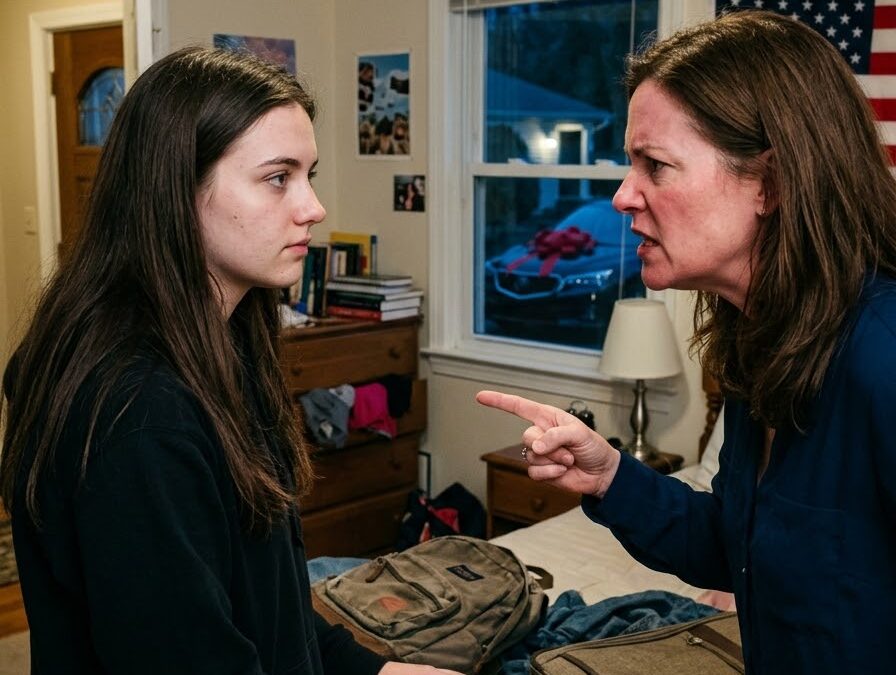
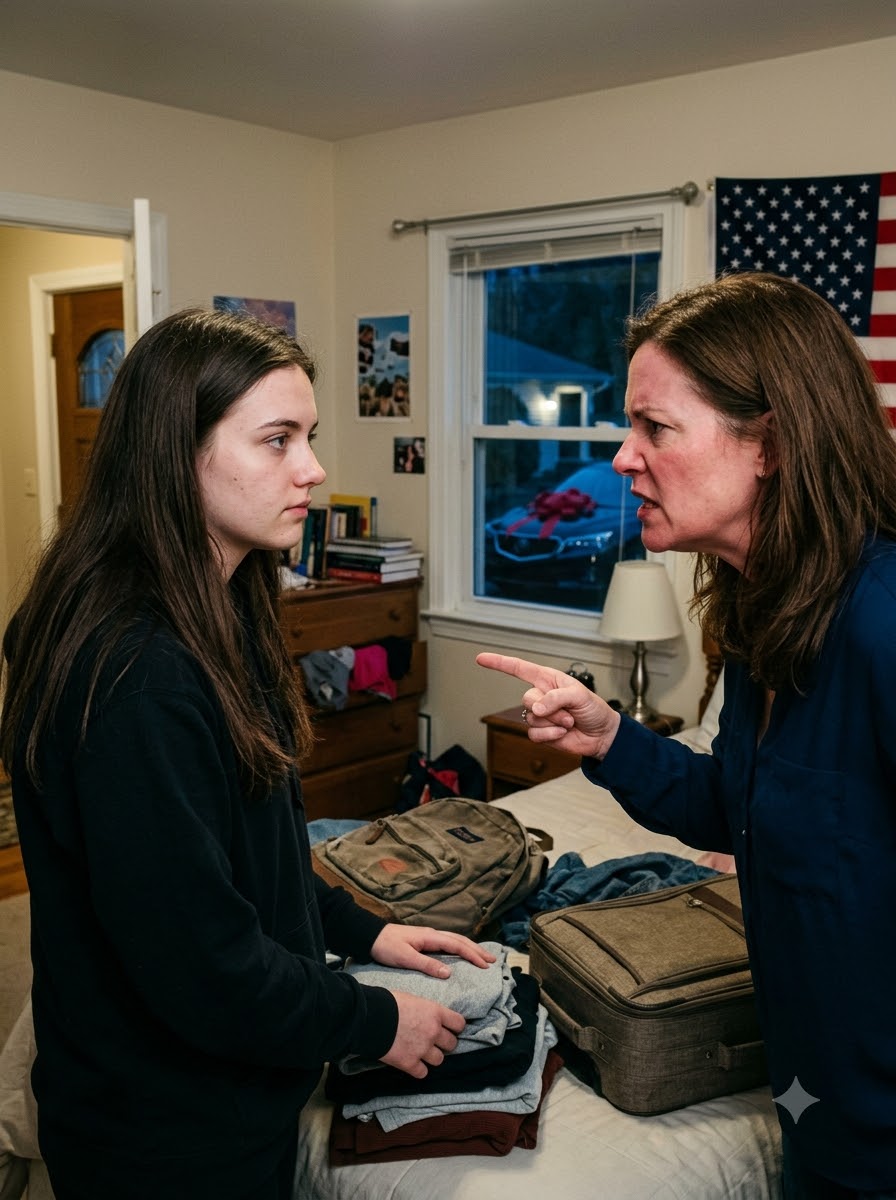
The morning I left home, my mother only noticed me because my suitcase was blocking the path to my brother’s new car.
It was 6:40 on a Tuesday at the end of June.
She came down the garage steps holding Steven’s keys, the ones on the red lanyard, because she drove him to hockey camp every morning in his new Civic so he could practice.
Her slipper caught the wheel of my suitcase and she stopped.
She looked at the suitcase.
Then she looked at me.
3 weeks there had been boxes stacked in the upstairs hallway with my name on them in black marker.
Nobody had asked about a single one.
“Hannah,” she said.
“Is this this because we bought your brother a car?”
I looked her in the eye.
“No, it’s because you never notice whether I’m here or gone.”
I tipped the suitcase onto its wheels and rolled it around the car.
Had a bus ticket in one pocket and a business card in the other.
The card belonged to a woman in Pittsburgh who made fake things look real for a living.
I spent one summer learning from her, and I was about to spend the next 12 years learning everything else she knew.
12 years later, mother called me for the first time in 14 months.
She didn’t ask how I was.
She asked for $25,000 in cash.
By then, I knew exactly what a fake looked like.
The call came on a Monday at 4:15 in the afternoon while I was standing inside a bank vault that didn’t exist.
We’re shooting a heist movie on a sound stage in Pittsburgh Strip District, and my crew had spent 3 days building the vault out of plywood, steel gray paint, and a door that weighed less than a folding chair. job that afternoon was the money.
Three straps of prop hundreds printed on one side only.
Every bill marked for motion picture use only in letters a camera would never catch from a distance.
I was counting each strap onto the shelves and signing the checkout log cuz that’s how it’s done.
You count it in, you count it out.
Phone buzzed in my back pocket.
I glanced at the screen and felt the floor tilt.
Mom, 13 months since she’d called.
14 months of group texts at Christmas and a birthday card that showed up 3 days late with nothing inside but her signature.
I stepped out into the hallway, still holding a strap of fake money.
Mom Steven’s in trouble.
No.
Hello.
No.
How are you?
He borrowed money from a lender, a private company, Midwest Capital Recovery.
Your father co-signed.
They want $25,000 by Saturday at noon in cash or they’ll garnish your father’s wages.
Mom, slow down.
What kind of loan?
I don’t have time for 20 questions, Hannah.
You’re the only one in this family who has that kind of money.
Breath then softer in the voice I remembered from being 10 years old.
We need you, honey.
I closed my eyes.
I hated how fast those words got into me.
And don’t forget, she added, we gave you a home.
Send me the paperwork, I said.
Whatever letter they sent.
I’ll text you a picture.
Don’t make this complicated.
Hung up.
When I walked back onto the set, I counted the same strap three times and still couldn’t have told you the number.
The phone buzzed again.
Photo, a letter with a bold blue logo and the words final notice across the top.
Behind me, the shelves were stacked with money that looked perfectly real from across the room.
That night, I sat on the edge of my bed in my apartment in Lawrenceville with my phone in both hands.
I didn’t study the letter.
I glanced at it the way you glance at a bill you already know you’re going to pay.
Some part of me wanted it to be real because if it was real, then my mother needed me.
And if she needed me, maybe she would finally see me.
I opened my banking app. $41,212.
Every cent of it had a job.
On November 1st, I owed Joan Puit a final payment of $41,000.
And when I made it, the prop house I’d worked in since I was 18 would be mine.
Not Jones with my name on the payroll.
Mine.
If I gave my family 25,000, I’d have to call Joan and ask her to wait.
She would say yes.
She always said yes to me.
That was exactly the problem.
I started working out how to do it anyway.
How much notice a bank needs before it hands over that much cash?
Which branch?
Whether I’d drive it to Ohio myself.
I was halfway through planning a rescue before I decided whether to make one.
I noticed that about myself and I didn’t like it.
I typed 25,000 into the transfer screen.
My thumb hung over the button.
Then one line in the letter caught me.
Reit in cash or money order only.
Something in the back of my head itched.
The same itch I get when an insert shot is wrong.
And I can’t yet say why, but I was tired and I was scared and I didn’t want to look any closer.
I closed the app without confirming anything.
The last time I’d felt this needed by my mother, I was 10 years old and she was asking me for my bedroom.
Steven came to live with us the spring I turned 10.
He was eight.
My parents had been visiting him on weekends for almost a year, driving to a group home on the east side of Columbus every Saturday and bringing him back to our house in Westerville for dinners that ended with him silent in the back seat.
By the time the paperwork was final, I had made him a banner out of printer paper and markers.
Welcome home, Steven.
A different color for every letter.
My mother barely looked at it.
She took me by the shoulders in the upstairs hallway and said she needed to ask me something important.
My bedroom was the big one at the end of the hall with a window that looked out on the maple tree.
I had glow-in-the-dark stars on the ceiling.
I had a window seat my dad built.
Steven has never had the best of anything, she said.
He needs to feel like he has one thing that’s the best.
Would you give him your room?
I said yes.
I don’t remember deciding.
I just remember saying it.
She pulled me into a hug that smelled like her vanilla lotion and she said, “You’re such a good big sister.”
I carried my things into the small room by the laundry where the dryer thumped against the wall every night.
The last thing I did in my old room was stand on the window seat and peel the stars off the ceiling one by one.
That first night, Steven kicked the wall between us for almost an hour.
He was scared.
Anyone would have been.
I went to his door with my flashlight, the good one with the blue beam, and set it on the carpet just inside.
The kicking stopped.
I want to be fair about this.
He was a little boy who needed care.
That was never the problem.
The problem was that in our house, care became something you took from one child to give to the other.
I learned the rule that week.
When you give things away, people see you.
It was the last time I remember my mother thanking me for anything.
I spent the next eight years trying to earn a second one.
The next year, my mother redid the hallway.
She called it our family story.
She bought matching black frames and hung them in a long line from the top of the stairs to the bathroom door.
Steven’s first day at his new school.
Steven in his first hockey jersey.
Steven on Santa’s lap at the mall, 9 years old and too big for it and grinning.
Anyway, there were a few of me from before.
Me as a baby, me at 4 in a strawberry costume.
Me at 10 holding a science fair ribbon.
After 10, my school pictures went into a shoe box in the hall closet.
Until I get more frames, my mother said.
She never got more frames.
On my 13th birthday, Steven had a hockey tournament in Toledo.
They left Friday night and came home Sunday.
I found a box of yellow cake mix in the pantry and baked it myself, frosted it from a can, and ate a piece standing at the counter.
When my dad came in on Sunday, he cut himself a slice and ate it over the sink.
He never asked whose cake it was.
That was how it went.
Parent teacher conferences got missed because Steven had been in a fight.
My science fair got skipped because Steven had been suspended.
Every crisis was his and every crisis was urgent.
And I learned to stay out of the way.
Whenever I asked for anything, my mother said the same thing.
You’re fine, Hannah.
You’ve always been fine.
I believed her.
Fine was what I was for.
The summer I was 17, I got a job as a production assistant on a small independent film shooting in Columbus.
[snorts] I fetched coffee and held doors.
And on my third day, I got loaned out to the props department.
The propmaster was a woman in her 50s named Joan Puit with reading glasses pushed up on her head and a label maker in her fist.
I started labeling every bin on her truck without being asked.
On the last day of the shoot, she handed me a business card.
If you ever want to come to Pittsburgh, she said, “You’ve got a job.”
I put that card in my jewelry box under the velvet tray and told myself I’d never use it. senior year, the date for graduation came out.
It was a Saturday in early June.
It was also Steven’s 16th birthday.
We’ll be there, my mother said.
Of course, we’ll be there.
[snorts] Graduation was at 2:00 in the football stadium.
I had saved two seats in the family section marked with my program right on the 40 line.
When we filed in, I scanned the bleachers.
The seats were empty.
I texted my mother from the line.
Where are you?
10 minutes later, they’re starting.
Nothing came back.
When they called my name, one voice screamed it.
Aunt Carol, my father’s older sister, had driven across town on her own, and she was standing on the bleachers, waving both arms.
After the ceremony, she found me on the field and made me hold up my diploma cover while she took my picture.
I was squinting.
I was smiling.
I was still looking past her shoulder at the stands.
Carol drove me home.
When we turned onto our street, I saw them in the driveway.
A red Honda Civic sat there with a giant silver bow on the hood.
Steven was leaning against it.
My mother was filming him on her phone.
My father was holding a helium balloon shaped like a number 16.
My mother turned around and saw me in my cap and gown.
Oh, honey, she said.
Was that today?
My father moved the balloon to his other hand.
We tried, kiddo.
The financing took forever.
Steven honked the horn and laughed.
Hannah, take one of all of us.
So, I did.
I took the phone from my mother, backed up to the curb, and framed the three of them against that red car.
It came out nicely.
I wasn’t in it.
That night, while she loaded the dishwasher, my mother mentioned that they wouldn’t be able to help with my tuition at Ohio State after all.
Not this year. with the car and Steven’s tutoring.
She said, “Things are tight.
You understand?”
I did understand.
That was the worst part.
I went upstairs to the small room by the laundry, opened my jewelry box, and lifted out the velvet tray.
The business card was still there.
I spent the next 3 weeks packing.
I stacked the boxes in the upstairs hallway, right beneath the family story wall, and wrote Hannah on everyone in black marker.
Nobody asked what they were for.
You already know what my mother asked me in the garage that morning.
What I haven’t told you is what she said after.
She looked at the suitcase for another second.
Then she said, “Well, call when you get there.”
And she went back inside to hurry Steven along because he was going to be late for camp.
I didn’t call.
And for 11 days, nobody called me.
I got to Pittsburgh on a Greyhound with one suitcase, two boxes, and $1340.
Joan picked me up at the station herself.
She didn’t ask why I’d come.
She drove me straight to Second Take Props, a brick warehouse near the river full of everything a movie might need.
Church pews, hospital beds, a stuffed moose.
She pointed me at a wall of cardboard boxes and said, “400 rotary phones.
Sort them by decade.”
I started that afternoon.
The first winter, I slept in the loft above the upholstery room on a mattress Joan pulled out of inventory with a space heater that clicked all night long.
I worked 14-hour days, some in the shop and some running on set.
I learned how to age paper with cold tea and a low oven.
I learned how to make a newspaper from 1974 look like it had been sitting in a drawer since 1974.
I took classes at the community college at night.
And when the rent on my first real apartment came due and I didn’t have it, I dropped a semester and took every overtime shift Joan would give me.
And every single morning when I came through the door, Joan looked up from her coffee with her reading glasses pushed up on her head and said, “There she is.”
The first time I didn’t know what to do with it.
By the second week, I realized I’d started walking faster on the way to the shop just to hear it.
Nobody had noticed me arrive anywhere in years.
On the 11th day after I left, my phone finally lit up with a text from my mother.
Did you take the good suitcase?
That was it.
That was the whole message.
I stood in the loft and read it four times, looking for a second line that wasn’t there.
I wrote back, “Yes.”
She never replied.
I kept working.
When I was 21, a feature film shot in Pittsburgh and at the very end of the credits under property department, it said, “Assistant property master Hannah Mercer.”
Joan took me out for pancakes to celebrate.
I ate them trying not to cry into the syrup.
Joan taught me everything, but some things she taught me more than once.
Prop money was one of them.
Ours was printed on one side only, and every bill said for motion picture use only right across the face.
It lived in a locked cage in the back of the shop and it went out with a signature and came back with a count.
It never leaves the set, Joan said.
Ever.
We count it in and we count it out.
The day you get casual about fake money is the day you’ve got a real problem.
Paper was the other thing.
As the years went on, I became the person productions called when they needed documents that could survive a close-up on a 4K camera. bank letters, eviction notices, court summones, hospital bills.
And to make a fake letter look real, you have to know every way a fake gives itself away.
A logo that’s been screenshotted off a website and blown up until the edges go soft.
The default font from a free template.
A phone number that doesn’t belong to anybody.
My whole job was hiding those things.
So, I learned to see them everywhere.
I wish I could tell you I stopped chasing my family the day I left Ohio.
I didn’t.
I just did it from farther away.
When I was 22, I got a credit on a film that played in real theaters.
I took a picture of my name up on the big screen and emailed it to my mother.
She sent back a thumbs up.
Then a minute later, can you get Steven a job on a movie?
So, I did.
I called in a favor and got Steven, who was 20, hired as a production assistant.
On his second day, he argued with the assistant director about his call time and walked off the set.
That night, he posted online about slave labor.
I worked his shifts for the rest of the week and apologized to the line producer in person.
My mother called to tell me, “You should have warned him it was hard.”
After that, I stopped sending news home.
I still sent birthday cards.
I’m not proud of that, but it’s true.
When I was 26, Joan sat me down and told me she was ready to slow down.
She offered to sell me second take on a payment plan with a final lump sum of $41,000 due on November 1st, 4 years later.
I saved it almost to the dollar.
So, at 10:00 on the night of my mother’s call, I did the only thing I could think of.
I texted Joan, “Can I come by early tomorrow?”
Joan was 67 now and mostly retired, but she still came in around 7:00 most mornings for coffee and gossip.
She was at the workbench when I came through the door on Tuesday.
“There she is,” she said.
Then she saw my face.
“What happened?”
I told her.
The call Midwest Capital Recovery 25,000 in cash by Saturday noon.
My father’s wages.
If I pay it, I said, could we push the final payment back?
Just a few months.
Joan took a long sip of her coffee.
I could, she said, but that’s not the question you’re asking me.
What am I asking you?
You’re asking me to tell you it’s okay to give it to them or that it’s okay not to.
I’m not going to do either one, she set her mug down.
What did the letter say?
I opened my mouth to answer and I realized I couldn’t.
I’d looked at that letter a dozen times since Monday and I couldn’t tell her what it actually said.
I had read it like a daughter.
I hadn’t read it like a propmaster.
I sent the photo to the shop computer and printed it at full size.
Then I laid it on the light table, the one we use to check paper before it goes on camera, and clicked on the lamp.
Pretend it’s an insert shot, Joan said.
Pretend it’s going up on a 40ft screen with your name at the end of the credits.
I picked up the loop and set it on the logo.
The first thing I saw was the edge of it.
It was soft and blocky, the way an image goes when someone screenshots a website and stretches it to fit a page.
There was a faint gray halo around every letter.
The second thing was the font.
I knew it.
It was the default font on a free business letter template I’d used myself more than once for background paper on set.
Paper that sits on a desk out of focus where nobody will ever read it.
The third thing was the account number.
It had no pattern to it at all.
Just a row of digits that looked like somebody had typed them with one hand.
Then the payment instructions.
Remmit in cash or money order only.
The remittance address had a sweet number and I looked it up on my phone.
It was a mailbox at a UPS store in Columbus.
And then the threat.
We will proceed with wage garnishment.
I’m not a lawyer, but I had dressed a lot of courtroom scenes, and in every one of them, garnishment came after a lawsuit and a judge.
There was no case number on this letter, no court, nothing.
Joan leaned over my shoulder.
If you’d handed me that for an insert shot, she said, I’d have sent it back.
It could still be real, I said.
Some little lender who’s bad at letterhead.
It could.
I didn’t need to know how to pay anymore.
I needed to know whether it was true.
I picked up my phone.
I started with the simplest test.
I called my mother.
I want to help, I said, which was true.
But I’m not comfortable driving that much cash across state lines.
I’ll get a cashier’s check made out to Midwest Capital Recovery and overnight it straight to them.
Hold on.
She covered the phone badly.
I heard her voice muffled and then another voice.
Stevens.
Then she came back.
They only take cash.
It’s a private company.
Steven says that’s just how they work.
Okay.
I said, “Let me think about it.”
Second test.
I went to the Ohio Secretary of State’s website where businesses registered in the state show up in a public search.
I typed in Midwest Capital Recovery.
No results.
I tried it without capital.
I tried it without recovery.
There was a roofing company with a similar name and an investment firm in Dayton, but nothing that lent money and nothing that matched.
Third test.
I dialed the number printed on the letter.
It rang four times and then a flat automated voice told me the person I was calling was not available.
No company name, no business hours.
I hung up without leaving a message.
When I looked the number up, it came back as an internet phone line, the kind anybody can set up with an app in about 2 minutes.
None of it was proof, not by itself.
But I started a folder on my phone anyway, and every search and every result went into it as a screenshot with the date and time at the top.
I was maybe 80% sure the letter was fake.
I had no idea who’d made it, and the other 20% kept me up because if I was wrong, I wasn’t the one who would get hurt.
My father was.
There was one person who might know what was really going on in that house.
At 7:00 that evening, I called Aunt Carol.
She picked up on the second ring and when I told her about the letter, she was quiet for so long that I thought the call had dropped.
“Honey,” she finally said.
I’ve been wondering when somebody was going to ask me.
She told me that over the last 2 years, my father had pulled $31,000 out of his retirement account for Steven.
There was always an emergency, a debt, a fine, a business partner who’d supposedly stolen from him.
It was always urgent, and it was always cash.
Last spring, my father had come to Carol and borrowed $4,000 more.
He sat at her kitchen table and told her there was nothing left he could take without touching the house.
Then Carol told me the other thing.
Your mother called me last Tuesday, first time in months.
She asked me for that picture I took of you at graduation, so I emailed it to her.
Carol’s voice went thin.
[snorts] I thought maybe she was finally sorry.
Last Tuesday, 6 days before she called me.
My mother had asked for my picture before she ever asked me for money.
The ask had been planned.
The picture was part of it.
I sat very still at my kitchen table.
I’m coming to Columbus, I said.
To pay to see.
Then you’ll stay with me, Carol said.
The guest room’s made up.
We hung up.
30 seconds later, my phone lit up again.
Mom, your father hasn’t slept,” my mother said before I could even say hello.
“He lies there staring at the ceiling.
I don’t know how much more of this he can take.”
“I’m sorry he’s scared,” I said.
And I meant it.
People at St. Brendan’s ask about you, you know.
They ask why you never come home.
I’ve always covered for you, Hannah.
I’ve always said you’re busy.
I don’t know what I’m supposed to tell them now, if you won’t even help your own family.
I didn’t answer.
I was learning that my silence made her keep talking.
Then her voice changed.
It got warm.
It was the voice she used for Steven.
Come to dinner on Thursday, she said.
Just us, the four of us.
I want us to be a family again.
And guess what?
I found your graduation picture.
I’m putting it up in the hallway where it belongs.
I knew I knew exactly where that picture had come from and exactly when she’d asked for it.
And still, for one second, my mouth opened and the word almost came out.
Really?
That’s the part I have the hardest time explaining.
You can know a thing with your whole head and still want it with your whole heart.
I was 30 years old.
I was about to own a business.
I could spot a forged letter across a room and a picture on a wall almost got me.
Bring the money Saturday by 10, my mother went on.
Steven has to drop it off by noon.
I’ll come Thursday, I said.
That was all I said.
I didn’t promise anything else, but I could hear in her breathing that she’d heard a yes.
After we hung up, I drove to the shop.
It was almost 11 at night.
I let myself in, turned on the light in the back, and stood in front of the prop cage for a long time, looking at a zippered bank bag on the middle shelf.
On Wednesday morning, Joan and I signed that bag out together.
250 prop hundreds printed on one side for motion picture use only across every face.
We counted them twice on the workbench.
I signed the log.
Joan signed underneath me.
Count it out.
Count it in, she said.
And it doesn’t leave your hand.
I might not even open it, I said.
Then it comes back the way it left.
On Thursday, I drove 3 hours west.
I got to Westerville a little before 6:00.
The house looked smaller than I remembered, and the maple tree looked bigger.
At the end of the driveway sat a dented red civic with a for sale sign taped inside the back window.
My mother opened the door before I could knock.
She hugged me, and she still wore the same vanilla lotion, and for one second, I was 10 years old again.
My father stood behind her in the entryway with his hands in his pockets.
“You look good, kiddo,” he said.
Then Steven came up the basement stairs.
[snorts] He was 28 now, broad through the shoulders with a fresh haircut and a watch that looked expensive.
Big sis.
He hugged me hard enough to lift me off the ground.
He’d been living in that basement for 3 years.
I found that out later.
My mother took my coat and walked me down the hall.
And there it was.
My graduation picture hung in the center of the family story wall in a brand new silver frame. me at 18, squinting into the sun, holding up my diploma cover.
It was a beautiful picture.
Carol had taken a beautiful picture.
In the lower corner of the glass, there was still a small white sticker.
14.99.
I looked down.
On the baseboard beneath the frame lay a thin line of white drywall dust.
The nail was so new that nobody had swept up after it.
All around my picture were pictures of Steven.
Steven at every age.
Steven at 16, grinning beside a red car with a silver bow.
I knew that one.
I’d taken it.
Whatever hope I’d carried up the front walk, that little white sticker took it right out of my hands.
My picture hadn’t gone up because my mother missed me.
It had gone up because Saturday was coming.
I stayed anyway.
Dinner’s ready, my mother called from the kitchen.
I made your favorite.
It was pot roast.
Steven’s favorite.
I had never liked it.
Nobody asked about my life at dinner.
I waited.
I cut my pot roast into small pieces and waited through the green beans and the rolls and a long story about the new neighbors fence.
Finally, my father turned to me and said, “So, still doing the movie thing?”
“Still doing it?”
I said.
“I’m buying the business in November.”
“Huh?” he said.
Good for you.
And he reached for the butter.
Steven cleared his throat.
Look, Hannah, I know I was a brat when we were kids.
I know that.
I’m not proud of it.
He looked down at his plate.
He was good at this.
He’d always been good at this.
I just got in over my head.
And these guys, they’re not the kind of people you want showing up at the house, you know.
When they loaned you the money, I said, “Which bank did the check come from?”
He barely paused.
It wasn’t a check.
It was cash.
They’re private.
My mother set down her fork.
Hannah, please, not tonight.
Can we not turn this into an interrogation?
She reached across the table and laid her hand on mine.
Her hand was warm.
Help your brother and we start over.
All of us.
That picture stays on the wall.
That’s a promise.
I looked at her hand on top of mine.
I thought about the sticker.
I’ll bring what I have for Steven,” I said.
“Saturday at 10:00.”
Steven let out a breath.
I watched his shoulders drop an inch.
Under the table, his thumb started moving on his phone.
My mother squeezed my hand and smiled.
When I left, it was dark.
I stopped at the end of the driveway beside the red Civic with the for sale sign.
12 years old.
A long scratch down the passenger door.
Steven had always called it his car.
I didn’t know yet why he was selling it.
I only knew that he was.
Carol’s house in Clintonville smelled like coffee and old books.
She’d been a school librarian for 31 years and it showed on every wall.
She made me tea I didn’t drink.
Then she went to a drawer in her dining room and came back with an envelope.
I printed these after your mother called, she said.
I figured you should have them.
They were the pictures from my graduation.
All of them. the one on my mother’s wall and 10 more.
Me in line, me crossing the stage, and one I’d never seen, taken from the bleachers with a zoom lens.
I was standing on the field in my gown, holding my diploma cover against my chest, looking up at the stands, looking for them.
I stared at that one for a long time.
“If I pay it,” I said finally, “Mom will love me for about a month.”
Carol didn’t argue.
She just waited.
If I say no over the phone, I went on.
She tells everybody at church I let my father lose his paycheck.
Dad keeps emptying his retirement and in 6 months Steven has another emergency.
Or I walk in there with the letter and everything I found with a witness and I let them see it and then I see what they do.
Which one do you want?
I don’t know what I want.
I set the pictures down.
No, that’s not true.
I know exactly what I want.
I want to walk in there and show them the truth.
And I want my mother to look at me and finally finally see me.
That’s what I want.
It’s stupid.
It’s not stupid.
Carol said, “It’s just not up to you.”
I thought about my father’s face at dinner about that 20%.
If I was wrong about the letter, if there was a real lender and a real debt, I was about to humiliate my family and hurt the one person in that house who had never once raised his voice at me.
But I didn’t think I was wrong.
I’m going to do it, I said.
The third way.
Carol nodded slowly and picked up her mug.
Then I’ll drive you on Saturday, she said.
I want to be in that kitchen.
On Friday morning, I sat at Carol’s kitchen table and made rules for myself.
That’s what Joan would have done.
You don’t walk onto a set with fake money and a hope.
You walk on with a plan and a count.
Rule one, the bag doesn’t leave my hand.
Not across the counter, not into anyone’s lap, not for a second.
Rule two, within one minute of opening it, I say out loud what it is.
Prop money, not real, not a payment.
Nobody in that room gets to believe for more than a minute that it’s anything else.
Rule three, Carol stays in the room the whole time.
Rule four, paper.
I printed the letter on Carol’s printer along with every screenshot from the folder on my phone. the business search, the UPS store mailbox, the lookup on the phone number.
Then I ran one more test.
I picked up Carol’s landline, the old beige one on the kitchen wall, and dialed the number on the letter.
Steven would never recognize Carol’s house phone.
It rang four times, the same flat automated voice, the same nothing.
I wrote four rings on the back of the letter, and I made one last rule because I was scared of being wrong.
If there turned out to be real court papers, a real lawsuit, a real judge, I would sit down with my father and read every page with him.
I would help him understand it.
What I would not do under any circumstances was hand anybody a bag of cash.
I called Joan around 11.
How’s the bag?
She asked.
Zipped.
Good.
A pause.
You know what the real job is, right?
It’s not getting people to believe the fake thing.
Anybody can do that.
It’s knowing when to tell them.
I know.
And count it back in when you’re done.
I will.
At 4:00 that afternoon, my phone buzzed on Carol’s table.
It was a text from Steven.
The first one he’d sent me in years.
Can you come at 9 instead of 10?
Got to be somewhere by 12:30.
Cash hundreds if you can.
And don’t make it a whole thing with mom.
Okay.
I read it twice.
Got to be somewhere by 12:30, but the lender’s deadline was noon.
Why 12:30?
I had never followed Steven on anything, but his accounts were public.
They always had been.
He liked being watched.
His Instagram story was 40 minutes old.
Steven at a car dealership off I270, leaning on a black pickup truck with a lift kit and tires nearly as tall as my waist.
He had his arm draped across the hood like it was somebody’s shoulder.
The caption said, “Tomorrow she’s mine, 100 p.m.” and a little gold key.
I took a screenshot.
The time was right there at the top.
I sat back in Carol’s kitchen chair, and I didn’t feel surprised.
That was the strange part.
I felt something heavier than surprise.
I felt like I was watching a rerun.
A red car on my graduation day, a black truck on the day his sister brought him $25,000.
The for sale sign in the Civic’s back window made sense now.
He wasn’t selling his car because he was broke.
He was selling it because he was trading up.
Carol read the screen over my shoulder.
She didn’t say anything.
She just put her hand flat on my back and left it there.
I typed back to Steven.
10 like we said.
He sent a thumbs up.
It was the same thumbs up my mother used to send me.
I barely slept.
At 5:30 on Saturday morning, I sat up in Carol’s guest bed, unzipped the bank bag, and counted the bills one more time on top of the quilt.
250.
I zipped it closed.
Carol pulled into my parents’ driveway at 9:55.
The garage door was open.
The red Civic sat at the end of the drive with its sign in the window.
My father was in the garage, bent over his workbench, pretending to fix a lamp that I’m fairly sure wasn’t broken.
Steven was on the garage steps, already standing, already looking at the car.
I got out with the bag in my right hand.
And there I was, standing on the exact spot where my suitcase had been 12 years before.
The same concrete, the same oil stain, the same three steps up into the kitchen.
My mother came to the door, and this time she saw me right away.
Her eyes went straight to my hand, to the bag.
Then she saw Carol getting out of the driver’s side and her face went tight.
“Carol,” she said.
“This is family business.”
“I’m family,” Carol said and walked past her into the kitchen.
My father set down his screwdriver.
Steven held the door open for me with a big smile like a doorman at a nice hotel.
We all ended up standing around the kitchen island.
My mother had set out a coffee cake.
Nobody touched it.
I put the bag on the counter in front of me.
I kept my hand on it.
Before I give anything to anybody, I said, I want to hear it one more time.
Who’s the lender and what happens if the money’s late?
My mother sighed.
Hannah, we’ve been over this.
Humor me.
Steven spread his hands.
Midwest Capital Recovery private lender.
If it’s not paid by noon, they go after Dad’s paycheck.
That’s it.
That’s the whole thing.
He glanced at the clock on the microwave.
It said 10:02. and dad co-signed.
“Yes,” my mother said.
“Your father co-signed.
Are we done?”
My father was looking at the floor.
I unzipped the bag.
Inside were the bundled hundreds packed tight the way they are in movies because they were from the movies.
Steven’s hand came across the island.
I kept my palm flat on the edge of the bag.
He lifted a bundle out anyway, and he did what everybody does.
He fanned it with his thumb.
The sound was wrong.
It was the sound of paper, not money.
Then he turned the bundle over and the backs were blank, plain white.
And across the face of every bill, in small green letters, it said for motion picture use only.
What is this?
My mother said.
It’s prop money, I said.
It’s from my shop.
It isn’t legal tender.
It isn’t a payment.
And it isn’t leaving my hand.
For a moment, nobody said a word.
The refrigerator hummed.
Then my mother found her voice.
“Is this a joke?
Your father could lose his paycheck and you bring toys into my kitchen?”
I didn’t answer her.
I reached into my jacket, took out the letter I’d printed at Carol’s, unfolded it, and laid it flat on the counter beside the bag.
“Now we’ve both brought fake paper into this kitchen,” I said.
Steven laughed.
“It came out too loud.
What are you talking about?
This letter?”
I turned it so my parents could read it.
I make these for a living.
Bank letters, court papers, anything a movie needs.
So, I’m going to tell you what I see and you can decide for yourselves.
I put my finger on the logo.
This was copied off a website and stretched.
See how the edges are blurry?
A real company has a real file.
I move my finger down the page.
This font comes from a free template online.
I’ve used it myself.
This address is a mailbox at a UPS store.
They only take cash and no real lender only takes cash.
And there’s no court case anywhere on this page as far as I’ve ever seen.
Nobody touches dad’s paycheck without a judge saying so first.
I laid down the screenshot from the state business search.
And there’s no company in Ohio called Midwest Capital Recovery.
I looked.
My mother looked at the paper.
Then she looked at Steven.
Steven shook his head slow and patient like I was a child.
Hannah, you don’t know that world.
These are small guys, old school.
They don’t do websites and state paperwork.
That’s the whole point of a private lender.
Okay, I said.
Then let’s call them.
What?
Right now on speaker, let’s call Midwest Capital Recovery and ask them what dad owes.
I took out my phone and dialed the number on the letter, digit by digit, reading each one out loud.
I pressed the speaker button and set the phone face up on the island.
It rang once and on the other side of the island, right next to his car keys, Steven’s phone started to buzz.
It was face up, too.
The screen lit and in big white letters, the name on the screen said, “Hannah.”
It buzzed again and again.
It rattled a little against the granite.
Steven lunged for it and jabbed at the screen to decline the call.
He got it on the third try.
The kitchen went silent, but he was too late.
My father had been standing right there.
He’d seen the screen.
I watched him see it.
Something in his face went very still.
My mother just stared at the phone in Steven’s hand.
The app forwards the calls, I said quietly, to whoever set it up.
Steven slid the phone into his pocket.
He looked at my mother.
He looked at me.
Then he put both hands up, palms out.
Okay.
Okay.
Just listen.
The debt is real, he said.
Okay, the letter.
Fine.
I made the letter, but only because mom wouldn’t take it seriously otherwise.
I do need the money.
I’m starting a mobile detailing business and I need a truck to do it.
I was going to pay it back.
All of it.
I held up my phone with the screenshot on it.
Steven, leaning on the black pickup.
Tomorrow she’s mine.
100 p.m. You posted that yesterday, I said.
At a dealership.
He looked at the screen and something in him turned.
Not toward me, toward my mother.
You said she’d pay, he said to her.
You said it.
You said she owes us for raising her.
You said she’s got all this money and nobody to spend it on.
My mother’s face went red.
She didn’t look at him.
She looked at me.
You set a trap, she said, for your own brother.
After everything that boy has been through, after where he came from, you set a trap in my kitchen with a bag of fake money and humiliated him in front of your aunt.
He’s been through a lot, I said.
So was I.
You just only ever looked at one of us.
She opened her mouth and nothing came out.
Then my father spoke.
It was the first thing he’d said since I walked in.
Steven.
His voice was quiet. the other times.
The $31,000 he swallowed.
Were any of those real?
Steven didn’t answer.
He turned and looked out the kitchen window down the driveway at the red car with the for sale sign.
That was the answer.
My father pulled out a kitchen chair and sat down in it heavily like a man twice his age.
I picked up the bundle Steven had fanned across the counter.
I squared the edges of the bills against the granite and I started counting them back into the bag out loud.
1 2 3 My mother said my name.
I kept counting.
Steven said, “Are you serious right now?”
I kept counting.
I lifted out every bundle in that bag, counted it bill by bill, and set it back while my family stood around the island and watched me do it.
It took almost 4 minutes.
It was the longest I had ever held their attention in my life.
250, I said and zipped the bag.
That’s everything I brought into this house.
Every fake thing.
All of it’s accounted for.
I looked at Steven.
Can you do that?
Can you count out the 31,000?
He didn’t say anything.
Out, my father said.
We all turned.
He was still in the chair, but he was looking right at Steven.
You’re out of this house by the end of the month, he said.
And before you go, you’re going to sit at this table and write down every dollar you took from me.
Every single one and where it went.
Greg, my mother said, “No.”
He didn’t raise his voice.
He didn’t have to.
I had never heard my father tell my mother no.
Not once.
Not in 30 years.
No, Linda.
Steven’s phone buzzed in his pocket.
He pulled it out and glanced at it and I saw the preview on the lock screen.
A reminder from the dealership about his 1:00 appointment.
He put the phone away without answering it.
I reached into my jacket and took out the folder.
Every printout from Carol’s printer, the letter, the business search, the mailbox, the phone lookup, the screenshot of the truck.
I didn’t give it to my mother.
I walked around the island and set it on the table in front of my father.
This is yours, I said.
What you do with it is your decision.
I’m not calling anybody.
I’m not threatening anybody.
It’s just what’s true.
He laid his hand flat on top of the folder, the way Carol had laid her hand on my back.
It was so quiet I could hear the kitchen clock.
Then my mother came around the island toward me, and her voice was soft.
It was the soft voice, the one for Steven.
Stay for lunch,” she said.
She put her hand on my arm.
“Please, just stay.
We’ll put all of this behind us.
I meant what I said about the picture, Hannah.
It stays up.
It stays right where he is.
We can start over, the four of us.
We’ll do it right this time.
And God help me.
I wanted to.
I want to be honest about that because I think it matters.”
The 10-year-old who gave away her room was still in there.
The girl on the football field looking up at the stands was still in there.
She had driven 3 hours for exactly this.
Her mother’s hand on her arm, a picture on the wall, and the words start over.
But I was also standing there with my eyes open.
And I noticed that in 5 days, my mother had not asked me one single question about my life.
Not about the shop, not about November, not whether I had anyone.
And the only thing she’d come close to apologizing for that morning was that Steven was embarrassed.
She didn’t want to start over with me.
She wanted to start over with the version of me that stayed fine.
I took her hand off my arm gently.
I didn’t want to be cruel.
Then I walked out of the kitchen and down the hall to the family story wall.
My picture was right there in the middle.
I lifted the frame off the nail.
It came away easily.
It had only been there since Thursday.
I turned it over in my hands and peeled the white sticker off the corner of the glass. $14.99.
I folded it in half and set it on the hall table.
My mother had followed me.
They all had.
They were standing at the end of the hallway.
What are you doing?
She said, “You hung this up on Thursday because you needed a check on Saturday.
I’m taking it home.
Keep the nail.”
That’s my picture.
Actually, Carol said from behind her.
It’s mine.
I took it.
I held the frame against my chest the way I’d held that diploma cover 12 years before.
Here’s how it’s going to be.
I said, “Don’t call me for money.
Not for Steven.
Not for an emergency.
Not through dad.
Not ever.
If you want to know how I am, you can call me and ask me that.
That’s the only call I’ll pick up.”
My mother stared at me.
For the first time in my life, I could see her trying to figure out what I was.
I picked up the bank bag from the counter on my way past.
I went down the three steps into the garage, across the oil stain, and out into the driveway.
I didn’t turn around to see whether anyone was standing in the doorway.
I didn’t need to know.
In Carol’s car, my hands finally started to shake.
Carol backed out of the driveway and didn’t say a word.
I opened my banking app.
The savings account still said $41,212.
I tapped the name, which had always just said savings, and I changed it.
Second take, November 1.
Then I turned my phone face down on my knee and held the picture in my lap all the way back to Carol’s house.
Two weeks later, Carol called me with the news.
Steven had moved out of the basement and into his girlfriend’s apartment on the north side.
The dealership had sold the black truck to somebody else.
My father had sold the red Civic.
The title had been in his name all along, ever since Steven was 16.
It went for $3,200.
My father wrote that number on a sheet of paper and taped it to the refrigerator, and underneath it, he wrote what Steven still owed him.
He’d pushed back his retirement.
He told Carol he’d work until he was 67 now, maybe longer.
My mother told people at St. Brendan’s that I had problems.
Two of them called Carol to ask what had really happened.
Carol told them.
My mother sent me one long text the night after I left.
It was mostly about Steven and how hard it had been to raise him and how I had always been so cold.
I read it once.
I didn’t answer.
I archived it and went to work.
9 days later, my father sent me one line.
I should have been at your graduation.
I sat with that for most of an evening.
Then I typed back, “Yes, you should have.”
That was all.
It wasn’t forgiveness.
It wasn’t a slam door either.
If my father wanted to know me, he knew where the shop was.
I left that up to him.
On November 1st, I walked into Second Take Props with a cashier’s check for $41,000 in an envelope.
Real paper.
I checked it under the loop anyway, just for fun.
Joan was at the workbench.
She read the check, tucked it in her shirt pocket, and slid a ring of keys across the table to me.
There were 11 keys on it.
I had carried most of them for years, but they’d always been hers.
There she is, Joan said.
The owner.
That afternoon, a man came with a stencil and a squeegee and put new vinyl lettering on the glass door.
[snorts] Second take props.
H.
Mercer, owner.
In the spring, I hired a shoprunner.
Her name was Maya.
She was 18, just out of high school, and she had a habit of labeling every bin she touched without being asked.
She came in 20 minutes early every single day.
I never asked her why.
I recognized it.
In the back of the shop, there’s a wall where we pin up the rap photos from every production we work on.
Crew shots, mostly.
40 people squinting into the sun on the last day of a shoot, holding coffee cups and sandbags.
I’m in almost all of them now, usually near the front, usually laughing at something Joan said.
In April, I hung my graduation picture on that wall.
Carol’s picture, same silver frame, no sticker.
It went right in the middle between a horror movie and a Christmas movie, surrounded by people who had actually shown up.
This morning I was in the prop cage at 7:40 counting bundles of fake hundreds into the log for a new crime drama.
Count it in, count it out.
The front door opened, footsteps, a backpack hitting the floor.
I looked up from the log.
There she is, I said.
Maya stopped in the doorway and for a second she looked at me like nobody had ever said that to her before.
Then she smiled, hung her jacket on the hook by the door, the same hook I’d used at 18, and went to find the label maker.
If you were standing in that hallway, would you have stayed for lunch and let the picture stay on the wall or walked out holding it?
Tell me in the comments.
And if this story stayed with you, subscribe.
There’s another one waiting for you.








