At my older sister’s wedding, she ripped the dress I was wearing right off me in front of 300 guests. “You dressed like this just to steal my husband!” Mom pointed at my tattered dress. “Get on your knees and apologize to your sister right now!” Just then, the bridesmaid handed the groom a phone. He read a message and looked over at my sister. “Should I read this out loud for all 300 guests to hear?” Her face went pale.
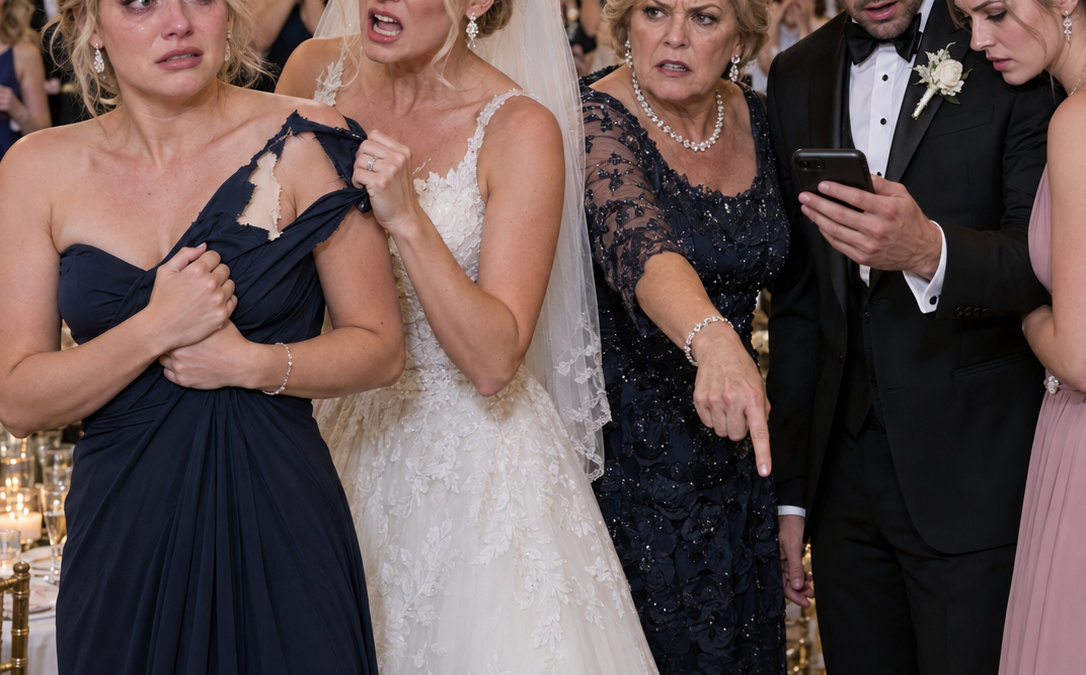

At my sister’s wedding, in front of 300 guests, Sophie grabbed the front of my dress and tore it open.
“You dressed like this to steal my husband.”
The room went so quiet I could hear someone set down a champagne glass.
I was still holding the torn fabric against my chest when Mom pointed at the floor.
“Get on your knees and apologize to your sister.”
For 29 years, that was how our family worked.
Sophie exploded.
Mom defended her.
I cleaned up whatever was left.
But before I could say a word, Emma, the maid of honor, walked straight to Daniel and handed him her phone.
He read one message.
Then he looked at Sophie.
“Should I read this aloud to all 300 people?”
Sophie’s face went white.
And that was when I realized she hadn’t attacked me because of my dress.
She was afraid of what I might say.
Ten minutes earlier, I had been standing beside the ballroom doors wondering whether I had finally made it through one major Bennett-family event without becoming a problem that needed to be managed.
The wedding was being held at Ashford House, an old country estate outside Bath that had been converted into the kind of venue where every photograph looked expensive even before the photographer touched it.
Tall windows overlooked wet green lawns.
White roses climbed around the stone terrace.
Inside, candles reflected off polished glassware while a string quartet played near the staircase.
Sophie had chosen ivory, champagne, and pale eucalyptus for everything.
Including, apparently, the people.
My dress was dark blue.
That mattered because Sophie had approved it herself three months earlier.
She had rejected my first choice because the neckline was “too severe.”
My second because the sleeves would “look heavy in pictures.”
And my third because the color was too close to what one of the bridesmaids was wearing.
So I had sent her a photo of the navy dress.
She had replied with a heart.
Perfect. Wear that.
I still had the message.
Not because I expected to need evidence about a dress.
I kept messages.
I kept drafts.
I kept versions.
It was a professional habit.
I worked in communications for nonprofit organizations, which meant a large part of my life consisted of making sure the sentence somebody approved on Tuesday was still the sentence they claimed to have approved on Friday.
At 29, I had learned that human memory was surprisingly flexible when reputations were involved.
I just hadn’t realized how useful that lesson would become inside my own family.
“Maya.”
I turned.
Sophie was standing six feet away.
She had changed after the ceremony into a fitted satin reception gown.
Her hair was pinned back.
Her makeup was still perfect despite hours of photographs.
And for one absurd second, I thought she had come to thank me.
I had spent most of the morning staying out of her way.
That had been my gift to her.
“What?” I asked.
Her eyes moved slowly from my face to my dress.
Then back again.
“What the hell are you wearing?”
I almost smiled because I thought she was joking.
“The dress you approved.”
Daniel was talking to two guests behind her.
Emma stood nearby holding Sophie’s bouquet.
Sophie stepped closer.
“I did not approve that.”
“Yes, you did.”
“Not like this.”
I looked down at myself.
Nothing had changed.
The dress was fitted, but not unusually so.
The neckline was modest.
The hem fell below my knees.
I had worn small silver earrings and the same black heels I wore to work dinners.
“Sophie, I sent you a picture.”
Her mouth tightened.
“Don’t do that.”
“Do what?”
“Pretend you don’t know.”
A few people nearby had started listening.
I felt it before I saw it.
The shift that happened whenever Sophie and I disagreed in public.
People waited for me to become the version of myself they had already heard about.
Sensitive Maya.
Competitive Maya.
Maya who always had to prove a point.
I lowered my voice.
“If something’s wrong, tell me what it is.”
“You really need me to explain?”
“Yes.”
Her eyes flicked past me.
Not toward Daniel.
Toward Emma.
It was quick.
So quick I almost dismissed it.
Then Sophie reached for my dress.
At first, I thought she was going to adjust the fabric near my shoulder.
Instead, she hooked her fingers into the seam near the neckline and pulled hard.
The sound was shockingly small.
A sharp rip.
Then another.
The seam gave way down one side, exposing the lining and enough skin that I instinctively grabbed the fabric with both hands.
Someone gasped.
A waiter stopped in the middle of the aisle.
Sophie stared at me as though I had done it myself.
“You dressed like this to steal my husband.”
Three hundred guests did not all hear the first sentence.
But enough did.
And silence spreads faster than sound.
Daniel turned.
“Sophie?”
Mom appeared almost immediately.
Of course she did.
Helen Bennett could detect public embarrassment the way other people detected smoke.
She took in Sophie’s expression.
My torn dress.
The guests watching us.
She did not ask what had happened.
She pointed at me.
“What did you do?”
I actually laughed once.
Not because anything was funny.
Because sometimes a question is so perfectly predictable that your body reacts before your brain can stop it.
“Sophie tore my dress.”
“She came dressed like this,” Sophie said.
“Like what?”
“Don’t.”
Her voice broke at exactly the right place.
“Don’t stand there acting innocent.”
Daniel moved toward her.
“Soph, what are you talking about?”
“She has been doing this my whole life.”
“Doing what?”
Standing?
Wearing navy?
Existing within visual range of a man Sophie had married 40 minutes earlier?
I could feel the old impulse rising in me.
Explain.
Produce the text.
Show Mom the picture.
Prove Sophie had approved the dress.
Prove I had not flirted with Daniel.
Prove I had spent the entire reception avoiding him because I knew how Sophie could be.
Prove.
Prove.
Prove.
Mom’s face hardened.
“Maya, look around you.”
I did.
People were watching.
That was apparently evidence against me.
“You have embarrassed your sister at her wedding.”
I stared at her.
“She just ripped my dress.”
“She is upset.”
“So she gets to tear my clothes?”
“Stop making this worse.”
There it was.
The family motto nobody had ever bothered to embroider on a cushion.
Sophie creates the fire.
Maya is responsible for the smoke.
Mom pointed toward the carpet between us.
“Get on your knees and apologize to your sister.”
Something inside me went very still.
Not strong.
Not fearless.
Just still.
I was 29 years old.
I had a career.
An apartment.
People who trusted me to walk into rooms full of executives, donors, board members, and journalists and tell them when the words they wanted to use were dishonest.
Yet my mother could point at the floor and, for one horrible second, some old part of me still considered obeying.
Because obedience had always been cheaper than the aftermath.
Then I looked at Sophie.
She wasn’t crying anymore.
She was watching me.
Waiting.
And behind her, Emma was watching Sophie.
That was different.
I tightened my grip on my torn dress.
“No.”
Mom blinked.
“What?”
“I said no.”
“Maya—”
“I am not kneeling.”
Sophie scoffed.
“Of course you have to make a scene.”
I looked at the ripped seam in my hand.
“You tore my dress open in a room full of people, and you’re still making yourself the victim.”
Emma moved.
She crossed the space between us so abruptly that Sophie stopped talking.
“Daniel.”
Emma held out her phone.
Sophie went rigid.
“Emma.”
Emma didn’t look at her.
“Read it.”
Daniel took the phone.
I watched his eyes move across the screen.
His expression changed.
Not dramatically.
That made it worse.
The confusion disappeared first.
Then the color in his face.
He looked at Sophie.
“What is this?”
“It’s nothing.”
“What is this?”
“Emma doesn’t understand the context.”
Emma finally looked at her.
“I understand exactly what you sent me.”
Sophie reached for the phone.
Daniel pulled it away.
“Don’t.”
That single word cut through the room more effectively than shouting would have.
Mom stepped closer.
“This is not the place.”
“No,” Emma said quietly. “It probably isn’t.”
Sophie stared at her.
“You’re my maid of honor.”
Emma’s jaw tightened.
“I know.”
Daniel read the screen again.
Then he looked toward the guests.
Most of them were pretending not to watch while watching every second.
“Should I read this aloud to all 300 people?”
Sophie went white.
For one brief, vicious second, I wanted him to.
I wanted every person in that room to hear whatever she had written.
I wanted Mom to stand there while the story changed around her.
I wanted Sophie to experience 10 seconds of what she had just given me.
Then I saw Mom.
She wasn’t looking at Sophie.
She was looking at Daniel’s phone.
Calculating.
Containment had already begun.
And I knew exactly what would happen if he read it.
Tomorrow, the story would become Daniel humiliating his bride.
Emma betraying her best friend.
A wedding ruined by drama.
And somewhere in the middle of all that, what Sophie had done to me would disappear.
“No,” I said.
Daniel turned toward me.
Sophie did too.
I surprised myself.
“Don’t read it aloud.”
Mom exhaled as though I had finally become reasonable.
Then I looked directly at Sophie.
“What were you afraid I was going to say?”
Her expression changed only slightly.
But I saw it.
I had spent years writing speeches for people who wanted to sound calm when they weren’t.
I knew what happened to a face when someone heard the question they had hoped nobody would ask.
Sophie looked away.
“Nothing.”
“Then why did you plan this?”
“I didn’t plan anything.”
Emma held out her hand.
Daniel returned the phone.
She turned the screen toward me.
There it was.
Sophie’s name.
A message sent three days earlier.
If Maya says anything tonight, make it look like she came here for Daniel.
I read it twice.
Not because I didn’t understand it.
Because I did.
Perfectly.
Mom stepped between us.
“Enough.”
I looked at her.
She was speaking to me.
Of course she was.
“Maya, go get yourself cleaned up.”
Not Sophie.
Me.
Daniel said:
“Helen.”
Mom looked at him.
“I think this is my family.”
The sentence landed harder than she intended.
Emma looked at me.
“Come with me.”
I went.
Not because Mom had dismissed me.
Because for the first time that evening, I knew there was something more useful I could do than defend myself.
Emma took me into a small bridal-preparation room off the main corridor.
The music resumed outside eventually.
People always prefer permission to pretend nothing happened.
Emma locked the door.
“I am so sorry.”
I let go of the fabric.
The dress sagged open along the torn seam.
“Do you have anything?”
Emma opened a cabinet and found a sewing kit.
Then shook her head.
“That won’t hold.”
“I don’t need it to hold all night.”
“You’re leaving?”
“Yes.”
She looked disappointed.
Almost frightened.
“Maya, you didn’t do anything.”
“I know.”
It was the first time I had said those words that evening.
They felt unfamiliar.
Emma found a cream shawl someone had left behind and handed it to me.
I wrapped it around myself.
“Can you send me that message?”
“Yes.”
“Not just a screenshot.”
She paused.
“The thread?”
“The full thread.”
“Don’t crop it.”
“Don’t edit anything.”
“Don’t delete anything either.”
Emma studied me.
“You think you’re going to need it?”
“I don’t know.”
That was the truth.
“But if I do, I want what actually happened.”
“Not a version of it.”
She nodded.
Then she sat on the edge of the dressing table.
“There are more messages.”
I looked at her.
“How many?”
“Not about tonight exactly.”
“What does that mean?”
Emma rubbed her thumb along the side of her phone.
“Sophie has been saying for weeks that you might try to ruin the wedding.”
“By wearing the dress she approved?”
“No.”
That answer came too quickly.
I waited.
Emma looked miserable.
“She said you were jealous of her public work.”
“The foundation stuff.”
“She said you had this thing about taking credit.”
For a moment, I forgot about the dress.
“What foundation stuff?”
Emma looked at me like she had just realized she had stepped into a room much larger than the one we were sitting in.
“She said you might bring up the speeches.”
I stared at her.
“What speeches?”
“I don’t know.”
“She just said you helped with some things, and now you were acting like they were yours.”
My hands went cold.
That was ridiculous.
Except it wasn’t.
I had written for Sophie.
Of course I had.
Everyone in the family knew I was the one who could write.
College applications.
A thank-you speech for Mom’s 50th birthday.
An apology email after Sophie offended one of Dad’s clients.
Three charity speeches.
Maybe four.
Her foundation biography—
No.
I hadn’t written the biography.
Had I?
I had edited something.
I suddenly couldn’t remember how much.
That frightened me more than Sophie’s message.
Not because my memory was bad.
Because I had never considered those things important enough to count.
They were favors.
Ten minutes here.
An evening there.
“Can you forward me everything that mentions me?”
Emma nodded.
“Only what you already have,” I added.
“Don’t go into Sophie’s accounts.”
“Don’t try to get anything else.”
“You think I’d—”
“I think you’re angry.”
She went quiet.
“So am I.”
That was precisely why I wanted clean evidence.
Emma sent the thread.
My phone vibrated.
I checked that it had arrived.
Then put it away.
“Why did you wait until tonight?”
Her face tightened.
“Fair question.”
“I thought she was venting.”
“Even when she told you to make me look like I wanted Daniel?”
“I told her that was insane.”
“But you stayed her maid of honor.”
“Yes.”
I nodded.
Emma looked like she wanted me to absolve her.
I didn’t.
Not yet.
“You helped me tonight,” I said. “Thank you.”
It was true.
It was also all I could give her.
Mom found me before I reached the front entrance.
Dad was with her.
“Maya.”
I kept walking.
“Maya, stop.”
I stopped because I wanted to hear what she would say.
Mom lowered her voice.
“You need to leave quietly.”
“I am leaving.”
“And don’t start messaging people tonight.”
I looked at her.
“Why would I?”
“You know exactly what happens when things get repeated out of context.”
That almost impressed me.
My dress had been torn less than half an hour earlier.
And somehow we were already discussing the danger of context.
Dad rubbed his forehead.
“Let’s all sleep on this.”
“Did you see Sophie tear my dress?”
He looked at me.
“Yes.”
“Did you hear what she accused me of?”
“Yes.”
“And you think I should be the one who leaves?”
His eyes shifted toward Mom.
That was answer enough.
“It is Sophie’s wedding,” he said.
I nodded slowly.
There are moments when someone says exactly what you needed to hear, even when they meant the opposite.
Mom folded her arms.
“You know how much is riding on tonight.”
I looked at her.
“What does that mean?”
Her expression flickered.
“The guests.”
“Daniel’s family.”
“Sophie’s foundation people.”
“Her reputation.”
There it was.
Not my humiliation.
Not what Sophie had done.
Reputation.
Mom stepped closer.
“If you love your sister at all, you will go home and let us deal with this.”
For most of my life, the phrase if you love your sister had been a key.
It opened my wallet.
My calendar.
My laptop.
My patience.
Tonight, it opened nothing.
“I’ll go home,” I said.
Mom relaxed.
“But you’re not dealing with this for me.”
Her face hardened again.
“Maya—”
“I am.”
I looked at Dad.
He said nothing.
So I left.
In the car, I photographed the dress before taking off the shawl.
The torn seam.
The exposed lining.
I recorded the time and wrote down the exact words I could remember.
Sophie: You dressed like this to steal my husband.
Mom: Get on your knees and apologize to your sister.
Sophie’s message: If Maya says anything tonight, make it look like she came here for Daniel.
It felt absurdly clinical.
Maybe that was why it helped.
At work, when something went wrong, I didn’t begin by asking who was evil.
I asked:
What happened?
In what order?
Who knew what?
What existed before the dispute started?
I drove home.
My phone lit up repeatedly on the passenger seat.
Mom.
Dad.
A cousin.
Two unknown numbers.
Then Emma.
I waited until I was parked outside my building before opening hers.
There’s more. I think this started before the wedding.
Another message followed.
Sophie kept saying you might bring up the speech stuff. She was especially worried about the foundation profile.
I sat very still.
The foundation profile.
I knew those words.
Six months earlier, Sophie had sent me a draft of a profile about her work with a children’s-literacy charity.
She had asked:
Can you make this warmer? It sounds corporate.
I had rewritten two paragraphs.
Or had it been four?
I went upstairs.
Changed clothes.
Folded the ruined dress into a paper shopping bag and put it in the back of my closet.
Then I opened my laptop.
I searched my email for Sophie’s name.
Thousands of results.
I added speech.
Hundreds.
Then foundation.
Dozens.
I stared at the screen.
For years, I had thought of these as little favors.
Five minutes.
Twenty minutes.
A Saturday afternoon.
Help your sister.
You’re better at this.
It comes naturally to you.
Sophie needs you.
I clicked the oldest message.
Three years earlier.
Subject line:
Need this tonight.
I opened it.
Sophie had attached a speech for a charity dinner.
Her email contained one sentence:
Can you rewrite this so it sounds like I survived it?
I read it again.
Then opened the attachment.
The first paragraph was hers.
The second was barely a paragraph.
The rest was bullet points.
I clicked my reply.
Attached beneath it was a complete speech.
914 words.
I knew because I had put the word count in the file name.
I scrolled farther.
Sophie had replied 11 minutes later.
This is perfect. This sounds exactly like me.
I stared at that sentence.
Then my phone vibrated.
Emma again.
Maya, I just remembered something Sophie said last month.
I opened the message.
She said if you ever started counting what you wrote, everything would get complicated.
I looked back at the folder on my screen.
Three years of drafts.
Speeches.
Profiles.
Statements.
Apologies.
Stories.
My words sitting under my sister’s name.
And for the first time since Sophie tore my dress open, I understood what she had really been trying to protect.
It wasn’t Daniel.
It wasn’t her wedding.
It wasn’t even her marriage.
Sophie was afraid I had finally started counting.
That thought kept me at the kitchen table long after midnight.
The apartment around me had gone completely still.
My navy dress was folded inside a paper shopping bag in the bedroom.
The torn seam hidden from view.
But my laptop screen held a different kind of damage.
Three years of it.
Speech drafts.
Donor letters.
Award nominations.
Thank-you notes.
Foundation biographies.
Event remarks.
Some files took 20 minutes to fix.
Others had swallowed entire evenings.
The problem wasn’t that Sophie had asked for help.
The problem was that I couldn’t remember when helping had turned into disappearing.
I opened the oldest charity speech again.
Her original attachment was mostly fragments.
Talk about literacy.
Maybe mention Grandma.
Something emotional here.
My reply contained a complete opening.
A story.
A transition into the foundation’s mission.
And a closing line about giving children a vocabulary large enough to imagine a life beyond the one handed to them.
That sentence bothered me.
Not because it was brilliant.
Because I remembered writing it at my kitchen counter after midnight while Sophie sent me champagne emojis from a restaurant.
A search for the phrase brought up a local magazine profile from the following year.
The headline called Sophie one of Bath’s most compelling young voices for children’s literacy.
Halfway down the article, the writer quoted her:
“A child deserves a vocabulary large enough to imagine a life beyond the one handed to them.”
No mention of me.
My fingers hovered over the keyboard.
Then the old reflex arrived.
Maybe Sophie had assumed I had given it to her.
Maybe I had.
Maybe when you rewrote someone’s speech, the finished words became theirs.
That was what ghostwriting often meant professionally.
Except Sophie had never hired me as a ghostwriter.
She had never asked whether I wanted credit.
She had never even called it writing.
She called it helping.
That distinction mattered more the longer I looked.
Instead of opening another article, I created a new folder.
Not on a shared drive.
Not anywhere Sophie had ever had access to.
I copied my original files into it without changing them.
Saved the corresponding emails exactly as they existed.
I didn’t rename the source documents.
I didn’t edit their content.
I added a separate index for myself with dates, subject lines, and public versions I could locate.
At work, I had learned that the fastest way to weaken a record was to become too eager to improve it.
So I didn’t improve anything.
I preserved it.
By two in the morning, 12 examples sat in the folder.
At 2:13, I found the first one that made me stop breathing for a second.
It wasn’t a speech.
It was an email from Sophie.
Subject line:
Need help sounding sincere.
I almost laughed.
The message was from 18 months earlier.
She had been invited to speak at a donor luncheon after receiving an award from the foundation.
Her draft included a paragraph about growing up beside a sister who struggled to fit in.
My stomach tightened.
I opened the attachment.
Sophie had written:
My sister Maya was always difficult growing up. She questioned everything and pushed people away, and watching her taught me how important compassion is.
That wasn’t what had gone public.
I knew because I had changed it.
At the time, I had thought I was protecting myself.
My reply had been careful.
Don’t describe me as difficult. If you want to talk about what you learned from having a sister who was different from you, keep it about your perspective. Don’t turn me into a case study.
Attached beneath that was my revision.
I had removed my name entirely.
The final paragraph said that growing up around people who experienced belonging differently had taught the speaker to listen before making assumptions.
I searched the foundation website.
The award speech was still archived.
My revision appeared almost word for word.
Then I noticed the biography beside it.
Sophie Bennett had developed an early understanding of exclusion after supporting a close family member who struggled for years to find her place.
Supporting.
I sat back.
That word hadn’t been in my draft.
Neither had the implication.
Someone had put me back into the story after I had deliberately taken myself out.
The next morning, I called Dad.
Not Mom.
Not Sophie.
Dad.
He answered on the fourth ring.
“Maya?”
His voice had that cautious softness people used when they wanted to sound neutral before they knew what side they were being asked to take.
“Are you okay?”
“I’m fine.”
“You left pretty quickly last night.”
There were at least six possible answers to that.
I chose none of them.
“I need to ask you something about when we were younger.”
A pause.
“All right.”
“Do you remember the summer Sophie and I stayed with Aunt Caroline while you and Mom went to Edinburgh?”
“I think so.”
“How old was I?”
Another pause.
Longer this time.
“What does this have to do with the wedding?”
“Nothing yet.”
“How old was I?”
He sighed.
“Seventeen.”
Then:
“No. Wait. Sophie had already finished school.”
“You were 18.”
“Are you sure?”
“Yes, because you missed the first week of that internship. Your mother was furious.”
That landed.
I remembered the internship.
I had placed the family trip before it in my head for years.
“Thanks.”
“Maya?”
I stayed quiet.
“What are you doing?”
“Checking something I wrote.”
“What?”
“An old essay.”
“Why?”
“Because I remembered that summer wrong.”
“That seems like a strange thing to care about today.”
“It matters to me.”
He lowered his voice.
“Don’t make this bigger than what happened yesterday.”
My eyes moved to the folder on my screen.
Twelve files.
The foundation profile.
Sophie telling Emma to make me look like I wanted Daniel.
“It was already bigger than yesterday.”
“Maya—”
“I have to go.”
“Your mother wants to talk to you.”
“I know.”
“She didn’t sleep.”
That nearly worked.
For years, the physical consequences of Mom’s emotions had been presented to me like invoices.
She has a headache.
She couldn’t sleep.
Her blood pressure is up.
She cried all morning.
Each one meant I had caused something simply by refusing to absorb it.
“I’m not ready to talk to her.”
“You can’t avoid this forever.”
“I called you, didn’t I?”
He had no answer to that.
After we hung up, I opened my personal writing archive and searched for the essay I had mentioned.
It took less than a minute.
I had written it four years earlier for myself.
Not for publication.
It was about being the daughter everyone called difficult because I asked questions at the wrong time.
The first version placed the summer with Aunt Caroline when I was 17.
Three months later, I had revised it.
A comment in the margin read:
Dad says I was 18. Internship had already started. Fix timeline.
My hand stopped over the keyboard.
There was nothing dramatic about the note.
That was why I trusted it.
No one had written it for an argument.
No one had expected it to matter.
I opened the later version.
One sentence had changed.
That was all.
At 11:27, Emma texted.
Can we talk?
I told her to call.
Her face appeared on my screen a minute later.
She looked exhausted.
Her hair pulled back.
Yesterday’s wedding makeup gone.
“I sent you the full thread,” she said.
“I saw it.”
“There are voice notes too.”
“From Sophie?”
“Yes.”
“Do they mention me?”
“Some.”
“Keep the originals.”
Emma nodded.
“I downloaded everything.”
“Good.”
“Don’t send anything you weren’t already part of.”
She frowned.
“I’m not going through her phone.”
“I know.”
“I’m saying it because we’re both angry.”
That silenced her for a moment.
Then she said:
“You sound like you’re at work.”
“That’s probably better than how I sounded last night.”
“You barely said anything last night.”
“Exactly.”
A small, uncomfortable smile appeared and vanished from her face.
“There is something I need to tell you.”
I waited.
“About two weeks ago, Sophie asked whether I thought you would say something during the wedding about Daniel.”
“No.”
That answer still gave me a strange sense of relief, even though I had never believed the accusation.
Emma continued.
“She said you had become weird about the foundation.”
“I hadn’t spoken to her about the foundation.”
“I know that now.”
“What exactly did she say?”
Emma looked away from the camera, thinking.
“She said you’d started acting like she owed you something because you’d helped with a few speeches.”
“I told her that if you’d written them, maybe you had a point.”
“And she said?”
“She said you didn’t write them.”
“You just polished them.”
I looked at the files spread across my screen.
“Did she say which speeches?”
“One of them was the literacy dinner.”
“The one people quote.”
Of course.
“What else?”
“The profile.”
“Maybe an award speech.”
“She kept saying you were trying to retroactively claim things.”
“Did she tell you I’d complained?”
Emma’s eyes came back to mine.
“No.”
“So what made her think I was going to?”
“I asked her that.”
My pulse changed.
“What did she say?”
“She said you’d always been obsessive about keeping old drafts.”
For a moment, neither of us spoke.
Sophie had noticed.
All those jokes over the years about me being anal.
Overly organized.
Incapable of deleting anything.
She had noticed exactly what I kept.
“What did you say?”
“That you worked in communications and probably kept files because it was your job.”
Emma swallowed.
“She got angry.”
There it was.
Not proof.
But pressure around a specific point.
“Did she say anything else?”
“She said if you ever started counting what you wrote, everything would get complicated.”
The sentence looked different hearing it aloud than it had in a text.
Less like fear.
More like knowledge.
I wrote it down.
Emma watched me.
“What are you going to do?”
“I don’t know yet.”
“You could post the wedding messages.”
“No.”
“She planned to humiliate you.”
“I know.”
“Then why protect her?”
“I’m not protecting her.”
The answer came easily.
“I’m protecting the truth from becoming entertainment.”
Emma leaned back.
I continued before she could respond.
“If I post one ugly message, people argue about whether Sophie was stressed.”
“Whether I provoked her.”
“Whether brides act crazy on wedding days.”
“That isn’t the question anymore.”
“What is?”
“How long she’s been using my work.”
“And who knew.”
Emma became very still.
That was the first time I had said it aloud.
Not whether.
How long.
After the call ended, I returned to the charity profile.
The language was polished enough that I could hear pieces of myself in it.
But instinct wasn’t evidence.
Recognition wasn’t evidence.
So I stopped searching for phrases and started tracing documents.
One email led to another.
The profile Sophie had originally sent me was only 600 words.
My return attachment was nearly 1,000.
She had asked me to make it sound less like a résumé and more like a person.
I had.
I had given it rhythm.
Transitions.
A story about feeling invisible at family gatherings.
My story.
Not Sophie’s.
At the time, I had written it generically.
Thinking anonymity made it safe.
In the public profile, the story had changed.
The woman who felt invisible had become someone Sophie had supported through years of insecurity.
The details were mine.
The moral belonged to her.
My phone started ringing.
Mom.
I watched it until it stopped.
Then she called again.
On the third attempt, I answered.
“Maya, finally.”
“Hi, Mom.”
“Have you spoken to Daniel?”
“No.”
“Good.”
That wasn’t what I expected.
“What does Daniel have to do with this?”
“You know exactly what.”
“No.”
“I don’t.”
She exhaled sharply.
“Emma had no right to interfere yesterday.”
“Sophie had no right to tear my dress.”
“I’m not talking about the dress.”
“I am.”
There was a beat of silence.
Then Mom changed direction.
“You embarrassed your sister.”
“Sophie tore my dress in front of 300 people.”
“And you stood there interrogating her in front of everyone.”
“I asked one question.”
“You always do this.”
“You take one thing and keep digging until nobody can breathe.”
My eyes fell on Sophie’s foundation biography.
“Did you send Sophie my private essay?”
The line went quiet.
Not dramatically.
Just enough.
“What essay?”
“The one about being called difficult.”
“You’ve written a hundred things.”
“Did you send it to her?”
“Maya—”
“I have no idea what you’re talking about.”
“That wasn’t my question.”
Her voice sharpened.
“You are not going to turn this into some investigation.”
“Then answer me.”
“You always said writing came easily to you.”
My fingers tightened around the phone.
The shift was so clean that it answered more than a yes would have.
“What does that have to do with my essay?”
“Sophie struggles with that kind of thing. You know she does.”
“So you did send her my writing.”
“I didn’t say that.”
“You just explained why it would have been okay.”
“Maya.”
There was warning in my name now.
I didn’t fill the silence for her.
Eventually, she said:
“Sophie has presence.”
“You have words.”
“You’ve always complemented each other.”
Complemented.
As if we had agreed on a partnership.
As if one sister hadn’t been standing on a stage while the other stayed home rewriting the applause lines.
“Did Sophie ever tell those audiences I wrote the speeches?”
“That isn’t how speeches work.”
“Did she ever tell the foundation?”
“You never asked for credit.”
That one hurt.
Because it contained enough truth to tempt me into blaming myself.
No.
I hadn’t asked.
I hadn’t understood I needed to.
The things I had given Sophie were always framed as too small to count individually.
A paragraph.
A polish.
A favor.
A rescue before a deadline.
Only when I placed them side by side did they become years.
“What about my personal stories, Mom?”
“Say who?”
“Now you’re being dramatic.”
“The profile describes Sophie helping a family member who couldn’t fit in.”
“Well, she did.”
I actually leaned away from the phone.
“When?”
“What do you mean?”
“When did Sophie help me through that?”
“You’re missing the point.”
“No.”
“I’m finally asking for one.”
Mom’s voice went flat.
“Why does everything have to become a competition with you?”
That sentence had followed me through half my life.
Whenever Sophie received something and I asked why I had been excluded, I was competitive.
Whenever she insulted me and I objected, I was jealous.
Whenever I asked to be credited for work, apparently I was competing.
“It became a competition when my life started appearing under her name.”
Mom inhaled.
Then she said, very carefully:
“Do not contact anyone at the foundation.”
I looked up from the screen.
I hadn’t mentioned contacting them.
I hadn’t even decided whether I would.
“Why?”
“Because this is between you and Sophie.”
“You just told me there was nothing to investigate.”
“There isn’t.”
“Then why are you worried about the foundation?”
Her tone changed again.
“Maya, please.”
The sudden softness was worse than anger.
“Sophie has worked hard for this.”
“She has too much to lose because you’re upset about a few old drafts.”
“A few?”
There were 21 items in my folder now.
And I wasn’t finished.
“I’m not doing anything tonight,” I said.
“Promise me.”
“No.”
“Maya—”
“I said I’m not doing anything tonight.”
“That’s all I’m promising.”
“You are going to destroy your sister over words.”
The question sat between us.
Words.
The thing I had built my career around.
The thing Sophie had built part of her reputation around.
The thing Mom apparently considered worthless when they were mine.
And dangerous the moment I might reclaim them.
“I have to go.”
“Don’t you dare hang up on—”
I ended the call.
For several seconds, I sat without moving.
Then I opened a blank document.
At the top, I typed the date.
Under it, I wrote one sentence.
Mom told me not to contact the foundation before I told her I was considering contacting the foundation.
That wasn’t proof she had planned everything.
It wasn’t proof she had sent Sophie every document.
I wasn’t going to turn suspicion into fact because it made a cleaner story.
But it was information.
And information changed what I did next.
Instead of confronting Sophie, I went back through my own records.
Not hers.
Mine.
By late afternoon, the pattern had widened.
A donor speech.
A volunteer letter.
An award nomination.
Two website profiles.
Three event remarks.
An apology to a board member after Sophie had made an insensitive comment.
And threaded through them were tiny pieces of my life.
A line about eating lunch alone at school.
A memory of hiding in the library during a family argument.
The feeling of being introduced as “the serious sister.”
Nothing dramatic enough to sound stolen on its own.
Together, they formed a version of Sophie who had supposedly spent her life observing pain, understanding exclusion, and learning empathy from people like me.
In reality, much of that emotional language had come directly from the person she described as difficult.
Near sunset, I found the childhood story again.
The summer at Aunt Caroline’s.
In my first draft, I had been 17.
In the corrected version, 18.
I searched Sophie’s archived foundation materials.
A speech from two years earlier opened.
There it was.
Not my name.
Not even the exact story.
But the corrected detail was inside it.
I leaned closer to the screen.
That speech had been published after my revision.
So it proved nothing by itself.
Still, I marked it.
Something about the corrected detail mattered.
I just didn’t know how yet.
My phone buzzed across the table.
A text from Dad.
Your mother is very upset. Please let this go for tonight.
A second message arrived.
Whatever Sophie did, she’s still your sister.
I read it twice.
Then typed:
And I’m still your daughter.
My thumb hovered over Send.
For years, I would have deleted a sentence like that.
Too confrontational.
Too emotional.
Too likely to start something.
I sent it.
Dad didn’t answer.
That hurt more than I wanted it to.
But it also clarified something.
The next move had to belong to me.
Not Emma.
Not Daniel.
Not Dad if he finally decided to be brave.
Me.
So I returned to the folder and created one more document.
Not an accusation.
Not a threat.
A chronology.
Date.
What Sophie sent.
What she asked me to do.
What I returned.
Where the finished language later appeared.
What I could prove.
What I only suspected.
By nine that night, the difference between those last two categories had become the most important thing on the page.
Mom called twice more.
I didn’t answer.
Sophie didn’t call at all.
That absence felt deliberate.
But I couldn’t prove that either.
So I left it out.
At 9:43, an email notification appeared from Mom.
The subject line was one word.
Please.
I opened it.
There were six sentences.
The first five said some version of the same thing.
Sophie was under pressure.
The wedding had been emotional.
Private family issues should stay private.
And I needed to remember how much my sister had worked for her position.
The sixth sentence stopped me.
Please don’t contact the foundation. Sophie has too much to lose.
I read it slowly.
Then saved the email with the others.
Because until that moment, I had been trying to understand whether Mom had helped Sophie use my voice.
Now I had a different question.
Why was she already afraid of the one place where someone might ask whose voice it really was?
That question followed me into the next morning.
The apartment looked exactly the same as it had before the wedding.
Same chipped mug by the sink.
Same stack of unopened mail.
Same gray light pressing against the windows.
But the folder on my laptop had changed the room.
Twenty-one documents had become 27 overnight.
Not because new evidence had appeared.
Because I had finally stopped dismissing old evidence as favors too small to matter.
A thank-you letter.
A donor appeal.
A short speech before a fundraising dinner.
A profile Sophie had once described as “basically done” when she sent it to me with four paragraphs missing.
Each item on its own looked harmless.
Together, they showed a pattern I could no longer pretend was accidental.
The hardest part was resisting the urge to write a furious email.
That would have been easy.
I knew exactly how to make anger sound controlled.
I did that for a living.
The harder thing was to write something that changed my position without giving Sophie another sentence she could twist into proof that I was trying to ruin her.
So I opened a blank message.
The first version was six paragraphs.
I deleted it.
The second version explained the wedding.
Deleted that too.
By the third, only four sentences remained.
Sophie, going forward, I will not write, edit, revise, polish, or prepare speeches, statements, biographies, apologies, donor communications, or personal narratives for you.
Please do not use my private stories or unpublished writing in future materials.
If you need to discuss any existing material I contributed to, do it in writing.
Maya.
Then I added Mom.
That was deliberate.
For years, Helen had benefited from every private conversation becoming uncertain later.
That isn’t what I said.
You misunderstood.
Sophie told me something different.
This time, there would be a record.
My finger hovered over Send.
The cost arrived before the action did.
Christmas.
Birthdays.
Dad calling me and asking why I had to be so rigid.
Mom telling relatives I had chosen work over my own sister.
Sophie laughing and saying I had finally shown who I really was.
All of it felt possible.
None of it changed the sentence in front of me.
I pressed Send.
The message left at 8:16.
At 8:19, Sophie called.
I let it ring once before answering.
“What the hell is that email?”
No hello.
No mention of the dress.
No apology.
“It’s exactly what it says.”
“You copied Mom in.”
“Yes.”
“Why?”
“So nobody has to remember it differently later.”
A short laugh came through the line.
“You really are doing this.”
“Doing what?”
“Building a case.”
There was the phrase.
Not setting a boundary.
Building a case.
I leaned back in my chair.
“Did you write the foundation profile yourself?”
“What?”
“The profile about your work with the literacy program.”
“Oh my God.”
“Did you write it?”
“You edited it.”
“That isn’t what I asked.”
“You always do this.”
The same sentence Mom had used.
I looked at the chronology beside my laptop.
“What did you send me?”
“A draft.”
“How long was it?”
“Who remembers that?”
“I do.”
“That doesn’t make you normal, Maya.”
There was the old trick again.
Move from the document to my personality.
I didn’t follow.
“Did you write the story about supporting a close family member through years of exclusion?”
A pause.
Then Sophie said:
“That story was about my experience.”
“My experience was inside it.”
“You don’t own childhood.”
“No.”
“I own my writing.”
Her breathing changed.
“You’re jealous because people actually listened when I said it.”
That sentence was so clean I almost thanked her.
Not because it proved anything by itself.
Because it showed me where the argument always went.
Who got listened to.
Who got seen.
Who got to stand in the front of the room.
“I don’t care that people listen to you,” I said.
“I care that they were listening to words and experiences you presented as yours.”
“They were mine.”
“Then you won’t have any trouble writing without me.”
The line went quiet.
For the first time that morning, I smiled.
Not because I had won anything.
Because I had changed one condition.
Sophie could no longer assume my labor would appear automatically whenever she needed it.
“Maya, don’t be childish.”
“I’ve been clear.”
“You think you can humiliate me and then walk away?”
I looked at the dark-blue dress bag leaning against my bedroom door.
“You tore my dress open in front of 300 guests.”
“Oh, here we go.”
“And you told Emma to make it look like I wanted Daniel if I said something you didn’t like.”
“She showed you private messages?”
“She showed Daniel a message about me.”
“You had no right to read—”
“I didn’t ask to read the rest.”
That stopped her.
Then her voice sharpened.
“You know what?”
“Fine.”
“Don’t help me.”
“I don’t need you.”
“Okay.”
She hung up.
The old version of me would have called back.
Not immediately.
Maybe 10 minutes later.
After guilt had enough time to rearrange the conversation.
I would have said we were both upset.
I would have made it easier for her to pretend nothing had changed.
The phone stayed on the table.
Nothing exploded.
The ceiling didn’t collapse.
No one died because I didn’t repair the call.
That was almost insulting.
By noon, Mom had replied to the email.
Her response was longer than mine.
She accused me of making a private disagreement formal.
She said Sophie had never forced me to help.
She reminded me that sisters support each other.
Then she wrote:
Your insistence on treating kindness like a transaction is exactly why people find it hard to get close to you.
I read that sentence three times.
Then moved the email into the folder.
No reply.
That choice mattered more than another argument.
If Mom wanted every boundary converted into a character defect, I wasn’t required to attend the conversion.
The next message came from Daniel.
Could we talk somewhere public? I need to understand what happened.
I almost ignored it.
Part of me assumed he had to know.
He had heard Sophie’s speeches.
He had stood beside her at foundation events.
He had thanked her once in front of me for a line I remembered writing.
That memory had irritated me for years without ever becoming important enough to examine.
Now it was.
I agreed to meet him at a café near the station the following afternoon.
He arrived early.
His wedding ring caught the light when he moved his coffee aside.
For a second, the whole thing felt absurdly intimate.
And I hated that this was exactly the shape Sophie had tried to give the story.
Me and Daniel at a table.
A secret conversation after her wedding.
So I chose a seat near the front window.
And kept my phone face up beside my cup.
“You can record this if you want,” he said.
“No.”
He looked surprised.
“I don’t need a secret recording.”
“I need clear answers.”
Daniel nodded.
His face looked tired.
“Did you know I wrote Sophie’s speeches?”
“I knew you helped.”
“How much did you think I helped?”
He rubbed his thumb along the cardboard sleeve around his coffee.
“She said you were good at editing.”
“That you’d fix wording.”
“Did she ever tell you I wrote full drafts?”
“No.”
“What about the literacy dinner?”
A frown crossed his face.
“The speech everyone quotes?”
“Yes.”
“I thought that was hers.”
I let that sit.
He looked at me.
“Wasn’t it?”
“She sent me bullet points.”
Daniel looked down at the table.
“Okay.”
“What about the foundation profile?”
“She said you made it less corporate.”
That phrase sounded exactly like something Sophie would say.
“What did she say about credit?”
His eyes lifted.
“Nothing.”
“Did she ever tell you I didn’t want credit?”
That took longer.
“Yes.”
There it was.
“What exactly?”
“She said you hated public attention.”
“That you liked being behind the scenes.”
“That you didn’t want your name attached to charity work because you thought it looked self-promotional.”
I felt something tighten beneath my ribs.
It was clever.
Not because it was completely false.
I did dislike attention.
I did prefer writing to performing.
Sophie had taken a real preference and stretched it into permission.
“Did you believe her?”
“Yes.”
At least he didn’t decorate it.
“Why?”
“Because you never said otherwise.”
That hurt.
But it was also fair enough to examine.
“I didn’t know she was saying it.”
Daniel looked toward the window.
“I should have asked.”
Maybe.
But I wasn’t there to assign him a moral grade.
“Did you ever see her write a speech from start to finish?”
He gave a small, humorless breath.
“No.”
“Did that seem strange at the time?”
“No.”
“Why?”
“Because the final version always showed up.”
There it was.
The machine worked.
So nobody inspected the gears.
Daniel leaned forward slightly.
“I need you to know something.”
I waited.
“I am not asking you to protect her.”
“Good.”
“But I also don’t want to hand you something and become the person who blows up my own marriage for you.”
“You won’t.”
His expression shifted.
“I have emails she sent me.”
“Then keep them.”
“You don’t want them?”
“Only if they contain material relevant to my work.”
“And only if you received them directly.”
“Don’t go looking through her accounts.”
“You really have thought about this.”
“I’m trying to.”
He nodded.
After a moment, he said:
“There is one email I remember.”
“She sent me a draft before a foundation event and said, ‘Maya fixed it again.’”
My pulse moved.
“Do you still have it?”
“I think so.”
“If you find it, forward only that message.”
“Nothing else.”
Daniel stared at me for a second.
“You don’t trust me.”
“I don’t know you well enough to.”
That seemed to land harder than anger would have.
He nodded once.
“Fair.”
As I stood to leave, he said:
“For what it’s worth, I never thought you wanted me.”
I picked up my coat.
“That was never the important part.”
Outside, the rain had started.
By the time I reached home, an email from Daniel was waiting.
One message.
One attachment.
The subject line from Sophie read:
Can you check this before tonight?
Underneath it:
Maya fixed it again lol.
Daniel had replied:
Much better. This sounds like you.
The phrase made me stop.
This sounds like you.
Sophie had said almost the same thing years earlier.
This sounds exactly like me.
The difference between identity and authorship had been disappearing for a long time.
That evening, another email arrived.
Not from Sophie.
Not from Mom.
From the foundation’s communications director.
I knew her name from public materials but had never spoken to her directly.
The message was polite.
Careful.
It said Sophie had informed them there was a private disagreement regarding informal editing assistance.
Then came the sentence that changed the pace of everything.
We are currently finalizing Sophie’s keynote for next month’s annual gala. If any material included in that speech belongs to you or contains private experiences you did not authorize for use, please identify the relevant sections so we can review them.
I read the message twice.
Next month’s gala.
There was now a deadline.
The easy move would have been to send the entire folder.
Twenty-seven documents.
Every email.
Every overlap.
Let them sort it out.
That would also make me look exactly like what Sophie had spent years describing.
Obsessive.
Vindictive.
Determined to claim everything she touched.
So I didn’t do that.
I opened a clean document and selected three examples.
Only three.
One full speech where Sophie’s input was mostly bullet points.
One profile where my private experience had been repackaged.
One later public piece that reused language from my writing.
Then I attached the original emails showing what had been sent to me and what I returned.
No adjectives.
No accusation of theft.
No statement about Sophie’s character.
At the end, I wrote:
I am not asking the foundation to resolve a family dispute. I am asking that my unpublished writing and personal experiences not be used without my consent, and that any existing attribution questions be reviewed against the attached source material.
My cursor paused over Send.
This was different from emailing Sophie.
Different from refusing Mom.
This moved the issue outside the house where Helen controlled the meaning of everything.
Once it left, someone else could compare dates.
Someone else could ask what existed before what.
My stomach tightened.
Then I sent it.
Mom called less than an hour later.
I stared at the screen.
That was fast.
Too fast to be coincidence.
But not proof of anything except that information traveled.
I answered.
“What did you do?”
Her voice was low.
“I contacted the foundation.”
“You promised you wouldn’t.”
“No.”
“I said I wasn’t doing anything that night.”
“You knew what I meant.”
“I knew what I said.”
A sharp exhale.
“Sophie called me hysterical.”
There it was again.
The state of someone else’s emotions offered as my responsibility.
“What does she want?”
“She wants you to withdraw it.”
“No.”
“You don’t even know what this could cost her.”
“I know what it has cost me.”
“Oh, stop.”
The words came hard.
“You are not some exploited employee.”
“You helped your sister.”
“Then why is it a problem if I stop?”
Mom went quiet.
The question hung there.
Not because she had no answer.
Because every possible answer would reveal too much.
Finally, she said:
“Come to the house tomorrow.”
“No.”
“Maya.”
“If you want to talk, we can do it in writing.”
“This is exactly what I mean.”
“You’re treating us like strangers.”
“Strangers don’t usually ask me to write their apology emails.”
“That is not the same thing.”
“Then explain the difference.”
Mom’s voice rose.
“Because Sophie is your sister.”
There it was.
The word that had turned every request into obligation.
“I’m not withdrawing the notice.”
“This isn’t over.”
“No,” I said.
“It isn’t.”
The next morning, Dad texted asking me to come over.
Mom sent a separate message five minutes later.
We are discussing this as a family. Be here at six.
I almost said no.
Then I changed my mind.
Not because Helen ordered me there.
Because there were questions I wanted answered while Sophie and Dad were in the same room.
At 5:45, I printed three documents.
Nothing dramatic.
My original draft.
Sophie’s public version.
The email asking me to rewrite it.
I put them in a plain folder and drove over.
Mom opened the door before I knocked.
She looked at the folder.
“What is that?”
“Paper.”
“Don’t be clever.”
Dad was in the living room.
Sophie sat on the sofa with her arms crossed.
No one offered me tea.
That detail would have been invisible to anyone else.
Growing up, Mom made tea before difficult conversations.
It was part hospitality.
Part ritual.
Tonight, three mugs sat on the coffee table.
None for me.
I took the armchair nearest the door.
Sophie looked at me.
“You contacted my foundation.”
“I contacted the foundation where my writing is being used.”
“You hear yourself, right?”
“Yes.”
Mom sat beside Sophie.
“This is exactly what I wanted to avoid.”
“You have taken something private and involved people who have nothing to do with it.”
“They’re publishing the material.”
Dad rubbed his hands together.
“Can we please lower the temperature?”
No one had raised their voice.
That was another old habit of his.
Ask for calm before asking for truth.
I opened the folder.
Sophie rolled her eyes.
“Oh my God.”
“This is the first draft you sent me for the literacy dinner.”
I placed it on the table.
“This is what I sent back.”
Second document.
“And this is the version published under your name.”
Third.
Mom didn’t touch them.
Sophie did.
She looked at the first page for less than two seconds.
“So?”
“How much of the final speech did you write?”
“I wrote the ideas.”
“How much of the language?”
“You edited it.”
“How much?”
“Why are you interrogating me?”
“Because you keep saying I only polished your work.”
“You did.”
I tapped the first page.
“There are six bullet points.”
“The final speech is more than 900 words.”
“You always overwrite.”
The insult was almost comforting.
Familiar terrain.
I looked at Dad.
“Did you know?”
He stared at the papers.
“I knew you helped.”
“That isn’t what I asked.”
His mouth tightened.
“No.”
“I didn’t know it was like this.”
Mom cut in.
“It isn’t like anything.”
“This is what people do for each other.”
“Then why was my name removed every time?”
“Because it was Sophie’s speech.”
“Written by me based on her ideas.”
Sophie leaned forward.
“You are unbelievable.”
I looked at her.
“Did you write the profile yourself?”
“Yes.”
That came too quickly.
“The entire thing?”
“I wrote the original.”
“Then why did you send me a draft asking me to make it sound like a person?”
Mom slapped her palm lightly against the sofa cushion.
“Enough.”
I turned toward her.
“No.”
“I want an answer.”
“You came here pretending you wanted a conversation.”
“I came here because every private conversation gets rewritten afterward.”
Her face changed.
Only for a second.
Then she said:
“You are deliberately trying to humiliate Sophie.”
I looked around the room.
Four people.
Closed curtains.
No audience.
“No one outside this room can hear us.”
“That isn’t the point.”
“Then what is?”
She didn’t answer.
Sophie stood.
“I don’t have to sit here and listen to this.”
“No.”
“You don’t.”
She froze.
That wasn’t the response she expected.
“You can leave.”
Her eyes narrowed.
“This is my parents’ house.”
“Yes.”
“Then maybe you should leave.”
That old pressure rose again.
The invitation to restore the hierarchy.
Sophie belongs.
Maya is tolerated.
I looked at Mom.
She said nothing.
Then Dad said:
“Nobody needs to leave.”
But the delay had already answered the real question.
I gathered the papers.
“I won’t withdraw the notice.”
Mom stood.
“If you walk out with this unresolved, don’t expect me to defend you when people start asking why you’re attacking your sister right after her wedding.”
My hand stopped on the folder.
There it was.
Not whether I was right.
Whether she would defend me.
A service I was expected to earn by surrendering.
“I didn’t ask you to.”
Then I left.
Halfway home, a new message appeared from the foundation.
They had reviewed the examples.
They wanted to discuss one specific story before the gala speech was finalized.
The story about being labeled difficult.
My story.
At home, I pulled up every version I had.
The first draft.
The edited version.
The later private essay.
The foundation profile.
Then the older speech where Sophie’s public version included the corrected age from my childhood memory.
I stared at that number.
Dad had corrected me years earlier.
The email proving when he corrected me still existed.
Something about that sequence mattered.
Not yet enough to use.
But enough to mark.
I highlighted the dates on my chronology.
Original memory: 17.
Dad’s correction: 18.
Later revised draft: 18.
Sophie’s published material: 18.
A clean sequence.
For the first time, the corrected detail felt less like trivia and more like a marker.
A point in time.
A sentence could travel.
But it could not arrive before it existed.
My phone rang.
Emma.
“You need to know something.”
“What?”
“Sophie is telling people she has originals.”
My eyes stayed on the highlighted dates.
“Originals of what?”
“The speeches.”
“The profile.”
“Everything.”
“Have you seen them?”
“No.”
“Then don’t guess.”
“I’m not.”
“She told me.”
“When?”
“About 20 minutes ago.”
“She said she’s going to prove you only edited her work.”
That should have frightened me.
Instead, my eyes went back to the childhood detail.
Then 18.
A correction with a date.
A correction no one had cared about when it happened.
“Emma?”
“Yeah?”
“Don’t ask her for anything.”
“I wasn’t going to.”
“Don’t argue with her either.”
“Maya, she is telling everyone—”
“Let her.”
The word surprised both of us.
Emma went quiet.
Because for the first time, Sophie’s confidence might be useful.
If she believed she had an earlier original, she would have to give it a date.
And once she gave it a date, the document would have to survive time.
The email arrived the next morning at 8:32.
From the foundation.
Subject line:
Authorship Materials Submitted by Sophie Bennett.
My stomach tightened before I opened it.
The message was careful.
Professional.
Sophie had provided what she described as an original draft predating the materials I had submitted.
They asked me to review it and respond.
The attachment opened.
At first glance, it was convincing.
Same title.
Same general structure.
Rougher wording.
Enough differences to make it look earlier.
I read the first page.
Then the second.
Then I reached the paragraph about childhood.
My eyes stopped on one sentence.
The summer I had spent with Aunt Caroline.
The age.
For several seconds, I did nothing.
Then I opened Dad’s old email beside it.
The date on his correction sat at the top.
Three months after the date Sophie claimed for her original.
I read both again.
The supposedly earlier document contained a fact that I had not corrected until later.
A fact Sophie could only have gotten from the revised version.
I didn’t feel triumphant.
Not yet.
I felt something steadier.
For weeks, Sophie had been trying to control what everyone believed about me.
Now she had given me something better than an accusation.
She had given me a timeline that could not be true.
The timeline that could not be true sat open on my screen for almost an hour before I touched anything.
That was the first useful decision I made.
Not sending it to Emma.
Not calling Dad.
Not writing Sophie a message that said:
I found it.
Nothing.
The attachment stayed exactly where it was while I opened the surrounding records one at a time.
The date Sophie claimed for her original.
The early version of my private essay where I had written that I was 17.
Dad’s later correction.
My revised version changing 17 to 18.
The public material that eventually carried the corrected detail.
The sequence was simple enough to explain without drama.
That mattered.
A complicated argument gave Sophie places to hide.
A short one did not.
By noon, I had reduced everything to four documents.
No pile of 27 examples.
No speeches about years of being overlooked.
Just the smallest chain that answered one question.
Could Sophie’s document have existed on the date she claimed?
The answer was no.
Before I sent anything, though, I needed to verify the one part that depended on Dad.
So I called him.
He answered quickly.
“Maya?”
“I need to ask about one email.”
He sighed.
“What now?”
“The message where you corrected my memory about Aunt Caroline.”
A pause.
“The summer you stayed with her?”
“Yes.”
“What about it?”
“Do you remember correcting me then, or did you just confirm it again last week?”
“That was years ago.”
“I know.”
He sounded uneasy.
“What exactly are you asking?”
“Did you tell me I was 18 during that old email exchange?”
“Yes.”
“Are you certain?”
“I think so.”
“I need more than ‘think so.’”
His voice hardened.
“Why?”
I looked at Sophie’s attachment again.
“Because she submitted something claiming it existed before you corrected me.”
“And it contains the corrected version.”
Nothing came through the phone for a moment.
Then Dad said:
“Maya.”
“Please answer the question.”
He exhaled.
“Yes.”
“I corrected you then.”
“What do you remember about it?”
“You were writing something about that summer.”
“You said you had been 17.”
“I told you that couldn’t be right because your internship had already started.”
“That’s what I remember too.”
“Then why are you asking me?”
“Because I don’t want to use my memory as proof when I have yours and the email.”
He went quiet again.
“You’re really going through with this.”
“I’m responding to what Sophie submitted.”
“You know what I mean.”
“No.”
“I know what you keep implying.”
“Maya, she could lose her position.”
“She was offered the chance to correct the attribution.”
“She thinks that would make her look dishonest.”
“That doesn’t make the alternative honest.”
Dad muttered my name like it hurt him to say it.
Then came the sentence I had expected sooner or later.
“Are you really going to destroy your sister over this?”
I stared at the window.
Rain slid down the glass in crooked lines.
“No.”
My voice came out steadier than I felt.
“I’m going to stop helping her destroy my name.”
He didn’t answer.
“Thank you for confirming the date.”
Then I ended the call.
The foundation replied an hour after I sent my response.
Their message was brief.
They wanted a meeting.
Not a hearing.
Not some dramatic legal confrontation.
A review.
That word helped.
A review meant documents on a table.
Dates.
Questions.
Answers.
Things I knew how to handle.
The meeting was scheduled for two days later in a small conference room at the foundation’s office.
When I arrived, Sophie was already there.
So was the communications director, Rachel Moore.
And one board representative I had never met.
Mom sat beside Sophie.
Seeing her there tightened something in my chest.
No one had told me Helen would attend.
Rachel stood.
“Maya, thank you for coming.”
I nodded and took the chair farthest from Mom.
Sophie gave me one glance.
“You brought more papers.”
“Only what you asked me to review.”
Rachel folded her hands.
“I want to be very clear about the purpose of this meeting.”
“We are not here to resolve personal disputes.”
“We need to determine whether material used by the foundation was accurately represented and whether any private writing was used without appropriate permission.”
“Which is exactly what I’ve been saying,” Sophie said.
Rachel looked at her.
“You’ve been saying Maya edited your original work.”
“Yes.”
“And the draft you provided is your original.”
“Yes.”
“Created on the date listed.”
“Yes.”
That was the first commitment.
I didn’t speak.
Mom turned toward me.
“Maya, maybe we can stop this now before it gets any uglier.”
Rachel raised one hand slightly.
“Helen, please.”
Mom leaned back.
The room went quiet.
Rachel looked at me.
“You said there is a timing problem with the document.”
“There is.”
I slid a single page forward.
“This is the version Sophie submitted.”
Then another.
“This is my earlier essay.”
Sophie gave a short laugh.
“We’ve seen all this.”
“Not this part.”
I pointed to the sentence in my original essay.
“I wrote that I was 17 when I stayed with Aunt Caroline.”
Rachel looked down.
Then I placed Dad’s email beside it.
“Months later, my father corrected me.”
“He reminded me that I was 18 because my internship had already started.”
Sophie shifted in her chair.
Mom said:
“People remember things—”
“Exactly.”
I looked at Rachel.
“That’s why I’m not relying on memory.”
Another page went down.
“This is the revised draft created after Dad corrected me.”
“The age changed from 17 to 18.”
Rachel followed the dates.
Then I placed Sophie’s claimed original beside it.
“The document Sophie submitted as predating my revision also says 18.”
The room changed.
Nothing dramatic happened.
No one gasped.
Rachel simply stopped moving.
The board representative leaned closer.
Sophie crossed her arms.
I looked at her.
“When was this document created?”
“You can see the date.”
“I’m asking you.”
Her eyes narrowed.
“That date.”
“And you wrote it yourself.”
“Yes.”
“Before I sent you my revised version.”
“Yes.”
Second commitment.
Rachel looked at the documents again.
I kept my voice level.
“Then how did a correction I had not made yet appear in your earlier draft?”
Sophie blinked.
“It was my memory too.”
“Were you there?”
“What?”
“At Aunt Caroline’s that summer.”
She hesitated.
“No.”
“But obviously I knew how old you were then.”
“Why does your supposed original use the exact corrected detail that appears only after Dad corrected my draft?”
Mom cut in.
“This is ridiculous.”
“You’re talking about one number.”
I turned toward her.
“One number is enough if it proves the date can’t be right.”
Sophie leaned forward.
“You’re twisting this.”
“Then explain it.”
“I probably changed that line later.”
Rachel looked at her.
“After creating the document?”
“Yes.”
Rachel pointed to the page.
“But you submitted it to us as the original version created on the earlier date.”
“I meant the original structure.”
That was the first change.
A few minutes ago, it had been the original document.
Now it was the original structure.
I said nothing.
Sophie filled the space herself.
“Maya edited things over time.”
“Everybody knows that.”
Rachel asked:
“Then why did you submit this particular file as proof that the language predated Maya’s contributions?”
Sophie looked at Mom.
Mom stepped in immediately.
“This whole thing is getting distorted.”
“Sophie has always said Maya helped her.”
That wasn’t true.
But I didn’t argue with it.
Rachel turned to me.
“Do you have evidence showing when the corrected detail first appeared in your files?”
“Yes.”
I handed over the dated email and both versions.
The board representative compared them.
“Was this material publicly available at the time?”
“No.”
“Was it sent to Sophie?”
“The revised version was sent later.”
When I gave the date, he checked it against Sophie’s claimed original.
Several months apart.
Wrong direction.
Sophie rubbed her forehead.
“This is insane.”
Rachel’s voice stayed calm.
“We offered a correction path before this meeting.”
Sophie looked at her.
“And I told you I don’t need one.”
Rachel continued.
“That option remains.”
“The disputed personal material can be removed.”
“Maya’s contribution can be acknowledged where appropriate.”
“And future materials can be reviewed under clearer authorship standards.”
Sophie stared at her.
“So I’m supposed to publicly say my sister wrote my life?”
“No one said that.”
“She wants credit for everything.”
“I asked for credit where I wrote the material,” I said.
“And for my private stories to stop being used as yours.”
Sophie turned toward me.
“You think this is about words.”
“Yes.”
My answer surprised her.
Because for once, I wasn’t going to pretend words were small.
“They are words.”
“They’re also the reason people think you said things you didn’t write and lived things you didn’t live.”
Mom’s voice sharpened.
“That is enough.”
I looked at her.
“No.”
“It’s finally accurate.”
Rachel closed the folder.
“We need a short break.”
Sophie stood immediately.
Mom followed her toward the door.
I stayed seated.
For one second, Sophie looked back.
Not angry.
Not wounded.
Just searching my face for something.
Fear.
Maybe guilt.
A sign that she could still make me stop.
Whatever she wanted, I didn’t give it to her.
The door closed.
Rachel returned about 10 minutes later.
The board representative came with her.
Sophie and Mom did not.
Rachel sat down.
“We’ve made an interim decision.”
My hands rested in my lap.
“The keynote will be reassigned.”
“The disputed personal material will be removed from foundation materials pending review.”
“Sophie will also step back from spokesperson duties while we examine the authorship record.”
The words landed quietly.
No applause.
No cinematic rush.
Just consequences.
“What about existing material?” I asked.
“We’ll correct attribution where the evidence supports it.”
“We’ll also remove the story you identified.”
That mattered more than the speaking role.
“Thank you.”
Rachel looked at me.
“You understand this may remain uncomfortable for everyone involved.”
“Yes.”
“I appreciate that you limited your submission to material you could document.”
I nodded.
That choice had mattered too.
Not because restraint made me morally superior.
Because accuracy left less room for escape.
When I stepped outside, Mom was waiting near the entrance.
Sophie was gone.
Dad was not there.
Helen walked toward me.
“You could have stopped this.”
There was no greeting.
I looked at her.
“I did.”
Her face tightened.
“What?”
“I stopped it.”
“You know that’s not what I mean.”
“Yes.”
“I do.”
She lowered her voice.
“You could have withdrawn the complaint.”
“It wasn’t a complaint.”
“Oh, please.”
“It was a correction.”
“My daughter has just been humiliated because you couldn’t let go of a few old speeches.”
The phrase almost made me tired.
Not angry.
Tired.
“A few old speeches didn’t submit a false timeline.”
“She panicked.”
“That doesn’t make it true.”
“She is your sister.”
“And I’m your daughter.”
Mom looked away for half a second.
Then back at me.
“You always have to win.”
“No.”
That came out softer than I expected.
“I spent years making sure she did.”
Helen’s mouth tightened.
“You think this makes you better than her?”
“No.”
“Then what do you want?”
That question had ruled most of my life.
What do you want?
Usually asked only after I had already given too much.
This time, the answer was simple.
“My work not to be used without me.”
“That’s it.”
“And my life not to be turned into material for Sophie.”
Mom shook her head.
“You’re tearing this family apart over words.”
There it was again.
Words.
Always insignificant until they threatened the right person.
“You could have stopped this,” she repeated.
I looked at her.
“I did stop it.”
She frowned.
“I stopped doing it for her.”
For once, Mom had no immediate reply.
I walked toward my car.
“Maya.”
My hand was on the door handle.
“If you leave like this, don’t expect us to be there when you need us.”
The sentence found the exact wound it was meant to find.
For a second, the parking lot blurred around the edges.
Christmas mornings.
Dad fixing my bike.
Mom staying up with me before exams.
Sophie asleep against my shoulder on long car trips.
A thousand ordinary memories rushed in to argue with one ugly pattern.
That was what made leaving hard.
Not because there had never been love.
Because love had always arrived with a job attached.
I opened the car door.
Then looked back at Mom.
“I’ll remember you said that.”
I got in.
And left.
Three weeks later, Sophie texted me.
No apology.
No explanation.
Just five words.
Are you happy now, Maya?
The message sat on my screen while I stood in my kitchen making coffee.
A year earlier.
Even a month earlier.
I would have answered.
I would have explained that I wasn’t happy she lost anything.
I would have written paragraphs about fairness and intention and how none of this had to happen.
I would have done what I always did.
Given her better words for what she had done to me.
The phone buzzed again.
This time it was Mom.
Your father wants everyone together for Christmas. Don’t make this worse.
Two messages.
Same job.
Sophie wanted me to explain.
Mom wanted me to repair.
My coffee machine clicked off.
I turned the phone face down.
For the first time in my life, I let both messages remain exactly as they were.
Nothing happened.
That was the part no one had ever taught me.
No siren went off because I didn’t answer Mom.
No catastrophe followed because Sophie didn’t receive a paragraph explaining my intentions.
The phone simply stayed face down beside the coffee machine while the morning continued without my permission being required.
That should have felt freeing.
Mostly, it felt strange.
For the next two weeks, the practical consequences arrived quietly.
The foundation removed Sophie’s profile from its featured-speaker page.
A revised version appeared later without the childhood story and without several phrases I had written.
The gala keynote was reassigned.
One archived speech received a short correction beneath it acknowledging editorial and writing contributions from me.
Another was taken down entirely.
No headlines.
No public scandal.
No strangers celebrating my victory.
Just a handful of web pages becoming more accurate than they had been before.
The first time I saw my name added beneath one of the speeches, I expected to feel vindicated.
Instead, I stared at it for almost a minute and felt tired.
Three words.
Writing contribution: Maya Bennett.
That was all.
Years of invisible labor reduced to three words I should never have had to fight for.
I closed the page.
Justice, I was learning, did not always feel like winning.
Sometimes it felt like finally receiving something after you had stopped needing it to prove your worth.
Sophie’s message remained unanswered.
Are you happy now, Maya?
Every few days, I opened the thread by accident or habit and saw it.
The question irritated me less each time.
There was a trap inside it.
If I said no, she could treat that as proof none of this had been necessary.
If I said yes, she could call me vindictive.
If I explained, I would return to the oldest role I had.
Translator.
Context provider.
The person responsible for making everyone understand what had happened even when understanding was not the real problem.
So the message stayed unanswered.
Dad called four days before Christmas.
I almost let it go to voicemail.
Then I answered.
“Hey, Maya.”
His voice sounded careful again.
“Are you busy?”
“Yes, but I can talk for a few minutes.”
There was a pause.
“Your mother said you haven’t responded about Christmas.”
“I saw the message.”
“We’d like you to come.”
The word we bothered me.
“Who is we?”
He exhaled.
“Your mother.”
“Me.”
“Sophie.”
“Does Sophie want me there?”
Another pause.
“I think it would be good for everyone.”
“That wasn’t my question.”
“Maya.”
“Dad, does Sophie want me there?”
He lowered his voice.
“She doesn’t want more conflict.”
That was not the same thing.
“What would happen if I came?”
“What do you mean?”
“Would we talk about what happened?”
“I don’t think Christmas is the time.”
“Would Sophie agree not to use my work or personal stories again?”
“That issue has already been dealt with.”
“Has it?”
“The foundation made changes.”
“The foundation did.”
“Sophie hasn’t said anything to me except asking whether I’m happy.”
Dad went quiet.
I walked to the window.
Below, people moved along the street carrying shopping bags and umbrellas.
“What are you asking me to do?” I said.
“Come home.”
“And then?”
“Have dinner.”
“But it ain’t—”
“No.”
His answer came quickly.
I waited.
He corrected himself.
“Just don’t reopen everything.”
There it was.
Peace still meant I closed my mouth first.
“Would you ask Sophie not to call me jealous?”
“She probably won’t.”
“Would you ask Mom not to tell me I destroyed the family?”
“Maya, you’re making conditions.”
“Yes.”
He sounded frustrated.
“Families aren’t contracts.”
“No.”
“But access to me has conditions now.”
He didn’t speak for several seconds.
I hated that part.
Not because I wanted to win.
Because I could hear the distance growing in the space between us.
Dad had never been the person tearing dresses or taking credit.
He had simply spent years standing close enough to see it and far enough away to claim he wasn’t involved.
Loving him did not make that less true.
“I don’t know how to do this with you,” he said finally.
“You could start by having a relationship with me that doesn’t depend on Sophie.”
“That isn’t fair.”
“Why?”
“She’s your sister.”
“And I’m your daughter.”
He let out a breath.
The same sentence had become almost absurd in how often I needed to say it.
Then he said something quieter.
“Can I see you separately?”
That changed the conversation.
Didn’t fix it.
Changed it.
“Yes.”
“When?”
“After Christmas.”
“Why not before?”
“Because I already made plans.”
I hadn’t technically.
But the moment I said it, I knew I would.
Not out of spite.
Because if I left the day empty, I would spend it measuring what I wasn’t attending.
“Okay,” Dad said.
His voice sounded smaller.
Then, almost immediately, he added:
“Maybe by then your mother will calm down.”
There was the old reflex.
I closed my eyes.
“Don’t make seeing me dependent on what Mom does.”
“I didn’t mean—”
“I know.”
“And I did.”
That was the problem.
Intent had protected too much in our house.
He hadn’t meant to abandon me at the wedding.
Mom hadn’t meant to erase my contribution.
Sophie hadn’t meant for years of help to become exploitation.
Somehow, the impact always belonged to me while the intent belonged to them.
“I’ll text you after Christmas,” I said.
“All right.”
“Dad?”
“Yes?”
“If you want a relationship with me, I need you to stop asking me to make things easier for everyone else.”
He didn’t answer right away.
Then he said:
“I’ll try.”
It wasn’t enough to erase anything.
But it was at least an answer directed at me rather than at the room we were all expected to keep peaceful.
We hung up.
An hour later, Mom called.
I almost laughed when I saw her name.
The timing was too predictable.
This time, I answered because I wanted to know whether anything had actually changed.
“Maya, your father is upset.”
There it was.
No hello.
“Don’t start.”
“I wasn’t.”
“You’ve put him in an impossible position.”
“He asked to see me separately.”
“I said yes.”
“You know that’s not the point.”
“Then what is?”
“The point is that he shouldn’t have to choose between his daughters.”
I sat down.
“He isn’t choosing.”
“You are forcing everyone into sides.”
“No.”
“I’m refusing to sit at a table where pretending is the price of dinner.”
Mom inhaled sharply.
“Sophie has already lost enough.”
“What has that got to do with Christmas?”
“Everything.”
“Then say what you mean.”
Silence.
A few months earlier, I would have filled it for her.
Not anymore.
Finally, she said:
“She needs help.”
There it was.
Not an apology.
A need.
“With what?”
“She has to respond to several organizations that are asking questions.”
I almost smiled.
“Then she should respond.”
“Maya.”
“What?”
“You know how to handle this kind of language.”
Of course.
The circle closed so neatly it was almost beautiful.
At Sophie’s wedding, Mom had told me to get on my knees and apologize for something Sophie had done.
Now, after Sophie had lost credibility for claiming my work, Mom wanted me to write the statement that would restore it.
For a second, I couldn’t speak.
Not because I was angry.
Because the absurdity had stripped the situation bare.
“What exactly are you asking?”
“Help her draft something.”
“No.”
“You haven’t even heard what she needs to say.”
“I don’t need to.”
“This affects her future.”
“I know.”
“So you want her to fail?”
“No.”
“Then help.”
The old equation.
If you love her, help.
If you refuse, you want her harmed.
There had never been room inside that equation for me.
“I don’t write for Sophie anymore.”
“You’re being petty.”
“No.”
“You’re going to throw away your sister over words.”
My hand tightened around the phone.
That sentence had followed the entire mess.
Words were small when I wrote them.
Small when Sophie used them.
Small when Mom dismissed them.
Then suddenly enormous when those same words could cost Sophie something.
“They were only just words when they belonged to me.”
Mom said nothing.
For once, I let the silence remain hers.
Then she said:
“I don’t know who you’ve become.”
That one landed.
Not because I believed it.
Because there had been a time when losing her recognition felt worse than losing myself.
Maybe that was what she sensed.
“You know who I am,” I said.
“You just preferred the version who said yes.”
Her breath caught.
I did not wait for a response.
“Merry Christmas, Mom.”
Then I ended the call.
The first Christmas away from them was not empowering.
I wish I could say it was.
It was awkward.
Quieter than I expected.
I spent Christmas Eve with two colleagues and one of their partners at a rented cottage outside the city.
We cooked too much food.
Ruined a pudding.
Argued over a board game.
Drank wine in mismatched mugs because someone had forgotten proper glasses.
Nobody asked me to fix anything.
At one point, Claire from work handed me a dish towel and said:
“Can you dry?”
I nearly laughed.
That was it.
A normal request.
No emotional debt attached.
No implication that refusing meant I didn’t love anyone.
Later, while everyone else cleaned up, my phone lit with a message from Dad.
Merry Christmas. I hope you’re okay.
I replied:
Merry Christmas. I am.
Nothing else.
No essay.
No accusation.
No guilt.
It felt almost suspiciously simple.
Emma contacted me in January.
Her message was short.
Can I buy you coffee? I owe you an apology, but I understand if the answer is no.
I stared at it for a while.
Then wrote:
Coffee is fine.
We met at a small café near my office.
She looked nervous.
“I should have said something sooner,” she began.
I didn’t interrupt.
“Sophie said things about you for years.”
“And I accepted most of them because it was easier.”
The honesty in that sentence mattered more than an excuse would have.
Emma continued.
“She made every disagreement sound like evidence that you were difficult.”
“The wedding was the first time I saw her create the evidence before anything had even happened.”
I looked down at my coffee.
“You helped stop it.”
“Too late.”
“Late isn’t the same as never.”
Emma nodded.
Then she said:
“I don’t expect you to trust me.”
“Good.”
A surprised laugh escaped her.
I smiled too.
Not warmth exactly.
Possibility.
Trust did not return because someone apologized.
It returned, if it returned at all, through repeated choices after the apology.
That was enough for now.
Work changed slowly too.
Not because anyone handed me a miraculous opportunity after hearing what happened.
Nothing about my career suddenly exploded upward.
But something in me stopped hiding.
When my team prepared a report I had largely written, I asked for my name to appear on it.
When a director introduced a campaign concept I had created, I corrected the credit politely in the room.
The first time, my voice shook.
The second time, it didn’t.
By early spring, an organization I had worked with invited me to speak at a communications forum about ethical storytelling in nonprofit work.
Months earlier, I would have recommended someone else.
Instead, I said yes.
The night before the event, I sat at my kitchen table with the final draft of my talk.
For years, this was the stage where I would have sent a copy to Mom.
Not because she understood communications strategy.
Because some part of me had always wanted her approval before my words became public.
My finger hovered over the email icon.
Then I closed the laptop.
The draft was finished.
It didn’t need permission.
The next afternoon, I stood backstage listening to chairs scrape across the floor on the other side of the curtain.
No ballroom.
No 300 wedding guests.
No torn dress.
Just a modest conference room filled with people who had come to hear professionals talk about work.
My name was printed on the program.
Maya Bennett.
No one else’s.
The event host approached with an index card.
“We’re about to bring you up.”
“Okay.”
She glanced at the card.
“How would you like me to introduce you?”
A year earlier, I might have offered a paragraph.
My title.
My clients.
Something polished enough to justify why I deserved the room.
Instead, I looked at my name.
“Just use my name.”
She smiled.
“That’s easy.”
A moment later, I heard her voice through the microphone.
“Please welcome Maya Bennett.”
Applause rose from the other side of the curtain.
For once, I wasn’t standing behind someone else’s words.
I wasn’t writing an apology for a wound I hadn’t caused.
I wasn’t turning my pain into a lesson that made someone else look compassionate.
I wasn’t waiting for Mom to tell me whether I had earned my place.
The curtain opened.
I walked forward when my own name was called.








