At my sister’s baby shower, she read the message on my gift card aloud: “A $50 gift card? From the family disappointment? How generous.” The guests laughed. Mom even clapped in approval. Suddenly… her husband took the card from her, flipped it over, and read the company name printed on the back. His face instantly went pale.
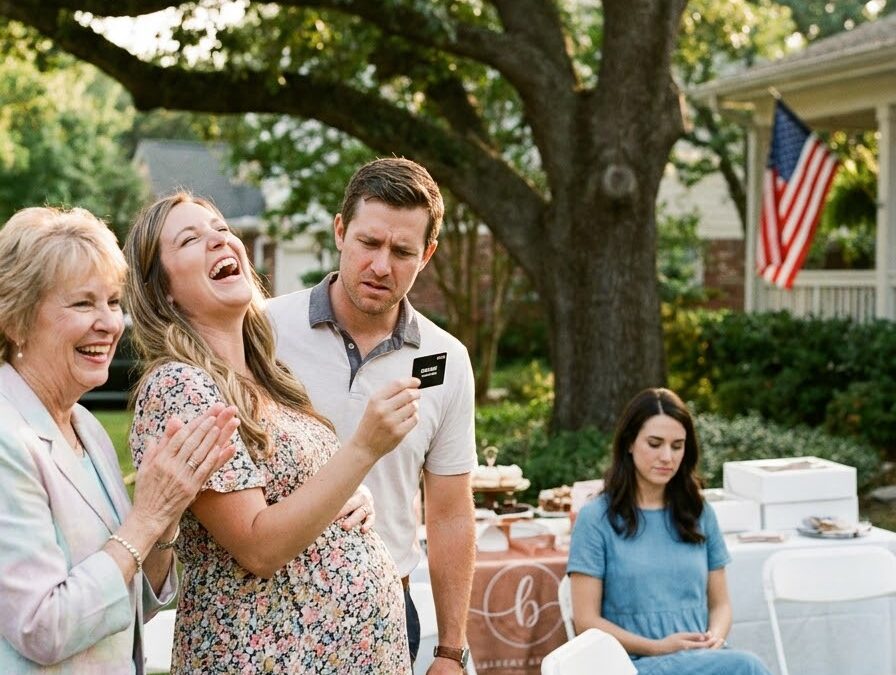
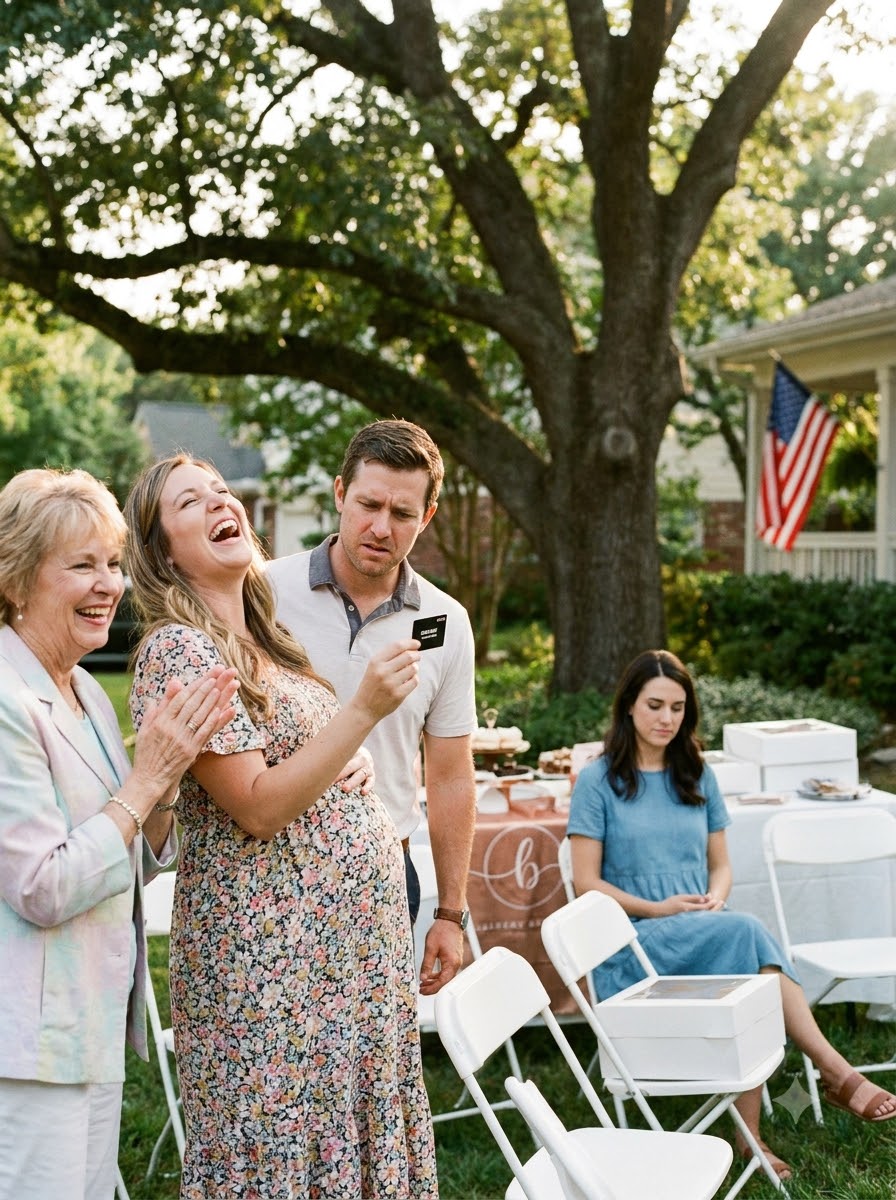
My sister read my gift out loud to 40 people.
Thirty-nine of them laughed.
The 40th was her husband, and he was reaching for the card.
Let me back up ten seconds.
It was 5:03 on a Saturday in September in a backyard in Kernerville, and my sister Kayla stood on the back step, eight months pregnant, holding a black gift card up by one corner like something she’d peeled off her shoe.
“A $50 gift card from the family failure. How generous.”
The yard broke open.
My mother in the second row clapped twice, quick and neat, the way you’d applaud a child who got through a recital piece.
Somebody’s phone came up to film it.
On the dessert table sat four white boxes of croissants, each stamped with a small copper leaf in the corner.
I knew that leaf.
I knew those croissants down to how the layers had proofed because I had trained the hands that made them.
Nobody in that yard knew the boxes were mine.
I sat in a folding chair in the last row with both hands in my lap, keeping the one promise I’d made myself that morning.
Don’t explain.
I didn’t stand.
And I didn’t laugh along.
I looked for the one person who wasn’t laughing.
It was my brother-in-law, Grant, who had watched me since I came through the gate.
And I’d taken it for pity.
For 15 years, I had let my family believe a story about me.
That afternoon, it ended in front of 40 people.
And the next two months would show me what a $50 card was worth in that yard and what it cost to stop being the failure.
I hadn’t planned for anyone to turn the card over.
His thumb found the edge, and he turned it over.
At 20 to nine that morning, my mother called while I stood at my kitchen counter in Greensboro with a cup of coffee.
I put her on speaker.
“Don’t bring anything big, honey. Nobody wants to watch you try.”
“Okay.”
Beside my keys lay a plain white envelope with a black gift card inside.
The copper leaf on its face, worn nearly to brown.
On Thursday night, I had taken that card out of a ledger at work and written my own name in the column marked ISSUED TO.
It was the first time that name had ever appeared in that column.
It was the one thing in my company I had never once given myself.
It was the first family event I’d attended in six years, and nobody met me at the gate.
Kayla pointed me to the last row of folding chairs with two fingers, still talking to someone else.
“So you can slip out if you need to.”
The dessert table stood under the oak.
Four white boxes with the copper leaf in each corner.
I recognized the croissants from 20 feet away, that pale gold that comes off my commissary line on a Tuesday.
I thought, Somebody paid for those.
I didn’t think any further.
Grant stood on the back porch by the post, holding his phone face down against his thigh.
We had never met.
He had married my sister in a ceremony that was described to me afterward as close family only.
Twice, while I fixed a plate of cheese and grapes nobody else was eating, I felt him look at me.
Both times, he looked away when I looked back.
“Grant’s stressed,” Kayla said, passing with the tray. “Work thing.”
I decided the looks were pity.
My mother steered me toward her friends from Sunday suppers at Cornerstone Community Church.
“This is my other one,” she told them. “She bakes.”
No shop name.
No last name.
I nodded and did not correct her.
I had agreed to all of it in advance.
I would sit where I was put and carry the small gift I’d been told to carry.
But I had changed one thing on my end.
The truth was printed on the back of that card for anyone who cared to turn it over.
Kayla tapped a spoon against her glass.
“Gift time,” she called. “Let’s start with the back row.”
Kayla found my envelope in the pile and tore the flap with her thumbnail.
She held the card up by one corner and read it to the yard, slower this time for anyone who hadn’t been quick enough to laugh.
“A $50 gift card from the family failure. How generous.”
The laughter came back warmer because now it was a bit.
My mother clapped twice.
Joanne, who had sat beside her at church for 30 years, lifted her phone and filmed.
None of them knew what the card was.
I did.
And I sat still.
Grant came down the porch steps like a man walking into cold water.
For an hour and a half, he had stood at that post like furniture.
He took the card out of Kayla’s fingers.
She let it go, still smiling at the crowd.
He turned it over.
Two women near the front were still laughing at the tail of the joke.
Then I watched them notice that nobody had joined them.
The back was printed in small silver type:
Founders Series Number 0212. Issued by Ridley Bake House Group Incorporated, Greensboro, North Carolina.
I watched his neck go white first.
Then his face.
He read it twice.
His thumb settled on the number and pressed as if it might smudge.
“What?” Kayla said. “It’s a Copper Leaf card. It’s your store. It’s—”
She stopped because he’d stopped listening.
He walked down the aisle between the folding chairs, past my mother’s knees, to the last row.
He crouched beside me with one knee in the grass.
“That’s a Founders 50,” he said so quietly I barely caught it. “Ms. Ridley, I’m the Triad Regional. I didn’t know it was you.”
I signed the offer letters for our regional managers.
Fourteen months earlier, I had signed one with the name Whitlock on it.
And I had trained myself over years not to look at anything that carried my sister’s married name.
The name dropped into place now in the grass in front of 40 people, exactly where I had refused to put it.
The laughter went out unevenly.
Table by table.
My mother had started to clap again for the pause, and her palms stopped an inch apart.
Grant stood.
He slid the card into his shirt pocket instead of handing it back.
“Put the phone down, Joanne,” he said.
It was the first thing he’d said out loud all afternoon.
Kayla’s voice went high.
“Grant, what is going on?”
He did not answer her.
I stood up and started for the gate.
People ask how you let your family believe something for 15 years.
It began in my grandmother’s kitchen.
And it began small.
My grandmother, June, moved in with us in Kernerville the year my father left, when I was 12.
Her kitchen had a window over the sink and a copper beech in the yard.
She taught me to roll pie dough on a hammered copper tray that had been her mother’s.
Kayla was three.
Kayla spent those afternoons on my mother’s lap in the living room, being told she was the prettiest thing in the county, while I stood on a step stool in the kitchen with flour to my elbows.
“Linda never could stay in the kitchen,” my grandmother told me, not unkindly. “You can.”
The living room went quiet.
Then I heard my mother close the door between us.
That autumn, a leaf the color of a new penny blew off the beech and landed on the windowsill.
My grandmother left it there until it curled.
In 2007, my mother fell three months behind on her mortgage.
I was 22.
One semester from finishing at UNC Greensboro.
I took a job at a bakery in town that started at four in the morning, and I sent her every dollar I didn’t need to eat.
I missed an early class.
Then a midterm.
Then the last semester altogether.
My mother told the women at Cornerstone that Nell had flunked out.
I heard it from a woman in the church parking lot who patted my arm.
I never corrected it because correcting it meant explaining where the money had gone.
And it had gone to my mother’s mortgage.
That was the first time I understood that my truth and my mother’s dignity could not both stand in the same room.
I let her stand.
My grandmother died in 2009 and left me her copper tray and a recipe box.
The card on top said in her slanted hand:
For Nell, the one who stays in the kitchen. June.
I sold pies from a stall at the curb market in 2011.
In 2012, I opened a storefront on Elm Street, incorporated it as Ridley Bake House Group, and filed a petition at the Guilford County Courthouse to change my last name from Callaway to Ridley.
Eleanor June Ridley.
After her.
It was my grandmother’s name and my mother’s before she married.
She said her piece in her own kitchen with her back to me.
“You threw away my name for hers.”
Kayla, 18, laughed from the doorway.
“So you’re Ridley now. Cute.”
By then, I had made a decision I never said out loud.
I decided that if I stayed small, they would keep a chair for me.
It never occurred to me to ask what the chair was for.
Fourteen years later, I was still bringing the small gift.
On my grandmother’s windowsill, the copper leaf sat where she’d left it.
Nobody ever moved it.
By the time I reached the gate, Kayla had found her footing.
I heard her behind me, bright and carrying, talking to the yard instead of to me.
“So she’s got a job there. Great. Maybe she can get us a discount.”
A few people laughed.
Thinner than before.
My mother’s voice followed, level and quick.
“Let’s do cake.”
She did not look toward the gate.
Grant was standing at the end of the driveway with his phone in his hand.
He didn’t walk me out.
As I passed, he said very low:
“I’m sorry.”
For what?
I didn’t ask.
His hands wouldn’t stay still, and I remember that better than the apology.
I was on Business 40 heading west, 25 minutes from home, when the phone lit up at a red light.
It was Ranata Vasquez, who runs my Elm Street store.
Boss, Kernersville ran a $912 comp on the community code for a Whitlock shower requested by G. Whitlock. Note says RM family courtesy. Yours?
I read it twice.
Four boxes of croissants.
The laughter.
How generous.
All of it had been paid for by my company, approved by my brother-in-law, and filed under the word family.
I typed:
No. Delete it.
I deleted that.
I typed:
Leave it. Don’t reverse it.
I sent that.
And I could not have told you who I was protecting.
The light turned green.
A car behind me leaned on its horn.
And I drove.
Before I reached the Greensboro line, a number I didn’t have saved sent a text.
This is Grant. Please, can we talk before Monday?
I didn’t answer it.
Monday came first.
At four on Monday morning, I was where I am two mornings a week.
At the head of the lamination line in our old commissary on Lee Street.
Sleeves pushed up.
A probe thermometer.
And a slab of butter.
Sixty-one degrees.
Three degrees warm.
I had the baker on the sheeter send a rack back to the cooler for ten minutes.
On my phone, I fixed the Durham store’s bake schedule with one line, moving the second croissant load to six.
The two bakers on shift called me Nell.
Nobody in that building called me Miss Ridley.
Between rolls, I went into the little office and took down the ledger.
A green cloth book with 212 lines in my own handwriting.
One for every Founders 50 I had ever issued.
Line 41 belonged to Ranata.
The last line read:
0212 — E.J. Ridley — Personal.
I looked at it longer than I meant to.
Marcus Odum came in at seven with a folder under his arm.
He has been the public face of Copper Leaf for 12 years.
The man on the local news cutting ribbons.
And he has never once asked me to stand next to him.
“You know Grant Whitlock’s under review.”
“I did not.”
“Kernersville’s GM says he had his closers clocking out before the floor was done. HR opened it in August. The formal notice went to his inbox Saturday at nine.”
I read the file myself.
Saturday.
Nine in the morning.
Six hours before my sister read a gift card out loud.
The phone held face down against his thigh.
Grant’s stressed.
Work thing.
The look on his face when the card turned over had a second reason under it now.
And it was a worse one for me.
Marcus tapped the folder.
“Anything you do to him is retaliation. Anything you don’t do, his wife will call favoritism the second she figures out who you are.”
“She’s figured it out.”
He didn’t know about the shower.
So I told him in three sentences.
He listened without moving.
“Then you can’t touch it now. Not for him. Not against him.”
“I know.”
Knowing it and living inside it were separate things.
And I could feel the second one closing around my hands.
Ranata called while he was still standing there.
“The 912. You sure? Dwayne’s asking.”
“Leave it,” I said. “I’ll go see it myself.”
I can read a labor report in my sleep.
I can tell you which store is short a prep cook from the bread waste alone.
I could not read what my sister was going to do with my name.
Marcus was almost out the door when his phone buzzed in his hand.
He looked at it.
Then at me.
And he did not leave.
“No. Your sister posted something last night. It has your face in it.”
My thumb stopped over the screen of my phone.
In November of 2020, I drove to Kernerville with a peach pie in my grandmother’s copper tray.
It was Thanksgiving at my mother’s table.
And it would be the last one I attended.
I had cut the lattice by hand at three that morning, and I rehearsed one sentence in the car for the whole 40 minutes.
My mother took the tray from me at the door, lifted the foil, looked, and carried it to the far corner of the table beside the rolls.
She put a pumpkin pie from the grocery store in the center.
I told myself the center was where the pumpkin belonged.
I tried once more.
While Kayla was filling her wine glass, I said my sentence.
“We opened the 12th store this fall. Durham.”
The radio was on low in the next room.
My mother passed me the green beans.
“That’s nice. Now Kayla’s getting engaged.”
Kayla held out her left hand.
Everyone stood.
The chairs scraped.
Somebody said:
“Oh, let me see it.”
And my pie sat at the corner of the table and went cold.
Afterward, my mother washed and I dried.
She didn’t look up from the sink.
“Bakeries close, honey. Kayla’s building a life.”
I dried my grandmother’s tray slowly.
Front and back.
I did not tell her that I had 60 people on my payroll that year and that some of them had children who ate because of what I’d built.
She wasn’t asking.
That was what I finally understood standing at that sink.
She wasn’t asking.
And she was not going to.
In the car, I made my decision.
I wasn’t going to hand them one more thing to not look at.
Six years went by without a holiday.
Without a call.
Nobody came looking.
Then this summer, an invitation to Kayla’s baby shower arrived with my mother’s handwriting on the envelope.
And I said yes because I still wanted the chair.
The pie had been sitting on the corner of that table when I left.
Uncut.
Six years later, in an office on Lee Street with Marcus standing in the doorway, I pressed play.
By Tuesday morning, the video had been shared 2,000 times.
On Monday, I had watched the first few seconds and put the phone down.
On Tuesday, I sat in my office at the commissary with the door closed and watched all 14 seconds.
Kayla holding up the card.
The line.
The laughter.
My mother’s two claps.
And my own face in the last row, gone very still.
The caption read:
Some people show up after 6 years with a $50 card. Blessed.
Anyway, it had gone through the mommy groups all over the Triad and through the church group chats my mother’s friends kept.
Under the video, a baker from our Winston-Salem store had written:
That’s a Founders 50. Wait, is that E.J. Ridley?
Four hundred replies hung under it.
She had seen me on the stage at our January meeting.
Four minutes a year.
The only time the people who work for me ever see my face.
My name and my face, which I had kept out of every newspaper for 12 years, now sat one inch from the word failure.
Overnight, Kayla had changed her caption.
Update: Turns out my sister owns the company my husband works for and never told her own pregnant sister. Let that sink in.
It was quick.
And it turned the whole afternoon inside out.
The woman who’d been laughed at was now the woman who had flexed on her own pregnant sister.
Nobody would remember whose gift was read aloud.
At ten, an email came from Priya Anand, a reporter at the Triad Business Journal who had spent three years trying to find the founder of Copper Leaf.
Is this you? I’d rather hear it from you than from the comments.
I forwarded it to Marcus.
He came down the hall and stood in my doorway.
“We can’t put this back,” he said.
I closed the laptop the way you close an oven door on a burn.
My phone buzzed against the desk.
It was Grant again.
She’s going to call you. Please don’t tell her about the review.
On Wednesday, I drove to Kernerville before anyone could call me.
Dwayne Hollis, who runs the store there, took me into the back room, shut the door, and turned his laptop around.
“Request came in September 2nd. Login G. Whitlock. Note says RM family courtesy shower for RM’s wife. $912 community events code for the Triad.”
He rubbed his jaw.
“I flagged it. He said it was fine.”
I photographed the screen with my own phone.
I didn’t want anyone else to hand me that picture.
On my way out, I passed the community wall in the back hall.
Thank-you cards pinned from the baseboard to the ceiling.
And I walked by it without stopping, the way I had walked by every wall of thank-yous in every store I owned.
In the parking lot, I called Grant.
He was driving between stores.
He talked fast and without taking a breath.
He had watched me the whole time because in January he had seen me on the stage at the leadership meeting for four minutes, and he had spent the shower trying to place my face.
Kayla only ever said Nell or my sister.
On the stage, I was Ms. Ridley.
Nobody had ever said E.J. or Eleanor.
The review notice had landed in his inbox at nine that morning, and he hadn’t told Kayla.
He had put in the comp request on the 2nd of September because she wanted the good pastries on the table and because he was afraid of what a plain shower would cost him at home.
“That’s not an excuse,” he said. “She wants me to ask you for things. I’m not going to.”
“You already did. Nine hundred and twelve dollars’ worth.”
The line went silent.
I could hear his turn signal ticking.
I stood in the sun by my car and did the only thing I could do.
Which was to say what I would and wouldn’t do.
“I’m not going to touch your review. Not for you and not against you. That’s the only promise you get.”
“Thank you.”
“It’s not for you.”
I heard him swallow.
I was about to hang up when he said:
“One more thing. She’s already talked to your mother. Your mom said something about the name. I didn’t get it.”
Kayla called on Thursday at seven while I was cutting an onion for supper.
I let it ring three times and answered.
Her voice was warm as syrup.
“I didn’t mean the failure thing. It’s a joke. You know that. Everybody knows that.”
I said nothing.
“Mom always said you had money squirreled away somewhere. She said don’t push her. She’ll come around. I should have listened to her.”
I set the knife down.
“When did she say that?”
“I don’t know. Years ago. Does it matter?”
It mattered.
My mother had said something.
She had not told Kayla that she didn’t know what I did.
She had told Kayla I had money and that Kayla should go easy.
“We need to talk about the baby’s future,” Kayla went on. “And Grant’s. He says there’s a director thing.”
“Not on the phone. Not this week.”
Her voice changed.
The syrup went out of it.
“You’ll write the check. You always come back. That’s your thing.”
I did not argue.
I did not say anything.
I listened to her breathe.
And for the first time in my life, I hung up before the other person was finished.
I stood at the counter a long time.
The cut onion dried out on the board.
For two weeks, I had wanted only to be left alone.
That stopped right there in my kitchen.
I wanted to know what my mother had meant by the name and how long she had meant it.
The church had been getting our day-old bread for four years.
I had never once been there on a pickup night because I never wanted to be recognized.
I picked up the phone to call her.
Then put it down again.
If I called, she would tell me what I wanted to hear.
And I would never know.
Twelve days later, on Tuesday the 29th at ten in the morning, my assistant texted me.
Your sister and your mom are in the test kitchen. They said family emergency. I’m sorry.
The test kitchen on Lee Street has a steel counter and a wall of ovens.
That Tuesday, it held two pastry cooks laminating dough at the far end, my assistant hovering in the doorway, my mother standing with her purse in front of her like a shield, and my sister sitting on a 50-pound bin of flour with both hands on her belly, nearly at term.
I had asked them in the hall to wait for my office.
“Here’s fine,” Kayla said. “We’re family.”
She took out her phone.
“It’s a family agreement,” she said, and read from her notes.
“One: $2,500 a month into a college fund for the baby as back pay for 15 years of hiding.
“Two: Grant confirmed as Director of Store Operations before Christmas.
“Three: Sunday suppers renamed the Callaway Family Table, sponsored by Copper Leaf, with Mom’s name on the banner.”
My mother nodded at each item, one after another, like a woman hearing the vows she wrote.
“No.”
I said it three times.
Once for each item.
Without explaining.
The cooks at the end of the counter stopped rolling.
The one nearest me kept his eyes on his dough as if it might leave.
“You’re going to say no to your niece?” Kayla asked.
“I’m saying no to you.”
She stood, one hand on the bin.
“It’s bread, Nell. Don’t act like it makes you somebody.”
Then, almost lightly, she added:
“We’ve been on Grant’s discount for a year. And Mom’s church bread, that was Grant too. You think you’re the only one who gives?”
That landed somewhere else.
The bread was mine.
Since 2022, the church had picked up our day-old loaves every Saturday.
And my whole family believed it was my brother-in-law’s doing.
If I told the truth, I would be taking credit from a man under review in front of the woman who’d been told to expect it.
My truth now had the shape of revenge.
Every no in that room was costing me something.
A niece I had not met.
A mother I had never quite had.
My mother spoke last.
Softly.
“You’ve got until the baby comes, Eleanor.”
Nobody but her called me Eleanor.
And only when she meant it as hers.
“Which one?”
She didn’t answer.
She looked down at the flour.
On their way out, my mother stopped beside the framed print of my grandmother’s recipe card that hangs at the entrance to the test kitchen.
It’s a copy.
The original is on the wall at Elm Street.
She laid two fingers on the glass and said nothing.
Then she followed Kayla out.
I decided I would be in Kernerville on Saturday evening at the hour the church came for its bread.
On Saturday the 3rd of October at 20 to seven in the evening, I stood in the back room of the Kernerville store looking at a partner file Dwayne had pulled up.
Cornerstone Community Church Sunday Suppers.
Added 2022.
Referred by E.J. Ridley.
I remembered typing that line myself.
Grant hadn’t worked for us yet.
Nobody had done that church a favor but me.
“I figured you’d want to see this before somebody told you,” Dwayne said.
He walked me out to the community wall in the back hall.
And this time, I stopped.
It took me a minute to find it.
A red card near the corner read:
Cornerstone Sunday Suppers. Thanks, Copper Leaf.
My fingers weren’t quite steady when I opened it.
Inside, in blue ballpoint, in a hand I have known since I learned to read, it said:
To Miss E.J. Ridley,
I know who you are. Thank you for the bread. I haven’t told Kayla and I won’t.
Linda C.
It was dated Christmas of 2023.
My mother had written I know who you are 33 months before she clapped.
Eleanor June Ridley.
She had seen it signed on a letter and read it the way you read your own handwriting.
“She asked me once if the owner was the Callaway girl,” Dwayne said. “I told her I don’t discuss the owner. She said, ‘That’s a yes,’ and never asked again.”
At seven, my mother’s car turned into the lot.
I stood behind the glass of the backroom door and watched her load bags of day-old bread into her trunk.
Laugh at something a volunteer said.
Shut the lid.
And drive away.
She never saw me.
I did not go out.
I thought of the living room of my childhood and Kayla on my mother’s lap.
And I missed her and resented her in the same breath.
“Take it, boss,” Dwayne said.
I lifted the card off its pin and put it in my coat pocket.
I didn’t know yet what I would use it for.
I knew only that I could no longer tell myself she simply hadn’t known.
In the car, my phone lit up.
It was Marcus.
Need you Monday, 8 a.m. HR. It’s about Grant and it’s about you.
On Monday the 5th of October at eight in the morning, I sat in the conference room at Lee Street across from Marcus and the head of Human Resources, a woman I have worked beside for nine years, with a folder between us.
Grant’s review was close to a conclusion.
So was the short list for Director of Store Operations East.
His name was on it.
“And now,” she said, “everyone in the company knows that the CEO is his wife’s sister. Whatever you decide, someone sues or someone posts.”
She said it the way you report the weather and closed her folder over her hands.
Marcus said it again, plainer.
“Anything you do is retaliation. Anything you don’t do is favoritism. The only clean way is not to be in either decision. And it’s in writing.”
“Will I be told how it comes out?”
“When it’s final,” said the woman from Human Resources. “Not before.”
I opened my laptop and wrote two lines.
I read them aloud before I sent them, the way I read back a recipe before I commit it to the oven.
Marcus, Grant Whitlock’s review and the East Director decision are yours and HR’s. I’m out of both effective now, and I’m not to be briefed until it’s final.
I sent it.
For 15 years, there had not been a single decision in my company that I wasn’t entitled to know about.
Now there were two.
And my own family was inside one of them.
It was the right thing.
It also felt exactly like being told to sit in the back.
On my way out to the parking lot, my phone buzzed.
Ranata had forwarded a booking request.
The subject line read:
Whitlock Sip and See — Elm Street Community Room — November 14th.
The Elm Street store is the first one I ever opened.
And on Thursday the 8th, I went in through the back door as I always do.
Ranata Vasquez’s office looks out over the community room.
A long space with a low stage and tables the neighborhood borrows for free.
She turned her monitor toward me.
The room request had come in on Monday from Grant’s regional login.
A sip and see, which is a party where friends come to meet a new baby, hosted by the Copper Leaf family.
Forty guests.
November 14th.
That morning, someone had added catering to the same request.
$1,460 on the same community code.
And in the notes field:
Approved E. Ridley family.
I had never approved it.
I hadn’t seen it until that minute.
My name sat on a line in my own first store like a signature I had not written.
Ranata folded her arms.
“Boss, that’s my room. Say the word and it’s gone.”
“Don’t cancel it. Don’t approve it. Let it stand exactly as it is.”
“If it stands, the audit people see your name on it.”
She said it flat.
“I know.”
That was the part I couldn’t control.
And I said so out loud in her office so that it would be true somewhere.
Through the glass, the original of my grandmother’s recipe card hung on the community room wall where it had hung since 2012.
Her slanted initials at the bottom.
I looked at it for a while.
“I’ll be there,” I said. “Front door.”
Ranata studied me.
“You’ve never once come in the front door.”
“I know.”
As I stood, my phone buzzed on her desk.
It was an email from Priya Anand.
The subject line said:
Your mother has agreed to talk to me.
On Monday the 12th, I was parked outside our Durham store with the engine off when Priya Anand called.
She has a good voice for bad news.
Unhurried.
And she wanted my comment before she ran it.
So she read me what my mother had told her.
“She left this family with nothing but a name change. She never brought anything to this family. Now she won’t help her own pregnant sister.”
Priya paused.
“Your mother also said she’d known for years.”
“Known what?”
I sat in the car and thought about the pies.
The tray.
The bread every Saturday.
The small gift I had carried to every chair my mother ever offered me.
Nothing.
Then I listened to her take the words she had written to me in blue ballpoint—
I know who you are.
—and turn them into a charge.
She had known for years that I was hiding it.
That was the version she was handing the paper.
Silence would be an answer, too, printed under my mother’s name.
I said in the voice I use for a supplier who has missed a delivery:
“Not today. After the baby’s born, I’ll talk to you on the record. With my name. Both of them.”
“Both?” Priya said.
“Callaway and Ridley.”
It would end 12 years of anonymity.
The ground the whole company stood on.
Priya agreed to hold the story until after the birth.
I didn’t know if she would keep her word.
And there was nothing I could do about that.
At 12 minutes to five on the morning of October 22nd, a text came in from Grant.
She’s here. June Elizabeth. 7 lb 2 oz. Kayla doesn’t know I’m texting you.
I was at the bench when Grant’s text came in.
And that afternoon, I packed the box myself.
Every Copper Leaf employee whose family has a baby receives the same one.
A first loaf.
A small round loaf of soft white bread in a paper sleeve with a printed card that says:
From all of us at Copper Leaf, for June’s first year.
I added nothing.
It was the same box a baker in Winston-Salem had gotten when her son was born and the man who washed pans in Durham when his twins came.
It went out through the Kernerville store with 40 other boxes that year.
Dwayne texted:
Sent, boss.
Then I stood in the commissary with my phone in my hand for 20 minutes and did not type a word to Kayla.
The baby’s name was June.
My grandmother’s name.
It took me the full 20 minutes to hold that.
I did not go to the hospital.
I told myself it was because of the review.
Part of it was.
Two days later, Kayla posted a photograph of the box on her kitchen counter.
My sister, the CEO, sent a loaf of bread. How generous.
Six hundred people liked it.
Under it, a woman from the church wrote:
Some people have no heart.
I answered no one.
I opened my calendar instead, found Saturday, November 14th, and typed four words into the two o’clock slot.
Front door. 2:00 p.m.
Then I closed it because I didn’t trust myself to look at it any longer.
The box went out the back door on a delivery van.
And I went back to the bench and my dough.
On Friday the 13th of November, from four to six in the afternoon, I sat in the GM’s office at Elm Street with the blinds closed and watched my sister set up my community room.
I watched on the security monitor and in the photographs Ranata sent up.
And I did not go downstairs.
Kayla was three weeks out of the hospital.
Moving slowly.
In charge.
Forty invitations were stacked on the front table, each printed with the copper leaf and the line:
Hosted by the Copper Leaf family.
Beside them, a stack of flyers for the church bulletin with the same leaf.
On the dessert table stood a hand-lettered sign:
Copper Leaf Cookies by Kayla.
She had opened a page selling cookies under our name and our leaf.
The week before, she told Ranata to take my grandmother’s recipe card off the wall and use it as a backdrop for photos.
“That doesn’t come off the wall,” Ranata said.
Kayla turned.
“Grant.”
He looked at the floor.
Then he lifted the frame from its hook.
“It’s just for photos,” he said.
He stood it on the dessert table beside the cookie sign.
Kayla said to Ranata, loud enough for the whole room:
“Grandma taught me too. Nell just had nothing better to do.”
That night, she posted:
Grandma June’s recipe, the real beginning of Copper Leaf from our family.
My mother stood under the empty hook on the wall and told Joanne:
“We’re all invited to our family’s bakery now.”
They moved through my room like people who had already settled it.
And I could not have told you what I would do about it.
Ranata texted:
Say the word.
I typed:
No word. Tomorrow.
At 20 to ten that night, my mother sent me her first text in six years.
Come tomorrow. Bring nothing. Sit in the back and we’ll forget the rest.
At five the next morning, Ranata was already in the GM’s office printing.
She laid two invoices on the desk.
$912, dated September 2nd. RM family courtesy.
$1,460, dated October 8th. Approved E. Ridley family.
I took the red card from my coat pocket, where it had been since the 3rd of October, and set it beside them.
Then I put it back in my pocket.
“Three things,” I said. “One order. The invoices. The Founders 50, if Grant still has it. And my mother’s card.”
I told Ranata that was all I would carry.
No discount.
No $2,500 a month.
Nothing that looked like collecting.
“Grant asked me last week what happens if a Founders 50 gets lost,” she said.
“What did you tell him?”
“Nothing gets lost in this building.”
“Good.”
Marcus’s voice came over the speakerphone.
“I’ll be there as the company. You be there as you.”
“I don’t know who that is in that room yet.”
At five minutes to two that afternoon, I parked on Elm Street and walked toward the front door for the first time in 14 years.
The front door of the Elm Street store is glass with a brass handle worn pale by 15 years of other people’s hands.
I had never touched it.
I pushed it open at two exactly.
The girl behind the counter, who had watched me cross her kitchen a hundred times, looked up at the glass door and did not seem to know what she was seeing.
Marcus came in a step behind me.
Ranata a step behind him.
A woman at one of the tables whispered:
“That’s Mr. Odum from TV.”
Then I watched her stop because she had understood whom he was walking behind.
The community room had been dressed.
My grandmother’s card stood propped beside the cookie sign on the dessert table.
A copper leaf invitation lay on every seat.
On the wall:
The empty hook.
And a pale rectangle where the frame had hung.
Forty people.
Most of them from the yard in Kernerville.
And Joanne with her phone already raised.
Kayla stood in the middle of it all.
Thin.
Tired.
Smiling.
“Look who came,” she said. “Sit anywhere now. The back’s fine.”
I didn’t sit.
The bassinet stood by the window.
And I walked straight to it.
June was asleep with one fist by her ear.
I bent down and kissed the top of her head.
Warm.
Smelling of milk and new cotton.
I had never touched her before.
When I straightened, my mother was on her feet.
“Eleanor, we said—”
“I know what we said.”
I lifted my voice just enough for the room.
“Ranata, would you bring me the folder from the office?”
Ranata put the folder in my hands.
I did not open it.
I carried it across the room to Grant, who stood by the dessert table.
And I held it out to him.
Not to Kayla.
“Two sheets. Nine hundred and twelve dollars, September 2nd. Fourteen hundred and sixty dollars, October 8th. Both on the community code.”
I showed him the second.
“This one says ‘Approved E. Ridley family.’”
I waited.
“Did I approve this?”
Grant looked at the page for a long time.
His eyes went to the note.
Stayed there.
“No,” he said.
Kayla said:
“He’s regional. He’s allowed.”
“I’m not,” Grant said low. “It’s my login.”
He took his own card from his wallet and held it out to Ranata.
“Run both.”
She ran them at the register in the corner right there.
The chirp of the reader was loud in a room that had stopped talking.
Kayla half rose from her chair.
My mother caught her sleeve and held it.
Kayla sat back down with her mouth still open.
Across the room, two of her coworkers from the dental office studied their cake.
“You kept it,” I said to Grant.
He reached into his wallet again.
Past the bills.
And took out the black card with the copper leaf.
He had carried it for nine weeks.
He put it in my hand.
I set it on the dessert table.
Backside up.
Beside the cookie sign.
And let the room read it.
Founders Series Number 0212.
I asked Ranata if she would explain it.
She didn’t look at Kayla.
She looked at the room.
“That’s a Founders 50. There are 212 of them in 15 years, and every one came from her hand. This store has had two. I have number 41.”
Nobody moved.
A chair creaked.
A man by the window said quietly:
“Two hundred and twelve.”
As if he were checking his own math.
Then I said the only thing I said to Kayla in those minutes.
“You asked how generous. That’s how.”
Kayla found her voice.
“It’s a $50 card with a story.”
“Kayla,” my mother said sharply.
I had never once heard her cut my sister off in front of anyone.
Joanne lowered her phone.
I took the red card from my pocket.
Opened it.
And laid it beside the Founders 50.
I didn’t read it.
Kayla picked it up because she couldn’t not.
And read my mother’s handwriting out loud, more and more slowly.
“To Miss E.J. Ridley. I know who you are. Thank you for the bread. I haven’t told Kayla and I won’t.”
In the bassinet, June stirred and made a thin waking sound.
Kayla looked up.
“You knew. You clapped.”
“I was protecting you,” my mother said.
“From what?”
Two women from Sunday suppers standing by the coffee urn were looking at my mother now.
I said it low.
For her alone.
“Thirty-three months, Mom. Before you clapped.”
My mother sat down in the nearest chair slowly.
One hand on the armrest.
It was the first time I had ever watched her make herself smaller.
The volunteers did not look away.
Neither did I.
Kayla tried to get the ground back.
“That’s our grandmother’s card. It belongs to the family.”
I picked up the frame from the dessert table and turned it toward the room.
“Ranata, would you read the top line?”
Ranata read it without any weight on it.
The way you read a label.
“For Nell, the one who stays in the kitchen. June.”
The room took a moment to work out what it had heard.
Grandma taught me too, Kayla had said yesterday in this same room.
Grant stood up.
He took the frame from my hands.
Carried it to the wall.
And set it back on its hook.
“Kayla asked me to take it down,” he said. “I shouldn’t have.”
“Grant, sit down.”
He didn’t.
Kayla dragged the bassinet toward herself.
I heard the wheels.
She stood with one hand on the rail.
“You’re doing this in front of my daughter.”
“You waited six years to humiliate a woman who was three weeks out of the hospital,” Kayla said.
“In front of my daughter.”
“In front of the same 40 people,” I said.
Her face was flushed to the collar.
“It’s bread. It’s just bread.”
She said it almost pleading.
Her old line grabbed out of the air.
I looked around the room.
At the ovens behind the glass.
At the staff at the counter.
At the floor under her feet.
“It’s bread,” I said. “You’re standing in it.”
Then I used what I had.
And nothing more.
I said it low to Kayla so the baby wouldn’t wake.
“The leaf comes off the invitations, the cookie page, and the church flyer by Monday. Marcus has the letter. That’s the only thing I’m taking.”
“You can’t take my cookies.”
“Bake all you want. Take the leaf off them.”
Marcus laid a plain envelope on the dessert table and said, for the first and only time that afternoon:
“It’s polite.”
I turned to the room and spoke in my ordinary voice.
“This room belongs to the neighborhood. The company isn’t hosting today. It never was. Stay. Eat. Everything on that table is already made.”
Nobody left.
I told Ranata:
“Strike my name from both invoices.”
“Already done.”
I looked at the empty wall.
Then at the frame Grant had rehung.
“The wall stays the way Grant left it.”
“Yes, boss.”
For the first time since I had come through the door, Kayla had nothing to answer with.
Grant spoke without being asked.
He said it to Kayla and to my mother in a voice I had not heard from him.
“I’m under review at work. Since August. I was never going to be able to ask her for anything, and I wasn’t going to.”
“You knew you couldn’t—” Kayla began.
My mother cut across her.
“I told you to keep it off the internet.”
“You told me she was nothing,” Kayla said.
The women by the coffee urn had stopped pretending not to listen.
Behind them, Joanne turned her phone off and put it in her bag.
I picked up the Founders 50 and slid it into my coat pocket.
It was the first one I had ever kept.
I did not mention the discount.
I did not mention the $2,500 a month.
Or what my mother had told the paper.
I felt a flicker of something like pity for Grant standing by that wall with his hands open.
Then I felt how tired I was behind me.
As I turned toward the door, Kayla said it to the room to make the room hear it.
“She’ll be at Thanksgiving. She always comes back.”
I walked out through the front door with Marcus and Ranata behind me.
The girl at the counter stood up straight as I passed.
On the sidewalk:
Cold air.
Marcus said:
“You okay?”
“I don’t know yet.”
A week later, on Sunday the 22nd at four in the afternoon, I was in my kitchen in Fisher Park with a loaf in the oven when my phone rang.
Mom.
The first call in six years.
I answered.
Her voice was the softest I had ever heard it.
“Thanksgiving’s at one. Don’t bring anything. June will be there.”
She didn’t apologize.
She didn’t mention the card.
“Kayla’s not sleeping, and the baby’s colicky, and everybody’s raw. Let’s just have a nice dinner.”
Behind her, I could hear running water.
The faucet in her kitchen.
The same one I had dried dishes beside a thousand times.
I wanted to go.
I’m not going to pretend I didn’t.
I stood with one hand flat on the counter and wanted it so badly that my knees felt it.
A nice dinner.
I knew that dinner.
I knew where they would seat me.
For three years, my mother had known exactly who I was.
And every day, she had chosen what to do with that.
Now she was offering me a seat at the end of the same table with the same silence set out in front of it like a place card.
Then I asked her for one thing.
“Mom, say it. Say, ‘My daughter owns Copper Leaf,’ out loud to me right now, and I’ll come.”
Silence.
I counted it by the ticking of the oven.
One.
Two.
I could hear her breathing.
And the water.
And something being set down on a counter.
Five.
Six.
Eight seconds.
Then she said:
“Why does it matter what I call it?”
“Then I’m not coming,” I said. “Not this year.”
“You always—”
“Not this year.”
I ended the call.
There would be a chair at her table on Thursday with June near it.
And none for me.
I had chosen that.
And I let myself feel what it cost.
For a minute.
The kitchen was very quiet.
And the loaf ticked in the oven.
I had said no to my mother before about small things.
A dress.
A date.
And I had always taken it back by nightfall.
I waited to take this one back.
I didn’t.
I did three things before the timer went off.
I wrote to Pastor Tilman.
The Sunday supper bread would keep coming every week.
Not one loaf less.
But from now on, the church office would sign for it.
And my mother’s name came off the form.
He wrote back within the hour.
Understood and thank you.
I texted Grant.
June’s first birthday cake is on the company like every family’s. That’s the tradition. That’s all.
Then I called Priya Anand.
“Run it. Use my name. Both of them.”
“I’ll come Tuesday,” she said.
My hands were steady.
They stayed steady.
The oven timer went off.
I turned my phone face down on the counter.
And I took the bread out.
In December, the profile ran.
The Founder Who Stayed in the Kitchen.
Priya had photographed me at the bench with flour on my forearms.
And the first line carried both names.
Eleanor June Ridley, born Callaway.
Our 62 stores saw their CEO’s face in the newspaper instead of on a stage for the first time.
Two bakers I had known for ten years stopped me in the hall.
“You could have told us.”
“I know.”
Marcus told me the rest once it was final, as I had asked.
The review ended in a written warning.
No promotion this cycle.
Grant kept his job.
The decision never passed through my hands, exactly as my email of the 5th of October had said.
The cookie page became Kayla Bakes.
The leaf vanished from the invitations.
In the middle of December, a Christmas card came from my mother with no message.
Only one word in blue ballpoint.
Mom.
I put it in a kitchen drawer.
I didn’t throw it away.
That night, a text arrived from Grant.
Can I bring June by the store sometime? Just me.
I read it standing at the bench.
And I did not answer yet.
In January of 2027, the company held its annual Founders Table at the commissary.
Two hundred managers at long tables under string lights.
Marcus didn’t introduce me.
I walked to the front on my own and gave them both of my names.
And I said nothing about my family.
“I’m Eleanor June Ridley. I was born Callaway. I’ve been making bread in this company for 15 years.”
That was all.
My hands didn’t shake.
I had always thought they would.
Then I handed out the first Founders 50 of the year.
Number 0213.
To Dwayne Hollis.
“For keeping a wall honest.”
He stood there holding it as if it were hot.
That afternoon, I had written his name in the ledger.
The line under my own.
Ranata clapped first.
Loudly, in the way she has.
And the room followed.
After dinner, Grant caught me at the door.
He had sat in the back row all night.
“About June,” he said.
He looked like a man who expected to be told no.
“Bring her Sunday,” I said. “Front door.”
He looked at me.
“Kayla can come or not. But she’s told first. Nothing hidden from anyone.”
He nodded once.
Swallowed.
Then nodded again.
I went back to my table and ate my dessert before it went cold.
It was 20 to five on the morning of the 22nd of October, 2027, and I was alone in the commissary.
On the pass sat a box with a yellow cake in it, baked from my grandmother’s card.
And the printed sleeve read:
For June’s first year. The same as every family’s.
Grant would pick it up at seven.
I wasn’t going to the party.
I didn’t need their table to know I had a place.
Number 0212 was clipped to the edge of the bench where I rolled my dough.
I cut a slice from the test cake and stood at the bench and ate it in my own kitchen before anyone came in.
The lights were on.
And the first tray was in the oven.
I ate first.
Then I fed everyone else.
If your family only claps when you stay small, what would it cost you to stand up?
If you’ve ever been the one who stayed in the kitchen, tell me in the comments below and subscribe.
There’s a chair here for








