During a family dinner, I said, “I’m about to give birth.” My parents laughed: “That’s not our grandchild.” I drove myself to the hospital. A week later, my mother knocked on the door: “Sweetheart, let me see the baby.” I opened the door and asked, “Which baby? What grandchild?”
My name is Imagin Torrance. I’m 33, and I timed my own contractions in a hospital parking deck with my phone in one hand and my mom’s last text in the other.
The deck smelled like hot rubber and somebody else’s cigarette, and the stopwatch on my screen kept climbing while the text sat right under it.
Don’t be dramatic. Call us when it’s real.
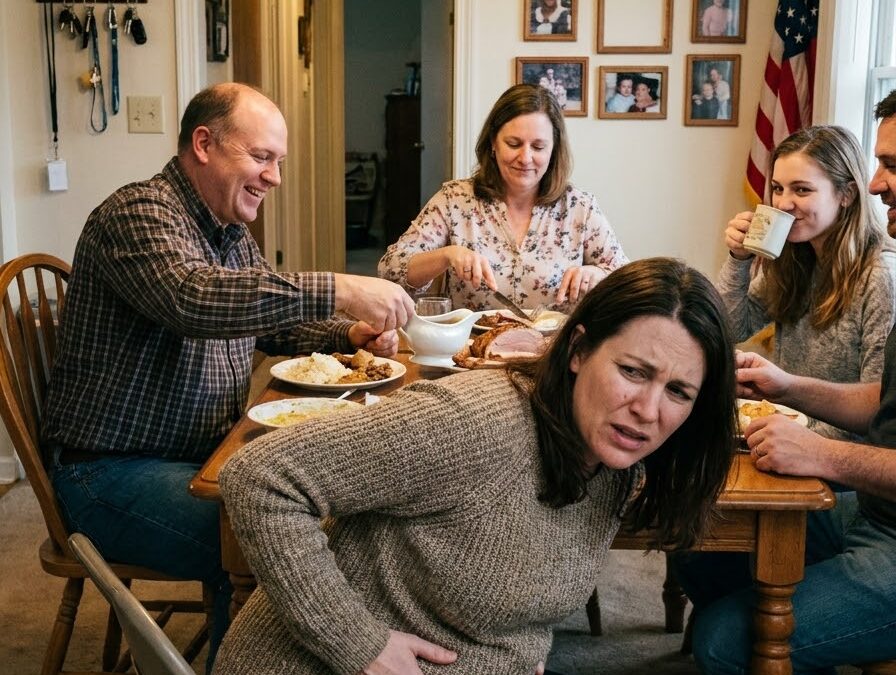
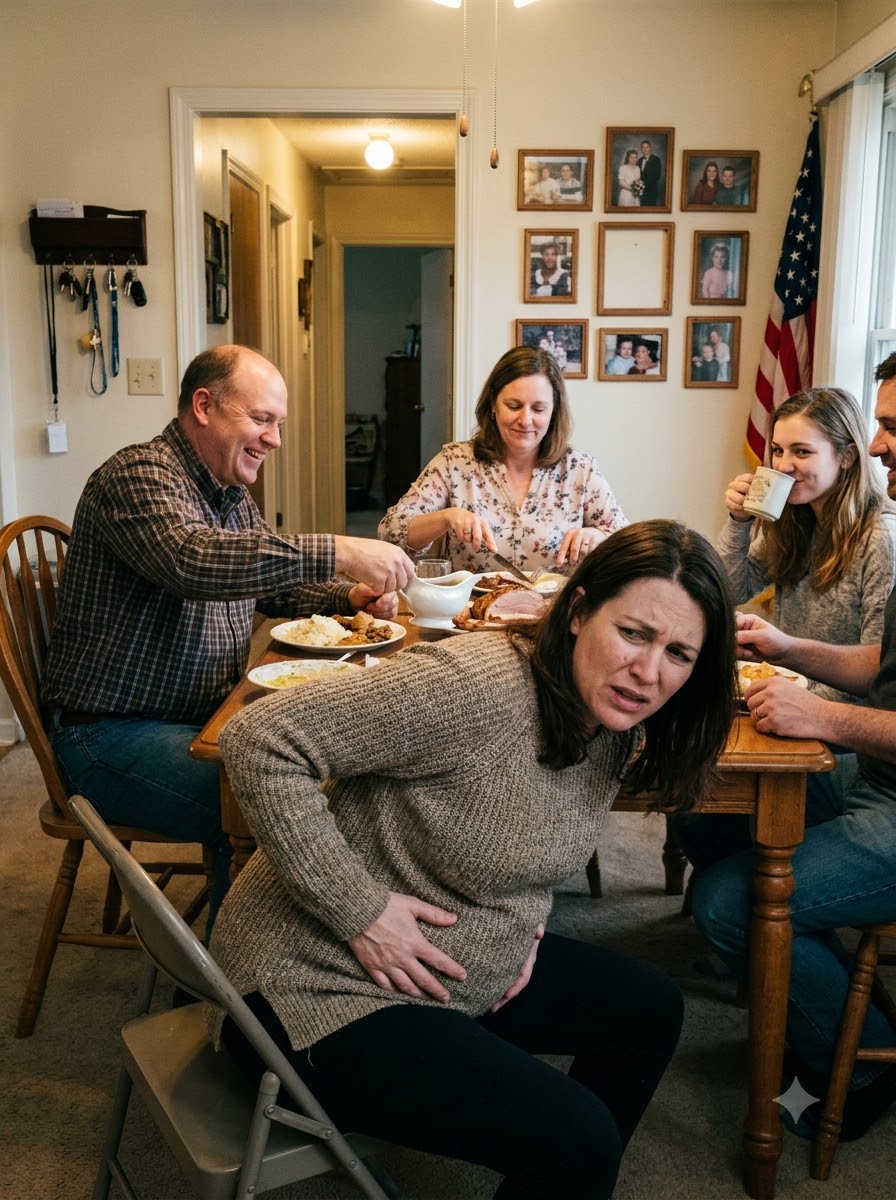
Twenty minutes earlier, I had been sitting on a folding chair at the end of my family’s dinner table in Midlotheian, 39 weeks pregnant, and I had said, as plainly as I knew how, that I was about to give birth.
My dad laughed.
My mom laughed with him.
And then my dad said the sentence I would hear in my head all the way down the Powheight Parkway.
“That’s not our grandchild.”
Nobody stood up.
Nobody walked me to the car.
I drove myself.
But that’s not the part of this story I need you to hear.
A week later, my mother knocked on my front door in Church Hill holding a casserole and asked to see the baby.
What I said to her through the screen door is the reason my sister hasn’t spoken to me since and the reason my aunt drove 70 miles to stand on my porch that same morning.
Welcome back to Calm Drama Stories, where quiet women tell you exactly what happened at the table and what they did about it afterward.
If you’ve ever been the daughter who did everything right and still got the folding chair, this one’s for you.
Drop a comment and be sure to subscribe.
Seven months before that parking deck, I was on my knees on a studio floor in Scott’s Edition, telling a grandmother to stop fixing a blanket.
“Mrs. Yansy,” I said, “leave the corner alone. Just look at her.”
Mrs. Yansy had been fussing with the swaddle for two minutes, tucking and retucking the way people do when they don’t trust their hands with something new.
Her daughter sat on the couch behind us, 19 days postpartum and too tired to argue with anybody.
The white noise machine hummed.
The heated bean bag under the blanket kept the baby warm enough to stay limp and sleepy, which is the whole trick of newborn work.
Yara, my best friend and my second set of hands on shoot days, held the reflector and mouthed the word, “Wait,” at me.
So I waited.
Mrs. Yansy pulled her rings off one at a time and set them on my prop shelf so she wouldn’t scratch the baby.
And her hands shook while she did it.
Then she stopped fixing things and just looked.
Her whole face came apart the way I have watched about 400 faces come apart in that room.
I got the shot.
“That’s the picture,” I told her. “That look. That’s the whole thing.”
Afterward, while I packed lenses and Yara peeled the baby’s blanket off the bean bag, she asked the question she’d been sitting on all morning.
“When are you telling them?”
I was 14 weeks along and not showing yet under a loose shirt.
“Sunday,” I said. “Dad grills on Sundays. People take news better near meat.”
Yara didn’t laugh.
“And if they don’t take it?”
I zipped the camera bag.
“Then I’ll have the ribs to myself.”
She let it go, which was kind of her and which I would think about later.
My dad grills on the back deck in Midlotheian in every kind of weather.
And that Sunday, it was cold enough that he came in with his ears red and the platter steaming.
My mom carried the gravy boat, the china one with the chip on the spout, and set it down with the chip turned toward herself the way she always does so nobody else has to see it.
My sister Raquel had Sawyer on her hip, two years old and covered in cracker dust, and my brother-in-law Tobias was cutting the meat because my dad’s hands were cold.
Vaughn, my little brother, sat across from me.
I waited until everybody had a plate.
“I have news,” I said. “I’m pregnant. Due in September.”
Raquel said, “Oh.”
And then she looked at my mom before she said anything else, which told me a lot.
My dad set his fork down.
“Who’s the father, Emmy?”
I had practiced this in the car.
“There isn’t one. I used a donor through a clinic. Everything on paper.”
He laughed.
It was short, and it wasn’t mean yet.
Just surprised.
The laugh you give a kid who tells you she’s going to be an astronaut.
“A donor,” he said. “So there’s no father.”
“There’s a baby,” I said.
My mom picked the gravy boat back up, poured a little on his plate he hadn’t asked for, and set it down again.
Chip turned in.
“Then there isn’t a baby,” she said. “Not one of ours.”
Nobody said anything.
Sawyer banged a spoon.
“Mom,” Raquel started.
Then stopped.
My mom smoothed her napkin flat.
“There’s no baby without a name, Imagin.”
Vaughn looked at his plate like it had something written on it.
I ate my dinner.
I even had seconds because I had decided in the car that I would not leave that table like a girl who had been sent from it.
But the whole time, I could feel the shape of the sentence she’d said sitting on the tablecloth between the platter and the bread, and nobody moving it.
Vaughn walked me out.
He carried the Tupperware my mom always sends home because she sends leftovers to everyone no matter what she has just said to them.
He set it on my passenger seat, where it fogged the window a little.
“They’ll come around,” he said, standing in the driveway with his hands in his jacket. “You know how they are. Mom had Sawyer’s crib bought before Raquel was even showing.”
“Sawyer’s crib had a last name on it before he did,” I said.
Vaughn winced because he was 27 and he loved everybody and he hadn’t yet learned that you can love people and still be honest about them.
“That’s not fair,” he said.
“It’s accurate.”
“Okay. It’s accurate.”
He looked back at the house.
The porch light was still on.
“Give it a month. Dad says things at the table he doesn’t say anywhere else.”
“Dad says things at the table because that’s where the audience is.”
I hugged him anyway.
He smelled like grill smoke and my mom’s dish soap.
When I backed the car out, the porch light went off before I reached the street, and I told myself that was the timer and not a person.
It’s 30 minutes from Midlotheian to Church Hill if the Powheight isn’t backed up.
And I spent every one of them not thinking about the word ours.
I pulled up in front of my narrow brick rowhouse, cut the engine, and my phone lit up on the console.
My mom.
We won’t be telling Aunt Teddy. Please don’t either.
Aunt Teddy is my dad’s older sister, the one in Charlottesville that the whole family reports to.
Not a congratulations.
Not a question about how I was feeling.
A rule about who got to know.
I sat in the dark car with the leftovers going cold beside me and read it three times.
And I thought, She already has the story written, and I’m not in it.
At 20 weeks, Dr. Ravvenel put the cold gel on my stomach and said the baby had all her fingers, all her toes, and her mother’s habit of turning her back when someone tried to get a good look.
Yara sat in the plastic chair by the wall, eating my crackers.
The heartbeat came through the speaker like a horse on a dirt road.
“Now,” Dr. Ravvenel said, wiping the wand. “Logistics. Who’s driving you when it’s time?”
“I am,” Yara said before I could open my mouth. “Petersburg. Thirty-five minutes. Less if I speed.”
Dr. Ravvenel looked at her over the top of her glasses.
“You’re the doula?”
“Doula, friend, person who yells at her.”
“Good. Have a second name anyway.”
“I’ve got one,” I said. “Sunny Baptiste. She’s a labor and delivery nurse here. We met in the prenatal yoga class. I quit after two sessions.”
“Sunny’s good,” Dr. Ravvenel said, and she meant it. “First babies take their time. You’ll have hours, probably, but have the second name and have a third.”
She typed something.
“Family?”
I watched the screen where my daughter was already a person with a spine.
“Working on it,” I said.
Yara pulled a pen out of her bag, took my hand, and wrote Sunny on the back of it in blue ballpoint big enough to read from across the room.
“There,” she said. “Now you’ve got a plan on your actual body.”
I laughed, and Dr. Ravvenel printed the pictures, and for a few minutes it felt like the kind of afternoon a person is supposed to have at 20 weeks.
Then she handed me the images and said, “Grandparents usually want a copy.”
And I said, “I’ll take two.”
I put both of them in my own bag.
Yara looked at me and did not say a word because she didn’t have to.
Raquel brought Sawyer to the studio on a Tuesday for his two-year pictures, the way she had brought him for his newborn pictures and his one-year pictures, and the way I had never once sent her an invoice.
He grabbed my camera strap with both fists and yelled at the shutter sound like it had insulted him.
Raquel rattled a box of animal crackers to get him to look up.
“Mom’s not being cruel,” she said from behind the box, not looking at me. “You know that, right? She’s protecting the family.”
I fired off three frames.
“From what?”
“From explaining you.”
I lowered the camera.
Sawyer took the chance to lick the strap.
“Explaining me to who, Raquel?”
“Church. Aunt Teddy. The Renfros. People ask things. She wants to have an answer ready.”
“The answer is I’m having a baby.”
“The answer is you’re having a baby with no dad and no ring. And she’s 57, and she doesn’t know how to say that at coffee hour.”
She finally looked at me.
“It’s not personal.”
I have photographed a lot of people who were saying something unforgivable in a reasonable voice, and I have learned to keep shooting.
“Chin up, buddy,” I told Sawyer.
He grinned.
I got the shot.
Raquel relaxed because she thought that meant it was over.
“So Sawyer’s party is next month at Mom’s. You’re doing the pictures, right? She wants a new one for the hallway.”
The hallway.
The wall in my parents’ house where every framed Torrance hangs in a straight line and where I have taken every single photograph since I was 19.
“You know the wall,” Raquel said.
I did.
I also knew, standing there with my nephew chewing on my equipment, that I had never once looked at it and counted who was missing.
The crib came in a box longer than my front door and heavier than I was supposed to lift.
I was halfway up the second brick step with it when a voice across the street said:
“Put that down before you have that baby on the sidewalk.”
Zora Peton is 72, retired from the post office after 31 years of walking Church Hill in every kind of weather, and she still wears the old gray mail gloves when she does anything outdoors.
She rolled a hand truck across the street with one wheel squealing, tipped the box onto it like it was a bag of flour, and had it on my porch before I had finished arguing.
“Thank you,” I said. “You don’t have to.”
“I know I don’t.”
She looked at the box, then at me.
“Who’s your person for the hospital?”
“I’ve got a plan,” I said. “My friend Yara. A nurse named Sunny.”
“A list on the fridge.”
Zora pulled the gloves off one finger at a time.
“A plan is not a person.”
The porch smelled like the paint I’d put on the railing the weekend before.
“My daughter’s in Atlanta,” she said. “I see my grandbabies on a screen on Sundays. It’s fine. It’s what it is. But when she had the first one, I flew down, and I slept in a chair for five days because a plan can’t hold your hand.”
I didn’t know what to say to that.
So I said the true thing.
“I’ve never really knocked on anyone’s door.”
“Well,” Zora said, picking up her hand truck, “mine’s the one with the light on. It stays on until 11. You knock.”
She went back across the street.
I stood there with a crib on my porch and a porch light across from me.
And I understood, without wanting to, that I had just been offered something my own mother hadn’t.
My dad had never come to the studio alone in the four years I’d had it.
So when he walked in on a Tuesday morning with his cap still on, I knew it wasn’t about pictures.
He sat in the client chair, the one that creaks, and put the cap on his knee and tapped the brim with one finger.
“Your mother’s worried,” he said.
“About what?”
“About how this looks.”
I leaned on the counter.
“It looks like a baby, Dad.”
He nodded like I’d made his point for him.
“Here’s what I’m asking. Wait to tell people. Let it settle. And when it comes, don’t put our name on it.”
I heard the creak of the chair and the traffic on Boulevard and my own pulse.
“It’s my name.”
“It was mine first,” he said gently, which was worse. “There’s a way to do these things. Your mother’s maiden name. Anything. So nobody at church has to ask what a Torrance is doing with no father on the paper.”
“You can’t decide her last name legally. That’s mine.”
“I’m not talking about legally. I’m talking about family.”
I thought about the wall in his hallway and every frame on it and whose finger had pressed the shutter.
“Okay,” I said. “Then here’s how it goes. I’ll keep my name, and you’ll need another photographer for the Christmas card.”
He blinked.
That, I could see, had not occurred to him.
In his head, I was something like the gravy boat.
Chipped, but always on the table.
Always turned the right way.
“You’d stop doing the card over this?”
“I’d stop doing a lot over this.”
He stood up, put his cap back on, and looked around at the backdrops and the bean bag and the wall of other people’s grandparents crying.
And he said:
“You always did have to make it complicated.”
Then he left.
The chair went on creaking after him.
And I realized I had just found the only thing in that family I had any control over.
What I would keep doing for free.
Yara’s kitchen in Petersburg has a paper calendar on the refrigerator because she doesn’t trust her phone with anything that matters.
And in April, she stood in front of it with a red marker and made a face.
“Okay,” she said. “Don’t panic.”
“I’m not panicking. You’re the one holding the marker.”
She tapped a square in September.
“This is you. Thirty-nine weeks.”
She tapped the square next to it, where there was already a red circle.
“This is Mrs. Whitlow. Also 39 weeks. I signed her in February before you told me.”
The two circles overlapped like a Venn diagram of my bad luck.
“Babies don’t read calendars,” I said.
“No, but I can’t be in two rooms. If she goes first, I’m hers until she’s done.”
She put the marker down.
“So we call Sunny.”
Sunny was already on speaker, her voice coming out of the phone on the counter between the decaf and the sugar.
“I’m on nights that whole week,” Sunny said. “Here’s the protocol. When it starts, you text me ‘now.’ Just that. No essay, no apology. I meet you at the labor and delivery door, and I have a wheelchair. Got it?”
“Got it.”
“Say it back.”
“Now. Nothing else.”
“Good girl.”
Yara poured the decaf and sat down across from me and did the thing she does where she looks at you until you say the true thing.
“You’re going to drive yourself, aren’t you?”
I wrapped my hands around the mug.
“If I have to, I have to. It’s 30 minutes. I’ve driven it a thousand times.”
“You’ve never driven it in labor.”
“Neither has anybody. The first time.”
Sunny sighed on the speaker.
“I’ll be at the door,” she said. “Whatever gets you there gets you there.”
I looked at the two red circles and thought about my brother in his work van and my parents 30 minutes in the wrong direction.
And I did not say the other thing I was thinking, which was that I had never once pictured them in the car with me.
Aunt Teddy called on a Wednesday while I was eating a sandwich in my car outside the studio with the windows fogging.
Teddy taught eighth-grade English in Charlottesville for 38 years, never married, and runs the family from 70 miles away by the simple method of asking direct questions and waiting.
“The Christmas card,” she said. “I’m doing the list early this year. Your mother says you’re seeing someone. An engineer.”
I stopped chewing.
Out on the windshield, my breath had made a gray oval, and I drew a circle in it with my finger without deciding to.
“An engineer,” I said.
“That’s what she said. Sounded very pleased. I said, ‘Well, bring him at Thanksgiving.’”
I could have let it ride.
That’s what my mom was counting on.
That I would be too polite or too tired to correct a nice story.
“Aunt Teddy, I’m not seeing anyone.”
A pause with a lot in it.
“Then why on earth would she tell me that?”
“You’d have to ask her.”
“I’m asking you.”
I wiped the circle off the glass.
I had promised not to announce, and I had decided I would not lie.
And the space between those two things turned out to be about the width of a windshield.
“I’m not seeing an engineer. I’m not seeing anybody. Whatever Mom is telling people, it’s her story, not mine.”
“That’s not an answer, honey.”
“It’s the one I’ve got right now.”
She let that sit.
Teddy is very good at letting things sit.
“You sound tired,” she said finally.
“I’m fine.”
“Nobody who’s fine says it that fast. When you’re ready to tell me the real thing, you call me. Not your mother. You.”
“Okay.”
“Okay.”
She hung up the way she always does, without goodbye, as if the conversation were a door she’d simply stepped through.
I sat in the car with half a sandwich and the knowledge that my mother had invented a man rather than admit a baby.
And somewhere in Charlottesville, a woman I trusted had just been handed the first loose thread.
I drove out to Midlotheian after work and found my mother folding dish towels at the kitchen counter.
Each one into a perfect square.
Each square stacked exactly on the last.
My dad was in the garage.
I could hear the grinder.
“You told Aunt Teddy I’m seeing an engineer,” I said.
She didn’t stop folding.
“It’s easier than the truth.”
“Easier for who?”
“For everyone, Imagin. For you, if you’d let it be.”
She set a towel on the stack and squared the edges with her palms.
“Teddy asks questions. Church asks questions. The Renfros ask questions. You want me to say what exactly? That my daughter went to a clinic and picked a stranger off a list?”
“I want you to say I’m having a baby.”
“Some things a family doesn’t explain.”
She said it like a recipe.
Like something passed down that you don’t argue with because it works.
“Here’s what you can say if you have to say something. Say the father’s out of the picture. People understand that. They feel sorry for you and they move on.”
“There’s no father to be out of the picture.”
“Then there’s nothing to tell, is there?”
She picked up the next towel.
The grinder in the garage stopped.
And in the quiet, I could hear the refrigerator hum and the clock over the stove that has run four minutes fast my entire life.
“You’d rather I had a man who left,” I said, “than no man at all.”
She folded.
“I’d rather you had a story I could stand behind.”
I looked at the stack of towels.
All those clean right angles.
And I understood that this was what she did with everything that didn’t fit.
She folded it until the edges lined up.
“I’m not a story, Mom.”
“Everybody’s a story, honey. The question is, who’s telling it?”
The grinder started up again in the garage.
And I let myself out.
And I did not know yet that she had just told me exactly how she would lose.
The Quarrels family booked a newborn session for a Thursday.
Three of them and a two-week-old girl.
The mother, who was 36 and had done exactly what I had done, and her parents, who had driven down from Fredericksburg in a truck with a car seat already strapped in the back.
Mr. Quarrel was a big man with hands like a mechanic’s, and he held that baby like she was a bird that had landed on him by mistake.
“You can support her head a little more,” I said. “There. Like that.”
“We didn’t understand it at first,” he said.
Not really to me.
He was looking down at her.
“When Roseanne told us how she was doing it. My wife cried for a week.”
“I didn’t say much,” his wife on the couch said.
“He said plenty.”
Roseanne laughed.
The baby did not wake up.
And then he said:
“We met her.”
That was the whole speech.
I kept the camera up longer than I needed to because the viewfinder is a very good place to keep your face.
I got the shot.
His thumb along her cheek.
His wife’s hand on his shoulder.
The daughter watching them both.
It’s one of the best frames I’ve ever taken, and I have never hung it in my studio because I couldn’t stand to walk past it.
In the back room afterward, Yara found me sorting cables that did not need sorting.
“That’s what it looks like,” she said, “when they choose you.”
“I know what it looks like.”
I wound a cable around my hand.
“I’ve shot 400 of them.”
“Then you know the difference.”
“I know the difference, Yara. I’ve known it since I was 19.”
She took the cable out of my hands and put it on the shelf.
“Then stop shooting their wall for free,” she said. “And let somebody shoot yours.”
I did not have an answer for that.
And I was 30 weeks pregnant with a birthday party to photograph on Saturday.
So I went out front and booked another session and let the question sit in the back room where I’d left it.
Sawyer’s second birthday was a sheet cake with a plastic fire truck on it, a bounce house my dad had rented and then complained about, and a backyard full of church people eating potato salad off paper plates.
I was 30 weeks along, and there was no loose shirt in the world that hid it anymore.
I worked the party with two cameras, one on each shoulder, the sun coming straight into my lens every time I turned toward the cake.
Zelma Haw, who has sat in the pew behind my mother for 20 years, caught me by the cooler.
“Imagin, look at you. When are you due, sweetheart?”
I opened my mouth.
My mother arrived from nowhere with a pitcher of tea.
“Oh, Imagin’s between things right now,” she said, warm as the weather, and poured Zelma a glass she hadn’t asked for.
Zelma looked at my stomach.
Then at my mother.
Then at the tea.
“Between things,” she repeated.
“Well, all right.”
And she walked away with a face that said she would be thinking about it for the rest of the party.
I wiped the lens with the hem of my shirt.
Raquel got me by the elbow and steered me into the kitchen where the extra ice was.
“Don’t make it a thing today,” she said.
“I didn’t say a word.”
“Your face did.”
“My face is 30 weeks pregnant, Raquel. It doesn’t have a lot of options.”
“Just get through the cake.”
She handed me a bag of ice like a peace offering.
“It’s his birthday.”
“I know whose birthday it is. I’m the one taking the pictures.”
Out in the yard, somebody started the song.
I went back out and shot Sawyer with frosting to his eyebrows and my dad holding him up like a trophy and my mother laughing with Zelma as if nothing had been said by the cooler at all.
I got every shot.
I always do.
And every one of them was a picture of a family that had just told a woman from church that I was between things.
When the guests thinned out, my mother took the new 8×10 of Sawyer, the one I’d printed that week, and carried it down the hallway to the wall.
I followed her because I always follow her to the wall.
It runs from the front door to the kitchen.
Every frame the same black.
Every photograph mine.
My parents’ 30th.
Raquel’s wedding.
Vaughn in his cap and gown.
Sawyer at one day old.
Sawyer at one year.
She hung the new one on a hook that had been waiting for it.
Then she stepped back to check the line.
And that’s when I saw the nail beside it.
A small brass nail alone, with a faint pale rectangle in the paint around it.
The ghost of a frame that had hung there long enough to keep the wall from yellowing.
I knew which picture that had been.
It was me at 20 in the college portrait my mother had asked for.
And I had not noticed when it came down.
“What’s that nail for?” I asked.
She straightened Sawyer a quarter inch.
“For when there’s a family to hang.”
“There’s one right here.”
I put my hand on my stomach where the baby was pushing a heel against me like she wanted a word in this.
My mother did not look at my hand.
“There’s no baby without a name, Imagin.”
She said it exactly the way she had said it at the table months earlier.
With the same flat palm, as if it were something she had read on a plaque.
I took out my phone and photographed the nail.
Just the nail and the pale rectangle and the edge of Sawyer’s frame.
“Why on earth would you photograph a nail?”
“So I remember where it was.”
She looked at me for a second like she almost understood.
Then the doorbell rang.
It was somebody’s grandmother leaving, and she went to be gracious.
I stood in the hallway with the nail in my phone.
And I want to be honest with you.
That was the first moment I stopped asking for a place on that wall and started keeping a record of it.
Vaughn showed up at my house in Church Hill with a rocking chair in the back of his work van.
A $30 estate-sale find that squeaked on every second rock like it was counting.
He carried it into my living room, set it by the window, and sat in it himself to test it, which made him look like a large child.
“It squeaks,” I said.
“I’ll fix it.”
He looked around for oil, found none, and went into my kitchen and came back with the vegetable oil, which is exactly the kind of solution Vaughn arrives at.
While he was on his knees drizzling canola into the joints, he said to the floor:
“Dad asked me to talk to you.”
“About what?”
“He said he’ll cover the hospital bill. All of it. Whatever insurance doesn’t. If the baby gets a different last name.”
“Mom’s maiden name?”
“Or anything. Just not ours.”
The chair squeaked when I pushed it.
“He’s buying a nail,” I said.
Vaughn sat back on his heels.
“I told him no. I told him I wasn’t going to be the guy who brought that over here.”
“But you’re bringing it.”
“I’m telling you it was said. That’s different.”
He was right.
And I told him so.
He wiped his hands on his jeans.
Then he said the other thing, the one he’d been carrying up the steps under the chair.
“I’m in Norfolk the week you’re due. Chiller install at the shipyard. Ten days. I can’t move it. I tried.”
“I know.”
“You don’t know. I just told you.”
“I know it’s the kind of thing that happens.”
He rocked the chair once with his hand.
It squeaked.
“I’m sorry, Emmy.”
“Don’t be. You brought a chair.”
He hugged me at the door with oil still on his fingers.
After his van pulled off, I sat in the rocking chair by the window and listened to it squeak.
And I counted my people the way my mother counted her frames.
Yara.
Maybe Sunny at the door.
Vaughn in Norfolk.
And a porch light across the street that I still hadn’t knocked on.
At 38 weeks, Sunny and Yara came over and packed my hospital bag on the kitchen table like it was a military operation.
Sunny read from a list on her phone.
“Chargers.”
“Two.”
“Two. Robe.”
“In.”
“Socks with grips.”
“In.”
“Lip balm.”
“In.”
“Your own pillow. Because ours are terrible.”
“In.”
“Going-home outfit for you. Going-home outfit for her.”
Yara held up a yellow onesie the size of a dish towel and got quiet for a second.
Then folded it in.
My phone rang on the counter.
It was my mother.
And because my hands were full, I put her on speaker without thinking.
“Imagin. Come to dinner Sunday.”
The kitchen went still.
“Your father wants to see you before—”
“Before what?”
“Before things change.”
Yara shook her head at me slowly.
The way you shake your head at someone reaching for a hot pan.
Sunny didn’t move at all.
“We thought we’d do a nice normal dinner,” my mother said. “Just family. Raquel and Tobias and the baby. Nothing heavy.”
I looked at the gray bag on the table, half-zipped, and at the two women who had packed it.
And I looked at the phone.
And I thought about the porch light and the nail and 33 years.
And I wanted—I am not proud of this—one more Sunday where it might be different.
“I’ll come,” I said.
“Good. Six.”
She hung up.
Yara said:
“Imagin.”
And I said:
“I know.”
Sunny picked up the bag, zipped it the rest of the way, and said:
“Then the bag goes in the trunk. Not the closet. The trunk. Tonight. And it stays there.”
She wrote NOW on a piece of masking tape and stuck it to the inside of my trunk lid where I’d see it every time I opened it.
If you’ve ever packed the bag yourself, checked the list yourself, and then still drove to the one table that never had a seat for you, I’d like to hear about it in the comments.
And if you’re new here, subscribe.
The knock on the door is coming.
I drove out to Midlotheian at five on Sunday with the bag in the trunk and the tape on the lid.
My dad was at the grill on the deck and lifted his tongs at me, which for him is a hug.
Inside, my mother had set the dining table for six with the good plates.
There were five wooden chairs around it.
And at the end, by the sideboard, one metal folding chair from the church closet with a seat cushion tied on.
“We put you on the end,” she said, “so you’d have room for your stomach.”
Tobias stood up from the chair nearest the kitchen.
“Take mine, Imagin. I’ll take the folding chair.”
“She’s fine, Tobias,” Raquel said, not looking up from cutting Sawyer’s roll into pieces. “It’s got a cushion.”
Tobias looked at me.
I looked at the folding chair.
Some fights are not worth the calories.
“It’s fine,” I said.
And sat.
The metal was cold through my dress, and the legs sank a little into the carpet so that I sat an inch lower than everyone else at the table.
Like a kid promoted from the children’s table, but not all the way.
As I sat, something low in my back drew tight and let go.
I looked at the clock over the sideboard.
Twelve minutes past six.
I had had a few of those over the past week, the practice kind.
I decided this was one of them and reached for the bread.
My mother came in with the platter and the chipped gravy boat and set them down.
Chip turned in.
“There,” she said. “We thought we’d just do a nice normal dinner.”
“Normal’s good,” I said.
My dad came in from the deck smelling like charcoal and sat at the head.
“Grace!”
He thanked God for family.
And I bowed my head with the rest of them.
Under the table, I put one hand on the metal seat of the chair and felt how cold it still was.
The third one came at 6:37.
And it was not the practice kind.
It started low and wrapped around to the front and held on long enough that I put my fork down and counted the seconds on the clock over the sideboard.
When it let go, I did the math.
The math was eight minutes.
I had a nurse’s voice in my head saying that first babies take their time.
I also had a 30-minute drive and a bag in the trunk.
So I said it plainly, the way I’d say it to a client.
“I think I’m about to give birth.”
My dad laughed.
Not a chuckle.
A real laugh.
The head-back kind.
The kind he does when Vaughn tells a story about a customer.
“At my table,” he said. “Sit down, Emmy. You’re not in labor at my table.”
My mother did not look up from cutting her meat.
“If it were ours, we’d know,” she said in the pleasant voice she uses for church visitors.
And then she laughed, too.
A small one.
Tidy.
Like a square towel.
“That’s not our grandchild,” my dad said, still grinning, reaching for the gravy.
And my mother, as if she wanted it on the record, said it back to him.
“That’s not our grandchild, Sydney. You’re right.”
Raquel snorted into her tea.
Sawyer, who did not know what anyone was laughing at, laughed anyway and banged his spoon.
Tobias put his napkin down and came half out of his chair.
“Imagin, do you need me to—”
Raquel caught his sleeve.
“Sit down. She’s being dramatic. She’s got a bag in the car. She’s been ready for a month.”
Tobias sat.
I want to tell you I said something.
I didn’t.
Another one was building, and I did not intend to have it in front of them.
I stood up.
The folding chair scraped.
I walked past my father, who said:
“Emmy, sit down and eat your dinner.”
And past my mother, who said nothing.
And into the hallway.
My keys were on the little bird hook by the door where my mother makes everyone hang them.
I took them down slowly because my hands wanted to shake, and I would not let them.
The hall light was on the wall.
On the frames.
On the brass nail with its pale rectangle.
From the dining room, my mother called in the same pleasant voice:
“Call us when it’s real.”
I opened the front door.
Nobody got up.
I heard my father ask Tobias to pass the rolls.
I walked down the front steps and across the driveway to my car.
I got in and put my hands on the wheel.
The next one hit before I had the key in the ignition.
I breathed through it in the driveway of the house I grew up in.
Alone.
With the porch light on and the curtains closed.
I called Yara from the on-ramp with the phone on the dash.
She picked up on the first ring.
Behind her, I could hear another woman breathing hard and a monitor beeping.
“Tell me,” she said.
“Eight minutes apart. Real ones. I’m on the Powheight.”
“Where’s your mother?”
“At the table.”
Yara said a word I won’t repeat.
“She’s at nine centimeters. Imagin, Mrs. Whitlow. I can’t walk out of this room.”
“I know. Go. I’ve got Sunny.”
“Text her right now. The word. Nothing else.”
“I’m doing it.”
I did it at the toll plaza.
One thumb.
The orange light sliding over the hood.
Now.
The reply came before I’d merged.
Deck B. I’m at the door with a chair. Nine minutes apart is fine. You’ve got time. Breathe out longer than you breathe in. Don’t talk to anybody who isn’t me.
Then the next one came.
I was on the bridge over the James River with the water black underneath and the city lit up ahead.
I held the wheel at ten and two, the way my father taught me in a church parking lot when I was 15.
And I breathed out longer than I breathed in.
When it passed, the dash lit up again.
My mother.
Don’t be dramatic. Call us when it’s real.
I looked at it for as long as the traffic allowed.
And then I looked at the road.
I did not answer.
There is a version of this story where I pull over and cry.
And I understand why people want that version.
But I was a woman in labor on the downtown expressway with a nurse waiting at a door.
And I had a job to do that no one at that table had signed up for.
Twenty-eight minutes.
Driveway to deck.
I know because the stopwatch was still running when I parked under a text I had not answered and would never answer.
I sat in the hot rubber smell of Deck B and timed one more.
And then I got out of the car.
Sunny was exactly where she said she’d be.
Blue scrubs.
At the labor and delivery door with a wheelchair.
And she did not ask me a single question about my family.
“Sit,” she said.
I sat.
She got me through the doors and into triage before the next one.
While it was happening, she took the clip out of her own hair and pinned mine back off my face without saying anything about it.
The triage nurse had a clipboard.
“Emergency contact?”
“Yara Quintinila.”
I gave her the number.
“Is there family we should call? Anyone on the way?”
I looked at Sunny, who was checking my blood pressure and pretending not to listen.
“This is my family,” I said.
Sunny didn’t look up from the cuff.
“Damn right,” she said.
The triage nurse wrote something down and did not ask again.
They snapped a plastic band on my wrist with my name on it.
Torrance, Imagin.
And my date of birth.
I turned it so I could read it.
Dr. Ravvenel came in at a quarter to eight with her glasses pushed up in her hair.
She looked at the monitor and then at me.
“Who drove you?”
“I did.”
“From where?”
“Midlotheian.”
She took that in.
“You had time,” she said. “You didn’t have company.”
“I had a plan.”
“Well.”
She pulled on gloves.
“Now you have a room.”
They wheeled me down a hallway that smelled like hand sanitizer and somebody’s dinner and put me in a room with a window that faced Broad Street.
Sunny came in on her break and sat in the chair by the bed and put her feet up on the rail like she lived there.
“Your phone’s been buzzing,” she said.
“I know.”
“You want it?”
“No.”
“Good.”
My mother’s voice was 30 minutes behind me saying:
“Call us when it’s real.”
And I was in a bed with a band on my wrist and a nurse in a chair.
And I have never in my life felt anything more real than that.
It was a long night, and I’m not going to walk you through it because you either know or you don’t.
At 10:02, the door opened and Yara came in still wearing the other room on her.
Hair up.
Sleeves pushed back.
She took my hand without a word.
And I held it like a rope.
“She’s okay?” I asked.
“Seven pounds. Screaming. Her mother’s mother is already on the phone with everybody in Petersburg.”
Then she looked at the monitor.
“Okay. Your turn.”
Sunny came off her shift at seven and did not go home.
Dr. Ravvenel came in for the last hour and stayed on her feet the whole time, calm as a woman reading a menu.
“One more, Imagin,” she said. “That’s the one.”
It was.
My daughter arrived at 12 minutes to six in the morning when the light through the blinds was still gray.
And she was furious about it, which I took as a good sign.
Dr. Ravvenel held her up.
“She’s perfect,” she said.
Then she put her on my chest.
She stopped yelling and looked at me like she had a complaint to file.
“Matilda,” I said. “Tilly.”
Sunny, writing on the whiteboard by the door, said:
“Tilly what?”
I looked at the band on my wrist.
“Torrance.”
She wrote it.
Yara took my phone off the table and put it in my hand.
“Go on.”
I took the first picture of my daughter myself.
One-handed.
Shaking.
It came out blurry.
And I have never deleted it.
Under the picture, when I closed the camera, the screen showed four missed calls from Raquel and one text.
Mom says, Are you actually at the hospital?
Yara read it over my shoulder.
“You want to answer that?”
I looked at Tilly, who had gone to sleep on me like she’d paid for the spot.
“Not today,” I said.
I turned the phone face down on the blanket and let it buzz.
Miss Vanderver from Patient Records came around at noon the next day with a clipboard and a pen on a string.
She asked the questions in the order the state of Virginia asks them.
“Mother’s full name?”
I gave it.
“Father’s name?”
“None.”
She didn’t blink.
“Child’s surname?”
“Torrance.”
“Same as yours,” she said, and wrote it. “Good. Makes the paperwork easy.”
Yara shifted in the chair.
“Emmy, your dad.”
“What about him?”
“He said don’t. He also said it was his name first.”
I signed where Miss Vanderver pointed with the pen on the string.
“Well, now it’s hers. He can take it up with her when she’s 18.”
Miss Vanderver smiled at the clipboard and went to the next room.
Then somebody knocked, which nobody does in a hospital.
And Zora Peton came in with a pot wrapped in a dish towel and a knitted hat the color of egg yolk.
“Sunny called me,” she said before I could ask. “You wrote my number on the back of that list on your refrigerator. Sunny read it upside down.”
She set the pot on the rolling table.
“Chicken soup.”
It was still warm through the towel.
“I told you,” she said, pulling the towel off. “A plan is not a person. But I’m a person, and I’m here.”
She put the hat on Tilly.
It was too big and slid down over one eye.
Tilly did not object.
Yara looked at the hat and then at me.
“Who’s driving you home?” Zora said.
I opened my mouth.
Zora said:
“Not you.”
And Yara said:
“Not her.”
And that was settled without me.
I lay there with a birth certificate worksheet on my lap that had my name on it twice and no one else’s, and a pot of soup, and a retired mail carrier adjusting a hat.
And I thought:
Nobody drove me here.
And three people showed up anyway.
Vaughn came straight from Norfolk on the third day, still in his work shirt, and held Tilly like she was a chiller unit he’d been warned about.
Elbows out.
Then he fixed it himself.
“There,” he said. “Okay. Hi.”
My old radiator ticked under the window.
He rocked her in the squeaky chair.
After a while, he said without looking up:
“You should know what’s being said.”
“Go ahead.”
“Dad says you made a scene. That’s his word. Scene.”
“Okay.”
“And Mom called Aunt Teddy.”
He rocked.
Squeak.
“She told Teddy you had a false alarm Sunday. And then she said, and I’m quoting her, ‘And then something happened.’ And she let it hang there. Teddy asked if you were all right. Mom said you were resting.”
I let that land.
My mother had not said I lost the baby.
She had simply arranged the words so that a kind woman in Charlottesville would think it.
“So they still don’t have a grandchild,” I said.
“That’s the version.”
I picked up my phone off the arm of the chair.
Vaughn said:
“I’m going to want to stay for this.”
I called my aunt on speaker.
She picked up on the second ring.
“Aunt Teddy, it’s Imagin. I have a daughter. Her name is Tilly Torrance. She was born Monday morning, and she’s healthy. And I drove myself to the hospital from Mom and Dad’s on Sunday night.”
There was a silence with 70 miles in it.
Vaughn stopped rocking.
“Say that last part again,” Teddy said.
“I drove myself from their table.”
“What did your mother say to you at that table?”
So I told her all of it in order.
The laugh.
The gravy.
The sentence.
And Vaughn sat there with my daughter and heard it for the first time, too.
When I finished, Teddy said:
“I’m coming Saturday. Don’t clean.”
Then she hung up without goodbye the way she does.
Vaughn looked at me over Tilly’s yellow hat and said:
“Well, that’s done.”
And I said:
“That’s started.”
Raquel came on the fifth day with a pink gift bag with a bow on it and a speech she’d clearly practiced on the drive.
She stood on the top step.
I stood inside the screen door with Tilly on my shoulder.
I did not unlatch it.
“That’s from Mom,” she said, holding up the bag. “She picked it out herself.”
“Okay.”
“She wants to come Saturday morning. Early, before Aunt Teddy gets here, because apparently Aunt Teddy is coming, which, thanks for that.”
“You’re welcome.”
“Just let her come in and see the baby and say whatever she says, and then it’s over. Let it be over.”
“It was over at the table.”
Raquel shifted the bag to her other hand.
“She’s your mother.”
“And this is my daughter.”
I turned a little so she could see Tilly’s face.
“Those aren’t the same size, Raquel.”
“You’re doing this to punish them.”
“I’m doing what they said. There’s no grandchild here. Dad said so. Mom seconded it. You laughed.”
That one got through.
I watched it land.
“I didn’t mean anything by it.”
“I know. That’s the problem. None of you did.”
She looked at the screen door between us like she was deciding whether to try the handle.
She didn’t.
She set the bag down on the top step in the damp and squared the bow like our mother would have.
“Saturday morning,” she said. “She’s coming whether you open the door or not.”
“Then she’ll find out what I do.”
Raquel went down the steps.
She stopped at the bottom.
For a second, I thought she’d turn around.
Instead she said to the sidewalk:
“You always did have to make it complicated.”
Which was my father’s sentence coming out of her mouth.
Then she got in her car.
The gift bag sat on my step for the rest of the week.
I did not bring it in.
I did not throw it out.
And every time I opened the door, it was there.
Pink with a bow.
Like an invitation to something I had already declined.
The night before, Zora came across the street after supper and sat on my porch with me while Tilly slept in the carrier between our feet and the crickets did what crickets do in September.
Her porch light was on across the way, like always.
I had the camera strap wrapped around my wrist even though the camera was inside.
A habit from shoot days I have never broken.
“She’s coming tomorrow,” I said. “My mother. Morning before my aunt.”
Zora nodded.
“What will you say?”
“I don’t know yet.”
“You know. You just haven’t said it out loud.”
I didn’t answer that.
Zora looked at her own porch light.
“My daughter’s mother-in-law tried something once,” she said. “Down in Atlanta. Said she’d get a lawyer. Said grandparents have rights. Said she’d see that baby whether my girl liked it or not.”
“What happened?”
“My girl saw a lawyer first. Richmond woman. I paid for the hour. And the lawyer said if the mother’s fit and the mother says no, then they’d have to prove the child is harmed by not seeing them. Harmed. Not sad. Not missing out. Harmed. And you can’t prove harm from a woman who never held her.”
Tilly sighed in her sleep.
“Nobody’s going to court over this,” I said.
“No. But you should know where the floor is so you don’t stand on air.”
She got up, knees cracking, and picked up her sweater.
At the top of the steps, she turned around.
“One more thing. When she says whatever she says, don’t say it louder than she did. Say it the way they said it. Not louder. Just the same.”
Then she went back across the street.
Her porch light stayed on.
And I sat with my daughter and a sentence I hadn’t said out loud yet.
And I found that I did know it and had known it since the driveway.
Before the knock, if you’re still here, you already know which line she’s going to hear back.
Tell me in the comments what you’d have said at that screen door.
And subscribe, because the porch is about to get crowded.
The knock came at a quarter to nine on Saturday morning.
Three soft ones.
The knock of a woman who has knocked on a lot of church doors.
I was in the front room with Tilly asleep in the bassinet.
I looked out the side window first.
My mother stood on my porch in her good blue cardigan with a wrapped box under one arm and a casserole dish in both hands.
Foil on top.
Still warm enough to fog the glass underneath.
At the curb, my father’s car idled with my father in it.
He did not turn the engine off.
I put Tilly’s blanket up to her chin.
I went to the door.
I opened the wooden one and stood behind the screen with my hands empty.
“Sweetheart,” my mother said.
Her voice was the church-visitor voice.
Warm and rehearsed.
“Let me see the baby.”
I had thought about a lot of ways to say it.
In the end, I said it the way they had.
Not louder.
Just the same.
“What baby? What grandchild?”
She actually smiled for a second as if I had made a joke she could work with.
“Imagin.”
“You said there’s no baby without a name at your table in front of everybody. I believed you. So there’s nothing here for you to see.”
The smile went.
She looked down at the casserole in her hands as if she’d forgotten it.
Then she bent and set it on the top step next to Raquel’s pink bag from earlier in the week.
She straightened up.
She was quiet for long enough that I heard my father’s engine change pitch.
“Can I tell you something?” she said.
It wasn’t a question.
“I was four months along when your father married me. October wedding. March baby. You.”
She held the porch rail.
“I have spent 34 years making sure nobody in that church could do the math. Thirty-four years of turning the chip to the inside. And then you sat at my table and told me you’d done it on purpose, with a stranger’s name on a form, and you were proud of it.”
Her voice was steady.
And it was the first true thing she had said to me in nine months.
“I didn’t want that for you.”
I have photographed a lot of women at the exact moment they told the truth, and I know what it looks like.
And I did not look away from it.
“You didn’t want it for you,” I said. “I’m not the one who’s ashamed, Mom. You are. And you’ve been trying to hand it to me since the day I told you.”
“We were joking,” she said. “At the table. Your father was joking. You know how he is.”
“Then laugh now.”
She didn’t.
The engine idled at the curb.
Somewhere behind me, Tilly made the small sound she makes before she decides whether to wake up.
My mother heard it.
Her hands came up off the rail.
And I did not move from the door.
“I have rights,” my mother said.
Her voice went up for the first time in my life.
Up and thin.
The word came out cracked in the middle.
“Grandparents have rights in this state. I looked it up.”
I kept mine where it was.
“You do. You can ask a judge, and I’ll be there. And I’m a fit mother who’s saying no. So you’d have to prove Tilly is harmed by not knowing you. Not sad. Not missing out. Harmed.”
“She’s my blood.”
“You told a table full of people she wasn’t. Bring that to the judge. Bring the laugh.”
My father’s window came down at the curb.
“Roa,” he said. “Come on. Get in the car.”
She didn’t turn around.
“You’ll keep her from us. Over a joke.”
“I’m not keeping her from anyone. I’m doing what you said. You said there’s no grandchild. I’m not arguing with you. I’m agreeing.”
That stopped her.
Because there is nothing to push against in a person who is agreeing with you.
And she had spent her whole life pushing.
Another car pulled in behind my father’s.
A gray sedan with a Charlottesville Parish sticker.
The driver’s door opened.
My brother got out of the passenger side holding a fruit basket like a man holding evidence.
Aunt Teddy stepped out slowly.
Sixty-eight years old.
Walking shoes.
She shut her door with a sound like a ruler on a desk.
She looked at the porch.
She looked at my father in his idling car.
“Sydney Torrance,” she said in the voice that had run a classroom for 38 years. “Get out of that car.”
Across the street, Zora’s front door opened.
Zora came out onto her own porch with her arms folded and did not pretend to be doing anything else.
My mother turned.
Then she saw Teddy.
She saw Vaughn.
She saw Zora.
And I watched her count the audience the way she counted frames on a wall.
“Teddy,” she said. “This isn’t a good time.”
“I was told Saturday,” Teddy said, coming up the walk. “I was told by the only person in this family who told me anything true.”
My father turned the engine off.
The silence where it had been was very loud.
He got out of the car the way a man gets out of a car he’d rather stay in.
He stood on my sidewalk with his cap in his hand.
And for the first time since I was 19, nobody in my family was looking at me to fix it.
Teddy came up the four brick steps and stood on my porch.
She did not hug my mother.
She did not hug me.
Because she had a question first.
“Roa, what did you say to her at that table?”
“It was a joke, Teddy. Sydney made a joke.”
“Then say the joke.”
My mother’s mouth opened.
Nothing came.
She looked at my father, who had found something on the sidewalk to look at.
It was Vaughn who said it.
He stood at the bottom of the steps with the fruit basket.
He said it to the porch.
Not to anyone in particular.
The way you read a thing off a card.
“Raquel told me Sunday night. She thought it was funny. Emmy said she was about to give birth, and Dad said, ‘That’s not our grandchild.’ And Mom said it again so it’d stick. And then she drove herself.”
“Vaughn,” my father said.
“Was I wrong?” Vaughn said. “Tell me which part I got wrong.”
My father did not tell him.
My mother stood on my porch, three steps from my door, with her hands empty.
The casserole cooling at her feet.
And she said nothing.
And the nothing was the answer.
And my aunt heard it.
Teddy turned to me.
Her face was the face I have seen 400 times through a viewfinder.
And I had never once expected to see it aimed at me.
“May I?” she said.
I unlatched the screen door.
I opened it for my aunt.
Then I looked across the street and said:
“Zora.”
And Zora came down her steps and across the road in her house shoes without hurrying.
Because a person who has shown up does not need to hurry.
I went inside and lifted my daughter out of the bassinet with the yellow hat sliding over her eye.
I carried her out onto my porch.
Past my mother.
And I put her in Teddy’s arms.
Teddy held her like a book she’d been waiting a long time to read.
Then she turned and put her in Zora’s arms.
Zora fixed the hat with one finger.
And the two of them stood in the September sun and looked down at her and did not say a word.
Because there is nothing to say at that moment.
And every grandparent I have ever photographed knows it.
My mother watched a retired mail carrier hold her grandchild.
I saw the exact second it went in.
Her hand opened and closed at her side.
“I would have held her,” she said very quietly to no one.
“You had a table,” I said. “And a week.”
My father said something from the sidewalk.
I looked at him.
And I said the thing I had known since the driveway.
“Whoever shows up gets the seat.”
Tilly, in Zora’s arms, opened her eyes and looked at all of us.
Then went back to sleep.
My father came to the bottom step and put his cap back on because he thinks better with it on.
He made the offer he’d been holding since the car.
“We’ll help with the studio. The expansion you talked about. We’ll cover it.”
He looked past me to the bassinet through the door.
“And we’ll put her on the wall. The nail’s right there. It’s been there. There’s a nail.”
“Keep it,” I said.
My mother made a sound.
“Then what do we do? Tell me what to do.”
“Write to her. Both of you. I’ll keep every letter in a box. And she reads them when she’s 18. And she decides. That’s the offer. It doesn’t get bigger.”
“Eighteen years,” my mother said.
“You had nine months.”
I didn’t slam anything.
I closed the wooden door with the flat of my hand, the way you close a door on a sleeping baby.
Through the front window, I watched my father pick the casserole up off the step and carry it back to the car.
And my mother stand a moment longer looking at the screen.
Then go down the steps holding the rail.
The car pulled away from the curb.
Teddy was already in my front room with her walking shoes off.
“Now,” she said, “show me her room.”
Zora put Tilly back in my arms.
Vaughn set the fruit basket down on the same step where the pink bag still sat.
And that was the end of it.
Or the end of that part.
Six weeks later, I held a sip and see at the studio on a Sunday afternoon, which is a Southern way of saying:
Come look at the baby. There’s iced tea.
Teddy drove down with two of my cousins from Charlottesville.
Zora came across town in a church hat.
Yara brought her own camera so I wouldn’t work.
Sunny came off a night shift and slept on the client couch for 20 minutes.
Nobody minded.
Dr. Ravvenel stopped in for ten minutes, held Tilly, said, “Still perfect,” and left.
Vaughn ran the tea.
And at three, the door opened.
Tobias came in with Sawyer on his hip and stood there looking like a man who’d rehearsed something on the drive.
“He should know his cousin,” he said. “Raquel knows I’m here. She’s not coming, but she knows.”
I looked at my nephew.
My nephew looked at the bean bag and the backdrops like he owned them, which in a way he did.
“Come in,” I said.
That was all it took.
Sawyer walked up to the carrier and touched Tilly’s nose with one finger very carefully, like he’d been told to.
“Baby,” he said.
And that was the whole introduction.
Teddy stood up with her tea.
She’s not a toast person, but she stood up anyway.
“I taught eighth grade for 38 years,” she said. “And I’ll tell you what I learned. Whoever shows up gets the seat.”
She looked around the room.
At the nurse asleep on the couch.
The mail carrier in the church hat.
The electrician with a two-year-old.
And she raised the glass an inch.
“This is the seat.”
Then she took an empty frame out of her bag.
A wooden one.
Plain.
And set it on my counter.
“For my hallway. You’ll take the picture.”
So I did.
I put Tilly in Zora’s arms in front of the gray backdrop in the yellow hat.
I got down on my knees on the studio floor.
And this time my hands didn’t shake.
The picture came out sharp.
My father called in December while Vaughn was on a ladder in my studio fixing the heat, so I put him on speaker.
“People at church ask about the baby,” he said. “Ask every week. Your mother says it’s private.”
“Then it’s private,” I said. “That was always the plan, wasn’t it?”
He let that go.
“The Christmas card. Your mother wanted to know.”
“Hire someone.”
“Hire someone?”
“Dad. There’s a lot of us.”
A pause with a garage in it.
“Two letters came for her. Your mother wrote them.”
“I’ve got them here.”
“Mail them. I’ll keep them.”
“You’ll keep them in a box with the year on it?”
“She opens it at 18.”
“All right.”
He said:
“Merry Christmas.”
And I said it back.
He hung up.
And it was the most honest conversation we had ever had.
Vaughn came down the ladder.
“The nail’s still there,” he said, wiping his hands. “In the hallway. Mom dusts around it.”
I nodded.
Then I picked up the small hammer from my prop shelf and a brass nail of my own.
And I put the print of Tilly in Zora’s arms on my studio wall between the Yansy grandmother with her rings off and the Quarrels grandfather who met her and understood.
The tin box on the shelf below said 18 on it in marker.
It had two envelopes in it.
It would hold more.
Tilly sleeps in her carrier under that picture on shoot days now, with the yellow hat on the hook beside my camera strap.
And I have finally learned the thing 400 grandparents tried to teach me through a lens.
I spent 33 years earning a chair at a table that was never setting a place for me.
And it took a folding chair, a parking deck, and a retired mail carrier with a pot of soup to show me that a plan is not a person.
But a person who shows up is a family.
That’s my story.
One folding chair.
One parking deck.
One knock on a Saturday morning.
If you’ve ever been told your child doesn’t count or your choice doesn’t count, hear this:
The seat goes to whoever shows up.
And you’re allowed to decide who that is.
If someone you love needs this today, send it to them.
Drop a comment, hit subscribe, and I’ll see you in the next.








