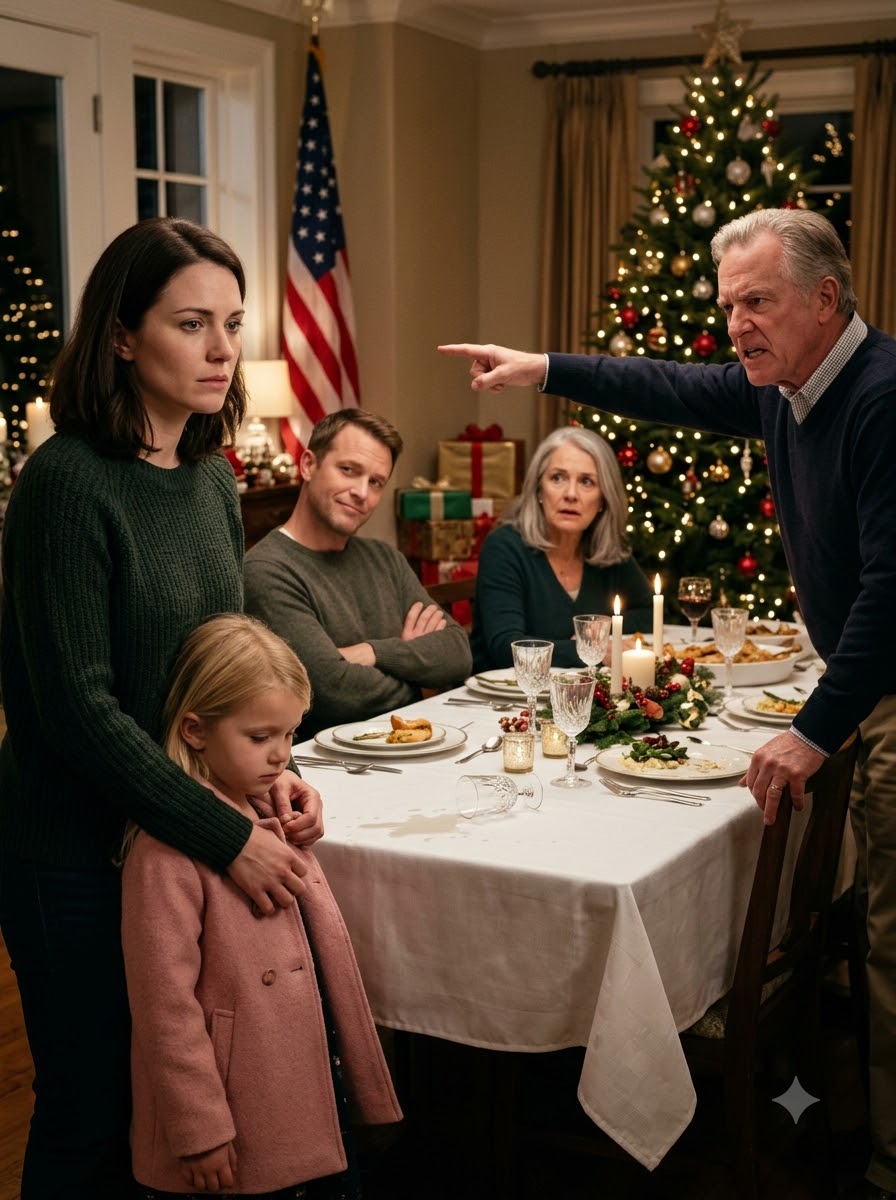
During Christmas dinner, my family berated me, calling me a failure and an embarrassment. My dad pointed at the door and shouted, “Get out!” I simply replied, “Fine,” and left with my daughter. Little did they know, their entire lifestyle was funded by my $71 million tech company. That night, I cancelled all fund transfers and flew back to my home on the coast. Their cards were immediately declined.

My name is Lucia Brennan.
I’m 37 years old.
And the best decision I ever made happened on a Tuesday night in December when my father pointed at his own front door and told me to get out.
I didn’t cry.
I didn’t argue.
I took my 5-year-old daughter’s hand, thanked my mother for dinner, and walked out into the cold like I had somewhere better to be because I did.
What none of them knew.
What I’d spent three years making sure they would never know was that the house behind me, the two SUVs in the driveway, my brother Tyler’s new boat, and my parents’ quarterly trips to Scottsdale had all been quietly funded by the company I I’d built from nothing.
Meridian AI, $71 million at last valuation.
And not one of them had ever thought to ask where their good fortune was coming from.
I thought about telling them that night.
I really did.
But some truths land better when they arrive on their own.
The town I grew up in was called Hartwell, Indiana.
Small enough that everyone knew your business.
Tight enough that reputation passed between neighbors like a casserole dish.
My father, Kenneth Brennan, ran an auto parts store he’d inherited from his own father.
He was precise about things that didn’t matter and completely indifferent to the things that did.
He kept his tools organized by size, his opinions organized by certainty, and his love organized by worthiness.
My brother Tyler was always worthy.
I was always being evaluated.
My mother Joanne was the kind of woman who mistook smoothing things over for keeping the peace.
She’d pour coffee and change the subject and later take your hand and say, “You know how your father is.”
As if knowing how someone is excuses what they do.
Tyler was 3 years older than me and already fluent in the language my father spoke.
Bravado, sports scores, a certainty that the world owed him something.
He got decent grades, great attention, and a truck for his 16th birthday.
When I got straight A’s at 15, my father looked at my report card and said, “That’s fine, but what are you doing with your hands?
You need skills, Lucia.
Real ones.”
I started doing things with my hands then.
Just not the kind he meant.
I taught myself to code from library books, staying after school in the computer lab until the custodian kicked me out.
Numbers made sense in a way people didn’t.
An algorithm didn’t care who your father was.
A function returned exactly what you gave it.
There was a fairness in that I found almost unbearable in its beauty.
My sophomore year, my computer science teacher, Miss Abernathy, pulled me aside after class.
She had bright eyes behind wire- rimmed glasses and a habit of saying things like they were already facts.
“You have a talent that belongs somewhere bigger than Hartwell,” she told me.
“Don’t let anyone convince you otherwise, not even the people who love you.”
She held my gaze an extra second, and I understood she knew exactly which people she meant.
I applied to universities in secret and got into Carnegie Melon on a partial scholarship.
The night I found out, I made the mistake of telling my parents at dinner.
My father put down his fork.
Carnegie Melon, he said.
That’s in Pittsburgh.
Yes.
And you think that’s realistic?
My mother said softly.
Kenneth.
He picked his fork back up.
Tyler’s already talking about taking over the store eventually.
Someone’s going to need to be around here.
Tyler smirked into his glass.
He’d barely finished community college.
I left for Pittsburgh that August with a secondhand laptop, a scholarship that covered tuition and not much else, and a certainty I kept having to rebuild from scratch.
I worked weekends at a campus cafe.
I ate cereal for dinner more nights than I’d admit.
I called home every other Sunday and listened to my father ask about my grades the same way someone asks about the weather, without any real interest in the answer.
Junior year, I built something.
A machine learning model that could predict supply chain disruptions before they happened.
Cross referencing shipping data, weather patterns, and geopolitical signals in real time.
My professor said it was a commercially viable student project he’d seen in a decade.
He introduced me to a woman named Sandra Holland at a venture capital firm in Boston.
She asked me smart questions for 2 hours, then slid a business card across the table.
When you graduate, she said, “Call me.”
I called her before graduation.
Meridian AI launched in a sublet office in Austin, Texas with two employees.
Me and my college roommate Cameron, who had a gift for sales and an even bigger gift for telling me when I was wrong.
The first year was the kind of hard that doesn’t look dramatic from the outside.
It’s just quiet exhaustion and a bank balance that makes your hands shake when you check it.
We ate a lot of takeout.
We slept maybe 5 hours a night.
We celebrated our first enterprise client with a bottle of wine that cost $11.
I called home to tell my parents we’d signed our first contract, a regional distribution company in Ohio worth $180,000.
My father said, “Is that enough to live on?”
My mother said, “We worry about you, sweetheart.
Maybe you could come home for a while and think things through.”
I didn’t call again for 3 months.
It was somewhere in that third year that I met Nate.
He was a journalist covering Austin’s tech scene.
Tall, genuinely funny, the kind of person who made you feel like the most interesting person in the room without even trying.
I fell for him in stages.
The way you do when you’ve spent years not letting yourself fall for anything.
We got married at a small vineyard in the Hill Country.
My parents drove down for the ceremony.
My father shook Nate’s hand warmly and spent the reception talking to him about football.
It was the most attention he’d paid to anything connected to me in years.
I should have understood then that he was marrying Nate, not attending my wedding.
The marriage lasted 4 years.
I worked long hours because Meridian was growing and I believed in what we were building.
Nate said he understood and then slowly stopped understanding.
The last year we lived more like polite roommates than partners.
Careful around each other, avoiding the conversations that mattered.
The morning I found a second phone in his jacket pocket while looking for his car keys.
Something inside me went very quiet and very clear.
I handed it to him when he walked into the kitchen, said nothing, and watched his face tell me everything.
He moved out within the week.
What I didn’t know yet was that I was 8 weeks pregnant.
Ellie was born on a Thursday in April during a thunderstorm that knocked out the power in half of Austin.
The nurses had flashlights.
She arrived screaming into
the dark like she had something important to say.
I held her and understood for the first time what it meant to love something unconditionally.
Not because it had earned it, not because it made you look good, not because of what it might give you someday, just because it existed and it was yours.
I raised her alone and ran a company and somehow improbably both of them thrived.
By the time Ellie turned three, Meridian had clients in 14 states and offices in Austin, Chicago, and Seattle.
We’d been featured in two industry publications and Sandra Hollands had led a second funding round that put our valuation at $42 million.
I hired 60 people, mostly women, many of them mothers, who’d been passed over elsewhere.
I knew what it was to be underestimated.
I wasn’t interested in continuing the tradition.
That was when I got the first call from my mother.
She didn’t come right out and say anything.
She called to talk about the weather, about Tyler’s new girlfriend, about my father’s back.
Then near the end, her voice shifted into a register I recognized from childhood.
Careful, slightly embarrassed.
The tone she used when something needed to be admitted.
“Things have been a little difficult lately,” she said.
“With the store.
Your father’s had some setbacks.”
I asked, “What kind?”
She hesitated.
He had to let go of two of his employees, and we had some unexpected repairs on the house.
Managing, of course.
We always manage.
I sat with that for 2 days.
I thought about the piano recital when I was 11, the one I practiced for every day for 3 months, hoping my father would finally look at me the way he looked at Tyler on the baseball field.
My father had been in the parking lot on his phone when I played my last chord.
I thought about the night I told him I’d gotten into Carnegie Melon, and he asked who was going to be around to help with the store.
I thought about Ellie asleep in the next room, one arm around a stuffed elephant, her whole life ahead of her.
Then I called my accountant and set up a wire transfer.
$8,000 a month routed through a trust I named the Brennan Family Support Account, which told them nothing except that someone had set it up for their benefit.
I attached no note.
I left no trail back to me.
I don’t have a cleanance explanation for why I did it that way.
Some part of me, I think, still wanted to see if they’d ever come looking, if they’d ever wonder enough to ask.
Some part of me was still that 11-year-old girl, hoping someone would turn around and notice.
They never asked.
Within 6 months, my mother was calling with lighter news.
They’d remodeled the kitchen.
Tyler had bought a boat.
My father was feeling better.
Things have really turned around, she said brightly.
I said that was wonderful, and I meant it.
And I also noticed that not once did she wonder why.
For 2 and 1/2 years, I watched from a distance.
I watched them build a comfortable life on money they’d convinced themselves had simply materialized.
I told myself it was enough.
I told myself I didn’t need credit.
Then came the invitation.
My mother called on a Monday in late November, her voice warm in a way it only got when she wanted something.
We’d love for you to bring Ellie home for Christmas.
The whole fan family will be here.
It’s been so long.
She said it like the distance between us was purely geographic.
My best friend Cameron, who had known me since we were 20 and had watched me rebuild myself from a divorce and a startup, and a father who never quite saw me, said exactly what I expected her to say when I told her I was considering it.
Why, she said flatly.
Why would you do that to yourself?
She’s my mother.
Lucia, I know.
Promise me something, she said.
If it goes sideways and I’m saying when you leave, no long explanation, no trying to fix it.
You just take Ellie and you go.
I promised.
I booked flights to Indianapolis and told myself it would be fine.
The drive from the airport to Hartwell took 40 minutes.
Ellie chattered about the snow and pointed at every cow she could see from the highway.
She was wearing a red velvet dress she’d picked herself and had her hair in two braids she’d insisted on doing partially by herself, which meant one was neat and one was slightly crooked, and both were perfect.
My parents’ house had changed.
A new addition on the left side, fresh paint, a heated driveway.
they definitely hadn’t had before.
Two vehicles in the garage I didn’t recognize.
A Cadillac SUV and a pickup truck with dealer plates.
I sat in the rental car for a moment and breathed.
Inside the entryway
had been redone in marble tile.
A professionally decorated Christmas tree filled the living room corner.
My father sat in a leather recliner watching football and looked up when we walked in with the expression of a man who has been mildly inconvenienced.
So he said, “You made it.”
My mother came in from the kitchen and hugged me briefly, then bent to Ellie’s level.
“My goodness, you’re just darling,” she said.
Ellie smiled, the polite smile she’d somehow already learned.
Tyler arrived an hour later with his girlfriend, Brooke, and a case of craft beer he’d apparently driven 40 m to find.
He shook my hand instead of hugging me and spent the first 20 minutes of dinner talking about the boat.
The food was good.
The conversation was navigated carefully.
the way you navigate a room, you know, has a loose floorboard somewhere.
My father made two comments about my little company with the particular smile people use when they want to seem supportive while making clear they aren’t impressed.
Tyler mentioned twice that he’d been thinking about getting into tech, which I’d heard him say for 15 years about different industries.
It was Ellie who broke the surface tension, not through fault of her own, but simply by existing.
She knocked over her water glass, reaching for a roll.
It spread quickly across the linen tablecloth toward my father’s end of the table.
The room went still.
My father stood up so fast his chair scraped back on the hardwood.
“For God’s sake,” he said.
His face had gone red.
“That tablecloth is from Portugal.
What is wrong with you people?”
“She’s five,” I said.
My voice came out steady, which surprised me.
“I don’t care how old she is.
This is not how children behave at a table.”
Ellie’s eyes had filled.
She was looking at her lap.
“Dad,” I stood.
That’s enough.
His eyes moved to me and I recognized the look.
The one that had ended every argument my entire childhood.
The one that said the room belonged to him and everyone in it served at his pleasure.
You want to correct me in my own house?
I want you to not speak to my daughter like that.
Then maybe he said, pointing toward the door with the certainty of a man who has never once been wrong.
You shouldn’t have brought her here.
Tyler leaned back in his chair.
Nobody forced you to come, Luchia.
My mother said, “Let’s all just No, I said we’re done.”
I helped Ellie into her coat.
She didn’t cry until we were outside and then only a little quietly into my shoulder while I buckled her into the car seat.
“Did I do something bad?” she whispered.
“You spilled water,” I said.
“That’s not bad.
That’s just Tuesday.”
She almost smiled at that.
I started the car.
The house glowed behind us.
That perfect exterior, those tasteful lights along the roof line.
I thought about all the money that had flowed into that house over the past 2 and 1/2 years.
Invisible and unclaimed, $8,000 a month, 2 years and 8 months.
I did the math in my head the way I always do when I’m trying not to feel something.
My phone lit up on the seat beside me.
A message from just Q4 projections finalized.
Meridian just crossed $71 valuation.
Board is thrilled.
Congratulations.
I stared at it for a moment.
$71 million built from a secondhand laptop and 5 hours of sleep and 15 years of being told my choices weren’t realistic.
Ellie had fallen asleep by the time we reached the hotel.
I carried her in and laid her on the bed and sat down at the small desk and opened my laptop.
The transfer portal took 4 minutes to load on the hotel Wi-Fi.
I found the Brennan family support account.
I clicked on the first recurring transfer.
Cancel scheduled payment.
I clicked yes.
Then the next cancel scheduled payment.
Yes, I went through all of them.
The monthly wire, the quarterly supplemental, the annual property tax contribution I’d added 18 months ago without a word.
Each cancellation chimed softly.
Each one felt like setting something heavy down on the floor.
When the screen showed a zero balance and no scheduled transfers, I closed the laptop and sat in the quiet for a long time.
We flew home the next morning.
Ellie slept against my arm and I watched the clouds below us and thought about how strange it is to grieve, something that was never quite right to begin with.
My mother called 3 days later.
Her voice was controlled in the way voices get when someone is very frightened and trying not to show it.
The account, she said the transfer didn’t come through.
Kenneth thinks there’s been some kind of banking error.
There’s no error, I said.
Silence.
Lucia, what does that mean?
It means I stopped the transfers, Mom.
You The word came out small.
It was you this whole time.
Yes, but you never.
Why wouldn’t you tell us?
Because I wanted to see if you’d ever ask.
I said it more quietly than I’d intended.
2 and 1/2 years, new cars, a remodel, Tyler’s boat, Dad Scottsdale trips.
Nobody once thought to ask where it was coming from.
She said nothing for a long time then.
You can’t just stop.
We have obligations.
You have obligations.
you built on money you never even questioned.
I closed my eyes.
I’m not punishing you, Mom.
I’m just done, Lucia.
I’ll be in touch when I’m ready.
Take care of yourself.
I hung up and sat with my hands in my lap until Ellie came and climbed up beside me and asked if we could make pancakes.
We made pancakes.
The weeks that followed were quieter than I expected.
Tyler left a voicemail that was half wounded and half furious.
something about betrayal and family loyalty that might have landed harder if he’d ever demonstrated either.
I didn’t call back.
My father didn’t call at all.
He was never going to call first.
That wasn’t something he was built for.
But I heard through my mother’s occasional texts that he’d had to make some adjustments.
I channeled the energy I’d spent on quiet generosity into something noisier.
I launched the Meridian Rising Fund, a grant program for women led startups in underrepresented communities.
Applications came in faster than I expected.
I read everyone.
I approved 23 in the first round, and every time I did, I thought about Ms. Abernathy pressing a hand to my shoulder and telling me I had a talent that belonged somewhere bigger.
I met a man named Finn at a conference in Seattle in the spring.
An engineer with patient eyes who asked better questions than he gave answers, which is the rarest thing I know.
He met Ellie on a Sunday in June, and she decided within 20 minutes that he was acceptable.
He let me win at Uno, she told me, but not on purpose.
I actually won.
Months later, I received a letter forwarded through my attorney’s office.
My father’s handwriting, careful, deliberate, smaller than I remembered.
He’d had a health scare, a stint in the cardiac ward, and he’d apparently spent some of his recovery time thinking.
The letter wasn’t long.
He said he’d been wrong about a lot of things.
He said he was proud of me, though he understood he didn’t have the right to say so.
He said he hoped Ellie was happy.
I read it three times.
I wrote back two sentences.
I hope you’re healing.
I wish you well.
It was the truest thing I knew how to say.
That Christmas, we stayed home.
I strung lights on the balcony of our house in Portland, where the winter sky is the color of pewtor and the air smells like rain and Douglas fur and everything.
I chose.
Ellie decorated sugar cookies in colors that made no sense and presented each one to Finn with a formal description of its artistic merits.
Cameron came with her husband and their new baby.
Kzia brought Amal’s her grandmother had made.
We ate too much and talked too loud and nobody once asked anyone to be smaller than they were.
Late that night, after Ellie had fallen asleep clutching a cookie she’d refused to let us eat, I stood on the balcony with Finn and a mug of coffee and watched the city lights.
“You doing okay?” he asked.
“Yeah,” I said.
“I really am.”
He didn’t press it because he’d learned by then that when I say that, I mean it.
I thought about a girl in a computer lab in Hartwell, Indiana, writing code in the quiet because quiet was the only place she’d ever felt safe.
I thought about everything she’d built out of that silence.
Not despite the years of being overlooked, but partly honestly because of them.
The dismissal
had been a kind of fuel.
The invisibility had given her room to move without anyone tracking her.
She’d been seen now.
The company, the fund, the life she’d built on the coast, all of it visible, all of it hers.
What she’d learned slowly and at real cost was that being seen by the wrong people had never been the point.
The point was to see herself clearly, and she did.
If you’ve ever kept yourself small to survive a room that was never going to appreciate your full size anyway, I hope you know this.
Walking away isn’t failure.
Sometimes it’s the first thing you’ve done in years that’s completely and honestly yours.
Family is not just the people who share your last name.
It’s the people who show up in the quiet moments, who never once ask you to earn what they give freely, who clap for you even when it costs them nothing, especially then.
What does that mean to you?
I’d love to hear your thoughts in the comments.








