Five birthdays came and went. Not a single call. Not a single gift. Nothing at all. Then, my sister posted a photo of a car with a big bow on it, captioned: “The best parents in the world!” I looked at the photo, smiled, and cut off all contact with my family. Three days later, my mother showed up, sobbing: “We made a mistake.” I looked at her and replied: “No—you made a choice.”
My name is Serena Voss, and I turned 29 three days ago.
Five birthdays.
No calls.
No gifts.
Nothing.
Then my sister posted a photograph of a brand-new car wrapped with a bow.
The caption read:
Best parents ever.
I stared at it.
Smiled.
And cut off every family connection.
Three days later, Mom showed up at my apartment sobbing.
“We made a mistake.”
I looked at her and said:
“No. You made a choice.”
What she didn’t know was that I had spent those three days doing more than blocking numbers.
I canceled the monthly transfers I had sent home for almost four years.
I removed myself from shared accounts.
Subscriptions.
Emergency contacts.
And every responsibility they had quietly handed me because I was “the dependable one.”
Then I opened a folder on my laptop labeled:
Five Years.
Inside were screenshots.
Bank records.
Unanswered messages.
And one photograph from every birthday they had forgotten.
Twenty-five.
I bought my own cake.
Twenty-six.
I waited until midnight before admitting nobody remembered.
Twenty-seven.
They contacted me the next morning only because they needed help with a bill.
Twenty-eight.
My sister got a surprise vacation two weeks before my birthday.
Twenty-nine.
The car.
That photograph didn’t make me cry.
It made me calm.
When a family forgets you once, maybe it’s an accident.
Five years in a row, while celebrating someone else loudly enough for everyone online to see?
That’s a pattern.
So I stopped arguing.
Stopped reminding.
Most importantly, I stopped being useful.
Within 72 hours, they discovered how expensive my silence could become.
Before I tell you what happened when my mother came to my door and why that perfect new car became the beginning of a family reckoning, tell me where you’re listening from and what the weather is like there today.
Does it match your mood?
I love seeing how far these stories travel.
Wherever you are, I hope your day is peaceful, beautiful, and filled with people who never make you question whether you matter.
People say favoritism is impossible to measure because love isn’t an equation.
Maybe.
But neglect leaves records.
The night I blocked my family, I didn’t sit crying over childhood photographs.
I opened my banking app.
That was when the past stopped looking like hurt feelings and started looking like a ledger.
My mother was Diane.
My father was Graham.
My younger sister was Mallerie.
For years, they described me with the same three words.
Responsible.
Practical.
Independent.
I once thought those were compliments.
Eventually, I realized they were job descriptions.
Responsible meant Serena will handle it.
Practical meant Serena won’t complain.
Independent meant Serena doesn’t need anything.
My competence became their excuse to ignore me.
When I turned 25, they forgot completely.
At 11:42 that night, I bought a miniature chocolate cake from a grocery store, lit one candle, took a photograph, and never posted it.
Four days later, Dad texted asking whether I could cover part of their insurance bill until payday.
I sent the money.
He replied with a thumbs-up.
No birthday mention.
At 26, I deliberately reminded nobody.
I wanted to know whether anyone would remember without prompting.
Nobody did.
That weekend, Mom sent 12 photographs from a brunch she organized because Mallerie had completed a certificate program.
Her caption read:
Family should always celebrate each other’s milestones.
I stared at that sentence.
Said nothing.
At 27, my phone finally rang the morning after my birthday.
For half a second, I thought Dad had remembered late.
Instead, he said:
“Are you near a computer?”
“Your mother locked herself out of the utilities portal.”
I fixed it during lunch.
Before hanging up, he said:
“Knew we could count on you.”
At 28, nobody called at all.
Two weeks earlier, they had surprised Mallerie with a resort weekend because she had “such a stressful year.”
I had spent that same year working full-time while building a design portfolio at night.
I didn’t mention it.
I already knew the response.
Serena can handle it.
What they never posted online was how much they depended on me financially.
I wasn’t wealthy.
But I had stable work.
Lived carefully.
Rarely bought myself anything expensive.
When Dad’s income dropped, I started sending $600 a month to help with household bills.
It was supposed to last three months.
It lasted almost four years.
I covered car repairs.
Internet bills.
An insurance premium.
And once, Mallerie’s apartment deposit after Mom said:
“Your sister isn’t as organized with money as you are.”
I sent $800.
Mallerie texted:
You’re the best.
Three weeks later, she posted photographs from a beach weekend.
I still said nothing.
That was why the car photograph changed everything.
It wasn’t just a vehicle.
It was a bow-wrapped receipt for every excuse I had accepted.
Mom had told me two weeks earlier that money was tight.
Dad had thanked me for continuing the monthly transfer.
Then Mallerie stood beside a gleaming new car with both of them smiling behind her.
Best parents ever.
I zoomed in.
Mom was holding a little sign that read:
You deserve it.
Those words hurt more than the price tag.
Apparently, deserving was a language my parents understood.
They simply never spoke it to me.
So I canceled the transfer.
Then the family streaming account.
The phone arrangement.
Cloud storage.
And two household services using my card as backup.
I emailed Dad the utility passwords and wrote:
You’ll need to manage these yourself going forward.
No accusation.
No speech.
Then I blocked all three numbers.
The next morning, I went to the fashion-design workshop I had been taking secretly for six months.
My instructor, Iris Moreno, was examining a structured jacket I had made when she stopped and said:
“Serena, why are you treating this like a hobby?”
I almost laughed.
My mother had once asked me the opposite.
You’re still doing the sewing thing?
Iris introduced me to Ethan Cole, a freelance stylist who helped emerging designers prepare portfolios and showcases.
He pulled three pieces from my rack and told me a local independent design event was accepting submissions for eight more weeks.
“Apply.”
My instinct was to explain why I wasn’t ready.
Then I remembered Mom’s sign.
You deserve it.
Maybe revenge doesn’t always begin by destroying something.
Sometimes it begins when you stop destroying yourself for people who would never do the same for you.
I applied that night.
Two days later, my collection was shortlisted.
Twelve hours after that, Mom began calling from numbers I hadn’t blocked.
The first voicemail came from an unfamiliar number at 7:16 Monday morning.
“Serena, please call me.”
“Something is wrong with the bank transfer.”
No happy belated birthday.
No mention of the car.
The first thing my mother noticed after I disappeared was missing money.
At 9:03, Dad emailed.
Your mother says she can’t reach you. We need to straighten out a few household things.
At noon, Mallerie messaged through social media.
Did you block me? What is going on?
I answered none of them.
That evening, I made myself one rule.
I would not explain a boundary to people who had not yet noticed what caused it.
I had explained enough in softer ways.
Every forgotten invitation.
Every “it would mean a lot if you came.”
Every conversation where I mentioned my work and Mom redirected toward Mallerie.
They had received the information.
They had simply never received consequences.
I turned off my phone and worked on my collection.
Iris helped me sharpen the concept.
I called it Negative Space.
Seven garments built around the idea that absence could shape something as powerfully as presence.
I refused to turn my family into literal costumes.
But every line carried something I had learned about restraint, emptiness, and the difference between being hidden and choosing not to be available.
Ethan helped prepare the submission photographs.
Two days later, Negative Space was officially accepted.
The achievement existed before anyone in my family knew about it.
That felt important.
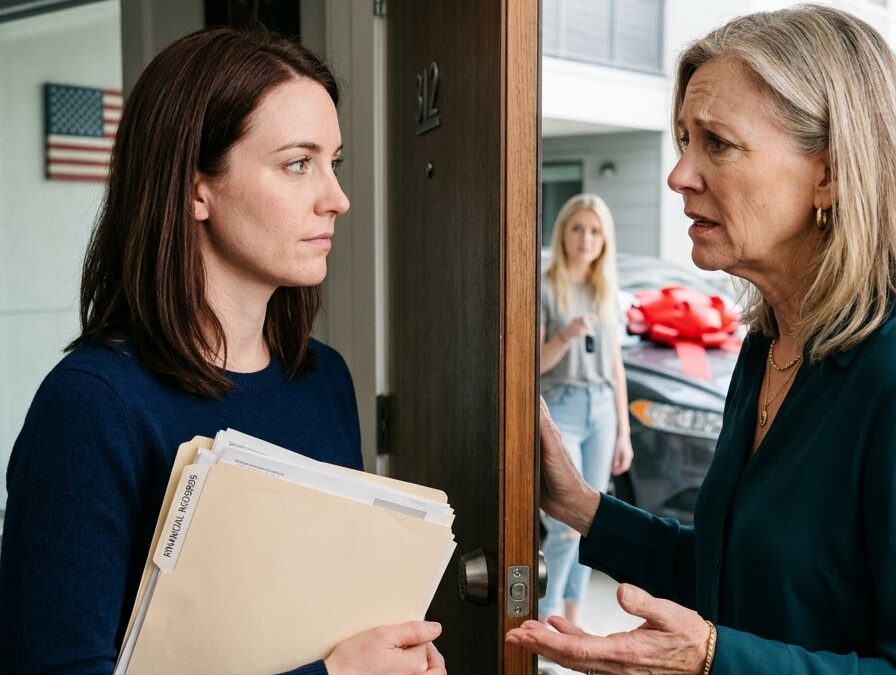
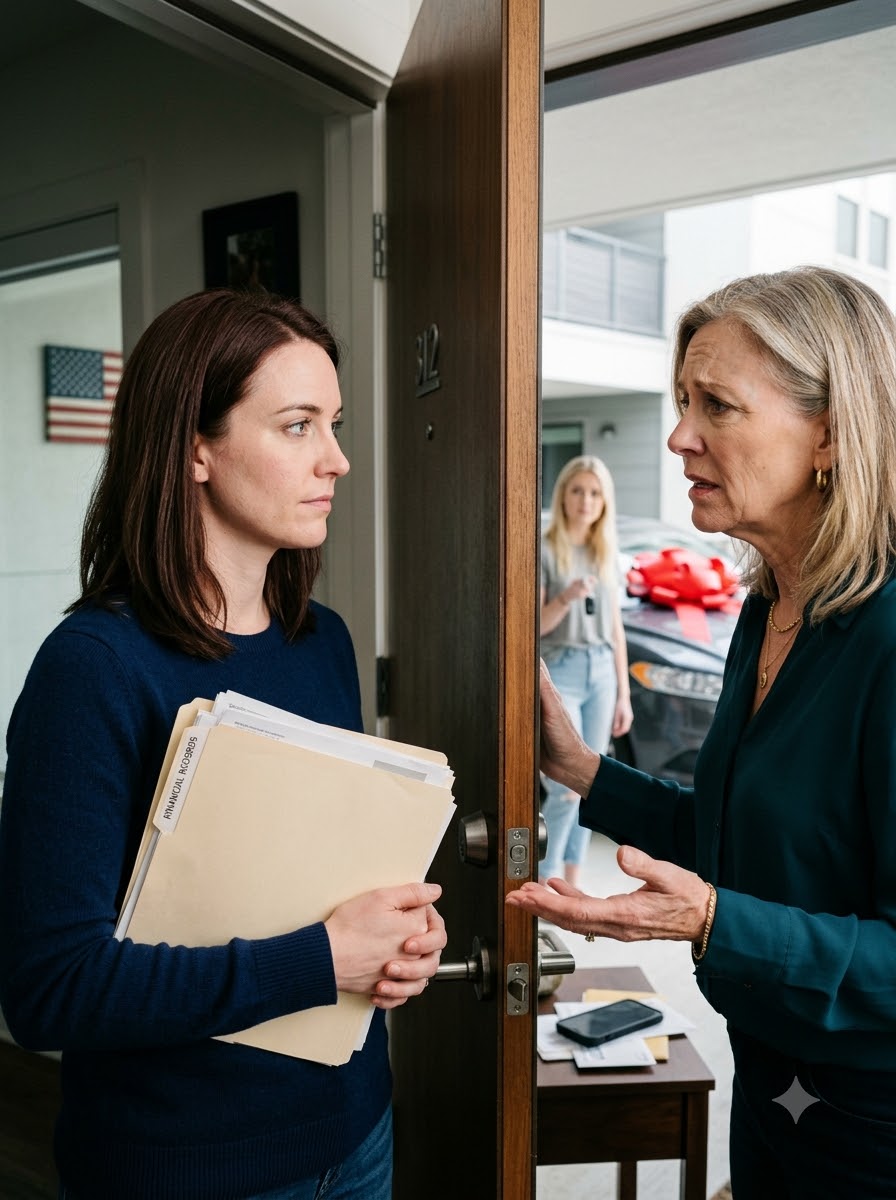
On the third evening after the car post, someone knocked hard on my apartment door.
Mom stood outside clutching her purse.
Her eyes were red.
Dad wasn’t with her.
Mallerie wasn’t with her.
For once, there was no audience.
I opened the door.
But I didn’t invite her inside.
“Serena,” she whispered. “We made a mistake.”
“No.”
“You made a choice.”
Her face tightened.
“Can I come in?”
“No.”
That one word shocked her.
My mother was used to me making room.
“Why did you stop the transfers?” she asked.
There it was.
“Is that why you’re here?”
“Of course not. We’re worried.”
“You blocked everyone.”
“Your father is furious.”
“Mallerie is confused.”
“And yes, the transfer disappearing created problems.”
“You had enough money for a new car.”
“That was different.”
“How?”
“Your father and I had been saving.”
“Mallerie needed reliable transportation.”
“She had a four-year-old Honda.”
Mom’s expression shifted.
“It was having issues.”
“The air conditioning needed repair.”
I stared at her.
Mallerie had complained about that car two weeks earlier while asking me which dealership offered better financing.
I had helped her research the vehicle that eventually woke me up.
Mom sighed.
“Serena, this is getting petty.”
Five birthdays had become petty because acknowledging the pattern would require admitting it was a choice.
I retrieved the folder I had printed.
Twenty-five.
I showed her my grocery-store cake.
“You forgot.”
Then the family chat from 26.
Dad’s utility message from 27.
Mom’s resort post before my 28th.
Finally, the car.
Twenty-nine.
Mom looked away.
“We didn’t realize it had been five.”
“That doesn’t make it better.”
“You could have reminded us.”
I laughed softly.
“Would Mallerie ever have to remind you that her birthday existed?”
Mom said nothing.
That silence was the most honest answer she had given me.
“I’m not asking you to return the car.”
“I’m not asking for birthday gifts.”
“I’m telling you the arrangement is over.”
“I will no longer finance a household that treats me like an emergency service with a first name.”
“We never thought of you that way.”
“Then why was the first thing you asked about the transfer?”
She couldn’t answer.
I handed her a list of services I had managed, with passwords and end dates.
“Everything you need is here.”
Her hands shook as she took it.
“Your father will take this badly.”
“He’s allowed.”
“And what about us?”
That question almost broke the old version of me.
The one who would have invited her inside.
Made tea.
Accepted half an apology.
Repaired everyone’s discomfort.
Instead, I said:
“For now, there is no us.”
After she left, my knees went weak.
Boundaries sound powerful afterward.
In the moment, they can feel like tearing away a piece of your history.
But pain doesn’t mean the decision is wrong.
Twenty minutes later, the showcase organizers emailed me.
Another designer had withdrawn.
Negative Space had been moved into a stronger presentation slot.
Then Mallerie sent a message request.
Mom told me what you did. We need to talk.
Need.
There it was again.
My family discovered urgency only when something stopped working for them.
I typed five words.
Thursday. Four. Bell Street Café.
Mallerie wanted a conversation.
She was going to get one.
But not with the sister who had spent 29 years begging to be chosen.
Mallerie arrived 13 minutes late, wearing sunglasses on her head and carrying the new car’s key fob.
She dropped into the chair across from me.
“This is insane.”
“No hello?”
“Good to see you too.”
“Mom hasn’t slept.”
“Dad is furious.”
“They had to move money around because you canceled everything.”
“I gave them the passwords.”
“That isn’t the point.”
“Then what is?”
She exhaled.
“You disappeared because of my car.”
“No.”
“Your car showed me something I had spent years refusing to admit.”
“They make room for you automatically.”
“I have to earn basic acknowledgment.”
Mallerie rolled her eyes.
“Serena, they love you.”
“That sentence has done a lot of unpaid labor in this family.”
“What does that even mean?”
“Every time their actions say one thing, somebody tells me their feelings secretly mean another.”
“I’m done grading invisible intentions.”
She leaned back.
“So you’re punishing everybody because they forgot your birthday?”
“Five birthdays.”
“Fine.”
“Five.”
“Cutting them off financially is still extreme.”
“Do you know I’ve sent them $600 almost every month for four years?”
Her face answered before she did.
“No.”
“Do you know I paid your apartment deposit?”
“Mom said they helped me.”
“They used my transfer.”
Mallerie stared at the table.
“Do you know who covered their insurance when Dad was short?”
“Who fixed their accounts?”
“Who helped you compare car financing because you said you needed advice?”
She looked at the key fob.
“You knew I was shopping.”
“I thought you were buying used.”
“Dad said I deserved something nice after everything.”
Again.
Deserved.
“Everything what?”
“Work.”
“Stress.”
“Life.”
“And what did they say I deserved after five birthdays?”
“Stop turning everything into a competition.”
The sentence was so backwards I almost admired it.
“I spent most of my life refusing to compete with you.”
“That’s why the arrangement survived.”
“I didn’t ask them to ignore you.”
“No.”
“You accepted every benefit of it.”
“What was I supposed to do?”
“Refuse birthday parties because yours were bad?”
“No.”
“You could have noticed.”
She looked offended.
“I noticed you.”
“Name the date of my birthday.”
She froze.
“Come on, Mallerie.”
“You came here to tell me I’m overreacting.”
“Name it.”
Nothing.
I nodded.
“Exactly.”
She looked down.
“Okay.”
“I deserve that.”
For a moment, I thought we had reached something real.
Then she said:
“I also wanted to ask you something.”
Of course.
“Mom said you got into a fashion showcase.”
“I saw your designs online.”
“My company is building a lifestyle campaign.”
“I mentioned my sister designs clothes, and my manager loves the family angle.”
“If we feature some pieces, it could help both of us.”
I stared at her.
Suddenly, the meeting made sense.
Mallerie hadn’t discovered my pain.
She had discovered my usefulness in a new category.
“That’s why you came.”
“Not the only reason.”
“But a reason.”
“I’m trying to support you.”
“By turning my work into your company’s family campaign?”
“You’re making it sound awful.”
“You did that yourself.”
Her voice softened.
“I thought you’d be happy I was proud of you.”
“You didn’t know my birthday five minutes ago.”
She looked away.
“I’m not participating,” I said.
“And don’t use my name or designs in your pitch.”
“I already told them you might be interested.”
“Correct it.”
“Serena, my manager is expecting—”
I raised one hand.
“There it is.”
“The actual emergency.”
Her face hardened.
“You think you’re better than us because a few people like your clothes?”
“No.”
“I think I’m finally unavailable for jobs I never applied for.”
I stood.
“So that’s it?” she snapped.
“You’re punishing me forever?”
I paused.
“You still think losing access to me is punishment.”
“That tells me you still don’t understand what access to me cost.”
That night, Ethan called.
A regional style publication wanted to profile three emerging designers before the showcase.
He had recommended me.
The interview would include a question about inspiration.
Family had always been the subject I protected.
Even when they disappointed me, I polished their image for strangers.
Everyone is busy.
We aren’t really birthday people.
I had spent years being abandoned privately and loyal publicly.
I agreed to the interview.
“Anything off limits?” Ethan asked.
I looked at the Five Years folder.
“No lies.”
“That’s my only rule.”
When the interviewer asked why my collection was called Negative Space, I said:
“I spent a long time believing absence meant I had no value.”
“Then I realized absence can reveal structure.”
“Sometimes you understand what you were carrying only after you put it down.”
She asked whether I meant family.
“Partly.”
I named no one.
The article went online Monday.
By lunchtime, Mallerie messaged me.
You’re really going to make us look like monsters, aren’t you?
I stared at the screen.
I hadn’t identified them at all.
Mallerie had recognized herself anyway.
Mom appeared at my studio the following Saturday carrying her phone.
“Did you know people are asking Mallerie questions about that article?” she demanded.
I kept pinning a hem.
“Hello, Mom.”
“One of her coworkers saw it.”
“Someone asked if we were the family you meant.”
“I didn’t identify anyone.”
“You didn’t have to.”
I finally looked at her.
“If a vague statement about being overlooked makes everyone immediately think of you, maybe I’m not the biggest problem in this story.”
Her mouth tightened.
“Private family issues shouldn’t become public entertainment.”
“My birthday became public when all three of you posed beside a new car and posted it online.”
“That wasn’t about you.”
“Exactly.”
Silence.
Iris was working in the adjoining room.
For half a second, I felt embarrassed.
Then I wondered why I should be embarrassed by the truth rather than by what








