For eight consecutive summers, my parents sent me to a cattle ranch so my older sister could study music abroad. By the time I graduated, I had left the state. Except for one unbelievable twist: I ended up owning the very ranch where they had sent me.
The summer I turned nine, my parents dropped me at a cattle ranch in West Texas with one duffel bag, a handshake goodbye, and a speech about building character.
My sister’s bags were already packed for Florence.
My name is FA Merritt.
I’m 31 years old and for eight consecutive summers, my parents sent me to a cattle operation outside of Marfa, Texas.
While my younger sister Cleo boarded planes to music conservatories, arts programs, and cultural immersions across Europe, every June, the same thing happened.
Cleo’s departure was treated like an event.
My parents ironed her clothes, double-checked her itinerary, and stood at the front door with their phones out to take pictures.
My departure was treated like a drop off.
My father, Steven, would load my bag into the trunk without ceremony, and my mother, Norma, would hand me a brown paper bag with snacks for the drive and remind me to mind my manners with the people at the ranch.
There were no photos.
I had a burn scar on my left forearm.
I got it when I was 6 years old from a splatter of grease off the stove while I was trying to help my mother cook dinner.
She had let me stand on a step stool beside her.
and I had reached across to stir something I had no business stirring.
And the oil caught the side of my arm before either of us could move.
The scar healed without infection, but it left a discoloration that ran from just below my elbow to my wrist.
Slightly raised, slightly pink, depending on the light.
It was not disfiguring.
It was not something most people noticed right away, but my mother noticed it every time she looked at me.
And I understood early on that it had changed something in how she saw me, even if she never said so directly.
She would steer me into long sleeves before family dinners.
She bought me cardigans for school pictures.
Once when a neighbor asked about it at a church potluck, my mother answered before I could, saying it was an old injury and changing the subject quickly.
She was not cruel about it.
She was careful, which somehow felt worse.
careful implied there was something that needed managing.
My father handled it differently.
He never mentioned the scar.
What he did instead was quietly reassign my future.
Steven Merritt ran a chain of diners across central Ohio, and he was good at identifying which employees were management material and which ones were best kept in the back making things run.
Somewhere along the way, he had placed me in the second category.
He never said I couldn’t amount to something.
He said things like, “You’re practical and you don’t need all that noise and stability is underrated.”
He said these things to me.
He did not say them to Cleo.
Cleo was 2 years younger than me, and from the time she could hold a pencil, she was treated as though her future was something worth tending.
She showed an early interest in piano, and my parents hired an instructor, bought an upright Yamaha, and cleared the living room corner for it.
When she was eight, she played in a local recital and my parents sat in the front row.
When I was eight, I was helping my father prep the supply orders for his diners on Saturday mornings because, as he put it, I had a good head for numbers.
He was right.
I did.
He just never asked what I wanted to do with it.
The summer I was nine, Cleo had been accepted to a youth music immersion program in Florence.
6 weeks, supervised, fully structured.
My parents talked about it for months before it happened.
They talked about it the way people talk about something they had been working toward for a long time.
When the acceptance letter arrived, my mother cried at the kitchen table.
My father poured himself a glass of iced tea and said, “This is what we work for.”
I sat across from them and understood without anyone explaining it that my sister’s future was the one they had invested in.
A few days later, my father told me I would be spending the summer at a ranch in Marfa.
The property belonged to a family connection from his side, a woman named Virginia Aldis, who had been running cattle on about 400 acres since before I was born.
He said I would help out around the property, learn responsibility, and stay out of trouble.
I asked why I wasn’t going somewhere like Cleo.
He said it wasn’t the same situation.
I asked what was different about it.
He didn’t answer directly.
He told me to start packing.
I cried in my room that night, not because I was afraid of the ranch, but because I was nine, and I already understood that my parents had divided us into categories, and I was in the one that didn’t require as much investment.
Virginia Aldis was 62 that first summer with a sunburned face, short silver hair, and the kind of patience that came from decades of dealing with animals that couldn’t talk back and weather that didn’t cooperate.
She met me at the end of the driveway when my father dropped me off, shook my hand like I was an adult and told me she didn’t expect me to be useful right away, but she did expect me to pay attention.
Then she walked me to the bunk house, and showed me where I’d be sleeping.
She never mentioned my scar, not once in 8 years.
That first summer, I learned the basic rhythms of the operation.
I helped feed cattle in the mornings, cleaned water troughs, mended fencing alongside the ranch hands, and learned which animals in each group needed watching.
Virginia ran a working cattle ranch that sold beef to regional buyers, and every part of the property had a function.
Nothing was decorative.
Nothing was wasted.
When she showed me something, she showed me why it mattered, not just how to do it.
By the second summer, I was asking questions she hadn’t asked me yet.
I wanted to know why certain calves grew faster than others, why the herd was moved between pastures on a specific schedule, and what happened to the revenue from each sale after expenses were taken out.
Virginia looked at me sideways the first time I asked about money and said, “You’re 11 and you’re asking me about operating margins?”
I said I’d heard my dad use the phrase and wanted to know what it meant.
She handed me a folded print out of the previous months was records and said, “Figure it out.”
I figured it out and then I kept going.
Every summer after that, I arrived in Marfa already thinking about what I had noticed the year before and what I wanted to learn next.
I started keeping records of my own alongside Virginia’s official logs.
I tracked which pastures produced the most consistent grazing when equipment breakdowns tended to cluster by season and how delivery timing affected what the ranch got paid per head.
Virginia let me sit with her during buyer negotiations when I was 13.
She didn’t explain the conversations afterward.
She let me ask one question and work out the rest myself.
At home between summers, I was still clearing tables and prepping supply orders for my father’s diners.
Cleo was doing master classes, auditioning for youth orchestras, and spending weekends at regional competitions.
My parents scheduled their lives around her calendar, the way you schedule your life around something you’re proud of.
My calendar was flexible by default.
I don’t want to make it sound like my parents were monsters, because they weren’t.
They were people who had looked at two daughters and made quiet decisions about which one they expected to shine and which one they expected to be steady.
The scar was part of it.
The fact that I didn’t protest loudly was probably part of it, too.
I was the child who adapted, who managed, who figured things out without making a scene.
That quality is genuinely useful.
It just gets misread as not wanting very much.
The summer I turned 15, Virginia sat me down after supper and asked what I plan to do after high school.
I told her I was thinking about business school, specifically agricultural business or operations management.
She looked at me for a long moment, then she said, “Good.
Now tell me what’s wrong with our feed contracts.
I had already been thinking about it.
I told her.
We talked until 10:00.
That was the first conversation I remember having with an adult who treated my ambition like information rather than an inconvenience.
When I was 16, Virginia showed me the full financial picture of the ranch for the first time.
Not just the income side, which I had been tracking in pieces for years, but the whole structure, operating costs, land taxes, equipment loans, buyer agreements, and the gap between what the ranch earned and what it needed to stay viable.
Virginia was not in immediate trouble.
But the picture had been tightening for several years in a row, and she knew it.
Feed prices were up.
One of her longtime buyers had switched to a cheaper regional supplier, and the equipment that ran the properties was getting old
in ways that would eventually require a decision.
She didn’t show me this because she wanted my help.
She showed me because she said I was going to be doing something like this one day, and I needed to see what the real version of it looked like.
I went home that fall and did something I had never done before.
I told my father I wanted to talk about the ranch, not the chores, the business.
He was sitting at the kitchen island going through invoices for his diners, and he looked up with that patient expression he used when he thought I was about to say something he’d have to redirect.
I laid out what I had been tracking in Marfa.
Feed cost trends, production ratios, the gap between contracted buyer prices and open market rates.
He listened for about 4 minutes, then said, “That’s impressive, FA.
Virginia’s lucky to have you.”
And then he went back to his invoices.
I sat there for another moment waiting for him to ask what I wanted to do with any of it.
The question didn’t come.
I was 17 when Virginia told me she had received an offer on the property.
A development group from Dallas had approached her, not to run cattle, but to convert the land to a different use.
The number they offered was significant enough that she had to think about it seriously.
Her health had been inconsistent that year.
Two trips to a specialist in El Paso and the physical demands of the operation were harder to manage.
She told me she wasn’t sure what she was going to do.
I asked to see the offer.
She slid it across the table and told me to be honest about what I saw.
I read it twice.
The number was real, but what struck me was that it assumed the land’s only value was in conversion.
Nobody in that offer had looked at what the property could produce under a different operating structure.
The existing model had inefficiencies I had been cataloging for 3 years.
I told Virginia that.
She said, “What would you change?”
I told her that, too.
She looked at the offer again.
Then she put it in the drawer and said, “Tell me what you’d need to fix the feed contract problem first.”
I spent my entire senior year of high school working on a plan that I never told my parents about.
I took a dual enrollment course in agricultural finance at the local community college and used the coursework to structure my projections for the Marfa operation.
I researched lending programs for young agricultural buyers, including Uda loan options for beginning farmers and ranchers.
I learned what lenders needed to see, stable production history, viable operating plan, proof of management experience, and enough working capital to survive a difficult first year.
When I graduated from high school, my parents gave me a card and took me to dinner.
They asked whether I had decided on a school.
I told them I had some plans in motion.
My father asked about the diners, whether I’d considered learning the restaurant side of the business.
I said I was going in a different direction.
He said that was fine, that I’d figure something out.
Cleo had just received an acceptance letter from a conservatory in Boston, and the conversation moved to her before the appetizers arrived.
I moved to Marfa 3 weeks after graduation.
I framed it to my parents as taking a gap year to work at the ranch while I figured out next steps.
That was technically true.
The next step I was figuring out was purchasing the property.
Virginia and I had been talking about it in practical terms since the spring.
She was 69 by then, tired in the specific way that people get tired when they’ve been carrying something heavy forms a long time.
and she trusted me in a way she didn’t trust the development group from Dallas or the other parties who had contacted her.
We engaged an attorney, a woman in Alpine, who had handled agricultural transactions for 30 years and spent 4 months working through the structure of the deal.
Virginia agreed to carry a portion of the financings herself at a rate that made the transaction feasible.
A USA beginning farmer loan covered another significant portion.
I contributed every dollar I had saved since I was 15, every paycheck from ranch work, every bit of money I had managed to set aside while living on almost nothing.
The closing happened on a Thursday morning in October.
The attorney set the documents in front of me and told me to read everything carefully.
I had already read everything three times.
I signed anyway slowly, making sure I understood each page as it passed.
When the paperwork was done, Virginia drove us back to the ranch in her truck without saying much.
When we pulled through the gate, she stopped the truck, looked at the cattle grazing in the far pasture, and said, “Don’t let anyone tell you what this place is worth.”
Then she got out and walked to the house.
I stayed in the truck for a few minutes looking at the property.
I had spent eight summers here learning how it worked.
Now I was responsible for whether it survived.
The first year was hard in the way.
First years always are when you’ve planned carefully but haven’t done it before.
There were equipment failures I had anticipated and costs I hadn’t.
A drought in the late spring put pressure on the grazing schedule and I had to make fast decisions about supplemental feeding that ate into my operating cushion.
I called the attorney twice that year with questions.
I called Virginia once on a Saturday evening when I had hit a wall and she listened to everything I said and then asked what I’d do if she weren’t available to answer.
I told her what I’d do.
She said, “Good.”
That was the last time I called her about a problem.
I hired a full-time ranchand by month 8, a man named Dale, who had been working cattle operations in the region for 20 years and knew things about this specific phrasing terrain that no amount of reading had taught me.
I gave Dale clear responsibilities and asked him to tell me when he disagreed with the decision.
He did sometimes and he was right often enough that I started consulting him before making calls that affected the daily operation.
That’s not something my father’s management style ever built in.
He kept the authority centralized.
I was learning that a good operation distributes it.
By the end of the second year, I had renegotiated two supplier contracts, brought feed costs down through consolidated purchasing, and established a direct relationship with a regional grocery distributor that eliminated two layers of middlemen from our sales channel.
The numbers weren’t dramatic, but they were moving in the right direction.
The ranch was stable.
Then a neighboring property came available.
The Kendrick place was about 280 acres running east of our boundary
with decent grazing land and an infrastructure that needed updating but was structurally sound.
The family had been trying to sell for 2 years and hadn’t found a buyer because the asking price was above what casual interest could support, but well within reach for someone who understood what the land could produce.
I spent 6 weeks running projections before I made an offer.
The lender I worked with on the original purchase reviewed the expansion plan and approved the loan.
I was 25 when I signed on that second property.
I didn’t call my parents to tell them.
By the time I turned 27, the operation had grown to include the original Marfa property, the Kendrick Land, and a third parcel I had taken on through a management partnership with an older rancher who wanted to stay involved but needed someone else to handle the day-to-day decisions.
We were supplying a regional grocery chain with consistent volume under a six-month rolling contract, something neither of the first two properties had been able to do individually.
Combined, we had the scale to make that kind of commitment and keep it.
I hired a full-time operations coordinator that year, a woman named Tamson, who had a background in agricultural logistics and came to me through a referral from the attorney in Alpine.
Tamson was methodical in a way that complimented how I worked.
I saw the big picture and pushed toward it.
She made sure the details didn’t collapse behind me.
We built out a standardized reporting system across all three properties so I could see inventory levels, production numbers, health records, and labor costs from one place instead of chasing three different notebooks.
I was in a supply meeting with a distributor out of San Antonio when my phone buzzed with a message from a number I hadn’t saved but recognized.
It was my mother.
She said she had seen something about me online.
A trade publication had run a short item about independent cattle operations in West Texas that had grown their distribution footprints without outside investment and my name was in it.
Norma said she hadn’t known I’d done all of this.
She asked if we could talk.
I put the phone face down and finished the meeting.
That evening, I read her message again and didn’t respond.
Over the next two weeks, messages came from both of my parents.
My father asked about the operation, how many acres, how many head, what markets I was selling into.
He asked in the tones of someone who found the answers impressive and wanted credit for having predicted it.
He had not predicted it.
He had redirected me towards something smaller every time I reached for something bigger.
Cleo sent one message that was different from theirs.
She said she had read the article and she didn’t know what to say, that she hadn’t understood what my summers in Texas had been about until now.
She said she was sorry she hadn’t asked.
I believed her because Cleo had always been genuinely unaware rather than deliberately unkind.
But aware or not, she had been the beneficiary of the arrangement that had kept me out of her category.
I wrote back to Cleo.
I told her I appreciated that she’d said it.
I also told her I wasn’t in a place where I needed to revisit any of it in depth.
I didn’t write back to my parents.
3 months later, they arrived in Marfa without announcing it.
I was in the main barn reviewing a delivery manifest with Dale when Tamson came in and said there were two people at the front gate asking for the owner.
She described them.
I knew immediately.
I walked out to meet them.
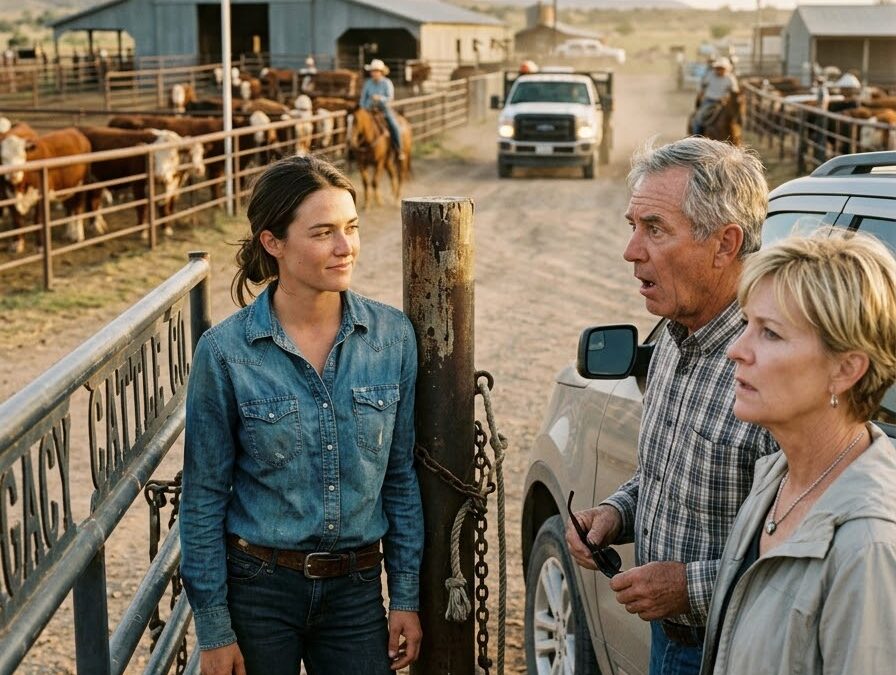
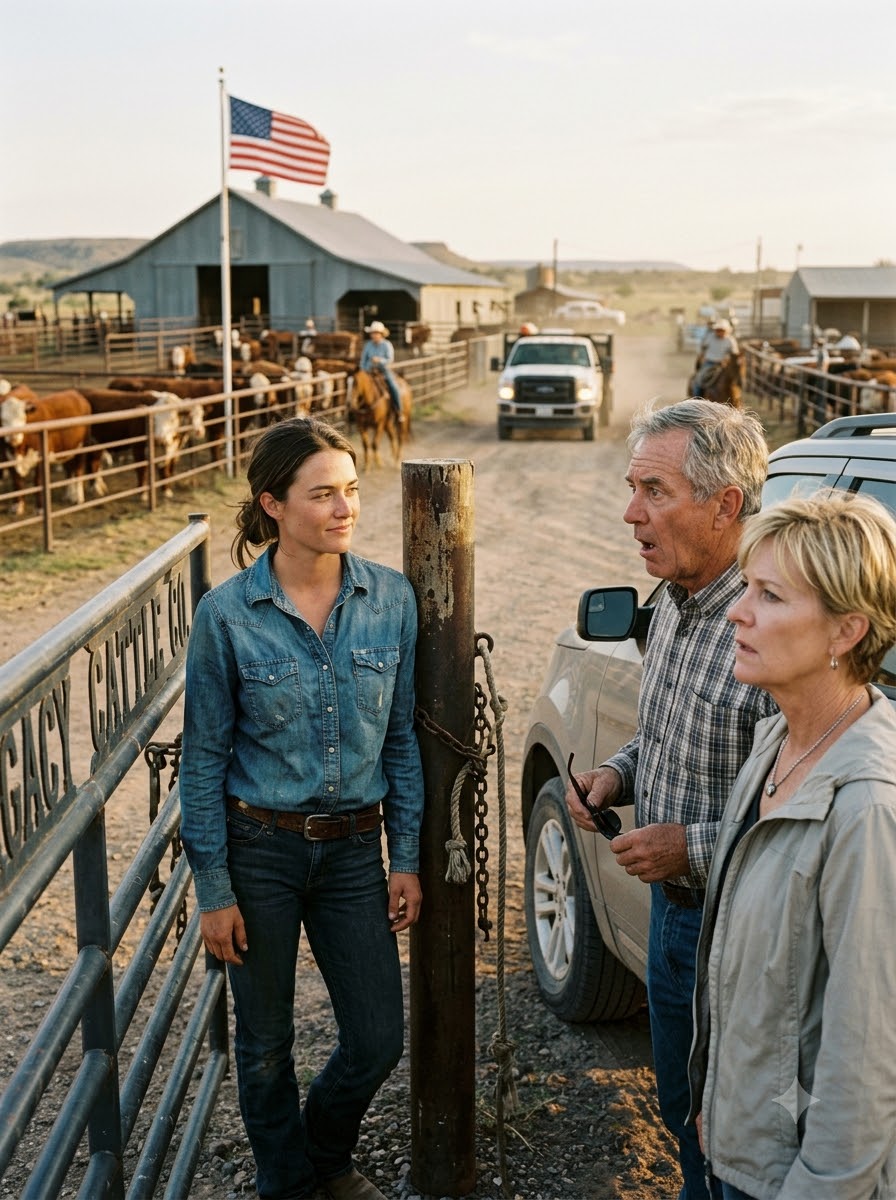
Steven and Norma Merritt stood beside their rental car, looking at the property with the same expression people get when a number they were told has turned out to be real.
My father was wearing a collared shirt with sunglasses pushed up on his head, the way he dressed when he was traveling and trying to look casual.
My mother had her hands folded in front of her.
They were both looking at the buildings, the signage on the gate, the company vehicle parked near the office, and the cattle visible in the far pasture.
They saw me walking toward them and my father’s expression shifted.
He looked confused in the specific way of someone whose mental categories aren’t organizing fast enough.
Fay, he said, “What are you doing out here?”
“I live here,” I said.
“I work here.”
“We know that,” my mother said.
We wanted to talk to the owner.
I looked at both of them.
“You’re looking at her.”
The silence lasted long enough to be uncomfortable.
My mother’s eyes moved from me to the gate sign to the truck to the visible operation behind me.
My father took his sunglasses off and held them.
You own all of this?
He said this property and two others.
Yes.
He looked at the main barn.
When did this happen?
It started the year I graduated.
I’ve been building it since then.
My mother said, “You never told us.
You never asked what I was doing out here for eight summers.
you dropped me off and assumed I was doing chores.
I was learning how to run a business.
Nobody responded to that immediately.
My father finally said, “FA, we’re proud of you.
I mean that.”
I looked at him.
I know you mean it now.
He heard the difference.
I could see it in his face.
Pride that arrives after the fact is a particular thing.
It carries information about what the person expected before they were surprised.
My mother asked if we could come inside, have coffee, start over.
She said things between us didn’t have to be what they’d been.
She said she wanted to know my life.
My father agreed quickly in the way he agreed to things when he wanted the conversation to move past a hard
point.
I thought about what it would mean to let them in.
Not into the house, but into the position they were describing.
Parents who finally believed in what I was doing.
showing up at the thing I had built, asking to be part of it.
I had spent years building something that didn’t require their belief to exist.
I was not sure I wanted to install them inside it.
Now,
“I want you to see it, but I’m not able to offer you a role in this company or in my day-to-day life.
What you see here isn’t something I built with you in mind.
I built it in spite of how you saw me, and I need you to understand that before anything else.”
My mother started to speak.
I waited.
She said she had always believed in me.
I said, “You showed me which one of us was worth investing in every summer for 8 years.
I’m not angry about it anymore.
I’ve been past angry for a long time, but I’m not going to pretend the difference didn’t exist, and I’m not going to make room for a relationship that asks me to.”
My father said, “That’s not fair.”
“Maybe not,” I said, “but it’s where I am.”
They stood there for another minute and I gave them the time because there was nothing cruel in making them feel what they were feeling.
Then my father nodded slowly and my mother pressed her lips together and they got back in the car.
I watched them drive out through the gate and down the road until the dust settled.
Dale was waiting by the barn door with the manifest still in his hand.
Tamson had gone back to the office.
The cattle were visible in the distance, moving the way they always did in the late afternoon, unhurried and indifferent to everything that didn’t involve grass and water.
I walked back toward the office.
The distributor in San Antonio had sent revised terms for our spring contract, and I needed to review them before end of business.
There was a maintenance issue on the second property that Dale wanted to discuss.
and Virginia Aldis, who was 79 now and living in a small house in Alpine, had sent me a postcard two weeks ago with a single line on the back, “Keep going.”
I sat down at my desk, pulled up the contract terms, and kept going.
That was the only future I had ever been building.
Not the one my parents planned for me in those long ago June mornings when they drove away without looking back.
Mine.
The one that had been waiting in every notebook, every supply manifest, every quiet observation I had made on land, they thought was just somewhere to put me.
It turned out the place they sent me to get me out of the way was exactly where I needed to








