I brought my boyfriend home to meet my family. That very night, he slept with my younger sister in the room right next to mine. A year later, at their wedding, she looked me up and down and smirked mockingly: “Still single?” I said nothing, merely smiling. Just then, my husband walked in and planted a kiss on my forehead. The champagne glass slipped from her hand and crashed to the floor. She stared at him in sheer horror, frozen in shock—because… she knew exactly who he was.

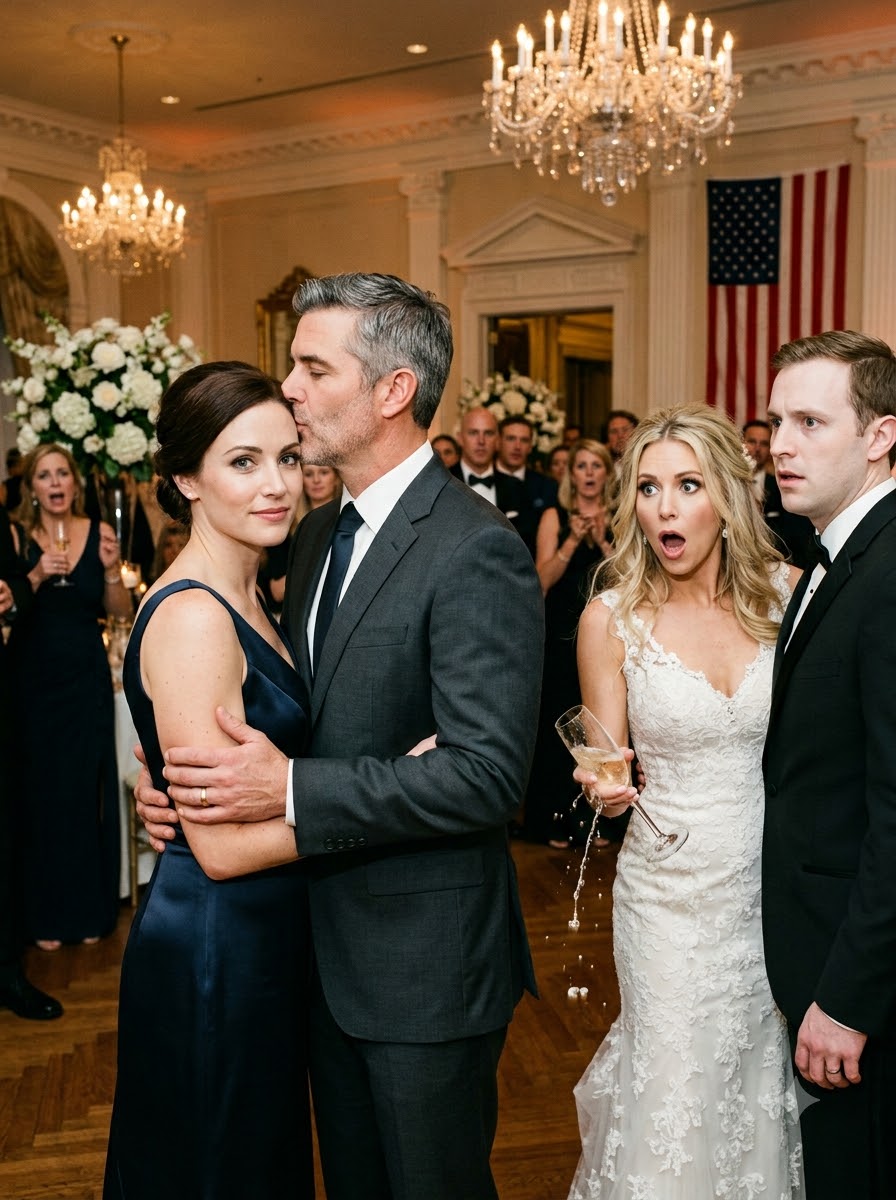
My sister’s champagne glass hit the floor before I had even said a word.
For a second, nobody moved.
The band was playing something soft behind us. Silverware clinked against plates. A waiter carrying a tray of wine stopped near the edge of the dance floor and stared at the broken glass spreading across the polished wood.
Danielle didn’t seem to notice any of it.
She was looking past me, at the man who had just walked into her wedding reception.
He crossed the room without hesitation, slipped one hand around my waist, and kissed me gently on the forehead.
“Sorry I’m late,” he said.
I smiled.
“You made it.”
When I looked back at my sister, the smug expression she had been wearing 30 seconds earlier was gone.
Eric, standing beside her in his tuxedo, looked even worse.
He had gone completely still.
Danielle’s lips parted. Her eyes moved from the man beside me to my face, then back again.
She knew exactly who he was.
But that wasn’t why I had come to the wedding.
And despite what Danielle would later accuse me of, I hadn’t brought him there to humiliate anyone.
In fact, 14 months earlier, I had believed Eric Danner might be the man I would marry.
I was 39 then, old enough to know the difference between infatuation and a relationship that had survived real life.
Eric and I had been together almost two years.
We had weathered busy seasons at work, his mother’s knee replacement, my father’s minor heart procedure, a burst pipe in my condo, and one miserable Christmas road trip through freezing rain on Interstate 71.
He knew how I took my coffee.
I knew he hated cilantro.
We had keys to each other’s homes.
Marriage had never been formally promised, but we had talked about it often enough that I knew where the conversation was heading.
That was why I finally brought him home for a weekend with my family.
My parents lived outside Cincinnati in the same brick house where Danielle and I had grown up.
My mother had spent two days preparing dinner as if the governor were coming.
My father cleaned a grill he never ended up using.
And Danielle arrived early.
That should have warned me.
My sister was four years older than I was, and she had always had a way of entering a room as if there were already a competition underway.
At 43, she was still beautiful in the kind of deliberate way that required effort.
Perfect hair, perfect nails, clothes that always looked more expensive than they probably were.
She hugged Eric longer than necessary.
“So, this is the famous Eric.”
Eric laughed.
“Famous?”
“Mari barely tells us anything.”
I looked at her.
“That’s not true.”
Danielle smiled sweetly.
“I’m teasing.”
At dinner, she asked Eric more questions than my parents did.
Where did he work? What exactly did he do? How many locations did he oversee?
Eric was a regional operations director for Northgate Facilities Group, which managed commercial and healthcare properties across several states.
He was proud of it.
He had worked hard to get there.
I was proud of him, too.
But Danielle had a way of turning interest into admiration.
“So you’re responsible for all those sites?”
“Twenty-three right now,” Eric said.
At 41, he gave a modest shrug.
It wasn’t very modest.
Danielle leaned back in her chair.
“That’s impressive.”
Eric smiled.
Then she looked at me.
“Mari never told us you were this successful.”
There are sentences that sound harmless when you first hear them.
Only later do you realize there was a blade inside.
I laughed it off.
“I’ve told you what Eric does.”
“Not like that.”
She reached for the wine bottle.
My glass was still half full.
Danielle topped it off anyway.
I covered the rim with my fingers.
“That’s enough.”
“Oh, come on. You’re home.”
“I’m also a lightweight.”
Eric smiled.
“That part is true.”
Everyone laughed.
Danielle did, too.
But she poured a little more.
At the time, nothing felt dangerous.
That’s the part people misunderstand when they hear what happened later.
There was no sinister music, no dramatic warning, no moment when my instinct screamed at me to take Eric by the hand and leave.
It was just dinner.
Pot roast, mashed potatoes, my father complaining about property taxes, my mother asking whether we wanted pie, and my sister watching my boyfriend every time he talked about himself.
I noticed it.
I just didn’t understand it.
By dessert, I was warm from the wine and tired from the week.
Eric was telling my father about a possible restructuring at Northgate.
“There could be a VP track eventually,” he said. “Nothing guaranteed.”
Danielle raised her eyebrows.
“Vice president?”
Eric gave another shrug.
“Maybe someday.”
“I can see it.”
Something changed in his face when she said that.
Not much, just enough that I remember it now.
I had congratulated Eric when he got promoted.
I had taken him to dinner.
I had bought him the watch he wore that night.
But I had never looked at him the way Danielle was looking at him, like his title made him larger, like ambition itself was seductive.
At 10:30, I yawned.
My mother laughed.
“That wine got you. It always does.”
Danielle turned toward me.
“You going upstairs?”
“I think so.”
Eric looked at me.
“You okay?”
“Just sleepy.”
I kissed his cheek.
“You can stay up. Dad’s finally found someone willing to listen to his furnace story.”
My father protested.
“It was a very expensive furnace.”
I laughed and started toward the stairs.
Behind me, Danielle called, “Sleep well.”
I lifted one hand without turning around.
My bedroom was at the far end of the upstairs hallway.
Danielle’s old room was next to it.
My parents had kept both mostly unchanged after we moved out, except for new paint and better mattresses.
I changed clothes, plugged in my phone, and lay down.
Downstairs, I could still hear occasional laughter.
Eric’s voice.
Danielle’s.
I remember thinking how relieved I was that everyone seemed to like him.
I remember thinking maybe Christmas would be easier that year.
Maybe I had finally reached the point in my life where family gatherings would stop feeling like something I needed to manage.
That was the role I had played for as long as I could remember.
Danielle reacted.
I adjusted.
Danielle got angry.
I smoothed things over.
And because I was good at it, everyone had come to believe I didn’t mind.
Before I fell asleep, I heard footsteps on the stairs.
Then a door closed somewhere nearby.
I didn’t open my eyes.
I didn’t know that downstairs after I left, Danielle had poured Eric another drink.
I didn’t know she had kept complimenting him.
I didn’t know she had already decided how the rest of the night would go.
And most importantly, I didn’t know that my sister understood something about me that Eric didn’t.
Whenever I drank wine late at night, I almost always woke up thirsty, usually around 2:00 in the morning.
Danielle knew that.
She had known it since we were teenagers.
Before she followed Eric upstairs, she told him something very different.
She told him that once I drank, I slept like the dead.
And Eric believed her.
At 1:57 that morning, I opened my eyes with my mouth dry and my head heavy.
I reached for the water glass on my nightstand.
Empty.
So I pushed back the covers and got up exactly as my sister knew I would.
The digital clock on my nightstand read 1:57.
I sat on the edge of the bed for a few seconds, waiting for the room to settle.
I wasn’t drunk anymore, but the wine had left that dull heaviness behind my eyes.
The house was quiet.
I picked up my empty glass and opened the bedroom door.
Danielle’s room was next to mine.
I had taken maybe three steps when I heard something behind her door.
At first, I kept walking.
Old houses make noises.
Pipes knock.
Floorboards complain.
My parents’ place had been doing both since the Reagan administration.
Then I heard a man’s voice.
I stopped.
There was a long silence.
I remember looking toward the stairs and thinking Eric must still be downstairs.
Then I heard him again.
Quiet.
Close.
Inside Danielle’s bedroom.
My body understood before my mind did.
I walked back and put my hand on the doorknob.
I wish I could tell you I hesitated.
I didn’t.
I opened the door.
Eric jerked upright.
Danielle grabbed the sheet against herself.
His shirt was on the floor beside the bed.
For several seconds, nobody spoke.
There are moments when anger comes immediately.
This wasn’t one of them.
What I felt first was disbelief so complete that it was almost calm.
“Mari.”
Eric scrambled out of bed.
“Mari, wait.”
I looked at Danielle.
She wouldn’t meet my eyes.
“What are you doing?”
It was a ridiculous question.
I could see what they were doing, but sometimes the mind asks for words because the truth in front of you is too ugly to accept without hearing someone say it.
Danielle finally looked at me.
“We were drinking.”
I stared at her.
“What?”
“We had too much. It just happened.”
Something inside me snapped into place.
“Nothing just happened.”
Eric pulled on his pants.
“Mari, please let me explain.”
“Explain what?”
“I screwed up.”
“You screwed up?”
“I don’t know what I was thinking.”
I looked from him to Danielle.
“You waited until I went to bed.”
Danielle shook her head.
“No, that’s not—”
“You waited until I went to bed. And then you brought my boyfriend into the room next to mine.”
My voice rose.
That woke my parents.
I heard my father’s bedroom door open.
“What’s going on?”
My mother appeared behind him in her robe.
Then Dad saw Eric standing there half-dressed.
He understood quickly.
“What the hell?”
“Dad—” Danielle began.
“Get dressed.”
Eric looked at him.
“Sir, I—”
“Get dressed and get out of my house.”
Eric reached for his shirt.
My mother stared at Danielle.
“What were you thinking?”
Danielle started crying.
That happened fast.
“I don’t know.”
“You don’t know?”
“Mom, we were drinking.”
“So was Mari.”
“I know.”
Eric stepped toward me.
“Mari, can we please talk outside?”
I backed away.
“Don’t touch me.”
He stopped.
“I love you.”
That almost made me laugh.
Instead, I said, “Get out.”
Dad followed Eric downstairs to make sure he left.
I could hear Eric calling my name from the foyer.
I never went down.
When the front door finally shut, I turned to Danielle.
“I’m done with you.”
My mother blinked.
“Mari, no.”
Danielle wiped her face.
“I said I’m sorry.”
“You’re sorry because I opened the door.”
“That’s not fair.”
I actually stared at her.
“Fair?”
Mom stepped between us.
“Everybody needs to calm down.”
And there it was.
A sentence I had heard in one form or another my entire life.
“Mom, I just found my sister in bed with my boyfriend.”
“I know what happened.”
“Then why are you telling me to calm down?”
“I’m not defending her.”
Danielle was still crying.
Mom glanced toward her, then back at me.
“She’s your sister.”
“And he was my boyfriend.”
“I know.”
“No, you don’t.”
Dad came upstairs again.
“He’s gone.”
“Good.”
I turned toward my bedroom.
Dad said, “Where are you going?”
“Home.”
“You’ve been drinking. You’re not driving.”
“I’m not driving.”
I pulled my overnight bag from the closet and began putting clothes into it.
Mom followed me.
“Mari, please don’t make any decisions tonight.”
I stopped folding a sweater.
“What decision am I making?”
“About your sister. About this family.”
I stared at her.
“Danielle made the decision.”
“She did something terrible.”
“Then let her live with it.”
Dad appeared in the doorway.
“Nobody is saying what she did was okay.”
“Then why am I the one being asked to stay?”
“Because everybody’s upset.”
I shook my head.
“No. Danielle does something unforgivable, and somehow we’ve already reached the part where I’m supposed to make it easier for everyone.”
Mom’s face tightened.
“That isn’t what we’re doing.”
“It’s exactly what you’re doing.”
“Mari, your sister has been drinking, too. She wasn’t thinking straight.”
I laughed once.
Not because anything was funny.
“So being drunk explains sleeping with my boyfriend?”
“I said it doesn’t excuse it.”
“Then stop using it to excuse her.”
Mom fell silent.
Danielle appeared in the hallway.
Her robe was tied tightly around her.
“Mari, I’m sorry.”
I looked at her.
There was something strange in her expression beneath the tears.
At the time, I couldn’t name it.
Years of knowing Danielle should have helped me.
But betrayal makes you look at the obvious wound instead of the knife.
“I never want to see you again.”
Mom immediately said, “Mari.”
I turned.
“What?”
“Don’t say something you can’t take back.”
That sentence hurt almost as much as opening Danielle’s door.
“You’re worried about what I’m saying?”
“I’m worried about both of you.”
“Why?”
Mom looked confused.
“Because you’re my daughters.”
“Then go talk to the daughter who slept with the other daughter’s boyfriend.”
“She’s in no condition to talk reasonably.”
“And I am?”
Mom hesitated.
Then she said the sentence that changed everything.
“Because you’re the one we can actually talk to right now.”
The room became very quiet.
I looked at my mother.
Then my father.
Suddenly, I wasn’t 39 anymore.
I was 16, standing in the laundry room while Mom told me not to make a scene after Danielle ruined a dress I had saved for months to buy.
I was 22, staring at a dent in my car while Dad explained that Danielle couldn’t afford to repair it.
I was 31, crying outside during Thanksgiving after Danielle humiliated me in front of relatives, only to hear Mom say, “Please come back inside. You’re making this worse.”
Danielle was difficult.
I was reasonable.
And somehow that had become my punishment.
“All my life,” I said quietly, “every time Danielle hurt me, you asked me to be the bigger person.”
Dad lowered his eyes.
Mom opened her mouth.
I didn’t let her interrupt.
“Tonight she slept with the man I brought home to meet you. Ten feet from where I was sleeping, and you’re still asking me to be the bigger person.”
“We’re asking you to wait until morning,” Dad said.
“No. You’re asking me to absorb it one more time.”
I zipped my bag.
My rideshare app showed a driver 11 minutes away.
Mom started crying.
“Please don’t leave like this.”
I picked up my coat.
“I’m done being the easiest person in this family to hurt.”
I walked downstairs.
Nobody stopped me this time.
Outside, the November air was cold enough to clear the last of the wine from my head.
I stood beneath the porch light until a gray Honda pulled into the driveway.
My mother watched from the doorway.
My father stood behind her.
Danielle never came downstairs.
I climbed into the back seat and gave the driver my address.
As we pulled away, I looked once at the house where I had grown up.
I thought I was leaving because my sister had slept with my boyfriend.
I didn’t understand yet that I was leaving because, for the first time in my life, I had finally recognized the pattern that had taught her she could.
My mother called at 8:12 the next morning.
I know the exact time because I had barely slept.
I had spent most of the night on my couch with a blanket around my shoulders, staring at a television I never turned on.
Eric had called 14 times.
I blocked him before sunrise.
Danielle called twice.
I blocked her, too.
When Mom’s name appeared on my screen, I let it ring longer than I should have.
Part of me still hoped she would say the right thing.
Not something perfect.
Just something that made it clear she understood who had been hurt.
I answered.
“Hi.”
Mom sounded exhausted.
“Mari?”
There was a pause.
Then she said, “Danielle feels terrible.”
I closed my eyes.
Of course that was her opening.
Not, How are you?
Not, I’m sorry we asked you to stay.
Not, What your sister did was unforgivable.
Danielle feels terrible.
“So do I,” I said.
“I know.”
“Do you?”
“Mari, please.”
I stood and walked to the kitchen.
Outside my window, people were already scraping frost off windshields.
A delivery truck idled across the street.
Everything looked painfully ordinary.
Mom continued.
“Your father and I barely slept.”
“I’m sorry you had a rough night.”
She heard the edge in my voice.
“That’s not what I meant.”
“I know.”
Another pause.
Then she said, “We just don’t want this family torn apart.”
I leaned against the counter.
There.
There it was again.
The family.
As if it were a glass bowl Danielle had knocked off the table, and somehow I had become responsible for gluing it back together.
“Danielle tore it apart,” I said. “You’re asking me to hold the pieces so nobody has to look at what she did.”
“That isn’t fair.”
I almost laughed.
“Mom, please don’t use that word with me today.”
She became quiet.
Then Dad came on the line.
“Mari.”
“Hi, Dad.”
“I’m not defending Danielle.”
“You already did.”
“No, I didn’t.”
“You told me not to make a permanent decision because it was 2:00 in the morning and because you thought I’d calm down.”
“I thought everyone needed to.”
I stared at the coffee maker.
“We’ve been doing this my whole life.”
Dad sighed.
“This isn’t about your whole life.”
“Yes, it is.”
That was the first time I said it out loud.
And once I did, I couldn’t unsee it.
I started remembering things I hadn’t thought about in years.
When I was 16, I saved money from a summer job at a pharmacy to buy a blue dress for homecoming.
Danielle borrowed it without asking.
She spilled nail polish remover on the skirt.
I cried.
Mom told me Danielle already felt bad and asked me not to ruin the evening over just a dress.
When I was 22, Danielle borrowed my car because hers was in the shop.
She backed into a concrete post in a parking garage.
The repair estimate was almost $900.
Dad said she couldn’t afford it.
He asked me to cover the deductible and let her pay me back when things were better.
Things apparently never got better.
She never paid me.
At 31, we had a Thanksgiving dinner with cousins and neighbors.
Danielle made a joke about a man I had been dating who broke up with me.
It was cruel enough that two people at the table went silent.
I got up and went outside.
Mom followed.
I thought she was coming to comfort me.
Instead, she said, “Can you please come back inside? You’re making this worse.”
That sentence stayed with me.
Not because it was the worst thing anyone had ever said.
Because it explained my place in the family.
If Danielle made the mess, I was still expected to clean up the atmosphere afterward.
I was the reasonable one.
The dependable one.
The daughter who could take it.
People sometimes think being called strong is always a compliment.
It isn’t.
Sometimes strong becomes the word people use when they want permission to give you less care.
Dad said my name.
I realized I had stopped listening.
“Mari?”
“I’m here.”
“We love you.”
“I know.”
“And we love Danielle.”
“I know that, too.”
“What do you want us to do?”
That question hurt more than I expected.
“I wanted you to stop asking me what I’m willing to tolerate.”
Dad didn’t answer.
I continued.
“I wanted one night where Danielle did something horrible and nobody turned around five minutes later to ask me to make things easier.”
“We asked you not to drive.”
“No, you were right about that. I wasn’t going to drive.”
“Then what?”
“You know what I mean.”
He did.
I could hear it in his silence.
Mom came back onto the phone.
“Mari, what are you saying?”
I took a breath.
“I’m saying I need to be done with Danielle. With all of this.”
She inhaled sharply.
“You can’t mean us.”
“I do.”
“Mari.”
“I love you, but I can’t keep coming back to a family where my ability to handle pain is treated like permission to give me more of it.”
“That’s not what we intended.”
“I know.”
That was important.
My parents were not monsters.
They had not spent 39 years plotting ways to favor Danielle.
They had simply chosen the path of least resistance so many times that it became a family system.
Danielle exploded.
They soothed her.
I adapted.
They praised me for adapting.
Everybody survived dinner.
Nobody fixed the problem.
Intent didn’t erase the result.
Mom began crying.
“So you’re just cutting us out?”
“I’m stepping away.”
“For how long?”
“I don’t know.”
“Christmas is next month.”
I nearly smiled at that.
Of course Christmas came up.
Not my heartbreak.
The calendar.
“I won’t be there.”
Mom cried harder.
Dad took the phone again.
“Take a few days. You don’t have to decide this now.”
“That’s the point, Dad. I’ve spent years not deciding.”
I ended the call a few minutes later.
Then I wrote one message to both of them.
I told them I loved them.
I told them I wasn’t asking them to choose between their daughters.
I told them I was choosing myself.
And I asked them not to contact me.
Then I blocked their numbers.
The silence afterward was frightening and peaceful both at once.
Three weeks later, a cousin sent me a message asking if I was okay.
Then, almost as an afterthought, she added, “I guess you heard Eric and Danielle are seeing each other now.”
I stared at the words for a long time.
Strangely, they didn’t surprise me.
If Eric had gone back to Danielle once, shame might have swallowed him.
If they turned it into a relationship, they could call it something else.
Chemistry.
Fate.
A connection they couldn’t ignore.
People can build entire romances around avoiding the sentence:
We did something cruel.
I deleted the message.
By February, I heard they were engaged.
I didn’t respond to that either.
Instead, I worked.
I started seeing a therapist every other Thursday.
I stopped checking social media.
I learned to eat dinner alone without feeling abandoned.
And slowly, something unexpected happened.
My life became quiet.
Not empty.
Quiet.
Then one Monday morning, my director dropped a new contract file on my desk.
Hail Meridian Group.
Large outpatient facility project.
High-value negotiations.
Several outside executives would attend.
I skimmed the names on the meeting list.
One of them meant nothing to me at the time.
Warren Hail.
By then, I thought I had already lost the future I had been building.
I had no idea I was about to meet the man who would show me how different love could feel when nobody needed me to shrink.
The first thing I noticed about Warren Hail was that he didn’t try to dominate the room.
That surprised me.
Men with power often had habits that announced it before their titles did.
They interrupted.
They made people wait.
They filled silence because they couldn’t stand the possibility that someone else might control it.
Warren didn’t.
He sat across the conference table in a navy suit with no tie, reading the draft agreement while everyone else introduced themselves.
When it was my turn, I said, “Mari Keller, senior contracts manager.”
He looked up.
“Mari.”
Not Ms. Keller.
Not a distracted nod.
Just my name, as if he intended to remember it.
The project involved a new outpatient medical facility west of Cincinnati.
Hail Meridian was handling part of the real estate development and long-term operational structure.
My job was to protect the hospital system from taking on obligations that looked harmless in a glossy presentation and expensive 10 years later.
About 40 minutes into the meeting, I found one.
The proposed language shifted more maintenance risk onto the hospital than we had discussed.
I marked the page.
“This doesn’t work.”
One of Hail Meridian’s attorneys glanced at Warren before answering.
“It’s consistent with the current structure for your side.”
The room became quieter.
I continued.
“That works very well for your side. It doesn’t work for ours.”
Nobody gasped.
This wasn’t a courtroom drama.
But I did notice two people stopped typing.
Warren leaned back slightly.
“What would you change?”
I gave him three points.
He disagreed with the first.
He was right about the second.
On the third, I held my ground.
“We’d be accepting a cost we can’t control.”
He looked at the language again.
Then he nodded.
“That one comes out.”
And we moved on.
That was it.
No fireworks.
No instant attraction.
Just a productive meeting.
I found out later that Warren remembered that exchange better than I did.
At the time, I mostly remembered being hungry because the meeting ran through lunch.
Over the next six weeks, we saw each other several times, always professionally.
We argued about deadlines.
We agreed on insurance provisions.
Once, we spent 20 minutes debating whether a certain clause was too vague, only to discover we were both interpreting it the same way and arguing over punctuation.
That made me laugh.
Warren looked at me.
“What?”
“We just wasted 20 minutes on a comma.”
“A very expensive comma.”
I smiled.
“That makes it important.”
That was probably the first time something between us felt personal.
Not romantic exactly.
Just easy.
He never flirted in meetings.
I appreciated that.
After Eric and Danielle, I had no interest in ambiguity.
I had also become more suspicious of charm.
Charm was easy.
Character took longer.
The project eventually closed.
Three days later, Warren emailed me.
Not through his assistant.
Directly.
The message was short.
Coffee?
I stared at it for a full minute before answering.
Is this another meeting?
His reply came two minutes later.
I was hoping it wouldn’t be.
I almost said no.
Not because I disliked him.
Because I liked my life quiet.
For months, I had been rebuilding routines that belonged only to me.
Saturday mornings at the grocery store before the crowds.
A pottery class I was terrible at.
Long walks near the river.
Dinner with two coworkers who had become real friends.
Therapy every other Thursday.
I had stopped waking up angry.
I didn’t know if I wanted to risk that.
Then I heard my therapist’s voice in my head.
Protecting your peace is not the same as refusing your life.
So I said yes.
Coffee became dinner a week later.
Dinner became another dinner.
Warren was 48, divorced years earlier.
No dramatic scandal.
No tragic mythology around it.
The marriage had simply become unhappy, and eventually both people admitted it.
I respected that answer because it lacked performance.
He asked about my family once.
I said, “We’re not close.”
He didn’t push.
That mattered.
Eric would have asked follow-up questions until he had a complete map of the conflict.
Warren simply said, “Okay.”
Months passed before I told him what had happened.
When I finally did, he listened all the way through.
No interruptions.
No declarations that he would take care of anyone.
At the end, he asked one question.
“What do you need from me?”
I almost cried.
Not because it was romantic.
Because nobody in my family had asked me that when it mattered.
“I don’t need you to do anything.”
He nodded.
“Then I won’t.”
That was Warren.
He didn’t confuse love with intervention.
The strange part was that for the first few months, I didn’t fully understand who he was professionally.
I knew he worked for Hail Meridian.
I knew he was senior.
I knew people listened when he spoke.
But Warren never talked about himself like a résumé.
One evening, we were having dinner with two of my colleagues when one of them casually mentioned an interview Warren had given about a major acquisition.
I looked at him.
“Interview?”
My coworker laughed.
“Mari, you do know he’s executive chairman, right?”
I turned slowly toward Warren.
He had the decency to look embarrassed.
Later, in the parking lot, I said, “You could have mentioned you run the company.”
“I don’t run every part of it.”
“That is not a defense.”
He smiled.
“I told you where I worked.”
“You told me you worked in commercial property and healthcare assets.”
“That’s true.”
“That’s also what someone says when he doesn’t want to say he’s chairman.”
He put his hands in his coat pockets.
“I just left out the version people put in press releases.”
I shook my head.
“You’re unbelievable.”
“Are you angry?”
“A little.”
“Fair.”
Then his expression changed.
More serious.
“People act differently when they hear the title.”
I understood immediately.
And that was when I saw the contrast clearly.
Eric had once loved that I didn’t care about titles.
Later, he had needed me to care more.
Warren had lived with status long enough to distrust anyone who cared too much.
What Eric eventually saw as a deficiency in me, Warren saw as relief.
Eight months after that first coffee, Warren and I married in a small ceremony.
No ballroom.
No society pages.
Just a judge, two close friends, dinner afterward, and the kind of happiness that didn’t need witnesses to become real.
My family knew nothing.
By then, I hadn’t spoken to them in almost a year.
A month after the wedding, Warren came home carrying a folder.
“Hail Meridian finalized the Northgate deal today.”
I looked up from the kitchen counter.
“Northgate?”
“Yes.”
I knew the name.
Of course I did.
Eric’s company.
For a moment, neither of us spoke.
Then Warren said very calmly, “That has nothing to do with us.”
And somehow that made me love him even more.
For nearly a year, my family had known almost nothing about my life.
That had been intentional.
I didn’t post photographs of Warren online.
I didn’t announce our marriage on social media.
I didn’t send my parents a wedding announcement out of guilt or obligation.
There had been a time when that would have felt cruel to me.
Now it felt like a boundary.
People sometimes confuse privacy with punishment.
I had learned the difference.
I wasn’t withholding my life to hurt them.
They simply no longer had automatic access to it.
The invitation to Danielle and Eric’s wedding arrived on a Tuesday afternoon.
Cream-colored envelope.
Heavy paper.
My full name written across the front.
I stood beside my mailbox for several seconds before opening it.
Danielle Keller and Eric Danner.
Seeing their names together didn’t hurt the way I expected.
Mostly it felt strange.
I carried the invitation upstairs, showed it to Warren, and dropped it into the recycling bin.
“I’m not going.”
He nodded.
“Okay.”
That was all.
He didn’t ask whether I was sure.
He didn’t tell me I might regret it.
He didn’t turn my decision into a test of forgiveness.
Three days later, my grandmother called.
Grandma Ruth was 84 and had been one of the few people in my family who never used peace as an excuse for silence.
She had called me after everything happened, not to defend anyone, just to say, “I’m sorry, honey.”
We had stayed in contact.
Her voice sounded thinner now.
“I heard you got the invitation.”
“I did.”
“You don’t have to go.”
That surprised me.
“Mom didn’t ask you to call?”
“She knows better.”
I laughed.
Then Grandma became quiet.
“I would like to see you, though.”
“You can see me anytime.”
“I know.”
Another pause.
“My heart’s not getting younger, Mari. I don’t know how many big family gatherings I have left.”
That landed differently.
She wasn’t asking me to forgive Danielle.
She wasn’t asking me to pretend.
She was simply an old woman acknowledging time.
“I’ll come,” I said.
“For me?”
“For you.”
“Good.”
Warren had a Hail Meridian board meeting scheduled that afternoon.
“I can cancel,” he said when I told him.
“No.”
“Mari, I’m serious.”
“I can handle walking into a room.”
“I know you can.”
“Come afterward if you can.”
He studied my face.
“What do you need from me?”
The same question.
Always the same respect.
“Just show up when you can.”
“I can do that.”
The wedding was held at a country club outside Cincinnati.
I arrived alone.
My mother saw me before I reached the reception area.
She stopped.
For a moment, she looked older than I remembered.
“Mari.”
“Hi, Mom.”
Her eyes filled immediately.
I didn’t move toward her.
Neither did she.
“You look beautiful.”
“Thank you.”
“Your father’s inside.”
I nodded.
“I’m here to see Grandma.”
The sentence hurt her.
I could tell.
But I didn’t soften it.
“I understand,” she said.
That was new.
Grandma Ruth was seated near a window.
When she saw me, she opened both arms.
I bent down and held her longer than I intended.
“There’s my girl.”
“I missed you.”
“I missed you, too.”
She touched my cheek.
“You look peaceful.”
Of all the things she could have said, that one nearly broke me.
“I am.”
Later, while Grandma rested before dinner, my cousin Allison found me near the coatroom.
We had never been especially close, but she looked nervous.
“Can I talk to you?”
“Sure.”
“Privately?”
Something in her face made my stomach tighten.
We stepped into an empty hallway.
Allison folded her arms.
“There’s something I should have told you months ago. About that night.”
I knew immediately which night.
She looked ashamed.
“I was at your parents’ house earlier that afternoon. Danielle and I were helping your mom with dinner.”
I waited.
“She was asking whether you still got sleepy when you drank wine.”
My skin went cold.
“What?”
“I didn’t think anything of it then.”
“What exactly did she say?”
Allison swallowed.
“She said you’d probably go to bed early.”
“That part isn’t surprising.”
“I know. But then she said something else.”
Allison looked directly at me.
“She’ll wake up around 2:00. She always does after wine.”
For several seconds, I heard nothing except the muted music from the ballroom.
My mind went backward.
Danielle filling my glass.
Danielle telling me to sleep well.
Her bedroom beside mine.
Eric later insisting Danielle had told him I would sleep through the night.
“She knew,” I whispered.
Allison nodded.
“I think she wanted you to find them.”
The truth was so ugly that my first instinct was to reject it.
Then every detail lined up.
If Danielle had wanted secrecy, there were a hundred better choices.
She could have waited until another night, gone somewhere else, closed the distance between risk and discovery.
Instead, she brought Eric into the bedroom 10 feet from mine after deliberately helping make me sleepy.
She knew I would wake thirsty.
She had not made a mistake.
She had built a scene for me to walk into.
And suddenly, I understood something else.
If Eric woke the next morning ashamed, he might have begged me to take him back.
He might have minimized it.
Called it drunken stupidity.
Danielle didn’t want to risk that.
She wanted me to see him with my own eyes.
She wanted the image burned into me so completely that there would be no road back.
It wasn’t enough to have Eric.
She wanted me to know she had him.
“Why didn’t you tell me?”
Allison looked down.
“I was scared of making everything worse.”
I almost smiled at the irony.
Our whole family had spent years being afraid of making things worse.
Usually, that meant letting Danielle do whatever she wanted.
“I’m sorry,” Allison said.
“I believe you.”
I returned to the reception carrying a truth I hadn’t had when I arrived.
Oddly, it didn’t make me want Eric back.
It didn’t even make me want revenge.
It made me look at Danielle differently.
She had spent 14 months building a marriage from a moment she had designed to destroy me.
And now I was watching her celebrate it.
Then she saw me alone.
Her eyes moved around the room, apparently checking whether anyone was with me.
A small smile appeared.
She picked up a glass of champagne and walked over.
“Well,” she said.
Her eyes traveled over my dress.
Then she gave me the same little smirk I remembered from childhood.
“Still single?”
I looked at my sister and smiled because behind her, the ballroom doors had just opened.
Warren stood just inside the ballroom doors.
He had changed out of the suit he wore to the board meeting and into the charcoal one I had laid across our bed that morning.
His silver-gray tie was slightly crooked, which told me he had probably changed in the back seat of a car.
He spotted me almost immediately.
Danielle followed my eyes.
I watched the color leave her face.
Warren crossed the room.
He didn’t look at Danielle.
He didn’t look at Eric.
He came straight to me, placed his hand lightly around my waist, and kissed my forehead.
“Sorry I’m late.”
“You made it.”
“Meeting ran long.”
Then he noticed the broken champagne glass.
A server was already approaching with a towel.
“Everything okay?”
I looked at Danielle.
“Everything’s fine.”
Eric had joined us.
His expression told me he recognized Warren, too.
“Mr. Hail.”
Warren turned.
“Yes?”
Eric swallowed.
“Eric Danner. Northgate Facilities.”
Warren offered his hand.
“Of course.”
That was all.
No dramatic recognition.
No threat.
To Warren, Eric was one regional director among hundreds of people across businesses in which Hail Meridian held interests.
To Eric, Warren Hail was the man sitting several levels above the future he desperately wanted.
Six months earlier, Hail Meridian had acquired a controlling interest in Northgate.
Since then, Northgate had been restructuring.
Eric had apparently talked constantly about the possibility of moving into a vice president of operations role.
Danielle knew Warren’s face because Eric had shown her corporate articles, leadership profiles, and a company town hall.
That was why she had dropped the glass.
Not because I had found another man.
Because she understood his title before she understood his relationship to me.
Her eyes moved to my left hand.
My wedding band was simple.
She hadn’t noticed it earlier.
Now she couldn’t stop staring at it.
“You’re married?”
“Yes.”
“To him?”
I almost laughed.
“Yes, Danielle.”
Her mouth tightened.
“You never told anyone.”
“We haven’t spoken in almost a year.”
“That didn’t stop you from coming here.”
“I came for Grandma.”
Danielle glanced at Warren, who had stepped aside to greet my grandmother.
Then she leaned closer.
“You married Warren Hail.”
“You asked if I was single.”
Her expression hardened.
“This is unbelievable.”
“What is?”
She waited.
Danielle lowered her voice.
“You expect me to believe this is a coincidence?”
“What is a coincidence?”
“You marrying the man who owns Eric’s company.”
“He doesn’t own Eric’s company personally.”
“You know what I mean.”
Actually, I did.
Danielle believed I had spent the last year planning a counterattack.
She could imagine that because it was exactly how she thought.
“You think I met Warren because of Eric, don’t you?”
“No.”
“Come on, Mari.”
“When Warren and I met, Hail Meridian didn’t control Northgate.”
She stared at me.
“I didn’t even know Eric would end up working under one of Warren’s companies.”
“You expect me to believe that?”
“I don’t particularly care what you believe.”
That stopped her.
For years, Danielle had been able to pull me into arguments simply by refusing to accept my version of events.
I would explain.
She would challenge.
I would explain more.
That game required two people.
I no longer played.
Warren returned.
He touched my elbow.
“Your grandmother wants us at her table.”
“Coming.”
Danielle stepped back.
For the first time, I realized the most painful thing I could do to my sister required no cruelty at all.
I could simply leave the conversation.
Dinner was surprisingly pleasant.
Grandma Ruth liked Warren immediately.
She asked him what he did.
“Commercial property mostly.”
I nearly choked on my water.
He looked at me innocently.
Grandma noticed.
“What?”
“Nothing,” I said.
Warren smiled.
Across the room, Eric kept glancing toward us.
Eventually, he approached Warren near the bar.
I wasn’t standing beside them, but Warren told me about the conversation later.
Eric began awkwardly.
“Mr. Hail, I wanted to clear something up.”
“About?”
“My wife and your wife.”
That got Warren’s attention.
Eric explained enough of the history to make the situation clear.
Then he said he hoped it wouldn’t affect anything professionally.
Warren stopped him.
“Your personal life is none of my business.”
Eric tried again.
“I just wanted to make sure—”
“Mr. Danner, whatever happened between you, your wife, and Mari happened before I knew any of you. I have no interest in it professionally.”
That should have reassured Eric.
Instead, it frightened him more.
Because people who obsess over status often have trouble believing powerful people when they say they aren’t thinking about them.
Two days after the wedding, Eric emailed Northgate’s HR director, then another senior executive.
He documented what he called a potential personal conflict involving Hail Meridian leadership.
He wrote that he wanted to ensure his candidacy for future advancement would be evaluated objectively.
On paper, it sounded careful.
In practice, Eric had just created a formal record suggesting that the executive chairman of Northgate’s controlling group might retaliate against him.
The company could no longer ignore the issue.
Warren immediately recused himself from anything involving Eric’s employment or promotion.
An independent review of Eric’s candidacy was ordered.
Eric had wanted protection.
Instead, he had invited people to look closely at the one thing he valued most.
His career.
But I didn’t know any of that yet.
At the wedding, I had something else to finish.
I found Danielle alone near the hallway outside the bridal suite.
“Allison told me.”
Danielle frowned.
“Told you what?”
“That you knew I’d wake up.”
For the first time that evening, she had no answer ready.
I stepped closer.
“You told Eric I’d sleep through the night.”
Her face changed.
“But you told Allison I’d wake around two.”
“Mari—”
“You poured the wine.”
She looked away.
“You chose the room next to mine.”
“It wasn’t like that.”
“You wanted me to hear you.”
“No.”
“You wanted me to open that door.”
Her eyes finally met mine.
I saw something there I had never seen clearly before.
Not guilt.
Fear.
Because this time I wasn’t accusing her of taking Eric.
I was telling her I finally understood why.
“You knew exactly what you were doing,” I said.
Danielle’s voice dropped to a whisper.
“You don’t understand.”
“Then explain it.”
She stared at me for a long moment.
And then my sister said the words that finally told me what our entire relationship had meant to her.
“I just wanted him to choose me.”
Then, almost as if saying it once had not been enough, she repeated it.
“I just wanted him to choose me.”
For a moment, I didn’t say anything.
Behind us, music drifted from the ballroom.
Someone laughed near the bar.
A waiter rolled a cart past the hallway as if my sister had not just reduced 30 years of rivalry to one sentence.
“Choose you over me?” I asked.
Danielle looked away.
“You always had everything together.”
“That wasn’t an answer.”
She folded her arms.
“You never needed anyone.”
I almost smiled.
That was what people had always mistaken about me.
Needing less drama was not the same as needing less love.
“So you wanted Eric because I had him?”
“No.”
“Then why did I need to see it?”
Her face tightened.
“I wanted to know he would choose me.”
“Then you should have let him choose you without needing me there to watch.”
She flinched.
For once, I didn’t enjoy being right.
I had spent years imagining Danielle as someone who kept taking things from me.
That night, I understood something more complicated.
My sister had built her self-worth around winning comparisons no one else had agreed to compete in.
“You thought you stole something from me,” I said.
She looked at me.
“You didn’t, Danielle.”
I paused.
“You didn’t steal the love of my life. You showed me what kind of man he was.”
Her eyes filled.
I believed the tears were real.
That didn’t mean I trusted her.
“I’m sorry,” she whispered.
“I believe you’re sorry now.”
“Can we ever fix this?”
I thought carefully before answering because forgiveness and access are not the same thing.
“I don’t want to hate you.”
Hope appeared in her face.
“But I don’t want a relationship with you either.”
It disappeared again.
“That’s cruel.”
“No. Cruel was arranging for me to find you in bed with the man I loved.”
She said nothing.
“I hope you build a life that doesn’t require beating somebody else.”
Then I walked back into the reception.
Warren never asked what Danielle said.
He simply looked at me and asked, “You okay?”
“Not yet.”
He nodded.
“Okay.”
We left after Grandma Ruth had cake.
The corporate fallout began the following week.
Eric had apparently expected his email to HR to protect him.
Instead, it forced Northgate to document that his promotion process was independent of Warren.
Warren removed himself completely.
He never made a phone call about Eric.
Never suggested an outcome.
Never even asked for updates unless the company’s counsel needed formal confirmation of his recusal.
The leadership team reviewed Eric’s record as part of the normal vice president evaluation.
That was where his real problem appeared.
Nothing criminal.
Nothing dramatic enough for handcuffs or television reporters.
Just patterns.
Quarterly performance numbers polished until weak results looked stronger than they were.
Certain expenses pushed into later reporting periods to improve how one quarter appeared.
Employees saying Eric had pressured them to present unfavorable information in the best possible light.
Several projects where he accepted more credit than the people beneath him thought he deserved.
None of those things had mattered enough individually to destroy a career.
Together, they mattered when deciding whether someone should receive more authority.
Eric did not get the promotion.
Warren had nothing to do with it.
That was almost poetic.
Eric had become so afraid that Warren might use power against him that he invited people to examine whether he deserved more power himself.
Six months later, Eric left Northgate.
He took an operations position with a smaller company.
Similar work.
Less prestige.
From what I heard, his marriage changed after that.
Danielle had loved telling people her husband was moving toward executive leadership.
Eric had loved being married to someone who treated every promotion like proof that he was exceptional.
Without that promise between them, they began seeing each other more clearly.
My cousin later told me about an argument she overheard at a family cookout.
Eric said, “You liked me a lot more when you thought I was going somewhere.”
Danielle answered, “And you liked me because I made you feel important.”
They separated before their second anniversary.
I didn’t celebrate.
By then, I had stopped measuring my life against theirs.
My parents were harder.
Mom called from an unfamiliar number about three months after the wedding.
I almost didn’t answer.
Then I did.
She said, “We owe you an apology.”
Not, Danielle feels terrible.
Not, Christmas won’t be the same.
An apology.
Dad came onto the phone.
“We thought you just needed time.”
“I needed a family that didn’t keep asking me to swallow pain for everyone else.”
“We made mistakes.”
“You made the same mistake for 30 years.”
He was quiet.
Then he said, “You’re right.”
That mattered.
It did not erase anything.
But it mattered.
We met for coffee once.
Then again months later.
There was no dramatic reconciliation.
I didn’t return to weekly phone calls.
I didn’t automatically spend holidays with them.
I never became the family peacemaker again.
I forgave enough to stop carrying them everywhere inside me.
I did not forgive so completely that I forgot what access had cost.
There is a difference.
That evening, after our second coffee, I came home exhausted.
I changed out of my work clothes and sat barefoot at the kitchen island.
Warren was heating soup on the stove.
He cut two pieces of bread.
“You hungry?”
“A little.”
He placed a bowl in front of me.
Nothing expensive.
Nothing impressive.
Just soup.
Bread.
A quiet kitchen.
After a few minutes, he asked, “You okay?”
I looked around the room.
At the man who had never asked me to make myself smaller so he could feel larger.
At a life where peace did not depend on me pretending nothing hurt.
“Yeah,” I said.
And this time, I meant it.
For years, I thought being the bigger person meant accepting whatever people did and returning quickly enough to make everyone comfortable.
It doesn’t.
Sometimes being the bigger person means leaving the argument without becoming cruel.
Sometimes forgiveness means releasing anger while keeping the door closed.
And sometimes the healthiest thing you can teach a family is that the person who can carry the most pain should not automatically be given the most.
They thought I lost everything that night in the bedroom next to mine.
It turned out I only lost what was never safe to keep.
Sometimes the best revenge isn’t taking back what someone stole.
It’s realizing they never took anything worth keeping.
If you’ve ever been the person in your family who was always told to be the bigger person, I’d love to know what that phrase has meant in your life.
Share your thoughts or your own story in the comments.








