I thought turning eighteen would finally be the day my family noticed me. Instead, it became the day I realized I had spent my entire childhood making myself smaller so everyone else could be okay.
Leanne rushed toward me from the sidewalk, weaving between strangers who barely noticed her until she called my name. I had been walking with my backpack pulled close against my shoulder, already thinking about the train schedule and the small apartment waiting for me at the other end of the city.
Then I heard her voice.
“There you are.”
I turned around slowly.
Leanne stopped a few feet away from me, breathing hard. Her hair was messy from the wind, and the anger on her face looked like it had been holding back something much heavier. She stepped closer.
“Mom is sick. The shop is struggling. Dad is losing his mind.”
I said nothing.
She looked around, as if she expected the whole street to understand what she was saying. She had always been good at making a room turn toward her. Even now, with cars passing and people moving around us, she carried herself like the world had paused for her emergency.
Then she grabbed my wrist.
“You are coming home.”
A few people nearby slowed down. Not enough to interfere, but enough to notice. I looked down at her hand, then back at her face.
I did not pull away quickly. I did not shout. I simply moved my arm back until her fingers slipped away.
“And?”
For a moment, Leanne looked like she had forgotten the next line.
“Are you serious?”
“Yes.”
Her mouth opened slightly. The confidence she had arrived with disappeared for just a second. Then she found it again.
“You blew up this entire family because of one small change of plans.”
I held her stare.
“I do not owe you anything.”
The sentence landed harder than I expected. Not because it hurt her. Because it was the first time I had ever said it out loud.
Leanne had spent years believing I would always answer when she called. That I would always understand. That I would always be the person standing behind her when she needed someone to absorb the impact. She looked past me at the strangers watching. Her voice became quieter.
“Dad is yelling at me now.”
I waited. For once, I did not rush to fix the silence. Her eyes dropped.
“You are the one who kept the peace.”
Another step closer, but slower this time.
“You handled everything.”
I tightened my grip on my backpack strap. Those words should have felt like an apology. They did not. They sounded like a confession. Leanne swallowed.
“Without you, it all falls apart.”
That was the moment I understood something I had spent eighteen years refusing to see.
They did not miss me because they loved me differently when I was gone. They missed me because everything I carried had become visible. I turned away. Behind me, Leanne did not follow. I kept walking.
And for the first time in my life, I let my family deal with the silence I had spent years filling.
Two days earlier, I had still believed my eighteenth birthday might be the day they finally saw me.
The message on my phone was still open when Leanne walked into the kitchen. I remember the exact moment because I was smiling. That was apparently the mistake.
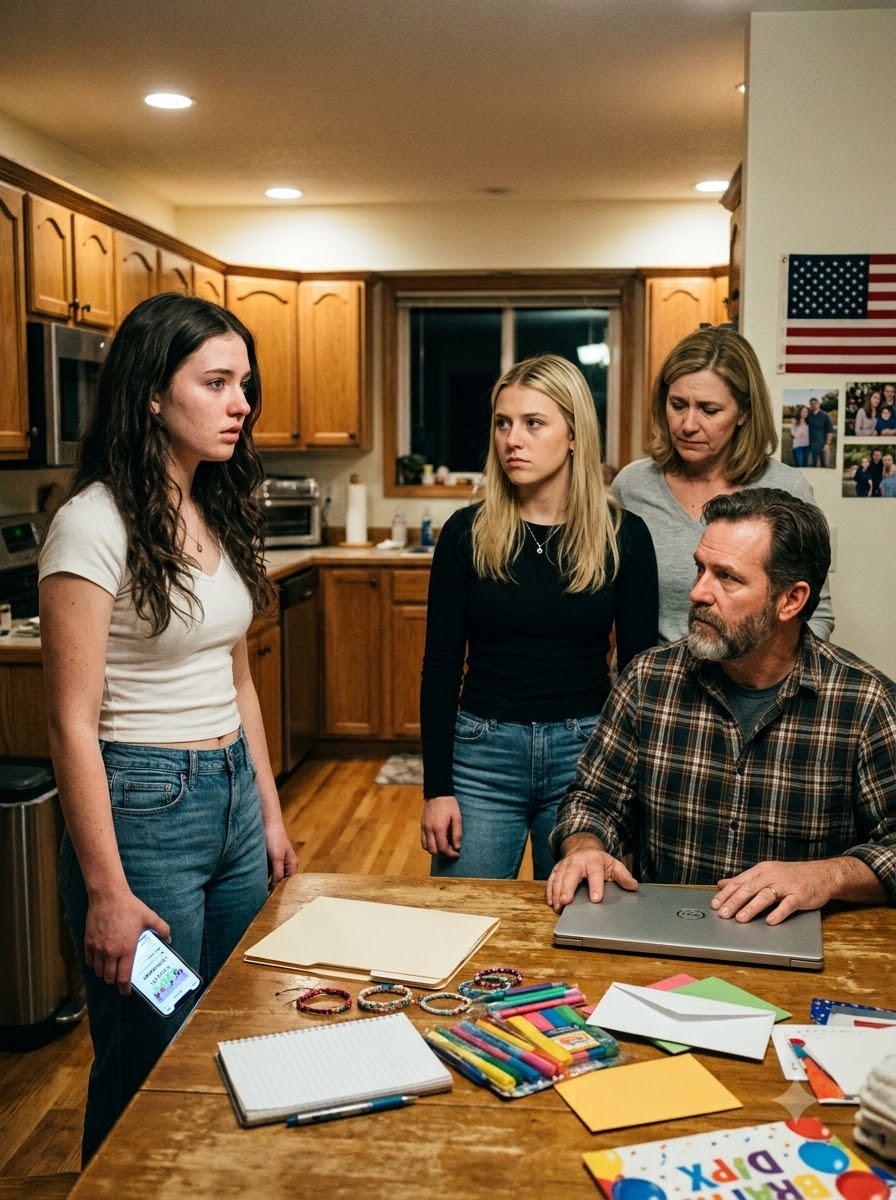
The party invitation confirmation sat on my screen. The decorations had arrived. The cake order was paid for. The playlist was finished. After weeks of saving money from early morning coffee shop shifts and selling handmade bracelets after school, I had finally created one night that belonged to me.
I had not asked my parents to plan it. I had not asked them to pay for it. I had simply wanted them to show up.
Leanne walked in carrying the same sadness she had worn for three days.
Her mascara was running. Her phone was in her hand. Her boyfriend had left her, and since then our house had changed shape around her pain.
Mom lowered her voice whenever Leanne entered a room. Dad stopped making jokes at dinner. Plans were canceled without discussion. Everyone moved carefully, as if Leanne’s heartbreak was a glass object sitting on the edge of a table. I understood. I always did. That was my role.
The mature one. The easy one. The person who did not need anything. Leanne looked at my phone.
“What are you smiling about?”
I locked the screen.
“My party. The final details came through.”
Her expression changed. Not sadness. Something sharper.
“How can you be happy right now?”
I looked at her.
“Leanne—”
“My life is falling apart, and you’re celebrating some stupid party?”
The kitchen went quiet.
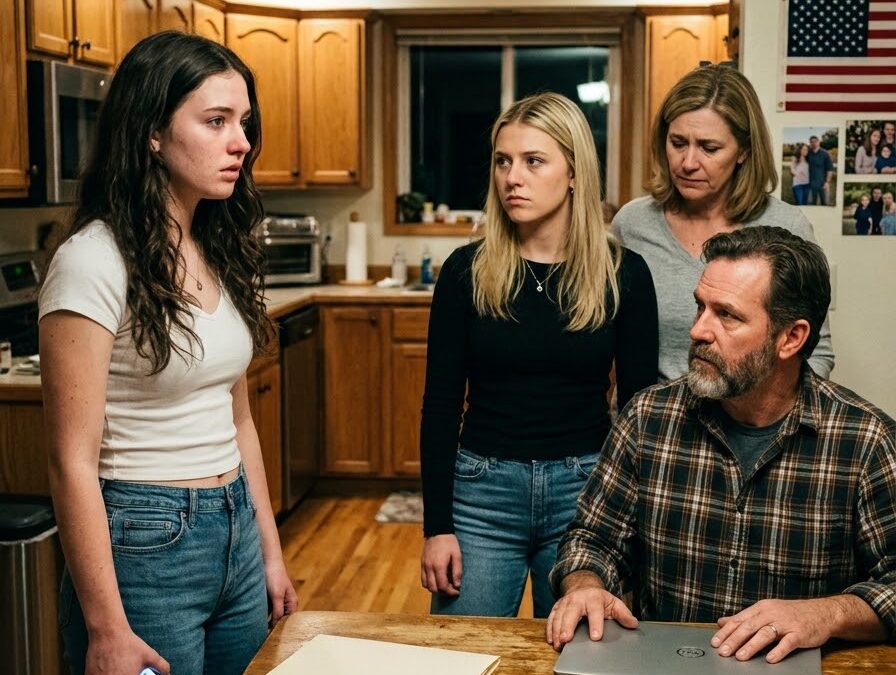
Mom was standing near the counter. Dad was sitting at the table with his laptop open. Both of them heard every word. I waited for someone to say something. Anyone.
I wanted Dad to tell her that she was being unfair. I wanted Mom to remind her that I only turned eighteen once. Instead, I did what I had always done. I tried to make it easier for everyone.
“I know you’re upset, but my birthday doesn’t have anything to do with what happened.”
Leanne laughed once, but there was no humor in it.
“You always do this.”
“Do what?”
“Act like you’re above everything. Like you’re the only one who can handle things.”
I stared at her.
I almost laughed because I had never felt less above anything in my life. I felt tired. I felt invisible.
Then Leanne said the words that changed the way I saw my family forever.
“If I can’t be happy, then she won’t be either.”
The room stayed silent. Dad closed his laptop. Slowly. Carefully. As if the decision he was about to make required concentration.
“The party is canceled.”
I thought I had misunderstood him.
“What?”
Dad looked at me.
“It’s only a party. We can do something another time.”
“No, we can’t.”
My voice sounded strange even to me.
“I paid for most of it.”
Mom looked away.
“You’re the mature one. You understand.”
That was the sentence that broke something. Not because it was cruel. Because it was familiar.
I had heard it after every sacrifice. Every forgotten promise. Every time my needs were placed at the bottom of the list. You understand. You are mature. You are strong. The words sounded like compliments until you realized they were instructions. Be quiet. Need less. Accept more.
I looked at the three people standing in that kitchen and finally understood that they had not been protecting me from disappointment. They had been depending on me to survive it. That night, after everyone went to sleep, I packed one backpack. I did not take everything.
That was the strange part.
Leaving felt less like running away and more like admitting I had never truly been allowed to arrive.
I packed clothes, my wallet, my toothbrush, and the small notebook where I kept ideas for the future I was afraid to admit I wanted. I left my birthday dress hanging in my closet. I placed my house keys on my pillow. Then I walked out.
No goodbye. No final argument. No dramatic message waiting on their phones. I simply closed the door behind me and kept walking. I thought they would call immediately. They did not. I thought they would understand by morning. They did not. And I thought I would feel guilty.
I did.
But underneath the guilt was something I had not felt in a long time. Space.
For the first few days, everyone acted like I was making a point. Then they realized I was making a choice. That was when the calls started.
And that was when I learned the truth about what happened after I left. Because my family had not fallen apart because I abandoned them.
They were falling apart because I had been the only thing holding them together.
The first call came from Dad.
I stared at his name on my phone for almost a full minute before answering. Not because I did not want to hear his voice. Because I knew exactly what his voice would sound like. Not worried. Not sorry. Frustrated. Like my leaving was another problem he had to solve.
I answered.
“Where are you?”
No hello. No question about whether I was safe. No asking if I had eaten or slept or found somewhere to stay. Just where are you.
“I’m okay,” I said.
There was a pause.
“That’s not what I asked.”
I leaned against the wall of the tiny apartment I had rented above a closed bakery three streets away from the bus station. The place was barely big enough for a bed, a table, and a kitchen corner where the sink leaked whenever someone upstairs used their pipes.
It was the first place I had ever lived where nobody expected me to notice the leak before anyone else did.
“I needed time,” I said.
Dad exhaled sharply.
“Time for what?”
I looked around the room. At the boxes I had not unpacked. At the notebook on the table. At the window that looked out over a street where nobody knew my name.
“To figure out who I am when I’m not fixing everything.”
The silence that followed was longer than I expected. Then Dad laughed once, quietly. Not because it was funny. Because he did not understand.
“You think we don’t need you?”
“I think you need me too much.”
His voice hardened.
“Your mother is sick. Your sister is overwhelmed. The shop is barely running. This is when you decide to make some kind of statement?”
I closed my eyes. There it was. The thing I had been afraid of.
Even after I left, I was still responsible for making my leaving easy for them.
“It’s not a statement, Dad.”
“Then what is it?”
“A boundary.”
He did not answer immediately.
That word sounded strange in our family. Like a language nobody had ever taught us.
“Your mother needs help getting to her appointments,” he finally said.
“You can take her.”
“I work.”
“So did I.”
The line went quiet. I did not say the rest. So did I when I cooked dinner after closing shifts. So did I when I handled bills after midnight.
So did I when I remembered everyone’s birthdays, medications, appointments, arguments, promises, and excuses.
So did I when nobody called it work because I was the daughter who always managed.
“You are angry,” Dad said.
I looked down at my hands.
“No. I was angry for years. Right now I’m tired.”
He hung up without saying goodbye. I expected the guilt to come back immediately. Instead, I felt something else. Relief. And that scared me more than the anger ever had.
The next morning, I started my new job at a small print shop across town. It was not impressive. There was no title. No one introduced me as the person who kept a family business alive. I spent eight hours sorting orders, answering customers, and learning a machine that jammed every twenty minutes.
When I made a mistake, my manager showed me how to fix it. She did not sigh. She did not say, “I thought you would know this.”
She did not remind me of everything else she had to do because I had failed at one thing.
It was such a small kindness that I almost cried the first time it happened. I started building a routine. Coffee in the morning. Work until evening. A walk home when the weather was good.
Dinner that I made only because I wanted to, not because everyone else was waiting. For the first time in years, my life was quiet. But home was not quiet. The calls became less frequent, but the messages became longer. Mom sent the first one. I almost ignored it.
Then I saw the words: “I miss you.” Not “we need you.” Not “come back.” Just those three words. I read the message ten times before replying.
“I miss you too.”
Her answer came hours later.
“I don’t know how to do this without you.”
I stared at that sentence until my screen went dark. Because that was the truth nobody wanted to say out loud. They had not only missed me. They had lost the person who knew where everything was. The person who remembered what needed ordering before it ran out.
The person who knew which customers were angry and which ones just needed someone to listen. The person who noticed when Mom looked more tired than usual.
The person who could tell when Dad was about to explode and redirect the entire room before it happened. They called it being responsible. They called it being mature. They called it being the strong one.
But when I was gone, they finally had to call it what it was. A job. And nobody had hired me. Three weeks after I left, Leanne called.
I answered because I wanted to believe that maybe she was calling as my sister, not as someone sent to bring me back.
“Hey,” she said.
Her voice sounded smaller than I remembered.
“Hey.”
For a moment, neither of us spoke. We had spent years knowing exactly what the other person was thinking. Now we were strangers trying to remember how to start.
“The shop is a mess,” she said.
I smiled sadly.
“I know.”
“How do you know?”
“Because you called me.”
She was quiet. Then she sighed.
“Dad keeps asking where everything is.”
“Where what is?”
“Everything. Customer records. Supplier numbers. The paperwork. The passwords.”
I looked toward my table.
“And?”
“And I don’t know.”
There was a crack in her voice.
“I thought you just knew that stuff.”
I sat down.
“Leanne.”
“What?”
“Did you ever wonder why I was always the one who knew?”
She did not answer.
“Did you ever ask how I knew which bills were due? Or why I stayed late? Or why Mom stopped asking you to help?”
“She said I had school.”
“You were twenty-two.”
Silence.
“I know,” she whispered.
That was the first time she admitted anything. Not everything. Not enough. But something.
“I thought you liked being the reliable one,” she said.
I laughed softly, but there was no humor in it.
“Nobody likes being needed more than they are loved.”
She breathed in sharply.
“That’s not fair.”
“No. It wasn’t.”
Neither of us spoke for a while. Then Leanne said, “Dad found some papers.” The change in her voice made me sit up.
“What papers?”
“Old shop records. Financial stuff.”
“And?”
“I don’t know. He got angry when I asked.”
I felt something shift. Not fear. Recognition.
Because in our family, anger was often the first sign that someone had found something they did not want explained.
“What kind of records?”
“I don’t know. I only saw the folder. It had your handwriting on it.”
I frowned.
“My handwriting?”
“Yeah. Your notes were all over the pages. Dates. Numbers. Things highlighted.”
I looked around the apartment, suddenly aware of all the things I had left behind.
“Where is the folder now?”
“Dad took it.”
“Why?”
Another pause.
“Because he said some things were never supposed to be your responsibility.”
The sentence stayed with me. Because it sounded almost like an apology. Almost.
“Leanne,” I said, “what exactly did he find?”
Her voice dropped.
“I don’t know. But I think it has something to do with the shop money.”
Outside my window, cars moved through the street. People walked home carrying groceries, talking about ordinary things. My family had always looked ordinary from the outside too. A small shop. A tired mother. A hardworking father. Two daughters. A family that had survived together. That was the story everyone knew.
The truth was that I had spent years quietly rewriting the ending for them.
And now that I was gone, the original story was starting to show.
That night, I opened the notebook I had carried with me when I left. Not the one with work schedules and bills. The other one. The one nobody had ever seen. The one where I wrote down things I was afraid to say.
On the first page, there was a sentence I had written three years earlier.
“One day I want to know what happens when I stop saving everyone.”
I stared at it for a long time. Then my phone lit up. A message from Leanne. One photo. A picture of the folder Dad had found. And beneath it, four words.
“I think he lied.”
I called her immediately. She answered on the second ring, but she did not say hello.
“I knew you would call,” she whispered.
“Send me the picture again.”
There was a pause.
“You are not going to come home, are you?”
The question was not angry this time. It was smaller. Like she already knew the answer and was only asking because she needed to hear me say it.
“I need to see what Dad found,” I said.
“That is not the same thing.”
“No. It is not.”
She breathed out slowly.
“I will send it.”
A few seconds later, my phone buzzed.
The photo was blurry. Dad had taken it quickly, probably with one hand while holding the folder with the other. But I could make out enough. Old bank statements. Receipts. A handwritten note on the top page. The date caught my attention first. Three years earlier.
The year I had started working full-time at the shop after school. The year Mom’s health began getting worse. The year everyone told me it was temporary. I zoomed in. The note was written in Dad’s handwriting.
“Transfer completed. Keep this separate.”
Underneath it was an amount of money.
The same amount that had disappeared when my birthday plans were suddenly canceled. I felt my chest tighten. Not because of the money. Because I remembered exactly what they had told me.
There had been a family emergency. The shop needed repairs. Everyone was stressed. We would celebrate later. Later never came.
I had pretended it did not matter because that was what I always did. I took the disappointment, folded it carefully, and placed it somewhere nobody else had to look at.
“Do you see it?” Leanne asked.
I realized we were still connected on the phone.
“Yes.”
“What does it mean?”
I stared at the picture.
“I don’t know yet.”
“You know Dad. If there is an explanation, he will have one.”
Her voice changed on that last sentence. Not defending him. Not exactly. More like she was remembering all the times explanations had been enough for her. I sat down on the edge of my bed.
“Leanne, why did you send this to me?”
Silence.
“Because I found the folder in his office.”
“That is not what I asked.”
Another silence. Longer.
“Because I think I knew,” she said.
The words landed harder than I expected.
“Knew what?”
“That things were not right.”
I closed my eyes.
“And you said nothing.”
“I was fourteen.”
“You were twenty-one when I left.”
She did not answer.
That was the part that hurt. Not an excuse. Not an argument. Just the quiet space where the truth had been sitting.
“Leanne,” I said, “you were old enough to ask why I was working every night. You were old enough to notice Mom stopped cooking because I was doing it. You were old enough to see I was not okay.”
“I know.”
Her voice cracked.
“I know.”
For a moment, neither of us spoke. Then she said, “I thought you wanted to be the strong one.”
I looked around my apartment. The small kitchen. The clean counter. The quiet walls.
“No,” I said. “I just got tired of waiting for someone else to notice I was carrying everything.”
She started crying quietly. I did not comfort her. That was new.
For years, the moment someone in my family broke down, I moved toward them. I solved. I softened. I translated everyone’s feelings into something easier to survive.
But I was tired of being the person who made pain disappear before anyone learned from it.
“What else was in the folder?” I asked.
She wiped her face.
“There were documents. Old ones.”
“What kind of documents?”
“I don’t know. Some were about the shop. Some were about you.”
My hand tightened around the phone.
“About me?”
“Yes.”
“Read them.”
“I shouldn’t.”
“Leanne.”
She went quiet.
“I am scared,” she admitted.
I almost laughed, but not because it was funny.
“You think I wasn’t?”
“I know you were.”
“No. You know it now. That is different.”
She did not argue.
That night, she stayed on the phone while she opened the folder again.
I listened to the sound of papers moving on the other end. The same kind of papers I had spent years organizing. Bills. Orders. Receipts. Things that looked meaningless until someone depended on them.
“There is a letter,” she said.
“From who?”
“Dad.”
My stomach tightened.
“To who?”
A pause.
“To you.”
I said nothing.
“Leanne, read it.”
“Are you sure?”
“Yes.”
The paper unfolded. I heard her take a breath.
“It says…”
She stopped.
“What?”
“It says, ‘If she finds out, she will think we used her.’”
The room became completely silent. Even the city outside seemed to disappear.
“Keep reading.”
“‘That is not what happened. We were trying to protect her.’”
I felt something cold settle inside me. Protect me. That word had followed me my entire life.
Protecting me meant deciding things without me. Protecting me meant hiding problems until they became mine anyway. Protecting me meant making sure I never had enough information to say no.
“What else?”
Leanne’s voice shook.
“‘The money was supposed to be returned after the loan was approved.’”
“Loan?”
“I think so.”
“What loan?”
She kept reading.
“‘The shop needed help. We could not risk losing it. She was already doing so much. We thought one more sacrifice would not hurt.’”
I stood up. One more sacrifice. That was how they described my life. Not years. Not choices. Sacrifices. Things I was supposed to give because I loved them.
“What was my birthday money for?” I asked.
Leanne was silent.
“Leanne.”
“I don’t know.”
“Look.”
More papers moved. A minute passed. Then two.
“There is something here.”
“What?”
“A receipt.”
“For what?”
She swallowed.
“A deposit.”
“For what?”
Her answer came quietly.
“A business class.”
I frowned.
“What?”
“A business management course.”
I stared at the wall.
“Whose name is on it?”
She did not answer. She did not need to. I already knew.
“Leanne.”
“It was mine.”
The confession was barely audible. I sat back down.
“Your class.”
“Yes.”
“The one Dad said we couldn’t afford.”
“Yes.”
“The one you told me not to worry about because you were not going anyway.”
“I lied.”
I closed my eyes. There it was. Another piece. Not the whole truth. Not yet. But another piece.
“Why?”
“Because Dad said it would help me take over the shop someday.”
I laughed once. A small, empty sound.
“And what was I supposed to do?”
“I don’t know.”
“No. You do.”
Her breathing changed.
“You were supposed to keep running it until I was ready.”
The sentence hurt because she said it like she was hearing it for the first time too.
Like the truth sounded worse when it came out of her own mouth.
“They had a future planned for me,” I said.
“I think so.”
“Without asking me.”
“Yes.”
I walked to the window.
The street below was full of people living lives that belonged to them.
I used to think my family needed me because I was capable. Because I was reliable. Because I was the person who could handle things. But maybe that was only half true.
Maybe they needed me because they had built a life where my choices were never supposed to matter as much as theirs.
“I am sorry,” Leanne said.
I looked at my reflection in the dark glass.
“I know.”
“No. You don’t.”
“I do.”
“I should have told you.”
“Yes.”
She went quiet.
“You are not making this easy.”
“It was never easy for me.”
The words came out before I could soften them. And for once, I let them stay. A few seconds later, she whispered, “What happens now?” I looked back at the photograph on my phone. The folder. The documents. The proof that the story I had been given was incomplete.
“Now,” I said, “I find out the truth.”
“Are you coming home?”
I looked around the apartment that had slowly become mine. The place where nobody waited for me to fix their mistakes.
“No.”
She exhaled.
“Then what do I tell Dad?”
I thought about the years I spent afraid of disappointing him.
The years I measured every decision by how much trouble it would cause everyone else.
“Tell him I know about the folder.”
“Okay.”
“And tell him I want to talk.”
A pause.
“With everyone?”
I looked down at my notebook sitting open on the table. The sentence I had written years ago was still there.
One day I want to know what happens when I stop saving everyone. Maybe this was the answer. Maybe everyone had to finally stand on their own.
“With everyone,” I said.
After we hung up, I did not sleep. I sat with every memory I had tried to make smaller. The canceled birthday. The extra shifts. The conversations that ended whenever I asked about my future.
The way Dad always said, “We will figure it out,” when what he meant was, “You will figure it out.”
The next morning, I opened my laptop and searched for the shop records I had saved before leaving. Not because I wanted to help them. Because I wanted to understand.
For the first time, I was looking at my family’s problems without immediately taking responsibility for them. And that difference changed everything. By noon, I found something strange. A missing page from an old financial report. A page I remembered filing myself. A page that showed the shop’s debt before the loan.
And at the bottom, a signature. Not Dad’s. Not Mom’s. Mine. I stared at the screen. I knew that signature. I had written it. But I had never agreed to what it was attached to. My phone rang. Leanne. I answered. Her voice was shaking.
“You need to come see this.”
“What is it?”
A long pause.
“The birthday money was not the only thing they used.”
I waited.
“They used your name.”
And suddenly, the secret was no longer about what my family had hidden from me.
It was about what they had made me part of without my permission.
I called Leanne back immediately.
“Where are you?” I asked.
“At the shop,” she said. “I found the old storage box behind Dad’s office. The one with the tax papers and loan documents.”
I closed my eyes for a moment.
The shop had always been the place where everything disappeared. Bills disappeared into drawers. Arguments disappeared behind locked doors. My exhaustion disappeared because everyone had already decided I was the person who could handle it.
“Do not touch anything else,” I said.
Leanne was quiet.
“You are coming here, right?”
It was not the same demand she had made on the sidewalk. There was no anger in it. No assumption. Just fear.
“I am coming,” I said. “But I am not coming to fix it.”
“I know.”
I almost laughed at that. A month earlier, she would have argued. She would have told me I was being dramatic, that family did not work that way. Now she only said, “I know.”
When I arrived at the shop, the front windows were covered in dust. The sign above the door had one broken letter hanging loose. The place looked smaller than I remembered. Not because it had changed. Because I had.
Leanne stood outside waiting for me. She looked tired. Not the tiredness I had carried for years, the kind that came from waking up before everyone else and going to sleep after everyone else. This was different. This was the tiredness of someone who had finally realized she could not escape consequences by letting someone else carry them.
She held out a folder.
“I found these in Dad’s office.”
I did not take it immediately.
“What am I looking at?”
“The loan agreement. The one from three years ago.”
My stomach tightened.
“The one you told me was just a temporary problem?”
She nodded.
“It wasn’t temporary.”
I opened the folder. There were documents inside. Numbers. Dates. Signatures. My name appeared again. Not as an owner. Not as a partner. As a guarantor. I looked up slowly.
“Why is my name on this?”
Leanne swallowed.
“Dad said you knew.”
The front door opened behind us. Dad stood there.
For a second, none of us spoke. He looked older than he had the last time I saw him. His anger was still there, but it did not have the same power. It looked less like strength and more like something he had been using because he did not know what else to do.
“You shouldn’t have come back,” he said.
I held up the paper.
“Then why did you put my name on this?”
His face changed. Not much. But enough. Leanne saw it too.
“Dad.”
He looked away.
“It was a formality.”
“A formality?” I repeated. “You signed me into a financial agreement without explaining it to me.”
“You were helping the shop.”
“That is not an answer.”
His jaw tightened.
“You were the only one I could trust.”
The words landed harder than I expected. Not because they were kind. Because they were the truth he had never admitted. Dad stepped closer.
“You were responsible. You understood numbers. You understood people. You always knew what needed to be done.”
“So you decided I would keep doing it forever?”
He looked down.
“I thought you wanted to.”
I stared at him.
“You never asked.”
The silence that followed was different from all the others. In the past, silence meant I would eventually give in. I would apologize. I would make the uncomfortable thing disappear. This time, nobody moved. Mom came out from the back room slowly.
She had changed since I last saw her. She looked fragile, but her voice was steady.
“He did ask me.”
Dad turned.
“Don’t.”
But she continued.
“He asked me if it was fair.”
I looked at her.
“What?”
Mom looked at the floor.
“When the loan came through, Dad asked if we should tell you everything. He asked if we should put the shop at risk or let you help us temporarily.”
My hands tightened around the folder.
“And you said?”
She wiped her eyes.
“I said you were mature enough to understand.”
A bitter laugh escaped me.
“That is what you called it?”
She looked up.
“I know what it sounds like.”
“No,” I said quietly. “You know what it is.”
Mom nodded.
“Yes.”
The admission surprised all of us.
“I used the fact that you were capable as an excuse to keep asking more from you. Every time you handled something, I told myself it meant you wanted to.”
Dad looked at her.
“You agreed with me.”
“I did,” she said. “And I was wrong.”
Leanne stood beside me, holding back tears.
“I knew you were doing everything,” she said. “I just didn’t understand how much.”
I looked at her.
“You understood enough.”
She nodded.
“I did.”
Her voice broke.
“I knew Mom relied on you. I knew Dad listened to you more than he listened to me. I knew everyone came to you when things went wrong.”
She looked at the floor.
“And I hated that.”
The honesty hurt more than another excuse would have.
“So you helped push me out?”
Leanne shook her head.
“I didn’t think I was pushing you out. I thought I was finally getting the attention you always got.”
Nobody spoke.
“The birthday party wasn’t just about the money,” she said. “I was angry because everyone kept talking about you. Your plans. Your future. What you were giving up for the family. I wanted one day where nobody needed you.”
She wiped her face.
“But instead of asking for that, I let them take it from you.”
The shop was quiet except for the old refrigerator humming in the back. Dad looked around the room.
The shelves. The empty counter. The place he had spent his whole life trying to protect.
“I thought if I lost this shop, I lost everything.”
He looked at me.
“I never considered that I was asking you to lose everything instead.”
For the first time, I saw him without the anger covering him.
Just a man who had built his identity around being needed and did not know what remained when nobody needed saving. I placed the folder on the counter.
“We need to fix the documents.”
Dad nodded.
“Yes.”
“And my name comes off anything I did not agree to.”
“Yes.”
“And if the shop survives, it survives because the people running it take responsibility. Not because I come back and carry it.”
He looked at me for a long moment. Then he nodded again.
“I understand.”
I did not know if he truly did.
But for once, understanding was not something I had to force out of him. It was something he had to choose. Leanne stepped forward.
“What happens now?”
I looked at the three people standing in front of me. My family. The people I had loved. The people who had hurt me.
“Now,” I said, “we stop pretending this happened because nobody knew better.”
I picked up the folder.
“Everyone knew something. Everyone chose something.”
Nobody argued. And that was the first honest thing we had shared in years.








