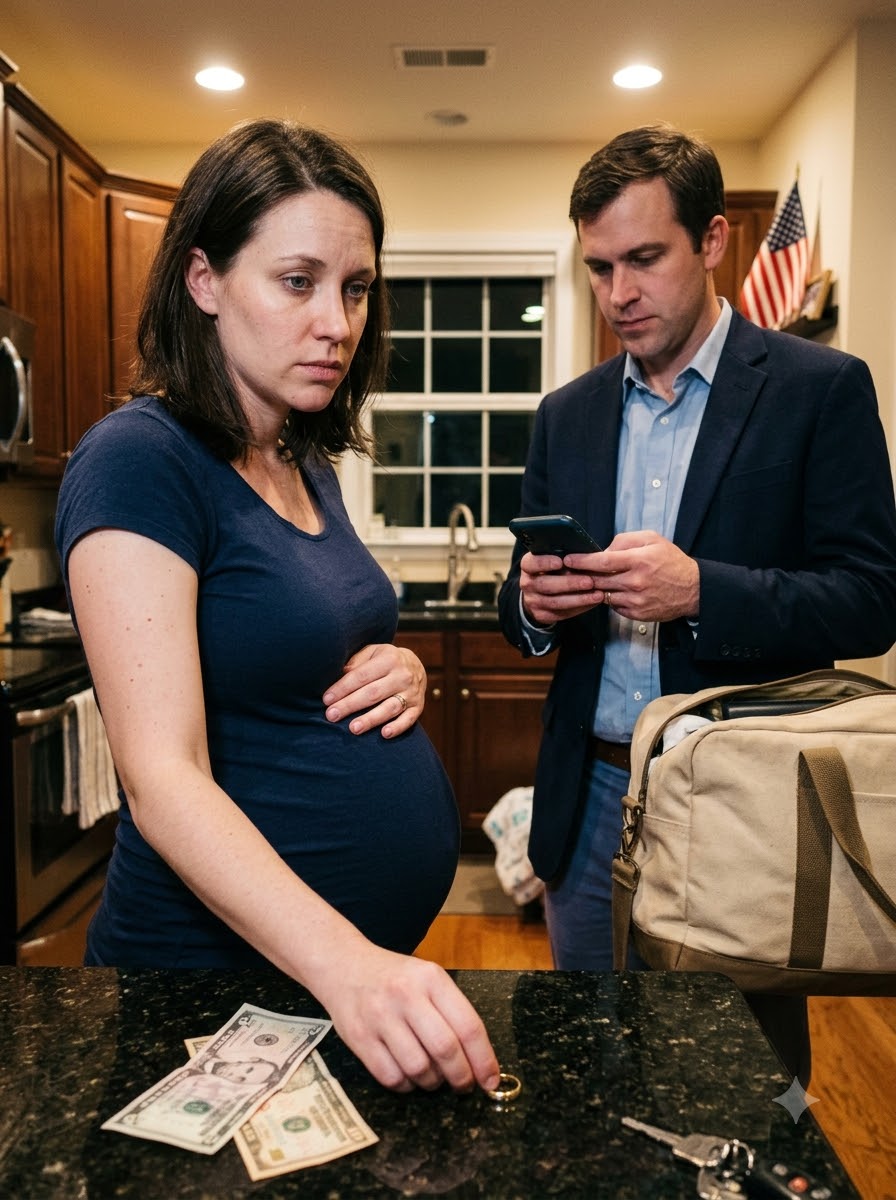
I was nine months pregnant, already in active labor, when my husband dropped fifteen dollars on the kitchen counter and told me it ought to be enough for a ride to the hospital. I was barely able to stand through the contractions, but he didn’t even look at me. He simply turned around and kept searching for his car keys, completely unfazed by the fact that his wife was ten feet away, struggling to catch her breath while carrying his child. In that moment, I finally realized something painful: if I stayed with him, I would spend the rest of my life asking a man who should have loved me to care.
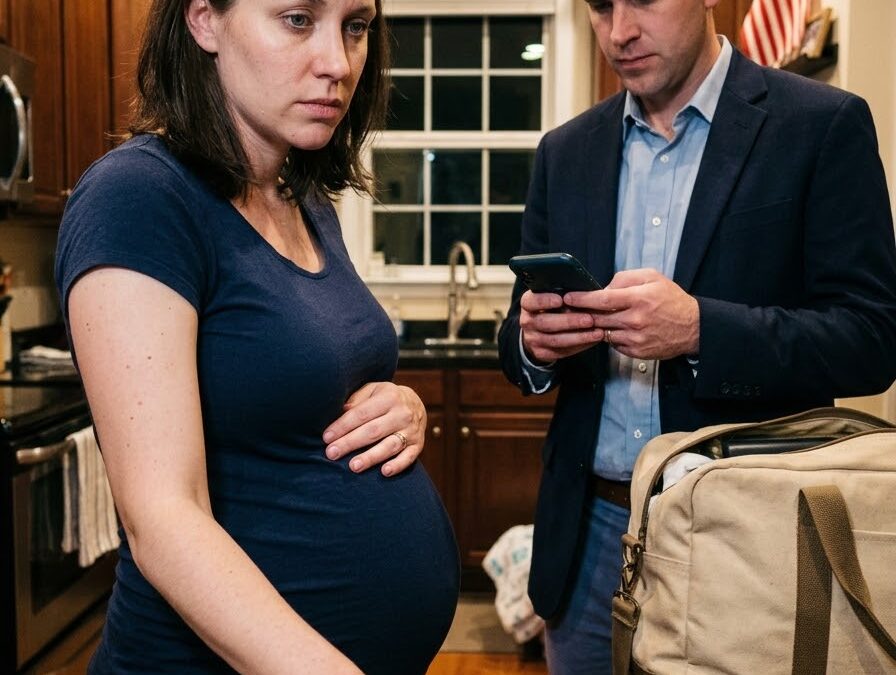
He wasn’t coming with me. He wasn’t going to drive me, hold my hand, sit beside me, or even pretend that the birth of our daughter mattered more than whatever he had planned for that evening. I didn’t argue with him, and I didn’t cry.
I didn’t ask him to choose his wife and unborn child over his dinner. I didn’t remind him that this was supposed to be one of the most important nights of our lives. Instead, I reached for my hospital bag, looked at the two bills resting on the granite, and made a decision he wouldn’t understand until much later.
What Derek didn’t know was that I had no intention of going to the hospital he expected.
That evening, I was standing in the kitchen of our house in Columbus, Ohio, with one hand pressed against the ache in my lower back and the other gripping the edge of the counter.
Another contraction tightened across my stomach, stealing my breath in a slow, crushing wave before finally beginning to ease. The clock over the stove read 7:18 p.m.
Across the room, Derek had one shoulder buried inside the junk drawer, pushing aside takeout menus, dead batteries, old receipts, and loose screws as he searched for his car keys.
He was wearing the navy shirt I had bought him for his birthday the previous year, the one he said made him look successful enough to impress clients. The sight of him getting ready for dinner while I tried not to double over felt so absurd that, for a second, I wondered if I had misunderstood the entire evening.
“I told you the contractions are five minutes apart.”
Derek finally found his keys and straightened, but he barely looked at me.
“And I told you I have a client dinner.”
There are sentences that hurt because they are cruel, and there are sentences that hurt because they confirm something you have been trying not to know. His answer did both. Another pressure was already building low in my abdomen, but somehow his indifference hurt more.
For the previous six months, Derek had treated my pregnancy as if it were an inconvenience that belonged entirely to me.
At first, I had made excuses for him because he worked long hours and because he always had some explanation ready before I could even say I was disappointed. Eventually, making excuses became easier than admitting how alone I felt.
He missed the twelve-week appointment because a meeting ran late. He skipped the anatomy scan because a client had flown in unexpectedly. When I came home holding the black-and-white ultrasound image of our daughter’s tiny profile, he glanced at it for three seconds before asking what we were having for dinner.
At night, when the baby kicked hard enough to wake me, I sometimes placed my hand against Derek’s shoulder because I wanted him to feel her move. He would groan, turn away, and tell me he had to be up early. By the third trimester, I stopped waking him.
When swollen ankles made it hard for me to stand after work, he called me dramatic. When I mentioned how exhausted I was, he reminded me that women had been having babies for thousands of years. And when my doctor discussed maternity leave, Derek laughed afterward and called it “basically a vacation.”
I had spent years believing the coldness in him was temporary. I told myself that marriage had difficult seasons, that people handled stress differently, that maybe I expected too much. Even after all of it, some stubborn, foolish part of me still believed labor would change him.
I thought there would be a moment when the contractions began and Derek would finally look at me and understand. I imagined him grabbing the hospital bag, helping me into the car, driving too carefully because he was nervous. I pictured his hand wrapped around mine while we waited to meet our daughter.
Instead, he checked the time on his phone.
“Derek, I don’t think this is early labor anymore.”
He exhaled as though I had just reminded him about a chore he had forgotten.
“What do you want me to do? Cancel dinner five minutes before I’m supposed to leave?”
I stared at him. For years, he had a way of asking questions that made basic human needs sound unreasonable. He could take almost any request and turn it into evidence that I was demanding, emotional, inconvenient.
“I want you to drive me to the hospital.”
He shook his head and pulled out his wallet.
The gesture was so casual that I didn’t understand what he was doing at first. He thumbed through the bills, removed one ten-dollar bill and one five, then dropped them onto the granite countertop between us.
“Taxi money. You know where Riverside is.”
The bills slid across the polished stone and stopped beside my hospital bag.
For several seconds, I just stared at them.
Fifteen dollars.
That was what my husband had decided the birth of our first child was worth to him that night. Fifteen dollars and directions to a hospital I had visited nearly every month of my pregnancy.
A strange thing happened then. The anger I had expected never came.
Instead, something inside me became completely calm.
The kitchen seemed sharper somehow. I noticed the faint reflection of the pendant lights in the granite. I heard the refrigerator humming behind me and the soft metallic jingle of Derek’s keys as he slipped them into his pocket.
No tears came. I didn’t raise my voice or demand an apology. I didn’t beg him to reconsider because, suddenly, the idea of convincing him to stay felt worse than leaving without him.
I picked up the fifteen dollars.
Then I looked down at my left hand.
My wedding ring had become tight during the final weeks of pregnancy. It resisted slightly when I pulled it over my swollen knuckle, but I kept twisting until it finally slipped free.
I held it between my thumb and index finger for a moment, remembering the day Derek had placed it there and promised to stand beside me through everything.
Then I set it on the granite where the money had been.
I didn’t leave him a note, because the wedding ring said everything I no longer had the strength to explain.
Derek was looking down at his phone. He didn’t notice the ring.
He didn’t notice when I zipped my hospital bag closed.
He didn’t notice when I looked around the kitchen one final time and realized I was no longer thinking of it as my home.
I walked toward the front door.
“Don’t forget your insurance card,” Derek called without turning around.
For one second, my hand froze on the doorknob.
There had been a time when that sentence would have broken me. That night, it only made my decision feel clearer.
“I have it.”
I stepped outside and closed the door gently behind me.
The September air was cooler than I expected. Our neighborhood was quiet, the kind of suburban street where porch lights glowed warmly and televisions flickered behind curtains while families finished dinner. Somewhere nearby, a dog barked twice and went silent.
I stood on the porch for a moment, breathing slowly as pressure tightened through my stomach again. The contraction was stronger than the last one, and I gripped the strap of my bag until it passed. When I could move, I started walking toward the end of the street.
Riverside Hospital was not where I was going.
Three weeks earlier, Derek had forgotten our anniversary.
It was our seventh. I had bought ingredients for the pasta dish we ate on our first date, put candles on the dining table, and waited until nearly ten before he finally came home. When he walked through the door and saw the table, his first reaction was confusion.
Then annoyance.
“You could have reminded me.”
I thought he was joking.
“It’s our anniversary, Derek.”
He dropped his laptop bag near the stairs.
“I’ve had a brutal week. You know that.”
I had stood beside the table with two untouched plates growing cold between us. I remember looking at the candles, already burned halfway down, and feeling something inside me slowly collapse.
“I just wanted you to remember.”
His expression hardened.
“This is exactly what I’m talking about. Everything has become a crisis since you got pregnant.”
I blinked.
“What?”
“You’re emotional all the time now. I can’t say anything without you turning it into some huge thing.”
The argument lasted less than ten minutes. Derek went upstairs, and I remained at the table until both candles went out. For the first time in years, instead of wondering how to fix the argument, I wondered why I was always the one expected to fix everything.
That night, I called my older sister Rachel in Pittsburgh.
We had always been close, but during my marriage to Derek, I had become skilled at giving her edited versions of my life. I told her he was busy instead of saying he ignored me. I told her we were careful with money instead of explaining that he questioned nearly every purchase I made.
I told her we argued sometimes. I never told her what the arguments were actually like.
Rachel answered on the third ring.
“Hey. Everything okay?”
I tried to say yes.
Instead, I started crying.
At first, I apologized. I told her I was probably overreacting and blamed the pregnancy hormones before I even explained what had happened. Rachel stayed quiet until I ran out of ways to minimize it.
Then I told her the truth.
I told her how Derek controlled nearly every dollar in our bank account even though I worked full-time before maternity leave. My paycheck went into our joint account, but every major expense required a conversation that felt more like an interrogation.
I told her how he belittled my job in marketing because he earned more than I did. Whenever I disagreed with him about money, he reminded me that his income was what made our lifestyle possible. He called my career “a nice little job” even though I had spent almost a decade building it.
I told her that during arguments, Derek had a list he repeated like evidence.
The house was his because he had provided most of the down payment.
The car was his because the loan was in his name.
The insurance was his because it came through his employer.
Sometimes he even reminded me that the phone plan was his.
By the time he finished, there seemed to be almost nothing in my life that fully belonged to me.
Rachel listened without interrupting.
When I finally stopped talking, there was a long silence on the line.
“Why didn’t you tell me?”
I wiped my face with the sleeve of my sweater.
“I don’t know.”
“Yes, you do.”
I closed my eyes.
“Because saying it out loud makes it sound worse.”
Rachel’s voice softened.
“No. Saying it out loud makes it sound like what it is.”
I didn’t answer.
I could hear traffic in the background on her end, then a car horn somewhere far away.
“What are you going to do?”
“I’m having a baby in three weeks. What can I do?”
Rachel went silent again.
Then she said the sentence that changed everything.
“If you ever decide to leave, don’t give him a warning. Just come.”
I sat alone at the dining table, staring at the dead candles from our forgotten anniversary.
“You mean Pittsburgh?”
“I mean me. My house. My couch. My guest room. I don’t care. You call me, and I come get you.”
Something about the certainty in her voice made my chest tighten.
“What if I’m making too much of this?”
“You’re not.”
“What if he changes when the baby comes?”
Rachel took a breath.
“Then he can prove it with actions. But you don’t have to gamble your entire life waiting for that.”
That night, after Derek had gone to sleep, I opened a small suitcase in the nursery and started quietly gathering things.
Not enough for him to notice.
Copies of my identification. A few clothes. The baby’s first outfit. Medical records. A charger. Some cash I had slowly set aside from grocery purchases and small refunds.
I hid the bag behind boxes in the nursery closet.
Over the next three weeks, Rachel and I planned very little. We agreed that if I called, she would come. No warnings, no confrontation, no dramatic announcement.
I wasn’t even certain I would go through with it.
Until the fifteen dollars.
At the end of our street, a gray Honda was parked beneath a streetlamp.
Rachel had driven nearly three hours to reach Columbus after receiving one message from me earlier that evening.
Come tonight.
She stepped out of the car the moment she saw me walking toward her.
At first, relief crossed her face.
Then her eyes dropped to my stomach.
Another contraction hit before I reached the passenger door.
I grabbed the side of the car and bent my head, focusing on breathing through it. Rachel rushed toward me, one hand hovering near my arm, unsure whether touching me would help.
“You’re in labor.”
I managed a breathless laugh.
“Probably.”
Her face went pale.
“How far apart?”
“Five minutes. Maybe less now.”
Rachel looked back toward my house, then toward me.
“Then we’re going to the hospital.”
I shook my head.
“Not his hospital.”
She stared at me.
“What?”
“Not Riverside.”
Another contraction began gathering before the last one felt fully gone. I leaned against the car and waited until I could speak again.
Rachel lowered her voice.
“Okay. There are other hospitals in Columbus.”
I looked at her.
“Not his city either.”
For several seconds, she said nothing.
She understood then.
This wasn’t a fight.
I wasn’t leaving for one night so Derek could calm down.
I was leaving.
Rachel opened the passenger door.
“Get in.”
I slid into the seat, placed my hospital bag at my feet, and fastened the seat belt beneath my stomach. Rachel hurried around to the driver’s side, started the engine, and pulled away from the curb.
As we passed my street, I looked back once.
Our house was visible for only a few seconds between the trees and parked cars. The porch light was still on. Derek’s car was still in the driveway.
Then Rachel turned onto the main road, and the house disappeared.
My phone rang less than ten minutes later.
Derek.
I watched his name flash across the screen.
Rachel glanced at the phone mounted loosely in my hand.
“You don’t have to answer.”
“I know.”
The call stopped.
Thirty seconds later, it rang again.
I let it go.
The third call came while we were merging onto the highway.
I finally answered.
“Where are you?”
There was no hello.
I looked out the window at the lights streaking past us.
“On my way.”
“To Riverside?”
I stayed silent.
“Hello?”
“I heard you.”
His voice sharpened.
“Then answer me. Are you going to Riverside?”
I glanced at Rachel. She kept both hands on the steering wheel, eyes fixed on the road.
“No.”
There was a pause.
“What do you mean, no?”
I could picture him in the kitchen, finally noticing the hospital bag was gone. Maybe he had seen the ring by then. Maybe he hadn’t.
“I’m going somewhere else.”
“Where?”
Another contraction started.
I closed my eyes and breathed.
“Where are you?” he repeated.
I ended the call.
My hands were shaking afterward, and that surprised me. I had expected to feel triumphant or free the second we left Columbus. Instead, I felt terrified.
For seven years, every major decision in my life had somehow passed through Derek. Where we lived. What car we drove. How much we saved. When we traveled. Even which hospital would deliver our child.
Now, for the first time, I was making a decision he had not approved.
The freedom of it felt almost as frightening as the marriage had.
Rachel reached over and squeezed my forearm between contractions.
“You’re okay.”
“I don’t know if I am.”
“You don’t have to know yet.”
My phone rang again.
Then again.
Then again.
By the seventh call, Derek had started sending messages.
Where are you?
Stop acting crazy.
You are about to have a baby. This is not the time for drama.
Tell me what hospital.
I read that last message twice.
Not because it hurt.
Because it didn’t.
Three weeks earlier, those words might have made me question myself. That night, sitting beside my sister while highway lights moved across the windshield, I could finally see the pattern.
Every time I was hurt, Derek called me emotional.
Every time I resisted him, I was dramatic.
Every time his choices had consequences, somehow my reaction became the problem.
For years, he had taught me to distrust my own pain because that made it easier for him to ignore it.
We drove east.
Columbus slowly vanished behind us.
At first, Rachel tried to keep conversation light between contractions. She asked whether I had eaten. She told me there were crackers in the glove compartment. She promised we would stop whenever I needed.
Eventually, I couldn’t answer.
The contractions were getting stronger.
Each one seemed to take over my entire body, beginning in my lower back and wrapping around my stomach until there was no room in my mind for anything except breathing.
I pressed my forehead against the cold passenger window and counted silently until the pain loosened.
Rachel checked the dashboard clock.
“That was four minutes.”
“I know.”
“We might need to stop sooner.”
“I know.”
Another call came from Derek.
Then another.
By the time we reached the area outside Zanesville, he had called seventeen times.
His messages had changed tone too.
Pick up.
This isn’t funny.
Your doctor is at Riverside.
You can’t just disappear.
We need to talk.
Then finally:
I found the ring.
I stared at those four words.
My wedding ring had sat on the counter for nearly three hours before he noticed it.
Rachel glanced over.
“What?”
“He found it.”
She didn’t ask what I meant.
A minute later, another message appeared.
What is this supposed to mean?
I almost laughed.
Not because anything was funny, but because the question was so perfectly Derek. Even now, he wanted me to explain what he should have understood years ago.
I typed a response.
It means I’m done.
My thumb hovered over Send.
Then I deleted it.
I didn’t owe him an explanation while I was in labor.
Another contraction hit, stronger than anything before it.
I gasped and grabbed the door handle.
Rachel immediately straightened.
“What? What happened?”
“I don’t know.”
Then I felt warmth beneath me.
For one stunned second, neither of us understood.
I looked down.
“Rachel.”
Her eyes flicked toward me.
“What?”
“My water just broke.”
Her face drained of color.
“Oh my God.”
“Please don’t say it like that.”
“I’m not saying anything.”
“You just said ‘Oh my God.’”
“I’m adjusting.”
Despite the pain, a breathless laugh escaped me. Rachel laughed too, but hers had panic underneath it.
She moved into the right lane.
“We are stopping at the next hospital.”
I started to shake my head.
“No. Keep going.”
“We are not driving all the way to Pittsburgh.”
“I know.”
“I mean it.”
“I know.”
Rachel looked at me again.
“We find the closest hospital near the state line. Okay?”
I closed my eyes as another contraction started.
“Okay.”
My phone rang again.
Derek.
The screen lit up in my palm while the contraction tightened.
I stared at his name.
For years, seeing his name on my phone had triggered a reflex. Answer quickly. Explain clearly. Avoid making him angry.
That reflex was still there.
But something else was stronger now.
I held down the power button.
The screen went black.
For the first time in our marriage, Derek could demand an answer and I could simply choose not to give him one.
Rachel looked at the dark phone.
“Good.”
I leaned my head back against the seat.
“I’m scared.”
“I know.”
“What if I’m making a huge mistake?”
Rachel tightened her hands around the steering wheel.
“You’re having a baby while your husband is more concerned about where you went than why you left.”
I looked at her.
“That’s not what I meant.”
“I know. But remember it anyway.”
The next forty minutes blurred together.
Road signs appeared and disappeared in the headlights. Rachel called hospitals through the car’s hands-free system until a nurse told us where to go. I stopped tracking the contractions because there was barely enough time between them to recover.
When we finally pulled into the emergency entrance of a small hospital near the Pennsylvania state line, Rachel leaned on the horn.
Two nurses rushed out with a wheelchair.
One of them took one look at me and stopped asking unnecessary questions.
“How close are the contractions?”
“Very.”
“When did your water break?”
“Maybe forty minutes ago.”
“First baby?”
“Yes.”
They moved quickly.
Rachel grabbed my bag from the car and ran behind us while a nurse pushed me through bright fluorescent corridors. The smell of antiseptic, the squeak of wheels, the blur of signs overhead—everything felt unreal.
At the admissions desk, someone asked for my husband’s information.
I froze.
Rachel stood beside me.
“You don’t have to call him.”
The nurse looked between us, understood something without needing details, and changed the question.
“Who do you want listed as your emergency contact?”
I looked at Rachel.
“My sister.”
Rachel’s eyes filled immediately, but she nodded.
The room they brought me into was small and bright, with pale walls, a narrow couch, monitors, and a window overlooking a dark parking lot. Nurses moved around me with practiced efficiency while Rachel tried to stay out of their way.
A doctor examined me.
Then she looked up.
“You’re further along than I expected.”
“How far?”
“Eight centimeters.”
Rachel made a small sound from across the room.
I closed my eyes.
“So I can’t go anywhere.”
The doctor smiled gently.
“No. You’re having this baby here.”
Something about those words settled me.
Here.
Not Riverside.
Not Columbus.
Not the hospital Derek had selected because it was covered by his insurance network and close to his office.
Here.
A place neither of us had planned.
A place he didn’t know.
The next few hours stripped away everything except the immediate work of labor.
There was no space left for Derek, our marriage, the house, the money, or the ring. There was only pain and breath and Rachel’s hand locked around mine.
Whenever I started to panic, she brought me back.
“Look at me.”
I did.
“You can do the next minute.”
“I can’t.”
“You can.”
“I really can’t.”
“You already are.”
At some point, exhaustion became heavier than fear.
I remember gripping Rachel’s hand and suddenly thinking about the nursery at home. The crib Derek and I had assembled without speaking after an argument. The folded blankets in the dresser. The little painted wooden sign with Emily’s name above the crib.
For one terrible second, guilt flooded me.
I had taken her away from her father before she had even met him.
Then another thought followed.
No.
He had chosen not to come.
I hadn’t hidden the fact that I was in labor.
I hadn’t stopped him from driving me.
I hadn’t told him to choose dinner.
He had made that decision himself.
I had spent so many years carrying the consequences of Derek’s choices that I had almost mistaken them for my own guilt.
Shortly after three in the morning, the doctor told me it was time.
Rachel moved beside my shoulder.
My entire body shook from exhaustion.
“I can’t do this.”
She leaned close.
“Yes, you can.”
“I’m so tired.”
“I know.”
“I thought he’d be here.”
Rachel’s face changed.
For one heartbeat, I saw the sadness she had been trying to hide from me all night.
Then she squeezed my hand.
“I’m here.”
Those two words broke something open inside me.
Not because they replaced Derek.
They didn’t.
But because I finally understood the difference between someone who promised to be there and someone who actually was.
The room filled with voices.
The doctor gave instructions.
A nurse counted.
Rachel stayed beside me.
At 3:41 that morning, my daughter entered the world.
Her cry was immediate.
Sharp.
Indignant.
Beautiful.
For a moment, everything stopped.
The doctor lifted her just high enough for me to see a tiny red face, dark wet hair, clenched fists, and a furious expression that made Rachel laugh through her tears.
“She’s perfect,” Rachel whispered.
A nurse wrapped Emily quickly and brought her to me.
The second they placed her against my chest, the entire night disappeared.
The kitchen.
The bills.
The highway.
The phone calls.
The fear.
All of it went quiet.
Emily’s cheek rested against my skin, and her tiny fingers moved weakly beneath the blanket. I touched the back of her head with trembling fingertips.
That was when I finally cried.
Not the controlled tears I had swallowed for years.
Not the quiet tears I had hidden in showers or wiped away before Derek came home.
I cried so hard I could barely breathe.
Rachel stood beside the bed, crying too.
“She’s here.”
I nodded.
“She’s really here.”
For months, I had imagined this moment with Derek beside me.
I had pictured him touching Emily’s hand and looking at me differently. I had believed becoming a father might reveal some tenderness in him that marriage had never managed to reach.
But when I held my daughter, I realized I wasn’t crying because he had missed it.
I wasn’t crying because my marriage was over.
I was crying because I had spent years believing leaving Derek would mean losing everything.
The house.
The car.
The money.
The security.
The future I had planned.
And now I was sitting in a hospital bed nearly two hundred miles away, holding seven pounds of proof that I had been wrong.
Walking away from him had not left me with nothing. It had given me the chance to build a life that was finally mine.
Rachel sat down beside the bed.
“What are you thinking?”
I looked at Emily.
“That I almost stayed.”
Rachel didn’t answer.
“If he had driven me tonight, I probably would have stayed.”
She looked at me carefully.
“Maybe.”
“I would’ve told myself he came through when it mattered.”
Rachel nodded.
“And I would have ignored everything that happened before.”
“Maybe.”
I looked toward the dark window.
“He gave me fifteen dollars.”
Rachel let out a long breath.
“I know.”
“He really thought that was enough.”
Her eyes moved to Emily.
“It was.”
I frowned.
“What?”
“It was enough to show you who he was.”
I looked down at my daughter again.
For the first time all night, the truth didn’t hurt.
Around six that morning, Rachel turned my phone back on after asking if I was ready.
There were dozens of missed calls.
Messages filled the screen.
At first, Derek had been angry.
Where are you?
Call me immediately.
You can’t just take off like this.
Then confused.
Did Rachel pick you up?
Are you in Pittsburgh?
Then concerned, or at least trying to sound concerned.
Are you okay?
Is the baby okay?
Tell me what hospital.
The final message had arrived less than ten minutes earlier.
Please call me.
I stared at it for a long time.
Rachel waited.
“You don’t have to.”
“I know.”
I opened the message box.
For several seconds, I didn’t know what to write.
There were too many things I could have said.
You should have come with me.
You should have cared before I left.
You should have noticed the ring.
You should have been here.
Instead, I typed one sentence.
Emily was born at 3:41. She is healthy.
I sent it.
The phone rang almost immediately.
Derek.
I watched the screen.
Rachel looked at me but said nothing.
I declined the call.
A message arrived seconds later.
You named her Emily without me?
I stared at it in disbelief.
Emily had been the name we had agreed on four months earlier.
Another message came.
Where are you?
Then:
I’m her father.
The words made my stomach tighten in a way that had nothing to do with labor anymore.
For months, Derek had acted as though fatherhood were something scheduled to begin after the birth. The appointments, the discomfort, the planning, the fear—those had all been mine.
Now suddenly the title mattered.
I placed the phone face down.
Rachel watched me.
“You okay?”
“Yes.”
And for once, I meant it.
Later that morning, while Emily slept against my chest, I thought about the kitchen counter back in Columbus.
I imagined Derek finally coming home from his client dinner, perhaps irritated that I hadn’t answered him. I pictured him walking into the quiet kitchen and noticing the hospital bag missing.
Then the fifteen dollars would have been gone.
And in their place, beneath the pendant light, there would have been one wedding ring.
I wondered how long he stared at it.
I wondered whether he understood immediately.
Part of me hoped he did.
Another part no longer cared.
For years, I had thought the worst thing that could happen was losing my marriage.
That fear had kept me patient long after patience became self-erasure.
It had kept me explaining myself to someone committed to misunderstanding me.
It had kept me grateful for crumbs because I was terrified of having nothing.
But sitting in that hospital room, watching the morning sunlight slowly brighten the wall above Emily’s bassinet, I finally understood how wrong I had been.
There are losses that empty you.
And there are losses that make room.
By noon, Rachel was asleep in the chair beside the window, curled awkwardly beneath a hospital blanket. Emily rested against me, making tiny sounds in her sleep.
I looked down at her face.
She had Derek’s chin.
The realization hurt for a moment.
Then it passed.
She was not a symbol of my marriage.
She was not evidence of what had failed.
She was herself.
My daughter.
A new life beginning on the same night another part of mine ended.
I kissed her forehead.
“I’m sorry it started like this.”
Emily shifted in her sleep.
I smiled through fresh tears.
“But I promise it won’t stay like this.”
Nearly two hundred miles away in Columbus, Derek still had the house, the car, his insurance, his bank accounts, and every possession he had spent years reminding me belonged to him.
He also had fifteen dollars missing from the kitchen counter.
And a wedding ring sitting in its place.
What he didn’t have was me.
He didn’t have the woman who had spent years trying to become easier to love.
He didn’t have the wife who had convinced herself that loneliness inside a marriage was safer than uncertainty outside it.
And he had missed the first breath of the daughter he had assumed would enter the world according to his schedule.
Derek thought I had walked out of our house with nothing but a hospital bag. He didn’t understand that I had carried the most important things with me: my daughter, my choice, and the part of myself I had finally stopped surrendering.
That night had begun with fifteen dollars sliding across a granite countertop.
It ended with my daughter sleeping safely against my chest while my sister kept watch beside us.
For years, Derek had made me believe that everything important belonged to him.
The house was his.
The car was his.
The insurance was his.
The money was his.
But as dawn rose outside that unfamiliar hospital, one truth finally became impossible to deny.
My life was mine.
And for the first time in years, I knew exactly what I intended to do with it.








