I’m a nurse who picked up extra shifts at a nursing home just to make ends meet. I was assigned to care for the grumpiest resident—the one everyone tried to avoid. But then, when I accidentally knocked over his nightstand, a photograph fell out that left me stunned…
Olivia Collins was in her third year of nursing school in Portland, Oregon, and most days felt like an endurance test she hadn’t volunteered for.
Her weeks were divided into rigid blocks of time. Lectures in the early mornings, clinical rotations that ran long, and a low-paid part-time position at a public clinic that filled whatever hours were left.
None of it felt optional. Each commitment was necessary. Each hour accounted for, each dollar earned already spoken for before it reached her hands.
She lived in student housing on the edge of campus, a narrow room with thin walls and a radiator that never seemed to work properly. The space was clean but sparse. There were no decorations, no personal touches beyond a small stack of textbooks, a secondhand desk, and a battered backpack that carried her life back and forth across the city.
Olivia kept her expenses to a minimum out of habit, not choice. Growing up in foster care had taught her early how quickly stability could vanish, how important it was to live as if things might be taken away at any moment.
Money was always tight. But as autumn settled into Portland and the air turned damp and cold, the pressure became harder to ignore.
Olivia’s stipend had run out weeks earlier. Her clinic paycheck barely covered transportation, food, and tuition-related costs. Winter was coming fast, and she still hadn’t replaced her warm coat.
Each morning, she stepped outside and felt the cold seep through the fabric, settling into her bones before she reached the bus stop.
She told herself it was temporary.
Everything was temporary.
That was how she survived.
At the clinic, the pace never slowed. Patients came and went in a steady stream. Many elderly, many struggling, all needing more time than the system could offer them.
Olivia moved through her tasks with practice efficiency, checking vitals, updating charts, assisting physicians where she could. She liked the work even on the hardest days.
Medicine gave her structure. It gave her purpose, but it didn’t give her security.
Not yet.
One evening, as she finished a late shift and gathered her things from the staff room, Olivia paused near the bulletin board by the exit. The board was cluttered with flyers that had been there for months—tutoring offers, apartments she couldn’t afford, notices long past their relevance.
She almost walked past it without looking.
Almost.
A single new posting caught her attention.
It was neatly printed and pinned over the others, the paper crisp and uncreased.
A private senior living facility, Evergreen Care Residence, was seeking licensed nursing students for weekend shifts. The hours were long but flexible. The compensation was listed clearly, without exaggeration.
Olivia read the number twice, certain she had misunderstood.
The pay was significantly higher than anything she had earned before.
She stood there longer than she meant to, rereading the details.
Weekend shifts meant sacrificing the only downtime she had. It meant longer weeks, less rest, more strain. But it also meant warmth, stability, the possibility of buying a winter coat without calculating how many meals she would have to skip in return.
Olivia pulled out her phone and took a photo of the listing, her hand stiff from the cold.
The decision didn’t come with relief.
It came with resignation.
She already knew the answer.
She always did.
That night, back in her room, Olivia sat at her desk with a cup of cheap tea that had long since gone cold. Her textbooks were open in front of her, but she couldn’t focus.
Her mind kept returning to the flyer, to the number printed in bold near the bottom.
She thought about her schedule, about how much sleep she could afford to lose. She thought about the winter mornings ahead, the long walk to the bus stop, the cold that never quite left her fingers.
By the time she closed her laptop, the choice had settled into place.
The next day, during a brief lull at the clinic, Olivia typed out a short application email. She kept it professional and concise, listing her credentials, her current program, her availability.
When she hit send, there was no sense of accomplishment, only the quiet understanding that this was what survival looked like now.
Exhausted and already stretched thin, Olivia Collins didn’t feel hopeful as she applied to Evergreen Care Residence.
She felt practical.
And in her life, that had always been enough.
Evergreen Care residents sat on the outskirts of Portland, tucked away behind a line of tall evergreens that muffled the sounds of the road beyond.
Olivia arrived early, stepping off the bus onto a quiet street that felt far removed from the pace of the city. The air smelled faintly of wet leaves and pine.
A narrow path curved toward the building, bordered by trimmed hedges and benches placed at careful intervals, as if inviting slow walks and long pauses.
The building itself was old, but not neglected. Its brick exterior showed age in a way that suggested history rather than decay. Large windows lined each floor, and the entrance doors opened into a lobby that was warm and orderly.
Soft lighting replaced the harsh fluoresence Olivia was used to at the clinic.
For a moment, she stood still, taking it in, unsure what she had expected, but aware that this place operated on a different rhythm.
She was greeted by the nursing supervisor, a composed woman with a firm handshake and a practice smile.
The interview was brief and efficient. Olivia’s credentials were reviewed, her academic standing confirmed, and her availability noted.
There were no unnecessary questions, no attempts at small talk.
When the supervisor nodded and said they could move directly to orientation, Olivia felt a quiet sense of relief.
They began with the basics.
Evergreen Care residents housed older adults whose families could afford long-term private care. Some residents were largely independent. Others required full medical supervision.
The expectations for staff were clear: professionalism, consistency, and patience.
The shifts were long, especially on weekends, but the structure was stable. Medication schedules were strict. Documentation was non-negotiable.
Residents’ dignity was treated as a priority, not a courtesy.
As they walked through the corridors, Olivia noticed how calm everything felt. Voices were low, movements were unhurried.
There was a small library with armchairs facing tall windows, a dining hall that smelled faintly of coffee, and a common room where a handful of residents sat watching the rain streak down the glass.
It was quieter than the clinic, but not empty.
The quiet had weight to it.
They took the elevator up to the third floor.
“This is where things get more complicated,” the supervisor said, her tone shifting slightly. “Most of our residents here need closer monitoring, and some don’t make it easy.”
Olivia listened without interrupting, her hands folded loosely in front of her.
She had learned early on that people revealed more when they weren’t rushed.
As they continued down the hallway, the supervisor stopped outside a door near the end. She didn’t knock.
Instead, she turned to Olivia, her expression measured.
“Victor Harrington,” she said. “Former professor. Classical music. Brilliant mind. Difficult temperament.”
She explained that Victor had been at Evergreen for some time. He was mentally sharp, fully aware of his surroundings, and deeply resentful of being there.
He refused medication regularly, challenged staff authority, and had a habit of reducing conversations to sharp remarks that left younger nurses flustered or angry.
Several had requested reassignment after only a few weeks.
“He doesn’t like feeling managed,” the supervisor continued. “And he doesn’t hesitate to make that clear.”
Olivia nodded, absorbing the information.
None of it surprised her.
Every facility had at least one patient everyone quietly hoped someone else would handle.
“We don’t force assignments,” the supervisor added. “If you’d prefer another floor, we can arrange that.”
Olivia glanced at the closed door, then back at the supervisor.
She thought about the job listing, the number printed in bold. The coat she still hadn’t bought.
She thought about how often she had been labeled difficult herself, for asking questions, for not backing down, for surviving when it made others uncomfortable.
“I’ll take the third floor,” she said simply.
The supervisor studied her for a moment, then nodded.
“All right. We’ll see how it goes.”
They finished the tour without further mention of Victor Harrington.
Olivia signed the remaining paperwork, received her schedule, and was told when to report for her first shift.
As she stepped back outside into the damp afternoon air, she felt no sense of accomplishment, only a quiet awareness that something had been set in motion.
At the time, Olivia Collins had no way of knowing that the man behind that closed door would change the shape of her life.
She only knew that she had accepted another responsibility, just as she always had, without complaint, without expectation, and without realizing how much it would cost her to walk away later.
Olivia’s first weekend shift at Evergreen Care Residence began before sunrise.
The building was quieter than she had expected, the hallways dimly lit, the air carrying the faint scent of disinfectant and old paper.
After checking in at the nurse’s station on the third floor and reviewing her assignments, she picked up a thin chart with a name already familiar to her.
Victor Harrington.
She paused outside his room for a moment, reading the notes carefully.
Medication compliance inconsistent.
Attitude toward staff uncooperative.
Cognitive status fully intact.
Olivia took a slow breath, adjusted her badge, and knocked once before opening the door.
The room was unlike any other she had seen that morning.
Books lined the shelves and spilled onto the window sill, the desk, even the floor beside the bed. Stacks of sheet music lay neatly arranged in small piles, some yellowed with age, others marked with handwritten notes in careful script.
A narrow desk stood near the window, its surface cleared except for a lamp, a pen, and a few loose pages covered in precise handwriting.
Everything in the room suggested order, discipline, and a life shaped by thought.
Victor Harrington sat in a chair by the window, his back partially turned. He was tall and thin, his posture rigid despite his age.
Without looking at her, he spoke.
“Another one,” he said. “They’re persistent. I’ll give them that.”
Olivia closed the door behind her and approached at an unhurried pace.
“Good morning, Mr. Harrington,” she said evenly. “My name is Olivia Collins. I’m your nurse for today.”
He turned his head just enough to glance at her, his pale eyes sharp and assessing.
“You’re young,” he said, “which means you’ll be gone soon enough.”
Olivia didn’t react.
She moved toward the bedside table and checked the medication tray, her motions deliberate and calm.
“I’m here for the weekend,” she replied, “and possibly longer, depending on how things go.”
Victor snorted softly.
“That’s what they all say.”
She placed the medication cup and a glass of water on the table within his reach.
“These are your morning medications,” she said. “They’re for your heart and blood pressure. The doctor reviewed the dosage earlier this week.”
“I don’t take them,” Victor said flatly.
“I’m aware,” Olivia replied.
He turned fully toward her now, clearly expecting resistance, perhaps an argument.
When none came, his expression tightened.
“You can tell them I refused,” he said. “You won’t be the first.”
Olivia met his gaze without challenge.
“I will document whatever you decide,” she said. “That’s my responsibility.”
For a moment, the room was silent except for the muted sound of rain against the glass.
Victor watched her closely, as if waiting for something more.
“That’s it?” he asked. “No lecture?”
“No,” Olivia said. “You’re capable of making your own decisions.”
Something flickered across his face. Surprise, perhaps, or irritation that didn’t know where to settle.
He looked away, back toward the window.
“Everyone here is so eager to remind me what I should do,” he muttered, “as if I forgotten how to think.”
Olivia glanced around the room, taking in the books, the music, the order.
“You haven’t,” she said quietly.
Victor’s head turned again, slower this time.
“What did you say?”
“I said you haven’t forgotten how to think,” she repeated. “Your room suggests otherwise.”
He studied her, clearly weighing her words.
“You know what all of this is?” he asked, gesturing vaguely at the shelves.
“I know what some of it is,” Olivia answered. “And what I don’t recognize, I can usually tell belongs together.”
A faint, humorless smile touched his mouth.
“That’s a generous assessment.”
They stood there in silence for another moment, the tension easing just enough to breathe.
Victor glanced at the sheet music closest to him, then back at Olivia.
“You listen to classical music?” he asked.
“Sometimes,” she said honestly. “Not as much as I probably should.”
“Hm.”
He leaned back slightly in his chair.
“Most people don’t listen anymore. They hear noise. That’s not the same thing.”
Olivia nodded.
“Memory works that way, too,” she said. “Some things stay even when others fade.”
Victor’s eyes narrowed, but there was less hostility in them now.
“You’re careful with your words,” he said. “That can be dangerous.”
“It can also be useful,” Olivia replied.
He looked at the medication again, then at her.
The moment stretched.
Finally, with a dismissive sigh, Victor reached for the glass.
“Fine,” he said. “But don’t misunderstand this.”
He swallowed the pills without ceremony and set the glass down.
“It doesn’t mean anything.”
Olivia allowed herself a small nod.
“I wouldn’t assume it did.”
As she made a note in his chart, Victor watched her, his expression unreadable.
When she turned to leave, he spoke again.
“You’re different,” he said.
“Don’t get used to that.”
Olivia paused at the door, then looked back.
“I don’t,” she said. “I just do my job.”
She closed the door quietly behind her, unaware that this brief, restrained exchange had shifted something neither of them could yet name.
Over the following weekends, a pattern began to form quietly and without ceremony.
Olivia arrived early, reviewed her assignments at the nurse station, and made her way down the third-floor hallway with the same steady pace.
Victor Harrington remained on her list, and with each visit, the tension of their first meeting softened into something more measured, more deliberate.
She did her work efficiently.
Vital signs were checked, medications prepared, notes entered with care.
Victor no longer refused outright.
He still complained, still questioned the necessity of each pill, but the refusals became rare.
When Olivia explained what he was taking and why, she did so without condescension or urgency.
She never hovered, never pushed.
She documented everything and respected his autonomy.
And over time, that respect was returned in small, almost imperceptible ways.
Once her medical duties were finished, Olivia often lingered for a few minutes.
At first, she stood near the door, ready to leave at the slightest sign of irritation.
Victor noticed.
Of course, he noticed everything.
“You’re hovering,” he said one afternoon without looking at her.
“I can go,” Olivia replied.
He paused, then reached toward the small audio player on his desk.
“You may as well stay,” he said. “If you’re going to stand there, you might learn something.”
That was how it began.
Victor played recordings from his collection. Piano sonatas, violin concerto, orchestral works that filled the small room with sound that felt out of place in a senior care facility.
He didn’t lecture at first.
He simply listened, his eyes closed, his fingers resting lightly on the arm of his chair.
Olivia sat nearby, quiet and attentive, unsure what was expected of her.
After a while, he began to speak.
“People think listening is passive,” he said once as a slow movement faded into silence. “It isn’t. Real listening requires discipline, memory, patience.”
Olivia nodded, unsure whether he wanted a response.
“It sounds deliberate,” she said carefully.
Victor opened his eyes and glanced at her.
“Exactly.”
The sessions grew longer.
Victor talked about composers he had known, performances that still lived vividly in his mind, the way certain passages could call up entire decades with painful clarity.
He spoke with bitterness about the modern world, about noise mistaken for meaning, about attention spans that fractured too easily.
His disappointment was sharp but controlled, like a blade kept carefully sheathed.
Olivia listened.
In return, she began to share small truths of her own.
She didn’t tell her story all at once. Instead, it came out in fragments, casual remarks made without emphasis.
She mentioned moving through multiple foster homes, learning early not to expect permanence, choosing nursing because it was practical, because it offered a clear path forward.
She spoke of long nights studying after shifts, of exams taken on little sleep, of the constant fear of falling behind.
Victor absorbed these details without comment.
He didn’t interrupt.
When he did speak, it was to ask questions that surprised her with their precision.
“You never had parents?” he asked once, not unkindly.
“No,” Olivia said. “Not really.”
He nodded as if confirming something only he could see.
“That explains the restraint.”
She didn’t ask what he meant.
As the weeks passed, changes became noticeable.
Victor finished his meals more consistently. His posture straightened when Olivia entered the room.
He no longer greeted her with hostility, though he maintained a sharp edge in his voice that seemed more habit than intent.
He took his medication with minimal protest, occasionally commenting on dosage adjustments with an air of reluctant approval.
“You’re thorough,” he told her one morning. “Annoyingly so.”
“I’ll take that as a compliment,” Olivia replied.
He huffed, but there was no real irritation behind it.
The music sessions became an unspoken agreement.
Olivia never rushed them, but she never stayed longer than she should.
Victor respected that boundary, even as he began to look forward to her visits.
There was purpose in these moments, something neither of them named but both recognized.
For Olivia, the room felt different now, less like a workplace, more like a quiet refuge carved out of obligation and chance.
For Victor, the days no longer blurred together as easily.
There were things to anticipate, conversations that mattered, silence that felt earned rather than imposed.
Neither of them spoke of change.
They didn’t need to.
It was there in the small adjustments, the shared listening, the discipline of presence, and somewhere between the music and the pauses that followed.
A bond took shape, fragile, deliberate, and quietly transformative.
The questions did not begin abruptly.
They slipped into the spaces between conversations, asked in the same measured tone Victor Harrington used for everything else, as if they were incidental rather than deliberate.
One afternoon, while Olivia was recording his vitals, he glanced at her chart and said, “Your last name, Collins. Is that the name you were given at birth?”
Olivia paused for only a moment.
“Yes,” she said. “As far as I know.”
“As far as you know,” Victor repeated, not as a challenge, but as an observation.
She finished writing and kept her pen.
“That’s what’s on the records.”
He nodded slowly, filing the answer away.
Over the next few weekends, similar questions followed.
Where had she grown up? How many homes she remembered? Whether she knew anything at all about her parents—names, faces, even fragments of stories passed down secondhand.
“I don’t,” Olivia said when he asked directly. “There wasn’t much information. I didn’t ask for more.”
“Why not?” Victor asked.
She considered the question before answering.
“Because knowing wouldn’t have changed where I was,” she said. “And not knowing made it easier to keep moving forward.”
Victor studied her with an intensity that made her aware of herself in a way she wasn’t used to.
Not scrutinized exactly, but observed as if she were a piece of music he was trying to place, a theme just familiar enough to disturb him.
Sometimes Olivia caught him watching her when he thought she wasn’t paying attention.
His gaze would linger on her face, tracing lines and angles with quiet focus, then turn away just as she noticed.
When she met his eyes, he looked unsettled, as though pulled back from somewhere far away.
“You look like someone I used to know,” he said once abruptly.
Olivia smiled politely.
“People say that sometimes.”
“No,” Victor replied, sharper than before. “They don’t.”
She let the comment pass, unsure how to respond.
The tension beneath these moments surfaced fully during an incident one rainy afternoon.
A resident two doors down suffered a fall, the sound of it echoing down the hallway.
Staff rushed in, voices raised, movements hurried.
Olivia was among them, focused and efficient, helping stabilize the patient until emergency services arrived.
Victor, however, had risen from his chair in alarm.
When Olivia returned to his room later, she found him standing unsteadily near the window, his hands shaking.
“You shouldn’t be up,” she said gently, guiding him back toward the chair.
“I heard her scream,” he said, his voice uncharacteristically raw. “For a moment, I thought…”
He stopped, swallowing hard.
Olivia waited.
“I thought it was happening again,” Victor said quietly. “That sound.”
She adjusted his blanket and checked his pulse, careful not to crowd him.
“You’re safe,” she said. “She’s being taken care of.”
He sat back, breathing unevenly.
“I don’t like chaos,” he admitted. “It reminds me how little control there is in the end.”
The admission lingered between them.
Victor Harrington had always presented himself as immovable, insulated by intellect and discipline.
Seeing the fear beneath that surface unsettled Olivia more than his anger ever had.
After a long moment, he spoke again.
“When you’re here,” he said, staring at the floor, “the days are quieter. Ordered. I sleep better.”
Olivia looked at him, surprised.
“I don’t mean that sentimentally,” he added quickly. “It’s just calmer.”
“I’m glad,” she said softly.
He nodded, then glanced up at her.
“You bring a sense of balance. That’s rare.”
From that point on, the air between them changed.
The questions continued, but they carried more weight now, pressed closer to something neither of them had named.
Olivia felt it in the way Victor reacted to her presence, in the careful attention he paid to her words, in the moments when his voice softened without warning.
There was something building beneath the surface, an awareness, a recognition that refused to settle into clarity.
Olivia couldn’t explain it, only feel it growing with each visit.
The calm Victor described wasn’t one-sided.
In his room, surrounded by music and memory, she felt a sense of grounding she hadn’t known she was missing.
Neither spoke of what was forming between them.
But by the time Olivia left that evening, she understood that whatever lay ahead would not remain unspoken for much longer.
The moment arrived without warning, disguised as routine.
It was late afternoon, and rain tapped steadily against the window as Olivia finished Victor Harrington’s vitals.
He sat in his chair near the desk, listening to a familiar recording at low volume, his eyes half closed.
When she moved to change his bedding, a task she had done many times before, there was nothing unusual in the air, no sense of anticipation.
As she lifted the corner of the mattress, her elbow brushed the small bedside drawer.
It tipped, then fell.
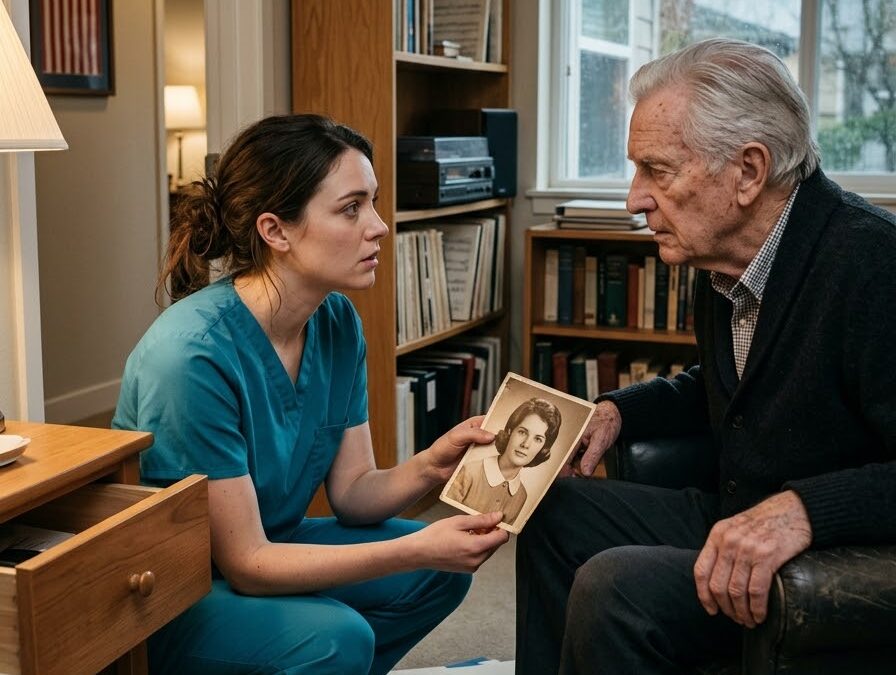
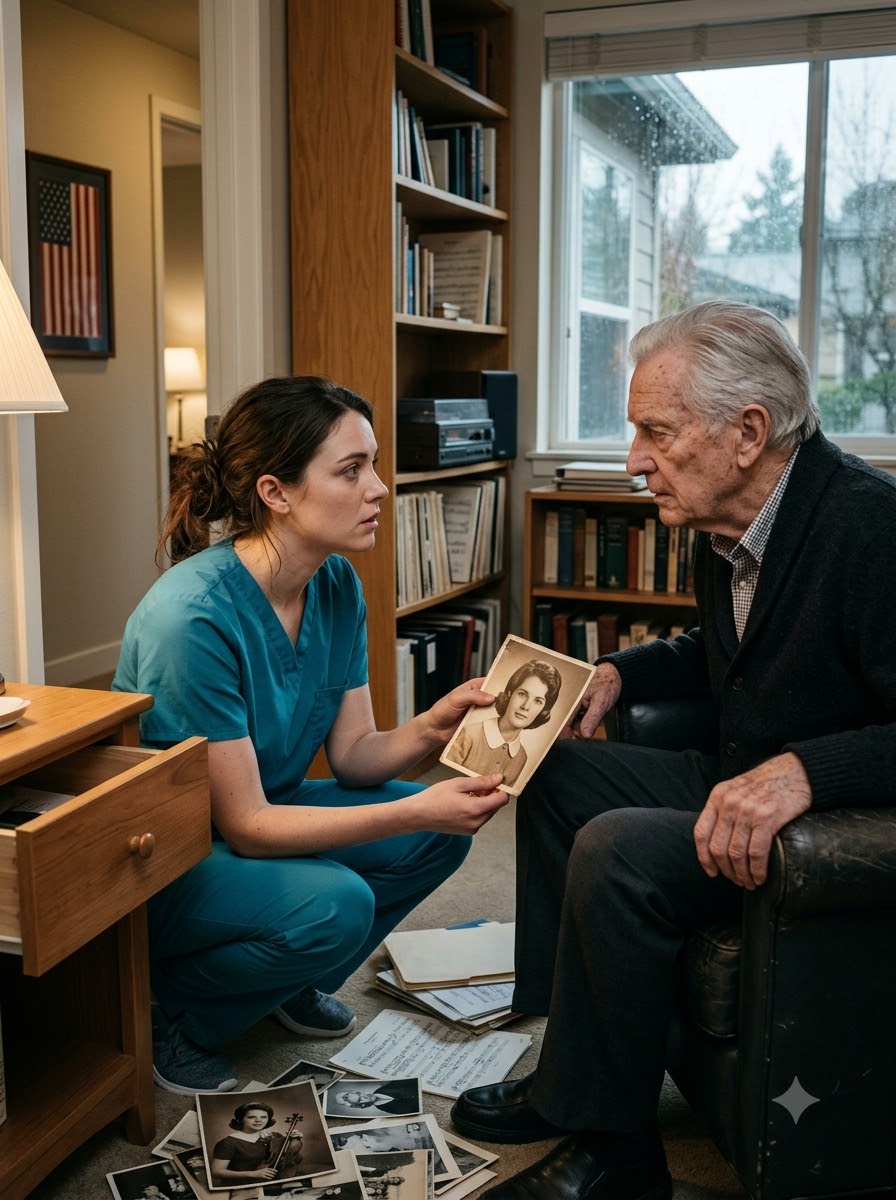
Papers slid out first, followed by a thin folder and several photographs that scattered across the floor.
Olivia froze, instinctively dropping to one knee to gather them before Victor noticed.
She reached for the closest photograph and stopped, her breath caught sharply, the room seeming to narrow around her.
The woman in the photograph stared back with a familiarity that was deeply unsettling.
High cheekbones, the same curve of the mouth, eyes set in a way that mirrored her own reflection so closely it felt intrusive, as if she were looking at herself from another life.
For a moment, Olivia couldn’t move.
“What is it?” Victor asked, his voice suddenly alert.
She stood slowly, the photograph trembling in her hand.
“Who is this?” she asked.
Victor turned his head, then stiffened.
The color drained from his face as he recognized the image.
He rose from his chair with visible effort, his usual composure fracturing.
“Put that down,” he said sharply.
“No,” Olivia replied, surprising herself with the firmness in her voice. “You need to explain this.”
The music continued playing unnoticed.
Rain pressed harder against the glass.
Victor closed his eyes briefly, as if steadying himself.
When he opened them again, his gaze was no longer sharp, but exposed, raw in a way Olivia had never seen.
“Where did you find it?” he asked quietly.
“It fell out of your drawer,” Olivia said. “And it looks like me.”
Victor sank back into his chair, one hand gripping the armrest.
For a long moment, he said nothing.
Olivia waited, her pulse loud in her ears.
“That is Margaret Collins,” Victor said finally. “She was my student.”
Olivia stared at him.
“My name is Collins,” she said. “You asked about it.”
“Yes,” Victor replied. “I noticed.”
He gestured for her to sit.
She did not.
“Margaret was more than a student,” he continued, his voice unsteady now. “She was exceptional, a violinist with perfect discipline, a composer with instinct and restraint. She understood silence in music better than anyone I ever taught.”
Olivia looked again at the photograph.
“Why does she look like me?”
Victor swallowed.
“Because I believe she was your mother.”
The words landed with a force Olivia couldn’t absorb.
Her mind rejected them instinctively, grasping for alternatives, explanations that made more sense than this.
“That’s not possible,” she said. “I would know.”
“You wouldn’t,” Victor replied gently. “Not if no one told you.”
He explained haltingly, piecing together the past with care.
Margaret Collins had been young, fiercely private. She became pregnant while still studying under him.
Shortly after giving birth, she was killed in a car accident while returning from a concert tour.
The child, Olivia, had been left in the care of her father, a man who disappeared not long after, overwhelmed by grief.
Victor’s voice faltered.
“I searched,” he said. “I searched for years. Records were incomplete. Names changed. You vanished into the system.”
Olivia shook her head, stepping back.
“You don’t know that,” she said. “You can’t.”
“I know the timing,” Victor said. “I know the resemblance, and I know Margaret.”
He reached for another photograph from the floor and handed it to her.
It showed Margaret holding a violin, her expression calm, resolute.
The resemblance was undeniable.
Olivia’s hands went numb.
Everything she thought she understood—her name, her history, the emptiness she had accepted as permanent—fractured under the weight of possibility.
She had grown up believing there was nothing behind her, nothing waiting to be uncovered.
Now the past had a face.
“I don’t remember her,” Olivia whispered.
Victor’s voice softened.
“You were very young.”
The room felt suddenly too small.
Olivia turned toward the window, needing distance. Air. Something solid to anchor her.
“This changes everything,” she said.
“Yes,” Victor replied. “It does.”
She pressed the photograph flat against the desk, as if that might make it less real.
Her reflection in the glass stared back at her, now unfamiliar.
The truth did not arrive with clarity or relief.
It arrived as rupture.
And as Olivia stood there, suspended between what she had been and what she might be, she understood that her life quietly, irrevocably had already begun to shift.
Victor did not begin with dates or documents.
He began with memory.
He spoke slowly, as if choosing each word with care, aware that once spoken, they could not be taken back.
Olivia remained seated across from him, the photograph still on the desk between them.
No longer something to be questioned, but something that demanded understanding.
“Margaret Collins was extraordinary,” Victor said. “Not because she was brilliant, though she was, but because she worked as if brilliance meant nothing without discipline.”
He told Olivia about Margaret’s rise in the classical music world, how she had entered conservatory younger than most, how she practiced relentlessly, how she listened more than she spoke.
She was respected not only for her technical skill on the violin, but for her compositions, pieces that carried restraint, clarity, and emotional depth without excess.
“She believed music should never beg for attention,” Victor said. “It should earn it.”
Olivia listened, silent, absorbing a portrait of a woman she had never known but somehow recognized—the focus, the quiet determination, the refusal to waste effort.
Victor explained that Margaret met Olivia’s father during a series of regional concerts.
He was a journalist covering classical music, thoughtful, perceptive, deeply moved by Margaret’s work.
Their relationship grew slowly, privately.
They married without spectacle.
Olivia was born not long after.
“You were already walking when it happened,” Victor said gently. “You were not an infant. You were nearly two.”
The words landed heavily.
Olivia had grown up believing she had never been held by her parents, never known their voices.
The idea that she had once been old enough to walk, to recognize faces, to be carried, shifted something deep inside her.
Margaret’s death came suddenly.
A car accident on an icy highway late one October night after a concert tour.
The driver lost control.
Margaret and her accompanist were killed instantly.
Victor paused, his gaze dropping.
“It shattered him,” he said of Olivia’s father. “Grief hollowed him out. He tried to keep going for you, but he was not strong enough to survive it alone.”
He told Olivia how her father left the city shortly after the funeral, taking her with him, how he moved, withdrew, stopped answering calls.
Victor searched through colleagues, legal inquiries, private investigators, but the trail grew colder each year.
“Then I learned he died of a heart condition,” Victor said quietly. “You would have been four.”
Olivia’s hands tightened in her lap.
“That’s when I lost you,” Victor continued. “Not because I stopped looking, but because the system erased you. You were placed into care. Your records were scattered. I never knew where you went.”
The silence that followed was heavy, but not empty.
Victor rose slowly and moved to the cabinet near the wall.
From it, he retrieved a worn leather album and several folders tied with string.
He placed them gently on the desk, as if setting down something sacred.
“These are hers,” he said.
They went through them together.
Concert programs with Margaret’s name printed in elegant type.
Handwritten sheet music, margins filled with notes and revisions.
Letters, some professional, some deeply personal.
Photographs of rehearsals, backstage moments, small dinners shared among musicians.
One photograph stopped Olivia completely.
Margaret sat on a bench in a park, Olivia as a toddler in her arms, midlaf, her falling into her eyes.
“That’s me,” Olivia whispered.
“Yes,” Victor said. “That’s you.”
Grief came not as a wave, but as a slow, crushing weight.
Olivia felt it settle into her chest, heavy and inescapable.
She mourned not just their deaths, but the years she had lived without knowing she had been loved.
Yet beneath the grief, something else emerged.
Belonging.
For the first time, her name felt anchored.
Her face felt explained.
The emptiness she had learned to accept no longer felt like a personal failure.
It was the result of loss, not absence.
“I wasn’t unwanted,” Olivia said quietly.
“No,” Victor replied. “You were deeply wanted.”
They sat together as dusk settled outside the window.
The past no longer felt like a void.
It had weight, texture, history.
Olivia left that evening carrying more than answers.
She carried roots.
The change did not come all at once.
It arrived in increments—shorter breaths, longer pauses, a fatigue that no amount of rest seemed to ease.
Olivia noticed it before anyone said anything aloud.
Victor began missing meals.
He spent more time seated, his hands occasionally trembling when he reached for his papers.
His voice, once sharp and resonant, softened at the edges, as if conserving strength.
Olivia followed protocol, documented symptoms, requested additional evaluations.
This time, the results were unmistakable.
The cardiologist was careful with his words, but the meaning was clear.
Victor’s heart condition was advanced.
Medication could manage discomfort.
Monitoring could slow deterioration.
But nothing would reverse what was already happening.
Months, perhaps a year if he was careful.
Victor listened without interruption.
When the doctor finished, he nodded once.
“I understand,” he said.
Later that evening, alone in his room, Victor spoke with a calm that unsettled Olivia more than fear ever could.
“I am not afraid,” he told her. “I have lived a full life. What matters now is that things are finished properly.”
Within days, he contacted an attorney.
Everything was handled with precision, transparency, and unmistakable intent.
Olivia was present for the meetings only as a witness, not a participant, though she protested at first.
“This isn’t appropriate,” she said quietly.
“It is necessary,” Victor replied.
The will was updated formally and legally.
No ambiguity, no haste.
Victor left Olivia his apartment in Portland, the one he had lived in before moving to Evergreen Care Residence, a spacious bookline place near the river, filled with decades of music, manuscripts, and quiet mornings.
He explained it without ceremony.
“You need a home,” he said, “not a room that can be taken away.”
He also entrusted her with Margaret’s violin.
When he presented it to her, the instrument rested in an aged case, the wood darkened by time but immaculately preserved.
Olivia hesitated before touching it, aware of its significance.
“She won it at an international competition,” Victor said. “She believed instruments carried memory, that they absorbed intention.”
“I don’t play,” Olivia said.
“You don’t need to,” Victor replied. “You only need to protect it.”
There was one more conversation, one Victor had clearly rehearsed.
He spoke of Margaret not as a tragic figure, but as a woman with an unfinished future.
He told Olivia about a dream Margaret had carried quietly for years: a music school for children without families.
Not a conservatory, not an elite academy, but a place where children from foster care and orphan backgrounds could learn music without cost or judgment.
“She believed music gave structure when life did not,” Victor said. “She wanted to give children what she never had. Stability through sound.”
Olivia listened, the weight of the idea settling slowly.
“I am not asking you to abandon medicine,” Victor said firmly. “Your work matters. Your calling matters. But perhaps one day, when the time is right, you will find a way to let her dream live alongside your own.”
The responsibility felt immense, too large to accept in words.
But Olivia did not refuse.
She nodded once, quietly.
Over the following weeks, Victor’s condition worsened.
He tired easily.
Conversations shortened, but his mind remained clear, his attention focused.
They spent their remaining time in quiet companionship, listening to music, organizing manuscripts, naming memories so they would not disappear.
On a cold evening in early spring, Victor asked Olivia to sit by the window.
“I am glad you found me,” he said.
“So am I,” Olivia replied.
He smiled faintly.
“No. I am glad you found yourself.”
When the time came, Victor passed peacefully, surrounded by the things he loved most—books, music, and the knowledge that what he carried forward would not end with him.
Olivia stood alone in the room afterward, grief present but steady.
She did not feel abandoned.
She felt entrusted.
Victor Harrington died quietly in the early hours of the morning.
There was no alarm, no struggle.
A nurse found him just before dawn, his hands folded neatly on the blanket, his expression calm.
The room was still, filled with the familiar presence of books and music, as if he had simply fallen asleep in the middle of a thought.
When Olivia was told, she did not cry at first.
She stood in the hallway outside his room, listening as the words settled into her body.
Then she walked inside and sat beside the bed, taking his hand one last time.
It was cool already.
Still, she stayed there longer than protocol required.
Victor was not just a patient.
He had never been just a patient.
He was family, one she had found too late and yet exactly when she needed him.
His absence left a hollow that felt strangely structured, like grief with edges, something she could carry without collapsing under it.
The funeral was small, dignified, and quiet.
A few former colleagues from the music world attended.
A representative from the conservatory sent flowers.
Victor’s son flew in briefly, standing beside Olivia with a solemn respect that needed no explanation.
There were no speeches, no dramatic gestures, only music playing softly in the background, just as Victor would have wanted.
Afterward, Olivia returned to the apartment he had left her.
For the first time in her life, she unlocked a door that belonged to her.
The apartment was everything Victor had promised.
Tall windows, shelves overflowing with books, the faint scent of old paper and polished wood.
It did not feel new.
It felt lived in, anchored, safe.
She slept on the couch the first night, wrapped in a blanket that still smelled faintly of tea and dust.
In the morning, she made coffee in the small kitchen and stood by the window, watching the river move steadily below.
There was no rush, no immediate crisis.
Only space.
In the weeks that followed, Olivia sorted through Victor’s papers carefully.
Manuscripts, correspondence, legal documents, programs from concerts long past.
She worked slowly, methodically, allowing the process to become part of her grieving.
One afternoon, she found a thin folder tucked behind a row of music journals.
Inside were letters, formal unfinished exchanges between Victor and the city council, proposals, architectural sketches, notes outlining a plan to convert a historic building on the outskirts of Portland into a community art center.
The project had stalled years earlier, abandoned due to funding issues and Victor’s declining health.
Olivia sat on the floor, reading each page twice.
The idea felt familiar.
Not new, but inherited.
She began to see connections where none had existed before.
Victor’s preparation.
Margaret’s dream.
The violin resting quietly in its case across the room.
Her own life, once defined by survival, now balanced on the edge of intention.
She did not make any sudden decisions.
She returned to her clinical rotations.
She completed her coursework.
She continued working at the clinic, grounded in routine and responsibility.
Medicine was still her path, one she respected deeply.
But something fundamental had shifted.
She was no longer reacting to circumstances.
She was no longer moving from one necessity to the next.
She was planning.
Late at night, after studying, Olivia would return to the folder.
She researched zoning laws, nonprofit structures, grants, community partnerships.
She made notes, not commitments.
Just possibilities.
For the first time, the future felt expandable.
Victor’s death had not diminished her world.
It had clarified it.
She was no longer simply enduring life as it happened to her.
She was shaping something that could last, something built from memory, intention, and care.
And in that quiet apartment overlooking the river, Olivia understood that while grief had changed her, it had not broken her.
It had given her direction.
Five years passed quietly, marked not by dramatic turns, but by steady, deliberate progress.
Olivia Collins became a licensed physician first.
She completed her residency with the same discipline that had carried her through nursing school, choosing a path that allowed her to work closely with underserved communities.
Her days were structured by patients, charts, and long hours.
But her life was no longer defined solely by survival.
It had direction.
Parallel to that life, another one took shape.
Margaret Collins Music House opened its doors on a mild September morning in Portland.
The building, a renovated historic structure once nearly forgotten, stood surrounded by tall trees and narrow walking paths.
Inside, the rooms were modest but warm—practice spaces filled with donated instruments, a small recital hall, a library lined with music scores, and books that smelled faintly of old paper.
The school was nonprofit by design, tuitionfree, open to children from foster care and low-income families.
No auditions required, only curiosity and commitment.
Teachers came from varied backgrounds.
Some were conservatory graduates.
Others had grown up in the foster system themselves and returned not out of nostalgia, but purpose.
They taught piano, violin, theory, and ensemble, not to produce prodigies, but to give structure, discipline, and expression to lives that often lacked all three.
Olivia served as director quietly, without ceremony.
She handled administration after clinic hours, reviewed grant proposals late at night, and met with social workers and foster coordinators to ensure access remained open.
She never framed the school as charity.
It was an institution built on respect.
On the fth anniversary of its opening, Margaret Collins Music House hosted its first full public concert.
The auditorium was filled beyond expectation.
Foster families sat beside donors.
Physicians from Olivia’s clinic recognized former patients now holding programs.
City officials attended discreetly, having followed the school’s growth through reports and word of mouth.
Backstage, Olivia stood alone for a moment, listening to the low hum of anticipation from the audience.
She wore a simple black dress, no jewelry, no embellishment.
In her hands was the violin.
Margaret’s violin.
She had learned to play slowly over the years, without ambition, without performance in mind.
Just persistence, guidance from patient teachers, long evenings practicing scales after exhausting shifts at the hospital.
The piece she would play was short, uncomplicated, a lullabi.
Margaret Collins had written it while pregnant, notes sketched lightly in pencil, unfinished in places, intimate in its restraint.
Victor had preserved it carefully, believing it belonged to a moment rather than a stage.
When Olivia stepped into the light, the room quieted.
She did not speak.
She lifted the violin, adjusted her stance, and began.
The melody emerged gently, almost tentative at first.
It was not technically flawless, but it carried something deeper—intention, memory, continuity.
Each note unfolded with care, as if honoring not just the composer, but the reason the piece existed at all.
As the final note faded, silence held the room.
Then applause rose.
Not thunderous.
Not performative.
But sustained and sincere.
Olivia lowered the violin and bowed once.
In that moment, she felt no grief, no longing, no unanswered questions.
She felt peace.
She had found her family not only in photographs and preserved memories, but in living people, in children learning to place their fingers correctly on strings, in teachers who stayed late because they understood what the work meant.
In a community built deliberately with patience and purpose.
Loss had not ended her story.
It had given it meaning.
As the lights dimmed and the audience slowly filed out, Olivia remained on stage for a moment longer, looking at the empty seats.
She imagined Victor’s quiet approval.
Margaret’s steady gaze.
The circle had not closed by returning to the past.
It had closed by carrying it forward.
And tomorrow, there would be lessons to teach, patience to see, and music to be made.








