My brother took me to court, plotting to seize $5 million by claiming I was no longer of sound mind. My mother sobbed uncontrollably, while my father backed up every one of my brother’s lies. I remained silent until the judge closed the file and said, “Before I issue a ruling, perhaps this family should know her true identity.” Their faces turned pale the moment the courtroom door opened.
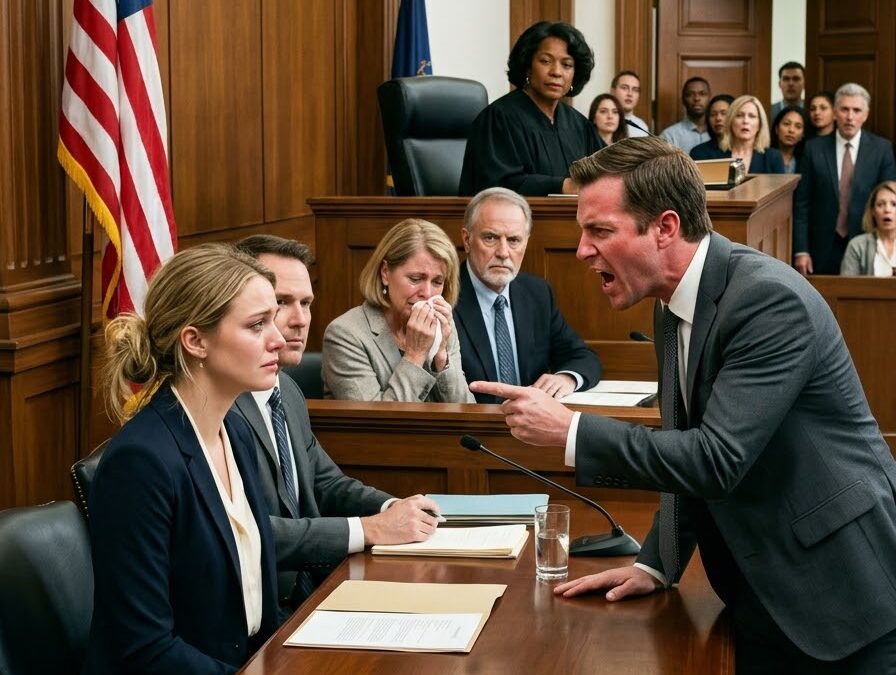
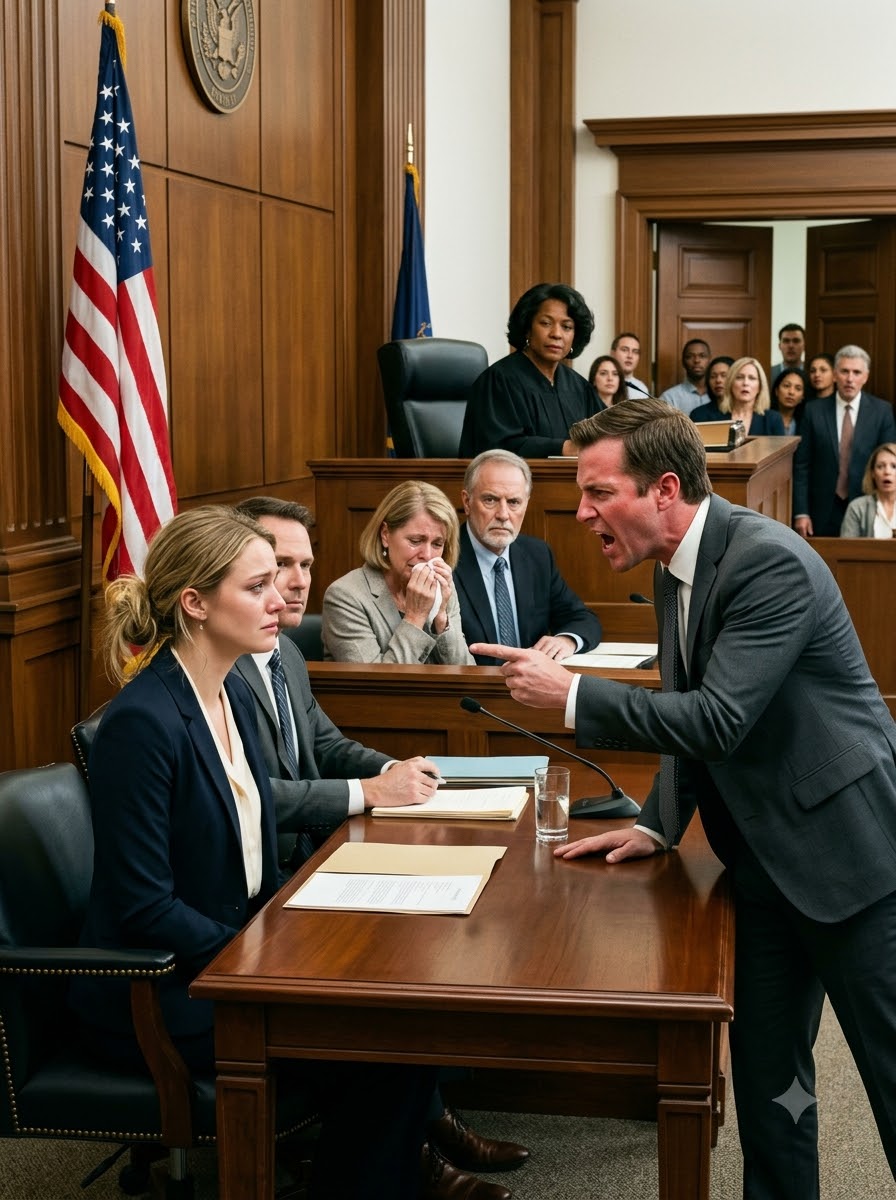
My name is Khloe Bennett, and I am 31 years old.
My brother took me to court, planning to gain control of $5 million by declaring me mentally unfit.
My mother wept behind his table.
My father supported every lie with a sworn statement bearing his signature.
I remained silent until the judge closed my file and said:
“Before I rule, perhaps this family should learn her real identity.”
Their faces drained of color as the courtroom doors opened.
But that moment came later.
That morning, my brother’s attorney stood 10 feet away from me and described me as unstable, dependent, and incapable of making a rational financial decision.
He spoke as though I were not in the room.
My father did not look at me.
My mother pressed a tissue to her mouth.
My brother watched me with the calm confidence of a man who believed the money was already his.
The $5 million sat inside an irrevocable trust scheduled to transfer to me in six weeks.
If the court appointed my brother as conservator, he would control every account, every signature, and every decision connected to it.
He thought my silence meant I had no defense.
He did not know that my silence had been ordered.
He did not know what was inside the sealed file beside the judge’s hand.
And he certainly did not know why three people were waiting in the hallway for permission to enter.
Before I tell you what he said and what happened after the judge opened that door, tell me: What time is it for you right now? Where are you watching from? And what is the weather like there?
Does it match your mood today?
I’m curious to see how far this story will travel.
The petition had arrived 43 days earlier in a white envelope marked urgent.
I had been reviewing a risk report at my apartment when someone knocked hard enough to shake the frame.
The process server handed me 12 pages that reduced my entire life to a list of alleged failures.
Temporary work contracts.
One late rent payment during the year my grandmother died.
Two therapy appointments after a panic episode.
And a photograph of me sitting alone outside a hospital.
None of it proved incapacity.
Together, arranged carefully and repeated in legal language, it looked frighteningly persuasive.
The petitioner was finally named on page four.
Isaac Bennett.
My older brother.
He was asking the court to freeze my trust distribution and appoint him temporary conservator.
Attached was an affidavit from our father, Daniel Bennett, claiming I had a long pattern of poor judgment.
A second statement said my mother, Sarah, had witnessed emotional episodes that made her fear for my safety.
Her signature was missing.
That detail stayed with me.
Isaac had not expected me to notice it.
He had expected me to panic.
Instead, I called Mia Walker, an attorney whose work I knew through a professional contact.
I told her only what she needed to hear.
The trust was worth $5 million.
The distribution date was approaching.
And my family had a financial reason to stop it.
“What reason?” she asked.
I looked at the quarterly report open on my laptop.
Then at the petition in my hand.
“I can’t explain that over the phone.”
“Some of the information is protected.”
Mia was silent for a beat.
“Protected by whom?”
“A federal banking agreement and a court order.”
That was the first moment she understood I was not the helpless woman described in the petition.
The trust had been created after my late grandmother’s estate forced my father to set aside my share of a property sale.
He had never viewed the money as mine.
He called it family capital.
And often reminded me that legal ownership did not erase moral obligation.
For years, Isaac repeated the same phrase.
When the family company began losing major contracts, the pressure sharpened.
My father invited me to dinner and placed a loan agreement beside my plate.
Isaac spoke gently, almost kindly, as he explained that I could save the company by pledging my trust as collateral.
I refused.
Three days later, Isaac sent me a message asking whether my therapist knew about my “delusions of competence.”
Two weeks after that, the petition appeared.
Those were not memories I replayed in long sentimental scenes.
They returned as fragments whenever I entered the courthouse.
The silver pen beside the loan document.
My father’s thumb covering the interest rate.
Isaac’s smile when I said no.
My mother staring down at her untouched food.
Each image carried the same warning.
They had not decided I was unwell and then tried to protect me.
They had decided they needed my money and then built a story that made taking it look protective.
Mia filed an immediate opposition.
She also submitted a sealed motion explaining why part of my employment history could not be discussed publicly.
The judge granted temporary protection but allowed the capacity hearing to proceed.
That decision frustrated Isaac.
He wanted my trust frozen before anyone examined his evidence too closely.
So he accelerated.
He hired a psychiatrist named Dr. Mark Taylor.
Or at least that was the name printed on the evaluation attached to his filing.
The report claimed I showed paranoia, grandiosity, and impaired executive function.
It also said I had refused a complete assessment.
I had never met the man.
When I told Mia, she did not celebrate.
She warned me that proving a document false was not the same thing as proving who created it.
“Your brother will say he relied on a professional.”
“Your father will say he trusted your brother.”
“Everyone will place the blame one step away from themselves.”
That was why we needed more than outrage.
We needed a chain.
The morning of the hearing, Mia met me outside the courtroom and asked whether I was ready for my family to hear the truth about my work.
“Ready?” I said.
“No.”
Then I looked through the narrow glass panel in the door.
Isaac was arranging papers.
My father leaned toward him, whispering.
My mother sat at the far end of the bench, crying without making a sound.
“But I’m done protecting people who are trying to erase me.”
Mia touched the sealed envelope beneath her arm.
“Then remember our plan.”
“Let them tell the story they rehearsed.”
“We will test every link.”
As the bailiff called the case, one question followed me into the room.
If the people who raised you can turn your worst moment into a weapon, how much of yourself should you ever give them again?
The courtroom was smaller than Isaac had imagined and quieter than he wanted.
There was no jury.
No television drama.
No crowd waiting to be persuaded by his performance.
Just Judge Helen Nickerson.
The clerk.
The bailiff.
Two legal teams.
And a few observers seated behind us.
Capacity cases in our county were decided by the judge.
That meant every claim had to survive questions.
Not applause.
Isaac sat beside his attorney, Richard Sloan, in a navy suit tailored to make him look responsible.
My father sat directly behind him.
My mother remained one seat away, as though that narrow space could keep her from choosing a side.
Judge Nickerson began by stating the issue plainly.
Isaac sought an emergency conservatorship over my finances and an injunction preventing the trust company from distributing the $5 million.
He alleged that I could not understand the value of money, evaluate risk, or protect myself from exploitation.
The irony nearly made me laugh.
The only people trying to exploit me were sitting across the aisle.
Sloan called Isaac first.
My brother walked to the witness stand with a folder pressed against his chest and swore to tell the truth.
He described himself as the sibling who had always “cleaned up after Khloe.”
He said I moved between jobs.
Rejected family guidance.
Became suspicious when questioned.
And suffered episodes in which I believed people were conspiring against me.
He never raised his voice.
He never called me stupid.
His cruelty was cleaner than that.
He used concern as camouflage.
Sloan asked whether Isaac wanted control of my trust for personal benefit.
Isaac looked toward the judge with wounded dignity.
“Absolutely not.”
“I would accept the responsibility only because my sister needs protection.”
My father nodded behind him.
Mia wrote three words on her legal pad and slid it toward me.
Let him finish.
Isaac then introduced screenshots of messages I had sent over the previous year.
One said:
Do not contact my employer again.
Another:
I know what you are trying to do with the trust.
A third:
You will not use me to cover your losses.
Read alone, they sounded defensive.
Read in context, they were accurate.
Sloan did not provide the earlier messages that had provoked them.
Mia stood.
“Your Honor, we request the complete message threads.”
“Not selected excerpts.”
Sloan claimed the rest were irrelevant.
Judge Nickerson ordered him to produce them before the end of the hearing.
Isaac’s jaw tightened for less than a second.
But I saw it.
His first perfect wall had cracked.
Then Sloan called my father.
Daniel Bennett did not glance at me as he took the oath.
He told the court that I had always been imaginative.
Sensitive.
Easily overwhelmed.
He said he had protected me from financial mistakes without embarrassing me.
He described the proposed loan agreement as an offer I had irrationally interpreted as coercion.
“Did you ever intend to take your daughter’s inheritance?” Sloan asked.
“Never,” my father replied.
“I wanted to preserve it.”
Mia’s turn came.
She approached slowly, carrying only one page.
“Mr. Bennett, is Bennett Industrial currently in compliance with its primary lending agreement?”
My father’s attorney rose from the gallery and objected that the company’s finances were unrelated.
Mia answered before Sloan could.
“The petitioner alleges this case is motivated solely by concern.”
“We are entitled to test whether the family has an urgent financial interest in Ms. Bennett’s trust.”
Judge Nickerson allowed limited questioning.
My father said the company was stable.
Mia placed the page on the evidence screen.
It was a letter from the bank warning of a covenant breach unless Bennett Industrial supplied additional collateral within 60 days.
The amount required was approximately $4.6 million.
My father stared at the document as though the paper itself had betrayed him.
“Where did you get that?” he demanded.
Judge Nickerson’s expression hardened.
“Mr. Bennett, counsel asks the questions.”
Mia did not answer him.
“The loan agreement you placed before Khloe would have pledged her entire trust as collateral.”
“Correct?”
“It was a family proposal.”
“That was not my question.”
He shifted in the witness chair.
“Yes.”
“But only temporarily.”
“And if the company defaulted?”
“We did not expect that.”
“Her trust could be seized.”
He looked toward Isaac.
Then, finally, toward me.
“Technically.”
The word landed harder than an admission.
Because it revealed how little my loss mattered to him.
Behind us, my mother covered her face.
Isaac leaned toward Sloan and whispered urgently.
The hearing had begun with them asking the court to examine my judgment.
Within the first hour, the judge was examining theirs.
Yet Mia did not push too far.
She knew the bank letter proved motive.
Not fraud.
Isaac could still argue that desperate concern and desperate finances existed at the same time.
When court recessed, he passed my table and murmured without looking at me:
“You have no idea what you’ve started.”
I kept my eyes on the sealed file beside Mia.
“Actually,” I said, “you do.”
After the recess, Sloan called the witness he believed would end the case.
Dr. Mark Taylor.
A gray-haired man in a charcoal jacket entered through the side door carrying a leather portfolio.
Isaac’s shoulders loosened for the first time all morning.
Sloan introduced him as a licensed psychiatrist who had reviewed my behavior and concluded that I showed signs of impaired judgment.
The witness confirmed the signature on the evaluation.
And said he had spoken with me by video for 47 minutes.
My stomach tightened.
Not because I doubted myself.
Because the man on the stand was not anyone I had ever seen.
Mia asked for permission to approach.
She placed a printed image beside the evaluation.
“Doctor, is this your professional licensing photograph?”
The man studied it.
The photograph showed someone younger.
Heavier.
Unmistakably different.
He said licensing databases were sometimes outdated.
Mia asked for his license number.
He gave the number printed on the report.
She asked the clerk to verify the name attached to it.
Sloan objected.
Judge Nickerson allowed Mia to continue but warned her to establish the record carefully.
The clerk searched the public database.
The number belonged to a psychologist named Marlene Taylor in another county.
The courtroom went still.
The witness cleared his throat and said the report contained an administrative error.
Mia asked where he had completed medical school.
He named an institution that had closed before the year he claimed to graduate.
Sloan immediately requested a recess, insisting he had been misled by a third-party referral service.
Isaac looked at the man as if seeing him for the first time.
My father whispered:
“What did you do?”
Loud enough for the bailiff to hear.
Judge Nickerson denied the recess.
“Mr. Sloan, you presented this witness.”
“We will determine what occurred now.”
Under questioning, the man admitted his legal name was Martin Vale.
He was not a psychiatrist.
He worked as a private wellness consultant.
And he had been paid $5,000 to conduct a behavioral review based on material supplied to him.
He claimed he believed the document would be used only in a family mediation.
Mia asked who paid him.
He said the invoice had come from a consulting company called IB Strategy Group.
Isaac’s initials.
My brother’s face changed.
Only briefly.
He recovered and shook his head, signaling that the company was not his.
Mia produced corporate-registration records showing Isaac as the sole member.
That should have been the moment the case collapsed.
It wasn’t.
Sloan argued Isaac had hired a referral company and had no knowledge that Vale lacked credentials.
He moved to withdraw the evaluation while preserving the rest of the petition.
Judge Nickerson struck the report.
But she did not dismiss the case.
“A false evaluation is deeply troubling,” she said.
“But the court must still determine Ms. Bennett’s capacity based on competent evidence.”
Isaac had lost his strongest weapon.
Yet the hearing continued.
Revenge stories often make truth look like a switch.
Expose one lie and the whole machine goes dark.
Real lies are built with backups.
Isaac had prepared for the possibility that one piece would fail.
Sloan called my former landlord.
He testified that I had once paid rent 12 days late.
He called a past supervisor.
She said I had taken six weeks of medical leave after my grandmother’s death.
He introduced a bank statement showing that I had transferred $75,000 to an unfamiliar company.
Each fact was real.
Together, they created a shape that could be misread.
When I took the stand, Sloan moved through them slowly.
“You missed rent once.”
“After an automatic-payment error.”
“You left work.”
“I took approved bereavement leave.”
“You transferred $75,000 to an entity called Rowan Advisory.”
“Yes.”
“A company with no public office, no listed employees, and no visible revenue.”
“That is not accurate.”
“Then explain it.”
I looked at Mia.
She stood and reminded the court that my business information was subject to the sealed order.
Sloan smiled as though he had trapped me.
“Convenient.”
“Ms. Bennett asks the court to trust a secret.”
Judge Nickerson turned toward me.
“Ms. Bennett, I will not require public disclosure of protected information.”
“But I do need an answer sufficient to assess the transaction.”
This was the narrow edge Mia had warned me about.
If I revealed too much, I could violate agreements and compromise an investigation.
If I revealed too little, my silence could be used as proof.
“The transfer was a capital contribution to a business in which I hold an ownership interest,” I said.
“The amount was reviewed by independent counsel and an accountant.”
Sloan lifted an eyebrow.
“Yet your family knows nothing about this supposed business.”
“My family was not entitled to know.”
“Or it does not exist.”
My father exhaled sharply.
Almost a laugh.
Isaac leaned back, satisfied.
For the first time that day, I felt the room tilt away from me.
Sloan then displayed a voicemail transcript in which I had told Isaac:
“When this is over, you will lose more than you came for.”
He asked whether that sounded like a threat.
“It was a prediction.”
“Based on what?”
“Based on documents I was not permitted to discuss.”
He turned toward the judge.
“Again.”
“A secret.”
The question I wanted to ask everyone in that room was simple.
If someone forces you into silence and then calls your silence evidence, how do you prove you still own your voice?
I did not say it aloud.
I held the judge’s gaze.
And waited for Mia to begin rebuilding the truth one fact at a time.
Mia did not begin by asking whether I was competent.
She began with numbers.
She asked me to explain the difference between liquidity and solvency.
The risk of pledging an irrevocable trust against a distressed company.
And the consequences of a lender accelerating a loan after a covenant breach.
I answered without drama.
I explained how collateral could be seized.
How personal guarantees could spread liability.
And why a company seeking nearly the exact value of my trust had a direct motive to delay its distribution.
Sloan objected that I sounded rehearsed.
Judge Nickerson overruled him.
“Knowledge does not become irrelevant because it is inconvenient.”
Mia then introduced an independent capacity assessment conducted by Dr. Evelyn Hart.
A court-approved neuropsychologist.
Dr. Hart had met with me three times.
Reviewed my medical history.
Tested memory.
Reasoning.
Attention.
Financial comprehension.
And found no condition that prevented me from managing my affairs.
Her report was detailed.
Cautious.
Frustratingly undramatic.
That made it powerful.
She acknowledged my anxiety and previous grief-related leave.
She also explained that anxiety was not incapacity.
And that seeking therapy demonstrated judgment.
Not its absence.
Sloan tried to undermine her by asking whether intelligent people could still make reckless decisions.
“Of course,” she replied.
“That includes petitioners.”
A few people behind us shifted to hide smiles.
Isaac did not.
Mia next called Brian Cooper.
Isaac’s former business partner.
Brian entered with his shoulders drawn tight and avoided looking at either table.
He had resisted our subpoena, claiming he knew nothing relevant.
On the stand, he answered every question narrowly.
Yes, he had worked with Isaac.
Yes, IB Strategy Group belonged to Isaac.
No, he did not know why Martin Vale had been paid.
Mia showed him an email chain recovered from the company server.
In it, Isaac wrote:
I need a professional opinion that pauses the distribution. It doesn’t have to survive forever, just long enough.
Brian had replied:
This sounds dangerous.
Sloan objected that the sentence was ambiguous.
Judge Nickerson allowed Brian to explain.
He swallowed.
“Isaac said the family company needed time.”
“He believed that once he controlled the trust, he could move the money into a secured account and nobody would challenge it because he would be acting as conservator.”
Isaac stared at him with a coldness that made Brian’s voice falter.
Mia asked why he had not come forward sooner.
“Because he told me I would be blamed for the consulting payments.”
“And because Mr. Bennett said the family would destroy my career if I interfered.”
My father rose halfway from his seat.
“That is a lie.”
The bailiff ordered him down.
Judge Nickerson warned him that another interruption would result in removal from the courtroom.
Brian reached into his jacket and produced his phone.
He had saved a voicemail from my father.
“Stay out of a private family solution, or every lender in this city will hear that you falsified our projections.”
My father’s own voice filled the courtroom.
My mother stopped crying.
She looked at him.
Not with shock.
With recognition.
That expression told me she had heard the same tone before.
Sloan requested that the message be excluded as an unauthorized recording.
Brian explained that it was a voicemail.
Voluntarily left.
The objection failed.
Mia then called my mother.
Sarah Bennett walked to the stand as though each step required permission.
She admitted Isaac had repeatedly told her I might lose the trust to strangers unless the family acted.
She admitted my father had drafted a statement for her to sign saying I behaved irrationally.
“Did you sign it?” Mia asked.
“No.”
“Why not?”
My mother looked at me.
“Because some of it was exaggerated.”
“And some of it was false.”
Isaac shook his head slowly.
Warning her.
She saw him.
Straightened.
“He told me Khloe had spent $75,000 on an imaginary company.”
“He did not tell me it was her company.”
“Daniel told me the business would collapse unless the trust became available.”
“They said we would all lose our home.”
“And that it would be Khloe’s fault.”
My father whispered her name.
She turned toward him.
“You made me mourn a daughter who was standing in front of me.”
The room held that sentence in silence.
Mia asked whether Sarah had ever witnessed me unable to understand money, contracts, medical decisions, or daily responsibilities.
“No,” she said.
“I witnessed grief.”
“I witnessed fear.”
“And I witnessed this family using both against her.”
Isaac’s composure finally broke.
“You don’t know what she is,” he snapped.
Judge Nickerson looked directly at him.
“That may be the first accurate statement you have made today, Mr. Bennett.”
Then she placed her hand on the sealed file.
Judge Nickerson opened it.
Read the first page again.
Then looked at Sloan.
“Counsel, you have repeatedly suggested that Ms. Bennett’s undisclosed work is imaginary.”
“Did your client conduct any investigation before making that claim?”
Sloan said the petitioner had searched public records and found no conventional employer matching my description.
“That was not my question,” the judge replied.
“Did he investigate the entity identified under seal?”
Sloan glanced at Isaac.
“We were not given access.”
“You requested access yesterday.”
“I denied it because the material is connected to an active financial investigation.”
“Your client nevertheless chose to call it fictitious in open court.”
Isaac leaned toward his attorney.
Speaking too quickly for either of them to appear calm.
Judge Nickerson closed the file.
Rested both hands on it.
Then said:
“Before I rule, perhaps this family should learn her real identity.”
My mother stared at me.
My father’s face tightened.
Isaac gave a short, dismissive laugh.
Then the courtroom doors opened.
Dr. Mark Taylor entered first.
The real Dr. Taylor.
The man whose license number had been copied onto the false evaluation.
Beside him walked Elena Ruiz, chief compliance officer for Meridian National Bank.
And Thomas Keane, an independent examiner appointed under a federal protective order.
They carried no dramatic boxes.
Only slim folders.
That made their arrival feel more final.
Dr. Taylor testified briefly.
He had never evaluated me.
Never authorized use of his name.
And had already referred the forged report to the licensing board and law enforcement.
Then Elena Ruiz took the stand.
Mia asked whether she recognized the name Rowan Advisory.
“Yes,” Elena said.
“It is the private holding company for Arkite Risk Partners.”
Sloan asked what that had to do with my capacity.
Elena turned toward me before answering.
“Ms. Bennett is the founder and controlling owner of Arkite.”
My father blinked.
Isaac stopped writing.
For six years, they had mocked my unstable contract work.
In reality, I had built a forensic-risk firm under my grandmother’s surname.
Khloe Rowan Bennett.
Our clients included regional banks.
Pension administrators.
Court-appointed receivers.
I had kept my ownership confidential because our work often involved fraud investigations and protected financial data.
The $75,000 transfer was a documented capital contribution during an expansion.
Independent audits showed the company was profitable.
Debt-free.
And managing investigations involving assets many times larger than my trust.
Elena explained that I had personally designed the risk model her bank used to identify concealed related-party transfers.
That model had flagged Bennett Industrial.
The room changed.
My father no longer looked angry.
He looked afraid.
Thomas Keane testified next.
Under the protective order, he had reviewed records showing that Bennett Industrial moved funds through IB Strategy Group.
Inflated receivables.
And concealed its covenant breach from Meridian National Bank.
He did not accuse anyone of a crime.
He stated that the evidence had been referred for formal investigation.
More importantly for this hearing, emails showed Isaac and my father discussing my trust as the “bridge” that would replace missing collateral.
One message from Isaac read:
Once capacity is questioned, the court can give me control before distribution. After the transfer, we can stabilize the company and repair the story.
Another from my father said:
Make sure Khloe looks emotional. People confuse emotion with instability.
My mother made a sound like air leaving a room.
I had read those messages before.
But hearing them spoken aloud still cut through me.
What kind of father studies his daughter’s pain only to decide how it can be edited into evidence?
Judge Nickerson asked Isaac whether he wished to explain.
Sloan advised him not to answer.
Isaac ignored him.
“She hid everything,” he said, pointing toward me.
“She let us believe she was failing while the company was drowning.”
I finally spoke.
“You never asked whether I was succeeding.”
“You only asked what you could take.”
He said the $5 million belonged to the family because our father had created the trust.
Mia corrected him.
The trust existed because my grandmother’s estate settlement required my share to be placed beyond my father’s control.
Isaac had known that.
The judge found the distinction significant.
My father stood abruptly and accused me of engineering the bank investigation to punish them.
The bailiff moved forward.
Judge Nickerson ordered him seated.
And warned that contempt was no longer hypothetical.
For years, their power had depended on defining me before I could define myself.
Now every definition they had used—
Unstable.
Dependent.
Confused.
Imaginary.
Was collapsing under documents bearing their own names.
Judge Nickerson recessed for 30 minutes.
No one spoke while she was gone.
Isaac stared at the table.
My father tried to whisper to Sloan.
But Sloan moved his chair away and began making notes for himself.
My mother sat alone now.
Hands folded in her lap.
I expected victory to feel warm.
Instead, I felt emptied out.
Being proven sane did not erase the fact that the people closest to me had tried to make my personhood negotiable.
When the judge returned, everyone stood.
She dismissed Isaac’s petition with prejudice.
Dissolved the temporary hold on my trust.
And ordered the trustee to proceed with distribution on the original date.
She found that Isaac had failed to establish any basis for a conservatorship.
And that substantial evidence showed the petition had been filed for an improper financial purpose.
She barred Isaac and my father from serving in any fiduciary role connected to me or my assets.
She ordered them jointly responsible for my reasonable legal fees.
And imposed sanctions for presenting the false evaluation without adequate verification.
Then she directed the clerk to preserve the record and transmit the forged report, payment records, emails, and voicemail to the district attorney, the state licensing authorities, and the bank examiner already handling Bennett Industrial.
“This court does not determine criminal liability today,” she said.
“But it will not ignore evidence because it emerged inside a family dispute.”
Isaac’s face lost all expression.
My father gripped the bench until his knuckles whitened.
Sloan asked for a stay of the ruling.
The judge denied it.
Isaac then turned toward me as though we were still at our family dinner and he could pressure me into fixing the problem.
“Khloe, tell them this got out of hand.”
“Tell them we can settle it privately.”
I thought of every time he had called control concern.
Every time my father had called obedience loyalty.
Every time my mother had been taught that keeping peace mattered more than telling the truth.
“It was private when you thought I was alone,” I said.
“You made it public when you filed the petition.”
The bailiff escorted my father and Isaac to a conference room to receive preservation orders.
They were not taken away in handcuffs.
That would have been a simpler ending.
Perhaps even a more satisfying one.
Their punishment began more slowly.
Meridian National Bank froze further advances to Bennett Industrial and demanded an independent audit.
Within three months, the company entered court-supervised restructuring.
My father lost control of the board after lenders discovered that he had concealed the covenant breach.
Isaac was removed as chief operating officer.
And became the subject of a fraud investigation tied to IB Strategy Group and the false evaluation.
His professional finance certification was suspended pending review.
The court later awarded me legal fees and additional sanctions.
He sold his house to meet part of the obligation.
The criminal case took longer.
Eventually, Isaac pleaded guilty to falsifying records and attempting to obtain control of property through deception.
My father entered a separate agreement concerning false bank statements.
And was prohibited from managing a regulated company.
They had wanted temporary access to my money.
Instead, they lost the authority, reputation, and status they had used to make me feel small.
My mother left the family home six weeks after the hearing.
She revoked the power of attorney my father held over her accounts.
And began working with a counselor.
She asked me to forgive her.
I told her forgiveness was not a door she could knock on once and expect me to open.
It would be a road.
And she would have to walk it without demanding that I shorten the distance.
We began with coffee once a month in a public place.
Some meetings ended well.
Some ended early.
That was more honest than an embrace followed by instant healing.
When the trust transferred, I did not use it to rescue Bennett Industrial.
I placed most of it in a diversified structure managed by an independent fiduciary.
I funded a legal program for adults facing abusive conservatorship petitions.
And kept enough liquid capital to expand Arkite without risking the company.
My first decision after being declared capable was to make sure no single person—
Including me—
could move the money without safeguards.
Capacity was never about refusing help.
It was about choosing help without surrendering control.
Months later, I returned to the same courthouse for a professional meeting.
I passed the courtroom where my family had tried to replace my identity with a diagnosis.
For years, I had believed revenge would mean watching Isaac suffer exactly as I had suffered.
I was wrong.
The deepest revenge was that his version of me no longer controlled any room I entered.
He had wanted the judge to call me incompetent.
Instead, the judge forced him to answer for his own choices.
So here is the question I carried with me as I walked away:
When your family demands access to your life as proof of love, where does loyalty end and self-respect begin?
I still do not have one answer for everyone.
I only know mine.
Blood may explain where I came from.
But it no longer decides who I am.
We hope this story entertained you while leaving behind something meaningful.
All characters, conflicts, and outcomes are fictional and created only for dramatic reflection.
We hope it reminds you that people who ignore your pain may still expect your support, your money, and your understanding.
But a relationship where your feelings are always dismissed is not a place where your hurt can truly rest.








