My family disowned me after I took her in to care for her—abandoned by them as she had been. Nine years later, at my younger brother’s wedding, my mother spat out a cruel remark: “So, the ungrateful daughter has finally deigned to crawl back here!” My brother ordered security to throw me out. Just then, her lawyer stood up and said, “Before she leaves, there is something everyone needs to hear.” My father dropped the glass he was holding…
My name is Monica Robertson, 37 years old.
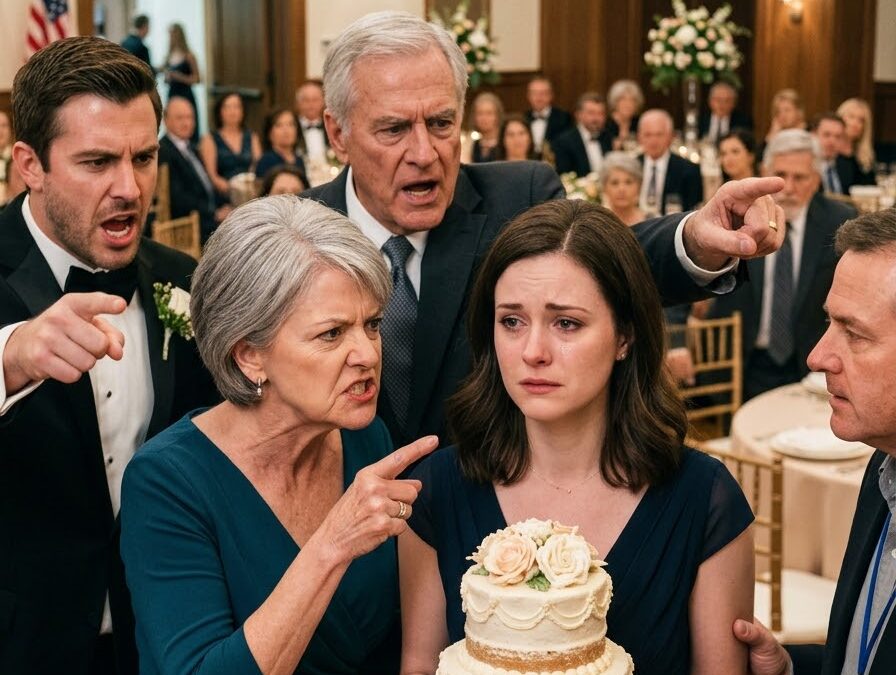
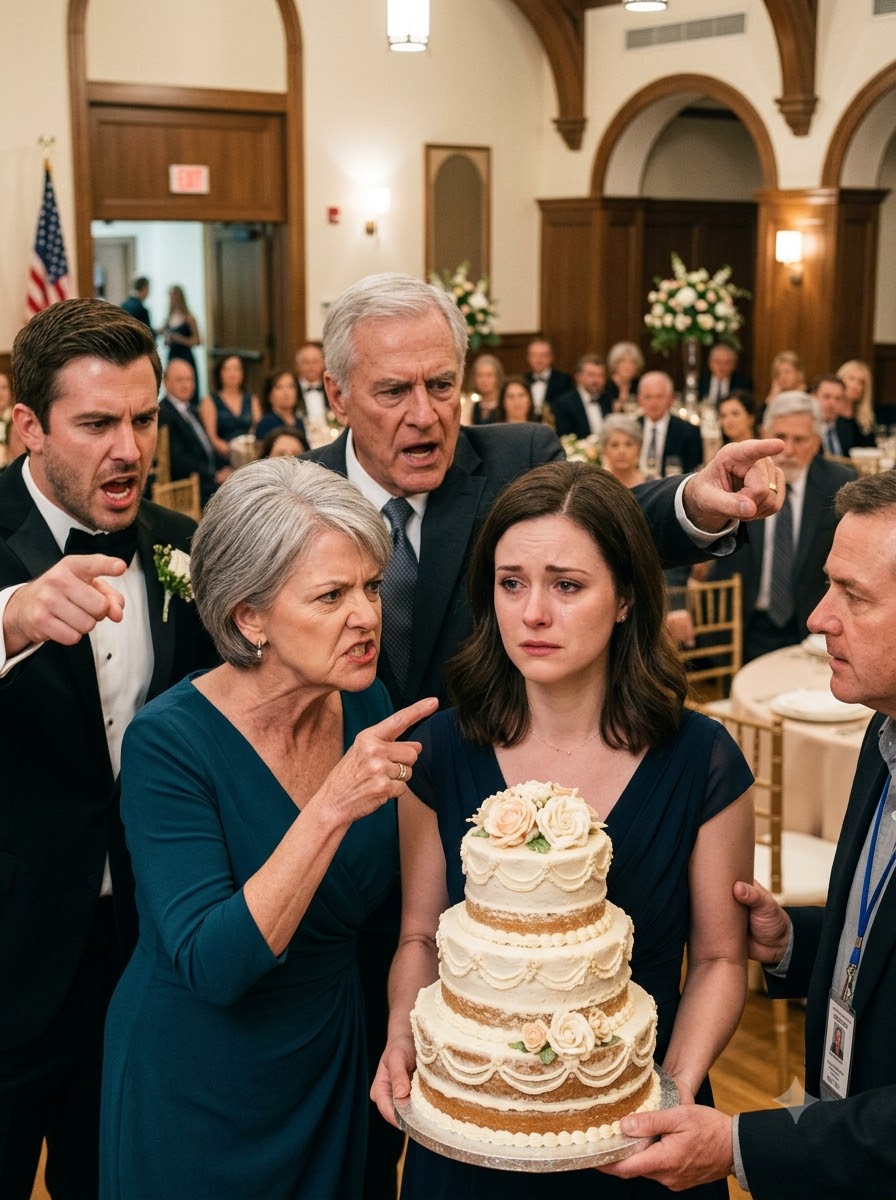
At my brother’s wedding reception in Mville, Tennessee, my mother pointed at me in front of 160 church guests and shouted, “The [snorts] ungrateful daughter finally crawled back.”
Then she told the room I hadn’t called in 9 years, as if she hadn’t blocked my number the same week they left Grandma’s clothes in black trash bags at the curb and told the family they no longer had a daughter named Monica.
My brother didn’t wait.
Four words to the men with earpieces.
“Get her out now.”
One of them took my elbow.
I was still holding the cake.
Grandma sent him seven layers. Kitchen twine.
I didn’t argue.
At a back table, a gray-haired attorney from Nashville sat down his tea and stood.
My family didn’t know who had really sent me into that hall. They didn’t know my father was the only person who understood the first sentence.
The mason jar hit the tile before the deacons reached the door.
Stay with me on this one if you’ve ever been the one they put out with the bags. Tell me what road you’re on while you’re listening. I like knowing who’s out there.
Because before I tell you what that man said next, you need to understand what they did the Easter they decided I wasn’t a daughter anymore.
The call came at 10 after 5 on the Thursday before Easter 2017.
I was 28, standing in my kitchen in East Nashville with wet hair, looking for my keys. I worked the early pastry shift at a hotel downtown, and Easter week was the worst week of the year.
300 brunch covers on Sunday.
The number had an East Tennessee area code.
I almost let it ring.
“Is this Monica?”
A woman whispering.
“My name’s Tammy. I work at a house in Alcoa. I help take care of your grandma.”
I told her she had the wrong person. My grandmother was in an assisted living place in Knoxville. My mother had told me so in January.
There was a pause.
“Honey, she’s not in Knoxville. She’s here. She’s been here since the end of January.”
The only paper on the counter was a hotel order ticket. I wrote the address on the back of it, right under a request for two dozen gluten-free scones.
“Your grandma made me memorize your number,” Tammy said. “She said you’d come.”
Then a door opened somewhere behind her. A woman’s voice called her name, and the line went dead.
I texted my mother at 5:30.
“Mom, where is Grandma? Call me.”
A minute later, a small gray word appeared under it.
Read.
Nothing else.
I stood there with two questions.
The first was where.
The second was why me.
My grandmother had a daughter 20 minutes from Alcoa. She had a grandson living in that daughter’s house. She had asked a stranger to memorize the number of the one person 3 hours away.
To answer that, I have to go back to a school pickup line in 1998.
I was nine.
My mother forgot me.
It wasn’t the first time, but it was the first time I decided not to wait.
Grandma [snorts] Betty lived 2 miles from my school, and I walked it.
She opened the door, looked at me, looked at the empty street behind me, and didn’t ask a single question.
She put me on a stool in her kitchen and gave me a job.
She was making a stack cake.
If you didn’t grow up near the Smokies, a stack cake is thin, plain layers baked one at a time in a cast-iron skillet, stacked with cooked dried apples. It sits a day or two until the apples soften everything.
Grandma owned seven skillets.
She baked seven layers.
Always seven.
“Up in the mountains,” she told me, spreading apples with the back of a spoon, “the neighbors built the bride’s cake. One layer each. You could count how loved she was.”
I asked what happened if a bride only got two layers.
“Then somebody should have baked more.”
My mother came for me after dark, annoyed that she’d had to drive over.
“You spoil her,” she said at the door.
Grandma handed her a slice of cake wrapped in foil.
“Somebody has to come for her.”
I remembered that sentence for years.
I didn’t understand it for a lot longer.
In October 2016, Grandma had a small stroke.
She was 78.
It left her left hand weak and her speech slow, like every word had to be carried up a flight of stairs.
My mother started a GoFundMe called Help Betty Recover.
In 6 weeks, it raised $9,600.
Half the church shared it.
I gave $200, which was most of what I had left that month.
“Every dollar goes to Mama’s therapy,” my mother posted. “God is good.”
My father handled the money.
He always did.
He sold insurance and served as a deacon, and people in Mville trusted him with their checks.
In December, my parents took a cruise for their 30th anniversary. My mother posted pictures from the deck.
In one of them, she was wearing Grandma’s pearl earrings, the old clip-on kind.
Grandma had lent them to her for the trip.
I remember thinking that was sweet.
In the middle of January, Grandma called me.
Her words were slow but clear.
“Opel thanked me today.”
Opel Dunn had been her closest friend at church for 40 years.
“She said she was glad the church could help pay for my therapy. Mo, Medicare paid for my therapy. All of it.”
I said maybe Opel had it mixed up.
Grandma didn’t answer that.
She said, “I’m going to talk to your mother on Sunday.”
A week later, her number was disconnected.
I called my mother.
She sounded tired and gentle.
Grandma was in assisted living in Knoxville, she said.
And, lowering her voice, Grandma had started saying things that weren’t true.
“It’s the stroke, honey. She gets ideas.”
She promised to text me the name of the place.
She never did.
Every Sunday from February into April, I called, and every Sunday Grandma was sleeping or resting or still settling in.
When I said I’d drive over, my father took the phone.
“There’s an approved visitor list,” he said. “Your mother’s handling it. Don’t make this harder than it is.”
I believed them.
That’s the part I still have to sit with.
I told myself my mother was worn out and I was the one being difficult.
At 9:40 that Thursday, Tammy called back.
I took off my gloves and answered in the walk-in cooler.
Nobody had paid for May, she said.
The owner, Darlene, planned to drive Grandma to an emergency room after Easter and leave her there, and the women in that back room got pills at night.
Not their own pills.
Something to keep them quiet.
I called my mother three times.
No answer.
The hotel wouldn’t release me on Thursday or Friday, not Easter week.
I traded away my Easter Sunday double holiday pay and all to get Saturday free.
Friday night, Tammy texted.
“She asked if you’re coming.”
I told her yes.
I left at 4 in the morning, 3 hours east on I40.
The house in Alcoa was a brick ranch with a plywood ramp and no sign.
Darlene opened the door in a bathrobe and didn’t want to let me in.
Grandma was in the back bedroom with three other women.
Four beds.
One window.
She was wearing a pink cardigan that wasn’t hers, with another woman’s name written on the tag in marker.
There was a bruise on her wrist the shape of fingers.
Her eyes took a long time to find me.
Then they did.
“Mo.”
Darlene said I couldn’t take her without family permission.
I said I was family.
Darlene said, “The other kind,” and she called my mother on speaker.
My mother’s voice filled that little room.
“Let her go. She’s Monica’s problem now.”
Grandma looked straight at Darlene.
Every word came slowly.
“I’m a grown woman. I want to go with my granddaughter. I’m going.”
At a gas station outside Knoxville, I reached into the canvas tote she’d been clutching and found a church bulletin folded in quarters.
Cedar Grove Baptist Church.
Sunday, January 22nd.
Under the prayer requests, one line:
“Please pray for Betty Hollis, who is struggling with confusion.”
I read the date twice.
One week after Grandma said she was going to talk to my mother.
As far as I could tell, no doctor had said anything of the kind.
The next morning was Easter.
We had reached my apartment late Saturday afternoon.
One bedroom, one bathroom, a kitchen you could touch both sides of.
I put Grandma in my bed and took the couch, which was 6 inches shorter than I am.
At 3:00 in the morning, she called out.
Not my name.
Just, “Hello. Hello.”
Like she was standing in a hallway somewhere.
I sat on the edge of the bed until she knew where she was.
“Did they pay her, Mo?” she asked. “For me?”
I told her I didn’t know.
It was the truth.
And it was the first of many times that year I wished I had a better answer.
I wanted to call Adult Protective Services before the sun came up.
I had the number on my screen.
Grandma put her good hand over the phone.
“Tammy’s got three more in that room,” she said. “If the state shows up Monday, Darlene knows who called. Tammy loses her job. And those ladies lose the only kind person in that house. Let Tammy do it. She’ll do it right.”
I didn’t like it.
I did it her way.
By 7, my phone was buzzing on the coffee table like something alive.
The family group chat had 23 people in it.
Aunts, cousins, a great uncle in Georgia who only ever posted Bible verses.
My mother’s message was at the top.
“Monica has removed Mama from her care home against our wishes. As of today, we have no daughter named Monica. Please respect our family’s pain.”
Under it, praying-hands emojis.
“So sorry, Rhonda.”
“Lifting you all up.”
One aunt wrote, “After everything you’ve done for Betty…”
I typed for a long time and sent something short.
“Grandma was sedated and bruised and she was about to be left at an ER because nobody paid for May. She [snorts] asked to come with me. She’s safe.”
Nobody answered.
People started leaving the chat one name at a time.
Then a gray line appeared at the bottom of my screen.
Rhonda removed you from the group.
That evening, I called my mother’s cell.
It went straight to voicemail.
I called again an hour later.
Voicemail.
By the fourth time, I understood that she had blocked my number.
Then a text came from my father.
“Don’t come to the house. Your grandmother’s things will be handled.”
Handled.
I read that word until it stopped looking like English.
On Friday, I took an unpaid day and drove back to Mville.
It was trash day on my parents’ street.
Five black garbage bags sat at the curb beside the bins, tied at the top.
I didn’t need to open them to know.
A sleeve of Grandma’s blue church coat was pressed against the plastic.
My brother Travis was in the driveway washing his truck.
He [snorts] was 20, in college, still living at home.
He turned off the hose when he saw me.
“Mom says you’re not family anymore.”
He said it like he was reading it off a card.
I loaded the bags into my back seat.
In the third one, I found Grandpa Harlland’s photograph, the one that had hung over Grandma’s couch for 30 years.
The glass was cracked straight across his face.
“Where’s her jewelry box?” I asked.
Travis shrugged.
“The rest got thrown out.”
I thought of the pearl earrings in my mother’s cruise photos.
Grandma had lent them for one trip.
They had never come back.
Above the garage, a blind moved.
My mother was watching.
She didn’t come down.
The next week, I took Grandma to my bank in Nashville to open an account in her name.
[snorts]
She had shared an account with my mother for years for convenience.
Grandma remembered having about $6,000 in savings.
The balance was $61.
The teller printed the statements.
Three cash withdrawals of $1,800.
One on the 1st of February, March, and April.
Everything else had been drained in smaller pieces, including 3 months of Grandma’s Social Security.
[snorts]
Grandma had paid for that back bedroom in Alcoa herself.
She just hadn’t known it.
When the teller slid the new forms across the desk, I reached for the pen.
Grandma got there first.
“My money, my name. I’ll hold the pen.”
Her signature took almost a minute.
Every letter was there.
We moved her Social Security, $1,290 a month, into the new account that afternoon.
In March, before any of this, I had accepted a job in Chicago, pastry sue chef at a new restaurant starting in July, the kind of job I’d been working toward since culinary school.
In May, I called the chef and asked if the start date could move.
It couldn’t.
I said, “Thank you,” and declined.
I thought Grandma was asleep.
She wasn’t.
“Don’t you dare make me the reason you stayed small,” she said from the bedroom.
“You’re not the reason. You’re the part I’m choosing.”
She didn’t answer.
But the next morning, she was at the kitchen table before me, trying to measure coffee with her weak hand.
That summer had a shape.
I left for the hotel at 4.
At noon, I came home and drove her to speech therapy, which Medicare covered.
In the evenings, we made stack cakes in my tiny kitchen, one skillet at a time because I only owned one.
She sat on a stool and told me when a layer was too thin.
Her therapist gave her flashcards.
Grandma made her own, too, in careful capital letters and taped them to the refrigerator.
Most were ordinary.
PASS THE SALT.
GOOD MORNING.
One she practiced more than the others.
I NEVER GOT IT.
I asked once what it meant.
I assumed it was the birthday card I’d mailed through my mother in February.
“I said something to your mother I can’t take back,” she said. “Leave it there.”
So I left it there.
In July, Tammy texted.
The state had come out to Darlene’s after her report.
The house was closed.
The other three women had been moved to licensed places.
Grandma read the message twice and handed my phone back without a word.
Then she folded her hands on the table and bowed her head.
At Thanksgiving, I called my parents’ landline because my cell was still blocked.
Travis answered.
I heard him go quiet, then hand the phone off.
“You made your choice,” my mother said. “Don’t call this house again.”
“Grandma asked about you.”
The line clicked.
In December, the chef from Chicago called again.
The restaurant’s opening had been pushed to February.
The job was mine if I still wanted it.
Grandma had heard enough to understand.
That night, she brought me a brochure she’d picked up at therapy, a Medicaid nursing home in Madison, 15 minutes away.
“Go to Chicago,” she said. “I’ll be fine there. I’ve been worse places.”
“You’re not a stop on my way somewhere,” I said. “You’re home.”
The next morning, I found her on the front step in her coat.
She had written HOLLIS in marker on a strip of masking tape and pressed it onto our mailbox just under ROBERTSON.
I called Chicago back that afternoon and said no for good.
When I came in, she was looking out the window.
“She’ll tell them I’m crazy,” she said.
“She already did.”
I didn’t ask her how she knew.
I should have.
In January 2019, we moved into a two-bedroom duplex off Gallatin Pike.
It had a walk-in shower with a seat, a door wide enough for a walker, and a second bedroom, which meant I finally had a bed again.
On the first of the month, Grandma sat at the kitchen table and wrote me a check for $400.
“Rent,” it said on the memo line in shaky capitals.
I told her to tear it up.
“Guests leave,” she said. “I pay rent so nobody can call me a guest.”
I took the check.
I took one every month after that.
Somewhere in those first years, I had turned into a person who woke at 2:00 in the morning just to listen for her breathing through the wall, then went back to sleep when I heard it.
I never spent a dollar of them.
I opened a savings account and labeled it G, and every check went in, and I never mentioned it again.
That same spring, Grandma asked me to find her a lawyer.
“Somebody who’s never met your mother,” she said.
His name was Philip Crane.
He was 51 then, with gray already coming in at the temples, and he had a small practice near Music Row that mostly handled wills and elder care.
He spoke slowly and wrote everything down.
Grandma liked him immediately because he talked to her and not to me.
She made a simple will.
She named me as the person who would make medical decisions if she couldn’t.
And she did something I didn’t expect.
She brought the results of her Medicare annual wellness visit, which includes a short memory test, and asked him to keep a copy.
Philip looked the page over.
Her memory and reasoning were normal.
The only problem the doctor had noted was her speech from the stroke.
“Has anyone ever questioned your capacity, Mrs. Hollis?” he asked.
“Not to my face.”
She pushed the paper toward him.
“Keep one every year. My daughter tells people I’m confused.”
He didn’t ask what that meant.
He just opened a brown folder and wrote HOLLIS, BETTY on the tab.
After that, every January, Grandma had me drive her to his office with the new page from her checkup.
The folder got a little thicker every year.
The results never changed.
In March 2020, the hotel laid off the entire pastry team in one phone call.
I sat on the kitchen floor with my back against the cabinets and did math that didn’t work.
Grandma watched me from the table for a while.
Then she said, “Tennessee lets you sell baked goods out of your own kitchen. Opal’s niece did it with pound cakes.”
“Nobody’s buying pound cake in a pandemic.”
“They’re not buying pound cake,” she said. “They’re buying stack cake.”
We bought six more cast-iron skillets at thrift stores, so we had seven like hers.
We baked at night.
She sat on a stool and graded every layer.
“That one’s too thin,” she’d say. “Nobody’s hungry for thin.”
The first month, we sold 11 cakes.
By summer, we had a waiting list.
In November 2020, I got a message from a name I hadn’t seen in 3 and 1/2 years.
Travis.
He was 23.
“Is Grandma even alive?”
I sat with that for a minute.
Then I took a picture.
Grandma was at the kitchen table folding cake boxes, frowning at one that wouldn’t close.
On the wall behind her hung our new calendar, a red cardinal for November, the year printed in bold across the top.
I sent it.
“She’s right here. Come see her.”
The message showed as read.
He never answered.
A week later, when I tried to send him the address, the message wouldn’t go through.
He had blocked me again.
In September 2021, I signed a lease on a narrow storefront in East Nashville and opened Seven Layers Bakery.
Grandma chose the name.
She also chose her spot, a wooden table in the front corner by the window where she folded boxes and said good morning to everyone who came in.
Within a month, the regulars called her Miss Betty.
She made a sign in marker and taped it to the wall above her table.
BOX FOLDING DEPARTMENT SUPERVISOR MISS BETTY.
I posted a photo of her under that sign on the bakery’s Instagram.
It got more likes than any cake I’d ever made.
It also got a comment.
“Is this Betty Hollis from Cedar Grove? Praise God she’s well enough to be out.”
The account belonged to a Joyce Tate from Mville.
Grandma leaned over my phone and smiled.
“Joyce was in my Sunday school class. She talked through every lesson.”
I replied warmly.
“It is. She’d love to hear from you.”
The next morning, the comment was gone.
Joyce’s account had been switched to private.
Grandma read the empty space where the comment had been.
“Why would she say ‘out’?” she asked. “Out of what?”
I didn’t have an answer.
I tried to find Joyce’s phone number and couldn’t.
A year later, in October 2022, I was scrolling the bakery account late at night and saw my brother’s name.
His profile was public now.
His newest post was a photo of Grandma smiling in a red sweater with little maple leaves on it.
“Missing you everyday. Keep fighting, Grandma. #PrayingForGrandmaBetty.”
My throat got tight.
I thought, he misses her after everything.
He misses her.
I showed it to Grandma the next morning.
I expected her to be moved.
She studied it for a long time.
Then she put a finger on the sweater.
“That’s my Thanksgiving sweater, Mo. I gave it to the church clothes closet in 2016. That picture is from before.”
She moved her finger to the background.
Someone had blurred it into a plain white wall.
“And I never sat in a white room.”
I looked again.
Somebody had taken an old holiday photo and made it look like a hospital.
I tapped the hashtag.
It led to a private group.
Request to join.
I didn’t.
After that, life got busy enough to push it aside.
The bakery grew.
I hired two part-time bakers.
I dated a man for most of a year who kept asking kindly when Grandma might go somewhere with more help.
I stopped returning his calls.
It wasn’t a hard decision.
It just wasn’t the last time I’d have to make it.
Then in February 2024, it pushed back.
At midnight, Grandma woke me with her hand pressed to her chest.
Her heart was racing and skipping.
“Atrial fibrillation,” the paramedic said as they lifted her onto the stretcher.
She was 85.
In the emergency room, a nurse with a clipboard asked for her emergency contacts.
“Put Monica,” Grandma said. “Only Monica.”
The nurse wrote one name on a form that had room for four.
I sat in the waiting room until dawn, looking at the other families in their clusters of three and four, and understood that if anything went wrong that night, I was all the family she had who would come.
The cardiologist put her on a blood thinner and talked to me in the hallway.
Stroke risk.
Keep her hydrated.
No long car trips if we could help it.
And if we couldn’t, stop every hour so she could move her legs.
When I went back in, Grandma caught my wrist.
“If I go,” she said, “don’t let her tell them I was crazy.”
“Tell who?”
But she was already asleep.
That spring, a blue spiral notebook appeared at the corner table.
Grandma wrote in it slowly in pencil and closed it whenever I came near.
When I asked, she said, “Church business.”
One afternoon, she left it open while she went to the restroom.
I didn’t mean to read it.
At the top of the page, in her capitals, it said:
OCTOBER 2016. WHO GAVE FOR ME?
Under that, a list of names and amounts.
Some I knew from church.
Some I didn’t.
Halfway down, I saw mine.
MONICA 200.
When she came back, I didn’t pretend I hadn’t looked.
“Grandma, what is this?”
She closed the notebook and set her hand flat on top of it.
“I’ll tell you when I’m ready. I’m not ready.”
She was ready at Christmas.
We had closed the bakery early and were sitting at her corner table with coffee and the last of a cake nobody had picked up.
She opened the notebook between us.
“The money your mother raised,” she said. “The $9,600. Medicare paid for every hour of my therapy. None of that money ever came to me.”
“Then where did it go?”
“You saw the pictures. The cruise, the deck, the pearls.”
She told me the rest slowly.
Opel had thanked her for the therapy money, and she had put it together.
On Sunday, January 15th, 2017, at my mother’s dinner table, she had said it out loud.
She told my mother the money had been given for her, and if it wasn’t returned, she would tell Pastor Fowler.
“She got up and did the dishes,” Grandma said. “She didn’t say one word. Two weeks later, I was in Alcoa.”
I went home and dug the church bulletin out of a kitchen drawer where it had been for seven years.
January 22nd.
One week after that dinner.
PLEASE PRAY FOR BETTY HOLLIS, WHO IS STRUGGLING WITH CONFUSION.
My mother hadn’t been worn out.
She hadn’t been overwhelmed.
Grandma had told the truth.
And within 7 days, the whole church had been told she couldn’t be trusted.
“Grandma, I’m calling her.”
“No.”
Her hand came down on mine.
“That was 8 years ago. I don’t want anything from your mother. I want to pay back the people who gave.”
She turned the notebook toward me and put her finger on a name near the top.
“Opel first. She’s on a widow’s pension.”
Then she took her pencil and, under Opal’s name, wrote a phone number from memory.
Grandma never had to call that number.
In the first week of May 2025, Opel Dunn walked into the bakery.
She was 80, in town for her granddaughter’s graduation from Belmont.
She had come in because the sign in our window said EAST TENNESSEE APPLE STACK CAKE and she missed home.
She was halfway through telling me that when she looked past me at the corner table.
Her aluminum cane hit the floor and rolled under the display case.
“Betty.”
Grandma looked up from a half-folded box.
For a second, neither of them moved.
Then Opel was crossing the room with one hand on the counter, and Grandma was trying to stand, and I was getting the chair out of the way.
They held on to each other for a long time.
When Opel finally sat down, she kept one hand on Grandma’s arm as if Grandma might disappear.
“They told us you didn’t know anybody anymore,” she said. “I’ve sent $50 every month for your memory care since 2018.”
The bakery was full of the usual Saturday noise.
At that table, nobody breathed.
“What memory care?” I asked.
Opel took out her phone.
It took her a while with her glasses and her thumbs, but she found it.
A private Facebook group with about 900 members.
PRAYING FOR GRANDMA BETTY.
My mother had started it in January 2018.
She handed me the phone, and I scrolled.
According to the group, Betty Hollis lived in a locked memory care unit in Nashville.
A relative the family was estranged from had placed her there and would not allow them to visit.
My parents, the post said, sent what they could to cover what Medicaid wouldn’t.
Every Christmas, there was an update with a drawing of a thermometer.
The red line climbing.
The one from last December said $38,400 since 2017.
“Pray for the relative who keeps Mama from us,” one post read. “We’ll keep carrying her.”
The relative was me.
Near the top of the group was an announcement pinned for August.
GRANDMA BETTY’S 87TH BIRTHDAY BAKE SALE AND SILENT AUCTION.
CEDAR GROVE FELLOWSHIP HALL.
FEATURING MAMA BETTY’S FAMOUS STACK CAKE.
I put the phone face down on the table.
My hands weren’t steady enough to hold it.
Opal was looking at Grandma now, not me.
“Betty, I have to tell you something. In January 2017, Rhonda stood up in Wednesday night prayer meeting. She asked us to pray for you. She said, ‘Mama says things that aren’t true now.’ She was crying.”
Opel’s voice broke.
“But you’d called me that same week. You were as clear as you are this minute.”
“She told you before she moved me,” Grandma said.
“She told us before anything happened,” Opel said, “like she was getting us ready.”
I thought about the bulletin in my kitchen drawer.
Since Christmas, I had known my mother had lied about the money.
I had still told myself it was one ugly season, a thing that ended when Grandma left Mville.
It hadn’t ended.
And it hadn’t been a season.
It had been preparation.
First, she had told the church Grandma couldn’t be trusted.
Then, she had made Grandma disappear.
Then, when I brought her back into the light, she had cut me off so completely that no one in Mville would ever hear her voice again.
For as long as nobody saw Grandma, Grandma stayed sick.
“Opal,” I said, “would you say this at church?”
She looked down at her hands.
“Honey, I’m 80. If I say it, they’ll say I’m scenile, too.”
Then she lifted her chin.
“But I can send you every one of those posts. I’m a member. I can see them.”
After Opel left, I picked up my own phone and found my mother’s number.
I didn’t know if it was still blocked.
I didn’t care.
Grandma’s good hand closed over mine.
“Don’t.”
“They’re selling you, Grandma. They’re selling you.”
“And the minute you call, she posts that the relative is harassing her and 900 people pray for her.”
She didn’t raise her voice.
She never did.
“Proof first. And not for her. For the people who gave.”
It was the first real fight we’d had in 8 years.
I walked out to the back alley and stood by the dumpster until I could breathe.
When I came back, she hadn’t moved.
“Call Philillip,” she said.
Opel sent screenshots every week that summer.
On Saturday, August 9th, 2025, Grandma’s actual 87th birthday, she sent them in real time.
In Nashville, I had baked a small cake.
Two of my employees sang.
Grandma [snorts] blew out one candle because she said a whole row was a fire hazard at her age.
At the same hour in the Cedar Grove Fellowship Hall, my mother stood behind a long table of stack cakes, cutting slices next to a poster of Grandma’s face.
Church women had baked them from what the flyer called her recipe.
There was a silent auction.
A handmade quilt.
A deer hunting weekend at somebody’s cabin.
At the end of the night, a photo of a whiteboard.
$19,000.
Grandma asked me to zoom in on one picture.
Not on the money.
On my mother’s ears.
“Those are my pearls,” she said. “Haron gave me those in 1961.”
Then one more text from Opal came through.
“Neil took the cash box home himself.”
In September, Philip sent a letter to my parents addressed to both of them.
It was not a lawsuit.
It was two pages, polite and plain.
Betty Hollis lived in Nashville.
She had never received a single dollar from any fundraiser in her name.
She asked that they stop using her name and her picture, and that within 30 days they tell the people who had given the truth.
Grandma signed it herself at Philip’s desk, and it took a long time.
“You could make it scarier,” I said.
“I could.”
She capped the pen.
“Give her a door. If she won’t walk through it, that’s hers to carry.”
For three weeks, nothing.
Then, in October, an email came to Philip’s office.
He printed it and brought it to the bakery.
“My mother has vascular dementia. Nothing she signs is worth the paper. Nobody will believe a confused old woman over me.”
Grandma read it once.
Then she folded it in half and set it on the table.
Philip laid out the folder.
7 years of memory screenings.
2019 through 2025.
Normal.
Normal.
Normal.
No doctor had ever diagnosed her with dementia of any kind.
“She’s right about one thing,” Grandma said. “It’s her word against mine. So we won’t use words.”
That night, a new post appeared in the group.
“Some people are spreading lies about our family. Please pray for them.”
Two days later, a second email arrived at Philip’s office.
This one came from the address of Robertson Insurance Agency.
It was from my father.
“Please direct any future correspondence to me. My wife has been through enough.”
It was calm and polite and exactly like him.
I knew my father.
[snorts]
He was an insurance man.
When a stranger’s name appeared on a letter, he looked that stranger up.
Philip’s photograph was right there on his firm’s website.
Gray hair and all.
Within a week, the one-star reviews started.
They came from accounts with Mville addresses and no other reviews.
“Owner locked her own grandmother away for money.”
“Ask her where her grandma really is.”
In a month, our rating went from 4.9 to 3.6.
A local coffee chain that bought our cakes wholesale, almost a third of our revenue, paused its orders after someone emailed their headquarters as a concerned customer.
An aunt I hadn’t heard from since that Easter sent me one message.
“How dare you harass your mother?”
I could fix it.
I knew exactly how.
Film Grandma at her table folding boxes, saying her name and the date.
Post it.
It would spread in a day.
I brought it up while we were closing.
Grandma didn’t look up from the box in her hands.
“She’s been posting me for 7 years,” she said. “Don’t you start.”
So I didn’t.
The coffee chain never called back that year.
In November, Opel called.
“Travis is getting married.”
In December, a Cedar Grove bulletin arrived in an envelope addressed in Opel’s careful handwriting.
On the back page:
THE WEDDING OF TRAVIS ROBERTSON AND MEGAN SUTTER.
SATURDAY, MAY 16TH, 2:00 P.M.
RECEPTION TO FOLLOW IN THE FELLOWSHIP HALL.
ALL CHURCH FAMILY WELCOME.
Opal had added a note on a sticky tab.
After the August bake sale, while they were stacking chairs, my mother had told the kitchen ladies she’d just paid the caterer for Travis’s wedding.
Grandma held the bulletin up to the window light.
“Church family,” she said. “That’s me.”
She had never moved her letter.
She had never transferred her membership.
After 50 years, her name was still on the roll.
“I’m going,” she said.
In January, Opel did something none of us had asked her to do.
She sat down at her granddaughter’s laptop, logged into her own bank account, and printed a picture of every check she had written for Betty’s care.
86 checks.
$50 each.
From March 2018 to April 2025.
$4,300 on a widow’s pension.
Every check was made out to Neil Robertson.
The memo line said, “Betty’s Care.”
She mailed me the pages.
I turned the first one over to look at the back.
A red bank stamp.
FOR DEPOSIT ONLY.
ROBERTSON INSURANCE AGENCY OPERATING ACCOUNT.
I turned over the second.
The third.
The 86th.
The same stamp every time.
On the phone that night, Opel cried.
“I thought I was buying you lotion,” she told Grandma. “And socks.”
I had always thought of my father as the quiet one.
The man who stood behind my mother and let her talk.
But the GoFundMe had gone into his account.
The cash box had gone home with him.
The checks had gone into his business.
He hadn’t been standing behind her.
He had been holding the money.
In February, I told her no.
We were at the kitchen table with her pill organizer between us.
Seven little plastic doors for seven days.
I laid it out the way I’d rehearsed.
Her cardiologist had said no long trips.
Mville was 200 miles.
A room full of people who had been told for 9 years that I was the villain.
My mother, who would say anything to anyone.
“They will humiliate you,” I said. “In front of everyone you ever taught.”
Grandma snapped Tuesday’s lid shut.
“I’m not asking your permission. I’m asking you for a ride.”
I didn’t have an answer for that.
“One thing first,” she said. “Travis gets a chance. Before anybody says anything to anybody, you find him. You tell him his grandmother is outside and wants 5 minutes. If he comes, we go home quiet.”
In March, she sat across from Philillip and signed a single page.
It let him speak for her and share certain papers.
She chose the posts, his letter, my mother’s email, the summary of her memory screenings.
Philip was careful with her.
“I’ll be there as a guest, Mrs. Hollis,” he said. “I won’t sue anybody at a wedding. I can’t order anybody to do anything. I can only say what you’ve asked me to say.”
“Then here’s what I’m asking.”
She looked at him, then at me.
“If Travis will see me quietly, you say nothing. If they put Monica out, you stand up.”
Philip wrote that down word for word.
“And if they put you out?” he asked.
Grandma almost smiled.
“Then Opel pushes me back in.”
In April, Opel called with news from the bridal shower.
It had been held in the fellowship hall.
Pink tablecloths and chicken salad.
In front of everybody, the bride had turned to my mother and asked if Grandma Betty could come to the wedding, even for 10 minutes.
She said she’d drive to Nashville herself to get her.
“Opel told us 10 minutes,” she said. “Betty should see him get married.”
Her name was Megan Sutter.
She taught second grade.
She had never met Grandma, and she had no idea what she’d just asked.
A stranger who was about to marry into my family had been kinder to my grandmother in one afternoon than my family had been in 9 years.
“Your mother said, ‘We’ll see,’” Opel said. “And then later in the kitchen, I heard her ask two men from the safety team to work the reception in case the relative from Nashville causes trouble.”
Every Baptist church our size has a safety team.
Volunteer deacons with earpieces who stand near the doors on Sunday mornings.
“Monica,” Opel said, “she looked scared. I’ve never seen your mother scared.”
On Sunday, May 10th, Mother’s Day, a new post went up in the group.
This one wasn’t from my mother’s account.
It was from my father’s.
He had never posted there before.
“Mama Betty had entered hospice this week. She was too weak to attend Travis’s wedding. The family was asking for help with final expenses. There would be a card box at the reception for anyone who wished to give. And the ceremony would be live streamed so Mama could watch from her bed.”
In seven years, my father had never written a word in that group.
He let my mother be the voice.
The first time he spoke, it was to put his mother-in-law in hospice and set out a box for money.
I thought about the red stamp on the back of Opel’s checks, and I understood why it was his name on this one.
This wasn’t a prayer request.
It was a collection.
Grandma read it at her corner table.
She read it twice.
“She’s going to bury me before I’m dead,” she said.
I understood it the moment she said it.
The next post could be an obituary.
After that, nobody in Mville would believe any version of Betty Hollis that showed up alive.
A card box at a wedding.
A funeral fund for a woman folding boxes in Nashville.
That night, I started baking.
On Wednesday and Thursday, after we closed, I made a stack cake with Grandma on her stool beside the stove.
Seven skillets.
Seven layers.
Dried apples cooked down with sorghum, the way she’d taught me when I was nine.
“Seven,” she said. “Travis gets seven whether he’s earned them or not.”
“Why?”
“Because somebody should bake for him.”
She watched me press down the fourth layer.
“Mo, listen to me. If anybody says I don’t know my own mind, you remember this. Those earrings clip on. On the back of each clip, where it presses behind your ear, Haron had it engraved. BH. June 1961. A jeweler on Gay Street in Knoxville did it the week before our wedding. You can’t see it unless you take them off.”
I repeated it back to her.
“BH. June 1961.”
She wrote a card for Travis and sealed it before I could see a word.
When I tied the cake box with kitchen twine, she slid the card under the knot.
We left Nashville on Friday, May 15th.
What should have been 3 hours took almost four.
Every hour, I pulled off the interstate so she could stand and walk a few steps holding the car door, the way the cardiologist wanted.
Philip drove separately.
We checked into a hotel in Alcoa with a room built for a wheelchair, 10 minutes from the church.
Opel came by after supper and sat on the edge of the second bed with her purse in her lap.
We went over it once.
Grandma and I would watch the ceremony on the live stream from the parking lot.
Philip would sit inside like any other guest.
Afterward, Opel would bring Grandma in through the side entrance and wait in the foyer.
I would walk in the front door with the cake and find Travis.
“I’ll be by the side door,” Opel said. “Nobody looks at old women by the side door.”
That night, I clipped the little pulse monitor on Grandma’s finger before bed.
The number jumped.
Settled.
Jumped again.
I sat on the edge of my bed with the car keys in my hand, thinking about driving her home at midnight.
“Put those down,” she said from the dark. “Morning will tell.”
In the morning, her pulse was steady.
At 1:45, we parked at the far end of the Cedar Grove lot under a tree.
I propped my phone on the dashboard.
At 1:55, the screen changed to a view of the sanctuary and a red word in the corner.
LIVE.
I knew what Grandma had told Philillip.
I didn’t know what she planned to say herself.
“You carry the cake,” she said. “I’ll carry the rest.”
Pastor Fowler stepped to the pulpit and opened with the prayer list.
The organ went quiet.
Travis stood at the front in a gray suit, hands folded, rocking a little on his heels the way he used to on the pitcher mound.
My mother sat in the first pew in a lavender dress.
“Before we begin,” Pastor Fowler said, “we lift up those who can’t be with us, and we lift up Travis’s grandmother, Betty Hollis, who is in hospice care and couldn’t be with us today.”
Heads bowed across the sanctuary.
On my little screen, 160 people prayed for the woman sitting in my passenger seat.
Grandma closed her eyes.
“I’m right here, Dean,” she said quietly.
The camera swung toward the aisle as the music started.
For a second, it caught the front pew.
My mother turned her head to watch the bride, and I saw two small white pearls catch the light.
The ceremony took 25 minutes.
When it ended, Opel came across the parking lot in her church shoes, and I lifted Grandma into her wheelchair.
We didn’t say anything.
Opel took the handles and headed for the side entrance.
I picked up the cake box and walked toward the front door.
The fellowship hall was the same room where I’d eaten a thousand potluck suppers as a child.
Round tables in white cloth.
Sweet tea in mason jars.
A barbecue caterer from Knoxville carving brisket at a long table by the kitchen.
Somebody had strung lights along the ceiling beams.
By the gift table stood a white box with a slot in the lid.
A printed label said:
GRANDMA BETTY’S CARE.
FINAL EXPENSES.
Beside it, in a silver frame, was a picture of Grandma from years ago.
Two men with earpieces stood near the double doors.
I knew one of them.
He had taught my fifth-grade Sunday school class.
My father was moving between tables with his hand out, laughing, touching shoulders.
My mother was at the head table, arranging the cake knife.
At a table in the back corner sat a gray-haired man with a glass of tea in front of him, reading the program as if he’d never seen a wedding before.
I walked past the gift table with the cake in both hands.
A woman I half recognized leaned toward her husband.
“Is that the sister?”
That was when my mother saw me.
She stood.
She didn’t come closer.
She raised her arm and pointed, and her voice carried to every corner of that room.
“Well, the ungrateful daughter finally crawled back.”
The room went still, one table at a time.
“9 years,” my mother said to the nearest guests, as if she were explaining something sad. “Not one phone call.”
I didn’t answer.
I thought about Easter night in 2017.
Calling her four times and hearing voicemail before the first ring.
I held the cake box a little tighter and kept looking for my brother.
He was already crossing the room.
Travis didn’t ask me anything.
He looked past me at the two men by the doors.
“Get her out now.”
The man who had taught me Sunday school came forward first.
His hand closed around my elbow.
Not rough.
Just certain.
The cake box tipped, and I steadied it.
“Grandma sent this for you,” I told Travis. “She wants 5 minutes.”
“My mother is in hospice,” my own mother said loudly enough for the whole table behind her, “and you know it.”
Travis’s face was red to the ears.
“You locked her in a home for 8 years. You wouldn’t even tell us where. And Mom said that picture you sent me was from before.”
So that was what she told him.
“There was a 2020 calendar on the wall, Travis.”
He didn’t hear it.
Or he couldn’t.
The deacons turned me toward the doors.
I didn’t pull away.
I didn’t argue.
I walked because they were walking.
And I kept both hands on the cake.
Behind me, a glass touched a tablecloth.
A chair scraped back across the tile.
“Before she leaves,” a calm voice said, “there’s something you all need to hear.”
Every head turned toward the back corner.
A stranger in a gray suit was standing beside his table.
I was still turned half around, and I saw my father’s face.
Everyone else was looking at a stranger.
My father wasn’t.
I knew that look.
It was the look he got when a claim came in that he’d hoped would never be filed.
He had seen that face before.
I was sure of it.
On a law firm’s website, next to a name he had written to seven months earlier.
And he understood what the rest of the room didn’t yet.
Betty Hollis’s attorney did not drive to Mville by himself.
The mason jar slid out of my father’s hand.
It hit the tile and broke, and sweet tea spread across the floor toward the gift table.
The deacon stopped.
We were four steps from the door.
My mother looked down at the glass, then at my father.
“Neil?”
He didn’t answer her.
She turned toward the back of the room.
“Who are you?”
“My name is Philip Crane. I’m an attorney in Nashville.”
He didn’t raise his voice.
He didn’t have to.
“I represent Betty Hollis.”
“My mother has dementia.”
My mother’s voice had gone high and bright.
“She can’t hire anybody.”
“I’m not here to sue anyone, ma’am. Mrs. Hollis asked me to say one thing.”
He looked at the room.
Not at her.
“She isn’t in hospice. She’s in the foyer, and she’d like to come in.”
The side door opened.
Opel pushed the wheelchair slowly, carefully around the edge of the spilled tea.
Grandma sat straight in her church dress with her hands folded in her lap.
The whole room watched her come.
A woman at a table near the front put her hand over her mouth.
“Betty,” Joyce Tate said. “Oh, Betty.”
Grandma didn’t look at my mother.
She looked at the man in the pastor’s collar standing by the head table.
“Dean,” she said slowly.
Every word carried up those stairs.
“You prayed for me today. I heard it in the parking lot.”
Pastor Fowler didn’t say anything.
He looked like a man trying to remember everything he had said about her from that pulpit for 9 years.
My mother recovered first.
“Mama,” she said gently. “You’re confused. You don’t know where you are. Somebody get her some water.”
She turned to the room.
“She drags her around like a doll. You can see it. Look at her.”
Some people did look at Grandma the way my mother wanted them to.
I saw an older man at a middle table nod slowly.
Philip opened his brown folder.
“In October, Mrs. Robertson wrote to me.”
He read it the way he’d read a grocery list.
“‘My mother has vascular dementia. Nothing she signs is worth the paper. Nobody will believe a confused old woman over me.’”
“That’s taken out of context,” someone said from a table on the left. “Rhonda’s been through so much.”
Grandma lifted her good hand.
“Rhonda, turn your left earring over.”
My mother’s hand went to her ear and stayed there.
“I’m not doing this.”
“Haron gave me those,” Grandma said to the room, “before our wedding. Turn it over.”
My mother didn’t move.
The bride did.
Megan came around the head table in her white dress and stopped in front of my mother.
Her voice was soft.
“Rhonda, may I see?”
“Rhonda,” Pastor Fowler said quietly.
My mother took the earring off.
She didn’t hand it over.
Megan held out her palm and waited.
And after a long moment, my mother put it there.
Megan turned it toward the string lights.
Her lips moved before her voice did.
“BH,” she read. “June 1961.”
Nobody said anything.
The man at the middle table stopped nodding.
“Mom,” Travis said.
He sounded 20 again.
“Where has Grandma been?”
Grandma answered for her.
“Nashville. 9 years. With Monica. Over a bakery. I fold the boxes.”
She took a breath, and I heard her reach for the words she’d practiced on a flash card taped to my refrigerator in the summer of 2017.
“I never got a card. I never got a dollar.”
Pastor Fowler turned his head slowly toward my father.
“Neil,” he said. “The love offerings.”
My father opened his mouth.
Nothing came out.
Opel had reached into her purse.
She took out the folded pages and held them up with a hand that shook but didn’t lower.
“86 checks,” she said. “$50 a month, made out to Neil. The back of every one says Robertson Insurance Agency.”
“I paid at the auction,” Joyce said. “$400 for that quilt.”
A few people still shook their heads.
A woman near me whispered, “There has to be an explanation.”
“It’s complicated, son,” my father said to Travis.
Megan was still holding the earring.
She looked from my father to the white box on the gift table, and I saw her put it together.
“You paid our caterer in August,” she said. “Right after the bake sale. You told us it was from savings.”
Travis looked at the box for a long time.
The silver frame.
The label.
FINAL EXPENSES.
Then he walked to the gift table, picked the box up in both hands, and carried it across the room to Pastor Fowler.
“Give it back to them,” he said. “All of it.”
“Travis.”
My mother’s voice cracked.
“You don’t understand. You told me she was locked up.”
Pastor Fowler took the box.
The church treasurer, a quiet man who had counted Cedar Grove’s offerings for 20 years, came to stand beside him.
The pastor picked up the microphone from the head table, the one meant for toasts.
“As of today,” he said, “the church will accept no further gifts in Mrs. Hollis’s name. Every person who gave through this church will be contacted.”
He looked at Grandma.
“I’m sorry. I’m sorry, Betty.”
Travis turned toward Grandma.
He took one step.
Then he stopped, as if there were a wall in the middle of the room he couldn’t get past.
Grandma looked at me.
I brought the cake box and set it in her lap.
She held it steady with her good hand and waited.
And after a moment, my brother crossed the rest of the way.
She lifted the box to him with the card still tucked under the twine.
“In the mountains,” she said, “the neighbors built the cake. One layer each. Your sister baked all seven.”
Travis took it.
He didn’t say anything.
He nodded once, holding the box against his chest the way he used to hold a baseball glove.
“Take me home, Mo,” Grandma said.
I took the handles of her chair.
We went out the way I had been walking a few minutes earlier, toward the double doors.
Nobody escorted us.
The man who had taught me Sunday school stepped ahead and held the door open.
And he didn’t look at me when he did it.
Behind us, my mother sat down in a folding chair.
My father was on his knees on the tile, picking up pieces of glass with his bare hands.
In the parking lot, Grandma’s breath came short and fast.
I knelt beside the chair and put two fingers on her wrist and counted.
Her pulse settled in the car.
By the time we reached the hotel, she was asleep before I got her shoes off.
I sat by the window with the lamp off and the little monitor glowing on her finger.
My phone wouldn’t have stop.
More than 40 messages from numbers I deleted years ago and numbers I’d never had.
Joyce Tate:
“I took that comment down because your mother told me it was an old picture. I’m so ashamed.”
A cousin who had left the group chat on Easter 2017:
“Is it true?”
And one from a number I didn’t know.
“This is Megan. I’m so sorry. I didn’t know. May we come see her?”
A little before midnight, Opel texted.
“The Facebook group was gone. Deleted.”
It didn’t matter.
Opel had screenshots going back to 2018, and Philip had copies in his brown folder.
I should have felt like I had won something.
I didn’t.
I kept seeing my father on his knees on that floor.
At 12:40, one more message.
“Is the calendar photo real?”
It was Travis.
I typed:
“It’s real. Come see her.”
Then I turned off the phone.
In the morning, we drove home.
Almost 4 hours.
A stop every hour.
On Tuesday night, the Cedar Grove deacons held an emergency meeting.
On Thursday, Pastor Fowler and the treasurer drove to Nashville and sat at Grandma’s corner table in their Sunday jackets with the church ledger between them.
It was all written down.
Every love offering collected for Betty Hollis had been paid out by church check to Neil Robertson for her care because he was a deacon and he was family and nobody had ever thought to ask.
My mother had been asked to step away from the caregiver ministry.
My father had resigned as a deacon and agreed in principle to pay the money back through the church a little at a time.
Two families who had given had already filed reports with the Blount County Sheriff’s Office.
“Do you want to file one, Betty?” the pastor asked.
“No,” Grandma said. “And I won’t tell anybody else not to.”
Pastor Fowler looked at his hands.
“I prayed you into hospice from my own pulpit. I don’t know how to apologize for that.”
“Pray for her now,” Grandma said. “She needs it more than I do. And I’m not leaving my church because my daughter lied in it.”
He nodded.
Then, carefully:
“Rhonda asked me to tell you that you ruined Travis’s wedding.”
“No,” Grandma said. “I came to it.”
Before he left, he mentioned that the women’s circle wanted to drive up and see her.
“Saturday after next.”
Grandma didn’t hesitate.
“Tell them to bring a layer each.”
On Friday night, after close, she brought out the blue notebook.
She wanted to start paying people back, beginning with Opal, and she wanted to use her own savings to do it.
I went to my desk and came back with a bank book.
“What’s that?”
“Your rent.”
She turned the pages slowly.
89 deposits.
$400 each.
January 2019 to this May.
$35,600.
I hadn’t spent a cent.
“You never took my rent,” she said.
“I didn’t need your rent. I needed you to feel at home.”
She didn’t say anything for a while.
Then she handed the book back and said, “Call Opel.”
We put Opel on speaker and told her we were sending $4,300.
“You’ll do no such thing,” Opel said. “I gave it to you. It finally got to you.”
When we hung up, Grandma slid the notebook across the table and opened it to the last page.
I’d never turned that far.
At the top, in her capitals:
THE ONE WHO CAME.
Underneath were three lines.
APRIL 1998. TWO MILES.
OCTOBER 2016. $200.
APRIL 2017. 3 HOURS.
“Tammy asked me who to call,” she said. “I didn’t have to think about it. You came to me once when nobody came for you. I knew you’d come again.”
I had spent 28 years remembering that walk in 1998 as the day my mother forgot me.
Grandma had spent them remembering it as the day I learned how to come.
And for 9 years, I had believed I’d been cut off because I chose wrong.
Because I embarrassed them.
Because I broke something.
But that wasn’t why.
I was the only one who came.
As long as I stayed with her, somebody could see her.
That was what they couldn’t allow.
The next morning, the bell over the door rang 20 minutes before we opened.
Travis stood on the sidewalk alone.
School had let out that Thursday.
He and Megan both taught, and their honeymoon had been planned for June since the day they booked the church.
He had driven 3 hours with a black external hard drive in his jacket pocket.
He put it on Grandma’s table.
“These are the originals. Mom sent them to me to make them look more recent.”
[snorts]
“She said the place wouldn’t let anybody take new pictures.”
He swallowed.
“I believed her. I blurred the walls myself.”
After a minute, he looked at me.
“Why didn’t you try harder to tell me?”
“You blocked me twice, Travis.”
He didn’t have anything to say to that.
Grandma pushed a stack of flat cake boxes across the table toward him.
“Fold,” she said.
He folded badly at first.
She corrected him.
By the time we opened, he had done 40.
When he left, he stopped at the door.
“Could we come next Saturday? Me and Megan?”
“Bring a layer,” Grandma said.
On Wednesday, a padded envelope came to the bakery with a Mville postmark.
Inside, wrapped in tissue, were the pearl earrings.
There was no note.
Grandma held them in her palm for a long time.
She didn’t cry.
“That’s as close as she can get,” she said. “I’ll take it. I’ll wear them Saturday.”
Opal called that evening.
Clients were leaving Robertson Insurance Agency, one policy at a time.
On Friday night, I baked one layer.
Just the bottom.
“The rest isn’t ours to bake,” Grandma said.
On the last Saturday in May, we closed at noon.
At 2:00, the Cedar Grove church van pulled up to the curb with Joyce’s daughter behind the wheel.
Six women climbed out.
Opel.
Joyce.
Four more I had known all my life as the ladies who ran the kitchen at every funeral and every wedding.
Each one carried a cake carrier with a single layer inside.
“We heard,” Joyce said, “there’s a cake that needs building.”
Travis and Megan came at three with a layer that leaned noticeably to one side.
Megan apologized for it twice.
Grandma said a leaning layer just meant somebody had been nervous, and nervous was fine.
Philip came last, holding a layer from a grocery store bakery.
“I want to be honest,” he said. “I didn’t make this.”
My two bakers, who had been with me since the day the storefront opened, brought one each without being asked.
Grandma sat at her corner table in her church dress with the pearl earrings clipped on, and she told everyone exactly where to put their layer.
The reviews that had been posted about us that fall were mostly gone by then.
Google had taken them down after I reported them.
The coffee chain’s manager had called that week to ask about starting orders again in June.
The sign above Grandma’s table had a new line in marker, in her capitals.
TRAINEE TRAVIS.
For 9 years, I thought I had been cut out of a family.
Standing in that bakery, I understood that I had been chosen.
And that the woman who chose me had been keeping count the whole time.
If someone once came for you when nobody else did, tell me their name in the comments.
I’d like to know who they were.
When the last layer went on, Grandma looked up at me.
“Count them, Mo.”
I counted.
“My bottom layer. Six from Cedar Grove. Travis and Megan’s. Philip’s from the grocery store. Two from my bakers.”
“11,” I said.
She studied it the way she’d studied every layer I had ever baked.
Then she nodded.
“11. Haron would have said we were showing off.”
She cut the first slice herself, slowly, with her good hand steadying the knife, and put it on a plate and passed it to me.
For 9 years, I counted what they took from us.
That afternoon, I counted layers.








