My family had cut ties with me for years—then abruptly walked into my downtown asset management firm, acting as if they owned the place. Waiting for the exact moment a client could hear, my father slammed a folder onto the desk and said: “Put my name down as CEO today… or else I’ll call your guarantor and have this company shut down.” I calmly replied: “Fine—go ahead and call.” I turned on the speakerphone… and the guarantor spoke up: “I’ve been waiting for this call for a long time…”

The call that ended my family took four minutes.
My father didn’t yell. He didn’t even sound upset, which was the part that stayed with me longest. He spoke the way he delivered bad news to employees. Measured. Final. Like he’d made peace with the decision before he even dialed.
“You’ve made your choices,” he said. “We’ve made ours. Don’t reach out again.”
Then the line went dead, and I was 28 years old, standing in my apartment kitchen with a phone pressed to my ear and nothing on the other end but silence.
That was eight years ago.
I didn’t call back.
I didn’t send letters for holidays.
I didn’t show up at their door.
I didn’t write the email I drafted 14 times and never sent.
I built something instead.
That’s what I know how to do when grief gets heavy. I work until the grief has nowhere left to sit.
My firm is on the 17th floor of a glass tower on Fifth Avenue South in downtown Nashville.
Mercer Wealth Management.
I chose the name before I chose silence. Before I understood that the name I grew up with would one day belong to people who treated me like a liability.
The lobby of my suite smells like good coffee and dry-cleaned wool. On clear mornings, the Cumberland River catches light in the east windows and turns the whole office amber.
I built it one client at a time.
I sat across from strangers at their kitchen tables and helped them understand what they had, what they owed, and how to protect it.
I earned their trust the slow way, which is the only way that sticks.
By the time I was 35, I had 11 employees, a compliance rating that made auditors yawn, and a waiting list that ran three months out.
I was not thinking about my family when my receptionist, Tova, knocked on the glass of my office door that Tuesday morning and mouthed a name at me.
I didn’t read it right the first time.
I leaned forward in my chair.
She pressed a notepad to the glass.
Alistister Crane.
My father’s name.
And below it, in her careful handwriting:
And your mother and your brother?
I set down my pen.
I took one breath.
I stood up.
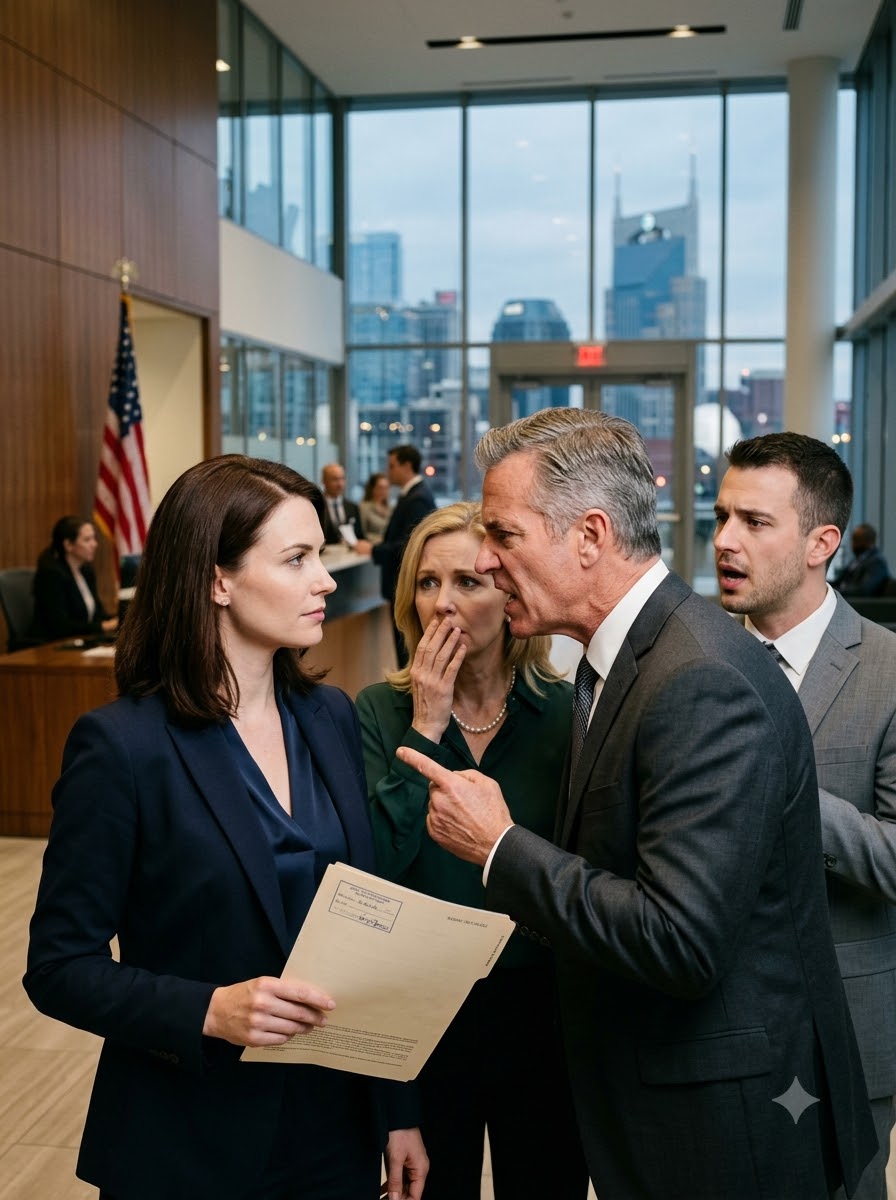
They were in the waiting area, arranged the way my father always arranged himself in rooms, with intention.
He stood near the center of the space, tall, charcoal overcoat, a leather portfolio under his arm.
My mother, Francine, stood slightly to his left, close enough to form a unit but positioned to watch the room. She wore a camel blazer and the expression she reserved for meetings where she already knew how the vote would go.
And behind them, my younger brother, Penn.
Hands in his jacket pockets.
Eyes on the floor.
Penn had my father’s jawline and my mother’s talent for disappearing into a room even while standing in it.
Three clients were already seated.
An older couple reviewing their retirement summary and a younger man in construction boots who ran a small contracting business and had driven from Murfreesboro for our 9:00.
None of them looked up right away.
My father made sure that changed.
He spoke before I reached the waiting area.
“Well,” he said, loud and warm and completely false. “There she is. Seventeen floors up. My daughter.”
The older woman glanced over her shoulder.
The contractor looked up from his phone.
My mother smiled.
It was the kind of smile that has nothing behind it.
Just surface.
Just performance.
I kept my pace steady.
I stopped six feet from my father and looked at him the way I look at a file I haven’t opened yet.
Calm.
Deliberate.
Assessing.
“Do you have an appointment?” I asked.
His smile shifted.
Something colder moved in behind it.
He reached into the leather portfolio and pulled out a document.
And he placed it on the reception desk the way you’d place a checkmate, with the satisfaction of someone who believes the game is already over.
He smoothed it flat with one hand.
“We need 20 minutes,” he said. “And then we need you to sign this.”
I didn’t touch the document.
I read the top line from where I stood.
Executive Director and Controlling Interest Agreement, Mercer Wealth Management LLC.
My mother’s eyes swept the office the way an appraiser’s do.
“All this,” she murmured. “You did well for yourself.”
My father tapped the document.
“You’ll make me executive director,” he said. “Controlling interest transfers today, or I contact your compliance bond carrier this afternoon and report irregularities in your client documentation practices.”
He paused to let it land.
“I know your carrier,” he added. “We have a relationship. One call and you’re under review for six months minimum. Frozen operations. You know what that does to a client list.”
The older couple in the waiting area had stopped pretending to review their paperwork.
The contractor’s phone was face down on his knee.
Tova stood behind the reception desk, hands flat on the surface, composure locked tight.
I looked at my father.
I looked at the document.
I looked at my mother, whose smile had settled into something patient, like she was waiting for me to do the math and arrive at the correct answer.
Then I looked at Penn.
He was staring at a framed photograph on the wall, the river at dusk, a shot I’d taken myself the spring I signed my first lease on this floor.
He didn’t look back at me.
I nodded once.
“Okay,” I said.
My father’s chest expanded.
“Good—”
“Call him,” I said.
He blinked.
“I’m sorry?”
“Your contact at the carrier,” I said evenly. “Call him right now. Put it on speaker.”
My father’s expression reassembled itself.
He didn’t expect agreement.
That’s the thing about people who use threats as leverage.
They’re prepared for resistance, not for someone who hands them the rope and steps back.
He pulled out his phone.
He dialed.
He held it up between us.
One ring.
Two.
Then a man answered.
“This is Dorian Pollock.”
Compliance liaison, Keystone Bond and Insurance.
My father smiled.
“Dorian,” he said. “Alistister Crane calling. I’m reaching out about a firm you carry, Mercer Wealth Management in Nashville. I have concerns about their client documentation practices, and I’d like to—”
Dorian cut in.
“Mr. Crane,” he said, his voice careful and absolutely flat. “I’ve been waiting for this call.”
My father’s smile stopped moving.
Dorian continued.
“We received a referral flag on your name last month from another firm in our portfolio. Similar framing. Similar concern.”
He paused.
“Can you tell me who you are in relation to Mercer Wealth Management?”
My father’s jaw tightened almost imperceptibly.
“I’m her father,” he said. “This is a family restructuring.”
Dorian’s tone didn’t warm.
“Mr. Crane, I’m a compliance officer. I don’t have a category for family restructuring. I do have a category for third-party interference in a bonded firm’s operations using insurance leverage. And that’s what this call sounds like so far.”
My mother leaned toward the phone and said sweetly, “Dorian, we’re simply trying to protect our daughter’s business. She’s had some difficulties lately.”
“Ma’am,” Dorian said, “I don’t know who you are, but protecting a business doesn’t look like contacting its bond carrier without authorization. That looks like interference.”
My father tried confidence.
“Dorian, I have a relationship with your office. I’ve referred clients to Keystone before. I know how this works.”
Dorian was quiet for one beat.
“Then your referrals don’t give you standing to file compliance actions against firms you’re not affiliated with. And based on what I’m hearing, you’re standing in this firm’s lobby right now attempting to pressure its owner into transferring controlling interest to you. Is that accurate?”
My father’s jaw flexed.
“That’s a private family matter.”
I stepped slightly forward.
“For the record,” I said calmly, “yes, that is accurate. He is in my lobby. He has a document. He is threatening to use your office as leverage.”
Dorian’s reply came without hesitation.
“Miss Mercer, this call is being documented on our end, and I want Mr. Crane to understand clearly. Using a bond carrier as a coercive tool to extract business ownership constitutes interference and potentially extortion. We take that seriously because it undermines every firm we carry.”
My mother’s smile had disappeared entirely.
Penn hadn’t moved.
My father tried one more angle, voice dropping low and hard.
“Dorian, you’re making a mistake. I have standing in this industry. If you document this incorrectly, I will—”
“I will document it exactly as it occurred,” Dorian said. “And if your name comes up in a third complaint, it goes to our legal team and to state financial regulators.”
He paused.
“Is there anything else?”
My father said nothing.
Dorian addressed me directly.
“Miss Mercer, do you want us to flag this on your carrier file as a documented third-party interference attempt?”
“Yes,” I said. “Please do.”
“Dorian—”
“Call me if anything changes.”
The line clicked off.
My father stared at his phone for a moment like it had just changed into something he didn’t recognize.
The waiting room was completely still.
The older woman was watching him with the expression people reserve for someone who has done something publicly embarrassing and doesn’t know it yet.
My father pocketed his phone slowly.
He looked at me.
“This isn’t done,” he said quietly.
“I know,” I replied. “But that part is.”
He reached for the document on my reception desk.
My hand got there first, flat over it.
“Not yours,” I said. “You left it here. It stays here.”
Penn finally looked at me.
His eyes were tight.
Not with anger.
With something that looked more like shame, which was worse because shame means he knew what he’d walked into.
My father straightened his coat.
My mother adjusted her bag strap.
She gave me one last look.
A mother’s look designed to cut deeper than anything else.
“You’ll regret this,” she said, soft and certain.
I looked back at her without flinching.
“You said that when I started the firm,” I told her. “I didn’t.”
They left.
Penn went last, and at the door he stopped for half a second with his back to the room.
I thought he might turn around.
He didn’t.
The elevator swallowed all three of them.
Tova exhaled slowly.
The contractor unclenched his jaw.
I looked at my clients.
“I’m sorry for the interruption,” I said. “If anyone would like to reschedule, I completely understand.”
The older woman shook her head firmly.
“We drove 40 minutes,” she said. “We’re staying.”
The contractor just flipped his phone back over and nodded once.
We continued.
I was present and professional because those people deserved it.
And because I’d already made my decision about what came next.
I wasn’t waiting.
I was building the record.
Dorian emailed me while I was still in that meeting.
He documented the call, referenced the prior complaint, and included the name of the other firm my father had targeted, a small investment advisory group in Brentwood, just outside the city.
Their owner had signed a partial agreement under pressure before realizing what it was.
They were still unwinding it with an attorney.
So it wasn’t impulse.
It was a method.
After my 9:00 left, Tova knocked again.
“Vesper,” she said quietly. “There’s an alert from the state financial registry. An attempt was made through the public portal to file an amendment to your firm’s registered ownership structure. From an IP address that traces to our building’s guest Wi-Fi.”
I sat with that for three seconds.
“Pull the IP timestamp and cross-reference it with the lobby camera logs from when they were here,” I said. “Can you do that?”
She nodded.
“Security gave me access when I called them earlier.”
She said, “I already started.”
That’s why I hired Tova.
She doesn’t wait to be asked.
The attempt had been submitted at 10:14 a.m.
My father had been in my lobby until 10:09.
The guest Wi-Fi session had opened at 10:11 from a device registered as a tablet.
Penn had been holding a tablet-style device in his jacket when they arrived.
I’d clocked it, but hadn’t understood its purpose until now.
The attempt failed.
My firm requires owner-verified two-factor authentication for any ownership-structure change, and that verification goes to a device only I carry.
The portal flagged the attempt and froze it automatically.
But the attempt existed.
Timestamped.
Tied to a device on my building’s network.
Cross-referenced with lobby footage that showed exactly who was standing in my lobby at exactly that moment.
I called the state financial crimes reporting line myself.
Not because I was afraid.
Because the trail was clean, and I wasn’t going to let it go cold.
Detective Fisk took my initial statement at 2:15 p.m.
He was efficient and humorless in the way that made me trust him immediately.
He asked for the portal screenshot, the IP log, the camera timestamps, and the document my father had left on the desk.
I gave him everything in a single email while he was still on the phone.
He told me my father’s name had appeared in a related complaint two weeks earlier.
The Brentwood advisory firm.
That owner had reported coercion through insurance leverage and a fraudulent partnership amendment.
The case was open, and my incident had just given it a second leg.
“I want to press charges,” I told him.
He didn’t pause.
“Good,” he said. “We’ll be in touch.”
The next morning, I arrived at the office at 7:30 because I always do and because I needed my building to be mine before they arrived.
They always arrive.
That’s what I’d learned.
People who operate the way my father does don’t stop because a call went wrong.
They recalibrate and return with something that looks more official.
At 8:50, Tova buzzed my desk.
“Vesper, your parents are downstairs with a new folder. They’re telling lobby security they have a state regulatory notice requiring them to inspect your client records.”
I put down my coffee.
“What exactly does the document say?”
She relayed what the lobby officer read to her.
Bold header:
Tennessee Department of Commerce and Insurance.
Pending Audit of Mercer Wealth Management.
My father’s name listed as the authorized audit representative.
I knew the name of every auditor assigned to my compliance file at that department.
I’d been building that relationship for four years.
None of those names was Alistister Crane.
I called the department’s main line while still sitting at my desk.
My contact there answered on the third ring.
She pulled up our file while I waited on hold for 90 seconds.
“There’s no pending audit,” she said. “There’s no outstanding notice. Your file is—”
She paused.
“Should I be worried?”
“I’m handling it,” I told her. “But please log this call as a timestamp that I called at 8:53 a.m. to confirm no audit was in progress.”
She said she would.
I forwarded that confirmation to Detective Fisk before I stood up.
Then I went downstairs.
Not running.
Not bracing.
Just walking.
My father was at the lobby security desk, the new folder open on the counter, pointing to text while the supervisor listened with carefully neutral composure.
My mother stood beside him, anxious in a way she was trying to suppress, which meant things felt less controlled than she’d expected.
Penn was near the door, three feet behind them, hands deep in his coat pockets.
I walked to the desk and stood beside the supervisor.
“Good morning,” I said.
My father turned.
His jaw tightened.
“Vesper, you need to let us upstairs. This is a state notice. You’re required to comply.”
“I called the department at 8:53 this morning,” I said. “There is no pending audit. There is no outstanding notice. Your name does not appear anywhere in my compliance file as an authorized representative.”
My mother made a small sound.
Thin and nervous.
“That’s a miscommunication,” she said. “The department doesn’t always update their systems in real time.”
I looked at her calmly.
“The person I spoke with was the senior district auditor. She pulled my file live while I was on the phone. Nothing is pending.”
My father straightened.
“That document is real,” he said. “It has a seal.”
“The seal is exactly why I’m treating this seriously,” I replied. “Because producing a fraudulent regulatory document with a forged government seal is a felony.”
Penn’s chin came up.
“Dad,” he said quietly.
My father’s eyes snapped toward him.
“Quiet.”
But Penn didn’t go quiet.
He stepped forward and looked at me, and his voice was low and unsteady.
“I didn’t know about the seal,” he said. “I didn’t know they added that. I thought it was just a letter.”
My father’s face went rigid.
I looked at Penn and held his gaze for a moment.
“Whatever you know, you should tell Detective Fisk,” I said. “Today. Because the longer this goes on, the harder the distinction becomes between what you knew and what you participated in.”
Penn swallowed.
“Okay,” he said.
“Okay,” I replied.
And I meant it.
Not as warmth.
Not as absolution.
Just as acknowledgement that he had just made a choice, and it was the right one.
The building supervisor handed me a note.
Building counsel says: Preserve everything and contact law enforcement. They’re backing you fully.
I already had a text from Detective Fisk asking for that morning’s lobby footage.
I forwarded the supervisor statement to him and photographed the forged document in place on the counter without touching it.
Two officers arrived 11 minutes later.
They processed what was in front of them without editorializing.
A forged state document.
And a man who had carried it into a building to use as leverage against a tenant.
My father tried twice to invoke industry relationships.
Neither officer responded to that.
They ran his ID.
They collected the document with gloves.
They took a statement from the supervisor.
My mother stopped performing somewhere in the middle of the second officer’s questions.
The confidence drained out of her face, and what was left was just a tired woman who had followed a bad plan to its logical end.
Penn asked to be interviewed separately.
He described the planning conversations that had preceded both visits.
He confirmed the Brentwood incident.
He confirmed the seal had been added to the document after initial drafts and that he’d said at the time that it felt wrong.
His statement, given voluntarily and on record, became the thread that connected the two cases and established deliberate intent.
My father was charged that afternoon.
Fraud.
Attempted extortion.
Filing a forged instrument.
My mother was charged with participation in the scheme.
Penn was interviewed as a witness, not a defendant.
His cooperation made that possible, and I think he knew it would when he spoke up in the lobby.
The state financial registry closed the attempted ownership amendment and flagged the account that submitted it.
The building issued a permanent no-trespass order.
Keystone Bond sent a formal letter documenting the interference attempt in my carrier file.
Three weeks later, I received a voicemail from a number I didn’t recognize.
It was Penn.
He didn’t ask for anything.
He said he was sorry.
And then he said something that stayed with me.
“I thought telling the truth would make everything worse. I didn’t understand until that lobby that telling it was the only way out.”
I didn’t call him back right away.
But I kept the voicemail.
That felt like enough for now.
My firm didn’t lose a client.
The older couple from that first Tuesday referred their son to me the following month.
They told me they had watched how I handled pressure and they decided they wanted someone like that managing their retirement.
I thanked them genuinely.
They had no idea how much it meant.
Tova got a raise.
She had already logged the IP alert, pulled the camera timestamps, and called building security before I’d asked her to do any of it.
That kind of instinct is worth more than the title she had.
At the end of that month, I sat in my office in the amber morning light, the river catching the east windows, and I thought about that four-minute phone call eight years ago.
My father had said I’d made my choices, and they’d made theirs.
He said it like a verdict.
Like proof that without their approval, I would eventually collapse.
The 17th floor exists because he was wrong about that.
Every client file in my cabinet, every referral, every satisfied portfolio review exists because he was wrong.
And the charges on his record and the clean status of my firm’s registry exist because when he came back to prove it, everything he tried to use against me had already been answered.
I didn’t build this firm to survive my family.
I built it because I had something real to offer people, and I wasn’t going to let grief talk me out of delivering it.
The fact that it could withstand them turned out to be a side effect.
A very satisfying one.
If anyone in your life has ever looked at what you built and reached for it instead of celebrating it, you already know what I know.
The best protection isn’t anger.
And it’s not fear.
It’s a clean record, a documented trail, and the patience to let the facts do the talking.
That’s all it ever takes.
Just let them speak.








