My husband came to pick me up after work. I hid in the office storage cabinet to surprise him, but when he couldn’t find me, he hurriedly made a phone call. What he said next left me absolutely stunned—it was like a bolt from the blue…
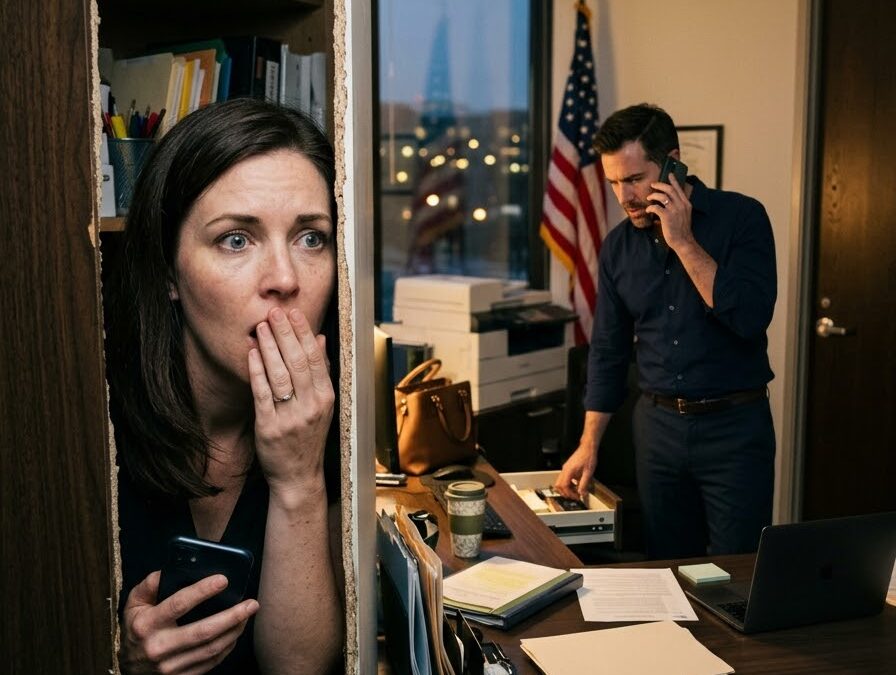
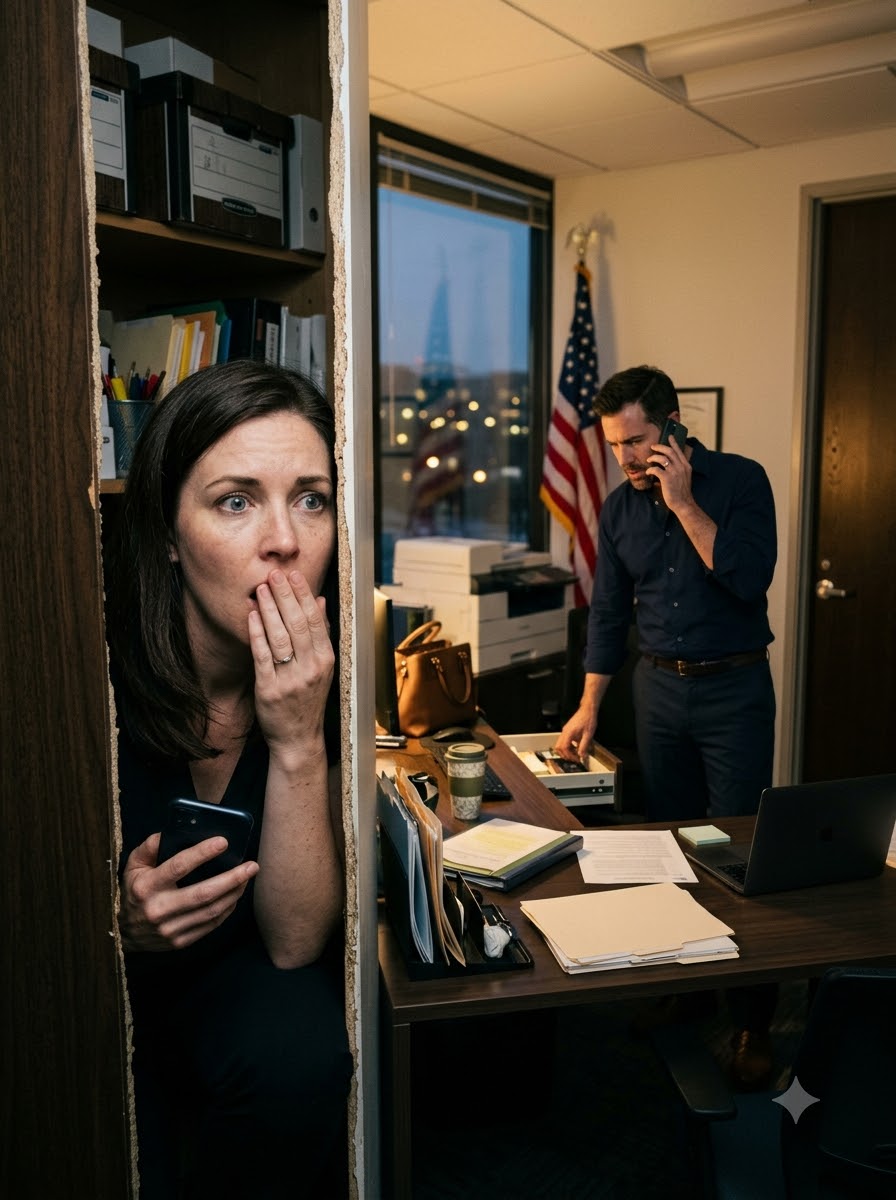
I was crouched inside the supply closet off our main office floor when my husband walked in and didn’t call my name.
The whole thing had been Carl’s idea, a plan that sounds funny when someone else proposes it and makes you feel like a fool the moment you’re folded behind a shelving unit, breathing toner dust and old Post-it notes.
Hugo had texted me at 4:30 to say he was leaving the gym early and would swing by to pick me up.
Carl, who has been my office manager and closest work friend for three years, and who overestimates his own comedic instincts by a significant margin, had looked over my shoulder at the message and declared that we’d been married for 6 years and still did the picked up from work thing.
And wouldn’t it be something if I hid and leapt out and finally got a real expression out of Hugo’s face?
Hugo was very hard to unsettle.
His shirts were always pressed.
His shoes were polished every morning without fail.
He had never once taken out the recycling in anything less than clean dark jeans.
Our building superintendent once told me her daughter should find someone like Hugo.
A man who always presented himself well.
I had taken that as a compliment.
So I climbed into the supply closet.
Carl pulled the door most of the way shut with a wink and I waited in the dark, genuinely amused, imagining the look on Hugo’s face when I jumped out.
He came in at 5.
I heard his footsteps on the hardwood.
He wore leather sold Oxfords.
always the kind that announce themselves.
And then I heard nothing.
No Abby, no hello, not even a pause of confusion.
Just the soft push of the office door closing and the definitive click of the deadbolt turning.
Then he dialed someone.
His voice was low.
Even I know that voice.
He uses it when he wants to reassure someone without actually reassuring them.
A warmth at the surface that doesn’t go deeper.
He said she didn’t know anything yet.
He said the house would sort itself out after the dinner.
He said he had been laying the groundwork with her mother for months and that Jean was the kind of woman who couldn’t stand making a scene in front of family and that once the aunts and cousins started weighing in, she would agree rather than hold out.
I stopped breathing.
The house he was talking about was the one my father left me.
A three-story semi- detached on Pap Avenue in East Toronto.
Original hardwood floors, a bay window on the second floor where dad used to sit with his coffee.
A backyard that backed onto a small ravine.
when he died the April I was finishing my last semester at Ryerson.
The mortgage had two years left on it.
My mother Jean had kept the house, rented the top floor for a while to make ends meet, and eventually signed it into my name when I married because that was what my father had asked her to do before he died.
By any recent estimate, the house was worth somewhere between one and a half and $2 million.
And Hugo had been in the room when those numbers came up, and he had said warmly, easily, that it was mine, and I should handle it however I saw fit.
He was on the phone now in that same warm voice.
And what he was telling the person on the other end was that I was too sentimental to put up a real fight.
That raising the topic at my mother’s 70th birthday dinner in front of everyone who mattered to me would make it nearly impossible for me to refuse.
That once Gene got emotional, I would fold rather than cause a scene in front of family.
My hand was pressed so hard against my mouth, my teeth left marks on my palm.
The woman on the other end said something I couldn’t catch.
Hugo laughed, a particular laugh, slightly breathy.
The one I had heard on calls I assumed were work.
He told her to be patient, that once the house situation was settled, everything would change.
He walked to my desk.
I could see him through the gap in the closet door, the back of his charcoal blazer, one hand resting on the desktop.
He opened the top drawer, pens, a lip balm.
He closed it, opened the second.
He went through it quickly, very neatly, the way someone does when they know they need to leave no trace.
He was looking for the property file.
I sometimes kept a copy at the office because I’d been meaning to get something notorized and had never gotten around to it.
The file wasn’t there.
I had dropped it into my bag two weeks ago and forgotten about it entirely, which turned out to be the luckiest, careless thing I had ever done.
he said quieter now, that she was more careful than he’d thought.
Then, after a pause, that it didn’t matter, that my biggest weakness was sentiment, the house, my father’s memory, my mother’s comfort.
I couldn’t give up any of it.
All he had to do was press on that.
A few minutes later, he said a name, telling her not to text him too often so they wouldn’t get caught.
The name was Lena.
I had heard that name once, mentioned in passing as someone on a development file.
I had not thought about it again.
I was thinking about it now.
He finished the call, checked my desk one more time, and then sent me a voice note.
I felt my phone vibrate in my hand.
His voice, all warmth now, said he was at the office and where had I disappeared to.
And he had grabbed me a tea from the bridge head around the corner.
Oat milk, one honey.
Exactly how I liked it.
Exactly how I liked it.
I pressed record on my voice memo before I fully understood I was doing it.
My hands were shaking badly enough that the phone tapped against the shelf.
I heard Hugo go completely still.
The room was so quiet, the only sound was the hum of the elevator shaft down the hall.
He did not open the closet door.
Carl’s voice boomed from the hallway.
Something about an Amazon delivery and who had signed for it, and whether Stella at reception had just left it with anyone, and the hand I could sense moving toward the closet handle went still, then released.
Hugo stepped back, sent me the voice note a second time, tender and concerned, and went to find me.
I climbed out.
My legs had gone half numb, and my jacket was dusty at the knees.
On the desk sat the bridge head cup, a sticky note in Hugo’s handwriting on the sleeve.
Drink it warm.
You always forget.
I peeled off the note, folded it, and put it in my pocket.
I don’t know why.
Some habits outlive the information that should kill them.
When he came back into the office and found me standing at my desk, his face opened with relief.
He asked where I’d been.
I said the kitchen that I’d gone for water.
He said I was ice cold.
I said I’d warm up in the car.
He believed me completely.
That was the moment I understood how easy it is to lie to someone who has already decided what you are.
Hugoid I was soft and sentimental and wouldn’t rock the boat.
He had built his whole plan around that assumption.
He was not looking for anything different.
On the drive home south on the DVP with the lake flat and gray in the fading light, he brought up the birthday dinner.
Just the logistics at first, the guest list, whether Aunt Francis needed a ride, whether the private room at the restaurant could fit everyone.
Then, almost as an afterthought, he said it might be worth thinking about the Pape Avenue house at some point.
That my mother was getting older.
That four flights of stairs with no elevator weren’t ideal.
That something newer, more accessible, maybe closer to where we lived in Leslieville would make things easier for everyone.
I looked out the window at the 41 interchange sliding past and said I’d think about it.
He patted my knee.
That night, I heard him on the balcony after I’d gone to bed, his voice low through the glass.
I caught a few words.
She won’t make a scene.
I pressed my face into the pillow and let my heart do whatever it needed to do.
In the morning, I told Carl everything.
He set his coffee down hard enough that it slloshed onto his desk.
He stared at me.
Then he said, “You have a recording?”
I said, “Yes.”
He said, “So, what are we doing?”
I said, “We’re going to let him have his party.”
Carl looked at me for a long time.
Then he said, “You’re terrifying.
I mean that as a genuine observation.
I spent the following week being a careful wife.
I made breakfast.
I asked about his day.
I did not check his phone because I already knew what was on it and because checking would give him the opening to redirect everything toward my trust issues.”
Hugo was excellent at the pivot.
The moment any accusation surfaced, he would route the entire conversation toward how wounding it was to be accused.
and by the end I would be the one apologizing.
I was not going to apologize.
I called my mother midweek.
She was making butter tarts and complaining that the recipe called for too little salt.
She had bought a new dress for the dinner, dark green, and was worried it was too young for 70.
I told her it was perfect.
She asked if I was all right.
I said I was a little tired.
She was quiet.
Then she said, “There are two kinds of tired, Abby.
the kind you sleep off and the kind you sit with until you understand it.
I said I’d let her know which kind this was.
She said, “Don’t wait too long.
You were never good at sitting still.”
The morning of the dinner, I drove to Pape Avenue before going to the restaurant.
Let myself in with my key.
The house smelled the way it always had.
Butter tarts cooling on a rack, wood polish, that old house smell you cannot replicate in new construction.
There were photographs up the staircase.
My parents at Niagara Falls in 1985.
My dad on a fishing trip near Sudbury.
Me at six holding a perch I was clearly terrified of and trying to look proud about it.
My mother came downstairs in the green dress.
She took one look at my face and sat me down at the kitchen table without a word.
She said, “Tell me.”
I told her the shape of it.
Hugo had been making plans about the house without asking me.
He intended to raise it at dinner in front of everyone.
He thought I would agree rather than cause a scene.
She listened with her hands folded on the table, her face very still.
When I finished, she got up and came back with an old tin box I remembered from childhood.
The one I used to keep buttons in or hair clips or whatever I was collecting that year.
She opened it.
Inside were the original title documents, some papers in my father’s handwriting, and a photograph of him young grinning at the camera in a real estate office shaking someone’s hand.
She said, “Before your father died, he asked me for two things.
Don’t go into debt for the funeral and make sure the house stays yours.”
She pushed the tin toward me.
He said, “Whatever happened in your life, wherever you ended up, you needed a door you could always open with your own key.”
I looked at the photograph.
My father at maybe 30, looking so impossibly young, it cracked something open in me.
She put her hand over mine.
She said, “I’ve been watching Hugo circle this house since last fall.
a man who never once asked about the plumbing suddenly asking about loadbearing walls.
I’m not scenile, Abby.
I almost laughed.
She said, “Don’t let him make you feel like you caused this.
You loved someone who decided that wasn’t enough.”
We drove to the restaurant together.
Hugo called twice on the way.
I let it ring.
Gio Rana had given us the back room.
Warm light, big round tables, the kind of family dinner noise where six conversations happen at once and no one catches any of them completely.
My aunt Francis was already there with her husband.
My cousin Francesca with her baby, three of Hugo’s relatives, and his mother Sylvie, who wore a brooch the size of a saucer, and kissed the air beside everyone’s cheek.
Hugo was at the door when we arrived.
He kissed my mother on the cheek, took her coat, told her she looked wonderful.
He was so fluent at this, 6 years of watching him, and I had believed every syllable of it.
Carl arrived with a bottle of Niagara ice wine and the expression of a man who has agreed to something he already regrets.
He shook Hugo’s hand with genuine warmth and said he’d been looking forward to meeting everyone.
Hugo looked pleased.
He loved being liked by my people.
Sylvie found me near the bread basket.
She said what a generous thing Hugo was doing, organizing all this for my mother.
She said family was everything.
She said she did hope we could all keep a close eye on Jean, especially given that the Pape Avenue house was a lot for one woman to manage on her own.
I said, “You’re absolutely right.
We should definitely talk about that tonight.”
She blinked.
That wasn’t what she had expected.
Philip OC arrived later, Hugo’s development partner, a man who treats all conversation like contract terms.
Hugo had mentioned to him that my company’s media contacts might be useful for a project they were launching.
Philip had texted me about it once.
I had met him for coffee the previous Tuesday and told him gently that family matters were making it impossible to commit to anything right now.
I watched him recalculate Hugo’s value in real time on his way out the door of that cafe.
The dinner started.
Toasts were made.
My mother blew out candles on a lemon mering cake and looked so genuinely happy that my chest hurt.
Hugo stood up to speak and he was magnificent.
He talked about how hard my mother had worked her whole life and how much he admired her and how he and I were committed to making sure the next chapter of her life was comfortable and supported.
People dabbed their eyes.
Aunt Francis said, “That’s lovely.”
In a carrying whisper.
Then he said, “Jean deserves better than four flights of stairs with no elevator.
Abby and I have been talking about finding her something newer and more accessible, so she’s always close to us.”
He looked at me.
That look said now.
I stood up.
Relief crossed his face for exactly one second.
I smiled at the room and said, “Everything Hugo just said is true.
He cares so much about my mother’s comfort.
Since everyone who matters to us is here tonight, this seems like the perfect moment to go over the details.”
The table went quiet.
“Hugo,” I said.
Can you walk everyone through the plan, specifically where the money from a sale would go, whose name a new property would be registered in, and who authorized any of this with my mother or with me?
Hugo said pleasantly.
Abby, let’s not.
You brought it up, I said.
I’m just asking for specifics.
Sylvie tried.
This isn’t really the place.
My mother said very calmly.
I’d like to hear the answer.
Hugo’s hand went to his cuff.
He said the idea was just to explore options, that nothing was decided, that he was simply trying to help.
I said, “Then who did you tell that the house would be sorted out after the birthday dinner?”
“And who were you talking to when you said I was too sentimental to fight you on it?”
I did not say her name.
I didn’t need to.
The color left Hugo’s face the way water drains from a glass.
I took out my phone.
I said, “I was in the supply closet at the office when you came to pick me up last Tuesday.”
The room was absolutely still.
I pressed play.
Hugo’s voice filled the private room low, even unhurried, telling someone on the phone that the house would sort itself out after the dinner, that Jean would get emotional, that I would cave rather than make a scene in front of family.
Aunt Francis made a sound that was not quite a word.
Philip sat down his wine glass very carefully and did not pick it up again.
Carl at the back wall was studying the ceiling with great focus.
Hugo said, “That’s that’s not what it sounds like.”
My mother said, “Then tell us what it sounds like.”
He had nothing.
I watched the room.
Understand it.
The moment when someone who has been performing competence for years simply runs out of material.
His hands worked at his cuffs.
His eyes moved across the faces at the table and found no safe place to land.
Philip stood, picked up his jacket, and said quietly that he’d need to revisit their project timeline.
He said it to me, not to Hugo.
Then he left.
My mother stood up.
She is not a tall woman, but she knows how to take up the space she needs.
She said, “Thank you for the dinner.
The room was lovely, but I think you should go.”
Hugo looked at me one more time.
I looked back and said nothing.
I had already said everything that needed saying.
He left.
Sylvie followed after a long pause with a look in my direction that I chose not to interpret.
The room settled.
The waiters, who had frozen somewhere around the second minute, began bringing out the main course.
Aunt Francis refilled her wine.
Francesca’s baby woke up and started crying, which made everyone exhale at once and reached for the bread basket.
Carl appeared at my elbow.
He said very quietly, “You know what I keep thinking about.”
I said, “Don’t say the closet.”
He said, “You were in there breathing toner fumes for 20 minutes and then you came out and sat through an entire dinner and then you did that.”
He gestured vaguely at the room.
That is the most composed thing I have ever witnessed in my life, and I need you to know it is slightly frightening.
I laughed until my eyes watered.
The baby was still crying.
The Asobuko was arriving.
My mother pressed her hand to my arm and said, “Eat something.
It’s getting cold.”
I ate.
It was very good.
Later, Hugo came back to the doorway of the private room.
He had lost the composure somewhere between the parking lot and the restaurant entrance.
The jacket was slightly rumpled.
He looked like someone who had rehearsed a version of this moment and found the stage entirely rearranged.
He said he was sorry.
He said it had been bad judgment, a moment of weakness.
That six years together couldn’t be erased by one mistake.
I said it wasn’t one mistake.
It was a system.
He flinched.
I said, “Go home.
We’ll sort the rest through lawyers.”
My mother said, “Good night, Hugo.”
In a tone that closed every door at once.
he went.
I drove her home.
We sat on the edge of her bed the way I used to when I was small and couldn’t sleep.
And outside the ravine at the back of the house was full of October wind, the trees gone amber.
She said, “Your father would have liked tonight.”
I said, “The Osuko.”
She said, “You.”
I didn’t cry until I was alone in the car on Pap Avenue.
And even then, it was the quiet kind.
Not falling apart, just the sound of a chest finally catching up to what the mind had already accepted.
I slept that night better than I had in weeks.
In the days that followed, I found a different kind of rhythm.
I walked to work instead of waiting for a ride.
I ordered my own coffee at the bridge head in the mornings.
Sometimes oat milk and honey, sometimes black, sometimes a tea, depending on what I actually felt like, without anyone deciding that in advance on my behalf.
I called my mother on Tuesdays and Thursdays.
She had joined a choir at the community center and sang with great enthusiasm and questionable pitch.
Every call started the same way.
Something about scallions running low or the buttertart recipe needing adjustment or whether the pharmacy on Danforth carried her particular brand of arnica gel.
And every call ended with me laughing and her pretending she hadn’t meant to be funny.
Carl put a small paos plant on top of the supply closet.
He said it was aspirational.
I told him it would die without direct light.
He said that was a metaphor.
I told him to go back to work.
The house on Pap Avenue stayed in my name.
Some mornings I drive past it on the way somewhere else.
No particular reason, just because Pap is on the route and I look at the original brick and the bay window on the second floor.
I think about my father who drove a truck in the years before I was born and knew when he was dying too young that the most useful thing he could leave his daughter was not money in a bank account or advice.
she’d forget.
But a door she could always open with her own key.








