My husband said, “My family is coming, and they don’t like you. Get out.” He kicked me out of my own home so his family could move in—all without my knowledge. But little did he know, I controlled every camera, every lock, and held all the evidence. I had already set a trap, waiting for him to walk right into it.

My name is Vivien Mercer, and on a Thursday afternoon, my husband told me to leave the house I had owned long before I ever met him.
I was standing in the kitchen, quietly slicing strawberries, when Caleb walked through the door wearing his office suit and dropped his keys onto the counter. He barely looked at me before saying, “My mom and Mason are coming over.”
I kept cutting the strawberries.
His voice became firmer. “They don’t like you.”
That wasn’t exactly new information. For three years, his mother, Denise, had called me controlling simply because I refused to finance the lifestyle she expected from other people. Her younger son, Mason, was even more direct. Whenever the family gathered, he seemed to treat the occasion as an opportunity to explain what Caleb should be receiving from our marriage.
Caleb stepped closer to me and said, “So, when they get here, you’d better be gone.”
I finally stopped cutting the strawberries and looked at him. “Gone where?”
He shrugged. “I don’t care. A hotel, a friend’s place, wherever. Just don’t create drama.”
For a moment, I wondered whether Caleb had forgotten something important. He was standing in my kitchen, inside a property I had purchased four years before I met him. The deed was entirely in my name.
The company that paid for the private security around the property was also mine. Caleb had moved into the house after our wedding eighteen months earlier. He contributed to groceries and occasionally paid for small household expenses, but he had never purchased the property, never contributed to the mortgage, and never been added to the deed.
I looked at him and simply smiled. “Sure.”
Apparently, that was all he wanted to hear.
He left about twenty minutes later to collect Denise and Mason. I didn’t pack a bag. I didn’t argue. Instead, I called the security office at the front gate and gave them a simple instruction: no visitors tonight unless I personally authorized them.
Then I called my attorney, Natalie Brooks.
Caleb had been acting strangely for several weeks. He had started taking whispered phone calls, asking unusual questions about the property’s current value, and showing a sudden interest in whether I had ever considered putting his name on the deed.
At the time, I’d considered it annoying.
Now, it looked different.
At exactly 7:08 that evening, the gate intercom rang.
“Ms. Mercer, your husband is here with two guests.”
I opened the entrance camera on my phone.
Caleb was standing near the gate, arguing with the security guard. But something immediately caught my attention.
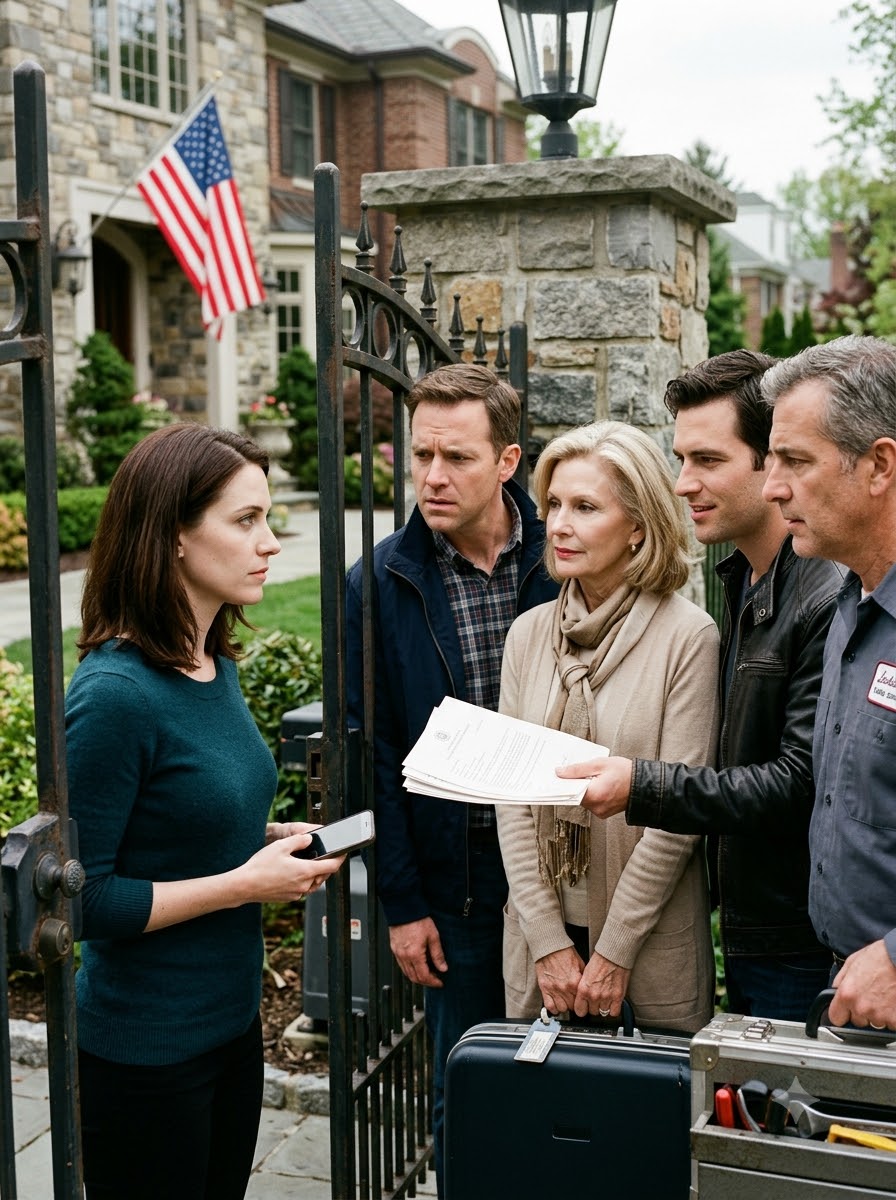
Denise wasn’t carrying food or anything that looked remotely connected to dinner. She was holding a suitcase.
And beside Mason stood a locksmith.
I stared at the screen.
A locksmith.
Caleb hadn’t brought his family over for dinner. They had arrived prepared to change something.
I told security not to admit anyone except Caleb, who was already registered as a resident. The guard relayed my instructions. Even through the camera, I could see Denise becoming furious.
Seconds later, my phone rang.
It was Caleb.
“Open the gate.”
“Why is there a locksmith with you?”
There was a long pause.
Then he sighed. “Mom needs somewhere to stay for a while.”
“And the locksmith?”
“Mason lost the spare key.”
I almost laughed.
Mason didn’t have a key. He had never been given one.
“He was supposed to,” Caleb replied.
That sentence caught my attention.
According to Caleb, Denise had supposedly lost her apartment after a dispute with her landlord. He had apparently promised her that she could stay temporarily in our guest suite.
He had never discussed any of this with me.
The locksmith, he claimed, was simply there because he wanted Denise to have independent access to the house.
I told him no.
His response was immediate.
“This is my house, too.”
I corrected him. “No, Caleb. It is your residence. I bought it before we met, and the deed is in my name.”
He hung up.
Five minutes later, Natalie called. I explained what had happened.
She told me not to confront anyone physically and instructed me to preserve every piece of security footage from the evening.
Before I could say anything else, the gate called again.
This time, Mason was holding a document up toward the security camera. He told the guard it proved Caleb owned half of the property.
My stomach tightened.
I asked security to photograph the document without accepting it as valid.
The image reached my phone moments later.
It appeared to be a property transfer document. My name was listed as the grantor. Caleb’s name appeared as a co-owner. At the bottom was a signature that looked similar to mine.
There was only one problem.
I had never signed it.
Natalie immediately noticed the date.
The document supposedly had been executed eleven days earlier.
I had been in Toronto on that date.
I wasn’t even in the country.
Natalie’s voice became serious.
“Do not let that locksmith touch anything.”
Security had already refused entry.
Caleb was still outside the gate, pacing back and forth while Denise continued arguing with the guards. Mason kept waving the document around as if repeating the claim could somehow make it legitimate.
Natalie asked me to send her the clearest photograph possible.
She then checked the public property records.
Nothing had changed.
I was still listed as the sole owner.
That should have made me feel safe, but it didn’t.
The document Mason was carrying appeared to have been prepared for filing. Whatever they were planning hadn’t been completed yet.
I called Caleb again.
“What exactly did you bring to my gate?”
This time, he stopped pretending.
“A deed adjustment.”
“Signed by whom?”
“You.”
“No.”
His voice hardened. “Vivien, don’t do this.”
I could barely believe the conversation.
I reminded him that I had been in Toronto on the date printed on the document.
He went silent.
Then Denise’s voice suddenly came through the phone. She was shouting loudly enough for me to hear every word.
“She agreed when she married you!”
Natalie was still connected on another line and heard it too.
I told Caleb that the document would be reviewed by counsel and that nobody was entering my property that night.
He called me selfish.
Then, in his frustration, he made the mistake that answered the question I had been asking myself since the locksmith appeared.
“You were supposed to be gone before we arrived.”
There it was.
Caleb hadn’t been trying to prevent a family argument.
He had wanted me out of the house while his family arrived with a locksmith and paperwork that appeared designed to give Denise access to property she had no legal ownership of.
Security eventually escorted the locksmith away after he learned there was a dispute concerning ownership.
Caleb was still allowed to enter the property as a registered resident, but he refused to come inside alone.
Then Mason stepped toward the intercom and looked directly into the camera.
“You think that gate protects you?” He smiled. “Check your home office.”
My stomach dropped.
My home office contained the original property documents and several other important records.
Suddenly, I remembered something I had dismissed three weeks earlier.
Caleb had asked to borrow my office key.
I didn’t rush upstairs.
Natalie had already told me to preserve the scene before touching anything.
Security sent a supervisor to remain nearby while I photographed the office door, the cabinet, the desk, and everything around them.
At first glance, nothing appeared disturbed.
I unlocked the document drawer.
The folder containing my original deed was still there.
My tax records were there.
My insurance policies were there.
But one folder was missing.
That folder contained copies of my passport, driver’s license, and several notarized documents from a business transaction two years earlier.
My hands went cold.
Caleb knew that folder existed. He had seen me take it out when we updated our insurance.
Natalie told me to contact the police and report the suspected missing documents as well as the disputed property transfer.
I did exactly that.
Meanwhile, Caleb and his family finally left the gate.
They didn’t return home.
Security footage showed them getting into two separate vehicles. Mason drove one while Denise drove the other.
The following morning, Natalie called me with an update.
She had discovered something unusual about the transfer document.
The notary named on it was a legitimate notary.
The notarization number, however, was not legitimate.
Someone had copied details from an older document, specifically one of mine.
The kind of document that had been stored inside the missing folder.
Before I could process that information, my bank called.
A representative asked me to verify an application for a home equity line of credit.
I told them I had not submitted one.
The requested amount was $450,000.
The property being offered as collateral was my house.
The application listed Caleb as a co-owner.
Natalie immediately contacted the bank’s fraud department and formally notified them that the ownership was disputed and that I had never authorized the application.
Then the bank representative asked me something else.
“Do you know a Denise Mercer?”
I said yes.
She was listed as the secondary contact on the application.
My stomach tightened again.
Then came the detail that made the entire situation even more serious.
The application didn’t say the money was needed for home renovations or repairs.
Under the purpose section, someone had written: family business acquisition.
Caleb had never mentioned purchasing a business.
Natalie warned me not to make assumptions and told me that we needed to follow the documents rather than speculate.
The bank froze the application while reviewing the ownership dispute.
A few hours later, I received an email from Mason.
There was no greeting and no apology.
It contained one sentence.
“You’re destroying something that would have benefited everyone.”
I forwarded it to Natalie.
Within hours, she discovered that Mason had recently registered a company called Mercer Residential Group.
The company’s stated purpose involved purchasing and renovating rental properties.
Suddenly, the $450,000 request made more sense, at least in part.
We still didn’t know exactly how the loan application connected to Mason’s company, so Natalie contacted the bank through the proper legal channels.
That same day, Caleb returned alone.
Security called me from the gate.
He looked exhausted.
I agreed to let him into the front courtyard, but I did not allow him inside the house.
He stood outside the locked door and stared at it.
“You changed my access?”
“Yes.”
He shook his head. “This is insane.”
“Where are my documents?”
His expression changed when I asked him about Mercer Residential Group.
That reaction told me I was finally getting closer to the truth.
Caleb admitted that Mason had found an apartment building they wanted to purchase together.
They needed capital quickly, and my house was supposed to provide it.
I asked him, “Our house?”
He rubbed his face.
“You have millions in equity sitting here doing nothing.”
That was the moment I understood how they had been looking at my home.
I had considered it our residence.
They had considered it available capital.
Caleb insisted he had planned to explain everything after the purchase closed.
I asked whether Denise was supposed to move into the guest suite permanently.
He hesitated before saying, “Temporarily.”
I asked why the locksmith had been necessary.
Another pause followed.
Finally, he admitted that Denise planned to stay in the house while her own property was being sold.
I frowned. “You told me she lost her apartment.”
Caleb looked away.
That was when I realized there had never been a landlord dispute.
Denise owned a house.
They were selling it to help finance Mason’s deal.
I asked Caleb how much Denise expected to receive from the sale.
He said approximately $300,000.
Mason, according to him, was contributing the business plan.
I actually laughed.
His mother was selling her own home.
My property was being used to secure a $450,000 loan.
And Mason’s contribution was apparently a presentation and a business plan.
Caleb insisted the apartment building would generate enough rental income to repay everyone.
I asked whether he had already signed anything.
He admitted that he had signed a purchase commitment.
The closing deadline was Friday.
Suddenly, the urgency made sense.
If their financing failed, they could lose their deposit.
I asked how much the deposit was.
Caleb looked away before answering.
“$75,000.”
I asked whose money had been used.
His silence gave me the answer.
Our joint checking account did not contain anywhere near that amount.
Natalie later helped me trace the transfer through records I was legally entitled to review.
The deposit had come from an account Caleb maintained separately.
And the source of that money included a $50,000 transfer from Denise.
At least that portion wasn’t mine.
Meanwhile, investigators examining my missing document report asked whether anyone besides Caleb knew the layout of my office.
Mason did.
He had stayed at our house for two weeks the previous summer.
Security records revealed something even more important.
Three weeks earlier, while I was attending a conference, Mason had entered the property using Caleb’s authorization.
He remained inside for approximately ninety minutes.
Caleb had told me Mason was only stopping by to collect his golf clubs.
When attorneys confronted him about the security record, Caleb claimed he didn’t know Mason had entered my office.
Then Natalie received a copy of the home equity application.
Attached were scans of my identification documents.
They were the same documents that had disappeared from my folder.
But there was something else.
A verification photograph showed a woman holding my driver’s license beside her face.
She wasn’t me.
I recognized her immediately.
She was Denise’s younger sister, Marlene.
According to the application, Marlene had claimed to be Vivien Mercer.
That photograph changed the situation completely.
Marlene had similar coloring to me, but anyone paying close attention would know we were different people.
Natalie immediately sent the evidence to the bank’s fraud investigators and to the detective handling my missing documents.
I didn’t call Marlene.
Neither did Caleb.
From that point forward, communication happened through attorneys.
The bank permanently stopped the $450,000 loan application.
Without that financing, Mason couldn’t complete the apartment building purchase.
The deadline expired Friday afternoon.
The $75,000 deposit then became part of a separate contractual dispute.
Mason blamed me.
Denise blamed security.
Caleb blamed everyone around him.
Then Marlene hired an attorney.
Through her lawyer, she claimed Denise had told her the verification was simply helping correct paperwork because I was traveling.
Whether Marlene understood the full purpose of what she was participating in was something investigators would determine, but she provided messages that revealed much more.
One message from Denise said, “Vivien will never agree if we ask first.”
Another said, “Once Caleb is officially on the deed, she can’t stop us.”
Then there was a message involving Caleb directly.
Denise had written to him, “Make sure she’s out Thursday. We need the locks handled before she starts asking questions.”
Caleb replied, “I’ll deal with Vivien.”
I read that message several times.
Maybe he hadn’t known every detail.
Maybe he hadn’t known exactly how my identification would be used.
But he knew his family intended to change access to my property while deliberately keeping me away from it.
That was enough for me.
I filed for divorce that afternoon.
Caleb moved out under arrangements handled through counsel, and security removed his resident authorization.
Then Natalie called with one final discovery.
The attempted deed transfer had not been prepared solely to secure financing.
Attached to the original draft was another document.
It granted Denise a lifetime right to occupy part of the property.
My husband hadn’t simply planned to let his mother stay for a few weeks.
He had planned to create a legal arrangement that could have made it extremely difficult for me to remove her from my own property.
The divorce process took eleven months.
My house never left my name.
The home equity loan was never funded.
The disputed deed documents were handled through the appropriate legal and investigative processes.
Denise sold her own house anyway.
Without access to mine, she had to find somewhere else to live.
Mason’s apartment deal disappeared.
Caleb continued insisting until the end that he had only been trying to help his family build something together.
But that was exactly the problem.
His definition of “together” included my property while excluding my permission.
Marlene’s involvement was handled separately.
And once Natalie confirmed that my identity, records, and property were protected, I stopped following the details.
I had spent enough time trying to understand what they had planned.
Now I needed to rebuild my own life.
I replaced the missing documents, changed every security credential, updated my estate plan, and kept the same security team Caleb had once mocked as unnecessary.
Several months later, I was making dinner when the security supervisor called.
“Ms. Mercer, your former mother-in-law is at the gate.”
Denise wanted to collect a box that Caleb claimed he had left behind.
I checked with my attorney.
The box had already been transferred through counsel weeks earlier.
There was nothing left for Denise to collect.
So I gave security the same instruction I had given them that Thursday evening.
“No unauthorized visitors.”
Through the camera, I watched Denise standing outside the gate, staring toward the house.
Then the gate remained closed.
I almost smiled.
She had once arrived carrying a suitcase, accompanied by a locksmith and backed by paperwork designed to make my home feel as though it belonged to her.
Caleb had ordered me to disappear so his family could walk inside.
Instead, he disappeared from my life.
The house remained exactly where it had always been.
Mine.
And the security system they had once treated as nothing more than protection around a gate ended up doing something far more important.
It gave me enough time to discover exactly who I needed protection from.
10 clickbait curiosity titles
- My husband ordered me out of my house. Then I saw who was standing beside the locksmith.
- “Be gone before we arrive,” my husband said. Then I saw the document they brought.
- My husband tried to put his mom on my deed, but one security camera exposed everything.
- He said his family was coming for dinner. Then a locksmith showed up at my gate.
- My husband claimed he owned half my house until my attorney found this.
- I was told to leave my own home. Then I discovered their $450,000 plan.
- My husband wanted me gone for one night. He never expected me to check the security camera.
- His family arrived with a suitcase, a locksmith, and a fake deed.
- “This is my house, too,” my husband said. Then the $450,000 loan application appeared.
- My husband tried to take my house for his family, but he made one huge mistake.
SEO description
My husband told me to leave my own house because his mother and brother were coming over.
I thought it was another family argument until I saw a locksmith standing at my gate with a suitcase and a document claiming my husband owned half of my property.
What I discovered afterward was far more serious: a disputed deed, a $450,000 home equity application, missing identification documents, and a plan involving his family’s new business.
As my attorney and investigators followed the evidence, the truth behind that Thursday afternoon slowly came together.
My husband hadn’t simply wanted his family to visit.
They had a financial plan that depended on my property, and they believed removing me from the house would make everything easier.
This story explores betrayal, marriage, property rights, family manipulation, financial deception, and the moment one woman discovers that the people closest to her may have been planning something she never agreed to.








