My mother-in-law slapped me right across the face during Christmas dinner, called my daughter trash, and threatened to leave my family homeless. Little did she know that I had recorded every single word—and that my signature held the key to controlling her entire multi-million dollar fortune.

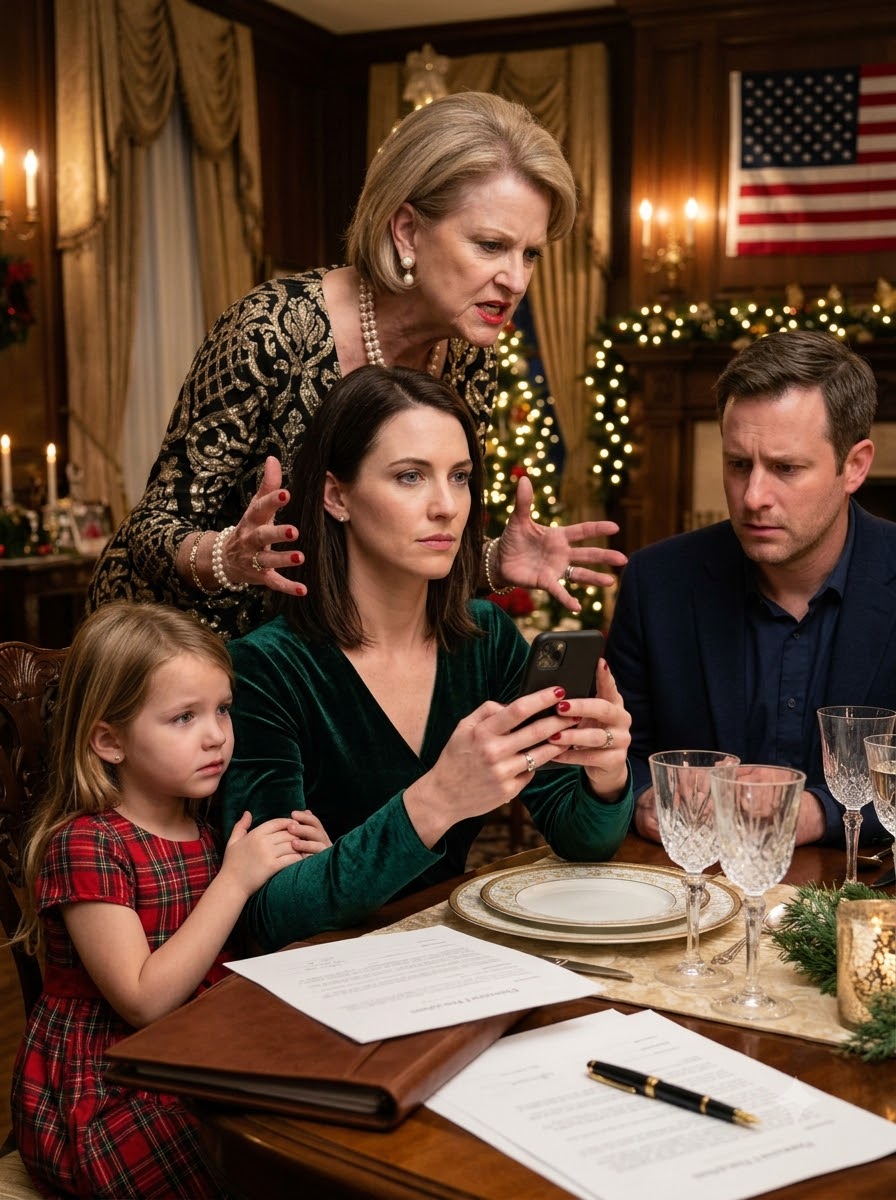
My mother-in-law struck my face at Christmas dinner, calling my daughter trash and threatening to make us homeless.
She had no idea I recorded every word and that my signature controls her entire million-doll fortune.
Margaret didn’t answer me on the porch.
She just stood there in the snow with her mouth open, one hand pressed to the doorframe like the house itself might steady her while Vanessa scrambled to gather the shards of her wine glass with her bare fingers, hissing when one of them cut her.
Daniel didn’t say anything either.
All the way to the car.
He buckled Lily into her seat with hands that wouldn’t stop shaking.
And when he finally spoke, sitting in the driver’s seat with the engine idling and his breath fogging the windshield, all he said was:
“How long have you known?”
“11 months,” I said. “Since your dad’s lawyer sent me the restructuring documents to review instead of you, because you were in Singapore and your mother told him not to bother waiting.”
“1 months,” he repeated.
Like the number itself was the betrayal.
“You’ve been sitting on this for 11 months.”
“I’ve been protecting this family for 11 months,” I said. “There’s a difference. I didn’t ask for it, Daniel. Your father built a safety valve into this family before he died because he knew exactly what your mother would do with unsupervised control of that money, and I happened to be the person standing closest when it activated.”
He didn’t say anything else until we got home.
Lily fell asleep in the car, snow damp mittens still on, and I carried her up to bed, still smelling faintly of Margaret’s dining room, roses, candle wax, and under it all, spilled wine.
I sat on the edge of her bed for a long time after I tucked her in, running my thumb along the little pink handprint she’d painted on a mug for me last spring, and I let myself shake for the first time since the porch.
I hadn’t planned to become anyone’s fortress.
I’d planned to be a compliance attorney who read documents for a living and went home at 6.
That was supposed to be the whole of it.
Franklin Whitmore built Cedar Hollow Manor out of a single converted Victorian in 1987.
Back when assisted living was still a phrase people had to explain at dinner parties.
By the time I married into the family, Whitmore Senior Care Group operated 11 facilities across Connecticut and Rhode Island.
And Franklin had become the kind of man who got quoted in trade journals about dignified aging and sat on state advisory boards.
He was also, in the four years I knew him before his heart gave out, the only Whitmore who ever treated me like I belonged at that table instead of merely being tolerated at it.
I’d spent 6 years before Lily was born as in-house compliance council for a regional hospital system.
The unglamorous work of reading billing codes and staffing logs until my eyes crossed, flagging the kind of small procedural rot that, left alone, metastasizes into fraud.
I left that job when I got pregnant.
Told myself I was done with spreadsheets full of other people’s negligence.
I had no idea I’d married directly into a field I understood better than anyone else at that table realized.
Franklin knew, though.
In the last year of his life, sick and increasingly worried about what Margaret would do once he wasn’t there to check her, he’d started asking me questions over coffee that seemed idle at the time.
How Medicaid reimbursement audits worked.
What a material misrepresentation looked like on a cost report.
Whether family members could serve as independent trustees of a facility holding trust without a conflict of interest problem.
I answered every question honestly, the way you’d answer any father-in-law making conversation.
I didn’t understand until much later that he’d been building a file on his own wife, one question at a time, and quietly deciding I was the only person in his family equipped to read it when the time came.
He restructured everything 18 months before he died.
The Whitmore family trust, $22 million controlling not just the mansion and the investment accounts, but 60% ownership of Whitmore Senior Care Group itself, went into an independent trustee structure that named me, not Daniel, not Margaret, not Vanessa, as successor trustee.
Activated automatically the moment any signing party executed a restructuring document without reading it in full.
Franklin’s estate attorney told me the week after the funeral that Franklin had said only one thing when he signed the activation clause.
“She’ll actually read it. That’s the whole test.”
Margaret failed the test 14 months later, signing tax paperwork Vanessa’s husband had shoved in front of her between two glasses of sincere.
For most of those 14 months, I told myself the trust was a hypothetical I’d never have to use.
A fire extinguisher bolted to a wall.
Nothing more.
I’d sat through enough Whitmore holidays by then to know exactly what kind of woman Margaret was.
The size when I mentioned my old job, like compliance work was something you did while waiting for a real career.
The way she introduced me to her friends as Daniel’s wife and never once in five years as anyone’s mother or anyone’s colleague or anyone with a name that mattered on its own.
I absorbed it the way you absorb weather.
Because Daniel loved her.
Because Lily adored her grandmother’s Sunday pancakes.
Because I genuinely believed, right up until the moment I stopped being able to, that whatever Margaret’s cruelty cost me personally, it wasn’t costing anyone else anything real.
I didn’t go looking for what I found next.
I went looking for reassurance, honestly.
Some small mercy that would let me believe the trust was just a formality.
That I could quietly hold the authority and never have to use it.
That lasted exactly nine days.
The first strange thing was a line item.
I’d pulled up the trust’s consolidated financials out of nothing but idle unease.
The kind of thing you do at 11 at night when you can’t sleep and you tell yourself you’re just being thorough.
A recurring monthly dispersement of $28,000 categorized as resident enrichment programming, paid to a vendor called Aurelia Events and Design LLC.
I told myself it was probably legitimate.
Holiday parties.
Craft supplies.
The small dignities that make a facility feel like a home instead of a waiting room.
Vanessa sat on the Witmore Family Foundation board.
Of course, she’d have vendor relationships.
The second strange thing was that Aurelia Events and Design LLC had been registered 11 months earlier, the same month Franklin died, at a residential address in Westport that, according to the county assessor’s site, belonged to Marcus Doyle, Vanessa’s husband.
I told myself it was nothing.
Family businesses overlap all the time.
I closed the laptop and made myself a cup of tea and did not think about it again for six days.
Until the third strange thing arrived by accident.
A forwarded email meant for Daniel containing a state surveyor’s preliminary notice that Cedar Hollow Manor had been selected for an unannounced compliance inspection.
Sometime within the next 60 days.
My stomach dropped before my brain had finished reading the sentence.
I knew exactly what that kind of notice meant to a facility with something to hide because I’d drafted the internal response protocol for exactly this scenario at my old job.
I called the facility administrator the next morning using my trusty authority as cover and asked to review the most recent staffing ratios against the quarterly cost reports filed with the state.
She stalled me for 2 days.
When she finally sent the numbers, the staffing ratios on paper were compliant.
Every shift, every unit, fully staffed at the required level.
But the payroll totals underneath them didn’t match.
Cedar Hollow Manor was billing the state as though it employed 31 certified nursing assistants.
Payroll records showed 19.
My hands were shaking by the time I finished the math.
The way they’d shake again and again over the next three weeks, every time denial ran out of road.
I told myself the fourth time that maybe the discrepancy was seasonal.
Vacancies.
Turnover.
Something explainable.
I drove to Cedar Hollow Manor myself on a Tuesday afternoon, unannounced, and walked the second floor memory care unit with a visitor’s badge clipped to my coat.
I counted staff.
I counted call lights blinking unanswered in the hallway.
Four of them.
For longer than any protocol I’d ever reviewed would permit.
An aid, exhausted and kindedeyed, apologized to me for the wait time like it was her personal failing instead of a structural one.
And told me she’d been pulling double shifts three times a week since September because corporate keeps saying the new hires are starting soon.
I went home and sat in my car in the driveway for 20 minutes before I could make myself walk inside.
Because I understood finally that this wasn’t a paperwork discrepancy.
It was people.
I tried one more time to find an innocent explanation because some part of me was still bargaining with what I already knew.
I emailed the facility’s regional director, framing it as routine trustee due diligence, and asked for the current CNA roster cross-referenced against the state’s employment verification system.
She responded within the hour.
Cheerful and reassuring.
Attaching a roster that listed 31 names.
I recognized four of them from Teresa’s staff directory as aids who had left the facility over a year earlier.
Someone hadn’t even bothered to update the fake list.
The fifth loop was the one that broke something in me permanently.
A nurse named Terresa Blake called the trust’s general line, my line now, three days after my walkthrough.
Her voice low and careful.
The voice of someone who’d rehearsed the call a dozen times and still wasn’t sure she’d go through with it.
She’d worked at Cedar Hollow Manor for 11 years.
Most of them on the overnight shift.
And she told me about a resident named Walter Griggs, 84, who’d fallen in his room in March during a shift so understaffed that no one checked on him for nearly 3 hours after the fall.
He died 6 days later from complications.
The incident report filed with the state listed the unit as fully staffed that night.
Teresa had the real schedule, the one from the facility’s internal system before someone went back and edited it, saved as a screenshot on a personal phone she’d been too afraid to do anything with until she heard through the staff grapevine that Franklin’s daughter-in-law was asking questions.
“I’ve been carrying this for 8 months,” she told me.
And I could hear her crying quietly, trying not to.
“I didn’t know who to tell that wouldn’t just bury it again.”
I didn’t sleep that night.
I sat at my kitchen table with Teresa’s screenshot open on my laptop and Walter Griggs’s name in front of me.
And I understood that this had stopped being about protecting my family’s money a long time before I’d caught up to it.
I still tried the quiet way first.
Because some stubborn, hopeful part of me wanted to believe Margaret was capable of shame if I simply handed her the exit.
I drove to the mansion the next afternoon, alone, and sat across from her in the same sitting room where she’d once told me my table manners needed refining, in front of Daniel’s college roommates.
I drove to the mansion the next afternoon alone and sat across from her in the same sitting room where she’d once told me my table manners needed refining in front of Daniel’s college roommates.
I laid out the payroll discrepancy.
Careful and measured.
And asked her as gently as I knew how whether she was aware of it.
“You’ve always had an overactive imagination, Clare,” she said, not even looking up from her tea. “Franklin left things complicated on purpose. Old men do that. It doesn’t mean anyone’s committed a crime.”
When I mentioned Aurelia by name, her hand went very still around the cup for exactly 1 second before she recovered.
“Vanessa handles the foundation’s vendor relationships. If you have questions, ask her. Honestly, I’d think you’d have better things to do than audit a grieving widow’s grocery bills.”
I left with nothing but the certainty, cold and total, that she’d known exactly what I was asking about before I finished the sentence.
My hands didn’t stop shaking until I was three exits down the highway.
I called Grace Sutherland the next morning.
Grace had been Franklin’s estate attorney for over 20 years, a trust and elder law specialist who’d sat across from him at the very signing that made me trustee.
And she was the only person outside my own household I fully trusted with what I now knew.
She listened to the whole thing without interrupting once.
And when I finished, she was quiet for a moment before she said:
“Claire, I need you to understand something. What you’re describing isn’t a family dispute anymore. It’s healthcare fraud and it may be concealment of a death. Those are two very different rooms, and we’re about to walk into both of them.”
She brought in a forensic accountant that same week.
David Okonquo.
A CPA and certified fraud examiner with 14 years unwinding exactly this kind of thing for elder care operators.
The kind of specialist whose business card said healthc care compliance investigations in plain, unglamorous type.
David spent nine days inside the trust’s books before he called Grace and me into his office.
A cramped space above a title company with three monitors and a whiteboard covered in arrows.
“I want to walk you through what I found in order,” he said, “because the order matters. It shows intent.”
He’d traced $2 .9 million paid to Aurelia Events and Design LLC over the preceding 14 months.
Invoiced as recreational and dietary programming across all 11 Whitmore facilities.
When Aurelia’s own bank records, subpoenaed through a state licensing complaint Grace had quietly filed, showed a single employee, Marcus Doyle, and no vendor relationships with any recreational supplier, caterer, or activities coordinator anywhere in New England.
The money went in as program funding and came out almost immediately as transfers to two personal brokerage accounts and one recurring wire to a Cayman doiciled account David flagged with a note that just said, in his neat handwriting:
Worth a subpoena.
David tapped the whiteboard where he’d drawn the money’s path in red marker.
Aurelia at the center.
Arrows fanning out to two brokerage accounts, a boat slip lease and mystic, and a line item labeled simply jewelry miss with a dollar figure I made him repeat twice before I believed it.
“I’ve done 11 of these engagements in 14 years,” he said. “The pattern’s almost always the same. Somebody skims a percentage nobody notices at first, gets comfortable, and the percentage creeps up every quarter because nothing stopped them yet.”
“What’s unusual here isn’t the skimming. It’s that the skimming required cutting real staff to stay hidden. Most people who do this pad an expense line. Your mother-in-law and her daughter emptied a floor.”
“Where does the payroll shortfall fit in?” I asked, though I already suspected the answer.
“That’s the part that’s going to be hardest to hear,” David said. “Every dollar that should have gone to staffing 12 more CNAs across the portfolio. The money the cost reports say was spent went into Aurelia instead.”
“Vanessa’s board seat gave her signoff authority on the foundation dispersements. Margaret’s signature is on the master services agreement with Aurelia. I have it right here. Dated 4 months after Franklin’s death.”
He turned his monitor toward us.
“They didn’t just skim the trust, Clare.”
“They stripped the floor staff to do it and then falsified the ratios to cover the gap so the state wouldn’t catch it at audit.”
Dr. Pria Anand, the forensic document examiner Grace brought in next, confirmed what none of us wanted.
Confirmed that the staffing schedule submitted with Cedar Hollow Manor’s quarterly cost report had been digitally altered after the fact.
The metadata showing edits made at 11:47 p.m. the night before state filing.
Four separate times over 6 months.
Always by the same administrator login.
Dr. Anand had spent 22 years testifying in fraud and probate cases and had the flat, unshakable delivery of someone who’d stopped being surprised by families a decade earlier.
“Someone was doing this routinely,” she told us, sliding a print out across the table with the timestamp metadata highlighted in yellow.
“Not once out of panic. This was a process. Whoever built it knew exactly what an auditor would look for and built the fix to arrive the night before. Every time. Like clockwork.”
I Vanessa called me twice that week.
Once icy and once nearly pleading.
Warning me that I had no idea what kind of lawyers Mom could hire.
And then an hour later:
“None of this had to touch me, Clare. I just signed what I was told to sign.”
I didn’t answer either call.
I let David’s forensic trail answer for me instead.
Because I’d learned by then that arguing with a Whitmore only ever gave them time to build a better story.
I confronted Daniel with all of it on a Thursday night after Lily was asleep, spreading Teresa’s screenshot and David’s spreadsheets and Dr. Ann’s report across our kitchen table like evidence in a trial.
Because in every way that mattered, it was becoming one.
Daniel read every page in silence.
When he got to Walter Griggs’s name, he put his head in his hands and didn’t move for a long time.
“I want to say I didn’t know,” he finally said. “But I think the honest answer is I didn’t want to know. Mom always said the numbers were complicated, that Dad’s old systems were outdated, that I should just trust her.”
“I let her keep saying it because it was easier than asking the next question.”
He looked up at me, his eyes red.
“What do you need from me?”
“The truth. When it’s your turn to give it,” I said. “And to not warn her.”
He didn’t warn her.
I found out three weeks later that not warning her had cost him more than either of us expected.
But that Thursday night, he gave me the one thing I actually needed.
His word.
And he kept it.
The call from Teresa came again on a Tuesday.
This time in a panic.
She’d overheard the facility administrator on the phone with someone from corporate discussing a records management contractor scheduled to come that night.
A shredding service.
Arriving at 11:00 with instructions to destroy all superseded staffing documentation prior to 2024 from the administrator’s office and a locked file room in the basement.
The state’s surprise inspection had been quietly moved up.
It was now scheduled for 9 the next morning.
I called Grace at 6:40 p.m.
She called Detective Adrien Cole of the Financial Crimes and Elder Abuse Unit within 11 minutes.
A 19-year veteran who’d built his reputation on exactly these cases.
The ones that looked on the surface like ordinary paperwork and turned out to be something closer to a body count.
He met us at Grace’s office 40 minutes later.
Still in his coat.
“Here’s our problem,” Grace said, laying it out on the whiteboard David had left behind. “We have 12 hours.”
“If that shredding truck runs tonight, we lose the primary documentary evidence of the falsified ratios. The paper originals. The ones that predate the digital edits Dr. Anand already flagged.”
“Detective Cole can get a preservation order, but a judge has to sign it after hours tonight. Not tomorrow morning after the truck’s already come and gone.”
“There’s a second problem,” I said.
Because I’d gotten the voicemail from my own attorney 20 minutes earlier.
Forwarded from the courthouse clerk’s office.
“Margaret’s council just filed an emergency petition alleging I’ve been exercising undue influence over an elderly and grieving widow to seize control of the family’s assets.”
“They’ve gotten it calendared for 9 tomorrow morning, the same hour as the state inspection.”
“If a judge grants even a temporary stay on my trusty authority before that inspection starts, I lose standing to have ordered the preservation request in the first place, and everything Detective Cole seizes tonight could get challenged as improperly obtained.”
Grace didn’t blink.
“Then we don’t sleep tonight. And neither does Judge Reyes’s night clerk.”
It was, without exaggeration, the longest 12 hours of my life.
Detective Cole drove to the emergency judge’s home at 8:15 p.m. with Dr. Shai, Ann’s report, and Teresa’s sworn statement in a folder.
And returned at 9:50 with a signed preservation order and two patrol units already dispatched to Cedar Hollow Manor.
I sat in Grace’s office watching the clock.
My stomach in knots.
Picturing the shredding truck pulling up to the loading dock.
Picturing 11 years of Terresa Blake’s shifts and every falsified log that could still prove what happened to Walter Griggs disappearing into a truck bed before sunrise.
9:40.
10:05.
10:31.
I stopped being able to sit.
I paced Grace’s narrow office and sock feet, my shoes abandoned by the door, refreshing my phone every 90 seconds for a text from Detective Cole that wasn’t coming yet.
Grace kept working the whole time.
Calm in a way I found almost unbearable.
Drafting the response to Margaret’s undue influence petition with the same unhurried hand she’d probably used to draft a hundred documents that mattered less.
“Sit down, Clare,” she said once, not unkindly. “Panicking doesn’t make the clock move faster. It just makes you useless when it does.”
I sat.
I didn’t stop checking my phone.
The patrol units arrived at 10:52.
The shredding contractor’s van pulled into the lot at 10:58.
Officers intercepted it in the parking lot before a single box was carried out.
The driver more confused than defiant, showing them a work order signed by the facility administrator that afternoon.
By midnight, Detective Cole had the entire contents of the basement file room under seal.
And Linda Marsh, the Connecticut Department of Public Health surveyor assigned to the original inspection, was on the phone with Grace.
Her voice sharp with the particular fury of a regulator who’d just realized someone had tried to outrun her.
“I’ve done this job for 16 years,” Linda told us the next morning, standing in Cedar Hollow Manor’s parking lot at 8:40, 20 minutes before her team walked in with the sealed evidence chain of custody paperwork in hand instead of a routine clipboard.
“I’ve seen facilities cut corners. I have never had someone try to shred the evidence out from under me the night before I arrived. That tells me everything I need to know about what we’re going to find inside.”
What they found over That tells me everything I need to know about what we’re going to find inside.
What they found over the following six hours was worse than any of us had let ourselves imagine out loud.
Falsified staffing logs across four of the 11 facilities.
Not just Cedar Hollow Manor.
A pattern once Linda’s team cross referenced David’s financial trail of siphoning roughly three 4 million in foundation and Medicaid supplemental funding through Aurelia over 18 months.
Precisely the period during which payroll shortfalls forced overnight staffing at Cedar Hollow Manor down to a single aid for 11 residents on the night Walter Griggs fell.
Harold Voss, the state’s long-term care ombbudsman, arrived by early afternoon and sat with me privately for 20 minutes.
Telling me quietly that his office had received two prior anonymous complaints about Cedar Hollow Manor’s staffing in the past year.
Both closed for insufficient corroborating evidence because the paper trail supporting them had, at the time, simply never existed to be found.
“I want you to understand this isn’t a failure you caused,” he said, reading something in my face I hadn’t managed to hide. “It’s a failure you’re the first person to actually stop. Those are different things, even if they don’t feel like it today.”
Linda’s team worked until nearly 6:00 that evening.
And by the time they left, Cedar Hollow Manor’s administrator had been placed on immediate unpaid leave, pending the outcome of the state’s investigation.
And a temporary staffing agency contract, paid for out of trust reserves I authorized from the parking lot, standing in the cold with my phone pressed to my ear, was already faxed over to cover that night’s overnight shift.
So that whatever else happened to this family, no resident on that floor would spend another night the way Walter Griggs had spent his last one.
Margaret’s emergency hearing happened at 9ine that morning, exactly as scheduled, in a courtroom four miles from where Linda Marsh’s inspectors were photographing a sealed file room.
I wasn’t there.
Grace argued the trustee authority petition alone.
Walking Judge Carmen Reyes through the preservation order, Detective Cole’s search seal, and a signed statement from David Okonquo, establishing that Margaret’s own signature authorized the master services agreement, funneling money to her daughter’s husband.
Judge Reyes denied the undue influence petition from the bench in under 6 minutes.
And in the same ruling referred the matter to the state’s attorney’s office for review of possible elder financial exploitation.
Given that the primary victim alleged in Margaret’s own petition, herself, appeared instead to be the architect of a scheme that had left actual vulnerable residents unstaffed and in at least one case dead.
Margaret was arrested eight days later.
Once the state’s forensic accountants finished cross-checking David’s findings against Medicaid’s own billing data.
On charges of healthcare fraud, falsifying business records, and reckless endangerment tied directly to Walter Griggs’s death.
Not homicide.
The prosecutor was careful to explain to Daniel and me both.
But a charge built on the theory that the falsified staffing records constituted a knowing, reckless disregard for resident safety that a jury could find directly caused the conditions of his death.
Vanessa was charged separately with conspiracy and grand lararseny for her role authorizing the Aurelia dispersements from the foundation board.
Marcus Doyle, facing the most direct financial exposure, agreed within a week to plead guilty to wire fraud and testify against them both in exchange for a reduced sentence.
Handing prosecutors the Cayman account records David had only been able to flag, not fully trace on his own.
The domestic assault charges from Christmas.
The three slaps.
The spitting.
The language toward Lily that Vanessa had laughed at from the porch railing.
Were folded into the same indictment once Detective Cole’s office reviewed my recording.
Giving the case a human face the financial charges alone might never have earned in the local press.
A reporter named Renee Castillo, who covered Elder Care accountability for the regional paper, broke the full story two weeks later under a headline that made Daniel Wince when he read it.
And made me, for the first time in months, feel something close to peace.
109 words about a Christmas dinner.
And underneath it, $3 million and a dead man’s name that had finally stopped being a rounding error on somebody else’s balance sheet.
Margaret pleaded guilty 5 months later rather than face trial to healthcare fraud, falsifying business records, and reckless endangerment.
Receiving 6 years with the possibility of parole after three, along with 3.4 million in court-ordered restitution to the trust and the state Medicaid program paid first.
She refused to look at me during the sentencing hearing.
But she looked for one long moment at Lily’s empty seat beside me.
I hadn’t brought her.
As though some part of her was still keeping score of an audience that had stopped showing up.
Vanessa pleaded to a reduced conspiracy charge.
18 months and 5 years probation.
And lost her seat on the foundation board permanently, along with any future distribution rights under the trust.
A provision Grace built directly into the settlement over Vanessa’s furious objections.
On the theory that a woman who’d laughed at a three-year-old’s humiliation didn’t get to keep drawing a salary from the same family she’d helped bankrupt.
Marcus Doyle’s cooperation agreement required him to forfeit the boat slip in Mystic and both brokerage accounts.
The Cayman account, once subpoenaed, turned out to hold $640,000 more than David’s initial estimate.
All of it ordered return to the trust within the year.
Cedar Hollow Manor entered 18 months of state monitorship.
I petitioned the court, with Grace’s help, to use trust funds to bring staffing at all 11 facilities into full compliance immediately rather than waiting for the criminal case to resolve.
And Judge Reyes granted it inside of a week.
Terresa Blake stayed on.
Promoted eventually to a staff advisory role the facility hadn’t had before.
One specifically built to give overnight aids a direct line to administration that didn’t run through the person who might be falsifying the very logs meant to protect them.
Walter Griggs’s daughter, a soft-spoken woman named Patricia, who’d flown in from Ohio for the sentencing, found me in the courthouse hallway afterward.
And held both my hands for a long moment without saying anything at all.
When she finally spoke, all she said was:
“Someone finally said his name out loud in a room that mattered. That’s more than I thought I’d get.”
I think about that hallway more than I think about the porch.
Eight months after the arrest, I stood in front of a state legislative subcommittee reviewing long-term care staffing oversight.
Invited by Harold Voss’s office to testify about what a falsified ratio actually costs in real hours and real hands when nobody’s checking the metadata behind it.
I wasn’t nervous the way I expected to be.
I’d spent a year learning cell by cell exactly how much damage a person can do while everyone around her assumes the paperwork is telling the truth.
And I had nothing left to be afraid of saying out loud.
Daniel and I are still married, which surprised some people more than it surprised me.
It wasn’t easy.
There were months where he could barely look at his own last name in a courtroom filing without flinching.
And I made him earn back the trust that not warning his mother had only begun to repair.
But he showed up.
He testified when it was his turn about the calls he remembered overhearing and chose not to ask about.
He sat beside me at every hearing his mother’s case required.
And he never once asked me to make any of it smaller than it was.
I still keep the recording from that porch, though I’ve never had to play it again after the arraignment.
What I think about more, most nights, is Walter Griggs.
A man I never met, whose name I learned only because a nurse was brave enough to make a phone call she’d been too frightened to make for 8 months.
Margaret called my daughter trash at a dinner table full of people who let her.
She had no idea that the woman she spat on had spent years learning exactly how to read the fine print she never bothered to check.
And that somewhere in that fine print was a dead man’s name, waiting for someone who’d finally stop looking Way.








