My mother set the table for eight but left my Thanksgiving meal out on the porch because I was considered “not clean enough” to sit and eat with everyone else. I ate alone in my car and then drove away. Seven years later, my sister found me; what she witnessed prompted her to call the whole family immediately. Then, 89 calls came flooding in within just one hour.
My name is Myra O’Neal and I’m 34 years old.
Last Thanksgiving at noon, I stood in a warehouse in Columbus, Ohio, watching 300 people find their seats at the longest dinner table this city has ever set.
Then the door opened.
My mother walked in.
My sister came in right behind her, phone already up and recording, and a room full of laughter went quiet row by row like someone turning down a dial.
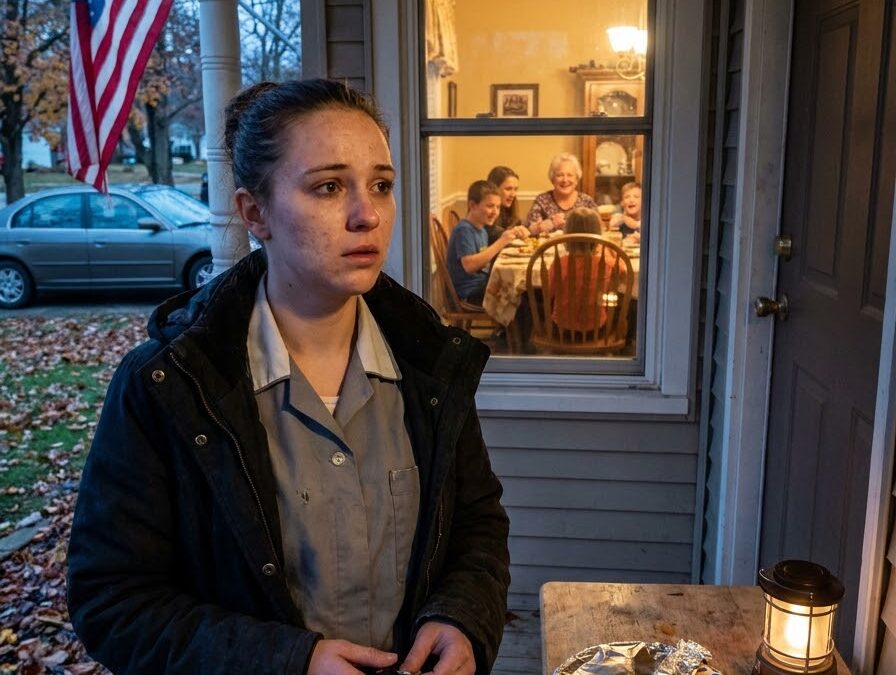
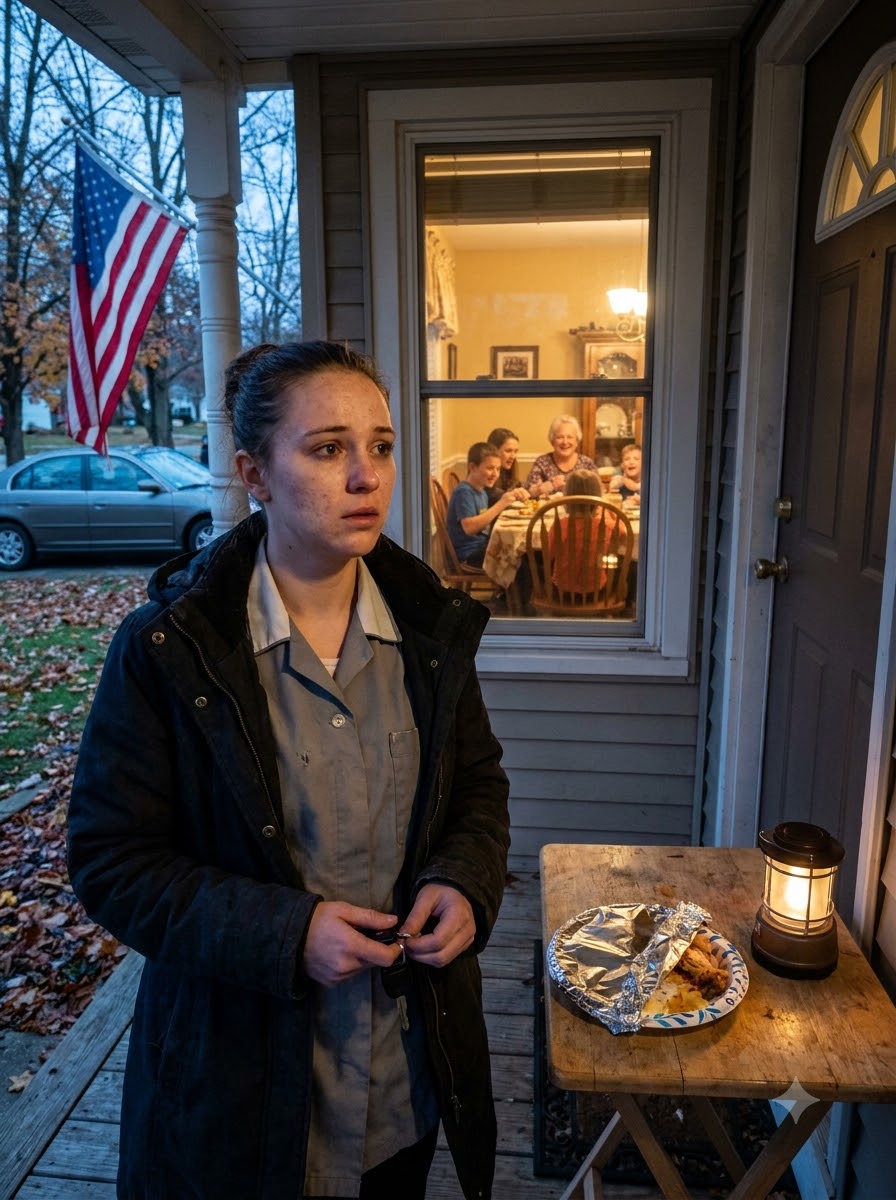
Seven years earlier, my family left my Thanksgiving dinner on a paper plate on the front porch.
My mother texted me that I wasn’t clean enough to eat inside.
I ate alone in my car at the end of their street.
And then I drove out of their lives.
What my mother did next in that warehouse in front of 300 witnesses is the reason I’m telling this story.
But here’s what none of them knew when they walked through my door.
And it’s bigger than the building they were standing in.
Welcome back to Calm Drama Stories, where quiet people finally get loud in their own way.
If you’ve ever been made to feel like you weren’t enough for your own family’s table, this story is for you.
Drop a comment below and be sure to subscribe.
To understand that silence in the warehouse, you have to go back seven years to a small town called Hartwell and the smell of bleach on my hands.
7 years ago, I was 27 and I lived in a rented room above Kesler’s laundromat on Main Street in Hartwell, Ohio.
The rent was cheap.
The dryers ran until 10.
My whole apartment smelled like warm lint, which honestly beat the alternative because I spent my days smelling like industrial bleach.
I worked housekeeping at the Hartwell Motor Inn, 6 till 2.
And after that, I cleaned private houses around town until dark.
Doctor’s houses, teachers houses, the kind of houses my mother pointed at from the car when I was a kid.
My hands were cracked at every knuckle.
I kept a tub of hardware store salve in my glove box and a pair of church gloves for occasions, and I can tell you which one got more use.
People hear cleaner and think of a mop.
They don’t think about the chemistry of it, the systems, the way a good cleaner walks into chaos and leaves order behind.
I loved it.
I was good at it.
And I had a plan written on a folded index card in my wallet.
A company of my own someday with my name on the paperwork and real wages for real work.
I’d already picked the name.
I used to say it out loud while I scrubbed grout like a prayer with rubber gloves on.
That November, I was pulling doubles because the motorin was short staffed and I was saving every tip in a coffee can I couldn’t afford to touch.
Two days before Thanksgiving, my phone rang while I was flipping a mattress in room 11.
My mother’s voice came through crisp as a starched collar.
She said dinner was at 2:00 sharp, that Danielle was making it a classy year.
And then before she hung up, she said the thing she always said to me, “Don’t embarrass me.” She didn’t say goodbye.
Mothers like mine never do.
They just leave you holding the tone.
You need to see my mother’s kitchen to understand my mother.
I stopped by that Sunday before the holiday to drop off pie pumpkins from the farm stand because that was my job in the family.
Useful, invisible, and gone by dessert.
Carol O’Neal ran her kitchen like a museum with a strict dosent.
My sister Danielle rinsed a glass and set it in the rack and my mother picked it up, held it to the window and washed it again without a word.
That was the whole relationship right there in one wet glass.
My mother grew up as the daughter of a school janitor, and the kids at Hartwell High called her the janitor’s kid for four straight years.
She told that story like a medal she’d won in a war she was still fighting.
She’d married my father, Walt, a parts manager with a steady check and a quiet spine, and she had spent 30 years scrubbing the smell of poverty off our family name.
Danielle had married into a catering adjacent business and a brick house with columns, which made her the good news.
I emptied waste baskets at a motel, which made me the weather.
Disgusted, endured, blamed.
That Sunday, Danielle was spreading fan decks of card stock across the counter, announcing that this year’s dinner would be elegant.
Adults only at the main table, cloth napkins, the works.
My mother nodded along and said she’d ordered place cards.
Place cards for a family dinner of 10.
My father looked up from the sports page, looked at the card stock, and looked back down.
That was his vote.
I remember thinking place cards were a strange thing to need for people who all shared a last name.
I remember wondering just for a second whose names would be on them.
Then I let it go because letting it go was the chore I’d done longest.
I should have counted the cards.
Thanksgiving morning, Rhonda quit.
She was the other housekeeper on the holiday rotation at the motor in.
And at 9:15, she walked into the supply room, hung up her apron, and said her sister in Dayton had a spare couch with her name on it.
I don’t blame her, but that left 14 checkout rooms, a full linen turnover, and one me.
I had planned this day like a wedding.
I’d traded shifts to be done by noon.
I had a garment bag hanging in my car with a clean sweater, good jeans, and the gloves so I could walk into my mother’s house looking like a daughter instead of a shift worker.
Instead, I stripped beds until my forearms burned.
At 11:00, I texted my mother.
Running late, coming straight from my shift.
Save me a seat.
The message flipped to read almost instantly.
No reply.
I told myself she was basting the turkey.
At 1:30, I clocked out, still in uniform, hair flattened, smelling like a hospital hallway.
And I had a choice.
20 minutes to shower at my place and be late, or drive straight over and be almost on time.
My family kept score with clocks, not with clothes, or so I thought.
So, I chose the clock.
I drove across town with the windows cracked in November, trying to air the bleach out of my collar.
I rehearsed my apology at every stoplight.
Sorry I’m late.
Rhonda quit.
14 rooms.
You’d have done the same.
At 240, I turned onto Birchwood Lane and saw every car already in the driveway.
Danielle’s SUV, my aunt’s Buick, my uncle’s truck with the dealer plates my father got him.
The dining room window glowed gold.
I saw the curtain move just once, the way a curtain moves when someone lets it go fast.
I parked at the curb, grabbed the garment bag out of habit, and walked up the path to the front door.
The storm door was locked.
The front door behind it was shut and the porch light was on at 2:40 in the afternoon, which is its own kind of message.
I rang the bell and heard it chime through the walls, heard chairs, heard my aunts laugh, heard silverware, and heard nobody move toward the door.
I rang again.
Nothing.
Then I looked down.
On the top step, centered like it had been staged for a photograph, sat a paper plate covered in foil.
My name was written across the foil in black marker, all capital letters.
Myra.
Under the foil there was turkey, a scoop of stuffing, green beans laid straight as pencils, and a dinner roll with a pad of butter already going stiff in the cold.
Whoever made that plate had taken care with it.
That was the part that hollowed me out.
I stood on my mother’s porch holding a warm plate with my name on it while my family ate on the other side of a locked door.
[snorts] My phone buzzed in my jacket.
A text from my mother and I can still see the shape of it on the screen.
You can eat on the porch.
You’re not clean enough for the table.
I looked through the gap in the dining room curtains because I couldn’t help it.
The table was set with cloth napkins and Danielle’s place cards, little white tents in front of every chair.
Eight cards.
Eight chairs.
Eight people seated.
Eating.
Warm.
I counted twice.
There had never been a ninth chair.
Whatever I had been to this family that morning, the table had been telling the truth about it since before the turkey went in the oven.
One more thing snagged in my mind, though it took years to matter.
The handwriting on the foil.
My mother writes in small slanted cursive, tight as barbed wire.
The letters on my plate were big, round, and careful with a long tail on the A.
It wasn’t her hand.
I was too busy breaking to wonder whose it was.
I picked up the plate, walked back down the path, and got in my car.
I drove to the end of Birchwood Lane and parked under the big sycamore because I didn’t trust myself at the wheel, and I didn’t want them watching me sit there.
I peeled back the foil and balanced my Thanksgiving on the steering wheel.
The turkey was still warm.
Somehow, that made it worse, eating a warm meal made by hands that wouldn’t open a door.
I managed three bites.
I sat there in my uniform with the engine ticking and my name on a piece of foil in my lap.
And I did the math a person should never have to do.
How many holidays?
How many casserles carried in through that door?
How many times I’d cleaned that very house top to bottom before parties so my mother could tell her friends she’d been scrubbing all week.
A tap on the passenger window nearly sent the green beans into the dash.
It was Mrs. Gaines from two doors down.
70some, walking her old beagle in a Christmas red coat a month early.
She looked at me, looked at the plate, looked back at the glowing gold window up the street.
“Honey,” she said through the glass.
“Is that your dinner?” I smiled.
The smile you learn in service work, the one that keeps tips coming and questions away.
Just heading out, I told her.
Big family, small table.
She stood there a second longer than politeness required, and her face did something I didn’t understand until years later.
She was memorizing it.
Then she nodded, tugged the beagle, and moved on down the sidewalk.
I set the plate on the passenger seat like it was riding along with me, and I pulled away from the curb.
I drove past the house without slowing down.
In the rear view, the porch light was still burning over the empty step.
I didn’t know it yet, but I was driving toward the rest of my life.
The plate came with me.
It never left.
For 3 days, my phone stayed silent, which told me everything about how the dinner conversation had gone after I drove off.
Nobody called to ask where I went.
Nobody called at all.
On Sunday night, I sat on my bed above the laundromat with the dryers humming under the floor and typed out the longest text of my life. two full screens about the double shift, about Rhonda quitting, about the garment bag hanging in my car, about what it does to a person to read her own name on foil.
I read it back twice.
Then I deleted the whole thing because explaining yourself to people who lock the door is just knocking with extra steps.
I typed one line instead.
I got the message.
I won’t bother the table again.
I sent it to my mother and then I started blocking numbers one by one working through the family like a checklist.
My mother, Danielle, my aunt with the Buick, the cousins who’d sat at those place cards and passed the gravy.
My thumb was hovering over my father’s name when the phone rang in my hand and made me jump.
It was Tessa, my cousin on my dad’s side, the only one who ever sat with me at the kids table long after we’d both outgrown it.
She didn’t say she was sorry.
She said something stranger.
Myra, there’s something in the family group chat you’re going to need to see someday.
Not tonight.
You’re not ready tonight.
But when you are, I’ll have it.
I asked her what it was.
She wouldn’t say.
She just told me to keep her number unblocked and to go build a life so big I’d forget the porch existed.
I kept her number.
I left my father’s unblocked, too, though I couldn’t have told you why.
Then I put the phone face down, pulled my coffee can of tips out of the closet, and started counting. $1,900.
That’s what a coffee can holds after 2 years of tips and a security deposit refund.
And that’s what I moved to Columbus with the week after Thanksgiving.
I rented a room by the month in a house full of nursing students.
Got hired for the overnight cleaning shift at a dental clinic off Sawmill Road and learned the city by its empty parking lots.
Scrubbing an operatory at 2 in the morning gives you a lot of quiet to think in.
Mostly I thought about my grandma Ruth, my dad’s mother, who died 2 years before the porch and was the only person in that family who ever looked at my chapped hands like they were something to be proud of.
She’d raised four kids on a line cook’s wages and a garden.
Once when my mother made a remark about my uniform at a Sunday dinner, Ruth reached over, turned my palm up like she was reading it, and said, “Clean hands are hands that worked.” She left me her recipe box when she died, and one letter I’ve never read out loud to anyone.
Those were the only two things I took from Hartwell that mattered.
In Columbus, I taped a torn piece of notebook paper to my bathroom mirror with a name written on it.
Bright, the company that didn’t exist yet, so it would be the first thing I saw every morning and the last thing I saw every night.
And I kept one more thing, and you can decide what kind of person this makes me, the paper plate.
I’d washed it, dried it flat under a stack of textbooks, and slid it into a manila envelope like a document.
My roommates thought I was saving a concert ticket.
Let them think it.
Some people keep photographs to remember the good days.
I kept a paper plate to make sure I never negotiated with the bad ones.
Tessa called in January with the official version.
That’s what she called it, the official version.
The one my mother was serving to the relatives with coffee.
In that telling, I had shown up to Thanksgiving hours late, refused to come inside, grabbed a plate they’d lovingly made me, and stormed off because I was ashamed of my job and jealous of Danielle’s beautiful table.
My mother told it with a catch in her voice, Tessa said.
She told it at church.
She told it at the Heartwell Cut and Curl.
She told my aunt that she’d begged me to come in, and I’d screamed at her on the porch.
There had been no begging and no screaming, just a locked storm door and a text message I could have framed.
But here’s the thing about a lie with a head start.
Nobody calls to check it against the person it’s about.
Not one relative dialed my number that winter to ask for my side.
The story fit what they already believed about me.
The moody one.
The one who cleaned rooms.
And a comfortable lie beats an uncomfortable question at every family table in America.
Tessa asked if I wanted her to set them straight.
I surprised myself with how fast the answer came out.
No, let them keep the story.
I’ll keep the receipts of my own life.
She laughed and said I sounded like Grandma Ruth.
Highest compliment I’ve ever gotten.
After we hung up, I opened the notes app where I’d started planning brightep and added a line at the top that had nothing to do with cleaning.
It said, “Build something they can’t ignore.” I looked at it for a while, then I changed it because spite makes a lousy foundation.
The new line said, “Build something that doesn’t need them.
7 years is a long time.” It turned out to be exactly long enough.
Year 1 was one woman, one used Corolla, and a trunk organized better than most operating rooms.
Days I kept the overnight clinic job.
Nights and weekends, I picked up my own accounts.
A chiropractor’s office, an insurance storefront, a tax place that only got messy in April.
I undercut nobody.
I outdetailed everybody.
The motor in had taught me hospital corners.
The dental clinic taught me the real rules, the bloodborne pathogen standards, the difference between clean and disinfected, the paper trail behind both.
I spent my grocery money on a certification course at the community college and sat in the front row in my work polo, taking notes like the degree students behind me were competition because they were.
My first private client paid me with a check made out to Myra O’Neal.
Wrong name, right amount.
I photocopied it before I cashed it and stuck the copy to my mirror next to the torn paper that said, “Bright, proof and a promise.
Side by side.” The turn came on a Tuesday at the clinic.
Dr. Feld, the owner, stayed late on a night I was working and watched me break down his operatory chair, base, hoses, the works.
He asked why I was cleaning the chair’s foot pedal when nobody would ever check it.
I told him the truth, that patients don’t check it, but germs don’t care what patients check, and neither do I.
He laughed.
Then he stopped laughing and looked around the room like he was seeing it for the first time.
You’re the only one who’s ever done the pedal, he said.
The cleaning company he contracted was big, cheap, and sloppy.
And he’d been unhappy with them for 2 years.
He didn’t offer me anything that night, but he started leaving the radio on for me, and every so often a note on the front desk.
The notes got longer.
Then one of them was a question.
The question was, “What would you charge to take this whole building yourself?” I named a number that was fair instead of desperate, which took every muscle in my body.
Dr. Feld said yes before I finished the sentence.
Then he said the thing that changed my life more than the money did.
Get yourself an LLC and insurance because I’d rather pay a company than a person, and you should be a company.
6 weeks later, I stood in a strip mall print shop holding the first page of Brightep Cleaning LLC’s operating agreement.
My name typed on the line where names go, and I carried it to my car like a newborn.
And then in the parking lot, in the driver’s seat, where nobody could see me, I came apart.
Big, ugly, grateful sobbing, forehead on the wheel, the whole performance.
The last time I’d sat in a parked car with something that mattered in my lap, it was turkey on a paper plate, same seat, different cargo.
I let myself have 10 minutes and then I fixed my face because I had a walkthrough at 4.
That week held one more envelope and I almost missed it.
It came through the mail forwarding I’d set up when I left Hartwell, a fat business envelope from a bank addressed to me at my old room above the laundromat.
I figured it was a closed account notice and threw it in the passenger seat where it rode around for 3 days like the plate once had.
I want to be honest about why I didn’t open it.
Mail from Hartwell felt like the porch in paper form.
Anything that town wanted to hand me, I’d already been handed.
But an envelope from a bank with my name through the window isn’t a memory.
It’s a document.
On the third night, parked outside the clinic at midnight.
I finally tore it open.
It was a past due notice for a second mortgage.
My parents’ names at the top, my old address in the window because of a contact sheet I’d once filled out at their kitchen table.
The loan was 90 days behind.
The number owed monthly sat there in bold.
And I knew that number the way you know your own birthday because for 3 years that exact amount had left my account on the first of every month in cash into my mother’s hand.
She called it gas money.
That was the fiction that let her take it.
Myra, help your mother with gas, she’d say.
And I’d hand over an envelope that would have bought enough gas to drive to both coasts and back monthly.
I knew where it really went.
She knew I knew.
The word gas just kept her from having to say the sentence out loud.
The janitor’s kid’s daughter, the one who isn’t clean enough, is the one keeping the house.
My father took early retirement the year his back gave out, and the second mortgage had come due behind that, and quiet envelopes from the daughter with the chapped hands had been holding the walls up.
The payment stopped the week of the porch.
Not a strategy.
I just moved, and nobody called, and an envelope you hand to someone who locks you out is called a donation.
90 days behind.
I did the math against the calendar, and it lined up to the week.
I sat in my car outside the clinic and waited to feel guilty. and what came instead was colder and steadier, like tile under bare feet.
They knew what stopped when I left.
They’d counted on my back the same way they’d counted their chairs.
I wrote the date on the outside of the envelope, filed it in the glove box, and sent nothing.
You want to know what happens to a house when the invisible daughter goes visible somewhere else?
Keep watching.
By year three, Brightep was me plus two. and I picked those two the way I wished someone had once picked me.
Rosa was a single mom who’d been fired from a chain service for missing a shift when her kid had strep.
She showed up to the interview with a reference letter from a client she’d cleaned for privately, which told me she understood receipts.
Dale was a 60-year-old Army veteran who ironed his work shirt to interview for a job stripping wax off floors.
I hired them both on the spot and paid a wage that made my accountant sigh because I’d done this work my whole life and I knew exactly what it costs the body doing it.
We specialized where nobody wanted the hassle.
Medical and dental offices, real standards, real inspections, real consequences.
Turns out consequences are a moat.
The sloppy outfits stayed away and the referrals came to us.
I said exactly one company rule that had nothing to do with disinfectant.
And I said it on Rose’s first day when I caught her eating a sandwich standing over the janitor’s sink like an apology.
Nobody eats standing up.
Not on my clock.
Every brightep sight got a break table and enough chairs, real chairs, and lunch happened sitting down.
All of us like people.
Rosa thought it was a quirk.
Dale, who had eaten off a lot of tailgates and hoods in his life, understood it immediately and never once ate before everyone was seated.
I never explained it.
Explaining it would have meant telling them about a porch in Hartwell.
And back then, I still kept that plate in its envelope like a classified file.
Word got around town anyway, the way Word does, a clinic manager told a colleague who told her sister.
And one day, I overheard our newest client describe us on the phone as the ones who treat cleaners like people.
Best marketing line we never wrote.
Tessa kept a wire open to Hartwell for me, whether I asked or not.
She’d call folding laundry, and I’d fold towels for the supply bins on my end, and she’d give me the town like a weather report.
Danielle and Rick got married in a tent with a string quartet and gold rimmed rentals, which Tessa described as a wedding designed to be photographed rather than attended.
Rick had a food distribution business, Prescott Provisions, that supplied restaurants and school kitchens across two counties, and Danielle had taken over its image, its invoicing, and most of its sentences.
My name did not come up at the wedding.
My name did not come up anywhere except once.
Tessa got quiet in the middle of one of those calls in year four and said, “You should probably know what your mom says when people ask about you.” I said, “I could guess.” She said, “No, it’s specific.” She tells people you clean toilets in Columbus.
She says it like a warning, like a bedtime story where you’re what happens to girls who don’t listen.
I looked at the towel in my hands, folded it in thirds, and set it on the stack.
She’s not wrong, I said.
I do clean toilets.
They’re spotless.
Tessa laughed.
The way you laugh when something isn’t funny, but the alternative is worse.
Then she told me the rest.
Emma was getting tall.
My father had stopped going to the diner with his old crew from the parts counter, and the house on Birwood needed paint.
It wasn’t getting.
I noticed the past due notices had stopped coming to my forwarding address.
They’d finally fixed the contact sheet.
So, I had no numbers anymore, just Tessa’s weather reports and a feeling like watching clouds stack up over somebody else’s field.
I want to say I didn’t wonder.
I wondered plenty.
I just never once picked up the phone and neither did they.
Year four nearly ended us.
A property group that owned [clears throat] six clinics, a third of our revenue by then, started paying at 60 days instead of 30, then at 90, then in promises.
I had 11 people on payroll by that point, and I will skip a week of my own pay before anyone on my crew misses an hour of theirs, which is easy to say until you’re actually doing it in the same month rent is due.
I sat one night at my kitchen table with a predatory loan agreement the internet swore was normal, interest that should have required a ski mask and a pen in my hand.
I’d gotten as far as the signature line.
Then the phone rang.
A heartwell number I didn’t know.
And every muscle from my neck down turned to rebar because unknown heartwell numbers were how I always imagined the news would come.
The news being my father.
It wasn’t.
It was a nurse at Hartwell General calling for a Mrs. Gaines, two doors down from Birchwood, admitted overnight for observation, who had badgered the staff into tracking me down through Tessa because she had something to say and I wasn’t planning to die with it unsaid.
Although she also wasn’t planning to die.
She got on the line and skipped hello.
You’re the girl who ate her dinner in the car.
She said, “You send me a card every Christmas and you sign it like I don’t know who it’s from.” I know who you are, honey.
I never forgot what I saw on that porch.
I just wanted you to know somebody saw it.
I sat there with a criminal loan in front of me and an 80-year-old witness in my ear.
And I put the pen down.
The next morning, I called the property group’s operations director and renegotiated like a woman with nothing to apologize for.
Net30, deposits up front or we walk with our checklists.
They blinked.
We stayed.
The loan agreement went in the shredder and I mailed Mrs. gains a card that for once I signed with my whole name.
The year after the payroll scare, I stopped waiting for business to find us and went hunting.
Carver Medical Group ran nine clinics across three counties and their facilities director, a retired hospital administrator named Pat Lumis, had a reputation for eating cleaning vendors alive at renewal time.
When their contract came open, four companies bid, and three of them had glossier folders than mine.
Pat did something none of us expected.
She skipped the folders and ordered a live walkthrough.
One supervisor from each bidder, one hour in a working clinic, narrating what they saw.
I heard later that one competitor spent his hour talking about his fleet.
Another quoted prices off a laminated card.
I walked Pat Lumis through her own building and showed her what her current vendor was missing.
The underside of the reception counter where hands actually go. the sterilization room door handle, the foot pedal on chair three, and a supply closet whose inventory sheet hadn’t matched its shelf since spring.
At the end, she asked me one question.
Where did you train?
And I gave her the answer I’d stopped being ashamed of somewhere around year 2.
Housekeeping, I said.
Hartwell Motor in 6 years.
Best infection control program in Ohio.
They just don’t call it that.
Pat laughed exactly once like a stapler.
We got all nine clinics.
On the drive home, I heard through a friendly rep that the glossiest competitor had spent his final pitch, reminding Carver’s board that Brightep’s owner was, his words, a motel maid playing dressup.
Pat Lumis had reportedly answered that she’d take a maid over a salesman in any building where people bleed.
I sent her a fruit basket that Christmas.
She sent it back with a note.
Spend it on your people.
You can see why we’ve renewed with each other three times since.
The week we signed the lease on Brightp’s first real office, a shopfront with a supply warehouse behind it off Route 33.
I finally unpacked the boxes that had followed me from the room above the laundromat through three apartments to now.
Bottom of the last box under the tax folders was the manila envelope.
I hadn’t opened it in seven moves.
I slid the paper plate out onto my new desk and sat down slowly in my new chair.
It had gone soft at the edges, the way paper does, and the foil was long gone, but the marker had only faded, not surrendered.
Myra, all capitals, big round letters, the long tail on the A.
There’s a thing people do with their first dollar.
Frame it, hang it by the register, point at it when reporters come.
I took the plate to the frame shop on Henderson Road, and the kid behind the counter treated it like I’d brought in a Picasso, gloves and all, no questions.
Which is how I learned frame shops must see everything.
It went up on the wall behind my desk and under it on a little brass plaque I paid too much for.
One line, reserved seating.
Rosa asked about it exactly once.
I told her it was a reminder of my first business plan, which was true.
And she nodded like that settled it, which is why Rosa runs half my company now.
Some people frame their first dollar.
I framed the plate they left me on the porch.
But here’s what actually happened that afternoon at the frame shop, the part I didn’t tell anyone.
The kid laid the plate on the counter glass under the good light.
And for the first time in seven years, I really looked at the handwriting instead of the hurt, the big round letters, the careful spacing, the long tail on the A.
Like the writer couldn’t help finishing gently.
My mother has never written gently in her life.
Standing at that counter, I finally let myself ask the question from the porch.
If she didn’t write my name, who did?
The long table started by accident in year five on the Wednesday before Thanksgiving.
I was walking the warehouse at closing and found Devon, 22, our newest hire, signing up for the holiday monitoring shift we barely needed.
I asked him why.
He shrugged and said, “No point sitting in an empty apartment when I could get holiday pay.” And there it was, the whole porch standing in front of me in a brightep polo.
I told him the monitoring shift was cancelled.
Then I went home and couldn’t sleep.
And by 6:00 a.m. I’d ordered folding tables.
And by Thursday noon, the warehouse smelled like turkey and 30 people were eating at one long line of tables pushed end to end.
My crew, their kids, Rose’s mother, Dale in a tie.
I stood up to say something and managed one sentence before my throat closed.
Everyone eats on real plates here, I said, and everyone gets a chair.
They thought it was a toast.
It was a policy.
The next year we did 120 crew families plus half the neighborhood because word gets around when a cleaning company roasts 14 turkeys.
By year seven we were planning for 300 seniors from the towers on Cleveland Avenue.
Night shift workers college kids who couldn’t afford the bus home.
Anybody whose holiday had an empty chair where a family should be.
We rented real China 300 settings.
I paid the deposit personally and I’d have paid it twice.
There is exactly one rule at the long table printed on the banner over the door and by now you can recite it with me.
No paper plates.
A reporter from the Columbus Ledger heard about us that fall and asked to do a profile on the founder.
I said yes on one condition.
They’d have to photograph the wall behind my desk.
The long table grew the way the company had. one deliberate ring at a time.
Year six, we partnered with the senior towers on Cleveland Avenue.
And that’s the year it stopped being a company dinner with guests and became something the city kept an eye on.
The towers sent two bus loads, 41 residents, some of whom hadn’t eaten a holiday meal in company in a decade.
I stood at the dock doors greeting coats and canes, and halfway down the second bus, gripping the rail like the queen descending, came a face from another life.
Mrs. Gaines had moved to the towers after her husband passed, it turned out, and when she reached the bottom step, she looked at me for a long, terrible second in front of everybody.
“You,” she said.
“The girl with the dinner in the car.” I said, “Yes, ma’am.” She handed me her cane, took my arm instead, and informed me she’d be sitting near the kitchen where the food was warmest.
And that was that.
A standing reservation was born.
She never once told the story to the room.
She just appeared every year like an auditor.
And every year on her way out, she’d pat my hand and say the same thing.
Better than last year.
Keep going.
Somewhere in there, we started the name cards after an elderly man stood frozen in the doorway that first tower’s year, asking the greeter whether he was really allowed in.
A name card fixes that.
Your name on the table, printed, waiting before you even arrive.
Nobody has to wonder.
Nobody has to ask.
My crew thinks the cards are hospitality.
They are.
They are also the exact opposite of a locked storm door manufactured in bulk every November by a woman who once counted eight of them through a window.
By year seven, we had a waiting list, a rented piano, and a decision to make about press.
Tessa came to Columbus that October, 7 years after the porch, to see the operation and eat her weight in supply closet snacks.
She toured the warehouse, saluted Dale, admired the framed plate with her jaw set and then over takeout at my kitchen counter.
She went quiet in a way that had furniture in it.
You said someday, she said.
I think it’s someday.
She slid her phone across the counter.
On the screen was the family group chat.
The real one, the one I’d never been in, screenshotted 6 years ago and carried around by my cousin like a stone in her shoe.
The time stamp was 1:11 p.m. Thanksgiving Day, 7 years ago, while I was stripping bed 14 at the motor in.
Danielle, she’s coming straight from work in the uniform.
Danielle, just leave her plate outside.
She’ll get the hint.
And under it, my mother.
Fine, but I’m not dealing with the drama when she cries.
Two more relatives had thumbs up it. my aunt with the Buick and one cousin I used to babysit.
That was the whole crime scene, four inches tall.
My sister drew up the porch like a work order and my mother signed off on it and two people I’d have driven through snow for approved it with a cartoon thumb.
I read it maybe 10 times.
I felt Tessa watching me the way you watch a glass near the edge of a table.
It’s fine, I told her.
And weirdly, it mostly was.
You can’t be newly wounded by an old scar.
You can only finally see its shape.
But there was one thing missing from that screenshot and it itched.
I asked the question before I knew I had it.
Who else was in the chat?
Tessa, who actually carried it out?
She looked down at her food and my unflapable cousin, keeper of receipts, said the first evasive sentence I’d ever heard from her.
“That’s not mine to hand you,” she said.
Two nights after Tessa flew home, I did the thing I’d promised myself.
I’d never do.
I got in my car after close, took Route 33 south out of Columbus, and drove the 50 minutes to Hartwell without one good reason on board.
I told myself I was just driving.
I told myself that right up until I was parked under the sycamore at the end of Birwood Lane, headlights off, like a woman in a movie about worst decisions.
The house needed paint.
Tessa hadn’t exaggerated.
The porch light was on, same bulb yellow it always was, shining down on the top step like a little stage waiting for its next show.
The kitchen window glowed.
I watched a shape that was probably my mother cross it twice carrying something and a shape that was definitely my father settle into the recliner by the window with the game on.
Ordinary people in an ordinary house who had done an extraordinary thing to their own daughter with cards stock and a deadbolt.
My hand was on the door handle.
I want to be honest about that.
Seven years of building and one screenshot had me parked in the dark composing speeches.
I could knock, lay the plate flat on their coffee table and watch their faces do arithmetic.
It would have felt incredible for about 90 seconds and then my mother would have a new story for the cut and curl about the daughter who showed up ranting in the night and I’d have traded seven years of peace for a minute and a half of theater.
Some doors you don’t knock on twice.
I took my hand off the handle, sat with it, and made the only decision that’s ever really held.
I would not burn their house down and I would not hold the bucket when it burned on its own.
No revenge, no rescue.
I pulled out quietly and drove the 50 minutes home and I slept like a paid invoice.
That fall, Brightep hit 120 employees and the regional chamber named us small business of the year.
I found out by email and had to close my office door because the janitor’s granddaughter had just been named businesswoman of anything and that’s a lot to do with your face in front of people.
I didn’t go up for the award.
I sent Rosa, who’d earned it running our whole medical division, and I sat in the audience in the third row and clapped until my hands hurt.
A photographer for the Ledger caught me anyway, midclap, looking like I’d swallowed the sun.
That photo is how Amanda Reyes, the ledger features writer, finally put the pieces together.
The anonymousish founder, the warehouse dinner that fed 120 people the year before, the company with a paper plate framed behind the founders’s desk.
She called me the next morning with the polite relentlessness of a good reporter and made her case.
The profile should run Thanksgiving morning.
Founders name, founder’s face, the plate, the whole story.
Everything in me that still lived above that laundromat said no.
Anonymous was armor.
Anonymous meant Hartwell stayed a weather report and never became weather.
But I just watched Rosa hold a crystal award in front of 600 people because I was too guarded to walk a stage.
And there were 300 chairs on order for the long table.
And somewhere out there was a 27year-old eating a holiday meal in a parked car who needed to know how this story goes.
I said yes.
Thanksgiving morning, I told Amanda.
Run it.
Thanksgiving morning, she asked if I wanted to see the questions in advance.
Just one warning instead, I said.
Ask me anything, but the handwriting on the plate stays out of it because there’s a question about it even I can’t answer yet.
She agreed.
Neither of us knew the answer was already driving toward me.
Before I tell you what happened when Hartwell finally turned on its television, I want to ask you something.
One holiday worker to another.
If you’ve ever eaten a holiday meal alone in your car, you know that particular quiet.
Tell me in the comments where you were when your family showed you your place and subscribe because in the second half, my family finds out exactly where my place is now.
Two weeks before Thanksgiving, my procurement manager forwarded me a vendor bid with a note that said, “This one’s laying it on thick.
We were sourcing the food for the long table.
300 covers, real volume, a real contract, and suppliers had come courting.
I opened the attachment and the room went very still.
Prescott provisions Hartwell, Ohio.
Richard Prescott, owner.
My brother-in-law’s letter head. my brother-in-law’s signature and a cover letter buttered on both sides.
Brightp’s community leadership, an honor to be considered, and the closing line typed by a man with no idea what he was typing.
It would be a privilege to serve your table, M.
O’Neal.
I read it three times.
He didn’t know.
The bid was addressed to M.
O’Neal the way you’d address a stranger, because that’s exactly what I was, a set of initials on a building Rick wanted inside of.
Danielle handled Prescott’s paperwork, Tessa had told me.
But this had gone out under Rick’s hand through some vendor portal, one of dozens of Hail Marys from a company that one search told me needed the business badly.
My brother-in-law was begging for a seat at my table.
He had no idea whose table it was.
I sat back and let myself feel the size of it.
For 7 years, Hartwell had been a place that happened to me.
Now it was mailing me bids.
Here’s what you need to hold on to for the rest of this story.
Because everything from here forward runs on it.
From that afternoon on, I knew who they were and they did not know who I was.
And knowledge like that is a loaded thing you have to carry carefully.
The clock mattered, too.
The ledger profile with my face in it would publish Thanksgiving morning.
The long table would seat 300 at noon the same day.
And the vendor decision was due before either.
Whatever was going to happen between my family and me, it now had a date, an hour, and a street address.
I want to be clear about what I did next because it matters to me that you see the order of operations.
I did not reject my brother-in-law’s bid because he was my brother-in-law.
I pulled his file the way I’d pull anyone’s.
Bright buys from vendors the way clinics hire us, on paper, on record, on references.
So, I ran Prescott provisions through the same civ as the other four biders.
It wasn’t close.
Two supplier judgments on the county docket, a food safety citation from the spring, corrected late.
Reviews from school kitchens describing shorted orders and swapped brands, and a wage claim from a former driver, settled, and a second one pending.
That last one ended it for me twice over.
You know by now how I feel about people who don’t pay the folks who carry things.
I called Tessa that night for the ground truth and she gave it to me plain.
Rick’s been robbing the schedule to cover the interest.
She said, “Danielle’s been telling everyone they’re expanding.
Your mom tells church they’re doing wonderfully.” Then she paused and said, “There’s something else in the gazette this week.” She texted me a photo of the legal notices page, the gray column nobody reads until their name is in it.
Third notice down, a pre-forclosure filing.
The property on Birwood Lane, my parents house, the house with the porch, was 90 days from a sheriff’s sale, listed between a storage unit auction and somebody’s dissolved LLC right there under the church bake sale ad.
I looked at that gray square of newsprint for a long time.
I don’t do revenge.
I do due diligence.
But I’d be lying if I told you the diligence didn’t come back with a verdict bigger than a food contract. because suddenly a lot of things about this particular November and about phones that were about to start ringing made a very specific kind of sense.
Tessa filled in the arithmetic of the last seven years and it was simple and it was brutal.
When my envelopes stopped, my parents refinanced.
When the refinance reset, my father’s back forced the early retirement and the pension didn’t stretch.
They borrowed against the house again, quietly, the way my mother did everything shameful, which is to say, while telling the cut and curl, they were doing wonderfully.
Interest compounds faster than appearances.
7 years after the porch, the bank had run out of patience the same week the town found out, because banks publish what families won’t.
And here is the part I had to sit with.
None of them ever connected the good years to me.
The three years the house ran smoothly.
The second mortgage that never missed.
That was just the world working as it should.
The collapse that followed my exile wasn’t evidence of what I’d been holding up.
It was proof I’d always been a drain.
Somehow in the story where my mother does the telling.
You cannot audit a family that keeps books like that.
I was reaching for the phone to call my attorney.
Not for them. for me because I wanted to know my name wasn’t on one signature line of that mess when the office buzzer went off and made me drop the thought entirely.
Front desk, a delivery, flowers, if you can believe it, a fat bouquet of grocery store chrysanthemums in autumn colors addressed to me at Brightep 10 days before the profile that would tell the world who Brightep was.
No name on the card, just a short line in a slanted, careful hand.
Proud of you.
I stood in the lobby holding $60 of mom’s like a live grenade.
Nobody outside the company and Tessa knew my name was on this building.
The handwriting slanted like my father’s, but I’d been wrong about handwriting before and I set the card in my desk drawer on top of the Manila envelope where the unanswered questions live.
The vendor decision went out on a Tuesday.
We chose Hollis Brothers Food Service out of Grove City. clean record, union drivers, a bid 8% higher than Prescott’s and worth every point of it.
And then I did the thing my attorney would have charged me $200 to talk me out of.
Every losing bidder gets a standard regrets letter from procurement.
Rick’s file deserved exactly that and nothing more.
Instead, I wrote it myself.
Professional, factual, three short paragraphs. the selection criteria, the compliance and labor record review, the door left open pending resolution of pending claims.
Nothing personal in it anywhere except the signature block.
For seven years, I had signed everything that left this company as M.
O’Neal, a habit I’d told myself was branding and knew perfectly well was a hiding place.
I looked at the letter for a while.
Then I typed it out in full for the first time.
Myra O’Neal, founder and CEO, Brightep Services.
My whole name going back to Hartwell at last, writing a rejection letter.
There are cleaner forms of honesty, but I’ve never found one more satisfying to sign.
I hit send at 4:00.
At 402, it bounced.
Rick’s inbox was full, a detail that told you everything about the state of Prescott provisions, and my assistant dutifully resent it to the company’s general contact listed on the bid.
I didn’t think anything of it.
Why would I?
A general inbox is a general inbox.
It wasn’t until Tessa’s good night text that the shape of it landed on me.
She asked how the vendor thing had shaken out and I told her and she went quiet for a minute and then sent one line that sat me straight up in bed.
Myra.
The office inbox is Danielle’s.
Somewhere in Hartwell, sitting unread in my sister’s queue, was a letter with my full name at the bottom of it.
The fuse was lit.
Nobody had noticed yet.
The Tuesday before Thanksgiving, a Columbus station came to shoot the long table prep for the evening news.
I’d agreed to B-roll only.
Steam trays, volunteers, Dale directing table placement like ground operations, and I stayed behind the camera line with a clipboard where founders belong.
But television crews are in the business of finding the person everyone else keeps glancing at.
While I was talking Rosa through the seating chart for the senior buses, the camera drifted.
And that evening at 6:11 p.m., five full seconds of my face went out across central Ohio above a banner that read, “Founder Myra O’Neal says no one eats on paper plates at her table.” 5 seconds.
After 7 years, that’s all it takes.
I watched it from my couch with takeout and had the strangest, calmst.
It’s done now.
Whatever it does.
50 minutes south in a waiting room I’d learn about later from Tessa.
My sister was flipping through her phone while Emma, 13 now, had her ankle looked at after a volleyball tournament in Columbus.
The waiting room TV was tuned to the 6:00 news.
Tessa heard the whole scene secondhand from Emma, who told it better than any reporter could have.
“Mom stopped talking in the middle of a word,” Emma said.
She stood up and walked to the TV and just stood there.
A nurse asked her to sit down, and she didn’t.
My sister stood under a mounted television in a pediatric ortho clinic, staring up at my face like it was a lottery number she’d once thrown away.
And then she lifted her phone and took a picture of the screen.
Emma said she could hear her mother’s breathing change.
The ankle, for the record, was only sprained.
Nothing else about that waiting room walked out unbroken.
Danielle didn’t say a single word on the drive home.
Emma said she was typing the whole time at red lights, at stop signs, typing.
What my sister was typing landed in the family group chat at 7:40 that night, and Tessa, still in it after all these years, silent as furniture, sent me the screenshots in real time.
So, I watched my own resurrection like a live broadcast.
First, the photo of the TV screen, my face pixelated under the Chiron.
Then in capital letters, “Guys, look who I found.” Then three messages stacked like falling dominoes.
She owns Brightep, that huge cleaning company.
The long table thing on the news is hers.
And then nothing for nine full minutes.
By the times, the busiest group chat in Hartwell went silent.
No typing bubbles, no thumbs.
Nine minutes of a family staring at a ghost who’d come back rich in the one currency they’d always claimed she didn’t have.
I’ve cleaned operating rooms quieter than that chat must have felt.
My aunt broke first with the eloquence the moment deserved.
A single question mark, then my mother.
And I want you to appreciate that after 7 years, this was her opening statement verbatim.
Screenshot preserved.
Is that Army Myra?
Our possessive first person plural from the woman who wrote the check.
My dignity bounced against.
Then the bubbles all bloomed at once.
Everybody typing over everybody.
And Tessa’s screenshots started arriving faster than I could read them.
Has anyone kept her number?
Someone find her address?
Is she married?
Does she know about the house?
Don’t mention the house right away.
That last one was Danielle.
Strategy in writing 11 minutes in.
I put the phone face down on the counter and stood in my kitchen listening to my own refrigerator hum.
And I felt the front edge of it arriving.
The thing I’d been too busy to imagine for 7 years.
They were coming.
All of them at once in whatever order the phone company allowed.
The screen lit the counter.
An unknown number.
Hartwell area code.
I didn’t answer it.
I was in the warehouse until 10 that night doing the final count on 300 rented place settings.
China, water glasses, real forks heavy enough to mean it.
And I had a decision to make about my phone.
So, I made the same one I’d made seven years ago on the porch, just pointed the other direction this time.
I turned it face down on a shipping crate and went back to counting plates.
It rang while I counted.
It rang while Dale and I taped floor plans to the loading dock wall.
It rang in my coat pocket on the drive home like a trapped bird, and I let it.
At midnight in my kitchen, I finally turned it over.
89 missed calls.
89 in a little over an hour of actual ringing from 14 different numbers.
My mother’s cell.
The Birchwood landline I still knew by heart.
Danielle, Rick, my aunt. numbers with no names that the internet said were cousins.
89 calls from people who for seven years had known exactly how to reach me and used none of it.
My voicemail had filled early and I played only the first one because you should always read the cover letter.
My mother’s voice came out syrup warm, pitched up half an octave into her church register, a voice I hadn’t heard aimed at me since before I wore a uniform.
Sweetheart, it’s mom.
We saw you on the news, honey.
We are so proud.
We’ve been looking for you everywhere, sweetheart.
Everywhere.
Call your mother back.
Looking for me everywhere.
I’d lived 50 minutes down a state highway with my name in the business registry the whole time.
I stood at my counter and laughed once, the way you laugh at a bill you expected.
Then I deleted the voicemail, plugged in the phone, and went to bed.
Not clean enough for the table, but clean enough to call 89 times.
The first night my name showed up next to money.
Sleep came easy.
It always does when you finally have receipts arriving in real time.
Wednesday morning, while I was signing for 18 turkeys, my sister finally cleaned out the Prescott Provisions inbox, and Tessa’s phone report arrived by noon, assembled from Emma and from Danielle’s own furious retelling at my aunt’s kitchen table.
Danielle had gone in looking for a lifeline, some vendor, any vendor, saying yes, and found instead a regrets letter from Brightep Services dated before the newscast, declining her husband’s bid on grounds of compliance and labor records, signed in full by Myra O’Neal, founder and CEO.
Think about the order of those blows.
Not just rejected, rejected by the little sister before the family even knew she was alive. for cause in writing politely rejected by someone who clearly hadn’t known or hadn’t cared whose bid she was reading, which was somehow the worst version because it meant I hadn’t spent seven years plotting against them.
I’d simply been holding them to the same standard as strangers, and they’d failed it on the merits.
Emma reported that her mother read the letter out loud twice, and that the second reading stopped in the middle, and that the kitchen got, in Emma’s words, weird quiet.
Then Danielle did what Danielle does.
She converted humiliation into a plan before lunch.
If phone calls weren’t being answered and bids weren’t being accepted, fine.
Thanksgiving was tomorrow.
The news had said exactly where 300 people would be eating at noon.
And you cannot decline family standing in front of you.
That’s a quote, by the way.
You cannot decline family standing in front of you.
She said it at my aunt’s table like a general announcing weather for the invasion.
And my mother my mother added the touch that still takes my breath away.
We’ll bring a pie, she said.
Ruth’s recipe, the pumpkin.
Grandma Ruth’s pie carried as a passport to a table run by the granddaughter she raised to know exactly what that recipe was worth.
Wednesday afternoon, the family sent a scout.
I was signing off produce deliveries at the dock when Rosa radioed that a woman up front was asking for the owner.
No appointment, wouldn’t give a name.
Said she was family.
I knew before I rounded the corner.
My aunt Lorraine, the Buick aunt, the thumbs up on the group chat.
Aunt standing in my lobby in her good wool coat, holding her purse with both hands like a casserole.
Myra Jean, she said, warm as a heating pad.
Look at all this.
Look at you.
Seven years and the first relative to reach me in person opened with the decorating.
She’d been elected clearly.
Sent up the highway to soften the ground, establish a beach head, report back on the terrain.
She tried the weather, then my health, and then with the elegance of a dump truck, arrived at her actual cargo.
Your parents are going through something just awful with the house, sweetheart.
And Thanksgiving would mean the world, and family is family, Myra, at the end of the day.
I let her finish.
Then I did the thing I’d promised myself in the car under the sycamore.
And it turns out a boundary at conversation volume is the loudest thing you can install in a lobby.
I’m glad you came, Aunt Lorraine, I said.
And I handed her one of the flyers from the front desk.
Doors open at noon tomorrow.
Everyone gets a chair and everyone’s welcome.
That includes all of you.
But there’s no private meeting before it and there’s no conversation about the house ever.
She blinked at the flyer then at me hunting for the crack that used to be there.
Family is family.
She tried again quieter.
Yes, ma’am.
I said that’s why the flyer says everyone.
She left with it in her purse.
By supper time, Tessa reported the group chat had its marching orders and its menu assignment.
The pie was already cooling.
Wednesday night, the warehouse stood ready, and I walked it alone, the way I used to walk motel corridors at final check.
300 chairs squared, 300 china settings laid.
At every place, a small white card with a guest’s name.
We ask ahead so nobody stands in a doorway wondering if they belong.
I straightened place cards for an hour.
And if you think I didn’t feel the arithmetic of that card stock tents with names on them, you haven’t been listening.
Every card on this table was an invitation.
Once eight of them had been a wall.
Tessa called at 9.
She didn’t bother with hello.
They’re coming tomorrow, she said.
All of them.
Mom, Walt, Danielle, Rick, Emma.
They’re bringing a pie, Myra.
They’re planning to make it a reunion in front of your cameras.
I stood in the middle of my long, bright, empty room and looked down the center line of those tables.
And the silence on my end went on so long, Tessa said my name twice.
“Then set three more chairs,” I said.
[snorts] She asked if that meant I was forgiving them.
“No,” I said.
It means nobody stands in my doorway holding a pie while 300 people watch.
Whatever happens tomorrow happens with everyone seated and fed, even them.
That’s the difference I’ve spent seven years building and tomorrow it holds or it doesn’t.
Amanda’s profile was already typet.
6 a.m. The story of the paper plate would belong to everyone.
89 calls in 1 hour.
7 years too late.
If your phone has ever lit up like that, only after you had something they wanted, type 89 in the comments because I read every one of them.
And stay with me now.
What happened when my mother walked into my warehouse the next day in front of 300 witnesses is the part of this story I have never told anyone.
The Ledger ran the profile at 6:00 a.m. Thanksgiving morning, front of the feature section, and Amanda had chosen her headline like a locksmith chooses a pick.
The founder who frames a paper plate.
The photo underneath was exactly what I’d asked for.
Not my face first, but the wall behind my desk, the softedged plate with Myra in fading marker, the brass plaque reading reserved seating, and me beside it, arms crossed, not smiling and not sorry.
The story told it straight.
The porch, the locked door, the text message, the seven years, the company, the rule about real plates.
She never named my family.
She didn’t have to.
Hartwell is a town of 9,000 people with one newspaper rack outside the Cut and Curl.
And by 8 a.m., Tessa reported that the Gazette’s sister site had picked it up and that you could track the story moving through town by whose porch lights came on early.
By 11, the warehouse was everything I’d built it to be.
Steam and cider and somebody’s kid playing an upright piano we’d rolled in from Dale’s church.
Senior buses unloading at the dock doors.
Rosa’s team walking folks to their named seats.
Mrs. Gaines.
Yes, that Mrs. Gaines, 81 now, my guest every year since her hospital call installed at the head table with the Beagle’s successor at her feet.
300 chairs filling.
I was carrying a tray of rolls because at my table the owner carries things when the noise changed.
It started at the door and moved inward. conversation dropping row by row, the sound of 300 people noticing something one table at a time.
I sat down the tray and turned around and there they were framed in my loading dock doorway with the November light behind them.
My mother in her church coat, my father with his hat in his hands, Danielle, Rick, Emma, and a pumpkin pie held out in front of them like a flag of truce.
My mother did not walk to me.
My mother made an entrance and there is a difference and every woman in that room over 50 knew it on site.
She came up the center aisle between the long tables with her arms opening wider with every step.
Voice pitched to carry church register at full volume.
My baby, there you are.
We found you.
She was crying before she reached me.
Real tears.
I’ll grant her that.
My mother has always been able to cry on schedule the way some people can whistle.
And behind her, Danielle had her phone up and horizontal, already filming, narrating softly like a nature documentary.
Rick had piled off toward the sponsor tables the moment he cleared the door, shaking hands, passing cards, working my room like it was a trade show.
Emma hung back by the coat rack, 13 and mortified, and my heart went out to that kid before anything else happened because she alone had come in with clean hands.
My mother arrived at me and held up the pie between us.
Ruth’s pumpkin, she announced to the room, to the cameras, to the story she was already writing.
Your grandmother’s recipe, honey, I made it for you for our fresh start.
300 people watched me look at that pie.
And then a chair scraped unhurried off to my right at the head table and Mrs. Gaines pulled herself up to her feet with her cane, took her time about it, and said in the clear, carrying voice of a woman who taught Sunday school for 40 years and has buried every fear she ever had.
I remember you, Carol.
I remember a plate on a porch.
I was there.
The room did not gasp.
It did something worse.
It went perfectly, attentively quiet, 300 people leaning in at once, and I watched my mother’s smile stay exactly where it was, while everything behind it packed a suitcase.
A misunderstanding, my mother said, wheeling toward Mrs. Gaines with the pie still raised.
That whole story got twisted years ago.
It was a difficult day.
Food was kept warm for her.
This town does love a tale.
She was good.
She’d had seven years of rehearsals at the cut and curl, but I’d stopped listening because I’d already turned and lifted the frame off my office wall.
I’d moved it to the serving station that morning, and maybe that tells you I’d known all along how this day would go.
And I set it down flat on the head table, glass up, in front of all of them.
The plate, Myra, big round capitals, the long tail on the A.
My mother glanced at it and away fast like it was the sun.
But my father, my father had still in his hands, who had not spoken since the doorway, looked down at that handwriting and could not stop looking, and his shoulders came down off their hooks.
And I watched him age in real time.
I’d carried the question for seven years, and standing there, I finally understood I’d always been afraid of exactly this answer.
Dad,” I said quietly, just for our little circle.
Though the room was so still it hardly mattered.
The plate was Mom’s idea.
You just watched, right?
And Danielle.
Danielle midlife stream actually laughed.
The short scoffing laugh of a woman correcting a detail before she can stop herself.
“Dad wrote it,” she said.
Mom told him to put it out and he.
And then she heard her own voice land in 300 ears and stopped.
My father’s hands tightened on his hatbrim.
When he finally spoke, it came out sanded down to almost nothing.
Your mother said, “If I let you in smelling like that, I could eat outside, too.” He looked up at me then, and his eyes were wet and old.
I wrote your name nice, he said.
It was all I could think to do.
I wrote it nice.
I want to tell you I had a speech ready.
I didn’t.
What I had was seven years of practice at not raising my voice in rooms where I held the power because that’s what running a company teaches you if you let it.
So when I finally spoke, it came out at the volume you’d use to read a bedtime story.
And 300 people held their breath to hear it, which is a kind of loud my mother has never once achieved by shouting.
You taught me exactly what a seat at your table costs, Mom.
I said, “It costs everything you are.” I stopped paying seven years ago.
She opened her mouth and I kept going, still quiet, still even, laying it out like a walk-rough checklist.
The double shift because Rhonda quit and someone had to strip 14 rooms.
The text that said I was coming straight from work, seen at 11:04, never answered. the locked storm door, the eight place cards on a table that was told I was coming, the text about the porch, and here I recited it word for word because some documents you keep in a frame and some you keep somewhere deeper.
You can eat on the porch.
You’re not clean enough for the table.
And then the last item, the one nobody in Hartwell had ever heard, not even in Amanda’s article.
The gas money, I said.
Three years of it, first of every month, every month.
Into your hand, Mom.
It carried that second mortgage.
You know it.
The bank knows it.
I stopped in November, 7 years ago, and now the whole town can read the legal notices and do their own math.
I didn’t accuse.
I didn’t plead.
I inventoried. around us.
I could hear the room doing what rooms do when the truth is itemized calmly, nodding, murmuring, turning toward my mother with the particular stillness of a jury that has stopped deliberating.
The church register broke first, then the mask under it.
My mother slammed the pie onto the head table hard enough to crack the dish, and 60 years of managed appearances came off her like shingles in a gale.
After everything I sacrificed, she screamed.
Actually screamed in the acoustic sweet spot of my own warehouse.
You owe this family.
You ungrateful, hateful girl.
We gave you everything.
And then she swept her arm at the room at my tables, my china, my 300 guests, and delivered the line she’d been saving her whole life, the one she thought was an arrow, and handed me as a crown.
You think these people respect you?
Look at you.
You scrub their toilets.
The silence after that had a texture to it.
And into it came a sound I will hear on my deathbed and smile.
Chairs.
Chair after chair after chair pushing back unhurried all around the room.
My crew.
Rosa standing.
Dale standing at attention like the flag was going by.
Devon.
The med division night team, still in their good clothes, 120 bright people, every one of whom scrubs toilets, rising to their feet around 300 guests, not saying a word, just standing.
The way you stand for something.
My mother turned in a slow circle inside that forest of standing cleaners, and for the first time in my life, I watched her fail to find a single face that was buying.
So, I gave her the last line she’d ever get from me at full volume, except I didn’t raise my voice at all.
I looked at my sister, phone still up, still filming, God bless her, and I said gently the sentence she wrote when I was stripping bed 14.
Just leave her plate outside.
She’ll get the hint.
Danielle went the color of my china.
Where did you?
She started from the corner.
Tessa standing too.
I kept the screenshots, Danny.
All of them.
Here’s how it settled.
Right there in the room, each of them handed back exactly what they’d brought.
My mother got the audience.
She had spent 30 years curating what Hartwell believed about the O’Neals.
And in 4 minutes of footage, Danielle’s own plus 200 phones.
She had recast herself for good.
No editor, no retake, nobody took anything from her.
She stood in a warehouse she’d have bragged about if it were Danielle’s and burned her life’s one asset, her image, in front of the town she built it for.
The church ladies she’d performed for were at my tables, eating off my china, watching.
By Monday, Tessa told me the pastor’s wife had asked her to step back from the welcome committee for a season.
A season.
Churches can say forever so gently.
Danielle got the internet.
The video she shot to star in went up before she left my parking lot, posted by someone else who’d filmed the wide shot.
And Hartwell’s own comment sections did the rest once the screenshots surfaced beside it.
Leave her plate outside, she’ll get the hint.
Her sentence, her handwriting on the whole affair, seven years delayed, attached to her name in every share.
Rick got arithmetic in front of the sponsor tables.
He’d been working all morning.
He tried one last angle.
Surely family the contract second look.
And I gave him the whole ruling in three sentences at conversation volume with witnesses.
The bid was reviewed on its merits.
It didn’t pass.
Family doesn’t change math.
Watching a salesman absorb a no with an audience is its own tuition.
And my father my father got the hardest sentence in the room, which was mercy.
You can stay and eat, Dad.
I said, everyone eats here.
That’s the difference between my table and yours.
He didn’t move for a long moment.
Then Walt O’Neal took off his coat, sat down at the nearest open place card, put his hat under his chair like a man in church, and stayed.
My mother left the way storms leave, loudly, and then all at once out through the dock doors with her cracked pie dish abandoned on the table.
She gathered nothing else, not even Danielle, who stood another few seconds filming reflexively before she understood there was no version of this footage that saved her, pocketed the phone and pulled Rick off the sponsor row by his sleeve.
The room let them go without a sound, which was somehow more final than booing.
And then there was Emma, 13, stranded by the coat rack between her sprinting family and 300 strangers, redeyed, holding her own elbows.
The whole aisle of my life narrowed to that kid.
I know exactly what it does to a person, being the one left standing on the threshold while the adults decide what she’s worth.
I crossed the room to her and just as I reached her, the volunteer coordinator’s microphone popped on overhead, cheerful and oblivious, announcing that dinner was served and the pie table was open.
The room began to move and rumble around us.
I put out my hand to my niece the way you’d offer it to something wild and gentle at the same time.
“Sit with me,” I asked.
She looked at the dock doors her mother had gone through.
She looked back at me.
“Okay,” she said in the smallest voice and then testing it.
“Aunt Myra, Aunt Myra, 7 years, and somebody in that family finally said my name right.” Dinner went on because dinner is what the whole thing was ever about.
300 people ate off real china at one impossibly long table and my father passed the rolls when they came to him and said thank you to every volunteer and ate everything on his plate like a man doing penants by casserole.
Emma sat on my right and demolished two kinds of pie and asked 17 questions about how a cleaning company works.
The framed plate lay flat at the head of the table all afternoon where anyone could read it, and people did, walking past on the way to seconds, touching the table edge next to it like a memorial, which I suppose it was, something ended there and got buried decently.
When the piano kid played the first notes of something slow and grateful, I looked down the full length of my table and let it land, reserved seating for everyone who ever ate alone.
The week after the calls kept coming and I want to be precise about the bookkeeping because how you spend the week after is the whole test.
I blocked the old numbers and the 30 new ones that bloomed to replace them.
Cousins I’d never met discovering deep wells of affection.
My aunt’s number cycling through three different phones like a bill collector.
My mother’s final voicemail before the block was four minutes of tears that turned at the twominute mark on a dime into what the family really needed me to understand about the house.
I deleted it at minute two and change.
The house went the way filed paperwork goes.
I did not catch it and I will not pretend the porch didn’t cross my mind when I read the auction date.
My parents moved into a two-bedroom apartment over on Miller Street.
As for the flowers, the grocery store moms, proud of you, the slanted, careful hand.
I finally set the card next to the framed plate and knew for certain what I’d have known in the lobby.
Same hand.
Both times the man wrote what he couldn’t say.
Once in shame and once in something better, and mailed it into the silence, hoping.
I haven’t answered my father, but the card is still in my desk, and his thank you note from December is beside it, and I notice I keep not throwing them away, which is its own kind of answer.
And slower.
Danielle sent exactly one text from a number I hadn’t blocked yet.
You’ve made your point.
That was it.
No apology inside it anywhere.
Just a referee’s whistle from a woman who’d run out of game.
I didn’t reply. some silences or answers.
She taught me that herself.
One Thanksgiving through a locked storm door.
What I did instead was paperwork of my own.
My attorney drew up an education trust in Emma’s name.
Hers alone, untouchable by any adult in Hartwell, unlockable at 18, funded quietly.
No announcement, no leverage in it for anyone.
And Emma herself takes the bus in on Saturdays.
Now, badge and all youngest volunteer on the longt roster, which was entirely her idea and the best hire I never made.
Tessa runs our community programs full-time as of January.
The screenshots are retired.
The receipts all cleared.
Here’s the one thing I know now that I didn’t know.
Sitting in that car with a warm plate on the steering wheel.
Family isn’t the people who share your name.
It’s the people who make sure you never eat alone.
And the cleanest thing I ever did was walk away from a table that only had room for my shame.
That’s my story.
One paper plate, 89 calls, a table with 300 chairs.
If someone ever made you eat outside in any sense of the word, set your own table and set it long.
Share this video with someone who needs a seat today.
Drop a comment below, hit subscribe, and I’ll see you in the next one.








