My mother told me, “The whole family is coming to your seaside vacation home this Friday. Eight of us, staying for five days.” I reminded her, “I’m recovering from surgery. Please postpone it.” She snapped, “Your recovery isn’t our concern.” I quietly hung up the phone. When they arrived, my mother froze in the entryway and immediately dialed my number.
My name is Madison Hayes.
I’m 36.
And 3 weeks after surgery, I was still measuring good days by whether I could make breakfast without sitting down halfway through.
That was when my mother called and announced, “The whole family is coming to your beach house Friday.
Eight people, 5 days.” She didn’t ask.
She informed me like she was confirming a hotel reservation.
I reminded her that I was recovering and asked her to postpone the visit.
Her answer came instantly.
Your recovery isn’t our problem.
I went quiet.
This wasn’t the first time my house had been treated like family property.
During previous visits, people had arrived early, stayed late, invited extra guests, entered rooms I had closed off, and somehow left me responsible for meals, towels, groceries, and cleanup.
One relative had even copied my spare key without permission.
I had swallowed it because every objection was answered with the same word, family.
But lying there with one hand against my side, I finally understood something.
They weren’t confused about my limits.
They expected those limits to disappear whenever they became inconvenient.
So, I ended the call without arguing.
I didn’t yell or threaten anyone.
I opened my laptop.
By Friday afternoon, eight people would pull into my driveway, expecting five free days at the beach.
My mother would step out first, stare at what was waiting for them, and immediately dial my number.
For once, I wouldn’t be the one scrambling to fix the problem they had created.
Before I tell you what my mother saw in that driveway, tell me where you’re listening from and what the weather is like there today.
Does it match your mood?
I love seeing how far these stories travel.
Wherever you are in the world, I hope your day brings you peace and maybe the courage to protect your own boundaries when someone decides they don’t matter.
At 23 the next morning, I stopped rehearsing speeches and started collecting evidence.
That sounds dramatic, but for years, my biggest mistake had been treating every family problem as if it could be fixed by explaining myself more clearly.
If I found the perfect sentence, the perfect tone, the perfect balance between firm and loving, maybe everyone would finally understand.
Surgery had stripped me of the energy required for that illusion.
I opened the family group chat and scrolled backward.
My mother, Susan, had already posted a cheerful message about our 5-day beach reunion.
My younger sister, Lisa, had sent a row of sunglasses emojis.
My older brother Jake had written, “Don’t worry about food.
Madison always goes overboard.” Anyway, that single sentence made my stomach tighten more than my incision ever had.
Jake had always understood exactly how the system worked because he benefited from it more than anyone.
Three summers earlier, he had borrowed my spare key to pick up a jacket, then quietly copied it.
I discovered that only after coming home one Thursday and finding him sitting on my deck with four friends I had never met.
He had laughed when I confronted him.
Relax, Maddie.
It’s a beach house.
People are supposed to enjoy it.
Another year, he extended a weekend visit by 3 days because traffic was going to be terrible, leaving me to change work meetings while he slept until noon.
At Christmas, he joked that owning a beach house meant I had finally become useful to the family.
Everyone laughed.
I did, too, because that was easier than admitting the joke hurt.
This time, I noticed something else.
Jake had created a smaller group chat that did not include me.
Lisa had accidentally forwarded a screenshot from it while discussing groceries.
I enlarged it.
Jake had written.
She’ll complain when mom tells her, but she always folds.
Use the old keypad code if she’s sleeping.
A second message appeared below it.
Saturday dinner is important.
I already told Karen her parents can come by.
Madison doesn’t need every detail.
I read the words twice.
Karen was Jake’s girlfriend.
Her parents were not among the eight guests my mother had announced.
So, the 5-day family visit was already expanding, and Jake had deliberately hidden it from me.
That was when Emily called.
She had been my closest friend since college, and normally she was the person who talked me down when family drama made me question myself.
This time, she didn’t soothe me.
After I read Jake’s messages aloud, she said, “Why are you still planning a better speech?
They heard you.
They’re coming anyway.” I stared at the screen.
What am I supposed to do?
Lock everyone out?
You said that like it’s unreasonable.
Her answer changed the entire shape of the problem.
I didn’t need eight people to agree that my boundary was legitimate.
I needed my boundary to exist whether they agreed or not.
At 9 that morning, I sent one message to the full family chat.
I need everyone to understand this clearly.
I am still recovering.
I am not hosting guests this weekend.
The beach house is unavailable.
Please do not travel here expecting access.
Susan called within 40 seconds.
I declined it.
Jake replied instead.
Very funny.
See you Friday.
Then he added a laughing emoji.
That emoji made my decision easier.
I contacted the locksmith who had installed my smart locks and had every exterior code replaced.
I deactivated the old physical key cylinder Jake’s copy fit.
I called the neighborhood office and removed all standing guest parking permissions attached to my address.
I canled two deliveries I hadn’t ordered, a rental grill and six folding tables after the company confirmed Jake had used my address.
Finally, I called the local property manager who checked my house when I traveled and explained that no guests had authorization to enter during my recovery.
She offered to place a simple notice at the gate and be available by phone if anyone created a scene, nothing threatening, nothing theatrical, just documentation.
Emily expected me to feel triumphant.
I didn’t.
I felt sick.
That is the strange thing about setting a boundary after years of being trained not to have one.
Even when someone is clearly taking advantage of you, protecting yourself can feel like betrayal.
Then Lisa called.
Her voice was low.
Madison, did mom tell you Jake said you’d already agreed?
I sat straighter.
What?
There was a pause.
He told us you were annoyed about the timing, but that your doctor said being around family might be good for you.
Mom thought you were just changing your mind again.
I closed my eyes.
Susan’s words, “Your recovery isn’t our problem.
We’re still cruel.
Nothing erased that.” But Jake had been feeding different stories to different people, creating just enough certainty that no one thought to ask me directly.
Why?
Because five days at my house gave him something he liked even more than a free vacation.
It gave him control.
It let him play host in a house he did not own, make promises using property he had not earned, and then rely on me to absorb the consequences.
Lisa, I said, send me everything he told you.
10 minutes later, my phone began filling with screenshots.
By the time I finished reading them, I wasn’t afraid of Friday anymore.
I was waiting for it.
Friday arrived at with the exact confidence I had spent years rewarding.
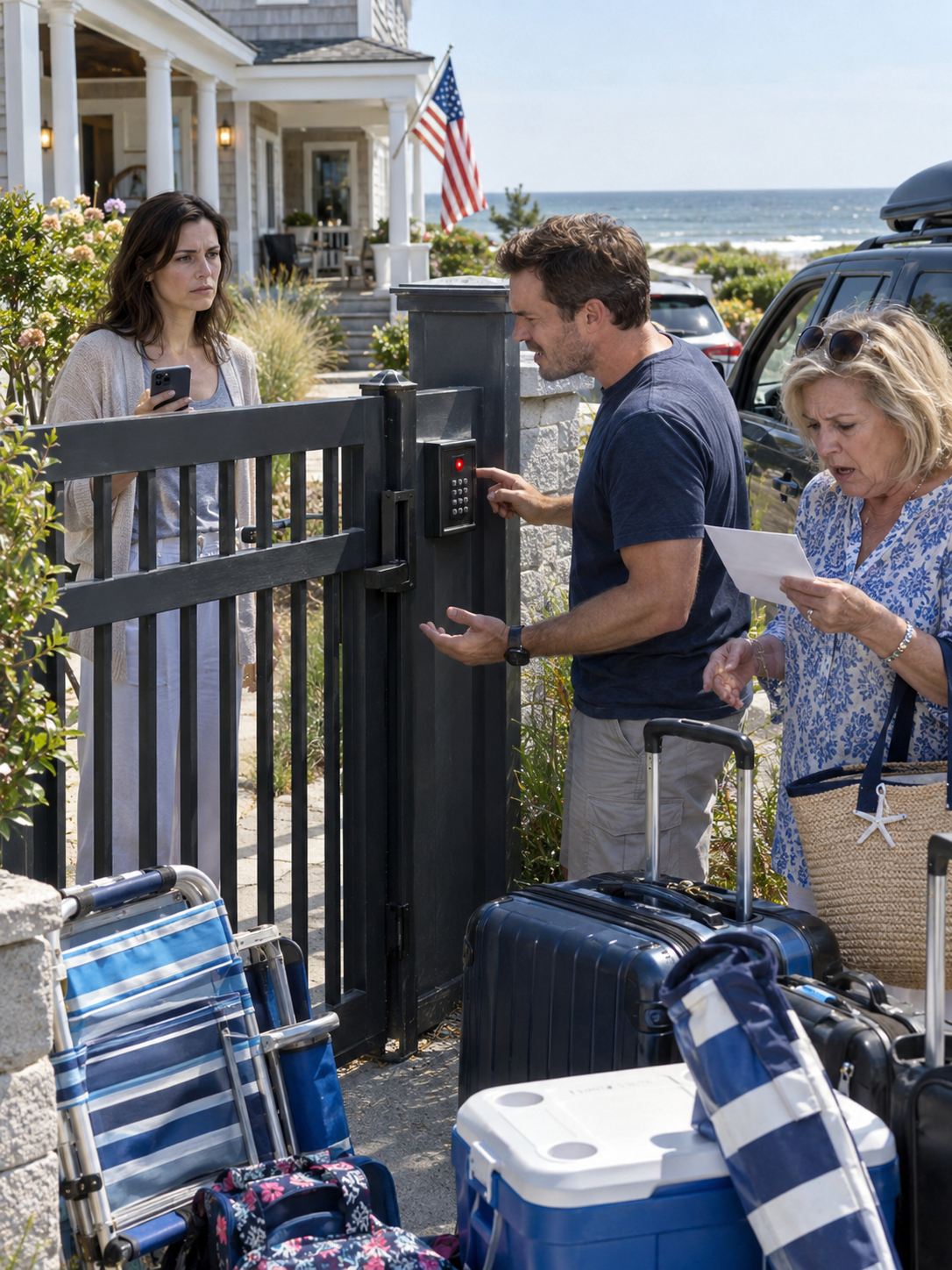
Through the security camera on my phone, I watched two vehicles turn into my driveway.
The first was Susan’s SUV.
The second belonged to Jake.
Suitcases filled the rear windows.
Beach chairs were strapped to the roof.
and someone had brought a cooler large enough for a week.
Nobody looked like they were visiting someone recovering from surgery.
They looked like tourists checking into a resort.
Susan climbed out first.
Jake followed.
Lisa and the others stretched after the drive and began unloading.
Then Susan stopped.
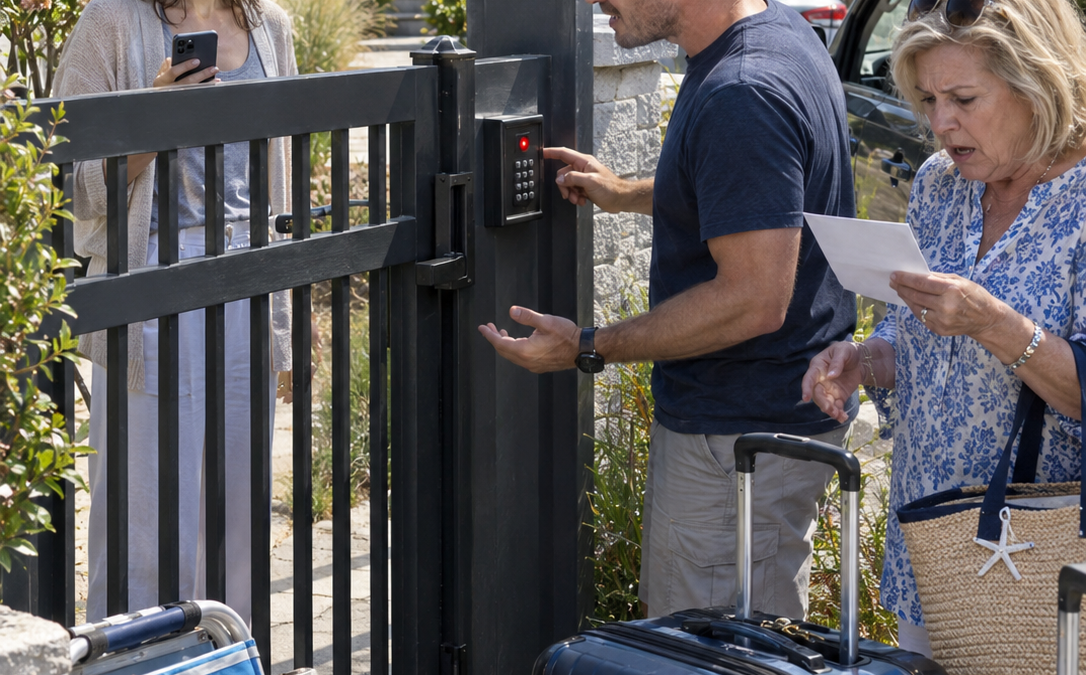
The gate was closed.
Jake entered the old keypad code.
Red light.
He tried again.
Red.
A third time.
red.
The expression on his face shifted from confidence to irritation, then to disbelief.
Susan noticed a white envelope inside the weatherproof holder beside the gate.
She opened it and read the property manager’s notice.
Owner has not authorized guest access to this residence.
Please contact the owner directly regarding alternative accommodations.
Her head snapped toward the house.
She pulled out her phone and called me.
I let it ring twice.
Madison, open the gate.
No greeting.
I told everyone on Wednesday the house was unavailable.
We drove 4 hours.
I told you not to.
Jake stepped closer.
Maddie, seriously, enough.
Open it.
Jake, the code has been changed.
Why?
He sounded offended as though I had altered something belonging to him.
because you copied a key to my house without permission and told people to use an old access code after I said the house was closed.
Susan turned toward him.
What is she talking about?
Jake waved a hand.
She’s exaggerating something from years ago.
Mom, I said, check the family chat.
I had scheduled one message for their arrival.
It contained three screenshots.
The first showed Jake saying I would complain but eventually fold.
The second told everyone to use the old code if I didn’t answer.
The third mentioned Karen’s parents and included Madison doesn’t need every detail.
Phones came out.
Silence followed.
Susan turned to Jake.
You told me she agreed.
She always agrees eventually.
Even I was stunned by how casually he said it.
That is not the same thing.
Lisa replied.
Jake looked around.
Can we not do this in a driveway?
We’re already here.
That has been your strategy for years, I said.
Arrive first.
Ask permission afterward, then make refusing you feel rude.
Jake’s jaw tightened.
So, you’re leaving your entire family outside because you’re mad at me.
No, I’m leaving eight adults outside because all eight were told this house was unavailable and came anyway.
One of my aunts quietly put her suitcase back into the SUV.
That small gesture told me the story Jake had sold them was already cracking.
Susan cut in.
Madison, I shouldn’t have said what I said on the phone.
Fine, but this is humiliating for who?
Everyone.
Mom, I told you I was recovering.
You said my recovery wasn’t your problem.
Then you drove here expecting me to make your vacation my problem.
Nobody answered.
And maybe that was the real question.
When does family support become a demand that one person sacrifice themselves so everyone else can stay comfortable?
Jake finally said, “Where exactly do you expect eight people to stay?
Wherever eight adults who ignored a cancellation normally stay.
It’s peak season.
Hotels are expensive.
Then whoever convinced everyone the trip was still happening should probably solve that.
[snorts] Every head turned toward him.
I had deliberately arranged no hotel and no backup.
If I rescued them, I would simply be hosting them somewhere else.
Susan opened a hotel app and stared at the prices.
The cheapest decent option had four rooms left, each requiring a twoight minimum because of a festival.
Jake suggested splitting the cost eight ways.
Susan looked at him.
Absolutely not.
You told us Madison agreed.
You told us lodging was handled.
You fix it.
Eventually, four rooms were booked on Jake’s card.
As he loaded the bags back into his car, he looked directly at the camera.
You think you proved something?
No, Jake, I said through the phone.
I think you did.
The vehicles backed out.
My driveway became quiet.
My hands shook as I set the phone down, but beneath the exhaustion was something steady.
For once, my family’s bad decision had landed where it belonged, and Jake had only seen the first consequence.
The next morning, I woke to 27 notifications.
11 were from the family chat.
Nine were from Jake.
Three were from Susan.
I ignored Jake first.
My entire life, his anger had functioned like a fire alarm.
Whenever it went off, everyone rushed to make it stop.
This time, I made coffee, took my medication, completed my recovery routine, and sat down before reading anything.
Susan’s messages were short.
We need to talk.
I didn’t know what Jake told everyone.
I’m still upset about yesterday, but I understand why you changed the locks.
That mattered, but it didn’t erase the call.
Lisa’s message mattered more.
Please call me.
There’s something else.
I did.
She answered from outside the hotel so Jake couldn’t hear.
Mom confronted him last night.
He admitted he told her you had approved the trip, but that wasn’t all.
I waited.
He told her you wanted everyone there because you were feeling isolated after surgery.
I stared at the wall.
He said, “I wanted this.” Yes.
He told me mom had already booked time off and would be devastated if you canled, so we should come and smooth things over.
Jake hadn’t merely ignored my boundary.
He had engineered the conflict by making everyone believe someone else had already decided the trip was happening.
That realization was worse than the driveway scene because it meant none of this was accidental.
There’s more.
Lisa said Saturday dinner wasn’t just dinner.
Karen’s parents were coming because Jake planned to announce that he and Karen were moving in together and beginning to look for a house.
He wanted the evening at my property because for months he had been presenting my beach house as part of his lifestyle.
Karen’s parents believed Jake and I had some kind of shared family ownership arrangement.
He told them the house was basically ours, Lisa said.
I laughed once.
I bought this place myself.
I know.
Does Karen?
Lisa paused.
I’m not sure.
When the call ended, I opened Jake’s messages.
They began angry and became desperate.
You embarrassed mom.
You made everyone think I lied.
Karen is asking questions because Lisa can’t keep her mouth shut.
You need to tell her this was a misunderstanding.
That last sentence exposed exactly what he wanted.
Jake wasn’t asking me to forgive him.
He wanted me to repair his image.
I replied once, “I will not lie to protect you from the consequences of lying about me.” His response came instantly.
I never said I owned it.
I said it was the family beach house.
It isn’t.
Three dots appeared.
Why are you being like this?
That question almost impressed me.
He had copied my key, hidden extra guests, misrepresented my consent, and used my property as a prop.
Yet, my reaction was somehow the confusing part.
I opened a folder on my laptop called access.
Inside were old messages, photographs, receipts, and the locksmith email documenting the copied key.
I didn’t need a legal case.
I needed a record because my family had a habit of turning history into opinion.
One photograph showed the deck after Jake’s unapproved gathering 3 years earlier, food containers everywhere, and a broken outdoor lamp near the steps.
His message afterward read, “Stop being dramatic.
I’ll replace whatever you’re crying about.
He never did.
Another message showed him asking for the keypad code because he was coming down for one night.
The security log showed four.
Each record reminded me how often peace had simply meant I paid while Jake moved on.
Around noon, Susan called.
I owe you an apology for what I said.
I waited.
Jake told me you had agreed, then said you were backing out because you were nervous about hosting.
I thought you were changing plans after giving permission.
So, you told someone 3 weeks after surgery that her recovery wasn’t your problem.
Yes, she exhaled.
And hearing it repeated yesterday sounded worse than it did when I said it.
It sounded exactly the same to me.
Silence.
That’s fair, she admitted.
Then came the familiar turn.
Still, Jake is dealing with a mess.
Karen is furious.
Are you asking me to fix it?
I’m asking if you could explain that he didn’t mean no.
Madison, you apologized for ignoring me.
Don’t turn the apology into another job for me.
After we hung up, I sent one final message to the family group to remove confusion.
The beach house is not shared family property.
I purchased it, maintain it, ensure it, and decide who stays here.
From now on, every visit requires a direct invitation from me.
Assumptions are not invitations.
Jake responded first.
“Wow, so now you’re keeping score.” For years, keeping no score had been the reason he kept winning.
By Saturday evening, the vacation Jake planned was collapsing in slow motion.
The eight guests still had hotel rooms, but nothing resembled the 5-day beach retreat they expected.
There was no private kitchen, no deck, no free beach parking, and no house where everyone could spread out.
Every inconvenience carried the same unspoken question.
Why did we come after Madison said no?
Jake hated that question because there was only one honest answer.
He had decided my refusal didn’t matter.
At , Karen called me.
I had met her perhaps six times over 2 years.
She was direct and usually stayed out of family disagreements.
I’m sorry to bother you, she said, but I need to ask you something.
Go ahead.
Does Jake own any part of your beach house?
No.
Has he ever?
No.
Did your parents help buy it?
No.
Pause.
So when he calls it the family beach house, that is his description.
It is not an ownership arrangement.
She breathed slowly.
He told my parents he had permanent access.
He doesn’t.
Did he before yesterday?
Not with my permission.
Another long silence.
I could almost hear her revisiting conversations she had previously accepted without question.
Thank you, she said.
I’m sorry you’re dealing with this while recovering.
She didn’t ask me to defend him or rescue dinner.
That should have ended my involvement.
Then Jake called six times.
On the seventh, I answered, “What did you say to Karen?” “The truth.
You made it sound like I’ve been pretending to own your house.
Have you?
No.
Then why are you worried about what the truth sounds like?
He talked over me, saying family property was just a phrase.
Karen’s parents misunderstood and I was weaponizing technicalities.
Finally, I interrupted.
Jake, you knew I said no.
Silence.
You wrote that I would fold.
You told people to use an old code.
You hid additional guests.
This isn’t confusion.
His voice dropped.
What do you want?
An apology?
Fine.
I’m sorry.
Now, can you stop?
Stop what?
Punishing me.
I changed the locks to my house and answered a question truthfully.
Which part is punishment?
He had no answer.
Instead, he snapped.
You finally have something everyone wants, and you love holding it over us.
That sentence clarified everything.
Jake didn’t think I was selfish because I refused him.
He thought ownership itself was selfish if he couldn’t benefit from it.
My mistake, I said, was thinking generosity creates gratitude in people who feel entitled to it.
He hung up.
20 minutes later, Lisa messaged me.
He just threw the hotel receipt on the table and told everyone to pay their share.
What happened?
Mom said no.
Aunt Rachel said no.
I said no.
He’s furious.
Four rooms, fees, parking, and weekend rates totaled a little over $4,000.
Jake expected eight adults to divide it.
Susan reminded him in front of everyone that he had personally promised lodging was handled.
“You made the decision for us,” she told him.
“You pay for the decision.” The larger confrontation came at dinner.
Karen and her parents arrived at the hotel restaurant because the gathering Jake had imagined on my deck had been relocated to a crowded table beside the lobby.
According to Lisa, he spent the first 15 minutes calling everything a misunderstanding.
Then Karen’s father asked, “Did Madison tell you not to come?” Jake tried to redirect.
Karen repeated it.
“Did she tell you not to come?” He finally admitted I had.
Susan corrected him when he claimed my message arrived after plans were finalized.
She told me before I packed, she said.
Lisa mentioned the hidden group chat.
Jake accused her of betraying private messages.
Karen stared at him.
Private messages where you discussed ignoring the owner of the house.
The question reportedly silenced the whole table.
He had built the weekend around the assumption that comfort would matter more than truth.
Now the group was doing the opposite.
Meanwhile, I was home, my medication schedule on track, reading instead of preparing food for 10 people.
15 minutes away, Jake was paying hotel bills, defending contradictory stories, and watching the image he had created unravel in front of the exact people he wanted to impress.
I didn’t celebrate his relationship problems.
Karen could make her own decisions.
What satisfied me was simpler.
I wasn’t fixing any of it.
That evening, Susan sent a photograph of everyone around the restaurant table.
Jake looked away from the camera.
Under it, she wrote, “We should have listened the first time.” In another version of my life, I would have immediately responded with something to make her feel less guilty.
Instead, I put my phone down.
An apology did not require me to comfort the person giving it.
Sunday should have been the moment Jake accepted defeat.
Instead, he made the mistake that cost him what remained of the family’s sympathy.
At that morning, he posted a long message in the extended family chat with cousins, aunts, and uncles who had not been involved in the trip.
He wrote that I had locked our family out without warning, forced everyone into expensive hotels, and used my recovery to punish people over old grudges.
He ended with, “Some people forget where they came from once they have something everyone else enjoys.” “Old Madison would have panicked and written paragraphs explaining herself.” “New Madison opened the access folder.” I responded once.
Since this has been brought into the extended family chat, I’ll correct three facts.
One, I informed everyone before the trip that I was not hosting.
Two, Jake acknowledged that message and replied, “See you Friday.” Three, Jake privately told others I would eventually give in and instructed them to use an old access code if necessary.
I attached the screenshots.
I didn’t mention surgery again.
Facts did the work.
My cousin Daniel replied first.
Jake, didn’t you tell me last year we could use that place for the fishing weekend because it was basically family property?
Another cousin wrote, “He told us the same thing for Labor Day.” Aunt Rachel, currently staying in one of the hotel rooms he paid for added, “Madison told us not to come.
We came because Jake said she didn’t mean it.
Then Susan wrote, “That is accurate.” I reread her message.
I wasn’t used to seeing my mother publicly contradict Jake.
What followed wasn’t a screaming fight.
It was worse for him.
People began asking calm questions.
How many times had he offered access to a house he didn’t own?
Did he actually have a key?
Why did he tell different stories to different people?
Someone even asked whether previous invitations supposedly coming from me had actually come through Jake.
Jake said everyone was overreacting.
Someone asked why he created a separate chat excluding me to arrange a trip to my property.
He claimed the visit was supposed to be a surprise.
Lisa replied, “It wasn’t a surprise.
Madison had already said no.” Every excuse produced another contradiction.
Eventually, Jake left the group chat.
Two hours later, he texted me privately.
Happy now?
No, but I’m no longer carrying this for you.
You turned everyone against me.
I posted your words.
Same thing.
That was almost his real problem in one sentence.
Jake believed consequences were something other people did to him, never something his choices produced.
I didn’t respond again.
Instead, I finalized the access changes I had started Thursday.
The property manager sent me an updated authorization form.
I removed every family member from standing guest access, not just Jake.
Susan was surprised.
Even me?
Yes.
But I apologized and I appreciate the apology.
Access is still invitation only.
In my family, forgiveness had always meant restoration of every previous privilege.
If someone apologized, you were expected to hand back the same trust they had damaged.
I was done confusing forgiveness with access.
I also sent Jake an itemized list of three older costs caused by visits he arranged without permission.
the broken outdoor lamp, professional cleaning after the 4-day stay he had called one night, and the locksmith work after the copied key.
The amount wasn’t huge, but it made history concrete.
“I covered these because I wanted peace,” I wrote.
“That arrangement is over.
Before another invitation is ever considered, these need to be resolved.” Jake replied, “Unbelievable.” That afternoon, Susan called from the hotel lobby.
Your brother is leaving early.
Okay.
Karen left this morning.
I said nothing.
She told him she needs space.
Apparently, this isn’t just about your house.
She said he does the same thing with plans, decides what people will eventually agree to, and behaves as if the decision has already been made.
I didn’t feel victorious about Karen leaving.
I felt validated.
The pattern I had spent years wondering whether I imagined was visible to someone outside the family.
Susan continued, “I also know I used him as an excuse.
Even if he told me you had agreed, I heard you say you were recovering and still told you it wasn’t our problem.
That part is mine.” It was the first apology from my mother without the word, but I accepted it.
I did not invite her over.
The family checked out Monday.
One day earlier than planned, Jake’s 5-day vacation lasted less than 72 hours and never crossed my gate.
He paid the hotel bill and the catering cancellation fee.
His copied key was useless.
His permanent access disappeared.
Karen stepped away.
Several relatives now questioned promises he had previously made using my property.
And because he had chosen to make the conflict public, he could no longer rely on the old claim that I was simply difficult.
He had lost control of the story.
The family left town Monday, but the story didn’t end with a dramatic apology at my front door.
I’m glad it didn’t.
Real change is rarely that convenient.
For the next 6 weeks, Jake and I didn’t speak.
Susan called twice, both times asking before discussing anything involving the beach house.
Lisa visited once, but only after messaging 3 days in advance and waiting for an explicit yes.
She brought lunch, didn’t ask where anything was, didn’t invite anyone else, stayed 90 minutes, and left when I said I was tired.
The [snorts] simplicity almost made me angry because it proved how easy respect could have been all along.
My recovery continued.
I walked farther each morning.
I worked from my desk again.
The house stopped feeling like a battlefield and became mine in a way it hadn’t for years.
Even ordinary silence felt different when I knew nobody believed they could interrupt it whenever they pleased.
One afternoon, I found the old basket where I used to keep spare keys for relatives.
It was empty.
I nearly put one back for Susan out of habit.
Then I remembered a boundary that survives only until guilt appears is not a boundary.
Seven weeks after the failed trip, Jake finally emailed me.
The subject line read, “What I owe you.” It wasn’t a perfect apology.
The first paragraph still irritated me because he explained how embarrassed he had been and how everyone had piled on.
Then his tone changed.
I keep coming back to the screenshot where I wrote that you would fold.
He said, “I thought I was joking.
I wasn’t.
I really assumed that if I made something inconvenient enough, you would eventually say yes.
I’ve done that more than once.” He admitted copying the key was wrong.
He admitted telling Karen’s parents he had permanent access because it made his life look more impressive.
He admitted using Susan to pressure me because he knew I was more likely to give in to her than to him.
Then he wrote, “I’m not asking for the house back.
I know it was never mine to have.” Attached was confirmation that he had paid the old repair and cleaning expenses.
I waited 2 days before answering.
I thanked him for paying and said I appreciated the acknowledgement.
I didn’t invite him over.
I didn’t say everything was forgiven.
I didn’t rush to restore a relationship because he had finally behaved responsibly once.
I used to imagine revenge meant giving someone the same pain they gave you.
What actually satisfied me was making the old system impossible.
Jake could apologize or not.
Susan could understand or stay angry.
Lisa could adapt or keep her distance.
None of those choices changed who controlled my front gate anymore.
Three months later, Susan organized a family dinner for her birthday.
For years, that sentence would automatically have been followed by, “We can do it at Madison’s.” This time, she booked a restaurant.
Everyone paid for their own meal.
Nobody asked me to cook.
Jake came alone.
Karen and he had not reconciled, though I never asked for details.
He looked different, not destroyed, not miserable, simply quieter.
He no longer filled every silence with jokes or acted as though every plan required his approval.
Near dessert, a cousin joked.
Maybe next summer we can invade Madison’s beach house again.
The old table would have laughed.
This one fell silent.
Then Susan said, “No one invades Madison’s house.
She invites people if she wants them there.
It was a small sentence, but I felt it in my chest.
Jake looked down at his plate.
Lisa smiled at me.
I said nothing.
Months earlier, I thought revenge would be the locked gate, the hotel bill, Jake’s embarrassment, or the moment everyone discovered his lies.
Those things were satisfying.
But the deeper revenge was watching the rule he depended on disappear.
He could no longer volunteer my time, promise my house, use my mother as a shortcut around my answer, or confidently tell people I would fold.
4 months after the original phone call, I sat alone on my deck with coffee.
My recovery was nearly complete.
The gate was closed, not because I feared anyone arriving, but because privacy didn’t require an emergency to be legitimate.
Susan had apologized.
Lisa had changed her behavior.
Jake had paid what he owed and finally admitted what he had done.
Maybe one day I would invite him back.
Maybe I wouldn’t.
Healing didn’t require that decision yet.
My mother had once told me, “Your recovery isn’t our problem.” She meant I should absorb their inconvenience so they wouldn’t have to change their plans.
Instead, those words became the moment I stopped absorbing consequences that belonged to other people.
Eight adults ignored my answer and drove to my house anyway.
They found a locked gate.
Jake found a hotel bill, exposed lies, damaged trust, a relationship forced to confront his behavior, and the permanent loss of a privilege he had mistaken for a right.
I found something simpler.
my own front door finally functioning the way a front door should.
It opened when I chose to open it.
And if someone believes loving them means they are entitled to your time, your home, your energy, or your forgiveness on demand, ask yourself one question.
Are they angry because your boundary is unfair?
Or because the old version of you was easier to use?
I know my answer now.
The beach house was never the real battle.
The battle was whether family gave people permission to treat my no as the beginning of a negotiation.
It doesn’t.








