My older brother changed the locks and moved into my $920,000 house while I was away; a few days later, I received 22 notifications…

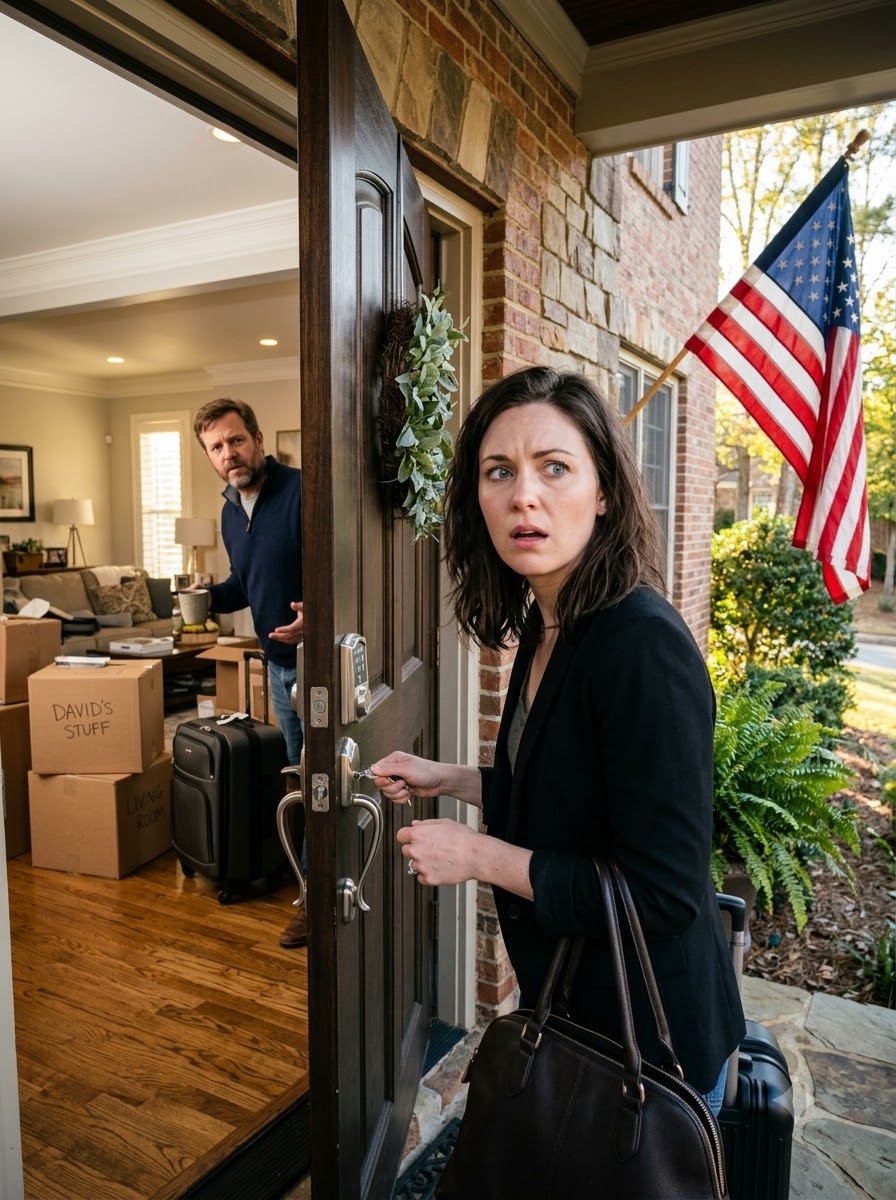
My brother posted a video tour of my house on Instagram three hours after he changed my locks.
Not after asking.
Not after paying.
Not after even telling me he planned to do it.
A 60-second reel.
Walking through my living room with his phone held high, voice bright and smooth like a man showing off something that had been handed to him by the universe.
“Welcome to the new home base,” he said, pointing at my fireplace, my bookshelves, my kitchen with the marble countertops I chose one Saturday after working 60-hour weeks for 11 years.
The caption read:
“New chapter. God always provides.”
My name is Evette Hargrove.
I was standing in the parking lot of a Hampton Inn in Charlotte with one suitcase, my work laptop, and my grandmother’s pearl ring on my right hand when I saw that video.
I watched it four times.
Not because I didn’t believe it.
Because I needed my anger to be cold before it became useful.
The house was called Sycamore Ridge.
Not officially.
That was just what my neighbor, Mrs. Callaway, had named it because of the old sycamore trees lining the driveway.
A four-bedroom Craftsman in Marietta, Georgia.
$920,000.
Hardwood floors through every room.
A sunroom off the kitchen where I kept my reading chair and my peace.
A backyard with a fire pit and a vegetable garden I started after my divorce because I needed something that grew when I cared for it.
My name was on the deed.
My credit score bought the mortgage.
My late nights as a marketing director.
My three years building my own consulting firm.
My decision to stop waiting for a co-signer and just get it done.
That was the house.
Not a family asset.
Not a shared blessing.
Mine.
But nine days before that video, my parents had called a family dinner at my house.
Not theirs.
They sat at my dining table and told me my brother Raymond needed stability.
He had been running a business consulting firm for six years, and the numbers never worked.
Not once.
But we had all agreed to believe they might.
The debts had finally added up.
$380,000 in small-business loans.
Lines of credit.
Borrowed money from family friends who were no longer friends.
Raymond was three months behind on his apartment rent.
Claudette, his wife, had stopped answering calls from her bank.
My mother looked at me with the expression I had known since childhood.
The one that said:
You are the one who can absorb this.
My father said Raymond just needed a runway.
Six months.
Maybe twelve.
They had already spoken to Raymond.
They had not spoken to me first.
Not loudly.
Not with a speech.
Just:
“No.”
My father set his fork down slowly.
My mother’s eyes filled.
Raymond looked out the window.
Claudette looked at the table.
Then my father said something I will remember for a long time.
“Evette, that house is more than one woman needs.”
More than one woman needs.
As if adequacy had a formula.
As if rest and space and privacy were resources distributed by committee.
As if the sunroom where I read on Sunday mornings was a surplus I owed to someone who had spent his share already.
I left my own dinner table that night and drove home.
Three days later, when I was in Charlotte for a client presentation, my mother let Raymond and Claudette inside with the spare key she had held since I moved in.
The one I gave her for emergencies.
Not for this.
They changed the garage code.
Then the front lock.
Then the alarm PIN.
When I flew home Thursday night and my key wouldn’t turn, I stood on my own porch in the January cold for six minutes before I understood what had happened.
I called my mother.
She answered on the second ring and said:
“Baby, just stay somewhere tonight. We’ll talk tomorrow.”
Raymond needed to feel settled.
Raymond needed to feel settled.
I want you to sit with that sentence for a moment.
Not whether Raymond deserved empathy.
He did.
I still believe that.
But who paid for his feeling of settled?
Whose locks were changed?
Whose key stopped working?
Whose porch was no longer accessible after 11 years of mortgage payments?
I called Mr. Marcus Ingram that night.
He had handled my home purchase five years earlier.
He answered his cell because he remembered my file was worth protecting.
I told him what happened.
He said two things.
First:
“Do not force entry.”
Not because you’re wrong.
But because we fight this cleanly.
Second:
“Sleep somewhere safe and send me everything in the morning.”
I drove to Monique’s apartment.
She opened the door before I knocked because I had texted from the parking garage and she had already put the kettle on.
That is the kind of friend Monique is.
When I told her, she didn’t speak for a moment.
Then she said:
“They changed your locks?”
“Yes.”
“While you were in Charlotte?”
“Yes.”
“I need you to sit down before I say what I’m about to say.”
I sat.
She said:
“Raymond posted a room tour two hours ago.”
The video was 60 seconds.
My fireplace.
My bookshelves.
His voice:
“God always provides.”
Monique made chamomile tea and let me sit in her kitchen until the shaking stopped.
Then I opened my laptop and sent Mr. Ingram everything.
Photos.
Texts.
The spare-key conversation from three years ago.
Every message from my family in the last two weeks.
The mortgage statements.
My name on every document attached to that property.
He called back in the morning.
He had found something.
While I was in Charlotte, Raymond had visited a notary service in Smyrna.
A small operation that processed quick documents for a flat fee.
He had filed a temporary family occupancy request using an emergency cohabitant clause.
A document type designed for elderly-parent housing situations.
The document claimed I had verbally agreed to the arrangement and authorized the temporary transfer of access.
It listed Raymond as temporary household manager.
There was a signature line at the bottom.
Something that looked like mine.
Mr. Ingram’s voice was steady when he told me.
Mine was not.
I asked if it was real.
He said the signature was inconsistent with my known samples and the notarization had irregularities he intended to examine closely.
Then he asked one question.
“Evette, were you in Georgia on the 14th?”
I was not.
Hotel check-in in Charlotte on the 13th.
Confirmed.
Client meeting on the 14th from nine to five.
Dinner after with the client team.
Receipts.
Timestamps.
And two witnesses.
Mr. Ingram said:
“Good.”
Then:
“That’s better than good.”
Before I tell you what came next, let me ask:
Have you ever watched someone you loved look straight at something wrong and call it family?
Stay with me.
Because what happened over the next 72 hours was not about revenge.
It was about responsibility.
It was about who gets to walk away from a mess they created inside someone else’s life.
Monique spent two days helping me gather everything Mr. Ingram needed.
Hotel records.
Flight documents.
My digital calendar with timestamps.
The client’s signed statement confirming my presence in Charlotte.
Texts where my mother had originally requested the spare key for genuine emergencies.
The original alarm-company contract with my credentials.
The HOA letter addressed only to me.
Raymond did not wait quietly.
He posted twice more that week.
A photo of Claudette at my kitchen island making coffee.
Tagged:
Home base.
A video of their son Tyler running through my backyard.
Tyler was five.
He had no idea what he was running through.
I held on to that distinction carefully.
My mother called four times.
My father texted twice.
Raymond sent one message.
You’re being dramatic.
We’ll figure the finances when I’m back on my feet.
I did not respond to any of them.
Mr. Ingram had been clear.
Paper over phone calls.
Always.
On the third day, Mr. Ingram sent correspondence to every vendor and service provider connected to my property.
The letter stated that I, Evette Hargrove, the sole owner of record, disputed the occupancy claim and had not authorized any transfer of household management.
They requested that all active notices, billing statements, and service invoices be delivered directly to the current unauthorized occupants, Raymond and Claudette, who had publicly represented themselves as the household managers.
Monique, when I explained this, sat completely still for a moment.
Then she said:
“You’re sending them the homework.”
I told her it wasn’t homework.
She said:
“It is absolutely homework, and they are going to fail.”
She was right.
Not because I designed it as punishment.
Because Sycamore Ridge was a real house.
And real houses cost real money every single month.
The mortgage payment notice arrived on a Tuesday.
$3,847.
Claudette texted me that afternoon.
“What is this?”
I forwarded it to Mr. Ingram.
He replied.
Then the HOA quarterly statement.
$2,200.
Property insurance.
$2,900 annual, broken into quarterly billing.
The alarm monitoring company.
$89 per month.
With a notice that account ownership had not been transferred and all service decisions required the account holder’s direct authorization.
Pool maintenance.
$165 per month.
Landscaping contract.
$240 monthly.
Gutter cleaning already overdue.
$300.
Internet and cable still in my name.
$178 per month.
No transfers processed without my presence.
Property tax installment.
$4,100 due in 30 days.
Water and sewer.
Gas bill.
Garbage collection invoice.
A notice from the alarm company about the unauthorized PIN change and the $175 service fee it triggered.
A notice from the HOA about unauthorized lock modifications.
$400 fine because my neighborhood required HOA approval for external lock changes under deed restriction.
A concern letter from my mortgage lender.
They had received conflicting occupancy information and wanted to confirm the primary borrower’s status.
Mr. Ingram’s formal dispute letters.
The second set of letters.
A notice from the Georgia Notary Board after Mr. Ingram filed a complaint about the document irregularities.
A letter from the State Real Estate Commission.
Twenty-two notices in four days.
Not one invented.
Not one exaggerated.
Just the cost of a house delivered to the people who had decided a house was a place to live rather than a responsibility to carry.
By Friday, the Instagram posts were gone.
Raymond’s video disappeared first.
Then Claudette’s coffee photo.
Then the video of Tyler in the backyard.
My mother removed a post I hadn’t even known she had made.
Something about God restoring family with a photo she must have taken through a window the afternoon they moved in.
Raymond called 11 times that Friday.
I watched my phone ring from across the room.
My father called once.
His voicemail sounded different.
Not commanding.
Tired.
He said:
“Evette, we made a mistake. Please call me back.”
That was the first sentence any of them had offered.
My mother’s voicemail came at 8:47 in the evening.
Her voice was not the gentle crying voice she used when she wanted me to relent.
It was smaller than that.
She said:
“The mortgage company called the house looking for you.”
“Raymond doesn’t know what to tell them.”
“There are letters everywhere.”
“Baby, we didn’t understand what all of this meant.”
She paused.
Then she said:
“We didn’t know it cost so much to live there.”
I played that voicemail three times.
We didn’t know it cost so much.
That was my family.
They saw the sunroom.
They saw the hardwood floors.
And the sycamore trees.
And the fire pit.
And the kitchen island with the marble countertops.
They did not see the 11 years.
They did not see the quarterly HOA meetings.
The flood-insurance rider.
The gutter cleaning I scheduled every October.
The alarm monitoring I had autopaid for four years without missing a month.
They wanted the life.
Not the ledger.
Raymond showed up at Monique’s building Saturday morning.
He didn’t get past the front desk.
He texted from the lobby.
This is insane.
You’re ruining us over a house.
I read the phrase over a house twice.
Then I thought about my key not turning on a cold Thursday night in January.
I didn’t respond.
Mr. Ingram scheduled a meeting Monday.
His office.
Raymond and Claudette came with a local attorney who specialized in landlord-tenant disputes and had clearly not been fully briefed before walking in.
My parents sat along the wall.
My father looked like a man who had rehearsed something and lost the notes.
My mother held her purse in both hands.
Monique sat beside me.
She had worn a blazer.
She had also brought snacks because she said:
“I’m not walking into a confrontation on low blood sugar.”
Mr. Ingram opened by placing a single document on the table.
A side-by-side comparison of my known signature samples against the signature on the occupancy filing.
The differences annotated in red.
Beside it, my Charlotte hotel receipt with timestamp.
My client’s signed statement.
My flight boarding record.
He said:
“Evette Hargrove was not in Georgia on the date this document was signed.”
“She could not have executed this filing.”
Raymond’s attorney shifted in his seat.
Raymond looked at the table.
Claudette looked at Raymond.
My father said quietly:
“We didn’t know about the signature.”
I turned toward him slowly.
“But you knew I hadn’t agreed.”
He was quiet for a moment.
Then:
“Yes.”
My mother covered her mouth with one hand.
I looked at her.
“You knew too.”
Her eyes filled.
She nodded once.
Raymond said:
“Nobody was supposed to get hurt.”
Claudette said his name.
“Raymond.”
He looked at her.
She shook her head.
Mr. Ingram continued.
The notary service had confirmed that the notarization did not occur on the listed date.
The individual who filed the document had provided a name that did not match any licensed notary in Cobb County.
A formal complaint had been filed.
The filing was legally void.
Raymond’s attorney asked about a negotiated timeline for vacating.
Mr. Ingram said the timeline was not subject to negotiation.
Vacate within 48 hours.
Restore all access codes and keys.
Provide a full accounting of any items moved or damaged.
Sign an acknowledgment confirming the filing had been unauthorized and that no occupancy rights had ever been transferred.
Raymond said:
“And if we don’t?”
Mr. Ingram looked at him with the patience of a man who had already answered that question.
He said:
“Then this becomes a criminal matter rather than a civil one.”
“A forged notarization is not a misunderstanding.”
“It is fraud.”
The room held that word for a few seconds.
Claudette said:
“Raymond, we have to go.”
He looked at her.
Then at me.
His face had the expression of someone who had planned thoroughly for winning and had no contingency for anything else.
He said:
“You would do this to your own family.”
I looked at him.
“You changed my locks while I was in another state.”
He had nothing for that.
They vacated in 31 hours.
Mrs. Callaway texted me updates from her porch because she is 73 years old and considers neighborhood accountability a civic responsibility.
She said Raymond made three trips with boxes and never looked up.
Claudette carried the children’s things without looking back at the house.
My mother helped fold blankets at the kitchen table and cried before my father walked her to the car.
When I returned, I came with Mr. Ingram, Monique, a locksmith, and a property inspector.
The house felt disrupted.
Not destroyed.
Disrupted.
Furniture rearranged in the living room.
Two cabinet doors off their hinges.
The vegetable garden dry and neglected for 10 days.
A box of my grandmother’s photo albums moved from the hallway closet to the garage.
Stacked under moving boxes like storage.
I found that stack in the garage and sat down on the concrete floor next to it.
Monique came and sat beside me without asking why.
She said:
“Tyler didn’t know.”
“I know.”
“Your parents were afraid of your brother’s failure.”
“I know that, too.”
She put her arm around me.
And we sat there until I was ready to stand.
The legal work continued for months.
The fraudulent filing had to be formally voided through the county recorder’s office.
The notary complaint resulted in a fine for the business that had processed the document.
Raymond was not criminally charged.
Mr. Ingram and I made that decision together.
And I made it because Tyler was five years old.
I did not want my nephew carrying that weight into his life.
But I made Raymond sign the acknowledgment.
Every sentence of it.
That the filing was unauthorized.
That I had not consented.
That the signature was not mine.
He signed without looking at me.
My father apologized in November.
Coffee shop.
Neutral ground, he called it.
When I sat across from him, he looked like a man who had rehearsed something for months and finally decided to stop rehearsing.
He said he had been afraid.
Not of losing Raymond’s respect.
Of admitting that Raymond had failed in a way he didn’t know how to repair.
And so he had looked at my career.
My house.
My independence.
And decided I was the answer to a problem that was not mine to solve.
He said:
“I told myself you were strong enough to give something up.”
“I didn’t ask if you were willing.”
I told him those were two completely different things.
He said:
“I know that now.”
My mother’s letter came in December.
Handwritten.
Three pages.
She asked for nothing in it.
She named every specific thing she had done.
Handing over the spare key.
Not calling me first.
Crying at dinner to wear me down.
Staying silent when she knew the signature wasn’t right.
She wrote that she had spent 40 years believing her job was to keep the family intact and had never once asked whether intact was the right goal when the pieces were held together by someone else’s silence.
I read the letter twice.
Then I put it in the top drawer of my desk in the sunroom.
Where I keep things that matter but aren’t finished yet.
Raymond’s apology took almost a year and a half.
By then, he and Claudette had separated.
Not over the house.
Over what the house had revealed about a longer pattern.
She came to me in the spring with one ask.
A referral to a family-law attorney.
I gave her one with no conditions attached.
Raymond reached out in the fall.
He asked to meet somewhere public.
Monique said:
“Library. Quiet witnesses. No pressure.”
We met at a Panera because I don’t always follow Monique’s advice.
He looked like a person who had spent a long season alone with his own choices.
He said he was sorry.
I asked him to be specific.
He took a breath.
He said he was sorry for letting his failure become my emergency.
For using our parents’ fear as permission.
For posting a video tour of my house like the rooms had been issued to him by God.
He said:
“For making you feel like living alone in a home you built meant you had more than you deserved.”
That last part stayed between us for a while.
I said I didn’t forgive him that day.
He nodded.
He said:
“Fair.”
He said thank you for not pressing charges.
I said that decision had been for Tyler.
He said he knew.
He said he was grateful anyway.
That was all he got.
And for the first time in his life, he accepted that all was more than he had earned.
Sycamore Ridge changed after that.
Not broken.
But different.
I repainted the living room the color it had been when I first chose it.
Before someone else’s furniture had been arranged against my walls.
I replaced the cabinet doors.
I bought a new alarm system with a code I never gave to anyone.
I fixed the vegetable garden.
Planted late.
And got tomatoes in August.
Which felt like the right kind of message.
And I started teaching.
Monique had been telling me for months that what I knew had value beyond my own property line.
She had watched me explain the vendor-notice strategy to a friend of hers dealing with a similar family-pressure situation.
And she had watched that woman’s face change.
The way a face changes when something you’ve been living through finally gets named out loud.
She said:
“Evette, you should run workshops.”
I said I was a marketing consultant.
Not a housing attorney.
She said:
“Mr. Ingram can be the attorney.”
“You just be the woman who’s already been through it.”
So that’s what we built.
We called it the Know Your Deed Project.
A monthly session at the public library conference room.
Free to attend.
Women came who had been pressured to let siblings move in.
Just temporarily.
Women whose in-laws had changed their locks.
Women who had co-signed names on informal notebook-paper agreements that were later treated as binding contracts.
Women whose families had told them a three-bedroom home was too much for a single woman.
Women whose spare keys had never come back.
We taught what I had learned the hard way.
Keep your deed in a fireproof safe.
Not a kitchen drawer.
Do not give spare keys to people who have not earned your trust with smaller things first.
Control your alarm codes.
Always put every property-related conversation with family in writing.
Text.
Or email.
Even when it feels like overkill.
Especially when it feels like overkill.
Know your vendors by name.
And make sure they know you.
Never sign anything under emotional pressure.
And know this:
A house is not just a place to live.
It is a financial system.
Anyone who wants its warmth must also be willing to face its ledger.
At our third session, a woman in the back row raised her hand.
She said:
“My mother told me I should give my brother my basement apartment because I have more than I need.”
Her voice was steady.
But her hands were not.
I looked at her and asked:
“Who decided that what you have and what you need leaves you with something extra?”
She was quiet for a moment.
Then she said:
“Nobody ever asked me that.”
I told her to start asking herself.
Then I told her to call Mr. Ingram’s office the next morning.
Monique, after that session, said we needed a slogan.
I said I wasn’t putting a slogan on a housing workshop.
She said:
“Every movement has a line.”
I said:
“This is not a movement.”
She said:
“It’s becoming one.”
We went back and forth until I gave up.
And she printed coffee mugs that read:
“They want the bedroom.”
“Ask them about the mortgage.”
Mr. Ingram saw one of the mugs and said it was the most precise legal advice he had seen on drinkware.
My mother volunteers now.
She makes coffee.
Arranges chairs.
And helps women sign in at the table.
She does not lead sessions.
She did not ask to lead sessions.
She asked if she could be useful.
And I told her:
“Small and consistent is the only kind of useful that rebuilds anything.”
She has not missed a session in seven months.
At one of them, I overheard her telling a woman:
“If you know your daughter would say no, don’t build a plan around her.”
Yes.
I stood in the doorway and didn’t make a sound.
Some repairs happen slowly.
And they should.
My father came once.
He sat in the back.
At the end, a woman asked if anyone had ever been on the other side.
The family member who had taken rather than the one who held on.
My father raised his hand without looking around first.
He said:
“I told myself my son’s failure was my daughter’s problem to solve.”
“I was wrong about that in more ways than I’ve finished counting.”
He paused.
“Don’t let someone else’s loss become a reason to take from the person who built something.”
The room was quiet.
Then they clapped.
Not because he was forgiven.
Because truth from the person who carried the lie is worth something when it’s offered without bargaining.
Today, Sycamore Ridge is mine in a way it wasn’t even before Raymond changed the locks.
Before, I owned it.
Now I know what I’m defending.
There is a real difference between those two things.
The sycamore trees still line the driveway.
The sunroom still catches the late-morning light.
The vegetable garden came back this year, stronger than the season before.
The way things sometimes do when they’ve been left alone too long and finally get what they need to grow.
Near the front door, where the garage code was once changed without my permission, I placed a small framed card with a line from my grandmother’s letter.
The one she sent the month I closed on this house.
“A home is not a burden to share.”
“It is a life you built.”
“Protect it like one.”
Monique added a sticky note underneath it on a day I wasn’t watching.
It says:
“Also, change your locks.”
She’s not wrong.
My family celebrated moving into my house before they understood what a house actually costs.
Within days, the notices arrived with their names on them.
That was when the celebrating stopped.
And the reality began.
Which is the only honest order for those two things.
If someone in your life has ever looked at what you built alone and called it excess.
If you have ever been told that your adequacy leaves room for someone else’s emergency.
Stay here.
Because what you made on your own terms is not a surplus.
It is exactly enough.
And anyone who wants a room in it owes you the respect of asking first.
The honesty of hearing no.
And the decency to understand that a key you give in trust is not permission for everything that comes after.








