My parents called while I was lying in a hospital bed, unable to move after a horrific car accident. “Your sister’s awards ceremony is more important, so we won’t be coming,” they said coldly. Left all alone, I watched my sister shine at the ceremony. But the next morning, my parents kept calling me… and their voices sounded full of panic…
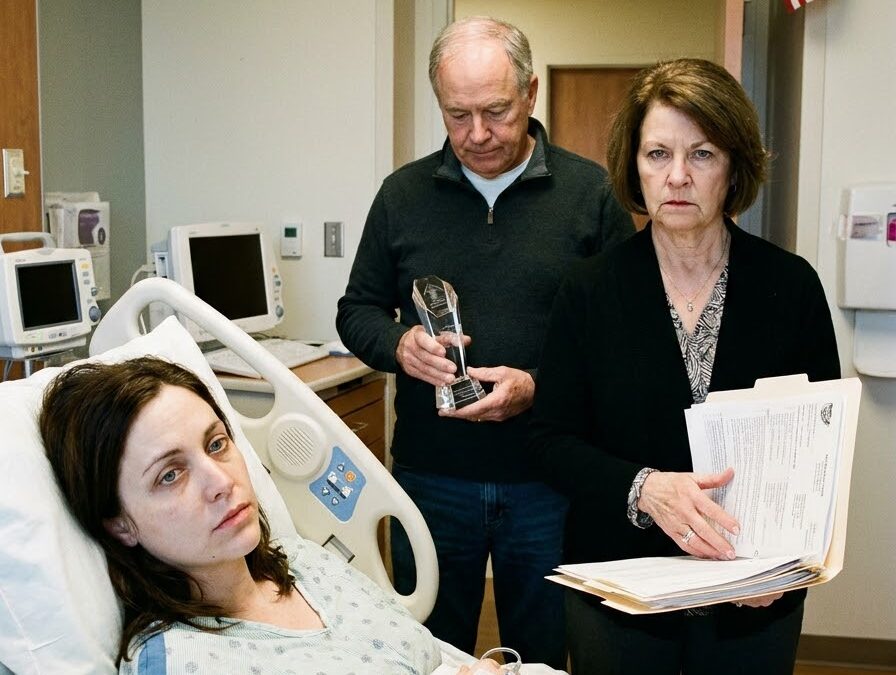
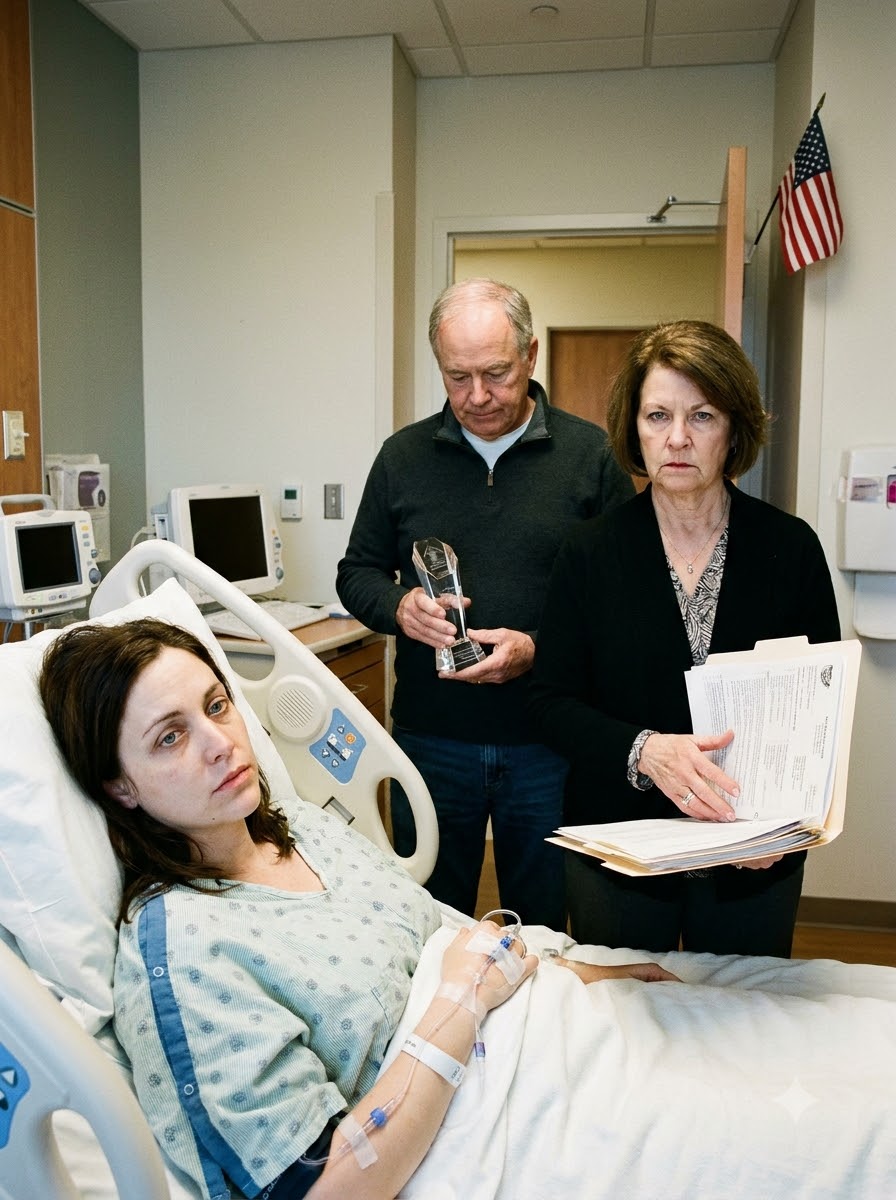
“Your sister’s ceremony matters more, sweetheart. We’re not coming.”
My mother said that while a nurse was tightening a binder around my broken pelvis.
I’m Caroline Ashb, 34 years old, and I’d been driving my dad’s blood pressure pills to that ceremony when a pickup ran the light on Route 31.
By seven, I was watching my sister accept a crystal award on a hospital television.
The camera found our family’s table. My mom was crying. My dad was clapping. And between them sat one empty chair with a gold card on the plate.
I’d made the seating chart.
I knew whose name was on it.
By one the next afternoon, my parents had called me 14 times.
They didn’t sound cold anymore.
They sounded terrified.
What they wanted from me by then was worse than what they’d done.
Welcome back to Calm Drama Stories.
This is where family drama meets quiet strength, stories about women who stop holding everyone else up and finally decide where they’ll stand.
If you’ve ever been the one who handles everything and gets thanked by no one, you’re in the right place. Drop a comment and be sure to subscribe.
The nurse’s name was Denise Ward, and she did not look at me when I hung up.
She looked at the monitor, then at my phone on the tray, then at the orange pill bottle that had rolled out of my jacket when they cut it off me.
“What were you doing on 31 at rush hour?” she asked.
“Bringing my dad’s blood pressure pills to a ballroom.”
She set the bottle next to my phone like it was evidence.
Ten minutes earlier, the ER doctor had asked for an emergency contact, and I had done what I always do.
I called my mother.
She picked up on the fourth ring with a band tuning up behind her.
“Care, we’re about to sit down. Can this wait?”
I told her about the truck, the pelvis, the surgery at six.
There was a pause, and in the pause I heard champagne glasses touching.
“You said you’re stable,” she said.
“I am. I can’t move from the waist down right now, but I’m stable.”
“Then the doctors have you, honey. We’d just be in the way.”
My dad’s voice came from farther off.
“Tell her we’ll come in the morning.”
“Mom,” I said, “they’re operating at six.”
“Then you’ll be asleep. You won’t even know we’re not there.”
Another glass.
Someone tested a microphone.
“Some things matter more, Caroline. You’ve always been fine.”
And she was gone.
And the band started.
Denise had heard every word of it through the speaker I’d forgotten to turn off.
She pulled the binder one notch tighter.
“Who’s your second contact?” she asked.
“There isn’t one.”
She wrote something on my chart anyway, and I have never asked her what.
Dr. Hail came in at a quarter to six with a tablet and the kind of calm that costs extra.
“Pelvic ring fracture, two places. Femur’s broken clean through. You’re not bleeding where it matters, which is why you’re talking to me instead of sleeping.”
He turned the tablet so I could see the gray bones.
“We fix both at six tomorrow morning. Plates, a rod. Nothing by mouth after midnight.”
I nodded like a client hearing a tax bill.
“Any questions?”
“How long until I can drive?”
“Three months if you behave and work. You can work from a bed. You can’t work from a coffin. So we’ll do this my way.”
He looked at me.
“Who’s picking you up in three weeks?”
“I’ll figure it out.”
“That’s not a name.”
“It’s what I have.”
He looked at Denise.
Denise looked at the ceiling.
He handed me the consent form.
My right arm was strapped for the IV, so I signed with my left.
The signature came out like a child’s.
I crossed it out and signed again, straighter, because it bothered me.
Denise watched me do it and said nothing.
My phone buzzed on the tray.
Hannah, the junior accountant I’d trained for three years.
Heard from Hollis. You okay?
I typed with my thumb.
I’m fine. Surgery tomorrow.
Denise read it upside down from the foot of the bed.
“You typed ‘fine’ with a broken pelvis.”
“It’s a reflex.”
“So is bleeding. We treat that, too.”
She adjusted the IV line and checked her watch.
“Anything you need before I do rounds?”
I looked at the black television bolted to the wall.
“Can you put Channel 8 on at seven?”
“What’s on?”
“My sister.”
At two minutes to seven, the screen filled with gold balloons and a banner that said, LAKESHORE LEADER OF THE YEAR.
Denise pulled the plastic chair to the foot of the bed and sat down like she had nowhere else to be, which was a lie and a kind one.
The camera swept the ballroom.
Round tables.
White hydrangeas in low glass bowls.
The Chamber of Commerce logo on every napkin.
Then it found table two.
My mother in the blue shawl I had hemmed the week before.
My father in the tie I bought him for Easter.
Two board members I recognized.
And one empty chair with a folded gold card on the plate.
“You ever been to one of these?” Denise asked.
“Eleven. I do the seating charts.”
I pointed at the screen with the hand that still worked.
“That empty chair is mine.”
“You want me to turn it off?”
“No. I paid for that centerpiece.”
She laughed once, short, and then she didn’t.
“Who’s the woman in blue?”
“My mom.”
“I hemmed that shawl Tuesday.”
“She looks happy.”
“She is. This is her favorite night of the year.”
The host read my sister’s introduction.
April Ashb, 32, executive director of the Harbor Light Children’s Foundation for five years, $4.2 million raised for reading programs across three counties.
April walked to the podium in a dress I had zipped her into at Christmas.
She thanked the board.
She thanked the donors.
She thanked our wonderful vendor partners, especially the team at North Line Events, who make every gala feel effortless.
My hand closed around the bed rail.
Denise noticed.
“Something wrong?”
“I know that name,” I said.
On the screen, the camera cut to my mother.
And my mother was crying.
April lifted the crystal award with both hands, and the ballroom stood up.
She waited for the applause the way she had waited for it since first grade.
Chin lifted.
Eyes wet at exactly the right moment.
“I want to thank my parents,” she said, “who have never missed a single thing I’ve done.”
The camera loved my mother for that.
“My family taught me that showing up is everything.”
Denise reached up and muted the television.
She didn’t ask.
She just did it.
And we watched my sister’s mouth move without sound for another minute while the crowd stood.
“Want me to call anyone?” Denise asked.
“There’s no one else on the form.”
She looked at the whiteboard on the wall where the day shift had written my doctor’s name and my pain scale.
She uncapped a marker and wrote a phone number under Dr. Hail’s name.
The marker squeaked the whole way.
“Now there is,” she said. “That’s my cell. It’s not hospital policy, so don’t tell my manager.”
I stared at the number until it stopped being digits and started being a fact.
At 9:40, my phone lit up.
A photo from my mother.
April holding the trophy between my parents, all three of them shining.
The caption said:
She did it. Wish you could have been there.
I did not answer.
I put the phone face down on the tray next to the pill bottle and the consent form with my two signatures.
Denise dimmed the lights on her way out.
“Six a.m.,” she said. “I’ll be here.”
At 5:52 the next morning, that phone started ringing.
They came for me at a quarter to six.
An orderly with cold hands.
A bed with one squeaking wheel.
A hallway that smelled like bleach and burned coffee.
The anesthesiologist walked beside the bed, reading my wristband.
“Caroline Ashby, date of birth?”
I told her.
“Anyone waiting for you upstairs?”
“No.”
She wrote that down without changing her face, which I appreciated.
“Allergies?”
“Latex. And being asked that question.”
“Everybody’s a comedian at six in the morning,” she said. “It’s the fasting.”
Denise was at the double doors.
Her shift had ended at six, and it was 5:50, and she was holding the clear plastic bag with my belongings like it was her own purse.
Inside it, my phone lit up.
Mom.
5:52.
“Want me to answer?” Denise asked.
“Let it ring. She’ll want to tell me how the afterparty went.”
It rang out.
The orderly pushed the bed through the first set of doors, and the phone lit up again, buzzing against the pill bottle in the bag.
Mom.
Denise looked at me.
I shook my head.
“Second call in a minute,” she said. “That’s not about a party, Caroline.”
“Then she can leave a message. That’s what I’ve been doing for her since I was 22.”
The anesthesiologist slid something cold into my IV, and the cold ran up my arm like a river deciding which way to go.
The last thing I heard before the mask was my phone buzzing a third time inside a plastic bag.
And Denise said very quietly:
“I’ve got it. Go to sleep.”
I woke up at a quarter to one with a mouth like paper and Hannah Beck’s face six inches from mine.
“Don’t talk,” she said. “You’re fine. I mean, you’re not fine, but you’re done.”
The day nurse, Toms, slid a spoon of crushed ice between my lips and set my phone on the blanket.
“Your friend said you’d want this first.”
The screen was a wall of red.
Fourteen missed calls.
Six voicemails.
Mom.
Mom.
Dad.
Mom.
Mom.
Dad.
“Geez,” Hannah said, reading over my shoulder. “Not one ‘How was surgery?’”
I hit speaker.
The first message was timestamped 6:58 a.m.
And my mother was breathing like she’d run up a hill.
“Caroline, pick up. Pick up. There were men at April’s door at six. Men in jackets. They put her in a car. Pick up the phone.”
Hannah’s hand found my wrist.
Message three was my father.
And I had never heard my father’s voice do what it did.
“Care. It’s Dad. We need you. Please call.”
Message six.
11:40.
“They’re saying $500,000 bail, Caroline. Cash or a bond? Call me the second you’re awake.”
The phone lay there on the blanket, still glowing.
Toms took the ice cup away.
Hannah sat back down in the plastic chair and stared at the whiteboard where a stranger’s phone number was written under my doctor’s name.
“Who’s that?” she asked.
“The night nurse.”
“She left you her cell?”
“She said not to tell her manager.”
Hannah looked at the phone, then at me.
“You’re not calling them back right now.”
“Yes, I am.”
“Caroline, you’ve been awake four minutes.”
“Then I’ve been the family accountant for four minutes.”
I pressed my mother’s name.
She picked up before it finished ringing.
“Oh, thank God. Caroline, are you—”
“I’m awake.”
“State police and people from the attorney general’s office in windbreakers. Handcuffs, Caroline, in front of the whole street, with the Hendersons on their porch.”
Behind her, a siren wound down.
She was still standing in front of April’s house, 25 minutes north, on a lawn I’d mowed once when April was in Cabo.
“They’re saying she stole from the foundation. A million nine. They said that number out loud on her porch.”
“What’s the charge?”
“I don’t know. Embezzlement. Something with the vendor payments. It’s how nonprofits do their books. You know that.”
“I don’t know that.”
“Well, you’re the accountant. You’ll explain it to them.”
I closed my eyes.
“Mom, I came out of surgery an hour ago.”
“I know, honey. I know. But—”
Hannah took the phone out of my hand.
“Mrs. Ashby, this is Hannah from Caroline’s office. She was under four hours. She’s on a morphine pump.”
The line went quiet for about a second.
“Is she okay?” my mother asked.
“She just had her pelvis plated, but she’s okay. She’s awake.”
“Good,” my mother said. “Then she can talk.”
Hannah’s mouth opened, and nothing came out.
I took the phone back.
“Mom, which vendor did they name?”
“Some events company. North something.”
“Northline?”
“Yes. Why?”
I didn’t answer her.
I looked at the ceiling tile above my bed.
The one with the water stain shaped like Michigan.
And I thought about a kitchen table in March, two years ago.
“Caroline, why does that matter?”
“I’ll call you back,” I said.
And for the first time in my life, I hung up on my mother.
Hannah had the news up before I asked.
She turned her phone toward me.
Channel 8 Breaking: Hours After Award, Foundation Director Arrested.
Under the headline was the same shot I’d watched the night before.
April lifting the trophy.
Except now the word ARRESTED ran under her smile in red.
“One-point-nine million,” Hannah read. “Allegedly diverted to a vendor called Northline Event Services, an LLC registered to a post office box.”
“Round-number invoices,” I said. “Twenty-five thousand. Forty thousand. No itemization. No W-9.”
Hannah lowered the phone.
“You’ve seen their books?”
“Once. March of ’24, at my parents’ kitchen table, on April’s laptop. She wanted me to be treasurer.”
“And?”
“I said no. In writing. To her and to the board chair. I recommended an independent audit.”
“You knew?”
“I suspected. I wasn’t on the board. I couldn’t pull records. I couldn’t prove intent from three invoices.”
I shifted, and the plates in my pelvis reminded me they were new.
“I did the one thing I had the right to do, Hannah, and then I walked away.”
“What did the board say?”
“Wendy Marsh wrote back, ‘Noted.’ That was the whole reply.”
Hannah stared at me.
“So where’s that letter now?”
I didn’t know.
That was the honest answer.
Somewhere in a foundation file cabinet or a shredder or a box in the back of a state investigator’s car.
If you’ve ever been the one in your family who saw the numbers didn’t add up and got called jealous for saying so, I’d like to hear it.
Tell me in the comments where you were when the truth finally caught up.
Because mine caught up while I couldn’t move.
And that’s when my family started coming to visit.
My parents arrived at 6:30 that evening, which was the first time either of them had been inside Port Wells Memorial since I was born there.
My mother came in first with a manila folder pressed to her chest.
My father came in behind her, carrying the crystal award in both hands like something that might spill.
“They let us take it home from the ballroom,” he said. “She wanted you to see it.”
He set it on the rolling tray next to his own blood pressure pills and didn’t notice them.
“The arraignment was at two,” my mother said. “She hasn’t sat down. Five hundred thousand, Caroline. Cash or surety. Gordon Feld is her lawyer. He says the judge set it high because of the lake house.”
“Hi, Mom.”
“Hi, honey.”
She looked at me then for about as long as it takes to read a price tag.
“You look better than I thought.”
“I look like someone who got hit by a truck.”
“Well, yes.”
She opened the folder.
My father looked at the traction bar over my legs and finally found something to say.
“How’s the leg?”
“Pelvis,” I said. “And the leg. They put a rod in it.”
“That’s good,” he said.
I could tell he didn’t know if it was.
I nodded at the tray.
“Your pills are there, Dad. The orange bottle. That’s what I was bringing you.”
He picked them up.
He turned them over and read his own name on the label.
Nobody said anything for long enough that the morphine pump beeped to fill the space.
My mother pulled a sheet of paper from the folder.
A form with a bail bondsman’s logo across the top.
She set it on my blanket where the phone had been.
“This is Ray,” she said. “He’s been very kind.”
Ray was on speaker before I could ask what kind meant.
My mother set her phone on the tray beside the trophy.
“Ray, I’ve got my older daughter here. She’s the accountant.”
“Ma’am.”
His voice sounded like a truck idling.
“Premium’s 10%. On five hundred, that’s fifty thousand, non-refundable. Then I need collateral for the rest. Property works. Retirement accounts work.”
“We have eleven thousand liquid,” my mother said.
She said it to the phone, but she was looking at me.
“Then you need a cosigner with assets, ma’am, or the property.”
“We’re applying for a line on the house Monday.”
“Takes weeks.”
“I know.”
She turned to me.
“You have the house money.”
I waited for her to finish.
Then I understood that was the whole sentence.
“I have a down payment. I’ve been saving for nine years.”
“Eighty-four thousand,” she said.
She knew the number.
Of course she knew the number.
I had told her at Thanksgiving when she asked why I still rented.
“Mom, I’m on a morphine pump.”
“So you’re not saying no.”
“Jan,” my father said from the chair. “Let her rest.”
“She can rest after.”
Ray cleared his throat on the tray.
“Folks, I’m going to let you talk. Call me when you’ve got a signer.”
The line clicked.
My mother picked up her phone and put it in her purse.
Then she smoothed the bondsman’s form on my blanket like a tablecloth.
I pressed the button on the pump.
It beeped.
She kept talking right through the beep, about Gordon, about the lake house, about how April hadn’t eaten.
And I let the medicine take the edge off the part of me that wanted to answer.
Denise came on at 11 and found me shaking.
It wasn’t pain.
The pump handled pain.
“What’d they bring you?” she asked before hello.
I tipped my head toward the tray.
“A trophy?”
She looked at it for a while.
Then she picked it up, opened the narrow closet by the sink, set it on the top shelf, and shut the door.
The particle board made a dry little clack.
“Not on my floor,” she said.
She checked my lines and my dressing, then pulled the chair over.
“My brother,” she said. “I bailed him out three times. Third time, I put up my house.”
“Did you lose it?”
“No. I lost him. He skipped. The bondsman took the deed, and my husband and I bought it back from the bank at auction.”
She said it like a weather report.
“Do you still talk to him?”
“He calls on my birthday. Collect.”
“And you accept every year?”
“Then I say happy birthday to me and hang up.”
“I’ve paid for every family thing since I was 22,” I said.
I hadn’t planned to.
“Birthdays. My dad’s roof in ’19. April’s first gala before she had donors. I covered the deposit.”
“What do they pay you in?”
I opened my mouth.
And there was nothing there.
Not gratitude.
That would have been easy to name.
Not even attention.
Denise nodded slowly like I’d said something out loud.
“That’s your answer,” she said.
She turned the lights down and stood at the door.
“The jail lets them call out at nine. Collect. You don’t have to accept.”
“I know.”
“You’re going to, though.”
“Yes.”
She left the door open a crack, and I lay in the dark and listened to the closet as if a trophy could make a sound.
At 9:04 the next morning, my phone showed a number I didn’t know, and a recorded woman told me I had a collect call from an inmate at the county correctional facility.
I pressed one.
“Care. Oh, thank God.”
My sister’s voice came through with a hollow ring behind it, like she was talking from the bottom of an empty pool.
“Are you okay? Mom said you had surgery.”
“I had surgery.”
“Okay. Okay, good. Listen, this is all a mess. It’s timing. Vendor invoicing, when the grants hit versus when we pay. You know how nonprofits are.”
“I know how books are.”
A pause with concrete in it.
“Right. That’s what I mean. Gordon says if a CPA can just tell them the books were reviewed and they were fine, that changes everything.”
“Reviewed by who?”
“You. In ’24. You looked at them.”
“I looked at them, and I wrote you a letter, April.”
“Nobody has that letter.”
“The board does. Wendy filed it. She wrote back, ‘Noted.’”
“Nothing.”
I could hear a door slam somewhere behind her and a man laughing.
“You have one minute remaining,” the recording said.
“Care.”
Her voice dropped.
“Mom says you have the money.”
“Mom says a lot.”
“You’ve been saving for a house you don’t even need. I’m in here.”
“I know where you are.”
“Then help me.”
The line beeped.
“April, did you set up Northline?”
I asked it, and the recording cut in, thanking me for using their service.
Then the call was gone.
I put the phone down on the blanket.
And I noticed my hand had left a wet print on the case.
My mother came alone on Sunday in church clothes, without the folder.
That should have told me something.
She sat in the plastic chair, opened her purse, and took out a small folded card of heavy cream paper.
Gold letters raised, the kind you can feel with your thumb.
Caroline Ashb. Table two.
One corner was bent from two days in her wallet.
“We saved you a seat,” she said. “I kept it.”
She held it out.
I didn’t take it right away, so she set it on my blanket.
“Prop it on the rail, Mom.”
She did, tucking it between the bed rail and the mattress so it stood up facing me.
She looked pleased.
I think she thought it was forgiveness.
“Your dad applied for a home equity line Friday,” she said. “Ray says five weeks to close. Maybe six.”
“She can’t sit in there five weeks, Caroline. She’s not built for it.”
“Nobody is.”
“Just bridge it. Fifty thousand. You’d have it back by Christmas when the line closes.”
“Would I?”
“Of course.”
She reached over and straightened the card, though it was already straight.
“I’ll think,” I said.
“That’s all I’m asking.”
She stood and kissed my forehead.
Dry.
Quick.
The way she had when I was nine and had strep and April had a recital.
At the door, she stopped.
“You’ve always been fine, Caroline. She isn’t.”
Then she was gone.
And it was just me and the card.
Gold letters catching the light from the window.
I looked at it a long time.
I decided it would stay right there on the rail until I knew what it was.
A gift or an exhibit.
Monday morning, Owen, the physical therapist, sat me up for the first time.
It took two of us and a strap.
The room tilted, then held.
“Breathe,” he said. “You’re doing the thing where you don’t.”
Dr. Hail stood at the foot of the bed with his tablet.
“Discharge in three weeks if the hip holds. Who’s driving?”
Hannah, in the corner on her laptop, didn’t look up.
“Me.”
“Good.”
There was a knock, and Theo Brandt filled the doorway with a brown paper bag under one arm and sawdust on his sleeves.
Theo owned Brandt Hardware on Main and had been my client for six years.
Sixty-one.
Widower.
Kept his receipts in a shoebox and paid on time.
“Your firm said you’re out eight weeks,” he said. “I told them I’ll wait for you.”
He set the bag on the tray.
Two grab bars.
A shower rail.
A bag of wall anchors.
The bag smelled like new steel and pine.
“I’m putting these in your bathroom Saturday. Hannah’s giving me the key.”
“Theo, you don’t have to.”
“Twelve thousand a year,” he said to the grab bars. “Six years. That’s what I gave that foundation of your sister’s reading programs.”
Owen stopped adjusting the strap.
Hannah looked up.
“Theo, I’m sorry. You didn’t—”
“Don’t apologize for it. I’ve got enough people doing that this week.”
He looked at me.
“I’d like to put something where it’ll actually hold somebody up.”
Nobody said anything.
He nodded at the room like he’d finished a transaction and turned to go.
At the door, he stopped.
“There’s a woman from the state at the nurses’ station,” he said. “Asking which room is yours.”
Her name was Dana Kesler, and she wore reading glasses on a cord and carried a thin blue folder.
“Investigator, Michigan Attorney General, Financial Crimes.”
She said all of that in the tone of someone reading a menu.
She waited for Owen and Hannah to leave.
Then she opened the folder and turned a photocopy toward me.
My own letterhead.
March 14, 2024.
“You wrote this?”
“Yes.”
It was a page and a half.
I had declined the treasurer’s seat.
I had listed three invoices from Northline Event Services totaling $90,000, with no itemization and no vendor tax form on file.
I had recommended the board retain an independent auditor before the next fiscal year.
I had copied Wendy Marsh, board chair.
“Am I a suspect?” I asked.
Kesler took her glasses off.
“You are the only person in five years of board files who told them no.”
She let that sit.
“I’d like a formal statement when you’re well enough. What you saw. When. Who you told.”
“My sister’s in your jail.”
“I know. That’s why I’m asking, not ordering.”
“Who found it?”
“The bookkeeper. Lorraine Petty. She traced the registered agent in September.”
I looked at the card on my bed rail.
Caroline Ashby. Table two.
Then at the woman who had read my letter more carefully than the people I’d written it to.
“I need to think,” I said.
“Fair.”
She set a business card on the tray, squared it against the edge, and left.
It sat there in a straight line with my mother’s gold place card.
Two pieces of paper.
Both of them had my name on them.
Only one of them had asked me a question.
My mother saw the card before she saw me.
She stopped two steps into the room at 6:30 that night with my father behind her.
She picked it up off the tray and read it.
And her face did something I had only seen it do once, when April didn’t get into Northwestern.
“You talked to them.”
“She talked to me.”
“What did you tell her?”
“Nothing yet.”
“If you sign anything, Caroline, you will bury your sister.”
“I haven’t signed anything.”
“But you’re thinking about it.”
“I’m thinking about a lot of things, Mom.”
I looked at her.
“I have the time.”
My father closed the door.
My mother folded Kesler’s card in half, then seemed to hear herself and unfolded it and set it back exactly where it had been.
“Family shows up,” she said. “That’s what we do. That is the one thing this family does.”
I looked at her.
I had been waiting six days to say it.
And I said it quietly.
“I was on my way, Mom.”
“What?”
“To her ceremony. With Dad’s pills. Route 31. The light at Grand. That’s why I’m in this bed.”
My father’s hand came off the doorknob.
“Jan—”
“Don’t,” she said without turning around.
The pump beeped.
Nobody moved.
“We’ll be back tomorrow,” she said finally.
“You’ve come every day.”
“Of course we have.”
“You never came before.”
She picked up her purse.
My father looked at the closet as if he knew what was in it.
“Tomorrow,” she said again.
And they left.
I lay there and realized she had not once in six days asked me what the surgeon had put inside me.
Thursday night, she came alone again.
But tired this time.
No folder.
No church clothes.
A cardigan with a button gone.
She sat before I said hello and didn’t take her purse off her shoulder.
“My mother never came to one thing of mine,” she said. “Not one.”
I waited.
“Graduation. I sat on the stage in the gym and looked at an empty chair. My wedding, she came late and left early. When April sang in first grade in that little Christmas program, I sat in the front row, and I swear to God I’d be in every room that child was ever in.”
“And me?”
She looked at the rail.
At the card.
Not at me.
“You never gave me a stage to sit in front of, Caroline. You just handled things. You were born handling things. So there was nothing to come to. There was nothing to miss. You were fine.”
The word sat in the room.
“Nobody ever came for me, Caroline,” she said, and her voice went thin. “I wasn’t going to let that happen to April.”
“I gave you a hospital,” I said.
She didn’t answer.
She stood up.
Then she did a thing she had not done in a week.
She reached over and pulled the blanket up over my shoulder, tucked it, smoothed it once.
Her hand was cold.
She smelled like the rose hand cream she’d used my whole life.
Then she left.
The door clicked.
And I lay there under a blanket my mother had straightened and could not decide if I felt warmer or if I felt handled.
In the morning, they were moving me upstairs.
Friday morning, Hannah packed my room into two plastic bags while an orderly waited with a wheelchair.
Toothbrush.
Phone charger.
The gold place card, which she looked at and then slid into my wallet without asking.
“Kramer Dental called yesterday,” she said, not looking up. “Asked if you’re the sister.”
“What’d you say?”
“I said you’re the one who does their taxes, right? And they should think about which of those things they care about.”
“Hannah, what?”
“It’s true.”
She zipped the bag.
“Hollis stopped by my desk after. Asked whether you might want a longer leave. His word, ‘longer.’ Paid.”
“He said ‘of course’?”
“Yes.”
“Then he’s already decided.”
She stopped zipping.
“That’s not what he said.”
“That’s what ‘of course’ means, Hannah. It means the answer was ready before the question.”
“So what do I tell him?”
“Tell him I said thank you and that I’ll be in touch.”
“That’s it?”
“That’s what you say to a client who’s leaving. He’ll recognize it.”
The orderly helped me into the chair.
Every inch of the transfer was a negotiation with a pelvis that had opinions.
They rolled me down the hall into the elevator, and the wheels dropped over the gap in the floor with a small jolt that went straight up my spine.
“Sorry,” the orderly said. “Fourth-floor rehab.”
My phone buzzed in the bag on my lap.
Theo Brandt.
If you ever hang your own sign, I’m your first client. Thirty-one years of books in a shoebox. No rush.
I read it twice.
Then I opened my wallet and looked at the place card.
Gold letters.
Bent corner.
And I thought about signs and about who decides where you sit.
The rehab gym on the fourth floor had a set of parallel bars and a mirror I did not enjoy.
“You’re holding all of it in your arms,” Owen said.
My knuckles were white on the bars.
“Let the bars take some. That’s what they’re for.”
I let them take some.
I stood for 20 seconds.
Sweat ran cold down the inside of my wrist, and my left hand slid an inch on the steel.
“Good,” Owen said. “That’s a week-two number.”
Denise showed up in jeans with two coffees, which meant it was her day off and she’d driven in anyway.
She waited until Owen lowered me back into the chair.
“You look like a person,” she said.
“I feel like a spreadsheet.”
She handed me a coffee.
I held it in both hands and asked the thing I’d been carrying up and down the hall for a week.
“If I don’t pay and they lose the house, is that on me?”
Denise didn’t blink.
“Who signed the loan?”
“They will. Monday, probably.”
“Then whose name’s on it?”
“Theirs.”
“Then whose house is it?”
I didn’t answer.
Owen pretended to write on his clipboard.
“You’re doing the thing with your arms again,” Denise said, sitting down. “I want to ask you something honestly. If your family put your name on a debt you never agreed to with a smile, would you have paid it?”
Write paid or didn’t in the comments.
I read them because a week later, I made the choice that split my family in two.
And I’d like to know how many of you would have sat where I sat.
Kesler came back the following Wednesday with the blue folder and a small silver recorder that she set on the tray and pointed at me like a question.
“Whenever you’re ready.”
I looked at the place card in my wallet, open on my lap.
“March of ’24,” I said. “A Saturday. My parents’ kitchen table on Birch Street. April had her laptop open to the foundation’s books because the board wanted a treasurer, and she wanted it to be me.”
“Why you?”
“Because I’m a CPA and because I’m family. She said it in that order.”
“Go on.”
“Three invoices from Northline Event Services. Twenty-five thousand. Forty thousand. Twenty-five thousand. No line items. No vendor tax form in the file. I asked who they were.”
“What did she say?”
“She said, ‘They’re a boutique vendor, Care. They do all our events.’”
“And you said?”
“I said a boutique vendor still fills out a W-9.”
“She laughed?”
“My mother told me to stop auditing my sister at the table.”
Kesler wrote nothing down.
The recorder’s red light reflected in her glasses.
“The next morning, I wrote the letter, declined the seat, recommended an audit, copied Wendy Marsh.”
“Response?”
“Noted.”
Kesler waited.
“Would you testify to that, Miss Ashby? Under oath? In a courtroom with your sister at the defense table?”
The gym down the hall clanged.
Somebody laughed at the nurses’ station.
I thought about a gold card on a plate on a television screen.
“Yes,” I said.
She reached over and stopped the recorder.
“Her attorney gets this in discovery, probably by Friday.”
“I know.”
She stood and put the folder under her arm.
“For what it’s worth,” she said, “most people in your chair say no.”
“Most people in my chair,” I said, “have somebody standing next to it.”
She left.
It was 2:40 on a Wednesday, and I understood that the old version of my family had just ended and nobody had heard a door.
The collect call came Friday at 9:02.
I accepted it.
I had decided I would accept every one because the recording never says who’s calling, and I wasn’t going to guess.
“Gordon read it to me,” April said.
No “Care.”
No “Thank God.”
Just the concrete echo in her voice, flat as a countertop.
“Okay.”
“You’ve wanted this since we were kids.”
“I wanted you to fix it two years ago at the table. I asked you.”
“You asked me in front of Mom like I was a client.”
“You showed me the books in front of Mom like I was staff.”
Something metal banged behind her.
“Mom’s putting up the house,” she said. “You know that. Birch Street. The one you re-roofed. One wire from you and she wouldn’t have to.”
“I could have,” I said. “That’s true.”
“So—”
“So that’s your debt, April. Not mine. I didn’t set up an LLC at a post office box.”
“You don’t know what you’re talking about.”
“Then tell me. Tell me who owns Northline.”
Silence with a door in it.
“You have one minute remaining.”
She laughed once, and it had nothing in it.
“Some things matter more, huh, Caroline?”
She let that land.
“Don’t come Tuesday to the hearing. Don’t sit behind me like you’re on my side.”
“I hadn’t decided about Tuesday.”
“I decided for you.”
Click.
Thank you for using—
I sat with the phone in my lap and found my thumb resting on the morphine button, pressing though nothing hurt that the pump could reach.
I moved my hand.
I put it flat on my knee.
I stayed like that until Owen came for the afternoon session and asked why I was looking at the wall.
Hollis came on Monday with a fruit basket wrapped in cellophane.
Every time he shifted his weight, the cellophane crackled.
He had been my managing partner for nine years and had never once visited me anywhere.
“You look strong,” he said.
“I look horizontal.”
He laughed too long.
“Listen, take the full 12 weeks. Paid, of course. Nobody expects—”
“Which clients asked?”
The cellophane stopped.
“Asked what?”
“About me. About the name.”
He looked at the basket.
“Kramer and—”
“Who?”
“It doesn’t matter.”
“It does to me.”
“Caroline, this is a small town. It’ll pass.”
“It’ll pass for the firm. My last name isn’t on a leave of absence.”
He had no answer for that.
So he adjusted the cellophane.
“Remind me of my non-solicit.”
He blinked.
“Twelve months. Clients you personally serviced.”
“You’re not thinking about—”
“I’m asking what it says.”
“That’s what it says.”
He set the basket on the tray where a trophy had been, and a bondsman’s form had been, and a state investigator’s card still was.
“Take the 12 weeks,” he said gently, like a man closing a file. “Rest.”
He left.
Hannah, who had been silent at the window with her laptop, closed it.
“You’re leaving.”
“I’m being left. Different thing.”
“It’s not different.”
“It is one of them. You choose. I’d just like to know where the exit is before I need it.”
She looked at me for a while.
“Theo’s coming Thursday,” she said. “He said to tell you he’s bringing the box.”
“What box?”
“He said you’d know.”
I did.
Theo set the shoebox on the table in the fourth-floor common room like a man setting down a baby.
Brandt Hardware.
Size 11.
The lid held on with a rubber band that had given up years ago.
“Thirty-one years,” he said. “You said you’d wait, too.”
I lifted the lid.
Receipts to the top.
Carbon copies.
Faded purple ink.
The oldest dated 1994.
I started sorting them into quarters on my lap, on the arms of the chair, on Theo’s knee when he sat down.
Owen walked past on his way to the gym and laughed out loud.
Denise, at the vending machine, said:
“Look at you.”
I looked at me.
My hands were moving.
Nothing hurt.
“I’m happy,” I said. “That’s weird.”
“That’s not weird,” Theo said. “That’s a Thursday.”
He watched me work for a minute.
“There’s an empty storefront next to my store. Landlord owes me a roof. I could make him a call.”
“Theo, you’d need a sign.”
I held a receipt for a box of drywall screws from 2003.
“Ashb Accounting,” I said, trying it.
“Same name as the news,” he said, not unkindly.
“Same name as the taxes I do, right?”
“People will ask.”
“Then I’ll tell them the truth. I’ve had practice lately.”
He nodded like that was settled.
I did the math in my head because that’s what I do.
Deposit.
Two computers.
A used desk.
A lease with a ramp.
Nine thousand, maybe ten, out of 84.
“The house money,” I said, “finally has a job.”
“Good,” Theo said. “It was getting lazy.”
Dr. Hail signed my discharge for the 20th, and I spent the next two weeks learning to sit up without holding anything.
Hannah drove me home on the 20th of November in her Honda with the seat all the way back.
The duplex on Elm Court looked the same and smaller.
Inside, the bathroom had two new grab bars and a shower rail, level, anchored into studs, with a Brandt Hardware price sticker still on one end.
$18.99.
I left it there.
My phone rang before Hannah had my bag on the bed.
“You’re home?” my mother said.
“I’m home.”
“Good. Listen, the bond hearing is Tuesday the second. Gordon says the judge wants to see family and surety both. The equity line closes the fifth. Too late. He needs fifty thousand wired to Ray by Monday, so it posts the second she rules. And a letter.”
“What letter?”
“A CPA letter. Gordon drafted it. It says the discrepancies are consistent with bookkeeping error. You just sign, and you’ll be there in the wheelchair behind her. The judge should see what this family looks like.”
Hannah had stopped moving in the doorway.
I looked at the grab bar with the sticker on it.
“Come over Monday night,” I said. “Both of you. Seven.”
“So it’s a yes.”
“I’ll answer everything once, Mom. In a room, not on a phone.”
“Caroline, so it’s a yes.”
“It’s a room, Mom.”
I hung up.
Hannah put the bag down.
“You’re going to let them in here.”
“They came to a hospital every day for a month,” I said. “I owe them an answer they have to sit down for.”
“Do you know what it is yet?”
I looked at the grab bar.
Level.
Anchored.
Holding nothing at the moment and ready to.
“I’ve known since the closet,” I said. “I just hadn’t said it to anyone with my last name.”
Monday morning, Hannah stopped by on her way to the office with two coffees and the face she wears when she’s decided to argue.
“You could just not open the door.”
“I could.”
“They’d call.”
“You’d let it ring.”
“Done.”
“They came to a hospital every day for a month, Hannah.”
“To ask you for money?”
“Yes. And I owe them an answer in a room, not a text.”
“You owe them?”
She sat on the arm of the couch.
“After the ballroom, I owe me saying it out loud where they can see my face while I do.”
She drank her coffee and looked at me for a long time.
“And if she cries?”
“She’ll cry.”
“And if your dad does that thing where he looks at the floor?”
“He’ll do that, too. I’ve watched them both my whole life, Hannah. I know the choreography. I’ve just never stayed in my seat for it.”
“Let me stay.”
“No.”
“I’ll sit in the kitchen. I won’t talk.”
“Hannah, this one I do sitting up by myself.”
She didn’t like it.
She stood up anyway.
“Where do you want it?” she asked.
And I knew what she meant.
I took the gold card out of my wallet.
Caroline Ashb. Table two.
The bent corner soft now from six weeks of handling.
She set it on the coffee table next to my tea, facing the door.
“Seven?”
“Seven.”
She left.
I sat in the wheelchair in the middle of my own living room and looked at the card and at the door and at the clock.
And I practiced saying no to nobody until the words stopped sounding like an apology.
They came at seven exactly.
My mother had the manila folder, thicker now.
My father had the trophy wrapped in a dish towel, which he unwrapped on my coffee table and stood up next to the gold card without looking at either.
“April asked us to keep it safe,” he said.
“Sit down, Dad.”
He sat.
My mother didn’t.
She opened the folder and laid things out in a row on the table like a dealer.
The bondsman’s agreement.
A page of wire instructions with Ray’s account.
A two-page declaration on Gordon Feld’s letterhead, with a signature line that had my name and my license number typed under it.
“He looked you up,” she said, “so he’d have it right.”
Her phone rang in her purse.
She pulled it out and put it on speaker before she’d finished saying hello.
The recording:
County correctional facility. Press one.
She pressed one.
“Are they there?” April’s voice came from the bottom of the pool. “Is she doing it?”
“We’re here, honey. I’m laying it out.”
My mother touched each page as she named it.
“The wire. Fifty thousand to Ray by tomorrow noon. The declaration. You sign, and Gordon files it tonight. And Tuesday, you’re in the courtroom in the chair behind your sister.”
She straightened.
“That’s all of it.”
I let the room be quiet for a second.
“No to the wire,” I said. “No to the letter.”
My mother’s mouth opened.
“And yes, I’ll be in court Tuesday.”
She breathed out like she’d been holding it since October.
“Behind the prosecutor’s table if they call me. In the back row if they don’t.”
The trophy caught the lamp and threw a small trembling light on my ceiling.
My father looked up at it.
My mother looked at me.
From the phone on the table, very small, my sister said:
“Care. Care, listen to me.”
April’s voice came up out of the speaker fast, the way it had when we were kids and she’d broken something and had 30 seconds before Mom got upstairs.
“Tell them it was errors. That’s all. Timing errors. A vendor without paperwork. A small shop that grew too fast. You’re the accountant. You’re the one they’ll believe.”
I looked at the declaration with my license number typed under a line I hadn’t signed.
“They’d believe me because I don’t lie, April.”
“Right.”
“So that’s the only reason it would work.”
I waited so she’d hear the next part.
“And it’s the whole reason I won’t.”
The speaker went silent for a second.
Then my sister screamed.
Not words at first.
Then words.
“You’re my sister. You’re my sister, Caroline. I am in a cell.”
And the recording cut across her, flat and pleasant.
“This call has ended.”
The phone lay on my coffee table, glowing.
Then dark.
My mother’s hands were shaking.
She put them on the back of my father’s chair to stop them.
“Family shows up, Caroline,” she said.
Her voice cracked in the middle, and she pushed through it.
“We raised you better than this. We raised you to—”
I picked up the gold card from the table.
I held it out to her across the trophy, across the folder, across the wire instructions with Ray’s account number.
And I waited until she took it.
“You saved me a seat at her table,” I said, “while I was strapped to a board.”
She looked at the card.
“You kept it in your wallet two days before you brought it to me. You said some things matter more.”
My mother’s face did the thing it had done in the hospital.
And then it did something else.
Something I had never seen it do.
“You were right, Mom,” I said. “They do.”
She stood there holding a piece of cream-colored paper with my name on it in gold, and she could not make a sound.
My father opened his mouth.
“We were in the wrong room, Jan.”
My father said it to the trophy.
And then he made himself say it to her.
“We watched the wrong daughter on the wrong screen.”
My mother turned the card over in her fingers.
Blank on the back.
She turned it again.
“You were never fine,” she said.
It came out of her like something she’d swallowed years ago and had finally worked loose.
“We just needed you to be.”
I had waited 34 years to hear my mother say a true thing about me.
And when it came, I found I was very calm.
“I know,” I said. “I’m done being needed, Mom.”
She looked up.
“You can visit when you want to see me. Not before.”
“And the house?”
Her voice was small now.
“The line closes Friday. Ray has the deed.”
“You signed it. Both of you. I’ll help you find someone to protect whatever’s left after this for you two, not for her. That’s the help I have, and I mean it.”
She shook her head slowly.
Not a no.
A person trying to make a room stop moving.
My father stood up.
He picked up the trophy and held it against his chest the way he’d carried it into the hospital six weeks ago.
“Where do you want this?” he asked.
“Not here, Dad. Take it home.”
He wrapped it back in the dish towel.
He didn’t argue.
My mother put the gold card in her purse, and I let her because it had never been mine to keep.
She was mine to let go of.
At the door, she stopped with her hand on the frame, and the December cold came in around her ankles.
“Will you still come Tuesday?”
“I’ll be there,” I said. “And I’ll tell the truth. It’s the only thing of mine you ever asked for.”
She stood a moment longer.
Then she went out after my father.
The door closed.
The lamp hummed.
I sat in the middle of the room.
No card.
No trophy.
Just a round mark on the wood where the base had stood and a folder of papers I would never sign.
I realized I hadn’t offered anybody water.
For 20 years, I’d have been up and in the kitchen before the coat came off.
I couldn’t get up.
It turned out I also didn’t need to.
That was the thing I had been unable to see from inside it.
Being needed had felt so much like being loved that I’d never checked the math.
I checked it now in my own living room, with the heat coming back on.
Tuesday was two days away.
Denise drove me in a borrowed van with a lift and pushed me down the aisle of the county courtroom at five minutes to nine.
The wheels squeaked on the stone floor.
Everybody turned.
My parents were in the front row directly behind the defense table, my mother’s purse in her lap where the card was.
She saw me.
Her face moved.
Then she faced forward again.
Denise parked me in the back row by the aisle and sat down beside me like she’d bought the ticket.
They brought my sister in through a side door in a gray county sweatshirt with her hair pulled back.
She had been the most watched woman in Port Wells on a Thursday night in October.
Now she looked like anyone.
Gordon Feld argued for reduction.
Ties to the community.
Aging parents.
Property surety.
The prosecutor stood up, a woman younger than me.
“Your Honor, the state notes it has a cooperating witness in this matter, the defendant’s sister. She is present today.”
She didn’t point.
She didn’t have to.
The wheels had already announced me.
Denise leaned over.
“You okay?”
“I’m in the room,” I said. “That’s the whole job today.”
The judge reduced bond to $250,000, ordered a GPS tether and surrender of passport, and moved on to the next file.
My mother turned around once.
Just once.
My sister did not turn at all.
In the hallway, Kesler was waiting by the elevator with her blue folder.
“Thank you,” she said.
“I didn’t do it for you.”
“I know.”
She almost smiled.
“That’s why it’ll hold.”
Denise pressed the button.
“Home?”
“Home.”
The elevator doors closed on the courthouse.
And I let the bars take some.
The following June, on a Saturday at ten in the morning, Theo Brandt carried 20 folding chairs from his stockroom through the side door of the storefront next to his and set them up in rows facing a desk that used to be his.
Hannah stood on a ladder outside hanging a sign.
She had given Hollis her notice in March, the same week the paper ran a photograph of my sister walking into the courthouse to plead guilty.
“Straight,” she called through the glass.
“Left side’s low,” Denise said from the coffee urn.
“It’s fine.”
“It’s not fine. It’s crooked, and the woman inside is an accountant.”
Owen was there off duty, eating a donut.
I sat behind the desk with a cane hooked on the arm of my chair because I walked now, slowly, and stood for as long as I liked.
On the desk, under the corner of my blotter, was a cream-colored card with gold letters.
Caroline Ashb. Table two.
It had come back to me in an envelope in April with no note.
My mother’s handwriting on the front.
I’d been meaning to throw it out.
I hadn’t.
“Saw the chamber pulled the award,” Theo said, setting down the last chair. “Channel 8 ran it Tuesday night. Quiet little segment.”
“Four years,” Hannah said, climbing down. “Restitution, one-point-nine. Sentencing was the 14th.”
“I read it.”
“Your folks?” Denise asked.
“Sold Birch Street in April. Two-bedroom condo by the marina.”
“That’s a long way from a lake house.”
“It’s a long way from a lot of things.”
The bell over the door rang.
My mother stood on the mat in a cardigan with all its buttons, alone, holding nothing.
She looked at the chairs.
The sign.
The coffee urn.
The people.
And last at me.
Nobody moved.
I did not stand up.
I could have.
“There’s a chair in the back, Mom,” I said.
She took it.
Hannah walked over with a paper cup of coffee and set it in her hands.
And I watched my own hands stay flat on the desk on top of a shoebox of receipts, not moving toward the kitchen, not moving anywhere.
My mother said something too quiet to hear.
“You came,” I said.
“I did.”
“Good,” I said. “Sit.”
Theo opened the door for the first client at ten sharp, and the room filled up with the people who had shown up.
Family isn’t the people who share your last name.
It’s the people in the room when you can’t move.
And the day I stopped earning my seat was the day I finally had one.
That’s my story.
One phone call.
One empty chair.
One nurse who wrote her number on a whiteboard.
If this reminded you to check who’s actually listed as your emergency contact, or to stop being everyone else’s, take that as your sign.
Do it today.
And if you know someone who’s always the one who handles everything, share this with her.








