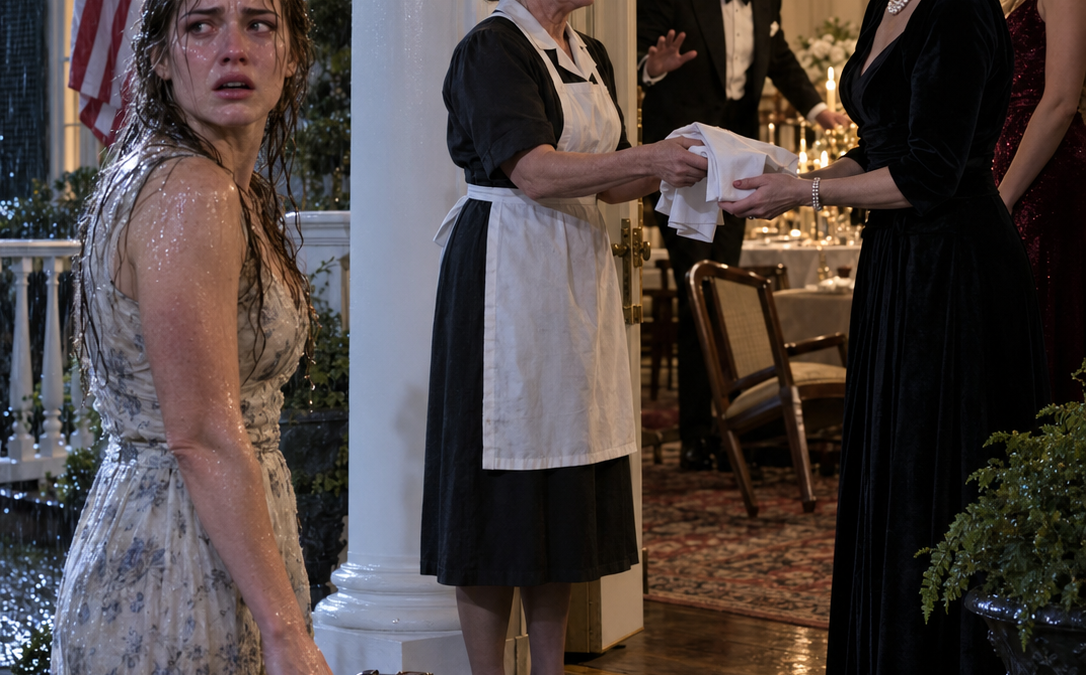
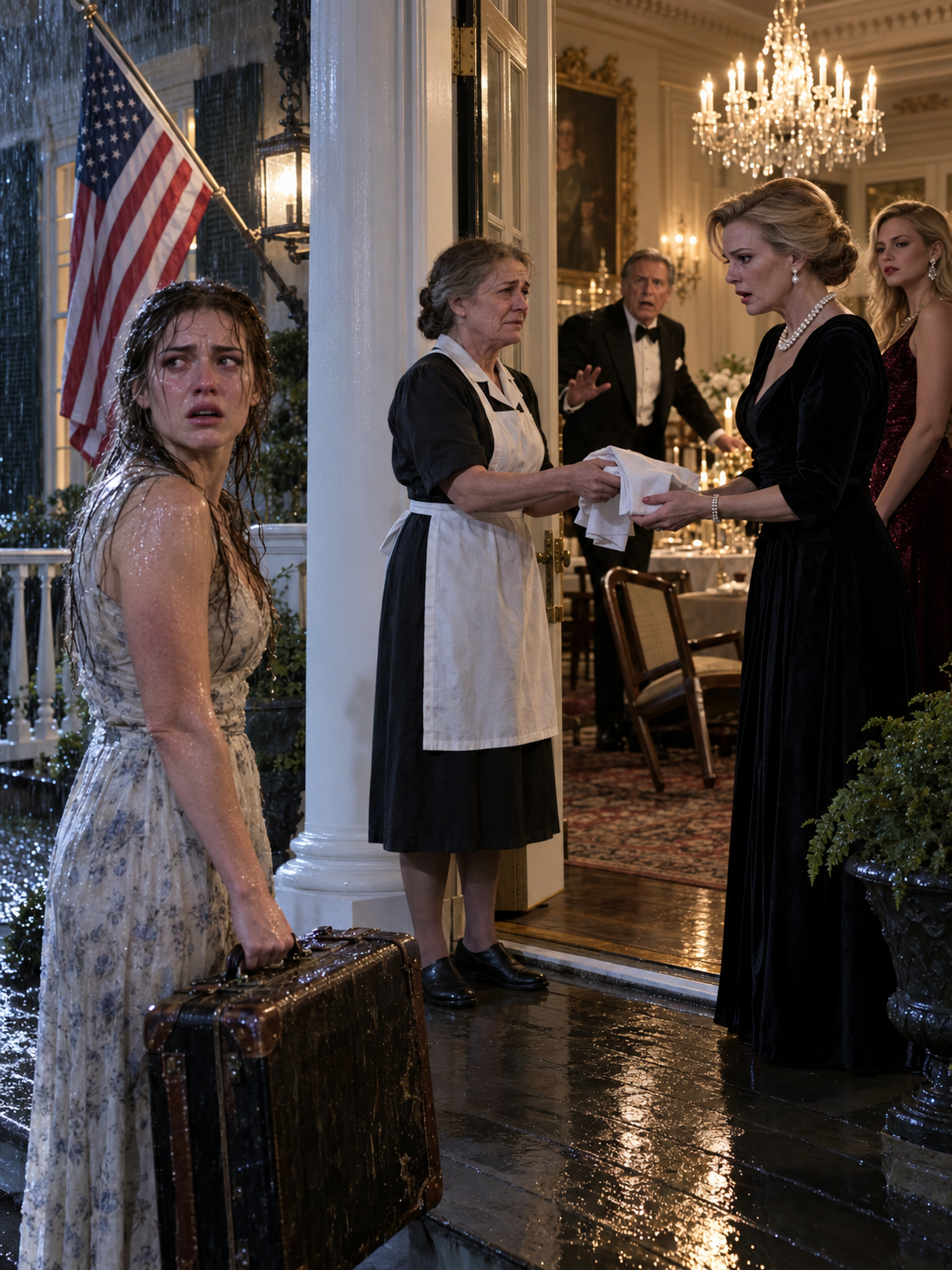
My parents fired the housekeeper who had raised me. My sister tossed her suitcase onto the porch. “Staff aren’t allowed to be strict,” Dad said. I picked up her bag. She slowly untied her apron, folded it, and placed it in Mom’s hands. “I think it’s time she knew the truth.” Mom went pale. Dad stood up so abruptly that his chair toppled over. “You swore you’d take that secret to the grave.”
They threw the woman who raised me out into the rain like she was trash.
Her suitcase was already lying on the porch when I got to it, an old thing with a handle mended in tape, holding everything she owned in the world, hurled out the front door by my sister and left face down in the pouring rain.
And my father stood in the doorway in his dinner jacket, bored, untouched.
When I asked if we couldn’t at least give her something after 27 years of service, he said in that flat voice he saved for anything he considered beneath him, “Staff doesn’t get severance.”
And the woman who had raised me stood in the rain and said nothing.
Her name was Oilia.
She had made my breakfast every single morning of my life. She had taught me to read, sat up with me every time I was sick, dried every tear I ever cried.
And I could not stand on that porch and watch her only suitcase lie in the rain like garbage.
So I walked out into it.
I bent down.
And I picked up her bag.
I did not know in that moment that this one small act of love was about to detonate a secret that had been buried in that house for 27 years.
Because Oilia watched me pick up her suitcase in the rain.
She watched the child she had raised choose her over the family that was throwing her away.
And something rose up in her face that I had never once seen there in all my life, something that had been held down for a very long time and was at last coming up.
She reached behind her back slowly and untied the white apron she had worn every single day I had ever known her.
The apron was so much a part of her that I am not sure I had ever seen her without it.
She pulled it off over her head.
She folded it carefully into a neat square, the way she folded everything.
And she stepped up onto the porch out of the rain.
She walked to my mother, who had come to stand behind my father in the doorway, and she placed that folded apron gently into my mother’s hands.
Then she said quietly, in a voice that shook just slightly, “I think it’s time she knew.”
My mother went white.
All the color drained out of her face at once, the way it leaves a face when the ground gives way beneath a person.
And my father, who had been standing there so bored, so far above all of it, moved so fast that the chair just inside the door scraped and toppled over backward and crashed to the floor.
The untouchable man was suddenly, unmistakably terrified.
And he said in a voice I had never once heard come out of him, a voice with real fear in it, “You swore. You swore to me you would take that secret to your grave.”
I stood on that porch in the rain, holding a suitcase, and I understood two things at once.
My entire life was about to change.
And the woman standing in front of me in her plain dress, with her apron gone from around her, was not and had never been only the housekeeper.
Let me take you back.
Because to understand that porch, you have to understand the 27 years before it.
And you have to understand who Oilia was to me, which was everything and everything I never knew.
My name is Elodie.
I’m 27 years old, and I grew up in a big house outside Charleston, South Carolina.
The kind of house with a name and a gate and more rooms than a family could ever use.
And I grew up, on paper, as one of the lucky ones.
The Sinclairs.
My father, Reginald Sinclair, came from old money and made more of it.
My mother, Vivien, was beautiful and cold and moved through her days like a woman posing for a portrait she was very tired of sitting for.
And I had a younger sister, Saraphene, two years younger than me, who was, by every measure that mattered in that house, the favored one.
The real one.
The daughter who fit.
Because I never quite fit.
I want to tell you that plainly, because it is the thread that runs under everything, and because I never understood it until the night on the porch.
I never quite fit in that family.
I was different from them.
Softer.
Warmer.
“More like the help,” my mother once said, not knowing—or perhaps knowing exactly—how true that was.
I didn’t have my father’s coldness or my mother’s polish or my sister’s sharp entitlement.
I was a quieter, gentler thing, and I grew up feeling always like a slightly wrong note in that family’s music.
Loved in a formal, distant way.
Provided for.
Dressed well.
Sent to good schools.
But never quite held.
Never quite warm.
Always a little bit outside the glass, looking in at a family I belonged to but didn’t match.
I remember, as a child, studying my own face in the mirror, looking for my mother in it, for Vivien, and never finding her.
She was fair and sharp-featured and cool.
And I was dark-eyed and round-faced and warm.
I remember being told by relatives at the holidays that I must take after some other branch of the family, said with a little laugh, and Vivien would smile, a tight smile, and change the subject.
I thought nothing of it because children think nothing of the things adults are careful about.
I did not look like my mother because she was not my mother.
I looked, I know now, exactly like the woman in the kitchen.
Anyone who had wanted to see it could have seen it.
No one ever wanted to see it.
And the coldness of that house was not the loud kind.
It was the quiet kind, which is worse because you cannot point to it.
No one hit me.
No one screamed at me.
I was simply, gently, perpetually not quite reached.
My father traveled and worked and, when he was home, treated his children like small adults he was mildly responsible for.
My mother arranged my life the way she arranged the flowers, with taste and distance and no particular warmth.
Birthdays were catered and photographed and joyless.
Christmases were beautiful and cold.
And through all of it, I felt a hunger I couldn’t name.
A child’s hunger to be held and known and delighted in.
And it went mostly unfed by the two people I was told were my parents.
I grew up thinking that was simply what family felt like, a kind of well-appointed loneliness, because I had nothing to compare it to.
Except I did have something to compare it to.
I had it every single day.
I just didn’t know that was what it was.
Because there was Oilia.
Oilia was the housekeeper.
She had worked for my family since before I was born.
And she had, in every way that actually matters, raised me.
My parents were not the kind of parents who raised their own children.
That was what staff was for.
And so it was Oilia who got me up in the mornings and made my breakfast.
Oilia who packed my lunches and walked me to the car.
Oilia who was there when I came home from school.
Oilia who sat on the edge of my bed when I had a nightmare.
Oilia who taught me to read, sounding out the words with me at the kitchen table while my parents were out doing whatever my parents did.
My mother, Vivien, I saw at dinners, at appearances, at the moments that required a mother to be present.
Oilia I saw every hour of every day.
Oilia raised me.
My mother supervised me.
Let me tell you what the days were actually like, because the texture of them is the whole truth hiding in plain sight.
I would wake in the morning and come down to the kitchen, and Oilia would already be there.
The kitchen was the one warm room in that cold house, warm from the stove and warm from her.
She would make me whatever I wanted.
She would ask me about my dreams.
Really ask.
And listen to the answer.
She would hum while she cooked.
Old songs in Spanish that I didn’t understand the words to but that I could sing every note of even now because they were the soundtrack of the only warmth I knew.
She packed my lunch every day.
And every day for years, she tucked a little note into it.
A drawing.
A heart.
A few words.
Be brave today.
I hope you smile.
And I have kept every one of them, I realize now, in a box, without ever understanding why the housekeeper’s lunch notes felt like the most precious thing I owned.
When I skinned my knee, it was Oilia who cleaned it and kissed it.
When I cried, it was Oilia’s shoulder.
When I had my first heartbreak at 16, it was Oilia who sat with me on the back steps until two in the morning and let me sob and told me I was worth more than any boy who could make me cry.
I remember thinking dimly that it was strange that I couldn’t imagine having this conversation with my own mother.
And then I stopped thinking it because Oilia was there.
And Oilia was enough.
And I didn’t need to understand why.
And here is the thing, the thing I need you to feel because it is the whole heart of this story.
Oilia loved me not the way you love a job.
Not the way staff, however kind, loves the children they’re paid to look after.
Oilia loved me the way I understand now only one kind of person can love a child.
With a fierce, total, aching devotion that I felt every day of my life and never once questioned because it was simply the water I swam in.
When I was sick, Oilia did not leave my side, sleeping in the chair beside my bed.
And I remember waking in the night to find her watching me with an expression I did not have a name for.
When I did well at something—a school play, a good report—it was Oilia’s face I looked for in the crowd.
And it was always there.
Shining.
Prouder than any parent.
And I remember as a child being confused sometimes about why the housekeeper looked prouder of me than my own mother did.
Then I stopped noticing it the way you stop noticing anything that has always been true.
I want to tell you about the clues because there were clues my whole life.
And I never saw a single one for what it was.
And now that I know, I cannot stop seeing them.
And they break my heart.
There was the way she touched my face.
Oilia had a way of cupping my cheek in her hand just for a moment when she thought no one was looking.
A gesture so tender and so private that even as a child some part of me knew it was not a gesture that belonged to a housekeeper.
And I treasured it without understanding it.
There was the fact that she never married, never had a family of her own, or so I thought.
This warm and loving woman who so obviously should have been a mother.
I remember asking her once when I was small why she didn’t have any children of her own.
And I remember the strange, long silence before she said quietly, “God gave me exactly the child I was meant to have,” and squeezed my hand.
I thought she meant it kindly.
Generally.
And I did not understand that she was telling me the truth.
The whole truth.
Right to my face.
There was my birthday every year.
My birthday.
Oilia would go quiet and strange in a way she never was any other day.
A kind of heaviness would come over her.
And I thought, when I noticed it at all, that maybe she just didn’t like parties.
I did not understand that my birthday was, for her, the anniversary of the most complicated day of her life.
The day she became a mother and lost her child in the same breath.
There was the way she looked at me sometimes across a room when she didn’t know I could see.
With a look of such deep and searching love and such deep and quiet grief that it should have told me everything.
And told me nothing.
Because I had no framework to understand it.
Because who imagines—who ever imagines—that the woman making your lunch is your mother?
There was the time I got very sick.
A bad fever when I was eight.
Sick enough that a doctor came to the house.
And I remember in the haze of it that it was Oilia who would not leave.
Oilia who argued with my mother about calling the doctor sooner.
And I remember Vivien saying, “Oilia, you forget your place.”
And I remember Oilia going quiet.
I remember, even in my fever, being confused because the housekeeper had sounded, for a moment, more frightened for me than my own mother was.
Had sounded like she would burn the house down before she let anything happen to me.
I know now what that was.
That was a mother watching her child burn with fever and being told to remember her place.
I cannot imagine what that cost her.
To swallow that.
To step back.
To be told she had no standing to fight for her own daughter’s life.
And there was the money.
I found out later, in the aftermath, that Oilia had, over 27 years, quietly spent almost every dollar she ever earned on me.
Not on herself.
On me.
The small gifts that appeared that my parents never gave and never noticed.
The good winter coat when I outgrew mine and my mother hadn’t gotten around to replacing it.
The money slipped to me at college when I was short and too proud to ask my father.
All of it, I understand now, came from a housekeeper’s wages.
From a woman who owned almost nothing and saved almost nothing because she poured it all secretly into the child everyone told her wasn’t hers.
She lived like she had nothing because she gave everything to me.
And I never knew because she never let me know.
Because that was the kind of love it was.
The kind that hides itself so completely that its object doesn’t even feel its weight.
And there was one thing.
One small thing that I think about now more than any of the others.
When I was a little girl, maybe five or six, I had a nightmare and I climbed out of bed and went looking for comfort.
And my feet, my small, confused feet, did not carry me to my parents’ room.
They carried me down the back stairs to the little room off the kitchen where Oilia slept.
I climbed into her bed, and she held me, and I fell asleep against her.
It was the safest I have ever felt in my life.
And in the morning, before anyone was up, she carried me back to my own room so no one would know.
She never said a word about it.
I understood even at five, without being told, that this was a secret.
That I was not supposed to seek comfort from the housekeeper.
That there was a line I had crossed.
I did not understand that I had, in my sleep, in my child’s animal knowing, walked straight to my mother the way children do.
Because some part of me had always known where home really was.
If any of this is landing somewhere true for you, if you’re thinking of someone right now, some quiet person who loved you in a way you didn’t have words for, stay with me.
Because the rest of this story is the day I finally understood what I’d been given.
And I promise you it is worth staying for because the strangest and most painful part of loving Oilia my whole life without knowing who she was is that I got to keep the love.
All of it.
Every day of it.
And only found out at the very end what it had truly been and what it had truly cost her.
Most people who are loved like that never find out at all.
I found out barely in time.
But I found out.
Now, let me tell you how it all came apart.
Because the day on the porch did not come from nowhere.
And the cruelty of it is the thing that finally broke a silence that had held for 27 years.
Oilia was getting older.
She was in her early 50s now, and she’d worked in that house on her feet for nearly three decades.
And she had begun, in the last year or two, to slow down the way bodies do.
She was a little less quick on the stairs.
She tired more easily.
And my parents, who had never in their lives seen Oilia as a human being with a body that could age and hurt, began to treat her slowing down as a failing.
A defect in a machine that was no longer running to specification.
My mother made comments.
My sister Saraphene, who had inherited every ounce of the family’s coldness and none of whatever small mercy hid underneath it, was openly contemptuous.
Complaining that the housekeeper was getting sloppy.
That they should just get someone younger.
Someone who could keep up.
I think about it now and it makes me sick.
The picture of it.
This woman had given her entire life to that family.
She had raised their heir.
She had kept their darkest secret for 27 years at unimaginable personal cost, protecting their name, their reputation, their comfortable lives.
She had poured every dollar and every hour and every ounce of love she had into that house and specifically into me.
And when her body finally began, after nearly 30 years, to slow down, their response was not gratitude.
Not care.
Not even basic decency.
It was irritation.
She had become to them a slightly malfunctioning appliance.
They discussed replacing her the way you’d discuss replacing a dishwasher that had started to leak.
And the woman they were discussing so coldly was, though only three of us in that house knew it, the mother of the daughter they claimed as their own.
They were planning to throw my mother out like trash.
Saraphene did not know that was what she was doing.
But my father and my mother knew exactly who Oilia was.
And they did it anyway.
Which is somehow the worst part of all.
And I want to be honest about my own part in this because it shames me.
I heard those comments and I did not fight hard enough against them.
I loved Oilia, but I was 27 and still, in ways I’m not proud of, under my family’s thumb.
Financially.
Emotionally.
Still seeking a warmth from them they were never going to give me.
And I told myself it wasn’t my place.
That they wouldn’t really do anything.
That Oilia was a fixture.
Permanent.
That of course they’d never actually let her go.
I underestimated their cruelty.
I have spent my whole life underestimating their cruelty because the alternative, understanding it fully, was too lonely to bear.
And then, on an ordinary evening at the end of an ordinary dinner, my father announced, the way he’d announced a change to the landscaping, that they had decided to let Oilia go.
Effective immediately.
She was, he said, no longer able to perform her duties to the standard the household required.
And they’d already arranged for a replacement to start the next week.
Someone younger.
Oilia would need to have her things out that night.
That night.
Twenty-seven years, and they gave her an evening.
I sat at that table stunned.
I looked over at Oilia, who had come to the dining room doorway to clear the plates and had heard the whole thing.
I watched her face.
She did not cry.
She did not argue.
She just stood there and received it.
The way she’d received every indignity for 27 years.
With a terrible, dignified stillness.
And I did not understand then that I was watching a woman absorb not just the loss of a job, but the loss of the only thing she had ever truly wanted.
Which was to be near me.
And that she was calculating, in that stillness, that the arrangement that had bought her silence was over.
That they were breaking it.
Not her.
And that everything was about to change.
Before I could even find my voice, Saraphene, my sister, actually laughed and said something about how it was about time.
Then she got up from the table and went upstairs to Oilia’s little room.
I heard her up there.
Then I heard her coming back down.
She was carrying Oilia’s suitcase.
That old, mended suitcase.
She walked to the front door.
She opened it.
It was raining outside.
And she threw the suitcase out onto the porch into the rain.
“There,” she said. “Saved you the trouble.”
Oilia stood in the hallway in her apron and watched her entire life get thrown out into the rain.
And said nothing.
I asked my father, my voice finally working, whether we couldn’t at least give her something.
Some severance.
Some help.
After everything.
After all these years.
My father looked at me with mild irritation, as though I’d suggested tipping the mailbox.
And he said those words.
“Staff doesn’t get severance.”
That was the moment I got up and walked out onto that porch and picked up her bag.
Because I could not.
I simply could not.
Be a person who let that suitcase lie in the rain.
And I did not know, as I bent down and lifted it, that in doing so, in that one small act of love, I was about to break open the biggest secret of all our lives.
Because Oilia, watching me pick up her bag in the rain, watching the child she’d raised choose her over the family that was discarding her, reached her breaking point and her freeing point at the very same moment.
She took off her apron.
She folded it.
She placed it in my mother’s hands.
And she said, “I think it’s time she knew.”
Now let me tell you what she knew.
Let me tell you the secret.
The one my father had made her swear to take to her grave.
The one my mother went white to hear spoken aloud after 27 years.
Oilia was my mother.
My real mother.
My biological mother.
The woman who had raised me as the housekeeper had, in fact, given birth to me.
I’m going to tell it the way she told it that night because she told it plainly and without melodrama, the way a person tells a truth they have carried for so long that it has worn smooth.
Twenty-eight years ago, Oilia was a young woman, 24 years old, who had come to work for the Sinclair family.
She was poor and alone in the world.
She’d taken a position in the household.
And she was, by every account, including my father’s own guilty one, a beautiful and gentle young woman.
My father, Reginald Sinclair, who was married to my mother, Vivien, but who had never in his life let a wedding vow or another person’s dignity stand between him and something he wanted, began an affair with her.
A young, powerless woman living in his house.
Dependent on him for her living.
I will let you sit with the shape of that.
With how much power was on one side of it and how little on the other.
Oilia did not tell me much about that part, and I did not press her because I could see it was the part that still shamed her, though God knows the shame was never hers to carry.
But she told me enough for me to understand that she had been young and lonely and far from anyone who loved her.
And that my father had been charming and powerful and attentive in the way powerful men know how to be when they want something.
And that she had believed for a little while that it might be real, the way a lonely young person believes.
Then she became pregnant.
And she found out very quickly exactly how real it was to him.
Which was not real at all.
She was not a person to Reginald Sinclair.
She was an appetite he’d satisfied.
And now she was a problem he needed managed.
The warmth he’d shown her turned, the moment she told him about the baby, into the cold administrative concern of a man protecting his assets.
She learned at 24, pregnant and alone, that she had never been anything to him but convenient.
And then she learned something worse.
Her baby was about to become convenient, too.
In a way she was powerless to stop.
Oilia became pregnant with me.
And here is where the real cruelty began.
The cold, calculated cruelty of powerful people protecting themselves.
My father and mother had a problem.
A scandal like this, a child by the housekeeper, could not be allowed to touch the Sinclair name.
But there was a complication that turned the problem into an opportunity.
My mother, Vivien, had been trying and failing to have a child of her own.
She was, in fact, at that very time under enormous social pressure to produce an heir.
And had even, I would learn, let their social circle believe she was expecting.
So my parents made Oilia an offer.
Though offer is far too gentle a word for it.
They would take the baby.
Me.
And raise me as their own.
As Vivien’s own.
The legitimate Sinclair heir.
The scandal would disappear.
Vivien would have her child.
And Oilia, a poor young woman with no money and no power and no way to fight a family like the Sinclairs for custody of a child they were determined to claim, was given a choice that was not a choice at all.
She could refuse.
And lose me completely.
Be cast out with nothing.
Never see me again.
While they took the baby anyway through lawyers she could never afford to fight.
Or she could agree.
She could sign away her motherhood publicly.
She could stay on as the housekeeper.
And she could raise me.
Be near me every day.
Love me every day for the rest of my childhood.
On one condition.
That she never, ever, as long as she lived, tell me she was my mother.
I have thought a great deal since that night about what kind of people can look at a young woman holding her newborn baby and offer her that bargain.
About the specific coldness it takes to say to a mother, “You may keep your child only if you agree to let her call another woman Mom. Only if you agree to be called staff by your own daughter. Only if you agree to spend your life in a uniform in the house where your child grows up believing you are hired help.”
It is a cruelty so precise, so total, that it could only be designed by people who genuinely did not see Oilia as fully human.
Who saw her the way they saw all their staff.
As a function.
A solution.
A thing that could be arranged.
And they did not offer her that bargain out of any mercy.
Out of any desire to let a mother keep her child.
They offered it because it was convenient for them.
Because a housekeeper who was secretly the mother would never leave.
Would never talk.
Would be bound to them forever by the one thing she could not walk away from.
Which was me.
They did not let her stay out of kindness.
They let her stay because her love for me was the leash that guaranteed her silence.
And they knew it.
And they used it for 27 years.
And Oilia, 24 years old, holding her newborn daughter, faced with losing me forever or keeping me close in silence, chose to stay.
She chose to give up the name of mother so that she would not have to give up me.
She chose 27 years of watching another woman be called Mom.
Of being called staff by her own child.
Of folding my mother’s laundry and cooking my father’s dinners.
And answering to people who had taken her baby.
All so she could be in the same house as me.
Could tuck me in.
Could cup my cheek in her hand when no one was looking.
Could be, in every way except the one that would have gotten her thrown out, my mother.
She traded her dignity, her freedom, her whole life for proximity to me.
She raised her own daughter as a servant in another woman’s house for 27 years.
And she never broke.
And she never told.
Because she had sworn she wouldn’t.
And because telling would have cost her me.
I asked her later, in the quiet, whether she ever regretted it.
Whether she ever wished she’d refused the bargain, kept her dignity, walked away, and started a new life somewhere free.
And she looked at me like the question made no sense.
And she said, “Regret it, mija? I got to raise you. I got 27 years of you. Every morning, I got to make your breakfast. Every night, I got to know you were safe under the same roof. They thought they were making me pay a terrible price. But I would have paid ten times that, a hundred times that, for what they gave me without meaning to, which was you.
“I did not lose, mija. I let them think I lost every day for 27 years. But I had you. I always had you. They only had the house.”
And I understood, hearing that, that my mother had, in her own quiet way, won a war those people never even knew they were fighting.
Because they had tried to take her child and had only managed to make her a servant.
While she had quietly, secretly, for 27 years been the only real mother in the house.
Until they threw her suitcase in the rain.
Until they took even the proximity from her.
Discarded her.
Ended the arrangement that had been the whole reason for her silence.
Because the deal had always been unspoken.
That she would stay silent as long as she could stay.
And now they were making her leave.
They were taking me from her after all.
At the end.
Casting her out with an evening’s notice and no severance.
And so the reason for her silence was gone.
She had nothing left to lose.
And she watched me, her daughter, walk out into the rain and pick up her bag out of love.
And she decided that I deserved, at last, to know who had really loved me my whole life.
I want to tell you what it was like to hear this standing on that porch.
But I’m not sure I have the words because my whole life reorganized itself in the space of a few sentences.
Every strange look.
Every tender touch.
Every quiet birthday.
Every time I’d felt like the wrong note in my family’s music.
Every time my feet had carried me to the wrong room in the night.
All of it.
All of it suddenly made sense.
Clicked into place with a completeness that was almost physical.
And I understood that I had not been the unloved child in that house.
I had been the most loved child in that house.
I had just been loved by the person no one let me call my mother.
It was like being handed the key to a room I’d been locked out of my whole life and stepping inside and finding it full of everything I’d been starving for.
And realizing it had been there.
Right there on the other side of a door.
The entire time.
All those years I’d felt unloved.
I had been drowning in love from the one person in that house who had any to give.
All those years I’d studied Vivien’s cool face and wondered what was wrong with me that my own mother couldn’t warm to me.
The answer had been standing at the stove.
Humming.
Packing my lunch.
Because the woman at the stove was my mother.
And there was nothing wrong with me at all.
And there never had been.
The relief of that, underneath the shock, was enormous.
For 27 years, I had carried a quiet, secret belief that I was somehow unlovable.
That I was the flaw.
The wrong note.
The child even a mother couldn’t love.
And in the space of a few sentences on a rainy porch, that belief, the heaviest thing I had ever carried, simply dissolved.
Because it had never been true.
I had been loved ferociously.
Completely.
Every single day of my life.
I just hadn’t been allowed to know it.
And I looked at Oilia standing there with her apron gone.
This woman I had loved my entire life without knowing why.
And I looked at Vivien holding the folded apron, gone white and silent.
The woman I had called Mom for 27 years, who had never once looked at me the way Oilia looked at me every single day.
And I looked at my father, his chair on the floor behind him, his face full of fear and fury.
And I understood finally the whole architecture of my childhood.
The beautiful cold house.
And the warm woman in the kitchen.
And the exact, deliberate cruelty that had kept them apart.
Oilia reached into the pocket of her dress and took out something small and worn.
She held it out to me with a trembling hand.
I took it.
And I looked at it.
It was a photograph.
An old photograph, soft and creased from being handled ten thousand times.
A young woman in a hospital bed.
Exhausted.
Glowing.
Holding a newborn baby wrapped in a blanket.
The young woman was Oilia, 27 years younger.
And the baby was me.
It was the only photograph that existed of the two of us as what we truly were.
Taken in the hospital in the hour after my birth.
Before the arrangement took hold.
Before I was handed over.
Before she became the housekeeper.
She had kept it for 27 years.
She had carried it in her pocket close to her every single day of my life.
The one piece of evidence that she had been, for one hour in a hospital bed, allowed to simply be my mother holding her daughter before the world took that away from her.
I looked at that photograph and I thought about what it meant that she had carried it every day.
Not framed.
Not hidden in a drawer.
But carried in her pocket against her body for 27 years.
It meant that every single day of my childhood, while she made my breakfast and packed my lunch and answered to the name of staff, she had that photograph on her.
Inches away.
A secret talisman.
Proof to herself.
On the days it must have felt impossible, that it was real.
That she was real.
That she was my mother, no matter what the world made her pretend.
On the hardest days, when Vivien was being called Mom and Oilia was being called by her first name like a servant, she could put her hand in her pocket and touch that photograph.
And know the truth that no one would let her say.
It had been her anchor for 27 years.
And now she was handing it to me.
Giving me the anchor.
Giving me the proof.
Because she no longer needed to hide the truth from the world.
And because she wanted me to see with my own eyes that I had been loved and held and wanted from the very first hour of my life.
I looked at that photograph.
At that young woman’s face so full of love.
And I looked up at the same face, 27 years older, still so full of love.
And I did the only thing there was to do.
The thing I should have been free to do my whole life.
I dropped the suitcase.
I stepped forward.
And I put my arms around my mother.
My real mother.
And I held her.
And I said the word I had never once been allowed to say to her.
The word that had been forbidden for 27 years.
I said, “Mom.”
And Oilia broke.
This woman who had held herself together through 27 years of unimaginable silence.
Who had not broken when they took her baby.
Who had not broken through decades of being called staff by her own child.
Broke completely in my arms on that porch in the rain.
She held me.
And she sobbed.
And she said my name over and over.
And she said, “I wanted to tell you every day. Every single day, mija, I wanted to tell you. I’m so sorry. I’m so sorry I couldn’t tell you.”
And I held her tighter.
And I told her she had nothing, nothing in this world, to be sorry for.
That she was the best mother a child could have had.
That she had loved me every day of my life.
And I had felt it.
I had always felt it.
Even when I didn’t understand it.
That her love was the ground I had stood on my whole life without knowing it was her.
And we stood there, the two of us, holding each other in the rain.
Twenty-seven years of a held-back embrace finally let go.
While behind us, in the warm-lit doorway of that cold house, the Sinclairs stood and watched the thing they had worked so hard to prevent finally happen.
A mother and her daughter in each other’s arms.
At last.
Here is what happened after.
And I’ll tell you the true way because the aftermath of a thing like this is not simple, and I would not insult you by pretending it all resolved in a single embrace on a porch.
I left that house that night.
I picked up Oilia’s suitcase.
And I picked up my own life.
And my mother and I walked out of the Sinclair house together into the rain.
We did not look back.
And we did not go back.
I want to tell you that my father tried to stop us.
That there was a dramatic confrontation.
But the truth is quieter and more damning than that.
My father did not try to stop us.
Because my father’s only concern in the end was the secret.
And the secret was already out.
There was nothing left for him to protect.
He and my mother, Vivien, stood in that doorway and watched me leave with Oilia.
And I think in some cold, calculating corner of his mind, my father was almost relieved.
Because the problem was solving itself.
The inconvenient daughter and the inconvenient housekeeper removing themselves from his life in one motion.
That is who he was.
That is who they both were.
And understanding it finally and completely did not break my heart the way you might think.
Because you cannot break a heart with the truth about people it had already quietly stopped hoping for.
There was only one moment, as we were leaving, that I let myself look back.
I had Oilia’s suitcase in one hand and my other arm around her shoulders, walking her down the porch steps into the rain.
And at the bottom of the steps, I turned just once.
I looked at the three of them in the lit doorway.
My father with his fallen chair behind him.
Vivien still holding the folded apron in her hands like she’d forgotten it was there.
Saraphene off to the side with an expression that was, for once, not contemptuous but stunned.
The whole cold portrait of the family I had spent 27 years trying to be enough for.
And I did not feel what I expected to feel.
I did not feel the pull of them.
The old ache to be let in.
The hunger for their approval.
I felt, looking at them, the way you feel looking at a house you used to live in from the street years later.
A little sadness.
A little strangeness.
And no desire, none at all, to go back inside.
I turned around.
I faced the rain.
And I walked my mother to my car.
I drove us away from that house.
And the ache I had carried my whole life, the ache of not being enough for them, stayed behind on that porch.
And I have never once gone back for it.
I do not have a relationship with the Sinclairs anymore.
I want to be honest about that.
Cleanly.
Without drama.
Vivien, the woman I called Mom for 27 years, never reached out.
Never fought for me.
Never, in all the time since, tried to explain or apologize or claim the daughter she’d raised.
Which told me everything I needed to know about what I had actually been to her.
A solution to a social problem.
An heir acquired to quiet the gossip.
A role.
Not a daughter.
And my father was my father.
And Saraphene was Saraphene.
And I discovered that when you finally understand that the people who were supposed to love you never did and never would, the leaving is not as hard as the staying had been.
I grieved the family I thought I had.
But you cannot lose what you never really had.
And what I gained walking out into that rain was so much larger than what I left behind.
I’ll tell you the one thing I did feel walking away that surprised me.
Because it wasn’t triumph.
And it wasn’t even really anger.
It was a kind of clean, quiet grief.
The grief of finally setting down a hope I’d been carrying my whole life without knowing it.
The hope that one day Vivien would look at me the way Oilia looked at me.
That one day my father would be proud.
That one day I would finally be enough for the cold people in the cold house.
I had carried that hope for 27 years.
And it had weighed more than I ever realized.
Walking out that door, I set it down.
Because I finally understood it was never going to be answered.
And more than that, that I didn’t need it answered anymore.
Because the love I’d been starving for from them, I’d already had in full from the woman walking beside me in the rain.
I had been rich the whole time.
I had just been looking for the treasure in the wrong room.
Because I got my mother.
My real one.
Oilia and I built a life together.
A small one.
A warm one.
The kind of life I had never known in all my years in that big cold house.
I had a job.
I’m a kindergarten teacher, which Oilia said made perfect sense.
That of course I’d spend my days loving other people’s children because I’d been raised by a woman whose whole life was love.
And she moved in with me.
My mother.
Into my small apartment that was warmer than any mansion.
And we started at 27 and 52 the life we’d been denied.
The ordinary, priceless life of a mother and a daughter who get to simply be a mother and a daughter.
I want to tell you what those first months were like because they were the sweetest of my life and also, at times, the strangest.
Because we had to learn how to be out loud what we had always secretly been.
For 27 years, Oilia had loved me in hiding.
In stolen touches and lunch notes and silences.
And now, suddenly, she was allowed to love me in the open.
And I watched her learn, week by week, that she didn’t have to hide it anymore.
That she could hug me in a doorway without glancing around first.
That she could introduce me to a neighbor, to a friend, as “my daughter.”
A phrase I could see her savor every single time she said it.
Like a food she’d been starved of.
The first time she said it out loud—
“This is my daughter, Elodie”—
to the woman in the apartment across the hall, I watched her voice catch on the word daughter.
Twenty-seven years of that word held behind her teeth, finally set free.
And I had to look away so she wouldn’t see me cry.
She makes me breakfast still, though I tell her she doesn’t have to.
And I tell her every day all the things I never got to say for 27 years.
And she tells me out loud, at last, the thing she had to swallow every day for my whole childhood.
That she is my mother.
And she loves me.
And she is proud of me.
And neither of us takes a single ordinary morning for granted because we know exactly what they cost and exactly how close we came to never having them.
And I found the notes.
That box of lunch notes I’d kept my whole life without understanding why.
The little hearts and the “Be brave today” messages.
I brought it out one evening and showed her.
And I told her I’d kept every one.
Oilia looked at that box.
At 20 years of the small, secret ways she’d found to tell her daughter she loved her.
All of them saved.
All of them treasured.
And she understood, I think, in that moment, that the love had gotten through.
That all those years she’d spent afraid I’d never know how she felt, I had known.
In my body.
In the part of me that kept every scrap of paper she ever slipped me.
The love had reached me.
It had always reached me.
It just hadn’t had a name until now.
We talk now about everything.
The way we never could before.
In the open.
At the kitchen table for hours.
She tells me stories about my babyhood that no one else on earth knew because she was the only one who was truly watching.
The first word I said.
The way I wouldn’t sleep unless someone hummed to me.
Which is why she hummed while she cooked my whole childhood.
It was for me.
It was always for me.
She tells me about her own mother.
My grandmother.
Whom I never knew.
In a small town far away.
And I have a whole history now.
A real one.
A lineage of warm, strong, poor, loving women that I descend from instead of the cold, gilded family tree I was raised to think was mine.
I know who I am now in a way I never did in 27 years of being a Sinclair.
I am Oilia’s daughter.
That is the truest and best thing about me.
And it was true my whole life.
And now, at last, I get to say it out loud.
And so does she.
I have that photograph now framed on my wall.
The young woman in the hospital bed holding her newborn daughter.
It is the most precious thing I own.
For 27 years, it lived in a housekeeper’s pocket.
A secret.
The only proof of one stolen hour of motherhood.
Now it hangs in the light where anyone can see it.
Where my mother can see it every day.
And she stops in front of it sometimes.
And I catch her looking at it.
At the young woman she was.
And the baby I was.
And she doesn’t cry anymore when she looks at it.
She smiles.
Because the thing in that photograph, the thing that was taken from her for 27 years, the simple right to be my mother out loud, she has back now.
And no one will ever take it from her again.
People ask me sometimes, the few who know the whole story, whether I’m angry.
Whether I hate the Sinclairs for what they did.
For the childhood they engineered.
For the 27 years they stole from my mother and from me.
And I’ve thought about it honestly.
And the truth is that I don’t spend much time being angry.
And it’s not because I’m a saint.
It’s because anger at them would be time spent facing backward toward the cold house.
And I have spent enough of my life facing that direction.
I would rather face forward.
Toward the warm apartment.
And the breakfast on the table.
And the woman humming in my kitchen who is at last allowed to be exactly who she always was.
The Sinclairs gave their whole lives to protecting a name and a reputation and a comfortable, loveless order.
And they succeeded.
And that is their reward.
A beautiful cold house.
And a name.
And no daughter in it who loves them.
And Oilia gave her whole life to loving one child in secret and lost everything for it over and over for 27 years.
And her reward is that the child grew up and found out.
And chose her.
And calls her Mom every morning.
Now, if you want to know who won, look at whose house has love in it.
It was never a close contest.
It just took 27 years and a suitcase in the rain for the score to finally be read out loud.
That’s my story.
A suitcase in the rain.
An apron folded into the wrong woman’s hands.
And a photograph a mother carried in her pocket for 27 years, waiting for the day she’d finally be allowed to say the truth.
So let me ask you one thing before you go, and I really want to know.
My whole childhood, the person who loved me most was standing right in front of me every single day, and I never knew because powerful people had decided I shouldn’t.
Have you ever realized too late, or just in time, that the person who truly loved you was not the one you were told to love, but someone quieter?
Someone who showed it instead of saying it?
Tell me about them in the comments.
I read every single one.
Subscribe so the next story finds you.
Leave a comment so I know you were here.
And I’ll see you in the next.








