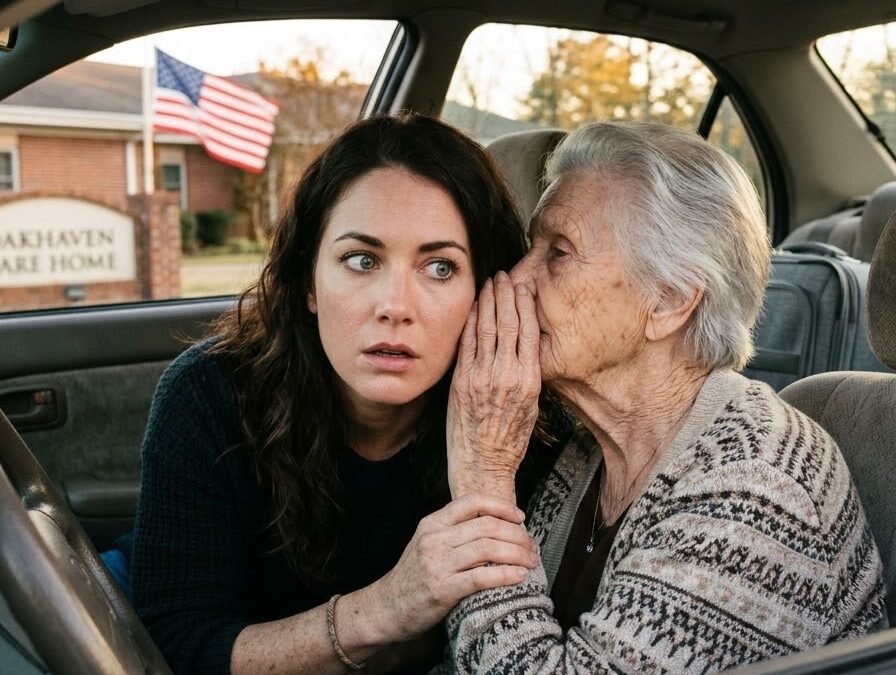
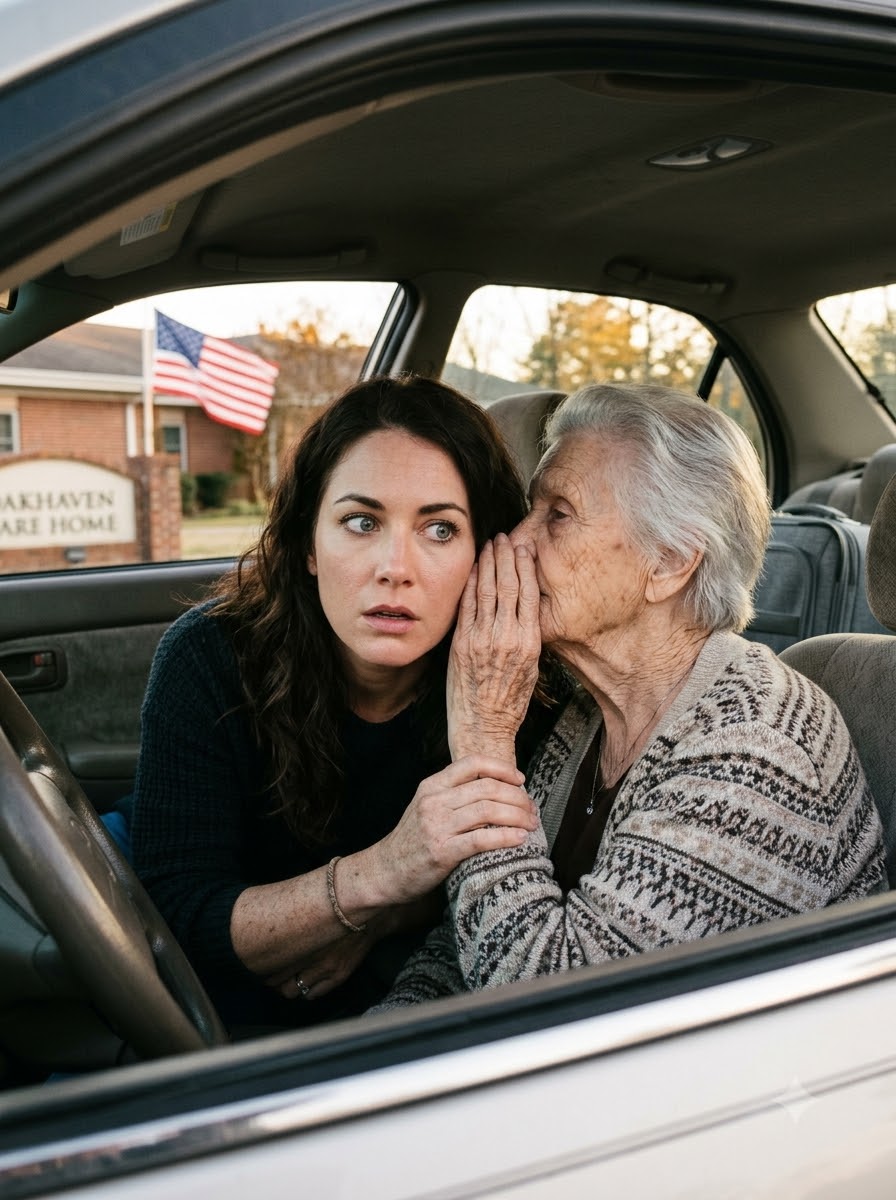
My parents told her they were taking her out to lunch. Three hours later, a nursing home called me; her suitcase was sitting in the lobby, and my parents had already left. I drove nearly 300 kilometers to pick her up. She fastened her seatbelt and said, “Don’t call them. I’ll tell you exactly where we’re going.” What she said next left me speechless.
At 2:40 on a Friday afternoon, a woman I had never met called to ask whether I knew my grandmother was sitting in her lobby with a packed suitcase and nobody coming back for her.
Her name was Tammy Boyd.
She was the admissions coordinator at a place called Pinehaven Care Center in Marlo, North Carolina.
And she said the name carefully, the way you say the name of a place you don’t expect anyone to have heard of.
I hadn’t.
She said my parents had walked my grandmother in a little after one, talked about a respite stay, and stepped out to the car for some paperwork.
That was an hour ago.
The parking lot was empty.
Nobody was answering their phones.
“Your grandmother won’t sign anything,” Tammy said. “And she gave me your number. From memory. She was very clear that I should call you and nobody else.”
I asked how far Marlo was from Charlotte.
One hundred ninety miles from Wilmington, where my grandmother had lived in the same house for 55 years.
About 85 from me.
Tammy lowered her voice.
“I can’t admit a competent adult who’s refusing. I also can’t leave an 84-year-old woman in my lobby until dark. I’m not trying to make this your problem. I just don’t know whose problem it is.”
I looked at the engagement folder open on my desk, closed it, and wrote the time of the call on the tab.
Then I told her not to let anyone move my grandmother and not to accept a single piece of paper from anyone but her.
I told my managing partner two words:
“Family emergency.”
And I was in my car by five after three.
I did not call my parents.
I spent my working life finding money that people swear isn’t missing.
And somewhere on the ramp onto the interstate, I realized that this was the first spring in 12 years my parents hadn’t sent me their tax documents.
Three hours later, my grandmother buckled her seat belt and said:
“Don’t call them. I’ll tell you exactly where we’re going.”
I had known her my whole life.
I had never heard her use that voice.
What did she know that made her say it?
And where exactly were we going?
Pinehaven sat at the end of a two-lane road behind a gas station that had stopped selling gas.
The carpet in the lobby had a path worn into it from the door to the front desk.
One of the fluorescent tubes overhead kept blinking, and a single nurse was moving between rooms down a hall long enough to need two.
It was old and underfunded.
It was not cruel.
My grandmother was sitting in a plastic chair beside a gray suitcase, her black leather handbag held in her lap with both hands, her back not touching the chair.
She had the look of a woman who had decided some hours ago that she would not cry in front of strangers and was still holding the line.
“Elise,” she said.
That was all.
And I understood that whatever she had to say was not going to be said in that building.
Tammy Boyd came out from behind the desk.
She was younger than her voice, maybe 40, with reading glasses pushed up into her hair.
She told me what she’d seen in order without adding to it.
My mother had done the talking.
“A respite stay of a few weeks while the wiring in the house was repaired.”
My mother had a photocopy of a power of attorney, but not the original.
And she hadn’t signed the deposit form.
My grandmother had said loud enough for the desk to hear:
“I do not agree to this.”
My father had gone out to get the paperwork from the car.
My mother had followed him.
Twenty minutes later, Tammy walked out to the lot.
There was no car.
“I’ve written down the times,” Tammy said.
She gave me a business card with her cell number on the back.
“If you ever need me to tell someone what happened here, I’ll tell it exactly like that.”
I knelt and unzipped the suitcase.
Three wool cardigans.
Two pairs of winter slacks.
It was the 12th of September and 81 degrees.
No reading glasses.
No seven-day pill organizer.
No toothbrush.
Somebody had packed this the way you pack for a person you have stopped picturing.
I zipped it closed and didn’t say anything.
When I looked up, my grandmother was watching me not say it.
Tammy slid a single sheet across the desk.
It said that I was taking my grandmother with me.
I signed it as her granddaughter.
Nothing else.
And I asked Tammy to note that no one else had signed anything.
My grandmother stood up on her own.
When I reached for her elbow, she moved it an inch out of range, the way she used to when I tried to carry her groceries.
I took the suitcase instead.
At the door, she said:
“Not here.”
And we walked out to my car in the last of the light.
She buckled her seat belt.
The click was loud in the closed car.
I already had my phone in my hand because that is what I do.
I call the people involved and I get the story straight.
She looked at the phone.
Then at me.
“Don’t call them,” she said. “I’ll tell you exactly where we’re going.”
I put the phone in the cup holder.
“Tonight, your apartment. They don’t have a key to it, and they won’t think of it. Monday morning, my bank. The branch on Market Street when it opens. Then home.”
She paused.
“After the locks are changed.”
I pulled onto the road.
In the mirror, the Pinehaven sign got small.
“You think I picked Charlotte to hide?” she said. “I picked it to get ready.”
The lunch had been real.
She told me that first, as if it mattered to her that I not think she’d been fooled from the start.
A table by the window at the seafood place at Wrightsville Beach, where my grandfather used to order the flounder.
My father had paid.
Then, instead of turning back toward downtown, he had taken the highway west.
When she asked, my mother said they were going to look at a place.
Just to look.
For someday.
It was only inside at the desk that the word respite came out.
And the word wiring.
My grandmother said she had turned to my mother in front of the woman with the glasses in her hair and said:
“I said yes to lunch.”
Her voice didn’t shake when she repeated it to me.
It had the flatness of a thing she’d already decided to remember exactly.
I asked why she remembered my number and not Meredith’s.
She thought about it.
“You changed your number once about six years ago, and you called me to tell me the new one. You made me write it down and read it back to you.”
She looked out at the dark pines.
“Nobody else ever thought I’d need to reach them.”
Then she patted the handbag in her lap.
“I don’t leave the house without my papers. My grandmother taught me that in 1952.”
She’d lived through a bank closing.
She didn’t open the bag.
We drove for a while without talking.
She fell asleep somewhere past the county line, her hand still flat on the leather.
And I drove through the dark with her plan in my head and repeated it under my breath like a checklist.
Apartment.
Bank.
Locks.
Because having an order to things was the only thing keeping my hands steady on the wheel.
A little after nine, we passed the exit my parents used to take every June, the one that led to my grandmother’s street when they were dropping me off for the summer.
I was 11 the first summer.
They packed me a suitcase.
Meredith was 15 and had just made the state junior tennis circuit, which meant tournaments every weekend from June to August in towns like Greensboro and Rocky Mount.
My mother said, standing in my bedroom doorway with the gray suitcase already open on the bed, that I’d have more fun at Grandma’s anyway.
The thing about that sentence is that it was true.
I did have more fun at Grandma’s.
That was what made it hard to hold against anyone.
And I have spent a good part of my adult life learning that a true thing can still be a thing that was done to you.
My grandmother’s house was an 1890s Italianate on a brick-sidewalk street in the Wilmington Historic District.
Tall windows.
Deep porch.
A staircase with a hand-carved rail.
She and my grandfather had bought it in 1971 for almost nothing because it was falling down.
And they had spent the rest of that decade putting it back up with their own hands.
My grandfather, Walter, had been a machinist at the shipyard.
My grandmother, Ruby, had kept the books at a hardware store on Castle Street for 31 years.
Their kitchen table was where I learned what I do.
She had a ledger with a green cloth cover.
A mechanical pencil.
And a shoebox of receipts.
The first week of that first summer, she sat me down and showed me how the columns worked.
“Every number has to come from somewhere,” she said. “A number without a source is a story, not a fact.”
When I finished adding a column, she checked it.
And when it was right, she had me initial the margin.
E.M.
I was 11 years old.
And it was the first time anyone had trusted me to be correct about something.
My grandfather taught me to rehang shutters and to hold a paintbrush so my wrist didn’t tire.
I knew which boards on the porch my grandmother had painted and which he had because she went with the grain and he didn’t care.
Every August, my parents pulled into the driveway tanned from a summer of bleachers.
And my mother would ask my grandmother:
“Was she any trouble?”
Before she said hello to me.
My grandmother always said no.
Then we’d drive home, and Meredith would show me her trophies.
I’d help her polish them because she asked and because it was something to do with my hands.
I grew up believing that if my columns were always right, I’d be kept.
I was 22 when I learned that a correct column can be taken from you as easily as anything else.
It was May of 2014.
I had graduated from UNC Charlotte the week before with an accounting degree and two jobs’ worth of exhaustion.
My grandmother had given me a check for $6,000 to buy a used car so I could get to the firm that had hired me.
My parents asked me to come by the house.
My mother had a legal pad on the kitchen table with numbers on it, which should have told me something because my mother did not use legal pads.
Meredith’s wedding was in six weeks.
The venue had raised its price.
The caterer wanted the balance early.
And there was a gap.
The gap was $6,000.
My mother didn’t ask.
She explained.
“We’d just be borrowing it until September. Your father’s bonus comes in September.”
My father, from the doorway, said:
“Grandma gave it to you and you’re family. So, in a way, it’s the family’s money.”
Meredith was on speaker from Raleigh, where she and Spencer were looking at rings for the second time.
“Elise, you’re a lifesaver.”
Which was easy to say from Raleigh.
I said yes.
I said yes because it was my sister’s wedding.
Because saying no would have made me the person who ruined it over a car.
And because I had never in my life said no to my mother about money and didn’t know how that sentence would sound coming out of me.
I transferred it from my phone while I was still sitting at the table.
My mother squeezed my hand.
September came and went.
Christmas came and went.
In January, I asked once, carefully, at the sink while my mother was rinsing plates.
She turned the water off and said:
“I didn’t raise you to be ungenerous.”
That was all.
Meredith called two days later.
I thought she was calling to say something about the money.
Instead she said:
“Mom says you’re making a thing about the wedding.”
I took the bus to work for a year and a half.
Nobody in my family mentioned it again.
And after a while, the story about me was settled.
Elise is a little cold about money.
Elise counts things.
My grandmother never asked what happened to the check.
She just noticed on a visit that spring that I got off a city bus at the end of her street instead of parking.
She didn’t say a word against my mother.
She waited until we were at the kitchen table with the green ledger between us.
Then she said:
“Write it down. Not so you can collect it. So that when they tell you it didn’t happen the way you remember, you’ll have your own page.”
I bought a notebook that week.
The first line in it is dated May 2014.
$6,000. Mom. Wedding.
I still have it.
I never asked for the money again.
What I did instead was become the kind of person nobody in that family could afford to be without.
Every March for 12 years, a manila envelope arrived at my apartment with my parents’ W-2s and 1099s and a note in my mother’s handwriting that said:
You’re a doll.
I did their returns for free.
I caught a pension withholding error of my father’s that would have cost him $900.
I explained three years running why they couldn’t deduct Meredith’s country club dues.
I was called in March.
I was not called for Thanksgiving the last two years because Spencer and Meredith were hosting and the table only sat ten.
And I told myself that was arithmetic and not a decision.
I had passed the CPA exam in 2016 and the fraud examiner certification in 2019.
And I joined Harrow and Lind, a forensic accounting firm in Charlotte, where I spent my days tracing money through companies that swore they had nothing to trace.
My brother-in-law called it counting other people’s money.
He said it at a Fourth of July barbecue with his arm around my sister.
Everybody laughed.
Including me.
This past March, no envelope came.
When I called to ask, my mother said:
“Oh, honey, Spencer’s guy is handling everything for us now. One less thing on your plate.”
I remember feeling two things at once.
And I remember only naming one of them.
The one I named was relief.
The one I didn’t was that I’d just been let go from the only job my family had ever hired me for.
It did not occur to me to ask why a part-time dental receptionist and a retired engineer needed a real estate developer’s accountant.
I was too busy being fine about it.
Saturday morning in Charlotte, I woke to the smell of coffee I hadn’t made.
My grandmother was at my small dining table in the clothes she’d worn the day before because the suitcase had nothing in it she could use.
The black handbag was on the table in front of her.
She waited until I sat down.
Then she unzipped it.
“I need you to read these the way you read things at your job,” she said. “Not the way you’d read them as my granddaughter.”
I went to the kitchen drawer and came back with a pencil instead of a pen.
I did it without thinking about it.
She noticed.
She began laying the papers out in three stacks.
The first stack was a photocopy of a durable power of attorney dated October 2017.
Three weeks after my grandfather’s funeral.
It named my mother, Diane Marsh, as agent.
I read it twice.
It was broad.
Banking.
Real property.
The right to sign on her behalf for nearly anything a person can sign for.
“Your mother brought it over with a notary,” my grandmother said. “She said it was in case I couldn’t manage things. I thought it was for if I ended up in the hospital.”
I explained what durable meant.
That it had been in effect from the day she signed it.
That my mother hadn’t needed her to be sick or confused to use it.
My grandmother’s mouth tightened.
Then I told her the other half.
The only part that mattered that morning.
“A person who still has her wits can revoke a power of attorney whenever she wants. In writing. Any day of the week.”
She looked at me for a long moment.
“Any day?”
“Any day.”
The second stack was two letters from Cape Fear Community Bank dated in June.
Each confirmed the early redemption of a certificate of deposit in the amount of $70,000.
Each letter listed an early withdrawal penalty of about $1,400.
She had never asked for either CD to be touched.
I told her what the letters proved.
That $140,000 had left two CDs in June.
And that whoever did it had been willing to lose almost $3,000 in penalties to do it fast.
I told her what they didn’t prove.
Which was where the money went next.
She nodded like a bookkeeper.
The third stack was a single sheet.
A confirmation that the mailing address on her accounts had been changed in July to an address on Pine Grove Drive.
My mother’s house.
The only reason my grandmother had it was that the bank sends that particular letter to the old address, too.
“I opened these in August,” she said. “I didn’t know who to tell who wouldn’t tell your mother.”
I asked her the hard question.
Because I’d have asked a client.
“Why didn’t you call me in August?”
She smoothed the letter flat with her palm.
“Because I wasn’t sure,” she said. “And because your mother is my daughter.”
I didn’t say anything.
I’d let a missing envelope go by in March for the same reason and hadn’t even had the decency to notice I was doing it.
I took a clean sheet from my printer and wrote three things on it.
Request 12 months of statements.
Revoke the power of attorney.
Change the address back.
“These are the only three things that matter this week,” I said. “And I can’t do any of them. You’re the account holder. Everything runs through you. I just read.”
She looked at the list.
Then she reached across and corrected me.
I had written Your mother’s access at the top of the page.
She crossed out the first two words and wrote MY in the same square hand that had checked my columns when I was 11.
Dana Lind called me back that afternoon.
She’s the managing partner at Harrow and Lind.
And she has never in six years asked me a question she didn’t want the real answer to.
So I told her most of it.
She gave me two weeks.
Then she told me the part I already knew and needed to hear anyway.
“You’re not on this as an examiner. No firm letterhead. No firm systems. You don’t say our name in a room. You’re a granddaughter with a good eye. That’s all you get to be.”
My promotion review moved from October to January.
And she said it plainly so I wouldn’t have to wonder.
That was the first cost with a number on it.
I wrote it down.
After we hung up, I sat with what I didn’t have.
No subpoena.
No way to see my mother’s accounts or Spencer’s or any document that wasn’t my grandmother’s to ask for.
No authority that didn’t come from an 84-year-old woman standing next to me.
What I had was the order of the questions.
And a person who still had every right the bank had ever given her.
My grandmother, when I told her, wanted to go home.
Not eventually.
Monday.
“You could stay here a while,” I said. “Just until we know what they’re going to do.”
It came out of me the way it always does.
The reasonable plan.
The safe arrangement.
The thing I could manage for someone.
She let me finish.
“I have been kept safe for nine months,” she said. “I want to go home to my house, and I want your mother to know I’m in it.”
So we made an order.
The bank first, because everything else needed the bank.
Then a locksmith.
Then a lawyer.
I’d find one in Wilmington who did elder law and nothing else.
Then her doctor, because I could already hear the word my mother would reach for next.
And I wanted a piece of paper ready for it.
I wrote the four things down in pencil.
Above them I’d written PROTECT.
I crossed it out.
Wrote DOCUMENT.
My grandmother, reading upside down, said that was the first thing I’d gotten right all day.
Then asked whether I had any cornmeal.
She made cornbread Sunday night in a skillet I’d never used and told me my oven ran hot on the left.
Standing at my counter in a borrowed T-shirt, she told me about 1974.
The year she and my grandfather stripped ten layers of paint off the staircase rail by hand.
One landing at a time.
With the windows open because of the fumes.
She said it was the only summer she ever saw him cry from the chemicals.
And that he’d laughed about it every year since.
“People keep calling it an asset,” she said, cutting the cornbread into squares. “It’s 40 years of your grandfather’s hands. That’s what it is.”
She asked whether there was anybody up here.
Meaning Charlotte.
Meaning a person.
“There was,” I said. “He wanted more weekends than I had.”
She nodded like that was a number she could check later.
Then she said the thing she was afraid of.
And it wasn’t dying.
It was being put somewhere and hearing people in the next room talk about her in the past tense.
I checked my phone while she was talking.
It was the fourth time that day.
There was nothing.
No call from my mother.
No text from my father.
Nothing from Meredith asking where our grandmother was.
Sunday night.
Fifty-two hours after they’d walked out of that lobby.
And not one person in my family had tried to find out whether an 84-year-old woman had a bed to sleep in.
I read it the way I’d read a bank statement with a gap in it.
Nobody was looking for her.
Which meant they knew where she was.
Or they didn’t need to.
My grandmother saw me looking at the screen.
“You’re still waiting for them to call.”
“I know they won’t.”
“Knowing and being done waiting are two different jobs.”
She put a square of cornbread in front of me.
I turned the phone face down on the table.
And left it there.
We left for Wilmington at six the next morning so we’d be at the bank when the doors opened.
The Market Street branch of Cape Fear Community Bank opened at nine.
My grandmother was standing at the glass at 8:55 with her driver’s license in her hand.
The branch manager was a man named Delgado who had a careful voice and a tie he kept touching.
She answered every security question without hesitating.
Her mother’s maiden name.
The street she’d grown up on.
The amount of her last deposit.
Then she asked for 12 months of statements on her checking account and on both certificates of deposit.
He pulled them up.
And I watched him see the agent on the file.
“Ma’am, I show that Diane Marsh is authorized on these accounts.”
“I’m the owner of these accounts,” my grandmother said. “She’s someone I allowed. I’m withdrawing the allowance.”
He brought a form.
She signed to end the agent’s access.
Changed the mailing address back to her own house.
And added me as a person the bank could speak with about her accounts.
Not as an agent.
Just as ears.
I wanted that distinction on the record.
And I said so.
The statements came out of the printer warm.
I read them standing up.
Beginning in March, $3,000 a month had moved from her checking account to an account in the name D. Marsh.
Memo line:
Household/care.
In June, both CDs had been redeemed into checking.
And over the following nine days, two transfers of $70,000 each had gone to the same D. Marsh account.
I did the arithmetic in pencil in the margin the way I’d been taught at a kitchen table.
$161,000.
My grandmother looked at the number.
She didn’t say anything at all.
Delgado had gone quiet, too.
He said, choosing each word, that the pattern was one the bank was required to refer to its elder financial abuse team.
And that a letter confirming the termination of agent access would be mailed to her.
I asked one question.
The only one I needed.
“Will the letter show the effective date?”
“It will.”
I numbered the pages of the statements while he wrote up the referral because my hands needed a task.
And because my mother’s name was on every page, and I could not look at it any longer than the numbering took.
The locksmith came at noon.
He changed the front door and the kitchen door.
Then handed my grandmother two new keys on a paper tag.
She stood on her own porch and turned the lock once to hear it.
Norah Whitfield came across from the porch next door before the van had backed out.
She’s 72 and has lived beside my grandmother for 30 years.
She hugged her hard without asking a single question.
Which told me she’d guessed most of it.
Then she turned to me.
“In August, Spencer came by with a man who had a clipboard and one of those laser measuring things,” she said. “They measured the porch. I thought y’all were fixing it.”
“Did the man take notes?”
“Pages.”
I looked at the porch boards my grandmother had painted with the grain 50 years ago.
And I decided that in the morning I’d go look at the county’s records myself.
The New Hanover County Register of Deeds is on the third floor of a building that smells like copier toner.
The public terminals are old enough that the search takes a breath before it answers.
I typed my grandmother’s name.
The deed from 1971 came up first.
Ruby and Walter Hail.
No lien.
No mortgage.
Nothing recorded against it in 55 years.
Then one more entry indexed this year.
The 2017 power of attorney had been recorded on July 8th.
I sat with that.
There is one reason a person records a nine-year-old power of attorney in a county’s real estate records.
And it is that they intend to sign something about real estate.
My mother’s signature was on the recording sheet.
The same signature that had signed my report cards.
I typed Cole Riverlight Development LLC.
Spencer’s company.
Six parcels along the river.
A deed of trust from a commercial lender.
And filed August 20th:
A notice of a foreclosure hearing.
I didn’t need to read the rest.
I took out my notebook, the one with the line from 2014 on the first page.
And I wrote four dates in a column.
July 8th — power of attorney recorded.
August 20th — foreclosure notice.
August — man with a laser measuring the porch.
September 12th — lunch.
For the first time, I was looking at a plan instead of a string of unkindnesses.
And it was worse.
And it was also easier.
Because a plan has a shape.
And you can put your hands on a shape.
I photographed the book and page numbers of the recorded power of attorney so a lawyer could file against exactly the right entry.
Then I went down the stairs faster than I’d come up.
Adaz Okafor’s office was two blocks from the courthouse.
She had a notary on staff, which was why I’d picked her.
My grandmother signed a written revocation of the 2017 power of attorney.
And on the next page, a new one naming me.
Ms. Okafor’s assistant walked the revocation to the Register of Deeds that afternoon with the book and page I’d photographed.
Copies went by certified mail to my mother and to the bank.
Then Ms. Okafor told us the limit in one sentence without a lecture attached.
“This stops tomorrow. It does not undo June.”
The money that had already moved was a matter for the bank, she said.
And, if my grandmother chose, for the authorities.
She added one more thing.
Families in this position sometimes file a petition to have the older person declared incompetent.
And the best defense to that was a capacity evaluation from a doctor who’d known her for years.
She’d call Dr. Anand’s office herself.
My grandmother asked one question.
“If we report this, what happens to my daughter?”
Ms. Okafor told her plainly.
“A report to the county. An investigation. If the facts hold, charges.”
She used the word felony once.
And didn’t soften it.
My grandmother listened.
Nodded.
Then put the question away somewhere I could see her deciding not to open yet.
We were home by five.
Norah called from her porch at a quarter past.
“Your parents’ car just pulled up.”
My mother reached the front door first.
I watched her through the sidelight.
She put her key in the lock.
Turned it.
Felt it not turn.
Tried again.
Then I opened the door and stood in it.
My grandmother stayed behind the screen door in the hall.
Close enough to hear.
My father was at the bottom of the porch steps with his hands in his pockets.
“Elise,” my mother said. “We have been out of our minds. You took your grandmother 190 miles without a word to anyone.”
“It has been three days. Neither my phone nor Grandma’s has rung once.”
I told her the woman at Pinehaven had written down the time they left her in the lobby.
And the time she’d gone outside to find their car gone.
My mother’s face did something small.
Then recovered.
“Your grandmother is confused,” she said lower, as if being kind. “You don’t live here. You don’t see it. She had a fall in January. She’s been forgetting things. We’ve been carrying it all, and we were arranging a few weeks of respite care while the wiring gets fixed.”
My father spoke for the first time.
“You embarrassed this family in front of those people.”
I didn’t argue about my grandmother’s memory because I’d learned a long time ago that you cannot win an argument about what someone else saw.
“She has an appointment with Dr. Anand at 8:30 in the morning. You can have the results from her lawyer.”
My mother heard the word lawyer.
I saw her hear it.
“The bank called me at lunch,” she said. “Someone ended my access to Mom’s accounts.”
She said it as if it had been done to her.
Then she said the truest thing she’d said all year.
And I don’t think she meant to.
“You have no idea what your sister is up against.”
My grandmother opened the screen door.
She didn’t step out.
She looked at my mother.
Her daughter.
And said the same thing she’d said at a front desk in Marlo.
“I said yes to lunch.”
My mother started to cry.
And it was real.
I want to be fair about that.
“Mom,” she said. “I did this for all of us.”
My grandmother didn’t answer.
My mother turned back to me.
Her voice changed.
Dried out.
“She’s not competent, Elise. A judge is going to see that.”
She went down the steps.
My father looked at the house for a second longer than he needed to.
At the porch.
At the tall windows.
Then he followed her.
Her old key was lying on the top step where she’d set it down to try the door.
I left it there.
I did not pick up what she’d put down.
And I noticed that about myself because it was new.
Norah came across a while later with a covered dish.
She didn’t ask anything.
Neither of us slept much.
Eight-thirty was early.
Dr. Priya Anand had been my grandmother’s doctor for 15 years, and she ran the screening herself instead of handing it to a nurse.
I sat in the room.
My grandmother gave the date.
The season.
The name of the president.
Counted backward by sevens without slowing.
Repeated three words after ten minutes.
Then added, unprompted:
“And I know exactly why I’m here.”
Dr. Anand laughed.
The letter she wrote was dated September 17th.
It said that Ruby Hail had the capacity to make her own decisions about her finances and where she lived.
In the hallway, out of my grandmother’s hearing, Dr. Anand told me that my mother had brought her in for a follow-up in February and had answered every question the doctor asked before my grandmother could open her mouth.
“I noted it in the chart at the time,” she said. “It’s the kind of thing you note.”
In the car, I realized I hadn’t taken a full breath for 15 minutes.
I had been so afraid she’d miss one word.
Then, driving home, I caught myself doing the other thing.
The thing I always do.
Composing the explanation I would give my mother so that she would finally understand.
I knew it was pointless.
I had known for years.
I built it anyway.
Sentence by sentence.
All the way down Market Street.
And in the parking lot at the pharmacy, my grandmother reached over and put her hand on mine on the wheel.
She was comforting me.
That was the wrong direction.
And we both knew it.
And she did it anyway.
On Friday afternoon, Meredith called.
“Can I come by?” she said. “Alone. Without Mom.”
My sister arrived with a folder and a box from the bakery on Princess Street.
The one with the lemon bars I liked when I was ten.
She hugged me at the door.
Which she had not done in years.
My grandmother said hello.
Kissed her on the cheek.
Then went into the dining room and left the door open.
We sat on the couch.
Meredith opened the folder on her knees and turned it toward me the way you turn a menu toward a guest.
The Hail Family Trust.
The house would go into it.
The trustees would be my mother and Spencer.
And there, on the second page, on the line for a third trustee:
My name.
Elise Marsh.
Co-trustee.
I had never seen my name on a family document that wasn’t a tax return.
Behind it was a broker’s opinion of value for the house.
$1,450,000.
“This protects it,” Meredith said. “From Medicaid. From all of it. And Grandma stays right here at home with someone paid to look in on her. That’s what she wants, isn’t it?”
It was.
That was the cruelty of the design.
Or maybe just its cleverness.
Because I don’t think my sister saw it as either.
She believed every word.
Then she told me what I hadn’t known.
And it explained the porch.
Spencer had signed a personal guarantee on the Riverlight loan.
If the lender called it, they didn’t just lose the project.
They lost the house in Landfall.
The one with the kitchen my mother liked to be photographed in.
“Mom and Dad put money in too,” she said. “Their own money. Everybody’s in, Elise. Everybody but you.”
She leaned in.
“Spencer can save Riverlight if the lender sees the family standing behind it. That’s all they need. Assets they can point to. And you’d be protected too. You’d be in it.”
Then she said:
“I’ve never heard Mom say your name as many times as she has this month.”
I felt that land.
I’d like to say I didn’t.
Then she took an envelope out of the folder.
A card.
Heavy stock.
An investor reception.
Friday, October 3rd.
The Harbor Room at the Riverfront Hotel.
“Spencer needs the investors to see us together. All of us. Grandma too.”
I understood what my grandmother was for in that sentence.
She was the proof of consent.
She would sit at a table near the front and smile and be photographed.
And that would be worth more to Spencer than any signature.
I asked two questions.
“Who pays for the person who’d look in on Grandma?”
Meredith didn’t know.
“And does the trust let the trustees borrow against the house?”
She frowned at the page.
“I mean, I think technically. But who would do that?”
That was where my sister’s knowledge ended.
She wasn’t lying.
She had stopped looking because looking would have meant choosing.
“Let me look at the numbers,” I said.
It came out in my old voice.
The one that always said yes eventually.
And I truly did not know, sitting there with the folder on my lap, whether I was saying it as the person who folds or the person who reads.
Meredith hugged me again.
She smelled like the perfume our mother wears.
From the dining room, there was no sound at all.
When the door closed behind her, my grandmother came to the doorway.
“Are you going to look at the numbers, or are you going to sign?”
I didn’t have an answer ready.
And she saw that I didn’t.
I read the trust at the kitchen table after midnight with one light on.
The way I read for clients.
It was well drafted.
A majority of the trustees could encumber or sell trust property.
My grandmother kept a right of occupancy which could be ended by the trustees for reasons of health, in their judgment.
The third trustee had a vote.
And no veto.
It was a chair without arms.
Page 11 answered Meredith’s first question for her.
The caregiver would be paid from trust income.
And the trust’s income would come from a loan against the house.
They were going to keep my grandmother in her home by borrowing against it.
And call that protection.
The longer I read, the clearer the other thing got.
The lender didn’t need my grandmother’s house so much as it needed the paperwork on the house to be clean.
And a co-trustee who was a certified fraud examiner made it clean.
They didn’t want me at the table.
They wanted my signature under it.
Everything I knew, everything I’d learned first at this exact table, would be the thing that made it legal to mortgage the table.
I read it a third time to be sure I wasn’t seeing what I wanted to see.
Which is the discipline of the job.
And the hardest part of it.
I wasn’t.
I thought about the Fourth of July when Spencer called what I did counting other people’s money.
And how he must have gone home that night and thought about it some more.
Because a year later, he’d found a use for it.
I thought about the envelope that hadn’t come in March.
They’d let me go in the spring.
And were hiring me back in the fall for one signature.
And the wage was my name on the second page.
My grandmother came down at one in the morning in her robe.
She sat across from me and didn’t ask.
I told her what I was afraid of.
Which was not the trust.
“If I say no to this, it will be the last time anyone in my family ever offers me a seat.”
She let that sit.
Then she said:
“I have been managed for nine months by people who love me in their way. I would rather be wrong with my own hands.”
She tapped the invitation.
“We’re going.”
I started to say why that was a bad idea.
She shook her head.
“Not to be seen. To see. I want to hear what they say about my house in a room where they think I’ve agreed.”
I opened my laptop and pulled up the county’s Adult Protective Services reporting form.
I filled in the part about the money.
The accounts.
The dates.
The amounts.
I got to the box that asked for the name of the person suspected.
My hands stopped.
I saved the file as:
DRAFT — DO NOT SEND.
Then closed the lid.
My grandmother watched me do it.
She went back up to bed without a word about it.
On Wednesday the 24th, an email came in at seven in the morning with the subject line:
Quick review before the 3rd.
It was from Spencer.
You’re the numbers person in this family. Mind giving the term sheet a once-over so it’s clean for Howell’s group? Owe you a drink.
Attached were the term sheet for the rescue round and a 12-page investor deck.
I read it with my coffee going cold while my grandmother watered the ferns on the porch.
Page seven.
Under Sources of Capital:
Family capital contributed to date: $140,000.
Marsh family.
Page nine:
Fourth-quarter additional collateral.
Historic district residence.
Family controlled.
Estimated value: $1,450,000.
Beside it was a rendering of my grandmother’s house with a sign on the porch rail that said:
THE HAIL HOUSE — RIVERLIGHT ROW PHASE 2.
A boutique inn.
And a parking area where my grandfather’s roses were.
I laid the June statement next to page seven.
Same number.
Same month.
This was what I could say out loud to anyone without stretching.
$140,000 left my grandmother’s CDs in June.
And Spencer told his investors his family had contributed $140,000.
What I could not say was how the money got from one to the other.
That was for someone with a subpoena.
I understood why he’d sent it.
For 12 years, I had looked things over.
It was what I was for.
Their mistake was a habit.
And it had been mine as much as theirs.
I didn’t reply.
I saved the attachments.
Forwarded them to Ms. Okafor.
And wrote one line in my notebook under the four dates.
September 24th — They still think I’m a calculator.
Then I picked up the phone.
And I didn’t call my mother.
I called my sister.
Meredith answered on the second ring.
Bright.
Expecting something else.
I asked her one question without dressing it up.
“The $140,000 on page seven of Spencer’s deck. The family capital. Do you know where it came from?”
“Dad said it was a gift from Grandma to the project. She said she wanted to help. She agreed.”
So that was the story my sister had been given.
And she had accepted it the way she accepted most things our parents told her.
As weather.
I said one true thing.
“Grandma didn’t agree to cash a single CD.”
There was a pause.
Then her voice went to the place it always goes.
“Here you go. It’s always money with you.”
I didn’t argue.
I didn’t explain.
“I’ll be there on the third. You should ask Spencer before then.”
Then I hung up before she could answer.
Which I had never once done to anyone in my family.
I sat there afterward with the phone in my hand, feeling the strangeness of it.
An hour later, Ms. Okafor called.
The revocation had come back from the county with a recording stamp on it.
And the bank’s letter had arrived.
The next eight days were quiet in the way a hallway is quiet before a door opens.
My grandmother signed a written statement for the bank’s fraud team, with me listed as her agent under the new power of attorney.
Ms. Okafor sent it over.
The bank’s letter confirmed that Diane Marsh’s access had ended on September 15th.
I built a folder thin enough to hold in one hand.
Four things went in it.
The revocation with the county’s recording stamp.
The bank’s letter.
Dr. Anand’s letter dated the 17th.
A printout of pages seven and nine of the deck.
The statements stayed home.
They were my grandmother’s private banking records.
I would talk about what was in them if I had to.
But I wasn’t going to hand them around a hotel ballroom.
I wrote a rule on an index card and taped it inside the folder.
WE ONLY SAY WHAT THE PAPER SAYS.
I called Tammy Boyd too.
I hadn’t planned to.
Then I had her card in my hand.
I told her the bank’s fraud team might reach out and asked whether she’d be willing to tell them what she’d told me.
“I already wrote it up,” she said. “The day it happened. I’ve been doing this 11 years, and I’ve never had a family just leave.”
She paused.
“How is she?”
“She changed the locks herself.”
“Good.”
In the voice of a woman who’d been waiting three weeks to hear it.
My grandmother chose the navy dress my grandfather bought her in 1998 for their anniversary and hung it on the closet door a week early.
One evening she asked:
“What if no one believes me?”
“Then they read the paper.”
I said:
“You don’t need to be believed. You need to be heard.”
Norah offered to come with us.
My grandmother thanked her.
And said no.
This was her family’s business.
Norah said she’d leave the porch light on.
We practiced nothing.
I’d thought about it and decided against it.
If my grandmother rehearsed, she’d sound rehearsed.
And the whole point of her was that she wasn’t.
The only thing we agreed on was that I wouldn’t speak first.
On Thursday, my mother texted me a photograph of a pot roast with the word Sunday and a question mark and a heart.
It was the first message from her since the porch.
I looked at it for a long time.
And understood that Meredith had told her I was looking at the numbers.
I wrote back:
See you Friday.
It was the closest I have ever come to lying to my mother.
And I still don’t know whether it counts.
Twice that week, I opened the file I’d named DRAFT — DO NOT SEND.
I read it through both times.
The box for the name was still empty.
Both times, I closed it without sending it.
And both times my grandmother saw me do it and didn’t say a word.
Which was harder than if she had.
Friday, October 3rd.
She buckled her seat belt.
The click was the same as it had been in a parking lot in Marlo three weeks earlier.
She didn’t say where we were going this time.
Neither did I.
The Riverfront Hotel had valet and gray vests and a sign on an easel that said:
COLE RIVERLIGHT DEVELOPMENT — PRIVATE RECEPTION.
My parents were inside the doors.
My mother saw me and came straight across the marble and put her arms around me.
And it wasn’t for show.
It was the hug she’d given me at the airport when I was 19.
“You came,” she said into my hair. “I knew you’d come.”
I understood exactly what she believed in that moment.
She believed I’d folded.
I let her believe it for 30 more minutes.
And what that cost me sat in my throat like something swallowed wrong.
Spencer appeared with two glasses of wine.
He gave one to my grandmother.
Then leaned toward me.
Easy.
Brotherly.
“Did you get a chance to look at the deck?”
“I did.”
He smiled.
He heard the sentence he wanted to hear.
My father took my grandmother’s arm and steered her toward a table near the low stage, saying something about a picture with Howell.
She went.
Her handbag under her arm.
Meredith was by the bar in a black dress.
She looked at me for a beat too long.
And I couldn’t read whether she had asked her husband anything at all.
Behind the stage, a screen came alive and began cycling slides.
The third one was my grandmother’s house.
The Harbor Room held about 40 people.
Men in blazers without ties.
Two women from the lender in dark suits.
A bartender.
A three-piece band that hadn’t started.
Howell Wickham sat at the center table with his reading glasses folded in his hand.
He had the stillness of a man who’d been to a great many of these evenings and had learned that the useful information came after the speeches.
Spencer worked the room toward him the way water finds a drain.
On the screen, my grandmother’s house came around again.
Rendered in soft evening light.
A sign on the porch rail.
A gravel lot where the roses were.
Then the next slide.
SOURCES OF CAPITAL.
Family capital contributed: $140,000.
I took my phone out and photographed it.
Because an email to me was one thing.
And a slide shown to a room of investors was another.
I wanted to be able to say later that I’d seen it shown.
My grandmother watched her porch go by with a parking lot on it.
Then put her hand flat on her handbag.
A man in a green blazer stopped at our table on his way to the bar.
He bent toward my grandmother with the smile people use for the elderly.
“Mrs. Hail, you must be thrilled about the inn.”
My grandmother looked up at him.
“I haven’t been asked about the inn.”
He laughed because he thought it was a joke.
Then moved on.
My mother, two seats down, laughed a half second late.
I wrote nothing down.
I didn’t need to.
The room was doing my work for me.
One sentence at a time.
Spencer took the microphone a few minutes early.
He thanked Howell.
Thanked the lender.
Made a joke about the river that got the laugh it was built for.
“And I want to recognize someone special,” he said.
He turned toward our table with his glass raised.
“The matriarch whose family home anchors Phase Two. Ruby Hail.”
The room applauded.
My mother, two seats down, was smiling with her eyes wet.
My father clapped.
My grandmother stood up.
I didn’t move.
Whatever the next thing was, it was hers to say.
And I had spent three weeks learning to let her say things.
She didn’t have a microphone.
She didn’t need one.
“My house is not for sale,” she said. “It is not in anyone’s phase. On September 16th, I revoked the power of attorney my daughter held, and the revocation is recorded with this county. No one in this room has the authority to sign anything about my home except me.”
The applause had stopped somewhere in the second sentence.
A waiter with a tray of crab cakes stopped in the middle of the floor.
Someone at the lender’s table said very quietly:
“What?”
Spencer’s smile stayed where it was.
“Ruby’s had a hard month, folks,” he said into the microphone.
Warm.
Regretful.
A man handling a family moment gracefully.
“Diane manages Mom’s affairs. We’ll sort this out after. I promise you.”
He lifted a hand toward the band.
I stood up.
Then I walked across the room to Howell Wickham’s table.
I set the folder down in front of him.
Opened it.
The revocation with the recording stamp.
The bank’s letter with the date.
Dr. Anand’s letter.
Pages seven and nine.
I spoke to him.
Not to Spencer.
And I kept inside the lines I’d drawn on an index card.
“Mr. Wickham, the $140,000 on that slide matches to the dollar and to the month the amount withdrawn from my grandmother’s certificates of deposit in June under a power of attorney that no longer exists. The bank’s fraud unit has the file.
“The house on the next slide is owned outright by the woman who just spoke to you, and she has a letter from her physician dated three weeks ago that says she knows exactly what she’s doing.
“Nobody controls that property but her.”
He picked up his glasses.
One of the women from the lender leaned over his shoulder.
Nobody in that room knew who I was.
And it didn’t matter.
They were reading a county stamp.
Spencer came off the stage without the microphone.
“Elise, this is a family matter.”
“You emailed me the deck. You asked me to review the numbers. I reviewed them.”
That was all I had to say to him.
And I found that it was enough.
Behind me, I heard a chair.
My mother was standing up.
Spencer tried the next thing.
And he tried it well.
“That capital was Diane’s own money. A personal loan to the project from my mother-in-law. It has nothing to do with Ruby’s accounts.”
“Then the statements my grandmother holds are wrong,” I said. “And you can show Mr. Wickham your mother-in-law’s statements right now.”
He didn’t.
Howell Wickham noticed that he didn’t.
Spencer looked at the room.
Then at Wickham.
And lowered his voice into the reasonable register men use when they want to sound like the adult.
“Howell, everybody in this family will tell you Elise has always been particular about money. There’s history there. I’d hate for a grudge to sink a project that puts 60 people to work.”
I didn’t answer him.
I’d spent my whole life answering that sentence.
And I found I didn’t need to anymore.
Wickham answered instead.
He tapped the recording stamp with one finger.
“Ms. Marsh, this is from the county?”
“Yes, sir. Book and page are at the bottom.”
He nodded once and set the page down.
He didn’t look at Spencer again.
The woman from the lender had Dr. Anand’s letter in her hand.
She asked me whether the physician would confirm it if called.
“Yes. Her office number is on the letter.”
She wrote something on the back of a cocktail napkin.
That was the moment I knew, if I hadn’t already, that the evening had stopped being Spencer’s.
My mother came around the table with her hands out toward my grandmother.
Toward the room.
Crying in earnest now.
“I did this for all of us, Mom. You agreed. You agreed.”
My grandmother looked at her daughter.
And said for the third time in three weeks, in a room where 40 strangers could finally hear what it meant:
“I agreed to lunch.”
My father moved.
Then he came up beside my grandmother and took her elbow gently, the way he’d taken it going into Pinehaven.
“Mom’s tired,” he said. “Let me get her home.”
My grandmother drew her arm out of his hand.
“I came here with Elise,” she said. “I’ll leave with Elise.”
He let go.
It’s the only time in this whole story that I saw my father do what his mother told him.
My mother turned to me.
Close.
Her voice dropped to the register she used when I was small and had embarrassed her in a store.
“You’re doing this to me in front of people.”
I said, quietly enough that only the nearest table heard:
“You did it to your mother in front of a woman with glasses in her hair, in a lobby, with a suitcase.”
I didn’t raise my voice.
I didn’t need to.
Across the room, Meredith hadn’t moved.
She wasn’t looking at me.
She was looking at her husband.
And she went on looking at him.
That was what she did in that room.
Howell Wickham closed the folder and stood up.
He said to Spencer at a volume meant to carry exactly as far as it did:
“We are not proceeding.”
The woman from the lender said they would need to speak before the 15th.
Nobody shouted.
That’s what I remember most.
Forty people set their glasses down on white tablecloths and walked out in twos.
The band packed up without having played a note.
And the screen behind the empty stage kept cycling.
The house.
The parking lot.
The number.
The house again.
I gathered the folder.
There was nothing in it now but an index card.
And I took my grandmother’s arm.
This time, she let me.
Meredith was standing at the doors with a full glass of wine she hadn’t touched.
She didn’t follow Spencer back toward the stage.
She didn’t follow us.
She stood exactly between.
And I left her there because there was nothing I could carry for her.
The valet brought the car.
My grandmother got in and reached for the seat belt.
I saw her hands shaking for the first time since Marlo.
She saw me see it.
“I wasn’t brave,” she said. “I was just done being polite.”
I pulled out onto Water Street.
And realized I’d run out of something too.
I’d run out of the belief that if I ever said it clearly enough, my mother would understand.
We drove along the river.
She said the roses had been planted in 1976 from a cutting off her mother’s bush in Whiteville.
And that a parking lot was a stupid thing to draw on top of 50 years of anything.
Then she was quiet for a mile.
I thought about what the evening had cost.
And it wasn’t the thing I’d expected.
Spencer’s company was going to fail whether I’d stood up or not.
What I’d spent was the last version of my family in which I was still somewhere in it.
The reliable one.
I’d handed that to a stranger in a folder.
He’d read it.
And it was gone.
Norah’s porch light was on when we turned onto the street.
She didn’t come out.
She’d left the light.
I hung the navy dress on the closet door before I let myself sit down.
At 11:48, my phone lit up on the kitchen table.
Meredith.
Did you know before tonight?
I typed:
Since Monday the 15th. I asked you on the phone.
I watched the screen for a minute.
Nothing came back.
I turned the phone off.
I didn’t wait for it.
I went to bed in the room I’d slept in every summer from 11 to 17.
There was one thing left that I hadn’t done.
And it was saved on my laptop under a name that told the truth about me.
Sunday morning, my mother’s car pulled up to the curb.
She was alone.
She had a white bakery box in her hands from the place on Princess Street.
She’d remembered the lemon bars.
She stood in the kitchen doorway looking smaller than I’d ever seen her.
My grandmother sat at the head of the table with her coffee.
And my laptop was open in front of my chair with the file already on the screen.
My mother didn’t shout.
She set the box down.
“Spencer will pay it back. The 140. Over three years. Your father and I will co-sign it. Nobody has to sign anything about the house. We keep this in the family. No agencies. No police.”
She looked at me.
“Think about your sister. Think about me.”
Then she said the thing she’d been saving.
The thing that had always worked.
“You were always the one who knew how to fix things, honey.”
I could have.
That’s what I need to be honest about.
I could see it whole sitting there.
A repayment schedule.
A promissory note.
Quarterly transfers I’d reconcile myself.
A way to hold my mother in my life by holding her paperwork.
Twenty years of reflex stood up inside me and reached for the pencil.
I looked at my grandmother.
She didn’t nod.
She didn’t shake her head.
She had told me at one in the morning that she’d rather be wrong with her own hands.
And she was leaving mine alone.
I looked at my mother.
At the bakery box.
At the empty field on the screen that asked for the name of the person suspected.
“I spent 20 years being useful to you, Mom,” I said. “I’m done being useful. I’m going to be honest instead. And honest means I file this today.”
My mother turned to my grandmother.
“Mom. Tell her.”
My grandmother set her cup down.
“She’s telling you.”
My mother looked back at me.
“I didn’t raise you to be this cold.”
I didn’t answer the label.
I’d stopped picking it up on the porch three weeks ago.
I told her instead that I remembered May of 2014 correctly.
That I had written it down at the time.
And that this time, I had more than my own page.
Then I turned the laptop toward me.
Typed her name into the field.
And pressed Submit.
While she watched, I told her I’d be filing a report with the police department that afternoon on Ms. Okafor’s instructions.
Then I told her the terms.
I kept them short because there was nothing to negotiate.
I would not be doing her taxes again.
If she wanted to see her mother, she would call her mother’s phone.
Not mine.
She would call first.
And she would come in daylight.
My grandmother’s money went through me now.
A caregiver started Monday.
Three days a week.
Paid from my grandmother’s account.
My mother listened to all of it with her coat still on.
“You’ll regret this when I’m gone,” she said.
I got up.
Opened the kitchen door for her.
She stood a moment longer.
And I think she was waiting for me to take it back because I always had.
I didn’t.
She went.
Her car sat at the curb for almost a minute before it pulled away.
When the door closed, my grandmother slid the bakery box across the table toward me.
“Eat one.”
The lemon bars didn’t do anything.
I filed the second report that afternoon.
The 15th of October came and went.
Spencer had nothing to show the lender.
And the foreclosure on Riverlight Row went forward the way those things do.
In filings.
And notices.
Without anybody in a ballroom.
The investors were gone.
By November, Cole Riverlight Development had filed to dissolve.
And Ms. Okafor mentioned without detail that at least one investor’s lawyer had written a letter about what had been represented on a slide.
The bank’s referral reached the county and the police.
An investigator interviewed my grandmother at her own kitchen table.
Then Tammy Boyd, whose card I still had.
Then Dr. Anand, who read from a note she’d made in February.
I gave them the photograph of the slide.
In the second week of November, my mother was charged with financial exploitation of an older adult.
Her lawyer began negotiating a plea that included restitution.
The $3,000 monthly transfers were traced into an account she shared with my father.
Some of the money came back under a court order.
The penalties the bank had charged for breaking the CDs did not.
And I wrote the true number down.
I didn’t dress it up.
My father came to the house once in November.
He called my grandmother’s phone first.
He came at two in the afternoon.
He sat on the porch with her for 20 minutes while I stayed inside.
I don’t know what they said.
When he left, he looked at the porch boards the way he had the night the key didn’t work.
Then he drove away.
And he has not called me.
Meredith sent a letter.
Handwritten.
Four pages.
She didn’t apologize on anyone’s behalf.
She wrote that she had chosen not to look because looking would have meant choosing.
And that she was working out what her life with Spencer was going to be.
She didn’t say which way that was going.
She asked for nothing.
I kept the letter in the notebook.
And I haven’t answered it yet.
Because I think taking responsibility is something that needs time to prove itself.
And I’m willing to give it the time.
I went back to Harrow and Lind.
Dana Lind said one thing about it in the hallway.
“You did it as a granddaughter. That’s the only way it would have held.”
My review moved to January.
It didn’t feel like a loss.
On a Tuesday, my grandmother told me she had an appointment.
And that it wasn’t with my lawyer.
The woman from the Cape Fear Preservation Trust sat in the front parlor with a legal pad and let my grandmother do the talking.
My grandmother had it worked out.
She would live in her house until she died.
After that, the house would go to the trust to be a community house for the neighborhood.
A place old people can come and sit without anyone talking about them in the past tense.
The lawyers could work out the instrument.
Then she said she wanted to put $25,000 of what she had left into a scholarship at Cape Fear Community College for students in bookkeeping and accounting.
And she wanted it called:
The Hail Ledger Scholarship.
For the one somebody trusted to add it up right.
It was her decision from beginning to end.
I hadn’t suggested the trust.
Or the scholarship.
Or the number.
I sat there with a legal pad of my own and wrote down what she said so it would be said the same way to the lawyers.
That was all.
The woman asked whether I’d like to sit on the trust’s advisory board.
“No,” I said. “I’m the granddaughter. I hold her power of attorney, and I keep her papers. That’s the whole of what I’m for now. And it’s enough.”
“The roses stay,” my grandmother added as the woman was standing to go. “Put that in whatever you write.”
Then she signed the letter of intent.
Pushed the page toward me.
And tapped the margin.
I initialed it.
E.M.
The Tuesday before Thanksgiving, my grandmother took the gray suitcase out of the hall closet and packed it herself on the kitchen table.
Reading glasses.
The seven-day pill organizer, filled.
Two light sweaters because Charlotte in November is not Marlo in a stranger’s idea of winter.
And the green ledger on top where she could reach it.
She was coming to stay with me for the week.
She decided it.
She told me the date.
And I had not helped her fold a single thing because I wanted to stand in that kitchen and watch a suitcase get packed by the person who was going to carry it.
Before we left, we sat down and reconciled November.
Her handwriting filled the page again.
There was one line in mine.
The caregiver’s wages.
She read it.
Checked my arithmetic.
And put her initials beside it.
Two sets of initials in one margin.
Hers and mine.
My phone lit up on the table between us.
Mom.
Can you look at something for me?
I looked at it.
Then I turned the phone face down.
And went back to the column.
In September, I’d checked that phone four times in a day, waiting for her to call.
Now she’d called.
And I was busy adding up a month with my grandmother.
I didn’t need to explain that to anyone.
Norah waved from her porch.
We put the suitcase in the trunk.
My grandmother got in.
Pulled the seat belt across.
It clicked.
“You know where we’re going this time,” she said.
“I do.”
Norah reached up and turned her porch light off because it was morning and she didn’t need it anymore.
And I pulled away from the curb and off the brick street.
If you were Elise, sitting at that table with your mother in the doorway, would you have filed the report or taken the offer to keep it in the family?
Tell me in the comments.
And if you’d like more stories like this one, subscribe so you don’t miss the








