Three days after my mother’s funeral, I returned home early and overheard my in-laws raising a toast just behind the door: “Just keep giving her those drops—the entire 28 million dollars will be ours!” I smiled, turned around, and set my own plan in motion…
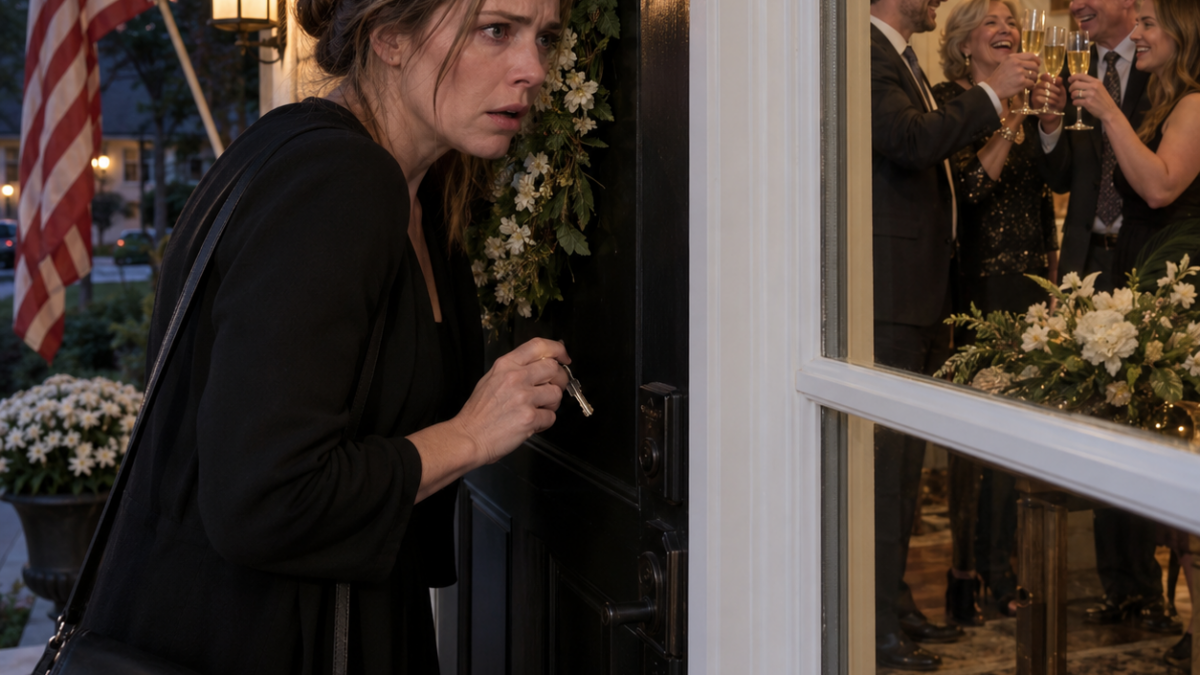
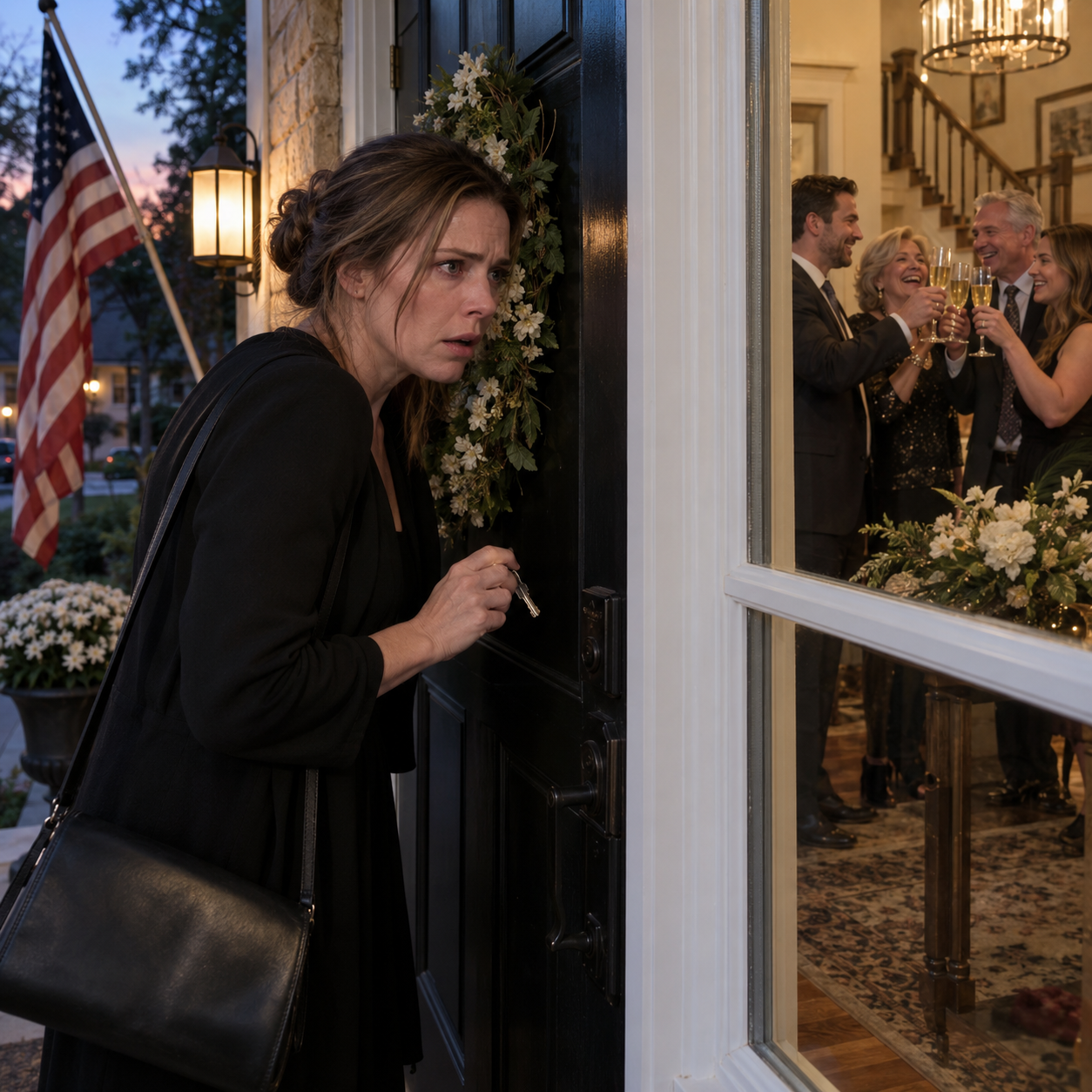
I had barely fit my key into the lock before I heard the laughter.
It was a Thursday evening in late October, and I had driven back from Muskoka three days early. My mother’s funeral had been on Monday. The paperwork was done. The estate lawyer had what he needed, and I simply could not stand another night alone in that lake house where she had spent her final months forgetting my name.
So I loaded the car and drove south on the 400.
And I did not call my husband, Damian, to tell him I was coming.
I had just wanted to get home first, decompress, cry in my own bathroom without having to explain myself to anyone.
Our house in Rosedale was a stone-and-brick Victorian, double-gated, one of those places that always looked more impressive from the street than it felt from the inside.
I dragged my overnight bag up the front steps and slid the key into the deadbolt.
And that was when I heard Helen’s voice cutting through the solid oak door like a blade through paper.
“Keep giving her those drops. Do not stop now. Once she’s declared incompetent, every cent of Margaret’s estate rolls directly to Damian as her conservator. $28 million. We have worked too hard and waited too long for you to get cold feet.”
I went completely still.
My hand did not turn the key.
My bag did not move.
I stood on my own front porch in the October cold and listened to my mother-in-law’s voice, steady and certain, planning my destruction.
Damian answered her.
His tone was so calm it turned my stomach.
“I’ve been putting it in her evening tea every night for two months. Mom, she thinks she’s exhausted from dealing with her mom’s decline. She has no idea. By spring, we petition the court. Dr. Holloway has already agreed to certify her.”
Porsha, my sister-in-law, laughed.
That particular laugh she reserved for situations that entertained her at someone else’s expense.
“She’s already forgetting things. I saw it at Christmas. She kept asking where Dad was, and he was standing right beside her. The drops are working.”
Bernard, my father-in-law, spoke last, his voice low and measured.
“Keep your voices down. No one celebrates until the ink dries.”
I pulled my key out of the lock without making a sound.
I walked back down the front steps, through the gate, and out to the street.
My legs were moving on their own.
The wind off the ravine was sharp and cold, but I did not feel it.
I stood on the sidewalk under the orange glow of a streetlamp and stared at the concrete for what might have been 30 seconds or 10 minutes.
I genuinely could not tell.
Then I thought about the last two months.
The strange fog that had settled over me like a permanent low cloud.
The way I kept losing words mid-sentence.
The morning I had stood at the kitchen counter and completely blanked on what I had been about to do.
Standing there, gripping the counter edge until the feeling passed.
I had blamed grief.
I had blamed the stress of watching my mother disappear into her illness over 18 months, watching her hands shake and her eyes go glassy and her voice thin out until it was barely a thread.
I had told myself I was just broken by it all.
I was broken, all right.
But not by grief.
I flagged down a cab on Yonge Street and asked the driver to take me to Toronto General.
My mother had been a close friend of Dr. Anson Webb since the late ’90s. He was the head of the neurology department, a man who called her Margaret instead of Mrs. Whitmore and meant it with genuine warmth.
He had sent flowers to the funeral.
When I walked into his office unannounced, he stood up from his desk so quickly he nearly knocked over his coffee.
He listened to everything I said without interrupting.
When I finished, he sat down slowly and pressed his palms flat on his desk.
“Nadia,” he said, “your mother’s death was not clean. I want you to know that I flagged something in her final blood work, a compound I could not immediately identify, and I preserved the samples. I’ve been trying to find a path forward without enough to bring to anyone.”
He looked at me steadily.
“I am going to draw your blood right now, and I need you to go home and act as though nothing has changed.”
I nodded and held out my arm.
He worked quietly and quickly.
When he finished, he said the results would take several hours.
He told me to drink nothing my husband handed me.
He told me to go home and perform the most important role of my life.
I took a cab back to Rosedale.
This time, I turned the key.
They were all still there.
Helen was on the settee with a glass of wine.
Bernard had his jacket off.
Porsha was scrolling her phone.
Damian looked up when I walked in, and for a fraction of a second, something moved across his face that he could not quite control.
A flicker of surprise.
And then the immediate suppression of it.
And that fraction of a second told me everything I already knew.
He crossed the room and hugged me.
“Darling, you should have called. I would have come up to get you.”
I pressed my face against his shoulder and said nothing for a moment.
Then I pulled back and gave him the tired, hollow smile I had worn for months without realizing it had been induced.
“I just wanted to be home.”
Helen was already on her feet, moving toward the kitchen.
“Let me warm up some tea, sweetheart. You look exhausted.”
I watched her go and thought, Yes. Please do exactly that.
I sat in the armchair across from Porsha and made small talk about the drive.
Porsha asked about the cottage.
Bernard asked if the estate lawyer had everything he needed.
They were so smooth.
So utterly practiced.
I marveled at it in a distant, horrified way, the way you might marvel at a venomous thing in a glass tank.
Helen brought me a mug.
The steam rose in a thin column.
I wrapped my hands around it and brought it to my lips and let the warmth touch my mouth without swallowing a drop.
I set it down on the side table after a few minutes and told them I was going up to sleep.
I excused myself, climbed the stairs, locked the bedroom door, and went straight to the closet.
At the very back, in a coat pocket, was a small digital recorder my mother had given me years ago for board meetings.
It recorded up to 12 hours and was no larger than a lipstick tube.
I slid it into the cuff of the cardigan I intended to wear the next morning.
Then I retrieved a small sterilized travel vial from my toiletry bag and poured the untouched tea into it.
I sealed it and slid it into a zippered compartment of my overnight bag.
Then I lay on top of the covers and stared at the ceiling.
Dr. Webb called at midnight.
His voice was controlled but tight.
“You have a synthetic sedative compound in your system. It’s a modified benzodiazepine analog, not something available at a pharmacy. Prolonged exposure causes memory degradation, emotional blunting, and, at elevated doses over time, permanent cognitive damage.”
He paused.
“The compound in your blood is consistent with what I found in your mother’s.”
Another pause.
“Nadia, your mother did not die from a neurological disease. She was poisoned. The illness was induced.”
I did not sleep at all.
The next morning, I called my university roommate, Zoe.
She was an investigative journalist at a national paper, the kind of person who answered the phone on the second ring, no matter the hour, and said nothing unnecessary.
When I laid out what I knew, she was quiet for exactly five seconds.
Then she said, “You need more than overheard conversations and a tox screen. You need recorded evidence and a financial trail. I know someone.”
She knew Remy LaBelle, a retired OPP detective who now ran a private forensic investigations firm out of a nondescript office in the Annex.
We met him the next afternoon.
He was compact and unhurried, with close-cropped gray hair and the kind of stillness that comes from decades of watching people without being watched in return.
I gave him authorization to access my mother’s corporate records.
Whitmore Holdings was a mid-sized property development firm my mother had built herself over 30 years, one of those Bay Street-adjacent companies that punched above its weight.
Damian had been brought in as VP of finance when we married.
He had, it turned out, used the position well for himself.
While Zoe quietly sourced surveillance equipment, Remy began pulling threads.
I went home and continued my performance.
Every evening, Helen or Damian produced something for me to drink or eat.
Every evening, I appeared to consume it and disposed of it methodically, siphoning samples into vials I had hidden inside a box of tampons at the back of the bathroom cabinet.
Dr. Webb processed each one.
Every sample came back positive for the same compound.
The recordings accumulated slowly.
I wore the device in my cardigan cuff, in my coat pocket, tucked against my palm during dinner conversations.
I captured Damian on the phone telling someone the compound needed to stay at the current dose.
I captured Helen in the kitchen asking Porsha how soon the psychiatrist could see me.
Zoe installed three cameras on the main floor.
One in a decorative clock on the mantel.
One embedded in a replacement outlet plate near the dining room.
One inside a picture frame on the hallway wall.
The footage was sharp and automatically backed up to an encrypted server.
Remy called 12 days after I had retained him.
He came to Zoe’s apartment, where I had been spending increasing amounts of time, claiming I needed to help a friend.
He set a folder on the kitchen table.
“Over the last eight months, Damian has moved approximately $2.1 million out of Whitmore Holdings through a series of shell companies registered in Alberta. The funds have been routed through a numbered account and parked offshore.”
He opened the folder.
“There’s a secondary set of transactions I’m still unpacking. Proxy share purchases going through a numbered holding company. He’s been quietly acquiring a minority interest in the firm using money he embezzled from it.”
“Why would he need minority shares if he was going to have guardianship over my assets anyway?” I asked.
Remy looked at me evenly.
“Because guardianship gives him control of your assets, but not ownership of the company itself. If you recover, the guardianship ends and he loses everything. If he acquires a significant stake through proxy buyers while you are incapacitated, he has a permanent financial foothold.”
He tapped the folder.
“Regardless of what happens to the guardianship petition, he’s building a two-track exit.”
I stared at the folder.
He’d thought of everything.
Two days later, Damian told me I had not been well.
He said it gently, sitting beside me on the sofa with his hand on mine, his face a painting of conjugal concern.
He said he had spoken to a specialist.
That he was worried about my cognitive decline.
That he wanted me to see someone.
I pressed my lips together and nodded and told him I agreed, that I had been frightened by some of the things I’d been forgetting.
His hand tightened briefly on mine.
Just relief.
Just pure, undisguised relief.
The specialist was in a low-rise medical building in Etobicoke.
The sign beside the door read Clearview Assessment Clinic.
Inside, the consulting room was sparse and had an oddly hurried feeling.
The doctor, a man named Holloway, had a medical degree on the wall that looked machine-printed.
He did not make eye contact with me for more than three consecutive seconds.
Damian described my symptoms.
“Hallucinations,” he said. “Paranoia. Episodes of confusion. Believing people were trying to harm her.”
He shook his head with the gravity of a man bearing a great burden.
Dr. Holloway asked me some questions.
I answered them with the careful incoherence of someone genuinely slipping, enough to be credible but not so extreme as to demand immediate hospitalization before I was ready.
I watched him write.
I watched him and Damian exchange a glance that passed no information between them because no information was needed.
At the end of the appointment, Holloway produced a written assessment and slid it across his desk.
Damian picked it up without offering it to me.
As they stepped briefly into the hallway, I shifted toward the cracked door and listened.
“Once the Ontario court issues the order, your standard fee will be transferred,” Damian murmured.
Holloway’s reply was almost inaudible.
“The assessment will hold. I’ve worked with the tribunal before.”
I stepped back to my chair, pressed record on the device in my sleeve, and waited.
I sent the audio to Zoe that night from a burner phone I kept in my gym bag.
Six days later, Damian came into the bedroom at 7:00 in the morning with two men I had never seen before.
He was wearing his good suit.
His expression was the most perfect composition of anguish I had ever witnessed on a human face.
He told me he had petitioned the court for emergency guardianship.
He told me the assessment supported an involuntary care arrangement.
He told me it was because he loved me.
He told me this while the two men in the room with him began gathering my things.
I screamed.
I fought them.
Not because I had lost control.
Because I needed them to believe I had.
They transported me to a private facility called Lake View Care Center, north of the city, just past Barrie.
The building was clean and quiet and sealed.
My phone was confiscated at intake.
The room they assigned me had a window with a wire-mesh insert and a mattress that smelled of industrial detergent.
On my second morning, a nurse came in to take my vitals.
She was in her late 40s, unhurried, with dark hair pulled back simply.
As she adjusted my pillow, her hand moved beneath the pillowcase and left something there.
She did not look at me when she did it.
When the door closed, I retrieved the folded square of paper.
Your mother, it read, helped pay for my son’s treatment at SickKids when we had nothing.
I know why you are here.
Dr. Fairfield, the medical director, is receiving payments to certify your deterioration.
There is a micro-recorder in the mattress seam.
Your sister-in-law has requested a visitor’s pass for Friday.
I will get word to your people.
My name is Louise.
I pressed my face into the pillow and breathed.
I did not take the medication they put in my food.
I did not drink the water that came with the evening tray.
I performed every symptom they expected with the precision of someone who had spent her career navigating boardrooms full of people who wanted something from her.
Porsha arrived Friday afternoon.
The visitation booth was divided by thick Plexiglas.
She sat down across from me with a specific quality of enjoyment that some people cannot conceal when they have won.
She was wearing a new coat.
Her watch was different from the last time I had seen her.
She picked up the intercom phone.
I picked up mine with hands that shook convincingly.
“Porsha,” I said, my voice small and fractured. “Where is Damian? He hasn’t come.”
She smiled.
“Damian is very busy right now, Harper.”
She caught herself.
“Nadia. Very busy.”
I tilted my head.
“I keep hearing Mom’s voice in the walls.”
Porsha’s smile settled into something more comfortable.
More permanent.
“Good,” she said, dropping her voice slightly. “Stay exactly like that.”
She leaned closer to the glass.
“By the time the guardianship order is confirmed, Damian will have full control of the Whitmore shares. We’re liquidating the commercial properties first. The portfolio is worth more than the inheritance on its own.”
She smiled.
“We’ll have everything sorted before you’re released.”
Then she added, “Which will be never.”
I let my mouth hang open slightly.
My eyes went soft and distant.
Porsha leaned closer to the glass, emboldened by how thoroughly I appeared to have departed from myself.
“Your mother was going to hire someone to investigate us. She’d figured out about the compound. We couldn’t let that happen, so we accelerated her treatment.”
My fingers tightened around the phone.
“She thought she was taking her supplements. She didn’t know what was in them. She went quietly, Nadia. She went confused and quiet.”
Porsha’s voice softened.
“And that was the kindest thing we could have done for her.”
The blood in my veins turned into something cold and structural.
Something that held its shape under pressure.
I kept my face slack and empty.
Porsha stood, gave me a small, satisfied wave, and walked out of the visitation block.
Louise extracted the recorder from my sleeve during the evening vitals check.
She carried it out in a folded piece of gauze.
Four days later, she passed me a note from Zoe.
The audio had been authenticated and transmitted.
Remy had the financial documentation.
Dr. Webb had the medical evidence.
The guardianship hearing was in 11 days.
They were ready.
The night before the hearing, Louise unlocked my door at 1:00 in the morning.
She walked me through the basement, through a maintenance corridor, through a fire door, and out into the cold black yard behind the facility.
I ran through a stand of pines until headlights flashed once on the service road beyond the tree line.
Zoe and Remy were standing outside an idling SUV.
Zoe already had tears running down her face.
Remy was scanning the darkness behind me.
“Get in,” he said.
We drove south toward the city.
The next morning, I walked up the steps of the Ontario Superior Court of Justice on University Avenue in a charcoal blazer and heels, flanked by Remy on my left and my lawyer on my right.
The press were already there.
Zoe had ensured that.
A CBC reporter shoved a microphone toward me at the base of the steps.
“Nadia Whitmore, you escaped a care facility last night. Can you explain?”
I stopped.
I looked into the camera and spoke clearly enough that the people at the back of the crowd could hear every word.
“My husband and his family have been poisoning me for two months in order to have me declared incompetent and seize control of my late mother’s estate.”
The crowd went still.
“Every word I have just said is supported by forensic toxicology, documented financial fraud, and recorded audio.”
I looked toward the courthouse doors.
“I will see you all inside.”
We pushed through the courthouse doors.
Damian was at the petitioner’s table.
When he saw me come through the gallery doors, the color vacated his face so completely he looked like a photograph of himself rather than the thing itself.
He reached for his lawyer’s arm.
Helen, in the front row, made a sound I had never heard from a human being before.
A small, sharp intake of air that preceded complete stillness.
Bernard stared at the floor.
Porsha dropped her phone.
I sat down at the respondent’s table and folded my hands.
The hearing lasted four hours.
My lawyer moved to dismiss the guardianship petition in his opening breath.
He introduced the toxicology reports from Dr. Webb.
The authenticated surveillance footage.
The financial documentation from Remy’s forensic audit.
The recorded assessment of Dr. Holloway accepting payment.
And the audio of Porsha’s visit to the facility.
Porsha’s voice filled the courtroom through the speakers.
“She went confused and quiet, and that was the kindest thing we could have done for her.”
The gallery went absolutely silent.
Damian tried.
His lawyer argued contaminated evidence.
Argued that I was a documented incompetent.
Argued procedural error.
The judge overruled each motion with the measured efficiency of someone who had heard enough.
When the RCMP officers came through the rear doors, Porsha stood up and screamed that the audio had been fabricated.
Helen grabbed her arm.
Bernard did not move.
Damian stood very still and watched them come toward him as though he had known it would end exactly this way and had simply been hoping to be wrong.
They arrested all four of them in the courtroom.
Three months later, the sentencing came down.
Damian received 12 years in federal custody on charges of criminal fraud, conspiracy to administer a noxious substance, and criminal negligence contributing to death.
The latter charge related to my mother’s death had been elevated based on Dr. Webb’s toxicology evidence and the audio establishing prior knowledge and intent.
Porsha received 14 years.
Her recorded confession in the visitation booth, authenticated by two independent forensic audio analysts, was devastating.
She had spoken with the freedom of someone who believed she was speaking to a woman who would never remember the conversation.
Helen and Bernard were convicted as co-conspirators and received eight and six years, respectively.
Dr. Holloway was struck from the medical register and received five years for fraud and criminal conspiracy.
The Ontario Superior Court issued a full restitution order.
The $2.1 million Damian had embezzled from Whitmore Holdings was recovered from the offshore accounts and returned to the company.
The proxy shares he had been accumulating through shell companies were voided.
I assumed full leadership of Whitmore Holdings the following month.
On the day of the sentencing, I sat in the front row of the gallery and watched the marshals lead them out one by one.
Helen stopped when she passed me.
She was crying.
The specific tears of a woman who has run out of options rather than a woman who has run out of justifications.
“Nadia,” she said, her voice cracking. “I am an old woman. Please.”
I looked at her and said nothing for a moment.
Then I said, “My mother was an old woman too. She was 62 years old when you started putting that compound in her vitamins. She had 30 more years ahead of her.”
Helen opened her mouth and closed it again.
The marshal touched her arm, and she moved.
Damian was last.
He had lost the easy countenance that had always sat on him like a good suit.
Without it, I could see what had been underneath the whole time.
Not cruelty, exactly.
Just an absolute absence of anything that would have prevented it.
He stopped at the end of my row and looked at me.
“I’m sorry,” he said. “I actually mean that.”
I held his gaze for a long moment.
Then I turned away.
Zoe was waiting for me outside.
The October sky over University Avenue was a hard, clear blue, the kind that appears in Toronto after the first real cold snap of the season, when the humidity finally burns off and you can see all the way to the lake from the right angle.
She linked her arm through mine as we walked down the steps.
The cameras were still there.
I gave them nothing.
We walked two blocks to a coffee shop on a side street, one of those narrow places with exposed brick and mismatched chairs.
We sat in the window and ordered two dark roasts and did not speak for several minutes.
Zoe wrapped her hands around her cup.
“What now?”
I thought about my mother’s company.
About the board meetings she used to hold in the boardroom on the 32nd floor, the ones I had sat in on as a teenager, watching her hold a room of men twice her age who had not wanted to be held.
About the lake house in Muskoka, where she had spent her last months in that terrible fog, believing she was simply aging too fast, too soon.
About how she had written me into her estate documents with the assumption that the people around me were safe.
I had a lot to rebuild.
I had a company to run properly.
I had a lawsuit to file against the Lake View Care Center for its role in holding me illegally.
I had Louise to thank properly with something more lasting than words.
“I have work to do,” I told Zoe.
She smiled and raised her coffee cup.
“Then let’s get started.”
Outside, the city moved at its usual pace.
The streetcar slid past the window, quiet and orange in the morning light.
A woman walked a dog.
A man stood at the corner checking his phone.
Everyone in a hurry toward something, with no idea what was happening in the window of the coffee shop two steps off the avenue.
I watched them and thought about my mother.
About the version of her life that had been taken from her before she could finish living it.
About the fact that the people who took it were now behind glass of a different kind.
I was 37 years old.
I was the head of a company my mother had spent her life building.
I had walked through something most people never walk through, and I was still walking.
That felt, for the first time in a very long time, like








