“We’re taking over your lakeside house this summer!” my sister announced in the family group chat. Everyone responded with a thumbs-up, as if the plan were already set in stone. I didn’t bother objecting. I simply waited until they had driven the full six hours before activating the new security system. The cameras captured their faces in crystal-clear detail the moment they arrived.
The Summer They Assumed Was Theirs
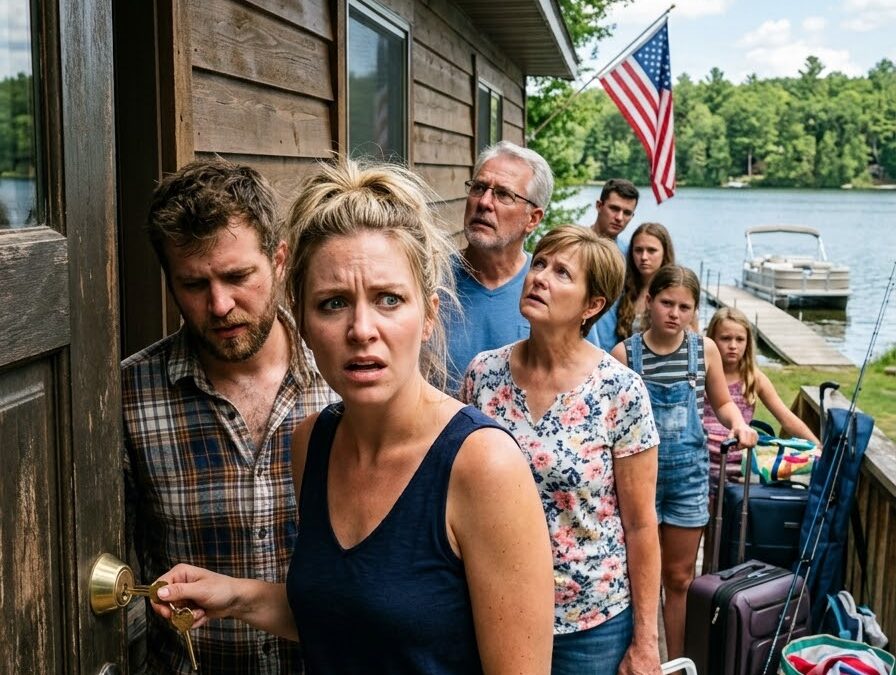
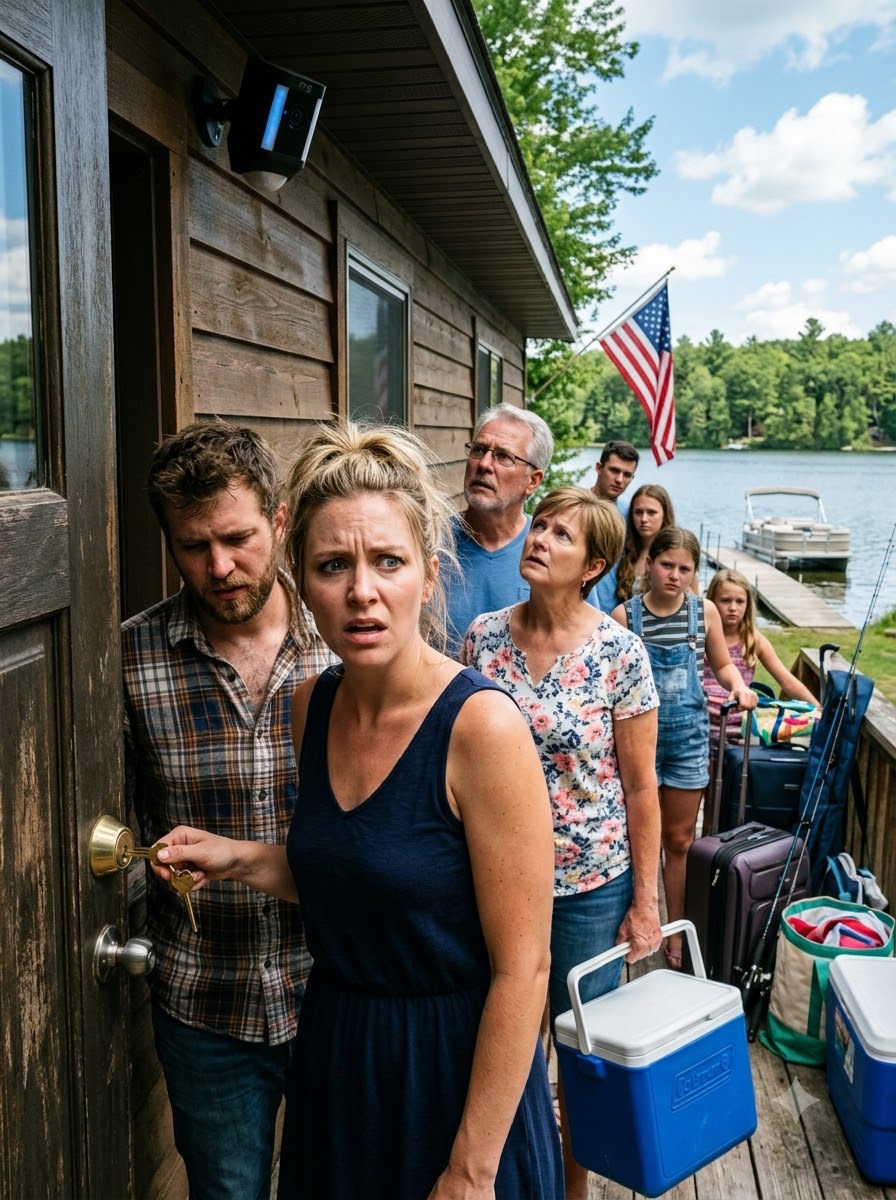
By the time my sister realized her key no longer opened my lake house, four cars were already lined up in the driveway.
I watched from my apartment in Chicago.
Hannah stood on the front porch in sunglasses, a beach bag hanging from one shoulder, twisting the old brass key harder as if the lock had personally offended her. Her husband, Tyler, came up behind her and tried his copy.
Nothing.
Behind them, our parents were unloading coolers. Aunt Maggie had a bottle of wine tucked under one arm. Uncle John had already pulled fishing gear from his trunk.
Everyone had driven nearly six hours from Indiana.
Nobody had asked me if they could come.
My phone began vibrating before Hannah even noticed the small camera above the porch.
I looked at the security feed, then at the family group chat filling with messages.
EMILY, THIS ISN’T FUNNY.
LET US IN.
WE DROVE ALL THIS WAY.
My coffee sat beside my laptop, cooling.
For most of my life, a scene like that would have sent me into immediate damage control.
I would have apologized even when I had done nothing wrong.
I would have driven three hours north, unlocked the door, changed my plans, filled the refrigerator, and convinced myself I was being generous.
That morning, I did none of those things.
To understand why, you have to go back six weeks.
The first message arrived while I was at work.
I was halfway through reviewing a forecasting model when my phone lit up beside my keyboard.
Hannah had written in the family group chat:
We’re taking your lake house for the summer!
There was a sunshine emoji after it.
Before I could answer, Mom reacted with a heart.
Dad added a thumbs-up.
Aunt Maggie wrote that she couldn’t wait to sit by the water again.
Uncle John asked whether the fishing was still good in June.
Two cousins started discussing weekends.
Within two minutes, my family had organized a summer vacation at a house they did not own.
I stared at the screen.
No one had written:
Emily, would this work for you?
Is the house available?
Do you mind?
Nothing.
Just plans.
I typed carefully.
Actually, I already have plans to use the house in June. Please check with me before arranging anything there.
Hannah answered first.
Don’t be selfish, Em. It’s just family.
Then Mom.
Everyone ignore Emily’s message. She’ll come around.
That sentence stayed on my screen longer than all the others.
She’ll come around.
Not: We misunderstood.
Not: Sorry, we should have asked.
She’ll come around.
The conversation continued around me.
Sleeping arrangements.
Who would bring what.
Whether Hannah and Tyler should take the downstairs bedroom because Tyler’s back bothered him.
Whether Mom wanted the upstairs room facing the lake.
They were negotiating possession of my house while I was still in the chat telling them it was not available.
I put my phone facedown.
Across the office, somebody laughed near the printers.
A meeting started in the glass conference room.
Normal Tuesday morning.
I looked at the spreadsheet on my monitor and realized I could no longer remember what number I had been checking.
I was thirty-four.
I worked in data analytics at a large bank in Chicago, which suited me more than I liked admitting. Numbers behaved better than families.
If a figure was wrong, you could trace why.
If a model produced a strange result, there was usually a variable somewhere that explained it.
My family did not operate that way.
With them, the same input could produce different rules depending on whether the person involved was Hannah or me.
Hannah was thirty-one, three years younger than I was.
Growing up, Mom called her a free spirit.
She called me sensible.
For years, I thought sensible was praise.
Eventually I understood it meant I was the child expected to absorb inconvenience without making noise.
If Hannah forgot her homework, someone drove it to school.
If I forgot mine, I learned a lesson.
If Hannah damaged something, there was always a reason.
If I objected, Mom reminded me that I was older.
Dad, Robert, was not cruel.
That distinction mattered to me.
He was simply deeply uncomfortable with disagreement.
His favorite phrase was, “Can we not make this a whole thing?”
He thought peace meant keeping voices low.
He rarely asked who was paying for that peace.
By fifteen, I had learned it was usually me.
So I stopped arguing.
Then adulthood turned that habit into usefulness.
When Mom and Dad’s washing machine died unexpectedly, I helped pay for a replacement.
When Hannah’s car was repossessed after she fell behind, I covered part of the down payment on another vehicle so she could keep working.
When her insurance became expensive, I helped there too.
I had been covering a regular amount toward some of my parents’ expenses for years.
When Aunt Maggie had medical bills she was struggling with, I contributed.
None of those decisions had seemed unreasonable individually.
I made good money.
They were family.
And I liked being capable.
That was the part I had never examined closely enough.
I did not only help because people needed something.
I liked being the one who could fix it.
That role gave me a place in a family where Hannah took up most of the emotional space.
If I could not be the exciting daughter, at least I could be the dependable one.
Six years earlier, after a promotion at work, I bought the lake house in Michigan.
No one gave me money for it.
There was no inheritance.
No family property.
I saved for the down payment, qualified for the mortgage, signed the paperwork, and carried the costs myself.
The house was modest.
White siding.
Blue trim.
A porch facing the water.
Two bedrooms upstairs, one smaller bedroom downstairs, old pine floors, and wide glass doors opening toward the lake.
The first morning after I got the keys, I sat on the dock holding coffee and watched fog move across the surface.
For the first time in years, I had nowhere I was supposed to be useful.
No one needed a ride.
No one needed a transfer.
No one needed me to smooth over a disagreement.
The lake gave me silence without punishment attached to it.
That was why I loved the place.
At first, sharing it with my family felt natural.
I gave Mom and Dad a spare key.
Hannah got one later after she and Tyler started visiting on their own.
There were good weekends.
Real ones.
Mom laughing on the porch.
Dad teaching Tyler how to clean fish.
Hannah making margaritas too strong and insisting they were fine.
I liked those memories.
That was one reason it took me so long to notice the shift.
People stopped asking whether they could use the house.
They started telling me when they planned to.
“Tyler and I might head up this weekend.”
“Mom wants the lake in August.”
“Aunt Maggie’s thinking about Labor Day.”
Most of the time, I allowed it.
Every yes made the next request less like a request.
The last warning came at Hannah’s birthday dinner in April.
I had driven to Indiana with a skincare set she had mentioned wanting.
She hugged me when she opened it.
“Oh my God, Em. You remembered.”
Then, almost immediately, she started telling everyone about her new office, her promotion, and Tyler’s car upgrade.
Mom listened proudly.
Dad asked questions.
I ate cake.
Eventually Mom turned to me.
“How’s work, sweetheart?”
I opened my mouth.
Hannah jumped in.
“You should see the office they’re giving me. It’s twice the size of Tyler’s.”
Everyone laughed because Tyler made a joke about being demoted in his own marriage.
The conversation moved on.
My answer never happened.
I sat there with my fork resting on the plate.
I was not jealous of Hannah’s promotion.
I was glad for her.
What hurt was how ordinary it was for my sentence to disappear and for nobody to notice.
Later, while I helped clear dishes, Hannah leaned against the counter.
“So what’s the plan for the lake house this summer?”
“A few quiet weeks.”
“With Ryan?”
“Some of them.”
Ryan was my boyfriend. He had learned early that the lake house was where I went when Chicago became too loud.
“I might have friends up. I might rent it for part of the summer.”
Hannah tilted her head.
“Good for you.”
Nothing openly hostile.
Still, something in her tone stayed with me.
Mom and Dad exchanged a look across the kitchen.
I noticed it.
Then dismissed it.
Two weeks later came the group message.
We’re taking your lake house for the summer.
At lunch, Ryan called.
“You okay?”
“Yes.”
“You sound like someone who is not okay.”
I told him about the chat.
He listened.
When I finished, he asked, “What are you going to do?”
Normally I would have answered with some version of:
I’ll work it out.
Maybe I’ll give them July.
Maybe I’m overreacting.
Instead I said, “I don’t know yet.”
“That’s probably better.”
“Better than what?”
“Deciding from guilt.”
That evening, I opened the family chat again.
They were still making plans.
I scrolled backward.
Old conversations.
Mom asking whether I could cover the washing machine.
Hannah asking if I could send part of her insurance payment.
Aunt Maggie apologizing for needing help with a medical bill.
Dad thanking me for helping with something and adding, We’ll make it up to you someday.
I had never expected repayment.
But I had expected something.
Respect, perhaps.
Recognition.
At minimum, the understanding that generosity did not erase ownership.
Around midnight, I made a list.
Not of every dollar.
That felt petty.
Instead, I listed patterns.
Emergency becomes Emily’s responsibility.
Hannah asks after decision is already made.
Mom calls resistance selfish.
Dad stays quiet.
Emily fixes the discomfort.
I looked at the page.
The lake house message suddenly did not feel like an isolated act of entitlement.
It felt like the logical conclusion of a system I had helped maintain.
The next morning, I requested two personal days from work.
Then I drove north.
The farther I got from Chicago, the less angry I felt.
The lake appeared between the trees in pieces.
Blue water.
Pines.
A flash of white siding.
I parked in the gravel drive and sat there for a minute.
This house had never rejected me for wanting quiet.
That thought was embarrassingly emotional.
It was also true.
I called a locksmith.
He arrived before noon.
His name was Carlos.
He looked at the keys I handed him.
“Lost copies?”
“Too many copies.”
He nodded.
“Family?”
I laughed once.
“Yes.”
He had probably seen enough family lock changes to know not to ask more.
By early afternoon, the exterior locks had been rekeyed.
Only I had the new keys.
I also called a local home-security company.
I already had basic alarms, but I upgraded the system.
Cameras covered the porch, driveway, and dock.
Motion alerts.
Door sensors.
Nothing extraordinary.
People install the same systems at vacation homes every day.
The technicians finished before evening.
One showed me the app.
“If somebody forces a door, you’ll get an alert and the system can contact the monitoring service.”
“Good.”
That was all.
I was not building a fortress.
I was simply removing informal access.
That distinction mattered.
That evening, I sat on the porch with a notebook.
The lake was almost perfectly still.
I could hear insects near the shoreline and a motor far across the water.
I wrote one sentence.
It ends here.
Not the family.
Not necessarily the relationships.
The assumption.
The next morning, I walked through the house before leaving.
I checked windows.
Turned off unnecessary lights.
Closed the porch doors.
Then I locked the front door using a key nobody else had.
For most people, turning a key is not emotional.
For me, that morning, it was the first boundary I could hear.
Click.
Back in Chicago, the group chat continued.
Hannah posted playlists.
Mom volunteered her potato salad.
Aunt Maggie asked how many bottles of wine they needed.
Dad talked about fishing.
I did not participate.
Part of me kept expecting someone to contact me privately.
Maybe Dad.
Maybe Mom.
Emily, are you serious about not wanting us there?
Nobody did.
Late in May, Hannah wrote:
Tomorrow we’re all heading to Emily’s lake house. Who’s bringing what?
I read it twice.
My earlier message was still in the thread.
I already have plans. Please check with me before making arrangements.
They had simply chosen to treat it as temporary resistance.
Ryan was at my apartment that evening.
He looked at the message.
“They’re actually going.”
“Yes.”
“You want to call them?”
I considered it.
“No.”
“You already told them not to make plans without asking.”
“Yes.”
He nodded.
“Then I guess they’re adults.”
That was the sentence my family had rarely allowed to apply to itself.
They’re adults.
The next morning, I worked from home.
I answered emails.
Joined a meeting.
Reviewed a dashboard.
Around noon, the security app notified me of movement.
I opened the feed.
Hannah’s silver SUV rolled into the driveway.
Mom and Dad arrived behind her.
Then Aunt Maggie and Uncle John.
Another vehicle followed.
Doors opened.
People laughed.
Coolers came out.
Beach bags.
Fishing gear.
For several seconds, the scene looked exactly like one of our old family weekends.
That hurt more than I expected.
If they had arrived angry, it would have been easier.
Instead, they arrived happy.
They genuinely believed everything would work out because it always had.
Hannah jogged to the porch.
She pulled out the key.
Inserted it.
Turned.
Nothing.
She frowned.
Tried again.
Tyler came over.
She handed him the key.
He tested it.
Same result.
Dad walked up carrying a cooler.
He said something I could not hear.
Then he looked above the door.
The camera was visible.
His posture changed.
One by one, everyone followed his gaze.
My phone started ringing.
Mom first.
Then Hannah.
Then Tyler.
The family chat lit up.
Emily, this isn’t funny.
Let us in.
Mom wrote:
How could you do this to your own family?
Dad:
We drove six hours. Call us.
Aunt Maggie:
Can we please just sort this out?
That last message hurt because Maggie sounded less entitled than the others.
I almost called.
Then Hannah wrote:
Stop being ridiculous and unlock your own house.
My own house.
I typed one message.
The house is not available. I already told you that. Do not force the door. The alarm is active and the monitoring service may contact local authorities if the house is entered by force.
I sent it.
On the camera feed, phones came out almost simultaneously.
I watched Hannah read.
She turned toward Mom.
Mom read next.
Dad looked from his phone toward the house.
No one looked frightened.
They looked offended.
That felt more honest.
For fifteen minutes, they argued.
Not with me.
With one another.
Hannah gestured toward the door.
Dad pointed toward the cars.
Mom stood with her arms folded.
Aunt Maggie eventually began returning bags to a trunk.
Then Tyler picked up the cooler.
That was the beginning of the retreat.
One car backed down the gravel drive.
Then another.
Then my parents.
Hannah’s SUV left last.
When the dust settled, the property looked unchanged.
No broken lock.
No confrontation.
No police.
Just a house that had remained closed because its owner had said no.
I shut the laptop.
Ryan was sitting across the room.
“Well?”
“They left.”
“How do you feel?”
I considered the question.
“Sad.”
He nodded.
That was one of the reasons I loved him.
He did not insist that setting a boundary should make me feel victorious.
That evening, Mom called again.
I answered.
“How could you do that?”
Her voice shook with anger.
“I told you the house wasn’t available.”
“We drove six hours.”
“I didn’t ask you to.”
“We are your family.”
“I know.”
“You changed the locks.”
“Yes.”
“Without telling us?”
“You had keys to my house because I trusted you to use them with permission.”
“We’ve always used that house.”
“Exactly.”
She went quiet.
I continued.
“Somewhere along the way, using it became owning access to it.”
“That isn’t fair.”
“What isn’t?”
“You’re acting like we’re strangers.”
“No. I’m acting like you’re adults who should ask before taking someone else’s property for an entire summer.”
“It was supposed to be family time.”
“Then why didn’t anyone ask whether I wanted to be there?”
Silence.
That was the question none of them had considered.
They were not inviting me to my own house.
They were claiming it.
Mom changed direction.
“You’ve changed.”
“Yes.”
The answer surprised both of us.
“You used to care about family.”
“I still do.”
“This doesn’t look like it.”
“Caring about family and giving family unlimited access to me are not the same thing.”
She exhaled sharply.
Then she said, “You’re being cruel.”
“No.”
I looked around my apartment.
“I’m being clear.”
Another silence.
Then I said the part I had spent years avoiding.
“And I’m done paying for everyone’s comfort.”
“What does that mean?”
“It means the recurring help stops.”
“Emily.”
“You and Dad can handle your own expenses. Hannah and Tyler can handle their insurance. Maggie and I can talk directly about anything I choose to help with. But there will not be automatic money anymore.”
“You can’t punish everyone because you’re angry.”
“I’m not punishing anyone.”
“That’s exactly what you’re doing.”
“No. I’m stopping voluntary support.”
“You make more than the rest of us.”
“That doesn’t make my income family property.”
Mom said nothing.
For the first time in years, I did not rush to fill the silence.
Then she said quietly, “Your father is going to be very hurt.”
“I’m sure Dad can tell me himself.”
That ended the call.
I sat at my kitchen table afterward and opened the automatic transfers I had set up over the years.
A regular amount to help Mom and Dad.
Hannah’s insurance payment.
Other recurring support.
I stopped them.
I did not claw anything back.
I did not demand repayment.
I did not cancel bills in someone else’s name or interfere with anyone’s accounts.
I simply stopped future money from leaving mine.
Aunt Maggie was different.
She had never demanded the medical help I had offered.
So I called her.
“I don’t want you finding out through everybody else.”
There was a pause.
“Your mother already called.”
“Of course.”
“I’m sorry about the house.”
I blinked.
“You are?”
“Yes.”
“We shouldn’t have driven up there after you said you had plans.”
The apology was so simple it almost hurt.
“Thank you.”
“I should have thought about it.”
“You weren’t the only one.”
“No, but I was there.”
That mattered.
I told her if she needed help with specific medical expenses, she could still speak to me directly.
“Are you sure?”
“Yes. The problem isn’t helping. The problem is people treating help like ownership.”
Maggie understood.
Not everyone did.
For several days the family chat cycled through anger, guilt, explanation, and attempted apology.
Hannah sent:
I guess I’m sorry we assumed, but changing locks was extreme.
Mom wrote long messages about everything she and Dad had done for us as children.
Dad sent almost nothing.
Then, late one evening, he called.
“Hey, kiddo.”
“Hi, Dad.”
“You doing okay?”
“Yes.”
“I don’t want to argue.”
“I don’t either.”
He cleared his throat.
“I probably should have asked.”
I waited.
“We all should have.”
“Yes.”
“Hannah got everybody excited.”
“That’s not really the issue.”
“I know.”
He became quiet.
Then he said, “I saw your message in the group.”
“Which one?”
“The one where you said you had plans.”
I closed my eyes.
“So you knew.”
“Yes.”
“And you still drove six hours.”
“Yes.”
“Why?”
He was quiet for a long time.
“Because your mother said you’d come around.”
There it was.
Dad did not sound proud.
He sounded tired.
“I’m sorry,” he said.
I believed him.
But belief did not restore the spare key.
“I appreciate that.”
“Are we okay?”
“No.”
He inhaled.
“But that doesn’t mean we never will be.”
“I guess that’s fair.”
It was the most honest conversation my father and I had had in years.
The following week, I drove to Michigan.
Nothing had been damaged.
The porch looked exactly as I left it.
Inside, the air smelled faintly of cedar and coffee.
I opened the glass doors and let fresh air move through the living room.
For two weeks, I stayed there.
I worked remotely when I needed to.
Read.
Sat on the dock.
Ryan visited for a weekend.
One evening he stood beside me on the porch while the sun dropped behind the trees.
“You think they’ll understand eventually?”
“Maybe.”
“Do you need them to?”
That was harder.
“I used to.”
“And now?”
I looked at the lake.
“No.”
Summer passed.
The calls slowed.
I muted the family chat, then eventually left it.
Not to punish anyone.
Because I had begun noticing how often I opened it with my shoulders already tense.
Work improved.
My concentration returned.
My manager noticed.
“You seem lighter,” she said one morning.
“I changed a few things.”
“Whatever they are, keep them.”
I did.
Months later, Mom texted me directly.
We’d like to talk. Maybe start over.
I stared at the message.
A year earlier, I would have answered immediately.
Maybe apologized for taking too long.
Instead I made dinner.
Washed my plate.
Then returned to the phone.
Not yet, I wrote.
Three minutes later, three dots appeared.
Disappeared.
Appeared again.
Finally she answered:
Okay.
That one word may have been the first boundary she ever accepted without arguing.
A year after the summer they tried to take, my life looked quieter rather than grander.
I had moved into a senior role at work.
Ryan and I were planning our wedding.
Mom and I spoke occasionally.
Dad called more often than before, strangely enough.
Hannah and I were not close.
Not yet.
She learned to pay her own insurance.
Mom and Dad adjusted their budget.
Nobody starved.
Nobody lost a home because I stopped sending money.
They learned the difference between support and entitlement.
So did I.
The lake house remained mine.
I kept the security system because it made sense for a property that sat empty part of the year.
The cameras no longer felt like weapons.
They were just cameras.
One September morning, I sat on the dock with coffee while Ryan slept inside.
Fog covered most of the lake.
For a few minutes I could not see the opposite shore.
Years earlier, that kind of emptiness had made me think about disappearing.
Being quiet enough that nobody expected anything.
Now the quiet felt different.
My phone was inside.
No group chat open.
No request waiting.
No one telling me what family required.
The spare keys hung on a hook in the kitchen.
Mine.
Ryan’s.
One for emergencies with a local caretaker.
That was all.
I watched the fog begin to lift.
The house behind me stayed quiet.
Nothing needed fixing.
Nobody needed persuading.
For once, I did not have to make myself smaller to keep anyone else comfortable.








